
Index Analysis
Intraday Analysis for 03 Sep 2026
KRV Prime13 September 202649 min
Educational/Derived AnalysisSource: KRV Prime Market Insights (End-of-Day)As of 13 Sep 2026, 11:34 AM IST
Intraday Analysis for 03 Sep 2026
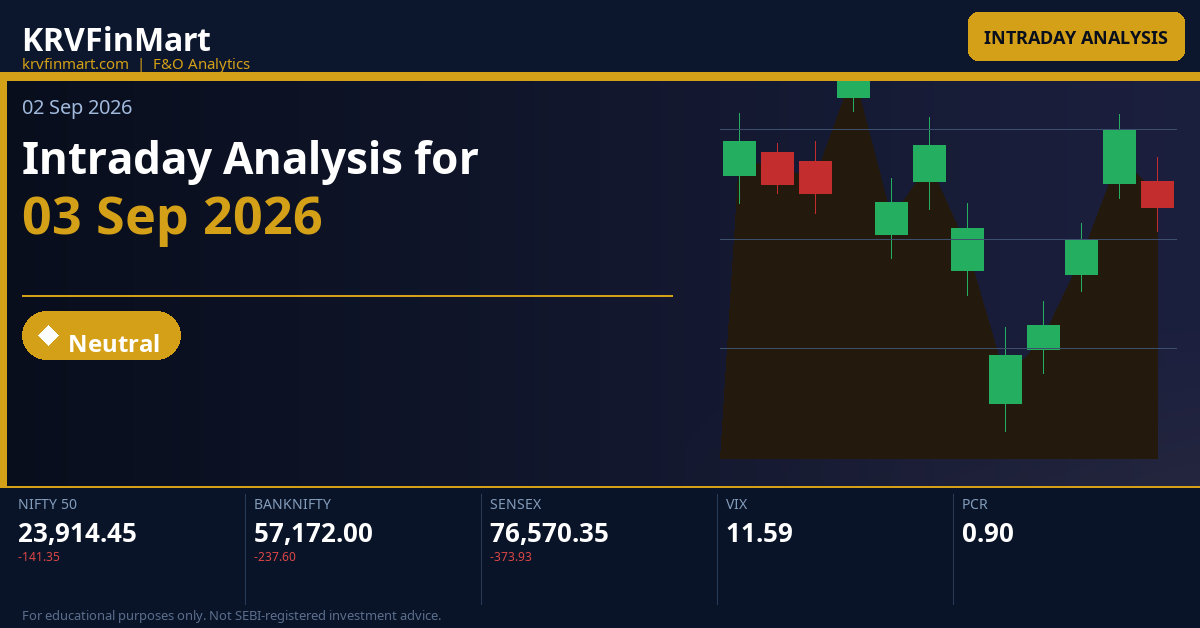
Markets closed with a broad-based decline on 02 Sep 2026, with NIFTY shedding 0.59% to 23,914.45, BANKNIFTY easing 0.41% to 57,172.00, and SENSEX falling 0.49% to 76,570.35 — all three indices printing red and signalling continued selling pressure into the session close. India VIX data was unavailable for today's close, making it critical to anchor bias directly on CPR structure, OI positioning, and straddle-implied move ranges rather than volatility regime signals. All three indices carry Descending Medium CPRs into 03 Sep, meaning the CPR band sits below yesterday's price, and a flat open would place each index above its respective TC — a configuration that initially favours sellers unless bulls mount a decisive reclaim of the full CPR band.
Key Market Signals — Intraday Setup
All three indices — NIFTY, BANKNIFTY, and SENSEX — open 03 Sep with Descending Medium CPRs where the entire CPR band lies below prior day closing prices, creating an overhead resistance structure that sellers will defend unless buyers generate a sustained gap-up impulse. With weekly CPRs overlapping and month CPRs wide and range-bound for all indices, the dominant intraday signal is the CPR band itself: a flat or minor-gap-down open traps price above a descending ceiling, while any meaningful gap-up would need to clear OI resistance walls at 24,200 (NIFTY), 57,500 (BANKNIFTY), and 77,000 (SENSEX) to change the session's bearish character.
Deep Technical Analysis & Levels
NIFTY
Descending — Medium (Width 0.18%)
▼ Bearish
Market Structure Balanced or transitional | Straddle Weekly ATM 23900 straddle = **246.0 pts** (Call 131.6 + Put 114.4), implying an expected intraday move of roughly ±246 points from ATM strike 23,900 — this places the upper boundary near **24,146** and lower boundary near **23,654**, giving traders a clear vol-implied range within which the market is pricing movement for the weekly expiry cycle. | Max Pain Weekly Max Pain = **23,950** (expiry 08-Sep-2026) — price is currently at 23,914.45, which is just **35.55 points below** max pain, suggesting option writers will attempt to pin price near 23,950 through the week; a drift toward 23,950 on 03 Sep would be the path of least resistance for sellers of premium, and any meaningful deviation above 24,000 or below 23,800 would begin to stress the max-pain gravitational pull. |
Tomorrow's Complete Level Map
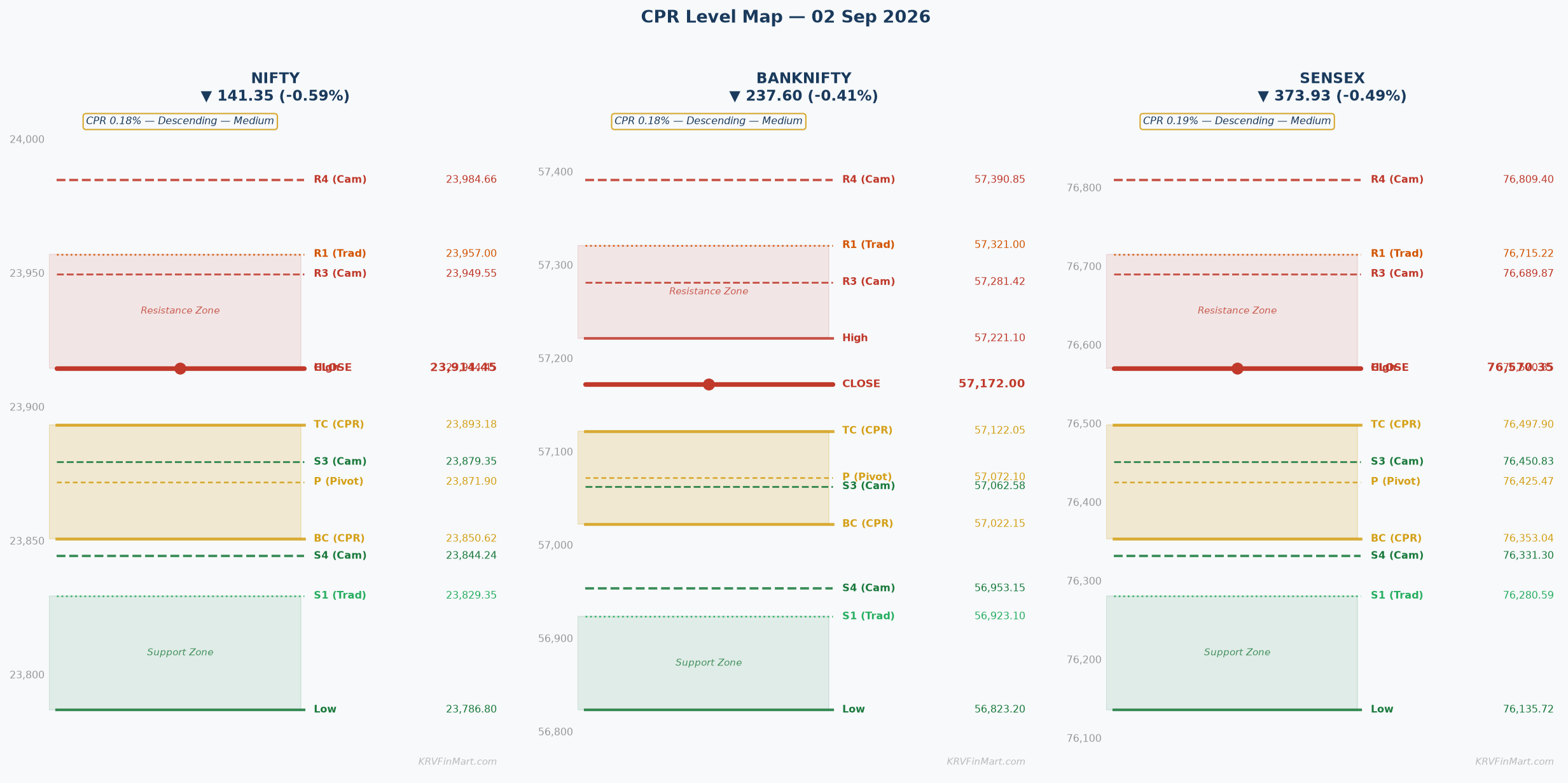
OI-R: 24,200 R3: 24,084.65 H6: 24,042.79 H5: 24,025.67 R2: 23,999.55 H4 ▶: 23,984.66 R1: 23,957 PDH: 23,914.45 H3 ↩: 23,949.55
TC: 23,893.18 P: 23,871.90 BC: 23,850.62
L3 ↩: 23,879.35 PDL: 23,786.80 S1: 23,829.35 L4 ▶: 23,844.24 S2: 23,744.25 L5: 23,803.23 L6: 23,786.11 S3: 23,701.70 OI-S: 23,000
↩ = Camarilla reversal point | ▶ = Camarilla breakout/breakdown trigger | OI-R/OI-S = Options wall (CE/PE max OI)
▲ Higher Open (Gap Up) — Open > Prev Close
▲ Bullish
Open lands: With a Descending CPR where TC=23,893.18 sits below yesterday's close of 23,914.45, a gap-up open (any open above 23,914.45) places price entirely above the descending CPR band — the entire CPR band (BC=23,850.62 to TC=23,893.18) now acts as a support shelf beneath price, and the gap-up launches price into Camarilla H3=23,949.55 territory from the very first tick.
CPR role: Launch pad / support shelf — the descending CPR band (BC 23,850.62 to TC 23,893.18) sits entirely below the gap-up open, transforming it from overhead resistance into an underlying support zone that bulls will defend on any pullback during the session.
Minor Gap (0.05–0.25%) — Structure Dominant
A minor gap-up of 0.05–0.25% places the opening print between approximately 23,926 and 23,974, which is above TC=23,893.18 but below or near Camarilla H3=23,949.55. The Descending Medium CPR structure adds a moderate lean toward bearish mean-reversion because descending CPRs reflect multi-session supply dominance, and even though the open is above TC, the structure warns that this gap may attract early selling pressure near H3=23,949.55 and PDH=23,914.45. The first target on the upside is H3=23,949.55 followed by R1=23,957, but the Medium width (0.18%) demands a first 30-minute close above TC=23,893.18 as confirmation before initiating longs — without that close, the gap risks filling back to TC and then P=23,871.90.
Significant Gap (0.25–0.5%) — Balanced
A significant gap-up of 0.25–0.50% places the open between approximately 23,974 and 24,034, pushing price above Camarilla H3=23,949.55 and approaching H4=23,984.66 and R2=23,999.55 almost immediately on open. At this level, delta-hedging flows from short-gamma option writers will add mechanical buying pressure as market makers cover short-gamma books above H3, but the psychological resistance at R2=23,999.55 and the round-number barrier at 24,000 will slow momentum. The probability of gap-fill back to TC=23,893.18 is moderate — a 90+ point gap creates temptation for early profit-taking — so bulls must see a sustained 30-minute close above H4=23,984.66 to validate extension toward H5=24,025.67 and ultimately the OI-R wall at 24,200.
Large Gap (>0.5%) — Gap Direction Dominant
A large gap-up exceeding 0.50% opens above 24,034, placing the open near or above H5=24,025.67 and H6=24,042.79, with the 24,042–24,084 cluster (H6, R3) acting as the first meaningful supply zone. At this level, the gap is dominant and largely overrides the descending CPR structure, but the OI-R wall at 24,200 from CE writers who have aggressively sold calls at the 24,200 strike represents a hard ceiling that will require extraordinary buying volume to breach. Gap-fill risk is elevated — the straddle of 246 points means a gap above 24,160 is already inside the upper boundary of the vol-implied range, and any large gap-up open that struggles to hold H5=24,025.67 on the first 30-minute candle risks a sharp reversal back toward TC=23,893.18; the abort level for longs is a 30-minute close below H4=23,984.66.
|
▲ Upside Path → OI-R From a confirmed 30-minute close above TC=23,893.18, the upside path progresses through **H3=23,949.55** (first Camarilla mean-reversion resistance, take partial profits here), then **R1=23,957** (Traditional first target, second partial), followed by **H4=23,984.66** and **R2=23,999.55** (breakout zone, hold above for trend continuation), then **H5=24,025.67** and **H6=24,042.79** (Camarilla upper extension, aggressive trail zone), and finally **OI-R=24,200** as the session's ultimate ceiling — genuine momentum through H4 on sustained volume confirms the bull run is real and not a dead-cat gap. |
▼ Downside Path → OI-S Failure to sustain above TC=23,893.18 after the gap-up triggers a reversal through **P=23,871.90** (pivot, first support), then **BC=23,850.62** (bottom of CPR, key bear confirmation on a close below here), followed by **L4=23,844.24** and **S1=23,829.35** (Traditional first downside target, partial cover for shorts), then **L5=23,803.23** and **L6=23,786.11** (near PDL=23,786.80 — critical cluster), and ultimately **S2=23,744.25** toward the macro **OI-S=23,000** base — a failed gap-up that closes below BC=23,850.62 on the 30-minute candle is one of the most reliable bearish setups in a descending CPR environment. |
| 🔴 OI-R: **OI-R at 24,200** represents the dominant CE writing strike for the weekly expiry, meaning a large number of call sellers have defined their maximum profit zone at or below 24,200 — as price approaches this level, short-gamma market makers will begin selling index futures and buying calls to hedge, creating a mechanical ceiling that increases resistance non-linearly. In a gap-up scenario, reaching 24,200 intraday would require a sustained breach of H6=24,042.79 and R3=24,084.65 first, making 24,200 the true momentum target only if bulls control the entire Camarilla upper band — traders should book full profits at 24,200 rather than holding through, as CE writers at this strike will defend aggressively. | 🟢 OI-S: **OI-S at 23,000** is structurally far below current price and essentially irrelevant for the gap-up scenario on an intraday basis, serving more as a long-term PE base that institutional put buyers have positioned for macro tail risk. In the context of a gap-up session, the 23,000 PE wall provides a psychological floor confirming that large institutional players are not net bearish at current levels, which is modestly supportive of the bullish thesis — however, any intraday move toward 23,000 would represent a catastrophic session breakdown entirely inconsistent with a gap-up opening context. |
⚡ Key Trigger: The critical trigger for the gap-up scenario is a **first 30-minute candle close above PDH=23,914.45 and TC=23,893.18 on above-average volume**, which is the Medium CPR confirmation rule — a close above TC=23,893.18 establishes the CPR band as support and signals that buyers are in structural control for the session. If the 30-minute close fails to hold above TC=23,893.18 and price reverses below this level, the gap-up becomes a bull trap, with the descending CPR structure reasserting overhead resistance and the session likely reversing toward P=23,871.90 and BC=23,850.62.
▼ Lower Open (Gap Down) — Open < Prev Close
▼ Bearish
Open lands: With a Descending CPR where TC=23,893.18 and BC=23,850.62 both sit below yesterday's close of 23,914.45, a gap-down open places price inside or below the CPR band — a minor gap-down lands between TC=23,893.18 and BC=23,850.62 (inside the CPR), a significant gap-down lands at or below BC=23,850.62, and a large gap-down pushes price below L4=23,844.24 and potentially toward L5=23,803.23 or PDL=23,786.80.
CPR role: Overhead resistance / battleground zone — the CPR band (BC 23,850.62 to TC 23,893.18) transitions from its descending structure into an active overhead supply zone in a gap-down scenario, as any recovery attempt must fight through both TC=23,893.18 and the prior day's close at 23,914.45 to neutralise the gap.
Minor Gap (0.05–0.25%) — Structure Dominant
A minor gap-down of 0.05–0.25% places the open between approximately 23,855 and 23,902, which for a Descending Medium CPR means the open lands inside the CPR band between BC=23,850.62 and TC=23,893.18 — this is a high-ambiguity zone where the first 30-minute candle direction is decisive. Minor gaps inside the CPR range often fill within 30–60 minutes as the path of least resistance is back toward the prior close, meaning a recovery above TC=23,893.18 within the first 30 minutes would neutralise the gap-down and revert to a flat-open-type dynamic; however, failure to reclaim TC within 30 minutes with BC=23,850.62 acting as the bearish confirmation level below opens the downside path toward L3=23,879.35 initially and then S1=23,829.35.
Significant Gap (0.25–0.5%) — Balanced
A significant gap-down of 0.25–0.50% places the open between approximately 23,795 and 23,855, pushing price below BC=23,850.62 and near PDL=23,786.80 — at this point, the entire descending CPR band (BC=23,850.62 to TC=23,893.18) sits above as overhead resistance, and the opening structure is definitively bearish. The 30-minute reclaim rule applies: if price recovers above BC=23,850.62 within the first 30 minutes on strong volume, it signals a failed breakdown and initiates a recovery toward P=23,871.90 and TC=23,893.18; however, a 30-minute close that holds below BC=23,850.62 confirms resumption of selling with L4=23,844.24 as the next target, followed by L5=23,803.23 and ultimately S1=23,829.35 — PUT writers at OI-S=23,000 remain comfortable but intraday momentum is clearly bearish in this configuration.
Large Gap (>0.5%) — Gap Direction Dominant
A large gap-down exceeding 0.50% opens below 23,795, breaking below PDL=23,786.80 and the Camarilla L6=23,786.11 cluster — this is a critical structural breach where panic selling from retail stop-losses below yesterday's range low accelerates the move toward S2=23,744.25 and S3=23,701.70. In this scenario, the gap is dominant and the descending CPR structure aligns perfectly with bearish momentum, with the CPR band (BC=23,850.62 to TC=23,893.18) acting as a distant overhead resistance that will take significant time and volume to reclaim; the VIX-implied straddle of 246 points means an open below 23,668 would approach the lower boundary of the vol-implied range, at which point short-straddle sellers would begin covering, creating a natural stabilisation zone near S3=23,701.70. Recovery triggers require a reclaim of L5=23,803.23 first, then L4=23,844.24, before the CPR band comes into play — absent that, S2=23,744.25 is the intraday target.
|
▲ Upside Path → OI-R The recovery path from a gap-down begins with a reclaim of **BC=23,850.62** (first bull validation, confirms selling exhaustion), then **P=23,871.90** (pivot recovery, marks mid-CPR strength), followed by **TC=23,893.18** (full CPR reclaim, session turns bullish on close above here), then **PDH=23,914.45** (prior day high and gap-fill zone, psychological milestone), and ultimately a run toward **H3=23,949.55** and **OI-R=24,200** — genuine recovery is confirmed only when two consecutive 30-minute closes hold above TC=23,893.18 with above-average volume. |
▼ Downside Path → OI-S The bear path in a gap-down moves from the open through **L3=23,879.35** (Camarilla mean-reversion zone, first stall point for bounce-hunters), then **L4=23,844.24** (breakdown trigger — a 30-minute close below here accelerates selling), followed by **S1=23,829.35** (Traditional first downside target, partial cover for shorts), then **L5=23,803.23** and **L6=23,786.11** (converging with PDL=23,786.80 — a critical cluster where retail stops are dense), and finally **S2=23,744.25** toward **S3=23,701.70** with the macro floor at **OI-S=23,000** as the structural PE base. |
| 🔴 OI-R: **OI-R at 24,200** in a gap-down scenario functions as a distant overhead ceiling that CE writers are defending — its primary relevance in a bearish gap context is to confirm that institutional option sellers are comfortable with the market staying well below 24,200, which provides no upside tailwind for recovery attempts and actually adds to the supply overhang above current price levels. Shorts can use 24,200 as a confidence anchor that the broader options market is positioned bearishly, reinforcing the case for staying with the trend rather than fading the move. | 🟢 OI-S: **OI-S at 23,000** is the primary downside target for PUT holders and the structural support where PE writers have concentrated open interest — in a significant or large gap-down scenario, a directional move toward 23,000 would monetise long-PUT positions and potentially trigger a sharp counter-rally as PUT writers begin covering shorts to limit losses near this mega-support. For intraday traders, 23,000 is a key level to watch not because price is likely to reach it in a single session, but because the gravity of PE OI here means any move toward S3=23,701.70 will begin to activate dynamic hedging flows that could stabilise the market temporarily. |
⚡ Key Trigger: The bear confirmation in the gap-down scenario is **failure to reclaim BC=23,850.62 within the first 30 minutes on the Medium CPR confirmation rule**, which signals that overhead supply in the CPR band is absorbing all recovery attempts and the downtrend is resuming. The bull trigger — recovery — requires a 30-minute close back above TC=23,893.18, which would flip the CPR band from overhead resistance to underlying support and initiate a gap-fill attempt toward the prior close of 23,914.45 and beyond toward H3=23,949.55.
◆ Near Flat Open — Open ≈ Prev Close (±0.05%)
◆ Neutral
Open lands: A flat open of ±0.05% from 23,914.45 places the open between approximately 23,902 and 23,926, which is above TC=23,893.18 by 9–33 points — the open sits in the zone just above the descending CPR band, creating a classic Descending CPR Flat scenario where price trades above TC (above the entire CPR band) but lacks the gap energy to commit directionally.
CPR role: Decision zone / compression band — the CPR band (BC=23,850.62 to TC=23,893.18) acts as an immediate support shelf just below the flat open, and whether price respects this support or breaks below it within the first 30 minutes defines the session's directional character entirely.
Near Flat (±0.05%)
A flat open in a Descending Medium CPR configuration is a textbook 'above TC but directionless' setup, where the session's entire bias hinges on the first 30-minute candle's relationship with TC=23,893.18 — above TC is a bull session, below BC=23,850.62 is a bear session, and inside the band is a range session. Specifically, TC=23,893.18 is the bull trigger: a first 30-minute close at or above 23,893.18 with above-average volume confirms that buyers are absorbing selling from the descending CPR structure and the session can target H3=23,949.55, R1=23,957, and ultimately H4=23,984.66 on the upside — conversely, BC=23,850.62 is the bear trigger: a 30-minute close below 23,850.62 confirms that sellers have broken through the CPR band's lower boundary and the session can target L3=23,879.35, S1=23,829.35, and L4=23,844.24 on the downside. The CPR width of 0.18% (Medium) means this is NOT a high-probability trend day from the open — instead, the first 30-minute candle is a retest of the CPR band's structural integrity, and traders should wait for the full 30-minute close before committing to direction rather than trading the opening 5-minute bar. Both the bull trigger (close above TC=23,893.18) and the bear trigger (close below BC=23,850.62) must be respected as hard rules: the 42.56-point CPR band width creates enough noise to trap scalpers who jump in prematurely, making patience the single most important variable in this specific flat-open configuration.
|
▲ Upside Path → OI-R Bull confirmation above TC=23,893.18 opens the path to **H3=23,949.55** (Camarilla mean-reversion resistance, first partial profit zone — expect a stall here as mean-reversion sellers enter), then **R1=23,957** (Traditional first target, second partial), then **H4=23,984.66** (Camarilla breakout trigger — a 30-minute close above here targets H5=24,025.67), then **H5=24,025.67** and **H6=24,042.79** (upper Camarilla extension, trail stops aggressively), and the ultimate session ceiling at **OI-R=24,200** where CE writers will defend with maximum intensity. |
▼ Downside Path → OI-S Bear confirmation below BC=23,850.62 opens the path to **L3=23,879.35** (Camarilla first downside reference, bounce zone — watch for 5-minute reversal candles here), then **L4=23,844.24** (breakdown trigger — close below here accelerates selling), then **S1=23,829.35** (Traditional first downside target, partial profit for shorts), then **L5=23,803.23** and **L6=23,786.11** (Camarilla lower extension converging with PDL=23,786.80 — a critical cluster of stops), and ultimately **S2=23,744.25** toward the macro **OI-S=23,000** PE base. |
| 🔴 OI-R: **OI-R at 24,200** in a flat-open scenario is a distant but structurally important ceiling — CE writers who have shorted calls at 24,200 are comfortable with current levels and will resist any rally that approaches their strike, meaning the 24,200 OI wall will function as a momentum extinguisher for any intraday up-move that reaches the H5-H6-R3 cluster (24,025–24,084). Flat-open sessions in a descending CPR rarely generate enough momentum to threaten OI-R directly on the same session, but the 24,200 wall confirms that the options market's directional anchor is bearish-to-neutral, making longs above H4=23,984.66 higher-risk without exceptional volume confirmation. | 🟢 OI-S: **OI-S at 23,000** in a flat-open scenario provides a structural PE base that implies large institutional players have defined their maximum bearish bet at 23,000 — PE writers at this strike are comfortable with the market staying above 23,000 through the weekly expiry, which creates a slow-moving gravitational support well below current price levels. For the flat-open session, OI-S=23,000 is too distant to influence intraday action directly, but its presence means any sharp move toward S3=23,701.70 or below would trigger defensive PE covering that provides a natural bounce — this keeps the downside targets (S1, S2, S3) as intraday objectives rather than trend-change levels. |
⚡ Key Trigger: **First 30-minute close above TC=23,893.18 = bull confirmation** (long entry targeting H3=23,949.55 with stop below BC=23,850.62); **first 30-minute close below BC=23,850.62 = bear confirmation** (short entry targeting S1=23,829.35 and L4=23,844.24 with stop above TC=23,893.18). These levels are the structural fulcrum because TC and BC represent the CPR band's boundaries — the market microstructure around these levels concentrates institutional orders (both stops and entries), making a close beyond them a high-conviction directional signal rather than noise.
BANKNIFTY
Descending — Medium (Width 0.18%)
▼ Bearish
Market Structure Balanced or transitional | Straddle Monthly ATM 57200 straddle = **1491.4 pts** (Call 891.65 + Put 599.75), implying an expected intraday/monthly move of roughly ±1491 points from ATM strike 57,200 — this places the upper boundary near **58,691** and lower boundary near **55,709**, giving F&O traders a wide vol-implied range for the monthly expiry cycle and suggesting elevated premium in the options market relative to current price action. | Max Pain Monthly Max Pain = **57,500** (expiry 29-Sep-2026) — BankNifty is currently at 57,172.00, which is **328 points below** max pain at 57,500, suggesting a gravitational pull toward 57,500 over the coming weeks as option writers seek to maximise premium decay; for the 03 Sep intraday session, this means a drift toward 57,500 (which aligns closely with the OI-R resistance at 57,500 and Camarilla H6=57,572.34) would be the path of least resistance for premium sellers. |
Tomorrow's Complete Level Map
OI-R: 57,500 R3: 57,718.90 H6: 57,572.34 H5: 57,518.66 R2: 57,470 H4 ▶: 57,390.85 R1: 57,321 PDH: 57,221.10 H3 ↩: 57,281.42
TC: 57,122.05 P: 57,072.10 BC: 57,022.15
L3 ↩: 57,062.58 PDL: 56,823.20 S1: 56,923.10 L4 ▶: 56,953.15 S2: 56,674.20 L5: 56,825.34 L6: 56,771.66 S3: 56,525.20 OI-S: 57,000
↩ = Camarilla reversal point | ▶ = Camarilla breakout/breakdown trigger | OI-R/OI-S = Options wall (CE/PE max OI)
▲ Higher Open (Gap Up) — Open > Prev Close
▲ Bullish
Open lands: With a Descending CPR where TC=57,122.05 is below yesterday's close of 57,172.00, a gap-up open (above 57,172.00) places price entirely above the descending CPR band — the CPR band (BC=57,022.15 to TC=57,122.05) sits well below the gap-up open and transitions into a support shelf, while the open immediately faces the Camarilla H3=57,281.42 and PDH=57,221.10 as the first resistance cluster.
CPR role: Launch pad / support shelf — the descending CPR band (BC 57,022.15 to TC 57,122.05) transforms into an underlying support zone in a gap-up scenario, with TC=57,122.05 acting as the critical pullback support level that bulls must defend for the session's bullish structure to remain intact.
Minor Gap (0.05–0.25%) — Structure Dominant
A minor gap-up of 0.05–0.25% opens BankNifty between approximately 57,201 and 57,315, placing the open above TC=57,122.05 but in the zone between the prior close and Camarilla H3=57,281.42 — the Descending Medium CPR structure introduces a mild bearish lean because descending CPRs reflect multi-session supply dominance, and even a minor gap-up is opening into the zone where the previous session's high (PDH=57,221.10) and H3=57,281.42 will act as consecutive resistance levels. The OI-R wall at 57,500 is a significant concern for minor gap-up opens because it is only 200–300 points away, and the dense CE writing at 57,500 (as evidenced by monthly max pain = 57,500) means the market is structurally capped at this level — requiring a 30-minute close above TC=57,122.05 as the Medium CPR confirmation before committing to longs, with the first target at H3=57,281.42 and the critical test at PDH=57,221.10.
Significant Gap (0.25–0.5%) — Balanced
A significant gap-up of 0.25–0.50% opens between approximately 57,315 and 57,458, pushing price above H3=57,281.42 and approaching R1=57,321 and H4=57,390.85 almost at the open — delta-hedging flows from short-gamma market makers will add buying momentum as short-call positions near H3 are covered, but the OI-R wall at 57,500 (monthly CE concentration and also the monthly max pain level) creates a near-impenetrable ceiling that short-gamma pressure alone cannot overcome. At this opening level, BankNifty faces a critical structural test at H4=57,390.85 and R2=57,470 within the first 30 minutes — a sustained 30-minute close above R2=57,470 would target H5=57,518.66 and H6=57,572.34 just above OI-R=57,500, but failure at R2=57,470 risks a sharp reversal given the density of CE writing at 57,500.
Large Gap (>0.5%) — Gap Direction Dominant
A large gap-up exceeding 0.50% opens above approximately 57,458, placing BankNifty at or above R2=57,470 and directly challenging the OI-R=57,500 wall from the very first tick — this is a rare but high-impact scenario where the gap-up energy directly confronts the most heavily defended resistance level in the BankNifty options chain. The monthly straddle of 1491 points provides ample room for a large gap-up without breaching the vol-implied range, but the CE concentration at 57,500 (monthly OI-R) combined with max pain at 57,500 creates a scenario where the market is technically allowed to be here but will face maximum seller aggression — a 30-minute close above H5=57,518.66 is required to validate genuine breakout momentum, otherwise the high-probability trade is a fade from OI-R=57,500 back toward TC=57,122.05.
|
▲ Upside Path → OI-R From a confirmed 30-minute close above TC=57,122.05, the upside path moves through **H3=57,281.42** (Camarilla mean-reversion ceiling, first partial profit — expect aggressive fading here from short-gamma players), then **PDH=57,221.10** (prior day high, psychological resistance — watch for volume at this level), then **R1=57,321** (Traditional first target, second partial exit for longs), then **H4=57,390.85** (Camarilla breakout trigger — sustained close above targets H5), followed by **R2=57,470** and **H5=57,518.66** converging with **OI-R=57,500** as the session's absolute ceiling defended by CE writers. |
▼ Downside Path → OI-S Failure to sustain above TC=57,122.05 after the gap-up triggers a reversal through **P=57,072.10** (CPR pivot, first pullback support), then **BC=57,022.15** (bottom of CPR band — bearish on a 30-minute close below here), then **L3=57,062.58** and **OI-S=57,000** (critical OI support level — PE writers have defended this strike, any move to 57,000 triggers PUT holder activity), followed by **L4=56,953.15** and **S1=56,923.10** (Traditional first downside target), and finally **PDL=56,823.20** and **L5=56,825.34** (converging historical low and Camarilla extension). |
| 🔴 OI-R: **OI-R at 57,500** is the dominant monthly CE writing strike and also aligns with the monthly max pain level — CE writers who have sold calls at 57,500 represent the single largest concentration of institutional supply in BankNifty, creating a ceiling where delta-hedging short-call sellers will actively sell spot/futures as price rises, adding mechanical overhead pressure that grows exponentially as price approaches 57,500. In a gap-up scenario, the 57,500 level should be treated as a hard profit-taking target rather than a level to hold through — book all long profits at or below H5=57,518.66 and do not chase above OI-R=57,500 without extraordinary volume and OI data confirming CE unwinding. | 🟢 OI-S: **OI-S at 57,000** is uniquely close to current price and to the CPR band, making it a highly relevant intraday support level even in a gap-up scenario — PE writers at 57,000 have written puts anticipating the market will stay above this level, and any intraday pullback that approaches BC=57,022.15 and then OI-S=57,000 would trigger defensive PE covering that stabilises price. For gap-up sessions, OI-S=57,000 serves as the ultimate stop-loss anchor: a 30-minute close below 57,000 would signal genuine momentum failure and trigger a cascade toward S1=56,923.10. |
⚡ Key Trigger: The critical trigger for the gap-up scenario is a **first 30-minute candle close above PDH=57,221.10 and TC=57,122.05**, confirming that the CPR band is holding as support and that buyers are absorbing the descending CPR's inherent supply pressure — this Medium CPR confirmation rule is non-negotiable, and any 30-minute close that fails to clear TC=57,122.05 signals that the gap is being faded by institutional sellers. Conversely, a 30-minute close below TC=57,122.05 after a gap-up is one of the most bearish intraday signals in a Descending Medium CPR, as it confirms the gap-up was a bull trap engineered by large participants to offload positions above the CPR band.
▼ Lower Open (Gap Down) — Open < Prev Close
▼ Bearish
Open lands: A gap-down open below 57,172.00 in a Descending CPR (TC=57,122.05) places price inside or below the CPR band — a minor gap-down lands between TC=57,122.05 and BC=57,022.15 (inside the CPR band), while a significant gap-down breaks below BC=57,022.15 and approaches OI-S=57,000, and a large gap-down pushes price below OI-S=57,000 and into L4=56,953.15 and S1=56,923.10 territory.
CPR role: Overhead resistance / battleground zone — in a gap-down scenario, the entire CPR band (BC=57,022.15 to TC=57,122.05) sits above the gap-down open and acts as an overhead supply zone; any recovery attempt must battle through both BC=57,022.15 and TC=57,122.05 before the session can be considered neutral.
Minor Gap (0.05–0.25%) — Structure Dominant
A minor gap-down of 0.05–0.25% opens BankNifty between approximately 57,029 and 57,144, placing the open inside the CPR band between BC=57,022.15 and TC=57,122.05 — this is a high-information zone where the CPR band contains price and the first 30-minute candle's relationship with BC and TC is entirely decisive. Minor gaps inside the CPR band often fill toward the prior close within 30–60 minutes, but BankNifty's specific structure is complicated by OI-S=57,000 sitting just 22–144 points below BC=57,022.15, meaning any failure to hold BC=57,022.15 immediately activates the OI-S floor at 57,000 — the bear confirmation is a 30-minute close below BC=57,022.15 targeting OI-S=57,000 and then L4=56,953.15, while the bull signal is a 30-minute close above TC=57,122.05 targeting PDH=57,221.10.
Significant Gap (0.25–0.5%) — Balanced
A significant gap-down of 0.25–0.50% opens between approximately 57,029 and 56,886, pushing price below BC=57,022.15 and directly testing or breaching OI-S=57,000 — this is structurally significant because OI-S=57,000 represents PE writers who have sold puts at this level, and a gap-down opening at or below 57,000 immediately puts these positions in-the-money, triggering defensive hedging from PE writers who must buy puts or sell futures to neutralize losses. The 30-minute reclaim rule is critical: a recovery above BC=57,022.15 within 30 minutes suggests that PE writer hedging pressure has created a bounce (consistent with OI-S dynamics), while a failure to reclaim BC within 30 minutes confirms resumption of selling toward L4=56,953.15, S1=56,923.10, and PDL=56,823.20.
Large Gap (>0.5%) — Gap Direction Dominant
A large gap-down exceeding 0.50% opens below approximately 56,886, breaking below PDL=56,823.20 and the Camarilla L5=56,825.34 cluster — this is a significant structural breakdown that bypasses OI-S=57,000, BC=57,022.15, and TC=57,122.05 in a single move, placing BankNifty in free fall territory below all near-term support levels. At this point, the dominant forces are panic selling from retail traders whose stop-losses sit below PDL=56,823.20, delta-hedging from long-PUT holders who are now deep in the money, and institutional bears who aggressively shorting into the gap — recovery requires reclaiming L5=56,825.34 first, then L4=56,953.15, and finally OI-S=57,000, with any large-gap-down open that stabilises above L6=56,771.66 being a potential bounce candidate as straddle premium at 1491 points would be heavily monetised by this move.
|
▲ Upside Path → OI-R Recovery from a gap-down begins with reclaiming **OI-S=57,000** (PE writers stop defensive selling — critical first step), then **BC=57,022.15** (CPR lower boundary reclaim), then **P=57,072.10** (CPR pivot restoration), then **TC=57,122.05** (full CPR reclaim — session turns bullish), then **PDH=57,221.10** and **H3=57,281.42** (prior day high and Camarilla mean-reversion zone), and finally **OI-R=57,500** as the session ceiling — each reclaim level must be confirmed with a 30-minute close above, not just a brief wick, to validate genuine recovery. |
▼ Downside Path → OI-S The bear path from a gap-down accelerates through **L3=57,062.58** (Camarilla first reference, brief bounce area), then **OI-S=57,000** (PE writers begin covering — watch for temporary stabilisation), then **L4=56,953.15** (breakdown trigger — close below here accelerates selling), then **S1=56,923.10** (Traditional first downside target, partial cover for shorts), then **PDL=56,823.20** and **L5=56,825.34** (critical convergence of historical support and Camarilla extension), and ultimately **L6=56,771.66** and **S2=56,674.20** as the extended bear targets. |
| 🔴 OI-R: **OI-R at 57,500** in a gap-down scenario is a distant ceiling that CE writers are confidently defending — its primary role in the bearish context is to confirm that the options market's upper boundary remains intact and that any recovery attempt faces both the CPR band resistance AND the OI-R ceiling, creating a double-layer overhead supply that strongly favours bears. Shorts in a gap-down session can anchor their confidence to OI-R=57,500 as evidence that large CE writers are not panicking and the market's structural supply is intact. | 🟢 OI-S: **OI-S at 57,000** is critically important in BankNifty's gap-down scenario because it sits only 172 points (0.30%) below the prior close — unlike NIFTY where OI-S is at 23,000 (far from current price), BankNifty's PE concentration at 57,000 is an active intraday battleground that will be tested in any meaningful gap-down. PE writers who have shorted puts at 57,000 will defend this level aggressively by buying futures or covering puts, creating a natural bounce zone around 57,000 that traders should use as a partial profit-taking level for short positions rather than holding through for deeper targets. |
⚡ Key Trigger: The bear confirmation in the gap-down scenario is **failure to reclaim BC=57,022.15 within the first 30 minutes**, which establishes the CPR band as overhead resistance and confirms that the descending CPR structure's bearish bias is dominating — below BC=57,022.15, the very proximity of OI-S=57,000 is the critical next test, and a 30-minute close below 57,000 is the ultimate bear trigger targeting L4=56,953.15. The bull recovery trigger is a 30-minute close above TC=57,122.05, which would signal a full CPR reclaim and a potential gap-fill attempt toward the prior close of 57,172.00 and PDH=57,221.10.
◆ Near Flat Open — Open ≈ Prev Close (±0.05%)
◆ Neutral
Open lands: A flat open of ±0.05% from 57,172.00 places the open between approximately 57,143 and 57,201, which is above TC=57,122.05 by approximately 21–79 points — the open sits just above the descending CPR band's upper boundary, in the narrow zone between TC and PDH=57,221.10, creating a Descending CPR Flat scenario where price is technically above CPR but without directional energy.
CPR role: Decision zone / compression band — TC=57,122.05 acts as the immediate underlying support with BC=57,022.15 as the deeper CPR floor, and the proximity of OI-S=57,000 just below BC creates a triple-layer support structure that makes a flat-open BankNifty session highly susceptible to a mean-reversion test of this support cluster before any directional move.
Near Flat (±0.05%)
A flat open in BankNifty's Descending Medium CPR is a particularly nuanced setup because OI-S=57,000 sits only 172 points below the open (0.30%), meaning both the CPR band support (TC=57,122.05, BC=57,022.15) and the OI floor (57,000) are clustered in a very tight range beneath the open — this creates a dense support zone that makes downside moves initially shallow but potentially explosive if all three levels fail simultaneously. The bull scenario is straightforward: a first 30-minute close above TC=57,122.05 (which is technically already below the flat open, so the question is whether price can stay above TC after the first 30 minutes of intraday volatility) confirms CPR support holding and targets H3=57,281.42, PDH=57,221.10, and ultimately OI-R=57,500. The bear scenario requires a break below TC=57,122.05 first, then BC=57,022.15, and critically below OI-S=57,000 — only a 30-minute close below 57,000 confirms genuine bearish momentum because PE writers at 57,000 will absorb selling pressure above this level. The Medium CPR width of 0.18% (99.9-point band) combined with the 30-minute confirmation rule means traders should never jump in on the first 5-minute candle — the flat open will generate false signals in both directions within the CPR band before the true direction emerges after the 30-minute mark, and patience in the first half-hour is the highest-value discipline a BankNifty trader can exercise today.
|
▲ Upside Path → OI-R Bull confirmation above TC=57,122.05 opens the path to **PDH=57,221.10** (prior day high — first meaningful resistance, volume surge expected here), then **H3=57,281.42** (Camarilla mean-reversion ceiling, first partial profit target for longs), then **R1=57,321** (Traditional first target, second partial exit), then **H4=57,390.85** (breakout level — close above here targets H5), then **R2=57,470** and **H5=57,518.66** converging with **OI-R=57,500** as the absolute session ceiling — longs must fully exit at or before OI-R=57,500 as CE writers will aggressively defend this level with futures selling. |
▼ Downside Path → OI-S Bear confirmation below BC=57,022.15 and OI-S=57,000 opens the path to **L3=57,062.58** (Camarilla first downside reference — brief stabilisation zone), then **L4=56,953.15** (breakdown trigger, accelerates selling on a 30-minute close below), then **S1=56,923.10** (Traditional first downside target, first partial cover for shorts), then **PDL=56,823.20** converging with **L5=56,825.34** (critical historical and Camarilla level), and ultimately **L6=56,771.66** and **S2=56,674.20** as the extended bear targets in an extreme session. |
| 🔴 OI-R: **OI-R at 57,500** in BankNifty's flat-open scenario is particularly significant because it simultaneously represents the CE writing wall, the monthly max pain level, and a key Camarilla zone near H5=57,518.66 and H6=57,572.34 — this triple confluence makes 57,500 not just an options-derived ceiling but a technically reinforced resistance zone that will require extraordinary buyer momentum to breach. In a flat-open session, the 57,500 level should be the explicit upside target for longs who confirm the bull trigger, and traders should plan their exit strategy at 57,470–57,500 (R2 to OI-R) rather than holding beyond this zone. | 🟢 OI-S: **OI-S at 57,000** in BankNifty's flat-open scenario is the most critically positioned OI level of the three indices because it sits only 172 points below the open and just 22 points below BC=57,022.15 — this proximity means any break below BC=57,022.15 almost certainly tests OI-S=57,000 within the same 30-minute candle, creating a fast-moving binary event where PE writer defensive buying either stabilises price near 57,000 or fails to hold it, triggering a cascade toward L4=56,953.15. Traders should watch price action at 57,000 extremely closely in any downside scenario — a clear rejection candle with high volume at 57,000 is a high-probability mean-reversion long setup targeting TC=57,122.05. |
⚡ Key Trigger: **First 30-minute close above TC=57,122.05 = bull confirmation** (long BankNifty targeting H3=57,281.42 with stop below BC=57,022.15); **first 30-minute close below BC=57,022.15 and then below OI-S=57,000 = bear confirmation** (short targeting L4=56,953.15 and S1=56,923.10 with stop above TC=57,122.05). TC=57,122.05 is the structural fulcrum because it is the exact boundary of the descending CPR's upper edge — a hold above it means the CPR band is absorbing selling and functioning as support, while a breach below it shifts the session's market microstructure to one where institutional sellers from the descending CPR are in control.
SENSEX
Descending — Medium (Width 0.19%)
▼ Bearish
Market Structure Balanced or transitional | Straddle Weekly ATM 76600 straddle = **419.25 pts** (Call 153.15 + Put 266.1), implying an expected intraday move of roughly ±419 points from ATM strike 76,600 — this places the upper boundary near **77,019** and lower boundary near **76,181**, which notably places the lower boundary near OI-S=76,000 and the upper boundary near R3=77,149.85 and OI-R=77,000, giving traders a vol-calibrated range that strongly aligns with the OI walls on both sides. | Max Pain Weekly Max Pain = **76,500** (expiry 03-Sep-2026 — same-day expiry) — SENSEX closes at 76,570.35, which is only **70.35 points above** the weekly max pain level of 76,500, making this an extremely tight and actionable max-pain anchor for today's expiry session; option writers will aggressively defend the 76,500 zone to maximise premium decay, and intraday price action is likely to oscillate between 76,280 (S1) and 76,715 (R1) with strong pinning forces near 76,500. |
Tomorrow's Complete Level Map
OI-R: 77,000 R3: 77,149.85 H6: 77,007.46 H5: 76,949.01 R2: 76,860.10 H4 ▶: 76,809.40 R1: 76,715.22 PDH: 76,570.35 H3 ↩: 76,689.87
TC: 76,497.90 P: 76,425.47 BC: 76,353.04
L3 ↩: 76,450.83 PDL: 76,135.72 S1: 76,280.59 L4 ▶: 76,331.30 S2: 75,990.84 L5: 76,191.69 L6: 76,133.24 S3: 75,845.96 OI-S: 76,000
↩ = Camarilla reversal point | ▶ = Camarilla breakout/breakdown trigger | OI-R/OI-S = Options wall (CE/PE max OI)
▲ Higher Open (Gap Up) — Open > Prev Close
▲ Bullish
Open lands: With a Descending CPR where TC=76,497.90 sits below yesterday's close of 76,570.35, a gap-up open (above 76,570.35) places price entirely above the descending CPR band — the CPR band (BC=76,353.04 to TC=76,497.90) now acts as a support shelf 73–217 points below the open, and the gap-up immediately faces the critical combination of PDH=76,570.35 (which equals the prior close in this case), H3=76,689.87, R1=76,715.22, and the major OI-R=77,000 as the upper boundary of the day's range.
CPR role: Launch pad / support shelf — the descending CPR band (BC=76,353.04 to TC=76,497.90) lies entirely below the gap-up open and acts as a support zone that bulls will defend on any intraday pullback; TC=76,497.90 is the key pullback support level for the session.
Minor Gap (0.05–0.25%) — Structure Dominant
A minor gap-up of 0.05–0.25% opens SENSEX between approximately 76,608 and 76,761, placing the open above TC=76,497.90 and PDH=76,570.35 but below or near H3=76,689.87 and R1=76,715.22 — the Descending Medium CPR adds a cautionary tone because descending CPRs reflect multi-session selling pressure, and even a minor gap-up that opens above TC must still prove itself by holding the TC level through the 30-minute confirmation window. The straddle-implied upper boundary of approximately 77,019 aligns with OI-R=77,000 and H6=77,007.46, confirming that the options market has already priced in the possibility of a 76,000–77,000 range today — the first target for a confirmed minor gap-up is H3=76,689.87 followed by R1=76,715.22, with the 30-minute close above TC=76,497.90 being the non-negotiable Medium CPR confirmation entry signal.
Significant Gap (0.25–0.5%) — Balanced
A significant gap-up of 0.25–0.50% opens SENSEX between approximately 76,761 and 76,953, pushing the open above H3=76,689.87 and approaching H4=76,809.40 and R2=76,860.10 almost immediately — at this level, delta-hedging flows from short-gamma market makers covering short-call positions above H3 add mechanical buying, but the approach toward OI-R=77,000 (which is only 47–239 points away depending on exact open) creates intense selling pressure from CE writers who are defending the 77,000 strike aggressively. The Medium CPR confirmation rule requires a 30-minute close above TC=76,497.90 (which will already be well below the open at this gap size), and the critical test becomes whether price can sustain above H4=76,809.40 — a 30-minute close above H4 targets H5=76,949.01 and ultimately OI-R=77,000, while failure at H4 risks a reversal back toward TC=76,497.90.
Large Gap (>0.5%) — Gap Direction Dominant
A large gap-up exceeding 0.50% opens above approximately 76,953, placing SENSEX near H5=76,949.01 and directly approaching the OI-R=77,000 wall from the first tick — this is an extraordinary gap that immediately tests the CE writing concentration at 77,000 strike (the weekly OI-R) and the straddle-implied upper boundary near 77,019. The weekly expiry on 03 Sep 2026 amplifies the gamma effect enormously: as price approaches 77,000 on expiry day, short-gamma CE writers face accelerating losses and must sell spot/futures to hedge, creating a mechanical ceiling that is virtually impossible to break on expiry day without genuine institutional buying force — the high-probability trade for a large gap-up is a fade from OI-R=77,000 back toward TC=76,497.90, with the weekly max pain at 76,500 acting as a gravitational anchor that pulls price back toward the 76,500 zone by session close.
|
▲ Upside Path → OI-R From a confirmed 30-minute close above TC=76,497.90, the upside path advances through **H3=76,689.87** (Camarilla mean-reversion ceiling and first partial profit — expect strong selling from CE writers here on expiry day), then **R1=76,715.22** (Traditional first target, second partial exit), then **H4=76,809.40** (breakout trigger — a sustained close above here targets H5), then **R2=76,860.10** and **H5=76,949.01** (upper Camarilla extension), then **H6=77,007.46** converging with **OI-R=77,000** as the session's absolute ceiling — on expiry day, OI-R=77,000 is an almost impenetrable resistance and should be used as the full exit level for all long positions. |
▼ Downside Path → OI-S Failure to sustain above TC=76,497.90 after the gap-up triggers a reversal through **P=76,425.47** (CPR pivot, first pullback support — watch for buyers here), then **BC=76,353.04** (bottom of CPR band — close below here is bearish confirmation on expiry day), then **L4=76,331.30** (Camarilla breakdown trigger), then **S1=76,280.59** (Traditional first downside target — aligns with weekly expiry pin zone below max pain) and **L5=76,191.69**, and ultimately **OI-S=76,000** as the PUT floor — on expiry day, a move toward 76,000 would inflict maximum pain on CE holders, making it a target for institutional bears who are short the market. |
| 🔴 OI-R: **OI-R at 77,000** is especially critical on 03 Sep 2026 because it is the **weekly expiry day** for SENSEX — CE writers at 77,000 have sold calls that expire worthless if SENSEX closes below 77,000 today, creating a maximum-incentive situation where these writers will sell futures and buy calls to hedge any approach toward 77,000, generating a gamma-wall effect that is far more powerful on expiry day than on a normal session. For gap-up opens approaching 77,000, the practical trading advice is clear: book all long profits at H6=77,007.46 and OI-R=77,000, never hold above these levels into expiry as the gamma reversal from CE writer hedging creates sharp intraday reversals that can retrace 200–400 points within 15 minutes. | 🟢 OI-S: **OI-S at 76,000** on SENSEX's weekly expiry day is the PUT writer's maximum profit zone — PE sellers who have written puts at 76,000 need SENSEX to close above 76,000 today for full premium decay, which means they will actively buy futures to defend this level if price approaches it. In a gap-up scenario, OI-S=76,000 is far below the open and primarily serves as a backstop confirmation that the options market does not expect SENSEX to close below 76,000 on expiry day — this PE writing support provides a confidence floor for bulls that the session's downside is limited to the 76,000–76,280 zone. |
⚡ Key Trigger: The critical trigger for the gap-up scenario is a **first 30-minute candle close above TC=76,497.90 (ideally with a sustained hold above PDH=76,570.35) on above-average volume** — this is the Medium CPR confirmation rule, and given that 03 Sep is the weekly SENSEX expiry day, the max pain dynamic at 76,500 makes TC=76,497.90 an even more powerful structural level as it coincides with the weekly pin zone. If the 30-minute close fails to hold above TC=76,497.90 (76,500 zone), the session will be dominated by max-pain pinning and the most probable outcome is a mean-reversion toward the 76,425–76,497 (P to TC) range.
▼ Lower Open (Gap Down) — Open < Prev Close
▼ Bearish
Open lands: A gap-down open below 76,570.35 in a Descending CPR (TC=76,497.90) places price inside or below the CPR band — a minor gap-down lands between TC=76,497.90 and BC=76,353.04 (inside CPR band), a significant gap-down lands at or below BC=76,353.04 and approaches L4=76,331.30 and S1=76,280.59, and a large gap-down pushes price below S1=76,280.59 and toward OI-S=76,000 — all against the backdrop of today being the SENSEX weekly expiry, which amplifies the significance of every level.
CPR role: Overhead resistance / battleground zone — the CPR band (BC=76,353.04 to TC=76,497.90) in a gap-down scenario becomes an overhead supply zone above the open; on expiry day, the max pain at 76,500 (which aligns almost exactly with TC=76,497.90) makes the CPR band even more significant as a magnet level — price will oscillate around this 76,497–76,500 zone throughout the session as expiry pinning dynamics interact with CPR structure.
Minor Gap (0.05–0.25%) — Structure Dominant
A minor gap-down of 0.05–0.25% opens SENSEX between approximately 76,378 and 76,532, placing the open inside the CPR band between BC=76,353.04 and TC=76,497.90 — on a weekly expiry day with max pain at 76,500, a minor gap-down inside the CPR band creates a powerful gravitational pull toward max pain (76,500 ≈ TC=76,497.90), meaning the most probable session outcome is a drift back toward the 76,497–76,500 zone as option sellers pin expiry near max pain. The bear confirmation is a 30-minute close below BC=76,353.04, which would also push price below L3=76,450.83 and target S1=76,280.59 and L4=76,331.30 — however, given the expiry pinning dynamics, shorts below BC should be taken only with tight stops as gamma-driven buying near OI-S=76,000 can cause violent intraday reversals on expiry day.
Significant Gap (0.25–0.5%) — Balanced
A significant gap-down of 0.25–0.50% opens SENSEX between approximately 76,187 and 76,378, pushing price below BC=76,353.04 and near the Camarilla L5=76,191.69 and the straddle-implied lower boundary of approximately 76,181 — this is a structurally important opening level because it places SENSEX near the edge of the vol-implied range, meaning short-straddle sellers on weekly expiry will begin aggressively defending against further downside to protect their premium. On expiry day, a significant gap-down toward 76,200 creates two competing forces: gamma-short CE sellers (who profit from price staying below 77,000) versus PE writers at 76,000 who begin covering puts as price approaches their strike — the 30-minute reclaim rule applies: recovery above BC=76,353.04 targets max pain at 76,500, while failure triggers L4=76,331.30, S1=76,280.59, and ultimately OI-S=76,000.
Large Gap (>0.5%) — Gap Direction Dominant
A large gap-down exceeding 0.50% opens SENSEX below approximately 76,187, potentially approaching OI-S=76,000 from the very first tick — on weekly expiry day, this is a catastrophic opening for CE holders and a maximum-pain scenario for CE writers who had bet on a calm expiry. PE writers at 76,000 will face immediate in-the-money pressure and must buy futures or cover puts urgently, which historically creates a sharp V-recovery bounce from OI-S=76,000 on expiry day — the recovery trade from a large gap-down is buying near OI-S=76,000 with a tight stop below L6=76,133.24, targeting a bounce toward L5=76,191.69 and BC=76,353.04, with max pain at 76,500 as the ultimate expiry-day recovery target.
|
▲ Upside Path → OI-R Recovery from a gap-down advances through **BC=76,353.04** (CPR lower boundary — first bull validation, confirms selling exhaustion), then **P=76,425.47** (CPR pivot restoration), then **TC=76,497.90** and **max pain 76,500** (full CPR reclaim — on expiry day, a close above here sets up pinning toward session end), then **H3=76,689.87** and **R1=76,715.22** (Camarilla and Traditional resistance targets for bull momentum above max pain), and finally **OI-R=77,000** as the session ceiling — each step of the recovery must be confirmed with 30-minute closes above each level, not just brief touches. |
▼ Downside Path → OI-S The bear path from a gap-down accelerates through **L3=76,450.83** (Camarilla first reference, potential bounce zone for scalpers), then **BC=76,353.04** (CPR lower boundary — sustained close below here confirms bears are in control), then **L4=76,331.30** (breakdown trigger — accelerates selling on a 30-minute close below), then **S1=76,280.59** (Traditional first downside target, partial cover for shorts), then **L5=76,191.69** and **L6=76,133.24** (Camarilla lower extension near PDL=76,135.72 — a critical convergence zone), and ultimately **OI-S=76,000** as the primary downside target and PE writer defence level on expiry day. |
| 🔴 OI-R: **OI-R at 77,000** in a gap-down scenario on expiry day is a distant ceiling that CE sellers are maximally motivated to defend — with the open well below 77,000, CE writers at 77,000 are fully in-the-money on their short calls (which expire worthless) and have no need to cover, meaning they actually add to selling pressure near resistance levels rather than buying to cover. For bears in a gap-down scenario, OI-R=77,000 provides ultimate confirmation that overhead supply is intact and the path of least resistance is toward the lower half of the trading range, validating short positions from BC=76,353.04 and below. | 🟢 OI-S: **OI-S at 76,000** on SENSEX's weekly expiry day is the single most important level in the gap-down scenario — PE writers at 76,000 have sold puts that expire today, meaning any close below 76,000 inflicts maximum pain on these writers and triggers emergency covering, creating a historically reliable bounce zone at exactly 76,000 on expiry. Traders should plan to cover short positions near OI-S=76,000 rather than holding through, as expiry-day gamma at the 76,000 strike will create violent two-sided action near this level — the risk/reward of holding shorts below 76,000 on expiry day is unfavourable due to the PE writer covering pressure that typically drives sharp 200–400 point reversals. |
⚡ Key Trigger: The bear confirmation in the gap-down scenario is **failure to reclaim TC=76,497.90 (the max pain zone) within the first 30 minutes**, which on expiry day simultaneously confirms both CPR bearish structure AND option seller pressure — a 30-minute close below TC=76,497.90 on expiry day means the market is drifting away from max pain downward, activating selling from CE writers who are near-fully in-the-money and adding momentum to the bear case. The bull recovery trigger is a 30-minute close above TC=76,497.90 and P=76,425.47 together (both must be reclaimed), confirming that max-pain pinning is pulling price back toward the 76,500 zone and the session will likely close near weekly expiry max pain.
◆ Near Flat Open — Open ≈ Prev Close (±0.05%)
◆ Neutral
Open lands: A flat open of ±0.05% from 76,570.35 places the open between approximately 76,532 and 76,608, which is above TC=76,497.90 by approximately 35–110 points — the open sits just above the descending CPR band's upper boundary and very near the weekly expiry max pain level of 76,500, creating a powerful convergence where TC=76,497.90, max pain=76,500, and the flat open cluster in the same 70-point zone.
CPR role: Decision zone / compression band / expiry pin magnet — on weekly expiry day, TC=76,497.90 simultaneously represents the CPR band's upper boundary AND the max pain level (76,500), making the flat-open scenario an extraordinarily significant setup where option writer pinning forces and CPR structure both converge on the same narrow price zone.
Near Flat (±0.05%)
A flat open on SENSEX's weekly expiry day with TC=76,497.90 aligned to max pain at 76,500 creates the highest-probability pinning scenario of all three indices — option writers have maximum incentive to keep SENSEX near 76,500 through the session, and a flat open right at this level means the market is already positioned at max pain, generating a self-reinforcing equilibrium where both CE and PE writers profit from price staying in the 76,353–76,570 range (BC to prior close). The bull trigger is a first 30-minute close above TC=76,497.90 AND a sustained hold above 76,500 (max pain) with above-average volume — this combination confirms that buy-side momentum is overcoming the pinning force and the session can target H3=76,689.87 and R1=76,715.22; conversely, the bear trigger is a 30-minute close below BC=76,353.04, which signals that sellers are pushing price below max pain and the session targets S1=76,280.59 and L4=76,331.30. The CPR width of 0.19% (144.86-point band) means the session has meaningful CPR width to absorb initial price exploration — traders must wait for the full 30-minute close, not the 15-minute candle, before committing directionally; the max-pain pinning force near 76,500 is so strong on expiry day that the first 15-minute candle will almost always be a false signal designed to trap early directional traders. Both the 76,497.90 (TC/max pain) resistance level above and the BC=76,353.04 support below define a 144-point intraday decision band within which the expiry pin will be established.
|
▲ Upside Path → OI-R Bull confirmation above TC=76,497.90 and max pain 76,500 advances through **H3=76,689.87** (Camarilla mean-reversion ceiling — CE writers near 77,000 will start selling near H3 on expiry day, making this the primary partial profit zone for longs), then **R1=76,715.22** (Traditional first target, second partial exit), then **H4=76,809.40** (Camarilla breakout level — sustained close above targets H5), then **R2=76,860.10** and **H5=76,949.01** (Camarilla upper extension), and finally **H6=77,007.46** converging with **OI-R=77,000** as the absolute expiry-day ceiling where CE writer gamma will extinguish all upside momentum. |
▼ Downside Path → OI-S Bear confirmation below BC=76,353.04 opens the path to **L3=76,450.83** (Camarilla first downside reference — watch for a 5-minute reversal candle here as max-pain buyers step in), then **L4=76,331.30** (breakdown trigger — 30-minute close below here confirms bears are in control), then **S1=76,280.59** (Traditional first downside target, partial cover for shorts), then **L5=76,191.69** and **L6=76,133.24** converging with **PDL=76,135.72** (critical Camarilla-historical convergence), and ultimately **OI-S=76,000** as the expiry-day PUT floor where PE writer covering creates a natural intraday base. |
| 🔴 OI-R: **OI-R at 77,000** on SENSEX's weekly expiry day is the most powerful CE concentration in the weekly options chain — call writers at 77,000 who have sold options expiring today will receive full premium if SENSEX closes below 77,000, giving them maximum motivation to sell futures near 77,000 throughout the session. In a flat-open scenario near max pain 76,500, OI-R=77,000 is a 430-point ceiling (from TC=76,497.90 to OI-R=77,000) that defines the upper boundary of the session's realistic trading range — longs should use every approach to H6=77,007.46 and OI-R=77,000 as a full exit zone, as expiry-day gamma dynamics make holding above this level for more than a few minutes extremely high risk. | 🟢 OI-S: **OI-S at 76,000** in the flat-open scenario on expiry day provides the session's downside anchor — PE writers at 76,000 who have sold puts expiring today will receive full premium if SENSEX closes above 76,000, giving them a strong incentive to buy futures aggressively if price approaches 76,000 during the session. The 497-point gap from OI-S=76,000 to TC=76,497.90 (flat open zone) defines the lower boundary of the realistic trading range today — bears should take partial profits near S1=76,280.59 and L5=76,191.69 rather than holding all the way to OI-S=76,000, as PE writer buying near 76,000 will provide a sharp bounce that can reverse 200–300 points within a single 15-minute candle on expiry day. |
⚡ Key Trigger: **First 30-minute close above TC=76,497.90 (max pain zone, 76,500) = bull confirmation on expiry day** (long SENSEX targeting H3=76,689.87 with stop below BC=76,353.04); **first 30-minute close below BC=76,353.04 = bear confirmation** (short targeting S1=76,280.59 and L4=76,331.30 with stop above TC=76,497.90). The 76,497.90 level is the structural fulcrum because it combines the CPR's TC (technical upper boundary of the descending CPR band) with the weekly max pain level (76,500), and on expiry day the convergence of these two signals creates the most powerful intraday directional trigger available to traders — a close above this level on expiry day means genuine buying has overpowered all structural resistance.
📊 VIX Insight: India VIX data was unavailable for the 02 Sep 2026 closing session, which introduces an important gap in our volatility regime assessment for 03 Sep — without a VIX reading, traders cannot precisely quantify whether the market is in a low-volatility complacency zone or a high-volatility stress environment, making the straddle-implied moves (NIFTY ±246 pts, SENSEX ±419 pts, BANKNIFTY ±1491 pts monthly) the primary volatility proxies for tomorrow's session. The absence of VIX data on a day when all three major indices declined (NIFTY -0.59%, BANKNIFTY -0.41%, SENSEX -0.49%) is a cautionary note — historically, VIX data gaps in conjunction with broad market declines can precede volatility spikes, and traders should size positions conservatively and maintain strict stop-loss discipline until VIX resumes normal data availability for the 03 Sep session.
Overall View:
All three indices — NIFTY, BANKNIFTY, and SENSEX — carry Descending Medium CPRs into 03 Sep 2026, with the entire CPR band sitting below each index's prior day close, creating a structurally bearish backdrop where a flat or minor-gap-down open places price either above a descending CPR band (confirming seller dominance) or inside the CPR band (a battleground zone). The addition of SENSEX's weekly expiry on 03 Sep amplifies the max-pain pinning dynamic near 76,500 (aligned with TC=76,497.90), making SENSEX the most range-bound of the three indices today, while BANKNIFTY faces the unique challenge of OI-S=57,000 sitting only 172 points below the prior close — a proximity that makes BankNifty the most sensitive to gap-down opens. The unified strategic framework for 03 Sep is: wait for the first 30-minute candle close before committing to direction in any scenario, use TC and BC as the definitive bull/bear pivots, respect OI walls at 24,200 (NIFTY), 57,500 (BANKNIFTY), and 77,000 (SENSEX) as hard ceilings, and anchor downside risk to OI support levels at 23,000, 57,000, and 76,000 respectively.
All three indices — NIFTY, BANKNIFTY, and SENSEX — carry Descending Medium CPRs into 03 Sep 2026, with the entire CPR band sitting below each index's prior day close, creating a structurally bearish backdrop where a flat or minor-gap-down open places price either above a descending CPR band (confirming seller dominance) or inside the CPR band (a battleground zone). The addition of SENSEX's weekly expiry on 03 Sep amplifies the max-pain pinning dynamic near 76,500 (aligned with TC=76,497.90), making SENSEX the most range-bound of the three indices today, while BANKNIFTY faces the unique challenge of OI-S=57,000 sitting only 172 points below the prior close — a proximity that makes BankNifty the most sensitive to gap-down opens. The unified strategic framework for 03 Sep is: wait for the first 30-minute candle close before committing to direction in any scenario, use TC and BC as the definitive bull/bear pivots, respect OI walls at 24,200 (NIFTY), 57,500 (BANKNIFTY), and 77,000 (SENSEX) as hard ceilings, and anchor downside risk to OI support levels at 23,000, 57,000, and 76,000 respectively.
Disclaimer: KRV Prime provides educational and informational content relating to financial markets. Articles, research, examples, charts, strategies and tools are provided for educational purposes and should not be interpreted as personalised investment advice or a guarantee of financial performance. Markets involve risk, including possible loss of capital. Past performance does not guarantee future results. KRV Prime is not a SEBI Registered Investment Adviser or Research Analyst.