
Index Analysis
Intraday Analysis for 09 Sep 2026
KRV Prime16 September 202652 min
Educational/Derived AnalysisSource: KRV Prime Market Insights (End-of-Day)As of 16 Sep 2026, 02:17 PM IST
Intraday Analysis for 09 Sep 2026
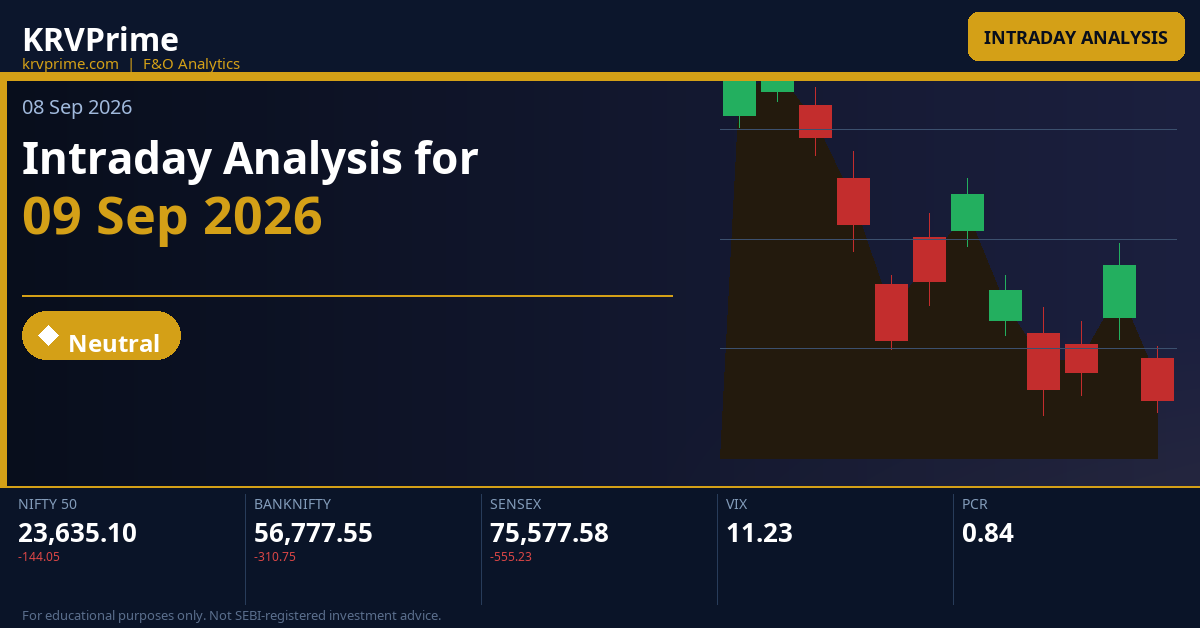
All three benchmark indices closed lower on 08 Sep 2026 — NIFTY at 23,635.10 (-0.61%), BANKNIFTY at 56,777.55 (-0.54%), and SENSEX at 75,577.58 (-0.73%) — confirming a broad-based bear grip heading into the 09 Sep session. India VIX data was unavailable for today's close, which itself warrants caution: traders should treat implied volatility as elevated given the consecutive selling pressure across indices and the fact that weekly straddles on NIFTY (ATM 23,650) are pricing just 14.9 points of expected move, suggesting either extreme complacency or an expiry-pinning environment. With all three indices printing Descending Medium CPRs for 09 Sep, the structural bias remains firmly bearish below the CPR bands, and any rally attempt will face supply within the BC–TC band unless accompanied by strong follow-through volume.
Key Market Signals — Intraday Setup
All three indices — NIFTY, BANKNIFTY, and SENSEX — are trading below their respective Day, Week, and Month CPR bands simultaneously, a classic triple-timeframe bearish alignment that typically invites continuation selling with each failed recovery attempt. The NIFTY weekly straddle at just 14.9 points reflects negligible weekly expiry premium, pinning price action near the 23,650 OI wall, while BANKNIFTY's month straddle of 1,303 points and SENSEX's 1,403.25 points signal larger institutional hedges active through September expiry.
Deep Technical Analysis & Levels
NIFTY
Descending — Medium (Width 0.16%)
▼ Bearish
Market Structure Balanced or transitional | Straddle ATM 23,650 straddle priced at 14.9 points (Call 0.05 + Put 14.85), implying a near-zero expected move for the weekly expiry — the market is essentially pinned at 23,650, and any breach of the ±14.9 pt band (i.e., outside 23,635.10–23,664.90) represents a volatility breakout that options sellers did not price in. | Max Pain Weekly max pain at 23,650 and monthly max pain at 24,200 — the weekly pin at 23,650 aligns almost perfectly with the current close of 23,635.10, meaning option sellers will defend 23,650 aggressively into Thursday's expiry; the monthly max pain at 24,200 is 565 points above current price, implying significant call-side pain compression that will suppress any rally through September. |
Tomorrow's Complete Level Map
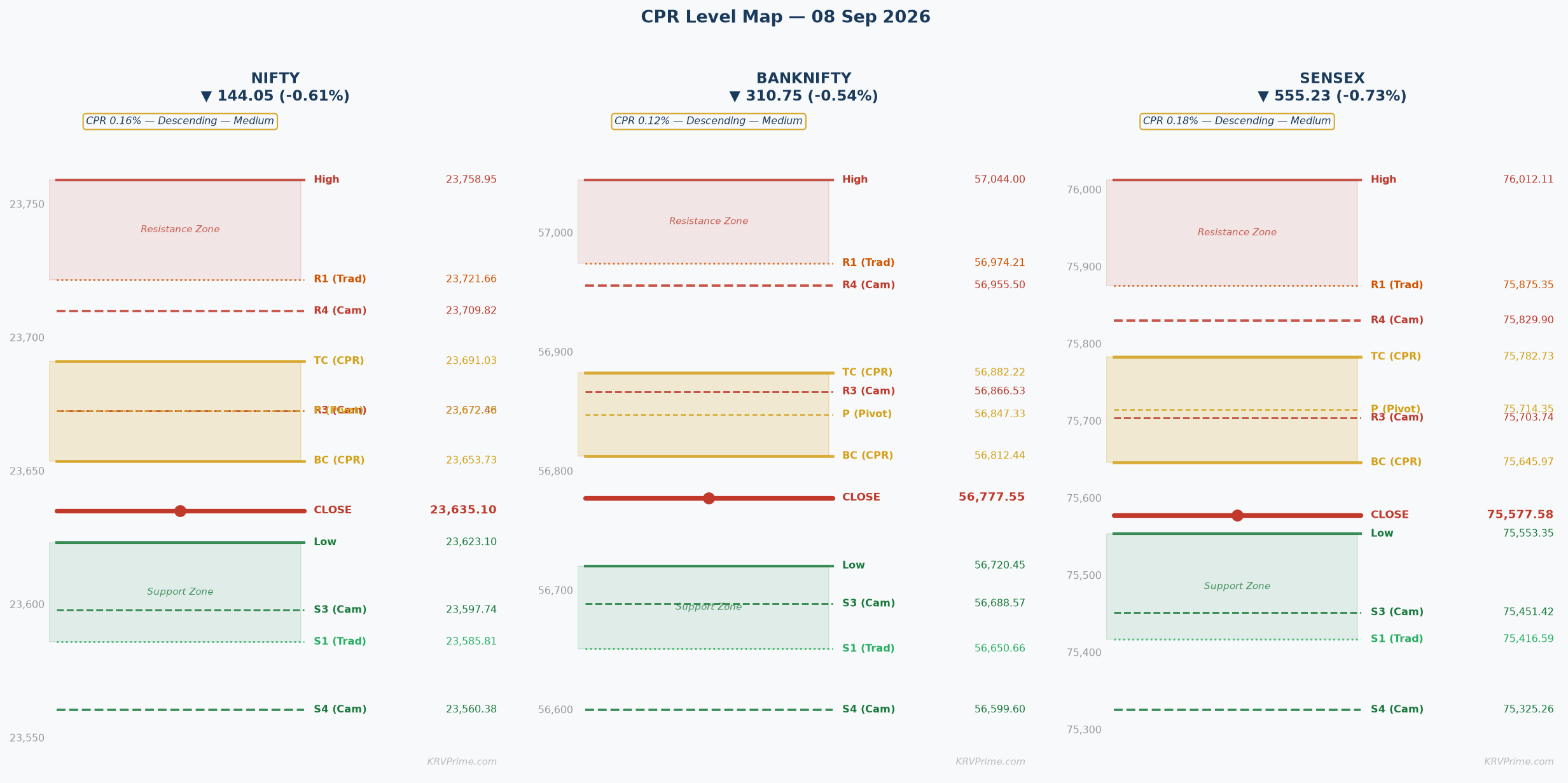
OI-R: 23,650 R3: 23,857.51 H6: 23,771.02 H5: 23,753.46 R2: 23,808.23 H4 ▶: 23,709.82 R1: 23,721.66 PDH: 23,758.95 H3 ↩: 23,672.46
TC: 23,691.03 P: 23,672.38 BC: 23,653.73
L3 ↩: 23,597.74 PDL: 23,623.10 S1: 23,585.81 L4 ▶: 23,560.38 S2: 23,536.53 L5: 23,516.74 L6: 23,499.18 S3: 23,449.96 OI-S: 23,600
↩ = Camarilla reversal point | ▶ = Camarilla breakout/breakdown trigger | OI-R/OI-S = Options wall (CE/PE max OI)
▲ Higher Open (Gap Up) — Open > Prev Close
↕ Conflicted
Open lands: In a Descending CPR setup, a gap-up open places price above TC (23,691.03). The entire CPR band (BC 23,653.73 – TC 23,691.03) now sits below the opening price, meaning the CPR band flips into an immediate support zone. However, note that OI-R is at 23,650 — critically, this is BELOW TC at 23,691.03, creating a unique conflict where the options wall is already inside the CPR band rather than above it.
CPR role: Support zone / potential trap door — the CPR band (23,653.73–23,691.03) acts as a first support on any opening dip; however, given OI-R at 23,650 sits within the BC–TC band, aggressive CE writers will defend this level and any rally above TC faces structural overhead from the descending CPR architecture.
Minor Gap (0.05–0.25%) — Structure Dominant
A minor gap up of 0.05–0.25% would open NIFTY approximately in the range 23,647–23,694, which places price either just inside or fractionally above TC at 23,691.03. Given the Descending Medium CPR structure, a minor gap up that opens between BC (23,653.73) and TC (23,691.03) still places price within the CPR band, meaning the structural bias remains contested rather than confirming bullish control — the CPR band acts as a decision zone, not a launch pad. The OI-R wall at 23,650 (a CE writing concentration) sits INSIDE the CPR band itself, creating significant overhead supply that will cap even minor gap-up attempts, and any intraday push above TC at 23,691.03 must clear H3 at 23,672.46 (nearly coincident with P at 23,672.38) in the first 30 minutes before targeting R1 at 23,721.66. Confirmation rule (Medium width): require a 30-minute candle close above TC at 23,691.03 on above-average volume before initiating longs — failure to hold TC on a 30-minute close signals the gap-up is a distribution trap and bearish resumption toward PDL at 23,623.10 and L3 at 23,597.74 becomes the higher-probability path.
Significant Gap (0.25–0.5%) — Balanced
A significant gap up of 0.25–0.5% would open NIFTY in the range 23,694–23,753, placing price clearly above TC at 23,691.03 and testing the H4 Camarilla breakout trigger zone at 23,709.82 on the open itself. At this gap size, the CPR band (23,653.73–23,691.03) sits entirely below the open and provides immediate support, but the ascending sequence H3 (23,672.46) → H4 (23,709.82) → H5 (23,753.46) compresses into a very tight resistance cluster, and with PDH at 23,758.95 capping the upper band, gap-fill risk toward TC at 23,691.03 within the first hour is substantial if opening momentum fades. Delta-hedging flows from options market makers will create mechanical selling above 23,700 as weekly CE writers (OI-R at 23,650 is already breached in this scenario) roll or add new strikes — watch for aggressive 23,700 CE writing in the opening minutes as a signal of institutional supply. Targets on the upside: first partial at R1 (23,721.66) which aligns with H4 (23,709.82) as a confluence zone; second target H5 (23,753.46) near PDH (23,758.95); abort below TC (23,691.03) on a 30-minute close.
Large Gap (>0.5%) — Gap Direction Dominant
A large gap up of more than 0.5% would open NIFTY above 23,753, potentially at or above PDH of 23,758.95 and H5 at 23,753.46 — this is a zone of heavy prior-day supply and the upper bound of Tuesday's entire range. At this extreme, the probability of gap-fill toward TC (23,691.03) or even BC (23,653.73) is high, as large gap-ups on indices that are already below descending weekly CPR (Week BC 23,920.13) tend to attract aggressive selling from players who were positioned short from higher levels, and the straddle pricing of just 14.9 points for the weekly expiry implies that the market was NOT expecting a move of this magnitude — the surprise factor will drive rapid straddle monetisation (put sellers covering, call buyers booking profits). Specific levels to monitor: if the opening 15-minute candle forms an upper shadow and closes below H5 (23,753.46), initiate fade toward H4 (23,709.82) and R1 (23,721.66) as first targets; full gap-fill toward TC (23,691.03) is secondary target; abort the fade only if price establishes two consecutive 30-minute closes above PDH (23,758.95) with expanding volume, which would signal a genuine directional reversal. H6 at 23,771.02 and R2 at 23,808.23 are the only upside extensions that would be valid in a true breakout scenario, but the monthly CPR (BC 24,181.59) acting as distant overhead and the weekly straddle pin dynamic make this the lowest-probability sustained outcome.
|
▲ Upside Path → OI-R Confirmed bull path: TC (23,691.03) hold → H3 (23,672.46) already below (acts as floor) → H4 (23,709.82) first Camarilla breakout trigger → R1 (23,721.66) first traditional resistance and partial profit zone → H5 (23,753.46) near PDH (23,758.95) as second target → OI-R wall at 23,650 already surpassed in this scenario (acts as support on dips). Each level should be treated as a partial booking point with trailing stops, as the descending monthly structure (Month BC 24,181.59) will cap any sustained rally through September. |
▼ Downside Path → OI-S Failure path from a gap-up: rejection at TC (23,691.03) → pullback through P (23,672.38) → breach of BC (23,653.73) signals gap-fill completion → L3 (23,597.74) is the first Camarilla mean-reversion bear target → PDL (23,623.10) as intermediate support that may slow but not stop the move → OI-S at 23,600 (PE writing wall) is the ultimate floor where put sellers will defend aggressively, and a close below 23,600 would be a major bearish signal for the weekly expiry. |
| 🔴 OI-R: OI-R at 23,650 represents the strike with maximum CE (Call) open interest for the weekly series — CE writers have aggressively sold calls at this level, creating a mechanical supply ceiling; in a gap-up scenario where price opens ABOVE 23,650, these same CE writers face mounting mark-to-market losses and will either add more calls at higher strikes (creating a rolling supply wall) or hedge dynamically, both of which suppress upside momentum and make any rally above 23,700 structurally fragile. The 23,650 OI-R becomes a SUPPORT flip level only if price can establish two 30-minute closes above TC (23,691.03) — until then, treat it as a gravity anchor pulling price back toward 23,650. | 🟢 OI-S: OI-S at 23,600 (maximum PE open interest) is the primary downside abort level for gap-up bulls — in a gap-up scenario, this level is 35 points below the close (23,635.10) and approximately 50+ points below a minor gap-up open, making it a distant but critical reference: if price reverses from the gap-up and breaks below 23,600 on closing basis, PE writers will be forced to delta-hedge (buy futures) creating a temporary bounce, but sustained trade below 23,600 signals that the PE support has been overwhelmed and L4 (23,560.38) becomes the next structural floor. |
⚡ Key Trigger: The primary trigger on a gap-up open is a **first 30-minute candle close above TC at 23,691.03** on above-average volume — this is the Medium-width confirmation rule, and a sustained hold above TC shifts the CPR from an overhead obstacle to a support launching pad, opening the path toward H4 (23,709.82) and R1 (23,721.66). Conversely, if the 30-minute candle closes back below TC at 23,691.03, the gap-up is structurally invalidated as a bullish signal, the CPR band becomes overhead resistance, and the bearish scenario (close below BC at 23,653.73) becomes the operative framework for the rest of the session.
▼ Lower Open (Gap Down) — Open < Prev Close
▼ Bearish
Open lands: In a Descending CPR configuration, a gap-down open places price below BC (23,653.73) — and potentially well below the entire CPR band (23,653.73–23,691.03). Given the current close is 23,635.10 and the CPR band sits ABOVE it (BC 23,653.73 > Close 23,635.10), even a near-flat open is already below BC, confirming the Descending CPR's structural bearishness: the CPR band is overhead resistance in all gap-down scenarios.
CPR role: Overhead resistance / supply zone — the entire CPR band (BC 23,653.73 – TC 23,691.03) acts as a ceiling for gap-down sessions; recovery attempts that fail to reclaim BC on a 30-minute close confirm bearish continuation toward L3 and OI-S.
Minor Gap (0.05–0.25%) — Structure Dominant
A minor gap down of 0.05–0.25% would open NIFTY approximately in the range 23,576–23,623, placing price below the PDL of 23,623.10 and potentially near OI-S at 23,600 — this is a structurally significant observation because a minor gap already tests the options market's primary support wall. With a Descending Medium CPR overhead (BC at 23,653.73), the probability of a quick gap-fill recovery to above BC is low unless buying emerges in the first 15 minutes, as the CPR architecture labels any price below BC as bearish territory and adds structural confirmation to the downside. Bear target sequence from a minor gap-down: L3 at 23,597.74 (Camarilla mean-reversion support) coincides almost exactly with OI-S at 23,600, making this the first critical decision zone — a 30-minute close below 23,597.74 activates L4 at 23,560.38 and S1 at 23,585.81 as the next downside cluster, while a recovery close above BC (23,653.73) would neutralise the gap signal.
Significant Gap (0.25–0.5%) — Balanced
A significant gap down of 0.25–0.5% would open NIFTY in the range 23,517–23,576, a zone that places price below OI-S at 23,600, below L3 at 23,597.74, and approaching L4 at 23,560.38 — this is a meaningful breach of the primary PE support wall and signals institutional distribution rather than retail-driven selling. In this scenario, the 30-minute reclaim rule is critical: if NIFTY fails to recover above OI-S (23,600) within the first 30 minutes, PUT writers who sold 23,600 PE will begin delta-hedging by selling futures, amplifying downside pressure mechanically toward L4 (23,560.38) and S2 (23,536.53). Full downside extension targets: L4 (23,560.38) → S2 (23,536.53) → L5 (23,516.74) as the next Camarilla exhaustion zone; recovery trigger is a 30-minute close back above BC (23,653.73), which would indicate the gap-down was an overreaction and the day shifts to a recovery mode toward P (23,672.38).
Large Gap (>0.5%) — Gap Direction Dominant
A large gap down of more than 0.5% would open NIFTY below 23,517, breaching L5 (23,516.74) on the opening bell itself — this would be a panic-level event that brings L6 (23,499.18) and S3 (23,449.96) into immediate focus as downside targets. In a large-gap-down scenario, the straddle pricing of 14.9 points for the weekly expiry is rendered completely irrelevant as implied volatility spikes; put buyers will aggressively monetise open positions, and the market makers' delta-hedging will create cascading futures selling that can overshoot technical levels before a violent reversal. Recovery levels to watch: first, any 15-minute candle that closes back above L5 (23,516.74) signals a potential exhaustion reversal; the critical recovery zone is L3 (23,597.74) which must be reclaimed on a 30-minute close within the first 90 minutes of trading for the session to shift from panic to recovery, and the monthly Camarilla L4 at 23,651.01 (just above Day BC at 23,653.73) represents the upper boundary of any meaningful recovery attempt in this extreme scenario.
|
▲ Upside Path → OI-R Recovery path from a gap-down: breach of BC (23,653.73) on 30-minute close → test P (23,672.38) as mid-band reference → TC (23,691.03) as full CPR reclaim trigger → H3 (23,672.46) is virtually coincident with P and confirms the CPR recovery → R1 (23,721.66) and H4 (23,709.82) as the first traditional targets if momentum is genuine → OI-R at 23,650 (now below open in recovery) acts as support on any pullback within the CPR reclaim sequence. |
▼ Downside Path → OI-S Bear continuation: below BC (23,653.73) → L3 (23,597.74) coincides with OI-S (23,600) as first major floor — retail stop-losses placed below PDL (23,623.10) will trigger between 23,600–23,623, accelerating the move toward L3; breach of L3 (23,597.74) on a 30-minute close → L4 (23,560.38) → S2 (23,536.53) → L5 (23,516.74) as the cascade targets; OI-S at 23,600 is the pivotal line: sustained trade below 23,600 means the PE support structure has failed and L4 (23,560.38) becomes the session's downside target. |
| 🔴 OI-R: OI-R at 23,650 functions as an impenetrable overhead ceiling in gap-down sessions — CE writers with maximum open interest at this strike have no incentive to cover, and the descending CPR (BC 23,653.73) sitting just 3.73 points above OI-R creates a double-layer supply zone that will repel any intraday recovery attempt that reaches 23,650; gamma pressure from short call positions means dealers will sell futures heavily as price approaches 23,650 from below, mechanically capping the recovery. | 🟢 OI-S: OI-S at 23,600 is the primary PUT monetisation zone — in a gap-down scenario where price approaches or breaches 23,600, PUT holders (who bought at higher strikes) will be aggressively booking profits while PUT writers (who sold 23,600 PE) will delta-hedge by selling futures to limit losses; the net effect is a complex battle at 23,600 where an initial bounce is likely (put buyer profit-taking creates a reflexive lift) but sustained selling will overwhelm if the macro environment driving the gap remains unresolved, making 23,600 a zone to watch for 15-minute consolidation before the next directional move. |
⚡ Key Trigger: The definitive bear trigger is **failure to reclaim BC at 23,653.73 within the first 30 minutes of trading** — if the opening 30-minute candle closes below BC, it confirms that the CPR band is acting as overhead supply and that sellers are in structural control for the session, activating the full downside path toward L3 (23,597.74) and OI-S (23,600). The bull recovery trigger is a 30-minute close above BC (23,653.73) on above-average volume, which would signal that buyers have successfully absorbed the gap-down supply and the session structure shifts to a test of P (23,672.38) and TC (23,691.03) as recovery targets.
◆ Near Flat Open — Open ≈ Prev Close (±0.05%)
◆ Neutral
Open lands: A flat open of ±0.05% places NIFTY in the range 23,623–23,647, which is BELOW BC (23,653.73) — the entire CPR band (BC 23,653.73 – TC 23,691.03) sits above the opening price. This is the classic Descending CPR flat-open setup: price opens below the full CPR band, making the BC the first resistance and TC the secondary resistance.
CPR role: Overhead resistance / decision zone — in a flat open below BC (23,653.73), the CPR band acts purely as resistance; bulls must reclaim BC on a 30-minute close to shift the session structure, while bears need price to stay below BC to confirm continuation toward L3 and OI-S.
Near Flat (±0.05%)
A flat open near 23,635 places NIFTY approximately 18–30 points below BC (23,653.73) with the entire CPR band overhead — this is a high-information setup because the first 30-minute candle's directional close determines the day's structural framework with exceptional clarity; there is no ambiguity about levels since the CPR band at BC (23,653.73) – TC (23,691.03) is a well-defined, compact 37.30-point zone sitting directly above current price. The Descending Medium CPR structure (width 0.16%) means the CPR is narrow enough to create trend-day potential but not so narrow as to guarantee a range break in the first 15 minutes — a 30-minute confirmation close is required by the Medium-width rule, and traders should resist early positioning before the 30-minute candle closes. A hold below BC (23,653.73) through the first 30 minutes is a strong bearish signal: the Descending CPR's inherent bias, combined with the close already below BC, creates a 'two-session below CPR' dynamic (yesterday AND today opening below CPR band) that is historically associated with trend continuation days to the downside — the targets in this scenario are L3 (23,597.74) → OI-S (23,600) → L4 (23,560.38). The bull trigger is a decisive 30-minute close above BC (23,653.73): if achieved on above-average volume, it negates the Descending CPR's bearish bias and opens the path to P (23,672.38), H3 (23,672.46), and TC (23,691.03), with the medium-width rule requiring a second 30-minute confirmation above TC before targeting OI-R (23,650) — note the unusual situation where OI-R at 23,650 is INSIDE the CPR band, meaning it will be tested on any BC reclaim attempt.
|
▲ Upside Path → OI-R BC (23,653.73) reclaim on 30-minute close → OI-R (23,650) cleared (acts as support on first retest) → P (23,672.38) and H3 (23,672.46) as near-coincident first targets → second 30-minute confirmation above TC (23,691.03) activates H4 (23,709.82) → R1 (23,721.66) as the traditional first partial profit zone; the PDH at 23,758.95 and H5 (23,753.46) are the session's maximum upside if momentum is exceptional, though monthly and weekly CPR structures (Week BC 23,920.13) provide distant but real ceiling context. |
▼ Downside Path → OI-S Failure to reclaim BC (23,653.73) on the first 30-minute candle → confirmation of Descending CPR bearish structure → L3 (23,597.74) as the first Camarilla mean-reversion bear target, virtually coinciding with OI-S (23,600) — retail stops below PDL (23,623.10) will be triggered in transit, accelerating the move; L3 breach on 30-minute close → L4 (23,560.38) → S2 (23,536.53) as the second traditional support → L5 (23,516.74) as the Camarilla exhaustion zone for the session's maximum downside. |
| 🔴 OI-R: OI-R at 23,650 (CE max OI strike) in a flat-open scenario sits effectively inside the CPR band — CE writers at this strike are positioned to supply the market with synthetic selling every time price approaches 23,650 from below, and the flat open near 23,635 means price is just 15 points away from this CE writing wall, making any early morning bounce to 23,650 a high-risk entry for bulls who will face immediate gamma-driven supply from option market makers. The 23,650 CE wall combined with BC (23,653.73) creates a layered resistance cluster in just a 3.73-point zone, which is the single most important confluence level in the flat-open scenario. | 🟢 OI-S: OI-S at 23,600 (PE max OI strike) provides a structural floor approximately 35 points below the flat open near 23,635 — PE writers (who sold 23,600 puts) will defend this level by buying futures, creating reflexive bounces as price approaches; however, in a flat-open scenario with the entire CPR band overhead and Descending CPR structure, reaching OI-S at 23,600 is the primary bear target for the session, and once tested, the behaviour of the 15-minute candle at 23,600 will determine whether the session closes near max pain (23,650) or extends toward L4 (23,560.38). |
⚡ Key Trigger: **Bull trigger: First 30-minute candle close above BC at 23,653.73** with above-average volume confirms CPR reclaim and shifts the day to bullish mode targeting P (23,672.38) then TC (23,691.03); **Bear trigger: First 30-minute candle close remaining below BC at 23,653.73** confirms Descending CPR overhead resistance and activates the bearish path toward L3 (23,597.74) and OI-S (23,600). The structural significance of BC (23,653.73) cannot be overstated — it is simultaneously the bottom of the CPR band, 18 points above the close (23,635.10), and just 3.73 points above the OI-R at 23,650, creating a triple confluence that makes the 23,650–23,654 zone the day's most critical battleground for both bulls and bears.
BANKNIFTY
Descending — Medium (Width 0.12%)
▼ Bearish
Market Structure Balanced or transitional | Straddle ATM 56,800 month straddle priced at 1,303 points (Call 795.0 + Put 508.0), implying a ±1,303 point expected move through the September monthly expiry (29 Sep 2026) — on an intraday basis, this straddle premium signals elevated institutional hedging and that a daily move of 200–400 points would be well within normal expectations for BANKNIFTY. | Max Pain Monthly max pain at 57,500, which is 722.45 points above the current close of 56,777.55 — this significant distance between current price and max pain means call sellers are comfortably positioned and will resist any rally toward 57,500; it also implies that the current week's price action is creating PE pressure for option writers at lower strikes, particularly the 56,000 PE OI-S level. |
Tomorrow's Complete Level Map
OI-R: 57,500 R3: 57,297.76 H6: 57,101.43 H5: 57,059.42 R2: 57,170.88 H4 ▶: 56,955.50 R1: 56,974.21 PDH: 57,044.00 H3 ↩: 56,866.53
TC: 56,882.22 P: 56,847.33 BC: 56,812.44
L3 ↩: 56,688.57 PDL: 56,720.45 S1: 56,650.66 L4 ▶: 56,599.60 S2: 56,523.78 L5: 56,495.68 L6: 56,453.67 S3: 56,327.11 OI-S: 56,000
↩ = Camarilla reversal point | ▶ = Camarilla breakout/breakdown trigger | OI-R/OI-S = Options wall (CE/PE max OI)
▲ Higher Open (Gap Up) — Open > Prev Close
↕ Conflicted
Open lands: In a Descending CPR setup, a gap-up open places BANKNIFTY above TC (56,882.22). The close at 56,777.55 is 34.67 points below BC (56,812.44) and 104.67 points below TC (56,882.22), meaning even a minor gap up may only push into the BC–TC band rather than clearly above TC. A significant or large gap would be required to place price convincingly above TC at 56,882.22.
CPR role: Overhead supply zone / decision band — the CPR band (56,812.44–56,882.22) sits above yesterday's close and represents the first zone where supply will emerge; bulls must close above TC (56,882.22) on a 30-minute candle to shift structure, while a rejection from within the CPR band confirms the Descending architecture's bearish bias.
Minor Gap (0.05–0.25%) — Structure Dominant
A minor gap up of 0.05–0.25% opens BANKNIFTY in the range 56,806–56,919, likely placing price inside the CPR band (BC 56,812.44 – TC 56,882.22) — at the lower end of a minor gap, price is near BC (56,812.44) which is the Descending CPR's first resistance, while at the upper end it is near TC (56,882.22) or fractionally above. The Descending Medium CPR structure creates a conflict here: an open inside the CPR band on a Descending setup means the market is testing whether the CPR band is reclaimed (bullish) or acts as a ceiling (bearish), and the 30-minute close rule is the only reliable confirmation — an open inside the CPR band without sustained follow-through above TC (56,882.22) reverts to the bearish default. First target on a 30-minute close above TC (56,882.22): H3 (56,866.53) — note this is BELOW TC, meaning H3 is already inside the CPR band and acts as an intraband reference — then H4 (56,955.50) and R1 (56,974.21) as the first meaningful resistance cluster on the upside; bear trigger inside the CPR band is a 30-minute close back below BC (56,812.44) signalling rejection from the CPR zone and activating L3 (56,688.57) as the downside target.
Significant Gap (0.25–0.5%) — Balanced
A significant gap up of 0.25–0.5% opens BANKNIFTY in the range 56,919–57,061, placing price above TC (56,882.22) and approaching H4 (56,955.50) and R1 (56,974.21) — this is a technically important zone because H4 is the Camarilla breakout trigger and R1 is the first traditional resistance, creating a dual confluence that will attract both profit-taking and fresh supply on the open. In this scenario, gap-fill risk toward TC (56,882.22) and then BC (56,812.44) within the first 30 minutes is meaningful — buyers who chased the gap will become sellers if price fails to hold above TC on the opening 30-minute candle, and the Descending CPR's structural bearishness adds to this fade risk. Upside targets if H4 (56,955.50) is sustained on a 30-minute close: R1 (56,974.21) as partial booking → H5 (57,059.42) and PDH (57,044.00) as the next cluster → OI-R at 57,500 is a distant target requiring exceptional momentum; abort gap-up trade below TC (56,882.22) on 30-minute close.
Large Gap (>0.5%) — Gap Direction Dominant
A large gap up of more than 0.5% opens BANKNIFTY above 57,061, which places price near PDH (57,044.00) and H5 (57,059.42) — at this extreme opening level, BANKNIFTY is essentially at yesterday's high on the open, representing an exhaustion zone where sellers from 08 Sep's PDH session will aggressively re-enter. The monthly straddle premium of 1,303 points provides context: a large gap up consuming 100+ points of the daily expected range on the open itself triggers rapid straddle monetisation, with call holders booking profits and put sellers delta-hedging, creating mechanical buying pressure that briefly sustains but ultimately reverses as the premium evaporates. Recovery abort for the gap-up in this scenario: two consecutive 30-minute closes above PDH (57,044.00) and H5 (57,059.42) would be required to confirm genuine breakout momentum targeting H6 (57,101.43) and eventually OI-R (57,500); absence of this confirmation triggers a fade toward H4 (56,955.50) → TC (56,882.22) → CPR reclaim test.
|
▲ Upside Path → OI-R Confirmed bull path: 30-minute close above TC (56,882.22) → H4 (56,955.50) as Camarilla breakout trigger and first resistance to clear → R1 (56,974.21) as first traditional partial profit zone (these two are close, treat as a cluster at 56,955–56,975) → H5 (57,059.42) and PDH (57,044.00) as the second target cluster → H6 (57,101.43) → OI-R at 57,500 is the ultimate monthly CE wall and maximum upside ceiling, requiring sustained institutional buying to reach. Volume confirmation: each Camarilla level break should be accompanied by volume spikes above the opening bar's volume. |
▼ Downside Path → OI-S Failure path from gap-up: rejection at TC (56,882.22) → drop through P (56,847.33) → BC (56,812.44) breach on 30-minute close signals CPR rejection → L3 (56,688.57) as the first Camarilla mean-reversion bear target below PDL (56,720.45) → S1 (56,650.66) as traditional first support → L4 (56,599.60) as the breakdown accelerator → OI-S at 56,000 is the massive monthly PE wall and the ultimate downside floor that is 777 points below current close, representing a potential scenario only in extreme selling conditions. |
| 🔴 OI-R: OI-R at 57,500 is the monthly CE maximum OI strike — in a gap-up scenario, this level is 722 points above the current close and approximately 600+ points above even a significant gap-up open, making it a DISTANT but directionally important target that defines the upper boundary of option sellers' comfort zone; call writers at 57,500 represent patient institutional supply that will begin rolling or defending only if BANKNIFTY approaches 57,200–57,300, making the OI-R a ceiling to keep in mind for swing context rather than an intraday target for 09 Sep. | 🟢 OI-S: OI-S at 56,000 is the monthly PE maximum OI strike — in a gap-up scenario, this level is 777 points below the current close and completely irrelevant as a near-term reference; it acts as the session's distant safety net, confirming that PUT writers have aggressively sold 56,000 PE and will defend the level with mechanical futures buying if price ever threatens that zone, making it a structural floor for the September contract rather than an intraday target. |
⚡ Key Trigger: The primary trigger for gap-up bulls is a **first 30-minute candle close above TC at 56,882.22** — this is the Medium-width confirmation rule and marks the definitive CPR reclaim that shifts BANKNIFTY's session structure from bearish (Descending CPR below price) to bullish (CPR converted to support), opening the path toward H4 (56,955.50) and R1 (56,974.21). If the opening 30-minute candle closes BELOW TC (56,882.22) despite a gap-up open, it signals a CPR trap and the structural bearish bias reasserts — the bear trigger becomes a 30-minute close below BC (56,812.44), activating L3 (56,688.57) as the session's downside objective.
▼ Lower Open (Gap Down) — Open < Prev Close
▼ Bearish
Open lands: A gap-down open in a Descending CPR setup places BANKNIFTY below the current close (56,777.55) and further below the full CPR band (BC 56,812.44 – TC 56,882.22), which sits as overhead resistance in its entirety. A minor gap down opens near PDL (56,720.45) while a significant gap down tests L3 (56,688.57) on the open, and a large gap down breaches L3 and approaches L4 (56,599.60).
CPR role: Overhead resistance — the CPR band (56,812.44–56,882.22) is entirely above all gap-down opening levels and acts as a remote recovery ceiling; the BC (56,812.44) is 34.89 points above yesterday's close, making CPR reclaim a 30+ minute effort even in a recovery scenario.
Minor Gap (0.05–0.25%) — Structure Dominant
A minor gap down of 0.05–0.25% opens BANKNIFTY in the range 56,636–56,748, placing price near or below PDL (56,720.45) and approaching L3 (56,688.57) — the breach of PDL on the open immediately activates bearish momentum as stop-loss orders placed below 56,720 trigger in the opening minutes. The Descending Medium CPR overhead (BC 56,812.44) means any recovery toward 56,750–56,800 will face CPR resistance even before reaching the bottom of the band, creating a structurally unfavourable risk-reward for longs. Bear target: 30-minute close below PDL (56,720.45) confirms continuation → L3 (56,688.57) → S1 (56,650.66) → L4 (56,599.60) as the session's extended downside; recovery trigger is a 30-minute close above BC (56,812.44), which would require a 60+ point recovery from a minor gap-down open, making it a high-bar confirmation with a valid long trade toward P (56,847.33) and TC (56,882.22).
Significant Gap (0.25–0.5%) — Balanced
A significant gap down of 0.25–0.5% opens BANKNIFTY in the range 56,494–56,635, placing price below L3 (56,688.57) and near L5 (56,495.68) — this is a meaningful structural breach where the Camarilla mean-reversion support (L3) is already compromised on the open, suggesting institutional selling of size overnight or in early pre-market. PUT writers at OI-S (56,000) will begin delta-hedging (selling futures) if the trend continues, creating mechanical selling pressure that accelerates price toward L4 (56,599.60) and S2 (56,523.78) in the first hour; the 30-minute recovery trigger is reclaim of L3 (56,688.57) which would signal an opening exhaustion reversal. Full downside targets: L4 (56,599.60) → S2 (56,523.78) → L5 (56,495.68) → OI-S (56,000) remains distant but directionally valid for the monthly expiry narrative.
Large Gap (>0.5%) — Gap Direction Dominant
A large gap down of more than 0.5% opens BANKNIFTY below 56,494, near or below L5 (56,495.68) and approaching L6 (56,453.67) — this is a panic-level event that would test the technical structure of the September monthly contract and put severe pressure on the 56,000 PUT writers. In this extreme scenario, VIX (unavailable today but inferred to be elevated from the multi-day selling) would spike at the open, triggering rapid straddle monetisation; put buyers with 56,000 PE will see significant mark-to-market gains and may book profits near L5–L6, creating a technical bounce zone at 56,453–56,495 that can be sharp but is not necessarily a trend reversal. Recovery threshold: L3 (56,688.57) must be reclaimed on a 30-minute close for any meaningful intraday recovery; without it, the cascade continues toward S3 (56,327.11) and eventually toward OI-S (56,000) — which if breached would represent an extraordinary monthly expiry event.
|
▲ Upside Path → OI-R Recovery path from gap-down: absorption near PDL (56,720.45) or L3 (56,688.57) → 30-minute close above L3 signals first recovery → BC (56,812.44) reclaim as the CPR bottom test → P (56,847.33) as mid-CPR reference → TC (56,882.22) as the full CPR reclaim confirmation → H4 (56,955.50) and R1 (56,974.21) as the upside targets if the recovery gains institutional momentum; each level requires volume above the opening bar for confirmation. |
▼ Downside Path → OI-S Bear continuation from gap-down: below L3 (56,688.57) → S1 (56,650.66) as first traditional support → L4 (56,599.60) as Camarilla breakdown acceleration trigger → S2 (56,523.78) → L5 (56,495.68) as Camarilla exhaustion zone → L6 (56,453.67) as the extreme bear extension; retail stop-losses below PDL (56,720.45) and L3 (56,688.57) create a waterfall effect as each level breaks, making partial profit-taking at each Camarilla level essential rather than holding for a single large target. OI-S at 56,000 remains the structural floor for the monthly contract. |
| 🔴 OI-R: OI-R at 57,500 is completely irrelevant as a near-term reference in a gap-down scenario — it is 700+ points above the open in even a minor gap-down, and the CE writers at 57,500 are entirely comfortable with their positions; traders should track whether NEW CE writing emerges at lower strikes (57,000 or 56,800) during the session as a real-time signal of where institutional supply is being repositioned. | 🟢 OI-S: OI-S at 56,000 is the monthly PE maximum OI strike and the primary structural floor for the September contract — in a gap-down scenario, this level is 750–800 points below the close, meaning it functions as the session's ultimate downside anchor; if intraday price action accelerates toward 56,200–56,300, the 56,000 PUT writer community will begin aggressive futures buying (delta hedge) creating a mechanical bid, making any 56,000 test a high-probability reversal zone with a quick 200–300 point bounce potential. |
⚡ Key Trigger: The definitive bear trigger is **failure to reclaim BC at 56,812.44 within the first 30 minutes** — in a gap-down scenario, the Descending CPR's structural bias combined with a below-BC open creates a near-inevitable bearish day unless buyers emerge with force in the opening 30 minutes. The bull recovery trigger is more specifically a **30-minute close above L3 (56,688.57)** as the first sign of absorption, followed by a second confirmation above BC (56,812.44) — without both levels being reclaimed sequentially, the recovery is statistically a dead-cat bounce rather than a genuine trend change.
◆ Near Flat Open — Open ≈ Prev Close (±0.05%)
◆ Neutral
Open lands: A flat open of ±0.05% places BANKNIFTY in the range 56,749–56,806, which is BELOW BC (56,812.44) — the entire CPR band (BC 56,812.44 – TC 56,882.22) is overhead. With a 34.89-point gap between the close (56,777.55) and BC (56,812.44), even a flat open sits clearly in bearish CPR territory.
CPR role: Overhead resistance / decision zone — the CPR band sits as a 69.78-point overhead structure (BC 56,812.44 to TC 56,882.22); a flat open below BC confirms the Descending CPR's bearish architecture, and the session will be defined by whether bulls can push through BC within the first 30 minutes or whether the CPR band acts as a ceiling for the rest of the day.
Near Flat (±0.05%)
A flat open near 56,777 places BANKNIFTY squarely below BC (56,812.44), confirming the Descending CPR's structural bearishness with the entire band overhead — this is the textbook 'flat below descending CPR' setup where the CPR band is the decisive battleground and the first 30-minute candle is the primary trade signal; traders must resist the urge to anticipate direction before the 30-minute candle closes. The BC at 56,812.44 and TC at 56,882.22 define a 69.78-point resistance corridor that sits 34.89 to 104.67 points above the flat open, meaning bulls face a meaningful climb before any structural positivity can be confirmed, while bears have the immediate advantage of the Descending CPR overhead and the prior day's confirmed selling. The CPR width at 0.12% is near the Narrow threshold (≤0.10%), which means this session has elevated trend-day probability — while technically classified as Medium (requiring 30-minute confirmation), the near-Narrow width means the first directional 30-minute candle tends to persist through the session without significant mean-reversion, and traders should be prepared to trail stops rather than taking quick partial profits at the first target. Bull trigger: first 30-minute close above BC (56,812.44) on above-average volume shifts the session to a CPR reclaim attempt targeting P (56,847.33) → H3 (56,866.53) → TC (56,882.22); Bear trigger: first 30-minute close remaining below PDL (56,720.45) confirms outright bearish continuation targeting L3 (56,688.57) → S1 (56,650.66) → L4 (56,599.60).
|
▲ Upside Path → OI-R BC (56,812.44) close on 30-minute candle → P (56,847.33) as mid-band interim target → H3 (56,866.53) near coincident with P as first partial profit zone → TC (56,882.22) full CPR reclaim (second 30-minute confirmation required) → H4 (56,955.50) and R1 (56,974.21) as the session's primary upside targets → PDH (57,044.00) and H5 (57,059.42) as the maximum bull extension; OI-R at 57,500 remains a distant monthly target well beyond intraday reach from a flat open. |
▼ Downside Path → OI-S Failure below PDL (56,720.45) on 30-minute close → L3 (56,688.57) as Camarilla mean-reversion bear target, where retail stop-losses below PDL create acceleration → S1 (56,650.66) as first traditional support → L4 (56,599.60) as the Camarilla breakdown trigger → S2 (56,523.78) and L5 (56,495.68) as the extended downside cluster; OI-S at 56,000 is the monthly floor that will be defended by PUT writers with mechanical futures buying if approached, making it an ultimate reversal zone rather than a pass-through level. |
| 🔴 OI-R: OI-R at 57,500 in a flat-open scenario is a distant ceiling providing directional context for the month — CE writers at 57,500 are comfortable at current price levels 700+ points below their strike, so there is no gamma pressure or delta-hedging supply being generated from the OI-R in today's session; instead, track whether institutional players add new CE positions at 57,000 or 56,800 intraday as a more relevant real-time supply indicator. | 🟢 OI-S: OI-S at 56,000 in a flat-open scenario provides a distant structural floor — PUT writers at 56,000 will begin feeling delta-hedge pressure only if BANKNIFTY drops below 56,300–56,400, which is 370–470 points below the flat open near 56,777; however, the mere existence of this massive PE OI at 56,000 provides psychological support that prevents panic selling from escalating into a full collapse, and traders should note that any move toward 56,200 will trigger mechanical PUT writer buying that creates a sharp but temporary bounce. |
⚡ Key Trigger: **Bull trigger: First 30-minute candle close above BC at 56,812.44** with above-average volume — this is the minimum requirement for any long position, and a second 30-minute confirmation above TC (56,882.22) is needed before targeting H4 (56,955.50) and R1 (56,974.21); **Bear trigger: First 30-minute candle close below PDL at 56,720.45** confirms that the Descending CPR overhead is unopposed and activates L3 (56,688.57) → S1 (56,650.66) → L4 (56,599.60) as the bear sequence. The BC level at 56,812.44 is the structural fulcrum: it is simultaneously the CPR band bottom, 35 points above the flat open, and the level where Descending CPR shifts from 'bearish environment' to 'potential recovery' — every market participant using CPR analysis will have this number on their screen, creating self-fulfilling buying and selling pressure at this precise level.
SENSEX
Descending — Medium (Width 0.18%)
▼ Bearish
Market Structure Balanced or transitional | Straddle ATM 75,600 week straddle at 559.8 points (Call 339.4 + Put 220.4) implying a ±559.8 point expected move for the weekly expiry (10 Sep 2026 — expiry is TOMORROW), meaning the options market prices approximately ±0.74% move remaining in the week; the month straddle at 1,403.25 points (Call 914.6 + Put 488.65) signals significant asymmetry with calls priced at nearly 2× puts, reflecting residual upside hedging despite the bearish price action. | Max Pain Weekly max pain at 75,900 is 322.42 points above the current close of 75,577.58 — this is highly significant because SENSEX weekly expiry is TOMORROW (10 Sep 2026), meaning market makers will work to pin SENSEX near 75,900 through tomorrow's close, creating a gravitational pull that could support the 75,600–75,900 range; monthly max pain at 77,000 represents a 1,422.42 point gap above current close, confirming massive call-side pressure suppressing any September recovery. |
Tomorrow's Complete Level Map
OI-R: 77,000 R3: 76,334.11 H6: 76,036.49 H5: 75,977.25 R2: 76,173.11 H4 ▶: 75,829.90 R1: 75,875.35 PDH: 76,012.11 H3 ↩: 75,703.74
TC: 75,782.73 P: 75,714.35 BC: 75,645.97
L3 ↩: 75,451.42 PDL: 75,553.35 S1: 75,416.59 L4 ▶: 75,325.26 S2: 75,255.59 L5: 75,177.91 L6: 75,118.67 S3: 74,957.83 OI-S: 75,000
↩ = Camarilla reversal point | ▶ = Camarilla breakout/breakdown trigger | OI-R/OI-S = Options wall (CE/PE max OI)
▲ Higher Open (Gap Up) — Open > Prev Close
↕ Conflicted
Open lands: In a Descending CPR setup, a gap-up open places SENSEX above TC (75,782.73). The current close is 75,577.58, which is 68.39 points below BC (75,645.97) and 205.15 points below TC (75,782.73). A minor gap up would likely open inside the BC–TC band, while a significant gap up would open above TC, and a large gap up would open near or above PDH (76,012.11).
CPR role: Overhead resistance transitioning to support — in a Descending CPR, the CPR band (75,645.97–75,782.73) sits above the close; a gap-up into the band makes it a decision zone, while a gap-up above TC (75,782.73) converts the band temporarily to support, but only if confirmed by a 30-minute close.
Minor Gap (0.05–0.25%) — Structure Dominant
A minor gap up of 0.05–0.25% opens SENSEX in the range 75,615–75,767, placing price inside the CPR band (BC 75,645.97 – TC 75,782.73) — at the lower end of this gap, price opens just above BC (75,645.97), while at the upper end it approaches TC (75,782.73). An open inside the CPR band on a Descending structure creates a contested environment: bulls see the CPR reclaim attempt as a potential recovery signal, while bears see the Descending CPR as an overhead trap that has historically rejected prices into continuation selling. The critical Medium-width confirmation rule requires a 30-minute close above TC (75,782.73) before initiating any long — without this confirmation, the CPR band acts as a distribution ceiling, and a 30-minute close below BC (75,645.97) after a minor gap-up open is a bearish trap signal targeting L3 (75,451.42) and OI-S (75,000).
Significant Gap (0.25–0.5%) — Balanced
A significant gap up of 0.25–0.5% opens SENSEX in the range 75,767–75,956, placing price above TC (75,782.73) and approaching H4 (75,829.90) — this is an important level because H4 is the Camarilla breakout trigger and its breach on the open will attract momentum buyers while simultaneously creating gap-fill risk toward TC (75,782.73) for those who missed the open. The weekly expiry tomorrow (10 Sep 2026) adds a critical dimension: with weekly max pain at 75,900 and a significant gap-up opening near this level, option market makers will experience a dramatic shift in delta exposure, triggering mechanical buying of futures near 75,900 that can sustain the gap temporarily but risks a reversal once the max pain attraction forces fade into tomorrow's expiry. Upside targets: H4 (75,829.90) → R1 (75,875.35) → weekly max pain zone (75,900) → H5 (75,977.25) → PDH (76,012.11); abort gap-up below TC (75,782.73) on 30-minute close.
Large Gap (>0.5%) — Gap Direction Dominant
A large gap up of more than 0.5% opens SENSEX above 75,956, likely near PDH (76,012.11) or H5 (75,977.25) — this places the opening bell at yesterday's intraday high, a natural exhaustion and distribution zone where sellers from Tuesday's session will eagerly re-enter. The week straddle premium of 559.8 points for tomorrow's expiry would be severely stressed by a large gap up: call holders at ATM 75,600 would be deep in the money and booking profits, while put sellers would be scrambling to delta-hedge, creating a complex mixed-flow open that initially supports price but rapidly reverses once the premium evaporates. Specific levels: opening above PDH (76,012.11) and H5 (75,977.25) makes H6 (76,036.49) the immediate target; R2 (76,173.11) and OI-R (77,000) are the extended monthly targets; fade trigger is a 15-minute candle closing below H5 (75,977.25) after an opening spike, targeting gap-fill toward TC (75,782.73) as the primary reversal trade.
|
▲ Upside Path → OI-R Confirmed bull path from gap-up: TC (75,782.73) sustained on 30-minute close → H3 (75,703.74) already below TC and acts as intraband reference → H4 (75,829.90) as Camarilla breakout trigger → R1 (75,875.35) as first traditional partial profit → weekly max pain gravity at 75,900 creates natural target zone → H5 (75,977.25) and PDH (76,012.11) as the next cluster → H6 (76,036.49) for extreme bull extension; OI-R at 77,000 is a distant monthly ceiling requiring a multi-session structural shift. |
▼ Downside Path → OI-S Failure path from gap-up: rejection at TC (75,782.73) → pullback through H3 (75,703.74) → BC (75,645.97) breach on 30-minute close confirms CPR rejection → L3 (75,451.42) as the Camarilla mean-reversion bear target → PDL (75,553.35) as an interim support that may slow (but not stop) the move → S1 (75,416.59) → OI-S (75,000) as the ultimate PE support wall where PUT writers will defend aggressively with mechanical futures buying. |
| 🔴 OI-R: OI-R at 77,000 (monthly CE maximum OI strike) is 1,422 points above the current close and an entirely distant reference in a gap-up scenario for 09 Sep — CE writers at 77,000 are deeply comfortable at current levels and are not generating any meaningful gamma pressure or delta-hedging flows; the more relevant near-term OI resistance is the weekly CE positioning around the 75,900–76,000 zone (max pain 75,900), which creates a real intraday ceiling for tomorrow's expiry and should be treated as the operative OI-R for gap-up scenarios on 09 Sep. | 🟢 OI-S: OI-S at 75,000 (PE maximum OI strike for both week and month) is 577 points below the current close and functions as a structural floor — in a gap-up scenario, this level is completely irrelevant as an intraday target but provides context that PUT writers have aggressive positions at 75,000 and will begin delta-hedging (buying futures) if SENSEX approaches 75,100–75,200, creating a reflexive technical bounce zone that limits downside in any reversal from a gap-up. |
⚡ Key Trigger: The primary trigger for gap-up bulls is a **first 30-minute candle close above TC at 75,782.73** with above-average volume — the Descending Medium CPR requires this 30-minute confirmation before the CPR band can be declared a support zone, and with tomorrow's weekly expiry adding urgency to the 75,900 max pain gravity, a 30-minute close above TC increases the probability of a max-pain drift toward 75,900 significantly. Failure to sustain above TC (75,782.73) on a 30-minute close in a gap-up scenario is the most reliable bear signal of the day: the gap becomes a bull trap, and the subsequent break below BC (75,645.97) activates the full downside toward L3 (75,451.42) and OI-S (75,000).
▼ Lower Open (Gap Down) — Open < Prev Close
▼ Bearish
Open lands: A gap-down open places SENSEX below the current close (75,577.58) and further from the CPR band (BC 75,645.97 – TC 75,782.73), which sits as distant overhead resistance. Given that the close is already 68.39 points below BC, any gap-down immediately tests the PDL (75,553.35) and threatens L3 (75,451.42) as the first Camarilla bear target.
CPR role: Distant overhead resistance — the CPR band (75,645.97–75,782.73) is 68–205 points above any gap-down open level; it acts as a ceiling that recovery attempts must clear before the session can be considered structurally improved; in practice, the CPR band is largely irrelevant for the first 60–90 minutes of a meaningful gap-down session.
Minor Gap (0.05–0.25%) — Structure Dominant
A minor gap down of 0.05–0.25% opens SENSEX in the range 75,388–75,540, placing price below PDL (75,553.35) at the upper end and approaching L3 (75,451.42) → S1 (75,416.59) at the lower end — the breach of PDL (75,553.35) on the open triggers stop-losses set below Tuesday's low, creating immediate selling pressure that accelerates toward the L3–S1 cluster (75,416.59–75,451.42). The critical context for tomorrow's weekly expiry (10 Sep): a minor gap-down open that tests L3 (75,451.42) puts significant pressure on 75,000 PE holders who bought as a hedge — they will be tempted to book profits near max pain gravity (75,900 being the target), creating a buyer base that limits downside extension below L3; however, a 30-minute close below L3 (75,451.42) confirms continuation toward L4 (75,325.26) and S2 (75,255.59). Recovery trigger: 30-minute close back above BC (75,645.97) confirms the gap-down was absorbed and the expiry max pain drift toward 75,900 can begin.
Significant Gap (0.25–0.5%) — Balanced
A significant gap down of 0.25–0.5% opens SENSEX in the range 75,389–75,388 (note: same as upper minor range — a 0.25% gap down is 189 pts, 75,577 – 189 = 75,388) to 75,200, placing price near L3 (75,451.42) at the upper end and threatening L4 (75,325.26) and S2 (75,255.59) at the lower end. The weekly expiry tomorrow adds extreme significance: a significant gap down that opens near or below L3 (75,451.42) on the day before expiry creates severe mark-to-market pressure on PE writers at 75,500 and 75,000, triggering delta-hedge selling that can cascade the move lower even if no new fundamental catalyst exists. PUT buyer momentum in this scenario: at-the-money or near-the-money puts (75,500, 75,000) will see rapid premium expansion, encouraging put holders to hold rather than sell, reducing the natural demand cushion; recovery requires reclaim of L3 (75,451.42) on a 30-minute close to stabilise, and full recovery requires BC (75,645.97) reclaim.
Large Gap (>0.5%) — Gap Direction Dominant
A large gap down of more than 0.5% opens SENSEX below 75,200, approaching L5 (75,177.91) and L4 (75,325.26) — this would be a panic-level event on an expiry eve, with tomorrow's weekly settlement creating extraordinary pressure on PUT writers at 75,000 who would suddenly see their strike under direct intraday threat. The OI-S at 75,000 becomes the primary immediate focus: PUT writers will begin mechanical futures buying from approximately 75,100–75,200 (100–200 point cushion above the strike), creating a reflexive technical bounce of 200–400 points that could reverse the entire gap within 60–90 minutes; however, without a fundamental catalyst for the gap, the bounce should be treated as a straddle monetisation opportunity with the following targets: recover above L3 (75,451.42) on 30-minute close for longs; abort below L5 (75,177.91) for catastrophic continuation toward L6 (75,118.67) and S3 (74,957.83).
|
▲ Upside Path → OI-R Recovery path from gap-down: first 30-minute close above PDL (75,553.35) signals gap absorption → BC (75,645.97) as the CPR bottom and critical reclaim level → P (75,714.35) as mid-band reference → H3 (75,703.74) near coincident with P as Camarilla mean-reversion upper target → TC (75,782.73) full CPR reclaim → H4 (75,829.90) and R1 (75,875.35) → weekly max pain gravity at 75,900 as the pre-expiry pin target; each recovery level requires 30-minute volume confirmation. |
▼ Downside Path → OI-S Bear continuation from gap-down: below PDL (75,553.35) → L3 (75,451.42) and S1 (75,416.59) as the first cluster (retail stops below 75,553 trigger in transit, accelerating to L3) → 30-minute close below L3 (75,451.42) activates L4 (75,325.26) → S2 (75,255.59) → L5 (75,177.91) → OI-S (75,000) as the ultimate floor where expiry mechanics (PUT writer delta hedging) will create a violent but temporary bounce; L6 (75,118.67) and S3 (74,957.83) are extreme bear targets only in catastrophic scenarios. |
| 🔴 OI-R: OI-R at 77,000 is irrelevant in a gap-down scenario for 09 Sep — the monthly CE wall at 77,000 is 1,400+ points above any gap-down opening and provides no near-term gamma pressure; traders should instead monitor the 75,900 zone (weekly max pain) as the effective intraday OI-R for tomorrow's expiry, as option market makers will systematically cap any intraday recovery near this zone to optimise their expiry positioning. | 🟢 OI-S: OI-S at 75,000 is the primary PE maximum OI for both the weekly (10 Sep) and monthly (24 Sep) expiry — this creates an extraordinarily powerful double-layer PUT writing base; in a gap-down scenario where SENSEX approaches 75,000 on the eve of weekly expiry, PUT writers at 75,000 face immediate assignment risk and will buy futures aggressively between 75,000–75,200, creating a mechanical support floor that can generate 300–500 point reversals; traders should treat 75,000–75,100 as a 'do not hold short below' zone and plan exits or reversals near this OI-S level. |
⚡ Key Trigger: The critical trigger in a gap-down scenario is **failure to reclaim BC at 75,645.97 within the first 30 minutes** — this confirms the Descending CPR overhead resistance is intact and bears are structurally in control, with L3 (75,451.42) → S1 (75,416.59) → L4 (75,325.26) as the bear path. The pre-expiry recovery trigger is more specifically: **a 30-minute close above PDL (75,553.35)** as the first sign of gap absorption, followed by BC (75,645.97) reclaim — if achieved, the weekly max pain drift toward 75,900 becomes the operative bias for the final pre-expiry session.
◆ Near Flat Open — Open ≈ Prev Close (±0.05%)
◆ Neutral
Open lands: A flat open of ±0.05% places SENSEX in the range 75,540–75,615, which is BELOW BC (75,645.97) — the entire CPR band (BC 75,645.97 – TC 75,782.73) sits overhead. At 75,577 (close), price is 68.39 points below BC and 205.15 points below TC. This is the Descending CPR flat-open scenario: bearish structural bias with CPR as overhead resistance.
CPR role: Overhead resistance / decision zone — the CPR band (75,645.97–75,782.73) is clearly above the flat open, making BC the immediate resistance and TC the secondary ceiling; the Descending CPR flat-open puts SENSEX in a vulnerable structural position with the bears in default control.
Near Flat (±0.05%)
A flat open near 75,577 places SENSEX approximately 68 points below BC (75,645.97), with the entire Descending CPR band overhead and tomorrow's weekly expiry (10 Sep 2026) creating a critical time overlay — the session on 09 Sep is the LAST full trading day before weekly expiry, meaning institutional positioning will be driven by expiry management dynamics that interact powerfully with the CPR structure: weekly max pain at 75,900 creates gravitational pull toward the upside, but the Descending CPR architecture (BC 75,645.97 below yesterday's BC) suggests sellers have been structurally dominant across multiple sessions. The CPR band width at 0.18% (Medium) means traders must use the 30-minute close rule for confirmation: a flat open that resolves with a 30-minute candle closing above BC (75,645.97) initiates the pre-expiry max pain drift trade toward P (75,714.35) → TC (75,782.73) → R1 (75,875.35) → weekly max pain at 75,900, while a 30-minute close remaining below PDL (75,553.35) confirms the Descending CPR overhead is unopposed and the bear path to L3 (75,451.42) → OI-S (75,000) is operative. The H3 level at 75,703.74 sits inside the CPR band (BC 75,645.97 to TC 75,782.73), making it an intraband milestone rather than an external target — once BC is reclaimed, the sequence is BC → H3 → P → TC in rapid succession. Both the bull and bear triggers carry elevated significance due to tomorrow's expiry: CE writers and PE writers will both be extremely active in defending their respective strikes, making whichever direction establishes first in the 30-minute candle likely to be sustained through the pre-expiry session.
|
▲ Upside Path → OI-R BC (75,645.97) reclaim on 30-minute close → H3 (75,703.74) and P (75,714.35) as near-coincident first targets within the CPR band → TC (75,782.73) full CPR reclaim (second 30-minute confirmation required by Medium-width rule) → H4 (75,829.90) as Camarilla breakout trigger above the CPR → R1 (75,875.35) and weekly max pain at 75,900 as the primary pre-expiry upside targets → H5 (75,977.25) and PDH (76,012.11) as the extended bull targets; OI-R at 77,000 is the monthly ceiling far above intraday reach. |
▼ Downside Path → OI-S Failure below PDL (75,553.35) on 30-minute close → L3 (75,451.42) as first Camarilla bear target where retail stops placed below 75,553 trigger and accelerate the descent → S1 (75,416.59) as first traditional support → L4 (75,325.26) as Camarilla breakdown trigger → S2 (75,255.59) → L5 (75,177.91) → OI-S (75,000) as the ultimate pre-expiry floor; the proximity of weekly expiry makes L3 and OI-S even more critical: PUT buyers will monetise near L3, while PUT writers will defend near OI-S (75,000), creating mechanical reversals at each level. |
| 🔴 OI-R: OI-R at 77,000 (monthly CE maximum OI) is entirely irrelevant for intraday trading on 09 Sep — the effective intraday OI resistance is the 75,900 zone (weekly max pain) where option market makers will apply synthetic selling to manage their expiry books; in a flat-open scenario, the 75,900 zone is 322 points above the open and represents the highest-probability destination if bulls successfully reclaim TC (75,782.73), making it the operative upside ceiling for the pre-expiry session rather than the distant monthly OI-R at 77,000. | 🟢 OI-S: OI-S at 75,000 represents maximum PE open interest for BOTH the weekly (10 Sep) and monthly (24 Sep) contracts — this double-layer PUT writing concentration at 75,000 creates the most powerful mechanical support available in the SENSEX option chain; in a flat-open scenario where price drifts lower through the session, the 75,000 zone (approximately 577 points below the flat open) will attract aggressive futures buying from PUT writers facing delta-hedge obligations, creating sharp reversal bounces of 200–400 points that can be traded as mechanical recovery plays with tight stops below 74,950. |
⚡ Key Trigger: **Bull trigger: First 30-minute candle close above BC at 75,645.97** — this confirms CPR reclaim and activates the pre-expiry max pain drift trade toward weekly max pain at 75,900, with sequential targets at P (75,714.35), H3 (75,703.74), TC (75,782.73), H4 (75,829.90), and R1 (75,875.35); **Bear trigger: First 30-minute candle close below PDL at 75,553.35** confirms that the Descending CPR overhead is intact and pre-expiry bears are in control, activating L3 (75,451.42) → S1 (75,416.59) → L4 (75,325.26) → OI-S (75,000) as the downside sequence. BC at 75,645.97 is the session's structural fulcrum: it is simultaneously the CPR bottom, 68 points above the flat open, and the level that separates the 'expiry pin recovery' narrative from the 'expiry pin failure' scenario — all serious institutional players will be watching this level from the opening bell.
📊 VIX Insight: India VIX data was unavailable for the 08 Sep 2026 close, which itself is a data point worth noting: on days following a broad market decline of 0.54–0.73% across NIFTY, BANKNIFTY, and SENSEX, VIX typically rises in concert with the selling, and the absence of a reported VIX figure means traders should assume elevated implied volatility conditions until the opening bell confirms otherwise. For 09 Sep, with SENSEX weekly expiry on 10 Sep and all three indices below their respective Descending Day CPR bands, the market environment is primed for a volatility expansion event — either a sharp pre-expiry recovery toward weekly max pain levels (NIFTY 23,650, SENSEX 75,900) or a continued decline that forces PUT writers to aggressively hedge, amplifying intraday moves beyond what the straddle premiums currently price.
Overall View:
All three indices — NIFTY, BANKNIFTY, and SENSEX — head into 09 Sep 2026 with Descending Medium CPR structures overhead, meaning the structural default is bearish: any opening that fails to reclaim the respective CPR band (NIFTY BC 23,653.73, BANKNIFTY BC 56,812.44, SENSEX BC 75,645.97) on a 30-minute close activates the full downside cascade toward OI-S levels at 23,600, 56,000, and 75,000 respectively. The SENSEX weekly expiry on 10 Sep adds a critical pre-expiry dynamic that may create a gravitational pull toward weekly max pain levels (75,900 for SENSEX, 23,650 for NIFTY), but this max pain drift trade ONLY activates if bulls successfully reclaim TC levels within the first 30 minutes of 09 Sep's session. The highest-probability intraday read for 09 Sep is: bears remain in structural control below the CPR bands; any gap-up or flat-open that fails the 30-minute CPR reclaim test becomes a short-selling opportunity targeting L3 and OI-S levels; and the single most important level across all three indices is the collective BC band — watch whether the first 30-minute candle establishes above or below it, as this binary outcome will define the entire session's directional structure.
All three indices — NIFTY, BANKNIFTY, and SENSEX — head into 09 Sep 2026 with Descending Medium CPR structures overhead, meaning the structural default is bearish: any opening that fails to reclaim the respective CPR band (NIFTY BC 23,653.73, BANKNIFTY BC 56,812.44, SENSEX BC 75,645.97) on a 30-minute close activates the full downside cascade toward OI-S levels at 23,600, 56,000, and 75,000 respectively. The SENSEX weekly expiry on 10 Sep adds a critical pre-expiry dynamic that may create a gravitational pull toward weekly max pain levels (75,900 for SENSEX, 23,650 for NIFTY), but this max pain drift trade ONLY activates if bulls successfully reclaim TC levels within the first 30 minutes of 09 Sep's session. The highest-probability intraday read for 09 Sep is: bears remain in structural control below the CPR bands; any gap-up or flat-open that fails the 30-minute CPR reclaim test becomes a short-selling opportunity targeting L3 and OI-S levels; and the single most important level across all three indices is the collective BC band — watch whether the first 30-minute candle establishes above or below it, as this binary outcome will define the entire session's directional structure.
Disclaimer: KRV Prime provides educational and informational content relating to financial markets. Articles, research, examples, charts, strategies and tools are provided for educational purposes and should not be interpreted as personalised investment advice or a guarantee of financial performance. Markets involve risk, including possible loss of capital. Past performance does not guarantee future results. KRV Prime is not a SEBI Registered Investment Adviser or Research Analyst.