
Index Analysis
Intraday Analysis for 13 Oct 2026
KRV Prime12 October 202660 min
Educational/Derived AnalysisSource: KRV Prime Market Insights (End-of-Day)As of 12 Oct 2026, 04:41 PM IST
Intraday Analysis for 13 Oct 2026
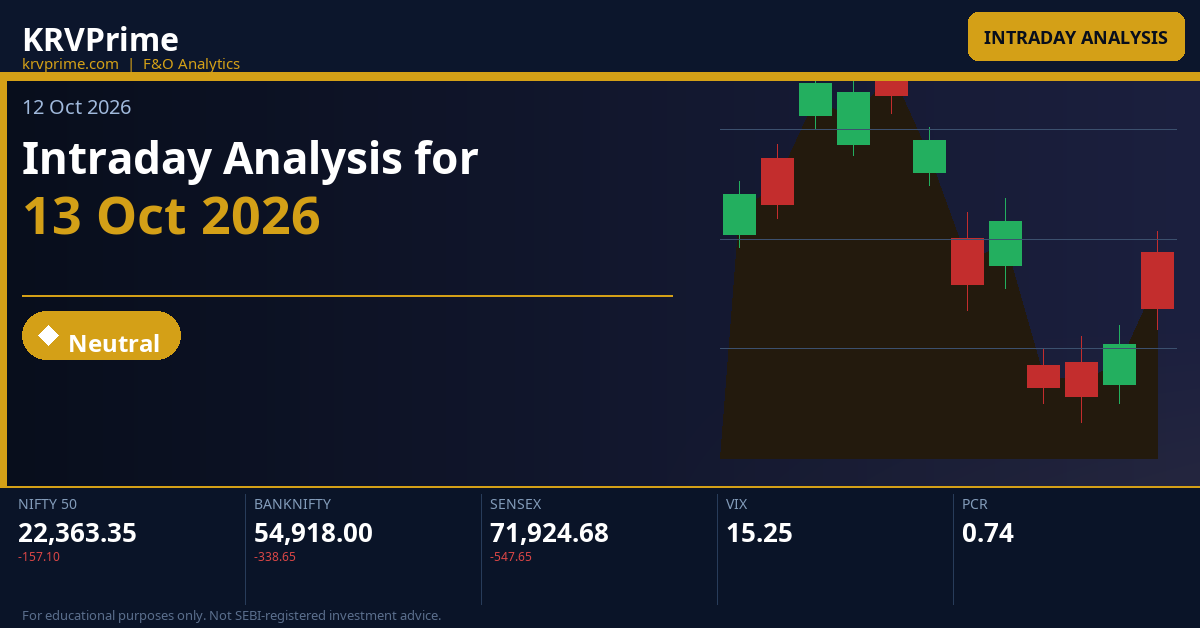
Markets closed on a broadly negative note on 12 Oct 2026, with NIFTY shedding 0.70% to 22,363.35, BANKNIFTY declining 0.61% to 54,918.00, and SENSEX falling 0.76% to 71,924.68, all three indices printing below their respective day CPR bands and reinforcing a near-term bearish tilt. India VIX data is unavailable for this session, which limits precise premium-decay calibration, but the across-the-board sell-off in all three indices alongside elevated weekly straddle premiums — NIFTY weekly straddle at 150.4 points and SENSEX weekly straddle at 871.15 points — suggests implied volatility is being priced for continued choppiness rather than a directional breakout. Max Pain for the weekly expiry sits at NIFTY 22,400 and SENSEX 72,000, both marginally above current closes, implying option sellers will exert gravitational pull upward but with CE walls at 22,600 and 74,000 respectively capping any meaningful rally attempt on 13 Oct.
Key Market Signals — Intraday Setup
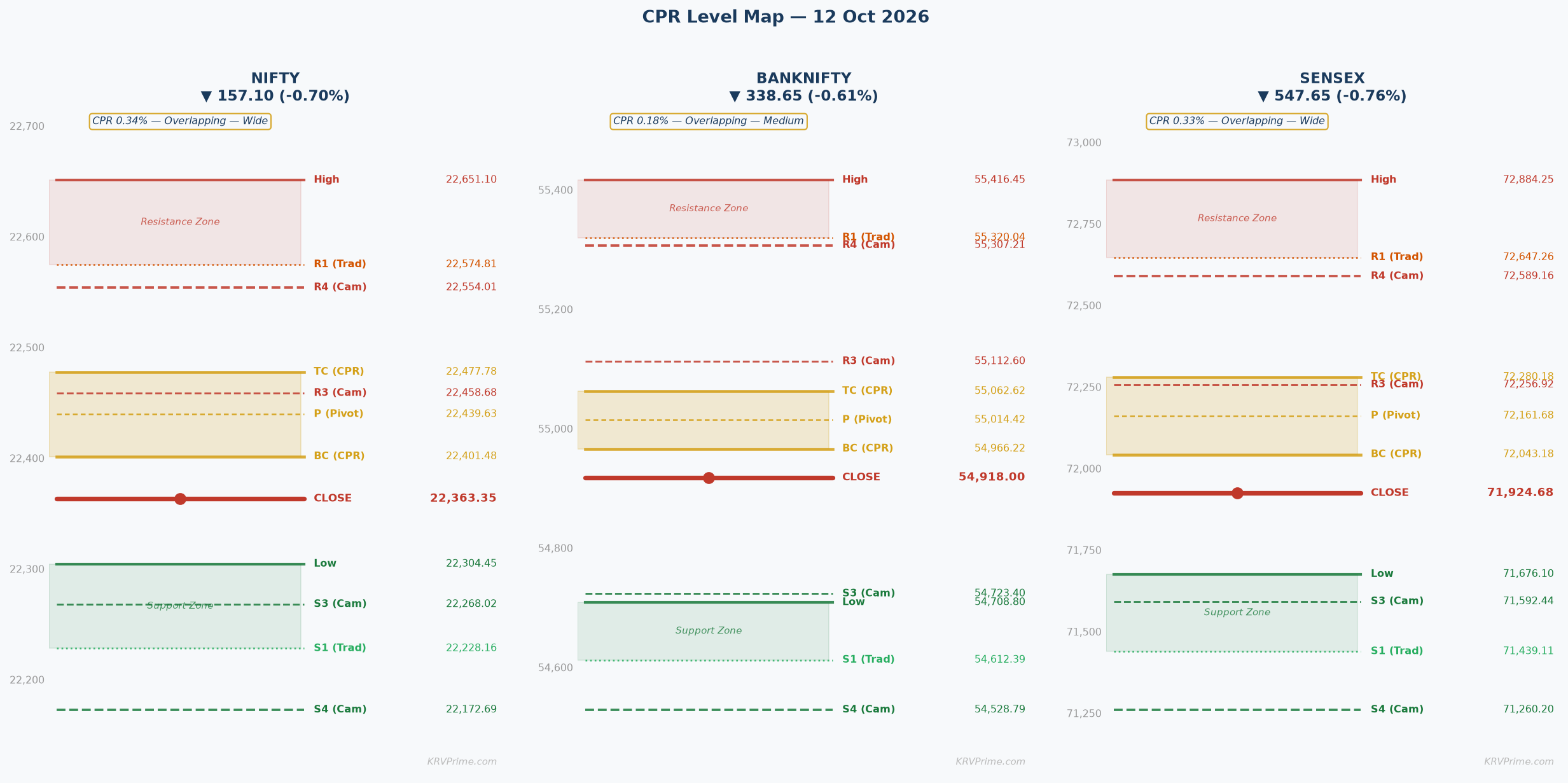
All three indices — NIFTY, BANKNIFTY, and SENSEX — closed below their respective Day CPR bands (NIFTY BC 22,401.48, BANKNIFTY BC 54,966.22, SENSEX BC 72,043.18), confirming the CPR band acts as overhead resistance into 13 Oct and the structural bias is bearish-to-neutral unless price reclaims these bands with sustained closes. With all three monthly CPRs also positioned well above current prices and weekly CPR structures mixed (BANKNIFTY weekly CPR is Ascending-Wide while NIFTY and SENSEX weekly CPRs are Overlapping/Inside-Wide), the session is likely to be a tug-of-war between Max Pain gravitational pull and OI wall resistance, demanding confirmation-first trade management.
Deep Technical Analysis & Levels
NIFTY
Overlapping — Wide (0.34%)
▼ Bearish
Market Structure Sideways or range-bound | Straddle ATM 22,350 straddle = 150.4 pts (Call 69.6 + Put 80.8), implying an expected intraday move of approximately ±150 pts from 22,350, putting the upper bound near 22,500 and lower bound near 22,200 — perfectly aligned with the Camarilla H3 at 22,458.68 on the upside and L4 at 22,172.69 on the downside. | Max Pain Max Pain for the 13-Oct-2026 weekly expiry is at 22,400 — sitting just above the CPR BC of 22,401.48 — meaning option sellers benefit most if NIFTY gravitates and pins near 22,400 by end of day, making the CPR band a natural magnet zone for the expiry-day session. |
Tomorrow's Complete Level Map
OI-R: 22,600 R3: 22,921.46 H6: 22,710.92 H5: 22,665.36 R2: 22,786.28 H4 ▶: 22,554.01 R1: 22,574.81 PDH: 22,651.10 H3 ↩: 22,458.68
TC: 22,477.78 P: 22,439.63 BC: 22,401.48
L3 ↩: 22,268.02 PDL: 22,304.45 S1: 22,228.16 L4 ▶: 22,172.69 S2: 22,092.98 L5: 22,061.34 L6: 22,015.78 S3: 21,881.51 OI-S: 22,000
↩ = Camarilla reversal point | ▶ = Camarilla breakout/breakdown trigger | OI-R/OI-S = Options wall (CE/PE max OI)
▲ Higher Open (Gap Up) — Open > Prev Close
◆ Neutral
Open lands: Previous close is 22,363.35. The Day CPR BC is at 22,401.48 and TC is at 22,477.78. A gap-up open means price opens above 22,363.35. A minor gap (0.05–0.25%) would place the open in the 22,374–22,419 zone — potentially between the prev close and the BC or just inside the CPR band. A significant gap (0.25–0.5%) would open near 22,419–22,474, likely inside the CPR band or approaching TC at 22,477.78. A large gap (>0.5%) would push the open above TC at 22,477.78 and potentially toward H3 at 22,458.68 or even R1 at 22,574.81.
CPR role: The CPR band (BC 22,401.48 — TC 22,477.78) acts as a launch pad on the upside if price sustains above BC, but given yesterday's close below BC at 22,363.35, the entire CPR band becomes immediate overhead resistance. Price needs to fight through 76 points of CPR width before the band converts to support, making the band a battleground zone rather than a passive support structure.
Minor Gap (0.05–0.25%) — Structure Dominant
A minor gap up of 0.05–0.25% opens NIFTY in the 22,374–22,419 range, placing it just below BC at 22,401.48 or barely inside the CPR band — a structurally ambiguous zone given the Overlapping-Wide CPR. The Overlapping CPR structure means there is no clean directional bias from CPR alone; the overlap with yesterday's range creates a contested zone, and the Wide width of 0.34% demands two 30-minute closes above TC at 22,477.78 before bulls can claim any sustained breakout. The first target on the upside is H3 at 22,458.68, which sits inside the CPR band and is the Camarilla mean-reversion stall zone — expect the first 30-minute candle to probe this level and face immediate selling pressure from trapped longs from yesterday's session.
Significant Gap (0.25–0.5%) — Balanced
A significant gap up of 0.25–0.5% would open NIFTY near 22,419–22,474, placing price inside the CPR band between BC 22,401.48 and TC 22,477.78 — a zone of balanced pressure where neither bulls nor bears have structural dominance. At these levels, the open is directly into the Camarilla H3 at 22,458.68, which is a mean-reversion stall level, and gap-fill risk back to PDC 22,363.35 is a real threat if the first 30-minute candle fails to close above TC at 22,477.78. Delta-hedging flows from the weekly expiry (Max Pain 22,400 directly in this range) will act as a gravitational anchor, making upside extension toward H4 at 22,554.01 or R1 at 22,574.81 conditional on a genuine volume-backed breakout above TC confirmed by two 30-minute closes.
Large Gap (>0.5%) — Gap Direction Dominant
A large gap up of more than 0.5% opens NIFTY above TC at 22,477.78 — potentially near or above H4 at 22,554.01 — and immediately challenges the OI Resistance wall at 22,600 and yesterday's PDH at 22,651.10 within the opening 30 minutes. Opening above the OI-R at 22,600 puts price in a zone of concentrated CE writing, where dealers and option sellers will aggressively defend shorts, creating a high probability of a gap-fill trade back toward TC at 22,477.78 and even BC at 22,401.48. Given the NIFTY weekly straddle at 150.4 points (implying an upper bound near 22,500 from ATM 22,350), a large gap above 22,500 consumes most of the straddle's upside budget, making extension toward H5 at 22,665.36 or H6 at 22,710.92 very low probability unless accompanied by exceptional broad market strength and VIX compression.
|
▲ Upside Path → OI-R Above TC at 22,477.78 confirmed by two 30-minute closes, the sequence targets H3 at 22,458.68 (already inside CPR band — watch for stall), then H4 at 22,554.01 and R1 at 22,574.81 as the first meaningful resistance cluster before the OI-R wall at 22,600 — each of these levels is approximately 75–120 points apart, providing a structured staircase only sustainable if volume expands on each breakout. The OI-R at 22,600 represents the CE maximum OI strike where the heaviest call writing is concentrated; a genuine momentum run above this level would trigger dealer delta-buying and accelerate toward H5 at 22,665.36 and PDH at 22,651.10, but the probability is low without a significant fundamental catalyst. |
▼ Downside Path → OI-S Failure to hold the CPR band (BC at 22,401.48 acting as key downside trigger on a gap-up scenario) sends price back toward PDL at 22,304.45 and then L3 at 22,268.02, which is the Camarilla mean-reversion support zone and the first legitimate intraday demand area. Below L3 at 22,268.02, the next structured support is L4 at 22,172.69 followed by S1 at 22,228.16, and a break below L4 opens a direct path toward the OI-S at 22,000 which anchors massive PE writing and is the options floor for the weekly expiry. |
| 🔴 OI-R: The OI Resistance at 22,600 represents the strike with maximum call open interest for the NIFTY weekly expiry (13 Oct 2026), where option sellers have written the largest concentration of calls — this creates a self-reinforcing ceiling as dealers hedge their short-call exposure by selling NIFTY futures near this level, amplifying the supply. In a gap-up scenario, approaching 22,600 triggers significant delta-hedging selling pressure; unless call OI at this strike is being covered (rolled up) on the day, the zone acts as a hard fade-and-short region, and price is expected to stall and reverse unless accompanied by exceptional momentum and open interest unwinding. | 🟢 OI-S: The OI Support at 22,000 is the PE maximum OI strike for the NIFTY weekly expiry, representing the largest concentration of put writing — this is the ultimate floor that option sellers are defending by selling puts at this level, creating a demand buffer that makes a sub-22,000 close extremely unlikely on a gap-up day. In a gap-up scenario, the 22,000 OI-S is largely irrelevant as an immediate target but serves as the critical abort level — if price somehow crashes through the entire CPR, L3 at 22,268.02, L4 at 22,172.69, and approaches 22,000, it signals a catastrophic breakdown that would also trigger massive stop-loss cascade and PE buying to cover the short-put book. |
⚡ Key Trigger: The primary trigger on the upside is two consecutive 30-minute candle closes above TC at 22,477.78 on above-average volume — this converts the CPR band from resistance to support and structurally confirms bulls have absorbed overnight supply; failure at TC after even one 30-minute close risks a rapid pullback to P at 22,439.63 and then BC at 22,401.48. On the downside, a failure to hold BC at 22,401.48 after the gap-up open flips the scenario into a gap-fill bear trade targeting L3 at 22,268.02 and PDL at 22,304.45, confirming that the gap was a bull trap and the session will trade below the CPR band for the remainder of the day.
▼ Lower Open (Gap Down) — Open < Prev Close
▼ Bearish
Open lands: Previous close is 22,363.35. BC is at 22,401.48 and TC at 22,477.78. A gap-down open places price below 22,363.35 — a minor gap (0.05–0.25%) opens in the 22,308–22,352 range, straddling the PDL at 22,304.45. A significant gap (0.25–0.5%) opens near 22,252–22,307, below PDL and approaching L3 at 22,268.02. A large gap (>0.5%) opens below L3 at 22,268.02 and potentially near L4 at 22,172.69 or S1 at 22,228.16.
CPR role: On a gap-down open, the entire CPR band (BC 22,401.48 — TC 22,477.78) sits well above the opening price and acts as a layered overhead resistance zone — bulls must reclaim BC at minimum to neutralise the bearish open, and the Wide CPR width of 0.34% means this band is substantial overhead supply requiring two 30-minute closes above TC at 22,477.78 for any genuine recovery signal.
Minor Gap (0.05–0.25%) — Structure Dominant
A minor gap down of 0.05–0.25% opens NIFTY between 22,308–22,352, placing price just below the previous close of 22,363.35 and in the zone between PDL at 22,304.45 and the CPR BC at 22,401.48 — this minor gap, while structurally bearish (below entire CPR band), has a high probability of filling (gap-fill back toward PDC 22,363.35) within 30–60 minutes given it opens near established support and the gravitational pull of Max Pain at 22,400. However, the CPR band remains overhead resistance; a 30-minute close above BC at 22,401.48 is needed to confirm gap-fill completion and any bullish reversal attempt, otherwise price will consolidate below the CPR band and gradually drift toward L3 at 22,268.02 as the structural bear bias of the CPR-below-price configuration reasserts itself. Bears maintain the upper hand as long as BC at 22,401.48 caps any recovery; the first bear target is L3 at 22,268.02, with the PDL at 22,304.45 acting as an intermediate pivot where short-term longs may try to hold.
Significant Gap (0.25–0.5%) — Balanced
A significant gap down of 0.25–0.5% opens NIFTY near 22,252–22,307, at or below PDL at 22,304.45 and approaching L3 at 22,268.02 — this configuration is decidedly bearish as price opens below the prior session's entire range and tests the Camarilla mean-reversion support zone at the open. Recovery to fill the gap requires reclaiming PDL at 22,304.45 within the first 30 minutes, followed by BC at 22,401.48 for the full gap-fill; failure to reclaim PDL confirms the bear case with L3 at 22,268.02 giving way and L4 at 22,172.69 and S1 at 22,228.16 becoming the primary downside targets. PUT writers at the OI-S 22,000 will be monitoring this level closely; a significant gap to this range will induce short-term PUT buying hedges while the market awaits structural confirmation, creating a sharp but often short-lived recovery bounce off L3 before the directional trend resumes.
Large Gap (>0.5%) — Gap Direction Dominant
A large gap down of more than 0.5% opens NIFTY below L3 at 22,268.02 — potentially near L4 at 22,172.69 or S1 at 22,228.16 — a severe dislocation that violates the weekly session low range and triggers panic selling and stop-loss cascades from retail longs positioned above PDL at 22,304.45. At these extreme open levels, the NIFTY weekly straddle of 150.4 points is instantly monetized on the PUT side; straddle sellers face maximum loss and will frantically buy back calls, creating upward delta pressure that may produce a sharp opening bounce from L4 at 22,172.69 or L5 at 22,061.34, but the structural damage is severe. Recovery is a multi-step process requiring: first, stabilise above L3 at 22,268.02 for 30 minutes; second, reclaim PDL at 22,304.45; third, attempt BC at 22,401.48 — each step requiring two 30-minute close confirmations given the Wide CPR width rule, making the session extremely volatile with both scalp-long and continuation-short opportunities.
|
▲ Upside Path → OI-R A genuine recovery from gap-down requires price to reclaim the PDL at 22,304.45 first, then challenge BC at 22,401.48 (CPR bottom), P at 22,439.63 (pivot), and finally TC at 22,477.78 — each level acting as a sequential resistance that must be cleared with a 30-minute close before the next target is valid; this is a slow staircase recovery trade with diminishing probability at each step. The OI-R at 22,600 remains the ultimate ceiling and is very unlikely to be reached on a gap-down day unless there is exceptional market-wide reversal; H3 at 22,458.68 and H4 at 22,554.01 are the realistic maximum recovery targets for even an optimistic bounce scenario. |
▼ Downside Path → OI-S Below PDL at 22,304.45, the structured bear path runs through L3 at 22,268.02 (Camarilla mean-reversion support — first stall zone where some longs will try to defend), then L4 at 22,172.69 (Camarilla breakdown trigger — retail stops concentrate here), followed by S1 at 22,228.16 and S2 at 22,092.98 before the critical OI-S at 22,000 — a break below PDL that sustains through L3 on two 30-minute closes is the highest-conviction bear signal. Below L4 at 22,172.69, momentum typically accelerates as trailing stops are triggered and the path to L5 at 22,061.34, L6 at 22,015.78, and eventually OI-S at 22,000 opens without meaningful structural support, making these levels rapid-succession targets in a high-volatility breakdown session. |
| 🔴 OI-R: The OI Resistance at 22,600 functions as a distant overhead ceiling in a gap-down scenario — CE writers at this strike are firmly profitable and have no incentive to cover, meaning the supply wall remains fully intact and will not contribute any meaningful upward delta pressure on a bearish session. The 22,600 CE wall actually serves as a psychological reference for shorts: knowing that upside is capped at 22,600 by concentrated call OI, momentum traders will be emboldened to hold shorts from the CPR band area (BC 22,401.48) all the way down toward the OI-S target. | 🟢 OI-S: The OI Support at 22,000 is the primary weekly PUT maximum OI strike and is the definitive floor for the 13-Oct-2026 weekly expiry — option sellers (PUT writers) who have written massive quantities of 22,000 PEs will buy NIFTY futures aggressively as price approaches this level to defend their short-put book, creating a strong demand cushion. If NIFTY actually reaches 22,000 on expiry day, the PUT writing community faces large mark-to-market losses and will partially unwind, triggering further PUT buying and potentially accelerating the fall past 22,000 toward L5 at 22,061.34 and L6 at 22,015.78 — so the zone just above 22,000 (say 22,015–22,061) will be a high-intensity battle ground between PUT sellers defending and directional bears pressing lower. |
⚡ Key Trigger: The critical recovery trigger on a gap-down is a 30-minute candle close back above BC at 22,401.48 — this is the minimum signal that bulls are absorbing selling pressure and the CPR band can begin to act as support rather than resistance; two consecutive 30-minute closes above TC at 22,477.78 would fully confirm recovery and open upside toward H3 at 22,458.68 (already inside CPR) and H4 at 22,554.01. The bear confirmation trigger is a 30-minute close below L3 at 22,268.02 on meaningful volume, which confirms the gap-down is not a gap-fill event but a genuine breakdown, targeting L4 at 22,172.69 and S1 at 22,228.16 in sequence before the OI-S at 22,000 becomes the session's primary downside magnet.
◆ Near Flat Open — Open ≈ Prev Close (±0.05%)
◆ Neutral
Open lands: A flat open of ±0.05% on prev close 22,363.35 places the open between approximately 22,352–22,374 — below BC at 22,401.48 and well below TC at 22,477.78, meaning NIFTY opens outside and below the entire Day CPR band. This is the most structurally informative scenario: price opens below the CPR band for a second consecutive session (yesterday also closed below BC), confirming the Overlapping CPR's resistance role and placing bears in structural control from the very first tick.
CPR role: The CPR band (BC 22,401.48 — TC 22,477.78) acts as a decision zone and overhead resistance in the flat-open scenario — it is not support (price is below it) and not a launch pad (no gap energy to propel price through it), but rather a compression wall that defines the bull-bear boundary for the entire session. A flat open creates a clean CPR-below-price setup where the direction of the first 30-minute candle relative to BC at 22,401.48 determines whether bulls can attempt a recovery or bears dominate the day.
Near Flat (±0.05%)
A flat open near 22,352–22,374 places NIFTY below BC at 22,401.48 and TC at 22,477.78, creating a textbook CPR-below-price setup for an Overlapping-Wide CPR — in this configuration the CPR band is the battleground and the first 30 minutes are critical for establishing directional intent without gap energy to assist either side. The BC at 22,401.48 is the most important intraday level of the session: a sustained 30-minute close above BC is the minimum requirement for bulls to suggest the prior session's weakness is being absorbed, while rejection at BC within the opening 30–60 minutes sets up a clean bear continuation toward L3 at 22,268.02. The CPR width of 0.34% is Wide, which by the framework rules requires two consecutive 30-minute closes above TC at 22,477.78 to confirm a genuine bull breakout — a single close above TC is insufficient for a trending up session, meaning most bull attempts will face multiple resistance tests at BC, P at 22,439.63, H3 at 22,458.68, and TC at 22,477.78 in sequence. Given the weekly Max Pain at 22,400 and this flat-open configuration, the most probable scenario is a choppy, range-bound session between PDL at 22,304.45 and BC at 22,401.48 with occasional probes toward CPR band interiors — scalpers should trade reversals at extremes while positional traders await a clean two-30-minute-close confirmation above TC or below L3 before committing to a direction.
|
▲ Upside Path → OI-R From the flat open zone (22,352–22,374), bulls must clear BC at 22,401.48 first (first resistance and Max Pain magnetic zone), then P at 22,439.63, H3 at 22,458.68 (Camarilla mean-reversion stall — expect selling here), and finally TC at 22,477.78 before two 30-minute closes confirm the breakout targeting H4 at 22,554.01, R1 at 22,574.81, and ultimately the OI-R wall at 22,600. Genuine momentum beyond OI-R at 22,600 requires exceptional conditions (broad rally, VIX collapse, foreign institutional buying) and would target H5 at 22,665.36 and PDH at 22,651.10, but this is a low-probability extension on a flat-open Wide CPR day. |
▼ Downside Path → OI-S Below the flat-open zone, the first structural support is PDL at 22,304.45 (prior session's low — a natural stop for day traders); below this, L3 at 22,268.02 is the Camarilla mean-reversion support and the trigger for the next leg, with a 30-minute close below L3 opening a direct path to L4 at 22,172.69 (Camarilla breakdown level where momentum accelerates). Below L4 at 22,172.69, the downside sequence targets S1 at 22,228.16, S2 at 22,092.98, L5 at 22,061.34, and eventually the OI-S PE wall at 22,000 — each level approximately 100–170 points apart, providing multiple scalp-short opportunities on a structured breakdown day. |
| 🔴 OI-R: The OI Resistance at 22,600 (CE maximum OI strike for weekly expiry) acts as the supreme ceiling in the flat-open scenario — call writers at this strike are deeply profitable from the current 22,363 level and will not cover unless NIFTY makes a very aggressive move, meaning the supply wall is thick, fresh, and largely unmoved. Any approach toward 22,600 on the session will encounter relentless CE writing-related delta-selling pressure that makes 22,600 a fade-and-short zone for intraday traders, and even a nominal touch of this level in a flat-open session would be considered an exceptional outcome given the 237-point gap from the open zone. | 🟢 OI-S: The OI Support at 22,000 (PE maximum OI strike for weekly expiry) serves as the ultimate downside anchor in the flat-open scenario — it is approximately 363 points below the flat-open zone, which is 2.4x the entire weekly straddle move of 150.4 points, making it a target only in an extreme, once-in-a-while breakdown session. However, the concentration of PE writing at 22,000 means that any approach toward this level (even intraday) will trigger furious covering by put sellers, creating a strong bounce zone — for the flat-open scenario, 22,000 OI-S functions as a theoretical floor and psychological anchor rather than a realistic intraday target, but it defines the outer boundary for stop-placement on short positions. |
⚡ Key Trigger: Bull trigger: two consecutive 30-minute closes above TC at 22,477.78 on above-average volume — this converts the Wide CPR band from resistance to support and targets H4 at 22,554.01 and R1 at 22,574.81 as the next resistance cluster. Bear trigger: a single 30-minute close below PDL at 22,304.45 or L3 at 22,268.02 with expanding volume confirms that the CPR band is acting as a definitive ceiling and that the session will remain directionally bearish, with L4 at 22,172.69 and the OI-S at 22,000 as the structured downside sequence — the Wide CPR width makes the bear trigger easier to execute since there is more distance to fail above before reaching downside levels.
BANKNIFTY
Overlapping — Medium (0.18%)
▼ Bearish
Market Structure Balanced or transitional | Straddle ATM 54,900 monthly straddle = 1,420.5 pts (Call 751.75 + Put 668.75), implying a significant expected monthly move of approximately ±1,420 pts from 54,900, placing the upper bound near 56,321 (near weekly H3 Camarilla at 55,545.04) and lower bound near 53,480 (near monthly L3 at 53,538.40) — this wide monthly straddle reflects the banking sector's higher beta and directional uncertainty. | Max Pain BANKNIFTY monthly Max Pain is at 55,500 — approximately 582 points above the current close of 54,918 — indicating that option sellers benefit from BANKNIFTY recovering and gravitating toward 55,500 by the 27-Oct-2026 monthly expiry, which aligns with the Day CPR TC at 55,062.62 and weekly CPR band (BC 54,894.95 — TC 55,136.09) acting as the first recovery milestones. |
Tomorrow's Complete Level Map
OI-R: 56,000 R3: 56,027.69 H6: 55,628.36 H5: 55,534.51 R2: 55,722.07 H4 ▶: 55,307.21 R1: 55,320.04 PDH: 55,416.45 H3 ↩: 55,112.60
TC: 55,062.62 P: 55,014.42 BC: 54,966.22
L3 ↩: 54,723.40 PDL: 54,708.80 S1: 54,612.39 L4 ▶: 54,528.79 S2: 54,306.77 L5: 54,301.49 L6: 54,207.64 S3: 53,904.74 OI-S: 52,000
↩ = Camarilla reversal point | ▶ = Camarilla breakout/breakdown trigger | OI-R/OI-S = Options wall (CE/PE max OI)
▲ Higher Open (Gap Up) — Open > Prev Close
◆ Neutral
Open lands: Previous close is 54,918.00. BC is at 54,966.22 and TC at 55,062.62. A minor gap up (0.05–0.25%) opens near 54,945–55,055 — just below BC or inside the CPR band. A significant gap (0.25–0.5%) opens near 55,055–55,192 — at or just above TC, approaching H3 at 55,112.60. A large gap (>0.5%) opens above H3 at 55,112.60 and potentially near H4 at 55,307.21 or R1 at 55,320.04.
CPR role: In the gap-up scenario, the CPR band (BC 54,966.22 — TC 55,062.62) transitions from yesterday's overhead resistance to a potential launch pad IF price opens above BC and immediately holds. The Medium width of 0.18% requires a first 30-minute close confirmation above TC at 55,062.62 for a bullish day structure — the band is relatively compact and digestible, unlike NIFTY's wider band, making recovery attempts more credible in BANKNIFTY.
Minor Gap (0.05–0.25%) — Structure Dominant
A minor gap up of 0.05–0.25% places BANKNIFTY between 54,945–55,055 — either just below BC at 54,966.22 or barely inside the CPR band — a zone that is structurally indeterminate given the Overlapping Medium CPR, where the gap slightly aids bulls but the structure's overlap with yesterday's range means the opening candle will be a tug-of-war between gap-fill sellers and CPR-reclaim buyers. The key first test is a 30-minute close above TC at 55,062.62; a successful close confirms CPR reclaim and targets H3 at 55,112.60 as the Camarilla mean-reversion first resistance, followed by H4 at 55,307.21 and R1 at 55,320.04 as the next meaningful cluster. Failure to hold BC at 54,966.22 within the first 30 minutes after a minor gap-up is a bear signal, confirming the gap is being faded and the session will retrace toward PDL at 54,708.80 and L3 at 54,723.40.
Significant Gap (0.25–0.5%) — Balanced
A significant gap up of 0.25–0.5% opens BANKNIFTY near 55,055–55,192 — at or just above TC at 55,062.62 and potentially touching H3 at 55,112.60 on the open — a zone where the Medium CPR confirmation (first 30-minute close above TC) is immediately tested without any warm-up phase, creating a compressed decision environment. Opening directly at H3 at 55,112.60 means BANKNIFTY is simultaneously above the CPR band and at the Camarilla mean-reversion stall level, creating a dual resistance environment where both structural and Camarilla sellers are active simultaneously — the first 30-minute candle's direction is the entire signal. Delta-hedging from the monthly straddle (ATM 54,900 straddle at 1,420.5 pts) is a significant force at these levels; a significant gap up toward 55,200 consumes nearly 40% of the monthly ATM straddle's upside budget and will trigger straddle sellers to buy back short calls and sell futures, adding downward pressure at H3 at 55,112.60.
Large Gap (>0.5%) — Gap Direction Dominant
A large gap up of more than 0.5% opens BANKNIFTY above H3 at 55,112.60 — near H4 at 55,307.21 or R1 at 55,320.04 — and challenges PDH at 55,416.45, the prior session's high, within the opening bars, creating a scenario where price opens right into the heaviest prior-day supply zone. A large gap to this zone immediately tests the weekly CPR band upper levels (weekly TC 55,136.09) as well as the monthly straddle's implied ceiling near 56,320, and the probability of a gap-fill back to TC at 55,062.62 and BC at 54,966.22 is elevated given that opening near PDH at 55,416.45 leaves only 584 points to the OI-R at 56,000 but 498 points of potential gap-fill back to PDC at 54,918.00. The abort level for any gap-up long in this scenario is a 30-minute close below TC at 55,062.62, which signals full gap fill and potential breakdown continuation; the only extension target above PDH at 55,416.45 is H5 at 55,534.51 and H6 at 55,628.36 before the OI-R at 56,000.
|
▲ Upside Path → OI-R Above TC at 55,062.62 confirmed by a 30-minute close, the BANKNIFTY upside sequence is H3 at 55,112.60 (Camarilla mean-reversion stall — first partial profit and potential reversal zone), then H4 at 55,307.21 and R1 at 55,320.04 as the first traditional resistance and Camarilla breakout trigger cluster (within 13 points of each other — a very tight zone that if broken opens significant momentum). Beyond H4 and R1, the targets are H5 at 55,534.51, H6 at 55,628.36, and ultimately the OI-R wall at 56,000 — but given the monthly Max Pain at 55,500 and H5 at 55,534.51 sitting right in this zone, the 55,500–55,534 area is the most realistic maximum upside target for a gap-up session without extraordinary catalyst. |
▼ Downside Path → OI-S Below BC at 54,966.22 on a gap-up failure, the first support is the previous close zone near 54,918 and then PDL at 54,708.80 together with L3 at 54,723.40 — these two levels (15 points apart) form the critical near-term demand cluster where a bounce is most likely on the first test. Below PDL at 54,708.80 and L3 at 54,723.40, the bear path extends to L4 at 54,528.79 and S1 at 54,612.39, then S2 at 54,306.77 and L5 at 54,301.49 (another tight cluster, within 6 points) before the structural floor at OI-S 52,000 — a deep level requiring multiple sessions to reach and representing the monthly PE wall for the 27-Oct expiry. |
| 🔴 OI-R: The OI Resistance at 56,000 is the BANKNIFTY monthly CE maximum OI strike (27-Oct-2026 expiry), representing the strike where the largest concentration of call options are written by market makers and institutional sellers — these participants actively sell futures as BANKNIFTY approaches 56,000 to delta-hedge their short call book, creating a structural ceiling that requires extraordinary buying pressure to breach. In a gap-up scenario, 56,000 is approximately 1,082 points above a large-gap open near 55,400 and is nearly the full monthly straddle (1,420.5 pts) away from ATM at 54,900 — making it an aspirational reference point rather than a near-term target, but its existence as the OI wall confirms that the monthly options community views 56,000 as the upper boundary of the probable range. | 🟢 OI-S: The OI Support at 52,000 is the BANKNIFTY monthly PE maximum OI strike (27-Oct-2026 expiry), located 2,918 points below the current close of 54,918 — this is a very deep monthly floor that represents the strike where put writers have maximum exposure, and any move toward this level would trigger emergency covering and futures buying by put sellers. In a gap-up scenario, the 52,000 OI-S is entirely irrelevant as an intraday target and serves only as a reminder of the monthly directional range that option sellers are pricing — it defines the outer boundaries of the monthly session and functions as a tail-risk abort indicator for positional short positions rather than an intraday stop reference. |
⚡ Key Trigger: The definitive bull trigger is a 30-minute close above TC at 55,062.62 on above-average volume for BANKNIFTY — given the Medium CPR width, this single confirmation is sufficient to establish a bullish intraday structure targeting H3 at 55,112.60, then H4 at 55,307.21 and R1 at 55,320.04 as the first partial profit zone. The bear invalidation trigger is a 30-minute close below BC at 54,966.22, which confirms the gap-up has failed and converts the CPR band back to overhead resistance, opening the downside path toward L3 at 54,723.40 and PDL at 54,708.80 — these two levels are within 15 points of each other and form a critical demand cluster that will determine whether the session becomes a full breakdown.
▼ Lower Open (Gap Down) — Open < Prev Close
▼ Bearish
Open lands: Previous close is 54,918.00. BC is at 54,966.22 and TC at 55,062.62. A minor gap down (0.05–0.25%) opens near 54,781–54,890 — between PDL at 54,708.80 and the previous close. A significant gap (0.25–0.5%) opens near 54,643–54,780 — at or below PDL and approaching L4 at 54,528.79. A large gap (>0.5%) opens below L4 at 54,528.79 and potentially near S2 at 54,306.77 or L5 at 54,301.49.
CPR role: On a gap-down open, the CPR band (BC 54,966.22 — TC 55,062.62) sits well above the opening price and functions as a multi-layered overhead resistance zone. Given that yesterday's close of 54,918.00 was already below BC at 54,966.22, a gap down compounds the bearish structure — bulls must fight upward through at least 48–144 points (to reach BC) before the CPR band even becomes relevant as a recovery target, and the Medium width requires a 30-minute close above TC at 55,062.62 for any bullish day structure.
Minor Gap (0.05–0.25%) — Structure Dominant
A minor gap down of 0.05–0.25% opens BANKNIFTY between 54,781–54,890, placing price below the previous close of 54,918.00 and approaching PDL at 54,708.80 — this minor gap has a gap-fill probability toward PDC at 54,918 within 30–60 minutes, but the entire CPR band remains overhead and reclamation of BC at 54,966.22 is required for any meaningful bull structure. On a minor gap-down, L3 at 54,723.40 and PDL at 54,708.80 are the immediate dual-support cluster (15 points apart) that defines the opening range's lower boundary — a bounce from this zone back toward 54,890–54,918 is the most natural short-term move, but without CPR reclaim it is merely a dead-cat bounce. Bear continuation requires a 30-minute close below PDL at 54,708.80 and L3 at 54,723.40, after which L4 at 54,528.79 and S1 at 54,612.39 become the next structured downside targets for the session.
Significant Gap (0.25–0.5%) — Balanced
A significant gap down of 0.25–0.5% opens BANKNIFTY near 54,643–54,780, at or below PDL at 54,708.80 and in the zone between L3 at 54,723.40 and L4 at 54,528.79 — opening below PDL is a structurally bearish trigger that immediately tests the Camarilla L3-L4 zone, where a battle between mean-reversion buyers and directional sellers unfolds in the first 30 minutes. The failure-and-resume vs recovery analysis hinges on a 30-minute close: reclaiming PDL at 54,708.80 within 30 minutes sets up a potential recovery toward BC at 54,966.22, while a 30-minute close below L3 at 54,723.40 confirms directional breakdown targeting L4 at 54,528.79, S1 at 54,612.39, and then S2 at 54,306.77 together with L5 at 54,301.49 — a very tight cluster at approximately 54,303 that represents the next major support confluence. PUT writing at the monthly OI-S of 52,000 creates a distant floor, but at these significant gap levels, PUT buyers will defensively add hedges, momentarily suppressing the OI-S floor's stabilizing influence and allowing directional selling to dominate the morning session.
Large Gap (>0.5%) — Gap Direction Dominant
A large gap down of more than 0.5% opens BANKNIFTY below L4 at 54,528.79 — potentially near S2 at 54,306.77 or L5 at 54,301.49 — a severe opening that violates the prior session's entire daily range and triggers stop-loss cascades from longs positioned above PDL at 54,708.80. Opening below L4 at 54,528.79 is a major structural breakdown signal for BANKNIFTY; L4 is the Camarilla breakout/breakdown trigger, and opening below it on a gap means the market is already pricing a confirmed breakdown, with momentum selling likely to dominate the first 60 minutes before any stabilization is possible. Recovery from a large gap-down requires first stabilizing above L5 at 54,301.49 and L6 at 54,207.64 for 30 minutes, then reclaiming L4 at 54,528.79 with a close, and then PDL at 54,708.80 — a multi-step recovery process that typically produces volatile, range-bound churning for most of the session before a late-day directional resolution; the monthly straddle at 1,420.5 pts will be heavily monetized by PUT buyers at these gap levels.
|
▲ Upside Path → OI-R Recovery from gap-down requires reclaiming PDL at 54,708.80 first (prior session low — natural gap-fill milestone), then L3 at 54,723.40 (Camarilla zone — converts from resistance to support on reclaim), followed by BC at 54,966.22 (CPR bottom — the first confirmation of bull control) and P at 55,014.42 before TC at 55,062.62 signals full CPR reclaim. The maximum recovery target on a gap-down day within the session is H3 at 55,112.60 and PDH at 55,416.45 — the latter being aspirational and only achievable if the gap-down proves to be an extreme morning flush followed by a powerful reversal, which is a low-probability scenario without a major positive catalyst. |
▼ Downside Path → OI-S Below L3 at 54,723.40 on a 30-minute close, the BANKNIFTY downside path progresses through L4 at 54,528.79 (Camarilla breakdown level — momentum accelerates here as stops are hit), S1 at 54,612.39 (traditional first support — partial profit for short positions), and then the S2/L5 cluster at 54,306.77 and 54,301.49 — a confluence zone approximately 400 points below the previous close. Below the S2/L5 cluster, L6 at 54,207.64 and S3 at 53,904.74 become the extended bear targets, with the OI-S at 52,000 being the theoretical monthly floor — a sub-54,000 close would represent a significant structural breakdown requiring multiple sessions of recovery and putting the monthly Max Pain at 55,500 under severe stress. |
| 🔴 OI-R: The OI Resistance at 56,000 (monthly CE wall) is approximately 1,082–1,300 points above the gap-down opening zones, making it completely irrelevant as an intraday reference in a bearish gap-down scenario — it serves only as the upper boundary reminder that CE writers at 56,000 remain fully in profit and will continue to apply delta-selling pressure on any recovery rally that approaches this level in coming sessions. In the gap-down context, 56,000 OI-R psychologically reinforces the bear case: knowing that 56,000 is the distant ceiling and OI-S is 52,000, the risk-reward for shorts from the gap-down zone toward 54,300 and below appears structurally sound to momentum traders. | 🟢 OI-S: The OI Support at 52,000 (monthly PE wall for 27-Oct-2026) is approximately 2,700–2,900 points below the gap-down open zones, making it a monthly structural floor rather than an intraday target — however, its presence 1,420 points below the monthly ATM straddle's lower boundary (55,000 - 1,420 = 53,480) confirms that PUT writers are comfortable defending above 53,000 and expect any dip toward 52,000 to be aggressively bought. In a gap-down scenario, the 52,000 OI-S gives institutional PUT sellers maximum incentive to buy BANKNIFTY futures anywhere below 53,500, creating a series of demand cushions in the 52,000–54,000 range that prevent catastrophic one-day crashes but do not stop structured, step-by-step declines toward L4 at 54,528.79 and below. |
⚡ Key Trigger: The bear continuation trigger is a 30-minute close below L3 at 54,723.40 (Camarilla mean-reversion breakdown) after the opening, which confirms that the gap-down is not a gap-fill opportunity but a genuine directional sell event — this triggers the L4 at 54,528.79 target followed by the S1 at 54,612.39 and S2 at 54,306.77 cluster. The bull recovery trigger is a 30-minute reclaim close above PDL at 54,708.80, followed by a second 30-minute close above BC at 54,966.22, which would signal full gap-fill completion and a return to the CPR band decision zone — both triggers must respect the Medium CPR width rule requiring the 30-minute close confirmation for directional commitment.
◆ Near Flat Open — Open ≈ Prev Close (±0.05%)
◆ Neutral
Open lands: A flat open of ±0.05% on prev close 54,918.00 places the open between approximately 54,890–54,946 — below BC at 54,966.22 and well below TC at 55,062.62. Like NIFTY, BANKNIFTY opens below its entire CPR band for the second consecutive session, confirming a structurally bearish CPR-below-price configuration where the entire CPR band (96 points wide) acts as overhead resistance.
CPR role: The CPR band (BC 54,966.22 — TC 55,062.62) acts as a compression decision zone — bulls need to break through it for the session to have upside, while bears find it convenient overhead supply to press against. The Medium width of 0.18% requires only a single 30-minute close above TC at 55,062.62 to confirm directional commitment, making it slightly more actionable than NIFTY's Wide CPR — the first 30-minute candle is the primary trade signal.
Near Flat (±0.05%)
A flat open near 54,890–54,946 places BANKNIFTY directly below BC at 54,966.22, creating a pure CPR-below-price setup where the opening 30-minute candle serves as the session's directional indicator without any gap-energy assistance — this is the most important scenario for the session as it gives traders a clean, unambiguous trigger. The BC at 54,966.22 is the immediate bull trigger level: a 30-minute close above BC followed by a close above TC at 55,062.62 (the Medium CPR confirmation rule) signals bull control and targets H3 at 55,112.60 (Camarilla mean-reversion zone), then H4 at 55,307.21 and R1 at 55,320.04 as the next resistance cluster. BANKNIFTY's Medium CPR (width 0.18%) is more actionable than NIFTY's Wide CPR — the market structure is described as 'Balanced or transitional,' implying that the session could break cleanly in either direction once the CPR band is decisively claimed or rejected, unlike NIFTY's more range-bound structure which requires two 30-minute closes. The flat-open scenario, combined with the monthly Max Pain at 55,500 (582 points above current close) and the weekly CPR band (BC 54,894.95 — TC 55,136.09, Ascending Wide) overlapping with the day CPR, creates a scenario where multiple time-frame CPR structures are converging at 54,900–55,136 — a zone where an Ascending weekly CPR provides underlying support bias while the day's Overlapping structure provides the confirmation rules, making BC reclaim above 54,966.22 on a 30-minute close the single highest-quality trade signal of the session for bulls.
|
▲ Upside Path → OI-R From the flat-open zone (54,890–54,946), the bull sequence is: BC at 54,966.22 (first resistance — must clear with 30-min close), then P at 55,014.42 (pivot midpoint — natural pause zone), TC at 55,062.62 (CPR top — Medium CPR confirmation trigger), H3 at 55,112.60 (Camarilla mean-reversion first target — scalp partial here), and finally H4 at 55,307.21 with R1 at 55,320.04 as the first major resistance cluster and partial profit zone for swing longs. The OI-R at 56,000 and H5 at 55,534.51 aligned near monthly Max Pain at 55,500 represent the session's maximum realistic upside, achievable only with sustained above-average volume and a broad market rally. |
▼ Downside Path → OI-S Below the flat-open zone, PDL at 54,708.80 and L3 at 54,723.40 form the first demand cluster (15 points apart — first scalp-long zone for aggressive buyers); below this cluster, L4 at 54,528.79 is the Camarilla breakdown trigger where momentum selling accelerates and retail stops are hit, followed by S1 at 54,612.39 (traditional first support — partial short profit zone) and the S2/L5 confluence at 54,306.77 and 54,301.49 (approximately 600 points below PDC — a major intraday support cluster). Below 54,300, L6 at 54,207.64 and S3 at 53,904.74 are the extended bear targets, with the OI-S monthly floor at 52,000 providing the ultimate limit — but in a flat-open session without extraordinary catalyst, S3 at 53,904.74 is the maximum realistic bear target. |
| 🔴 OI-R: The OI Resistance at 56,000 (monthly CE wall) in the flat-open scenario is approximately 1,082 points above the open zone — a distant ceiling that defines the monthly range's upper boundary but is not an actionable intraday target for 13 Oct. The CE writing at 56,000 suppresses any broad market enthusiasm about BANKNIFTY running above this level in October, and this wall — combined with PDH at 55,416.45 as the immediate prior session's high — creates a dual ceiling at 55,416–56,000 that makes any intraday bull case capped at H5 at 55,534.51 unless there is a fundamental change in market dynamics. | 🟢 OI-S: The OI Support at 52,000 (monthly PE wall) in a flat-open scenario is the deep structural floor that PUT writers are defending for the remainder of October — approximately 2,918 points below the current close, it represents the maximum downside that option sellers are pricing for the month and creates an implicit institutional demand zone in the 52,000–53,000 range. For the flat-open session on 13 Oct, the 52,000 OI-S functions as a distant but psychologically important anchor that gives long-side traders confidence that catastrophic losses below 52,000 are being actively defended by institutional PUT sellers, making aggressive short positions far below current levels risky — the more proximal S3 at 53,904.74 serves as the practical session floor reference. |
⚡ Key Trigger: Bull trigger: a single 30-minute close above TC at 55,062.62 (Medium CPR width rule satisfied with first 30-minute close) — this level also corresponds to the weekly CPR TC at 55,136.09 as the next resistance immediately above, making TC at 55,062.62 a dynamic fulcrum where a clean close signals genuine demand absorption and targets H3 at 55,112.60 and then H4 at 55,307.21. Bear trigger: a 30-minute close below PDL at 54,708.80 combined with a sustained move below L3 at 54,723.40, which confirms that buyers are unwilling to defend even the prior session's low range and opens the structured downside to L4 at 54,528.79, S1 at 54,612.39, and S2 at 54,306.77 in sequence — the 30-minute close below L3 at 54,723.40 is the definitive confirmation for directional shorts.
SENSEX
Overlapping — Wide (0.33%)
▼ Bearish
Market Structure Sideways or range-bound | Straddle ATM 71,900 weekly straddle = 871.15 pts (Call 412.15 + Put 459.0), implying an expected weekly move of approximately ±871 pts from 71,900, placing the upper bound near 72,771 (between H3 at 72,256.92 and PDH at 72,884.25) and lower bound near 71,029 (between S1 at 71,439.11 and L4 at 71,260.20) — this significant weekly range reflects elevated short-term uncertainty in the broader market. | Max Pain SENSEX weekly Max Pain (15-Oct-2026) is at 72,000 — just 75 points above the current close of 71,924.68 — creating a very strong gravitational pull toward 72,000 for the next 2-3 sessions, and since Day CPR BC sits at 72,043.18 (43 points above Max Pain), the 72,000–72,043 zone is a critical magnet for the 13-Oct session with option sellers actively defending this level. |
Tomorrow's Complete Level Map
OI-R: 74,000 R3: 73,855.41 H6: 73,137.02 H5: 72,977.22 R2: 73,369.83 H4 ▶: 72,589.16 R1: 72,647.26 PDH: 72,884.25 H3 ↩: 72,256.92
TC: 72,280.18 P: 72,161.68 BC: 72,043.18
L3 ↩: 71,592.44 PDL: 71,676.10 S1: 71,439.11 L4 ▶: 71,260.20 S2: 70,953.53 L5: 70,872.14 L6: 70,712.34 S3: 70,230.96 OI-S: 70,000
↩ = Camarilla reversal point | ▶ = Camarilla breakout/breakdown trigger | OI-R/OI-S = Options wall (CE/PE max OI)
▲ Higher Open (Gap Up) — Open > Prev Close
◆ Neutral
Open lands: Previous close is 71,924.68. BC is at 72,043.18 and TC at 72,280.18. A minor gap up (0.05–0.25%) opens near 71,961–72,104 — potentially just below BC or barely inside the CPR band. A significant gap (0.25–0.5%) opens near 72,104–72,284 — inside the CPR band approaching TC at 72,280.18. A large gap (>0.5%) opens above TC at 72,280.18 — potentially near H3 at 72,256.92 (already inside TC), H4 at 72,589.16, or R1 at 72,647.26.
CPR role: In a gap-up scenario, the CPR band (BC 72,043.18 — TC 72,280.18) plays a launch pad role if the open is inside the band and price can sustain above BC — however, the Wide width of 0.33% (spanning 237 points) requires two consecutive 30-minute closes above TC at 72,280.18 for a genuine bullish structure. Given yesterday's close at 71,924.68 (below BC), the entire CPR band is overhead supply that gap-up buyers must absorb, making partial resistance encounters at BC and P at 72,161.68 very likely before any TC breakout attempt.
Minor Gap (0.05–0.25%) — Structure Dominant
A minor gap up of 0.05–0.25% opens SENSEX between 71,961–72,104, placing it at or just inside BC at 72,043.18 — a zone that is structurally significant because SENSEX's weekly Max Pain at 72,000 sits right at this opening zone, creating a powerful gravitational pull that makes the 71,924–72,043 area a high-friction, low-directional-momentum environment for the first 30 minutes. The Overlapping Wide CPR means no structural bias advantage from the CPR type alone — the open inside the band creates a compressed decision zone where the first directional move is reactive rather than trend-confirming, and the Wide width rule demands two 30-minute closes above TC at 72,280.18 before any bull position can be established with confidence. The first target above is H3 at 72,256.92 (Camarilla mean-reversion zone sitting just inside TC), which represents the initial stall zone for any gap-up attempt; a rejection here sends price back toward Max Pain/BC at 72,000–72,043, while a hold above H3 with two 30-minute closes above TC at 72,280.18 targets H4 at 72,589.16 and R1 at 72,647.26.
Significant Gap (0.25–0.5%) — Balanced
A significant gap up of 0.25–0.5% opens SENSEX near 72,104–72,284, placing it inside the CPR band approaching TC at 72,280.18 and coinciding almost exactly with H3 at 72,256.92 (Camarilla mean-reversion first stall level) — an opening this close to H3 means price is immediately at the first meaningful resistance without any warm-up, creating a binary outcome: either sustained above H3 with a TC breakout or immediate fade back through P at 72,161.68 toward BC at 72,043.18. Gap-fill risk is significant at these levels: opening between 72,200–72,280 means a gap-fill back to PDC at 71,924.68 requires a 275–355 point decline, which is within one daily trading range, and the weekly straddle of 871.15 points accommodates this move within the week's expected range. Two 30-minute closes above TC at 72,280.18 are required by the Wide CPR rule — opening near TC means confirmation or rejection is resolved very quickly, making this the cleanest actionable scenario for gap-up traders: either hold TC on two 30-minute closes and target H4 at 72,589.16 and R1 at 72,647.26, or reject at TC and fade toward BC at 72,043.18 and L3 at 71,592.44.
Large Gap (>0.5%) — Gap Direction Dominant
A large gap up of more than 0.5% opens SENSEX above TC at 72,280.18 — near H4 at 72,589.16, R1 at 72,647.26, or even approaching PDH at 72,884.25 — a significant dislocation that bypasses the entire CPR band and immediately tests the Camarilla breakout zone at H4. Opening near PDH at 72,884.25 leaves only 1,115 points to OI-R at 74,000, and the weekly straddle of 871.15 points is entirely consumed on the upside if SENSEX opens near 72,800 — straddle sellers will be in heavy mark-to-market loss and will buy back short calls, creating additional upward gamma pressure but also eventually triggering mean-reversion selling as premium collapses. The abort level for any large-gap long is a 30-minute close below TC at 72,280.18; targets above PDH are H5 at 72,977.22, H6 at 73,137.02, and ultimately OI-R at 74,000 — but a sub-73,000 close is the more realistic maximum on a large-gap-up session without extraordinary global catalyst.
|
▲ Upside Path → OI-R Above TC at 72,280.18 with two 30-minute closes confirmed, the SENSEX upside sequence runs through H4 at 72,589.16 and R1 at 72,647.26 (a tight 58-point cluster — first traditional resistance and Camarilla breakout trigger combined — scalp partial profits here), then toward H5 at 72,977.22 and PDH at 72,884.25 as the prior session high (a 93-point cluster at approximately 72,880–72,977). The OI-R at 74,000 is the monthly CE maximum OI ceiling (approximately 2,075 points above current close) — an aspirational monthly target that provides context for the broader range but is not a realistic single-session target without exceptional catalyst; R2 at 73,369.83 and H6 at 73,137.02 are the more credible extended session targets in a strong gap-up scenario. |
▼ Downside Path → OI-S Failure to hold BC at 72,043.18 after a gap-up confirms the bear structure and sends SENSEX toward PDL at 71,676.10 (prior session low — first demand zone) and L3 at 71,592.44 (Camarilla mean-reversion support, 84 points below PDL — a tight cluster for defensive buying). Below L3 at 71,592.44 on a 30-minute close, the path extends to L4 at 71,260.20 and S1 at 71,439.11 before the L5 at 70,872.14 and S2 at 70,953.53 confluence zone at approximately 70,900–70,953 — and ultimately toward OI-S at 70,000 which is the weekly PE maximum OI floor and the definitive session abort level for bearish scenarios. |
| 🔴 OI-R: The OI Resistance at 74,000 (SENSEX weekly CE maximum OI strike, 15-Oct-2026 expiry, also coinciding with monthly CE max OI) represents a massive concentration of call option writing by institutional participants who have sold calls at 74,000 expecting SENSEX to remain below this level through the weekly expiry — this creates an aggressive delta-hedging ceiling where dealers sell SENSEX futures as price approaches 74,000, amplifying the supply wall. In a gap-up scenario, the 74,000 OI-R is approximately 2,075 points above current levels — a multi-day journey rather than a single-session target — but its presence as the OI wall clearly defines the month's upside range and means that any rally toward R2 at 73,369.83 or R3 at 73,855.41 will face compounding CE-writer resistance, making each level progressively harder to break. | 🟢 OI-S: The OI Support at 70,000 (SENSEX weekly and monthly PE maximum OI strike) is approximately 1,924 points below current close — the definitive weekly floor where PUT writers have maximum exposure and will aggressively buy SENSEX futures to defend their short-put book if price approaches this level. In a gap-up scenario, OI-S at 70,000 is an irrelevant intraday target and serves as a reference for the session's absolute downside limit — if the gap-up fails catastrophically and price crashes through L5 at 70,872.14, L6 at 70,712.34, and approaches 70,000, it signals a market-wide breakdown event requiring PUT sellers to cover en masse, which would temporarily create large buy orders but also signal extreme systemic stress. |
⚡ Key Trigger: The primary bull trigger for gap-up scenarios is two consecutive 30-minute candle closes above TC at 72,280.18 on expanding volume — this is the Wide CPR confirmation rule, and given TC at 72,280.18 is only 23 points above H3 at 72,256.92 (the Camarilla mean-reversion zone), a close above TC essentially means price has also cleared H3, creating a double-confirmation of upside momentum. The bear invalidation trigger is a 30-minute close below BC at 72,043.18 after any gap-up, which signals that the gap was sold into by participants and the CPR band continues to act as overhead resistance, redirecting focus to L3 at 71,592.44 (Camarilla support zone) and PDL at 71,676.10 as the downside structure.
▼ Lower Open (Gap Down) — Open < Prev Close
▼ Bearish
Open lands: Previous close is 71,924.68. BC is at 72,043.18 and TC at 72,280.18. A minor gap down (0.05–0.25%) opens near 71,565–71,888 — at or below PDL at 71,676.10, approaching L3 at 71,592.44. A significant gap (0.25–0.5%) opens near 71,205–71,565 — near or below L3 at 71,592.44, approaching L4 at 71,260.20. A large gap (>0.5%) opens below L4 at 71,260.20, potentially near S1 at 71,439.11 or L5 at 70,872.14.
CPR role: On a gap-down open, the CPR band (BC 72,043.18 — TC 72,280.18) sits 355–119 points above the various gap-down opening zones and functions as substantial overhead resistance requiring a significant recovery to even reach. Given yesterday's close was already below BC, a gap-down creates a two-session pattern of CPR rejection that strongly reinforces the bearish structural bias — the Wide CPR width of 0.33% makes CPR reclaim a heavy lift requiring two 30-minute closes above TC at 72,280.18.
Minor Gap (0.05–0.25%) — Structure Dominant
A minor gap down of 0.05–0.25% opens SENSEX between 71,565–71,888, placing price near PDL at 71,676.10 and approaching L3 at 71,592.44 — this is a particularly meaningful minor gap for SENSEX because it opens at or near the prior session's low, triggering immediate psychological pressure on longs who bought at yesterday's support. The CPR band at 72,043–72,280 is now 355–588 points overhead, reducing the probability of a gap-fill trade on a minor down gap compared to NIFTY and BANKNIFTY where the prior close was less extended from CPR — SENSEX's gap-down scenario is structurally more bearish. Bears maintain control as long as price stays below PDL at 71,676.10; a 30-minute hold below L3 at 71,592.44 confirms the next leg targeting L4 at 71,260.20 and S1 at 71,439.11, while a recovery back above PDL requires sustained volume and sets up a slow grind toward BC at 72,043.18 at best.
Significant Gap (0.25–0.5%) — Balanced
A significant gap down of 0.25–0.5% opens SENSEX near 71,205–71,565, breaching L3 at 71,592.44 and approaching L4 at 71,260.20 — opening below L3 (the Camarilla mean-reversion support) means SENSEX is already in Camarilla breakdown territory on the open, fundamentally changing the session's character from range-trading to potential trending-down. The critical recovery trigger is a 30-minute close back above L3 at 71,592.44 within the first 60 minutes; failure to achieve this confirms the structural breakdown with L4 at 71,260.20 and S1 at 71,439.11 as the immediate targets (within 5 points of each other at 71,260–71,439 — a dense support cluster). PUT writing at OI-S 70,000 will attract limited defensive buying at L4 at 71,260.20, creating a potential bounce attempt, but the 2,280-point distance from the monthly straddle's lower bound suggests options market is not yet pricing extreme stress, meaning any bounce from L4 is likely to be contained and fade-able within the Wide CPR framework.
Large Gap (>0.5%) — Gap Direction Dominant
A large gap down of more than 0.5% opens SENSEX below L4 at 71,260.20 — potentially near S1 at 71,439.11, L5 at 70,872.14, or approaching L6 at 70,712.34 — a catastrophic open that violates the prior session's entire range and signals a systemic-level sell event requiring either a massive global negative catalyst or domestic market shock. At these levels, SENSEX is within 712–872 points of the OI-S at 70,000 (weekly PE wall), and PUT sellers will begin emergency covering as the distance narrows, creating violent short-covering bounces but not sustainable recovery — these bounces are fade opportunities rather than trend reversals given the structural damage. The weekly straddle of 871.15 points is fully monetized on the PUT side at a large gap below 71,053 (71,924 - 871); straddle sellers who are short puts face unlimited stress and will cover aggressively, creating the sharpest single-day bounce opportunities from L5 at 70,872.14 to L4 at 71,260.20 — but the structural ceiling of BC at 72,043.18 makes full recovery to CPR band territory within one session practically impossible.
|
▲ Upside Path → OI-R Recovery from gap-down requires the following sequential milestones: L3 at 71,592.44 reclaim (30-min close above — first confirmation), then PDL at 71,676.10 (prior session low — structural repair), then BC at 72,043.18 (CPR band bottom — recovery midpoint), P at 72,161.68 (pivot — natural pause), H3 at 72,256.92 (Camarilla mean-reversion zone — expect selling) and TC at 72,280.18 (CPR top — Wide CPR confirmation requiring two 30-min closes). The maximum credible recovery target in a gap-down session is H4 at 72,589.16 and R1 at 72,647.26, achievable only if the morning gap-down proves to be an exhaustive final sell-off followed by sustained institutional buying — the OI-R at 74,000 is categorically out of reach in a single gap-down session. |
▼ Downside Path → OI-S Below L3 at 71,592.44 (30-minute close confirmation required), the structured bear path for SENSEX runs to L4 at 71,260.20 and S1 at 71,439.11 (dense cluster at 71,260–71,439 — first major support battle), then to the S2/L5 cluster at 70,953.53 and 70,872.14 (approximately 70,900–70,954 — second major support layer), and then L6 at 70,712.34 and S3 at 70,230.96 before approaching OI-S at 70,000 — a total downside of 592 points from L3 to OI-S, which is achievable in a high-volatility session. Each Camarilla level from L3 through L6 provides approximately 80–300 points of interim support and serves as a partial-profit zone for systematic shorts; the OI-S at 70,000 is the ultimate weekly floor where short-covering will be most intense. |
| 🔴 OI-R: The OI Resistance at 74,000 (weekly CE max OI for 15-Oct-2026 expiry) is approximately 2,075–2,323 points above the gap-down opening zones — a remote overhead ceiling that plays no intraday role in a gap-down scenario but psychologically defines the full weekly range. CE writers at 74,000 are deeply in-the-money profitable on a gap-down day and will not cover any positions, meaning the supply wall at 74,000 is fully intact and will remain the ceiling for any recovery attempt through the weekly expiry — this anchors aggressive downside trading as participants know the upside is capped at 74,000 by CE writers while the downside to 70,000 is defended only by PUT writers facing increasing stress. | 🟢 OI-S: The OI Support at 70,000 (weekly and monthly PE maximum OI strike for SENSEX) is the critical floor for the 13-Oct to 15-Oct weekly expiry — PUT writers who are short 70,000 puts are the primary institutional demand source below current levels, and as price approaches 70,000, these participants will buy SENSEX futures in large quantities to delta-hedge, creating a powerful bounce zone. A breach below 70,000 (if it occurs intraday) would be a catastrophic structural event triggering forced covering by PE sellers, potentially creating a sharp but temporary spike below 70,000 before a violent recovery — intraday traders should watch L5 at 70,872.14 and L6 at 70,712.34 as the precursor levels to OI-S at 70,000, treating each as early warning signals of intensifying downside pressure. |
⚡ Key Trigger: The bear continuation trigger is a 30-minute close below L3 at 71,592.44 — below this Camarilla mean-reversion zone, directional sellers have structural confirmation and the path to L4 at 71,260.20, S1 at 71,439.11, and eventually OI-S at 70,000 is open. The bull recovery trigger requires two steps: first, a 30-minute close above PDL at 71,676.10 (reclaim of prior session's low range — minimum signal), and second, a 30-minute close above BC at 72,043.18 (CPR band reclaim — genuine recovery signal); without both steps confirmed, any intraday bounce is treated as a bear-market rally to fade at resistance.
◆ Near Flat Open — Open ≈ Prev Close (±0.05%)
◆ Neutral
Open lands: A flat open of ±0.05% on prev close 71,924.68 places the open between approximately 71,889–71,961 — below BC at 72,043.18 and below TC at 72,280.18, with BC approximately 82–154 points above the opening zone. Like NIFTY, SENSEX opens below the entire CPR band for the second consecutive session, confirming a structurally bearish CPR-below-price configuration where the 237-point-wide CPR band acts as the definitive overhead resistance zone.
CPR role: The CPR band (BC 72,043.18 — TC 72,280.18) functions as a compression decision zone and overhead resistance in the flat-open scenario — it is not support (price is 82–354 points below the band depending on where the open lands) and not a launch pad, but a structural ceiling that defines the maximum bull ambition for the session unless two 30-minute closes above TC at 72,280.18 are achieved. The weekly Max Pain at 72,000, sitting 43 points below BC, creates a powerful magnetic pull that may cause SENSEX to gravitate toward 72,000 before either reversing or breaking higher, making the first 30 minutes around Max Pain the highest-value analytical zone.
Near Flat (±0.05%)
A flat open near 71,889–71,961 places SENSEX below BC at 72,043.18 for the second consecutive session, and the combination of Overlapping Wide CPR (0.33%), Max Pain at 72,000 sitting just above the open, and yesterday's close below the CPR band creates one of the most information-rich flat-open setups: the session will either be a grinding recovery toward Max Pain (72,000) and then BC at 72,043.18, or a continuation breakdown through PDL at 71,676.10 and L3 at 71,592.44. The BC at 72,043.18 is the supreme intraday bull trigger — a 30-minute close above BC (first step) followed by a second 30-minute close above TC at 72,280.18 (Wide CPR confirmation) are the two mandatory hurdles before any sustainable bull trade can be initiated; without both confirmations, all moves inside the CPR band are noise, and the structure remains bearish. The wide CPR (237 points from BC to TC) creates a substantial resistance layer that price must traverse in incremental 30-minute confirmed closes, and the intermediate levels P at 72,161.68 and H3 at 72,256.92 (just below TC) will each act as mini-resistance stall zones — a flat-open day in SENSEX with a Wide CPR is therefore a session of patience and level-by-level confirmation rather than aggressive directional trading. Given the weekly Max Pain gravity at 72,000, the highest-probability intraday path for the flat-open is a morning drift toward 72,000–72,043 (Max Pain magnet) followed by a decision: either buyers step in at Max Pain and push toward TC at 72,280.18 (requiring two 30-minute closes), or sellers reject BC at 72,043.18 and the session resumes its downtrend toward PDL at 71,676.10 and L3 at 71,592.44.
|
▲ Upside Path → OI-R From the flat-open zone (71,889–71,961), the SENSEX bull sequence requires: first drift to Max Pain zone at 72,000 (natural intraday magnet), then BC at 72,043.18 (first CPR boundary — 30-minute close needed), P at 72,161.68 (pivot midpoint — natural pause), H3 at 72,256.92 (Camarilla mean-reversion stall — within 23 points of TC), and finally two 30-minute closes above TC at 72,280.18 to confirm bull day structure. Confirmed above TC, targets are H4 at 72,589.16 and R1 at 72,647.26 (58-point cluster — first major profit zone), then H5 at 72,977.22 and PDH at 72,884.25 (93-point cluster near weekly high) as the maximum session upside before the OI-R at 74,000 becomes the multi-session ceiling. |
▼ Downside Path → OI-S Below the flat-open zone, the structured bear sequence begins at PDL at 71,676.10 (prior session low — first demand zone and bear confirmation trigger on 30-minute close below), then L3 at 71,592.44 (Camarilla mean-reversion support — within 84 points of PDL, so these two form the opening range's lower boundary), followed by L4 at 71,260.20 and S1 at 71,439.11 (dense support cluster at 71,260–71,439, 179-point range — second major demand zone). Below L4 at 71,260.20, momentum accelerates toward S2 at 70,953.53 and L5 at 70,872.14 (the S2/L5 confluence at approximately 70,872–70,954), and ultimately toward OI-S at 70,000 — a total of 889–1,025 points below the flat-open zone representing the session's maximum bear scenario, only reachable in extreme conditions aligned with the weekly straddle's lower bound near 71,029. |
| 🔴 OI-R: The OI Resistance at 74,000 (SENSEX weekly CE maximum OI for 15-Oct expiry) in the flat-open scenario is approximately 2,039–2,111 points above the opening zone — so far above current levels that it plays no direct intraday role, but its presence as the CE writing concentration point ensures that any recovery beyond R2 at 73,369.83 faces compounding delta-hedging selling pressure from CE writers defending the 74,000 wall. For the flat-open session, 74,000 OI-R functions as the maximum weekly upside boundary that prevents positional bulls from targeting beyond R3 at 73,855.41, and the knowledge of this ceiling motivates traders to take profits at R1 at 72,647.26 and R2 at 73,369.83 rather than holding for extended gains. | 🟢 OI-S: The OI Support at 70,000 (SENSEX weekly PE maximum OI for 15-Oct and monthly PE max OI for 29-Oct expiry) serves as the structural weekly floor in the flat-open scenario, approximately 1,889–1,961 points below the open zone — while not an intraday target in a flat-open session, it defines the boundary below which PUT sellers will buy futures in large quantities, creating a demand floor that gives intraday directional traders confidence to partially cover shorts at L5 at 70,872.14 and L6 at 70,712.34. The 70,000 OI-S's proximity to L5 at 70,872.14 (only 872 points away — equal to the weekly straddle's total move!) creates a remarkable alignment: the straddle's lower bound and the OI-S floor nearly coincide, suggesting the options market is precisely pricing the weekly downside limit at 70,000–70,900, and intraday traders should treat L5 at 70,872.14 as the practical OI-S equivalent for session-day purposes. |
⚡ Key Trigger: Bull trigger: two consecutive 30-minute closes above TC at 72,280.18 on above-average volume — this is the non-negotiable Wide CPR confirmation signal that converts the entire band from resistance to support and establishes a bullish session structure targeting H4 at 72,589.16 and R1 at 72,647.26 as the first meaningful resistance cluster above the CPR. Bear trigger: a 30-minute close below PDL at 71,676.10 after the flat open, which signals that even the prior session's low is failing to hold and buyers are absent, confirming a directional breakdown with L3 at 71,592.44 as the immediate Camarilla target, followed by L4 at 71,260.20 and S1 at 71,439.11 as the primary session targets — the flat-open bear trigger in SENSEX is PDL-based (71,676.10) given the wide distance to CPR, making it more structural than a CPR-proximity trigger.
📊 VIX Insight: India VIX data is unavailable for 12 Oct 2026, which limits precise implied volatility calibration for 13 Oct's premium decay trajectory — however, the elevated absolute straddle premiums across indices (NIFTY weekly 150.4 pts, SENSEX weekly 871.15 pts, BANKNIFTY monthly 1,420.5 pts) suggest the options market is pricing meaningful uncertainty and directional risk into the next 2–3 sessions. In the absence of VIX data, traders should treat the straddle's implied ranges as the primary volatility proxy: NIFTY is expected to move ±150 pts from 22,350 (upper 22,500, lower 22,200), which brackets the entire CPR band and key Camarilla levels on both sides, confirming that premium sellers are comfortable with range-bound conditions while premium buyers are hedging for a potential directional breakout — any VIX spike above recent norms (if data becomes available pre-open) would validate the bear scenario and widen the straddle range, favoring PUT-long strategies.
Overall View:
All three indices — NIFTY at 22,363.35, BANKNIFTY at 54,918.00, and SENSEX at 71,924.68 — closed below their respective Day CPR bands on 12 Oct 2026, establishing a consistent bearish-to-neutral structural bias heading into 13 Oct, with the CPR bands acting as primary overhead resistance zones requiring multiple 30-minute confirmations before any bullish reversal can be trusted. The session is a weekly expiry for NIFTY (Max Pain 22,400) and SENSEX (Max Pain 72,000), creating powerful gravitational pulls toward these levels that will dominate morning price action — the highest-probability intraday scenario across all three indices is a narrow, choppy morning session near Max Pain levels (22,400 NIFTY, 72,000 SENSEX) before a directional decision emerges in the second half of the session based on whether bulls can reclaim CPR bands or bears press through Camarilla L3 support levels. Traders are advised to wait for CPR band reclaim confirmation (two 30-minute closes above TC for Wide CPR indices — NIFTY and SENSEX; one 30-minute close above TC for Medium CPR BANKNIFTY) before initiating bullish trades, and to use L3 breakdown confirmations (30-minute closes below L3 at 22,268.02 for NIFTY, 54,723.40 for BANKNIFTY, and 71,592.44 for SENSEX) as the high-conviction bear entry signals for the session.
All three indices — NIFTY at 22,363.35, BANKNIFTY at 54,918.00, and SENSEX at 71,924.68 — closed below their respective Day CPR bands on 12 Oct 2026, establishing a consistent bearish-to-neutral structural bias heading into 13 Oct, with the CPR bands acting as primary overhead resistance zones requiring multiple 30-minute confirmations before any bullish reversal can be trusted. The session is a weekly expiry for NIFTY (Max Pain 22,400) and SENSEX (Max Pain 72,000), creating powerful gravitational pulls toward these levels that will dominate morning price action — the highest-probability intraday scenario across all three indices is a narrow, choppy morning session near Max Pain levels (22,400 NIFTY, 72,000 SENSEX) before a directional decision emerges in the second half of the session based on whether bulls can reclaim CPR bands or bears press through Camarilla L3 support levels. Traders are advised to wait for CPR band reclaim confirmation (two 30-minute closes above TC for Wide CPR indices — NIFTY and SENSEX; one 30-minute close above TC for Medium CPR BANKNIFTY) before initiating bullish trades, and to use L3 breakdown confirmations (30-minute closes below L3 at 22,268.02 for NIFTY, 54,723.40 for BANKNIFTY, and 71,592.44 for SENSEX) as the high-conviction bear entry signals for the session.
Disclaimer: KRV Prime provides educational and informational content relating to financial markets. Articles, research, examples, charts, strategies and tools are provided for educational purposes and should not be interpreted as personalised investment advice or a guarantee of financial performance. Markets involve risk, including possible loss of capital. Past performance does not guarantee future results. KRV Prime is not a SEBI Registered Investment Adviser or Research Analyst.