
Index Analysis
Intraday Analysis for 12 Oct 2026
KRV Prime11 October 202654 min
Educational/Derived AnalysisSource: KRV Prime Market Insights (End-of-Day)As of 11 Oct 2026, 05:17 AM IST
Intraday Analysis for 12 Oct 2026
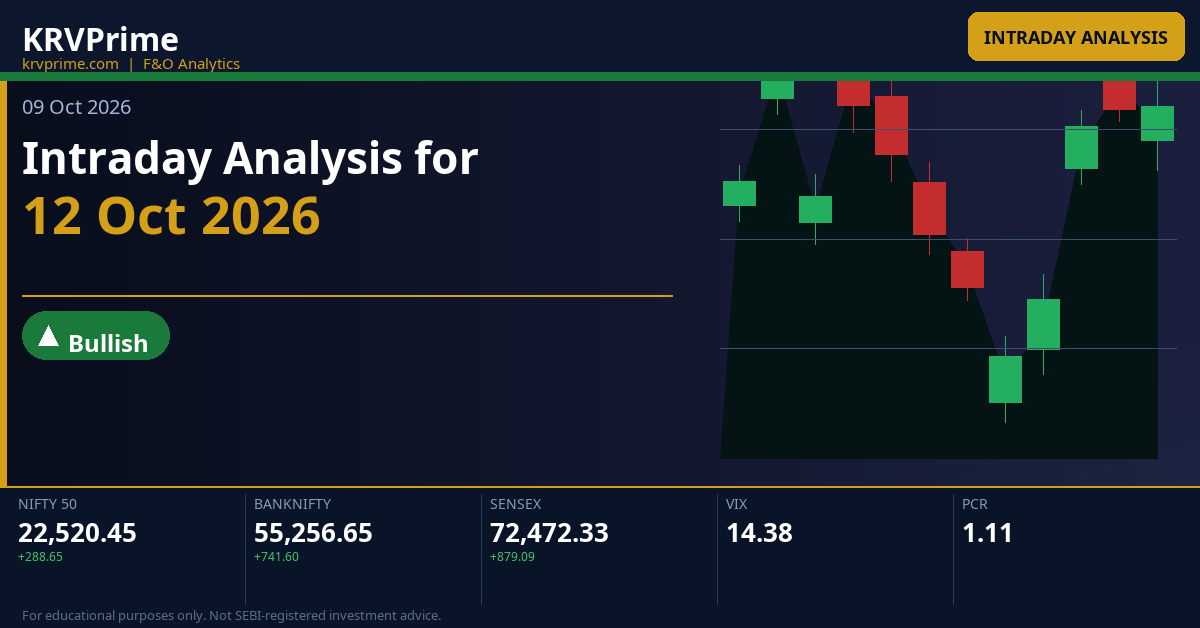
Markets closed on a strong note on 09 Oct 2026, with NIFTY gaining 1.30% to close at 22,520.45, BANKNIFTY adding 1.36% to settle at 55,256.65, and SENSEX rising 1.23% to end at 72,472.33, driven by broad-based buying across sectors. All three indices sport Ascending Wide CPR configurations for 12 Oct 2026, meaning the entire CPR band has moved decisively above the previous day's range — a structurally bullish setup that demands price to hold above the respective BC values to confirm continuation. India VIX data is unavailable for this session, which introduces an element of uncertainty around premium pricing; traders should size positions conservatively and rely on CPR confirmation rules and OI walls as primary anchors rather than implied volatility cues.
Key Market Signals — Intraday Setup
All three indices — NIFTY, BANKNIFTY, and SENSEX — are positioned below their respective weekly and monthly CPR bands, meaning the broader trend remains under overhead supply pressure even as the day CPR is ascending; this cross-index structural conflict between bullish day CPR and bearish weekly/monthly CPR context makes confirmation-first entries critical, and traders should avoid anticipatory longs without two 30-min closes above the day TC for each index.
Deep Technical Analysis & Levels
NIFTY
Ascending — Wide (0.25%)
▲ Bullish
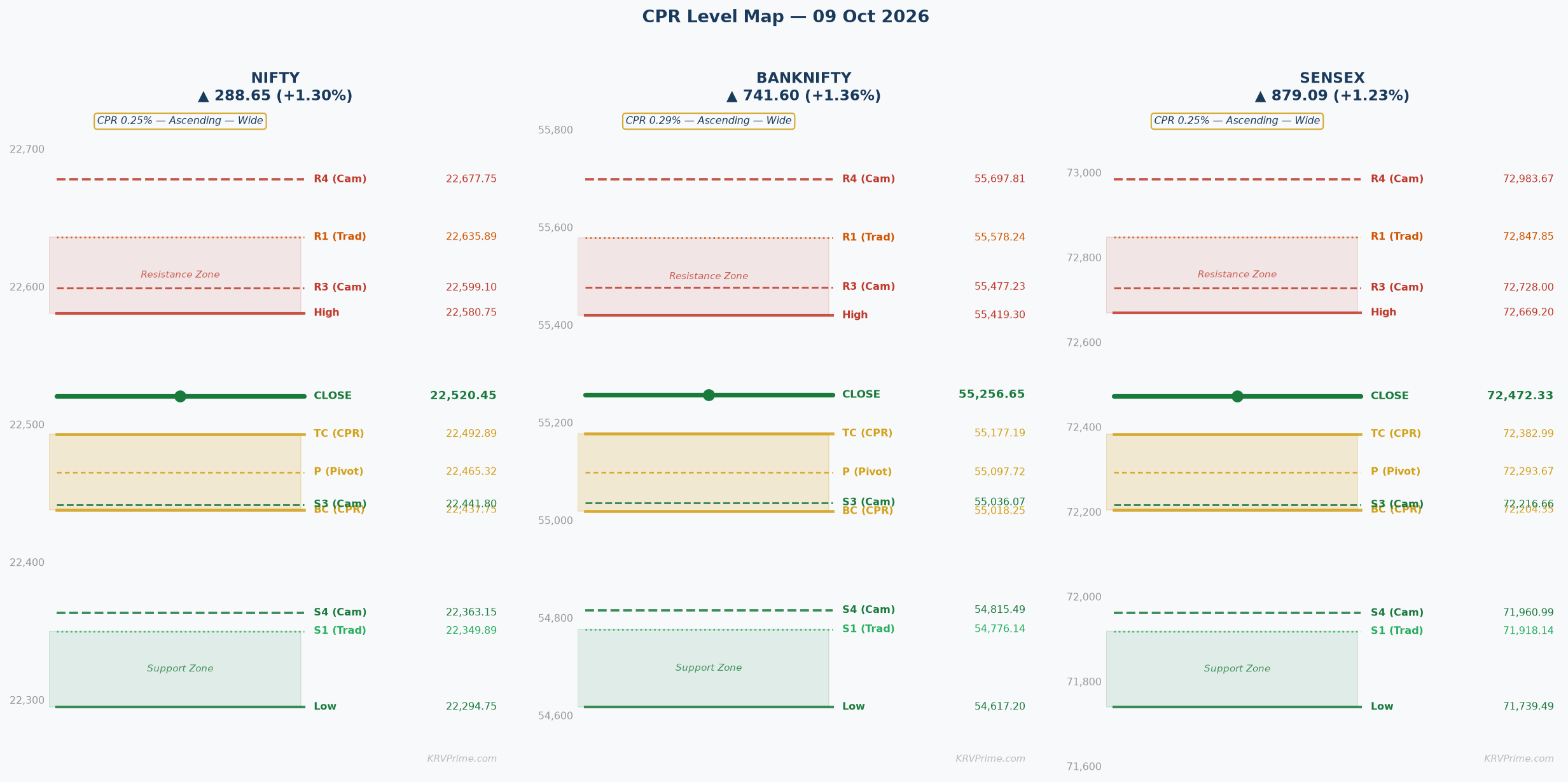
Market Structure Sideways or range-bound | Straddle ATM 22,500 straddle is priced at 211.75 points (Call 137.05 + Put 74.7), implying an expected intraday move of approximately ±211.75 points from 22,500, which sets an options-derived range of roughly 22,288 to 22,712 for the weekly expiry on 13 Oct 2026; this tight straddle value suggests premium sellers are not pricing in a large directional move, and any break beyond this band would represent outsized directional momentum that accelerates gamma-driven hedging flows. | Max Pain Weekly max pain is at 22,500 and monthly max pain is at 23,000; the weekly max pain at 22,500 is precisely at the OI-S (PE max OI support), indicating that option sellers are most comfortable with NIFTY pinning near 22,500 by Thursday's expiry on 13 Oct 2026 — a strong gravitational force that will resist large directional moves away from this strike through the week. |
Tomorrow's Complete Level Map
OI-R: 23,000 R3: 22,921.89 H6: 22,809.35 H5: 22,769.61 R2: 22,751.32 H4 ▶: 22,677.75 R1: 22,635.89 PDH: 22,580.75 H3 ↩: 22,599.10
TC: 22,492.89 P: 22,465.32 BC: 22,437.75
L3 ↩: 22,441.80 PDL: 22,294.75 S1: 22,349.89 L4 ▶: 22,363.15 S2: 22,179.32 L5: 22,271.29 L6: 22,231.55 S3: 22,063.89 OI-S: 22,500
↩ = Camarilla reversal point | ▶ = Camarilla breakout/breakdown trigger | OI-R/OI-S = Options wall (CE/PE max OI)
▲ Higher Open (Gap Up) — Open > Prev Close
▲ Bullish
Open lands: With an Ascending Wide CPR where BC is at 22,437.75 and TC is at 22,492.89 — both above the previous session's CPR — a gap-up open places price inside the CPR band (between BC 22,437.75 and TC 22,492.89) for a minor gap, or above TC 22,492.89 for a significant-to-large gap. Since prev close was 22,520.45 and the CPR band sits just below it (TC 22,492.89 < prev close 22,520.45), even a flat open lands above TC, making the CPR a potential launch pad below current price.
CPR role: Launch pad — the CPR band (BC 22,437.75 to TC 22,492.89) acts as immediate support below the gap-up open; as long as price stays above TC 22,492.89, the CPR is a bullish launch pad confirming the ascending structure.
Minor Gap (0.05–0.25%) — Structure Dominant
A minor gap up of 0.05–0.25% would open NIFTY in the range of approximately 22,531 to 22,576, placing price above TC 22,492.89 but still below the PDH of 22,580.75 and well below the Camarilla H3 at 22,599.10. The ascending wide CPR configuration adds strong directional confirmation here — price has gapped into the CPR's bullish territory, and the band from BC 22,437.75 to TC 22,492.89 now functions as an immediate support cushion below the open. Traders should wait for two 30-min closes above TC 22,492.89 given the wide CPR width of 0.25%, then target H3 22,599.10 as the first Camarilla mean-reversion reference and PDH 22,580.75 as the immediate intraday ceiling before momentum accelerates toward R1 22,635.89.
Significant Gap (0.25–0.5%) — Balanced
A significant gap up of 0.25–0.5% would open NIFTY between approximately 22,576 and 22,632, placing price above PDH 22,580.75 and into the H3 Camarilla zone at 22,599.10, which is the first major mean-reversion stall reference. At this opening level, price is also within striking distance of R1 22,635.89, meaning the first traditional target is nearly opened into — creating immediate gap-fill risk back to TC 22,492.89 if the opening momentum fails to sustain. The balanced gap-and-structure dynamics require two 30-min closes above H3 22,599.10 to confirm breakout intent; sustained trade above H3 targets H4 22,677.75 and then R1 22,635.89 in overlap, with the critical delta-hedging flow from CE writers at the 23,000 OI-R strike likely suppressing fresh call buying above R1.
Large Gap (>0.5%) — Gap Direction Dominant
A large gap up exceeding 0.5% would open NIFTY above approximately 22,633, potentially above R1 22,635.89 and approaching H4 22,677.75 territory, breaching the first traditional resistance level on the open itself. At this point, the gap is dominant over CPR structure per the Wide CPR rule, but with the 22,500 weekly max pain acting as a strong gravitational pin and the straddle of just 211.75 points already largely consumed by the gap, the probability of an immediate reversal or gap-fill back to TC 22,492.89 is elevated. Traders should NOT chase longs on a large gap; instead, watch for a retest of H3 22,599.10 or PDH 22,580.75 as the first partial exit zone, and the OI-R wall at 23,000 — over 350 points above current price — remains a distant ceiling that CE writers will defend aggressively if approached.
|
▲ Upside Path → OI-R The upside path from a confirmed gap-up open runs: TC 22,492.89 (support base) → H3 22,599.10 (Camarilla mean-reversion first stall, also near PDH 22,580.75) → R1 22,635.89 (first traditional partial profit — take 50% here per Wide CPR rule) → H4 22,677.75 (Camarilla breakout trigger, only enter if confirmed) → R2 22,751.32 → OI-R 23,000 (primary CE writing ceiling). Volume must expand meaningfully above H3 22,599.10 to confirm genuine momentum; a thin-volume push to H3 is a fade signal, not a breakout signal, especially with the tight weekly straddle at 211.75 points. |
▼ Downside Path → OI-S The failure path on a gap-up scenario begins with NIFTY unable to sustain above TC 22,492.89 after the initial euphoria — price then returns to P 22,465.32 as the first internal CPR support, then to BC 22,437.75 where the ascending band's lower edge provides a last line of bull defense. Below BC 22,437.75, the structure flips meaningfully bearish with L3 22,441.80 (virtually at BC) giving way to S1 22,349.89 and L4 22,363.15 as the next cluster of downside targets, ultimately aiming for OI-S 22,500 — the primary PE writing floor that will likely slow selling near the max pain zone. |
| 🔴 OI-R: The OI-R at 23,000 (CE max OI for the weekly series expiring 13 Oct) is a distant but powerful ceiling — CE writers have built maximum supply at this strike, and their delta-hedging requirements mean every 100-point rally toward 23,000 will face intensifying selling pressure from short-call positions being defended. In the gap-up scenario, 23,000 functions as an aspirational target but NOT a realistic intraday target given the straddle-implied move of only ±211.75 points from 22,500, making it approximately 480 points away — traders should use it as context for structural positioning, not as a near-term profit target. | 🟢 OI-S: The OI-S at 22,500 (PE max OI for the weekly series) is critically important in a gap-up scenario because it coincides with the weekly max pain strike — PE writers who are short puts at 22,500 will actively defend this level by buying dips near it, providing a strong floor approximately 20 points below the current CPR P of 22,465.32. If the gap-up fails and price retraces toward 22,500, expect aggressive put-writing absorption that will slow the downside; only a clean breakdown below 22,437.75 (BC) with sustained selling would threaten this PE base. |
⚡ Key Trigger: The primary trigger for the gap-up scenario is two consecutive 30-min closes above TC 22,492.89, confirming that the ascending CPR band has transitioned from an open-reference point to a live support base — this is the structural fulcrum because TC represents the top of today's value zone, and sustained price above it signals buyers are in control of intraday order flow. If NIFTY fails to hold two 30-min closes above TC 22,492.89 within the first hour, the bullish gap narrative is invalidated and price risks a reversion back to P 22,465.32 and then BC 22,437.75, where the next structural decision occurs.
▼ Lower Open (Gap Down) — Open < Prev Close
▼ Bearish
Open lands: With an Ascending Wide CPR where BC is at 22,437.75, a gap-down open from prev close 22,520.45 places price below the entire CPR band — below BC 22,437.75 — since the ascending configuration has the new CPR band sitting above the previous session's close area. A minor gap down opens price just below BC 22,437.75 near L3 22,441.80, while a significant or large gap down pushes price progressively below L3, toward S1 22,349.89, L4 22,363.15, and potentially PDL 22,294.75.
CPR role: Overhead resistance — the CPR band (BC 22,437.75 to TC 22,492.89) becomes an overhead resistance zone that bulls must reclaim for any recovery thesis to hold; the ascending wide CPR that failed to hold on the open acts as a battleground zone where bears defend and bulls attempt recovery.
Minor Gap (0.05–0.25%) — Structure Dominant
A minor gap down of 0.05–0.25% would open NIFTY between approximately 22,464 and 22,509 — placing price just below prev close 22,520.45 but potentially still inside the CPR band (between BC 22,437.75 and TC 22,492.89), with BC 22,437.75 acting as the immediate overhead inflection if price opens below it or as intraday support if price opens between BC and TC. The CPR structure for a minor gap down inside the band creates a decision zone — price is within the ascending CPR's value area and the first 30 minutes will determine whether bulls can reclaim TC 22,492.89 for a recovery or bears drive below BC 22,437.75 to confirm breakdown. If price opens near L3 22,441.80 (just 4 points above BC 22,437.75), watch for a two 30-min close pattern below BC 22,437.75 to confirm the bearish leg targeting S1 22,349.89 and L4 22,363.15 as the immediate downside cluster.
Significant Gap (0.25–0.5%) — Balanced
A significant gap down of 0.25–0.5% would open NIFTY between approximately 22,407 and 22,464, placing price decisively below BC 22,437.75 and into the zone between L3 22,441.80 and S1 22,349.89, with the entire ascending CPR band now acting as overhead resistance. The failure-and-resume analysis here strongly favors bears — a significant gap below the ascending CPR means price has rejected the bullish structure from yesterday's strong +1.30% close, and a 30-minute failure to reclaim BC 22,437.75 confirms resumption of the downside leg targeting L4 22,363.15 and S1 22,349.89 as the first meaningful support cluster. PUT writing at OI-S 22,500 will provide some defense near 22,437.75, but the gap-down itself signals that options sellers may need to adjust their delta hedge, potentially adding downside pressure toward the straddle-implied lower bound near 22,288.
Large Gap (>0.5%) — Gap Direction Dominant
A large gap down exceeding 0.5% would open NIFTY below approximately 22,407, potentially breaching S1 22,349.89 and approaching L4 22,363.15 — L5 22,271.29 territory on the open itself, signaling a panic-driven or news-led gap that completely invalidates the ascending CPR structure. In a large gap-down scenario, the absence of India VIX data is a concern — without confirmed VIX spike context, traders cannot calibrate whether this is a capitulation event or the start of a sustained breakdown, making position sizing critical. The primary recovery watch level is BC 22,437.75 — if NIFTY can stage a sharp morning reversal and build two 30-min closes back above BC within the first 90 minutes, straddle premium collapses rapidly as the 211.75-point expected move is consumed, creating a mean-reversion trade back toward P 22,465.32 and TC 22,492.89.
|
▲ Upside Path → OI-R The gap-down recovery path runs: reclaim BC 22,437.75 (structural pivot for recovery, confirmed by two 30-min closes) → P 22,465.32 (CPR midpoint, first internal target) → TC 22,492.89 (full CPR recovery, bullish restoration) → H3 22,599.10 (Camarilla mean-reversion upside target) → OI-S 22,500 (PE wall that becomes resistance overhead once breached, but then a ceiling on recovery). Genuine recovery is confirmed when NIFTY holds TC 22,492.89 on a closing 30-min candle with expanding volume — any volume-light recovery to TC is a trap, not a genuine reversal. |
▼ Downside Path → OI-S The bearish continuation path from a gap-down runs: below BC 22,437.75 → L3 22,441.80 (Camarilla mean-reversion stall, virtually at BC — retail stop-losses cluster here and accelerate the move lower) → L4 22,363.15 (Camarilla breakdown trigger, high-conviction bear signal) → S1 22,349.89 (first traditional downside partial profit target) → L5 22,271.29 → PDL 22,294.75 → OI-S 22,500 (PE base provides structural floor but may be approached as a gravitational magnet on extreme days). The clustering of L4 22,363.15 and S1 22,349.89 within 14 points of each other creates a high-conviction bear target zone. |
| 🔴 OI-R: In a gap-down scenario, the OI-R at 23,000 is a distant, irrelevant overhead ceiling — CE writers at 23,000 are deeply out of the money and their positions are not active gamma constraints on the day's price action. The real overhead resistance in a gap-down day is the BC 22,437.75 and TC 22,492.89 CPR band, which CE shorts at lower strikes (22,500 ATM call writers) will defend vigorously, making the 22,500 CE the functional overhead ceiling rather than the theoretical 23,000 OI-R. | 🟢 OI-S: The OI-S at 22,500 (PE max OI weekly) is the primary downside absorber and PUT monetisation zone — as NIFTY approaches 22,500 on a gap-down day, PE writers who are short puts at this strike will aggressively buy futures or call options to delta-hedge, creating natural buying support. If NIFTY trades through 22,500 toward L4 22,363.15 with conviction, however, those short puts begin losing value rapidly and the covering pressure from PE longs (who bought puts for protection) adds further momentum; the 22,500 strike is thus a critical PIVOT where options flow will determine whether the down move accelerates or stalls. |
⚡ Key Trigger: The dual trigger for the gap-down scenario: **Bear confirmation — failure to reclaim BC 22,437.75 within the first 30 minutes confirms bearish resumption**, with the next target cluster at S1 22,349.89 and L4 22,363.15; **Bull recovery trigger — two consecutive 30-min closes back above BC 22,437.75** signals absorption of the gap-down selling and opens a recovery path toward P 22,465.32 and TC 22,492.89. The 22,437.75 BC level is the structural fulcrum because it separates the ascending CPR's support territory from the breakdown zone, and market psychology at this level is driven by the 22,500 max pain gravitational pull keeping aggressive sellers cautious.
◆ Near Flat Open — Open ≈ Prev Close (±0.05%)
◆ Neutral
Open lands: A flat open of ±0.05% from prev close 22,520.45 places NIFTY between approximately 22,509 and 22,531 — which is above TC 22,492.89 (22,520.45 is already above the top of the CPR band). This means a truly flat open keeps NIFTY above the entire ascending CPR band, with TC 22,492.89 acting as live intraday support rather than a level to breach on the upside.
CPR role: Decision zone with bullish lean — the entire ascending CPR band (BC 22,437.75 to TC 22,492.89) sits below the flat open, making it a support structure; a flat open above TC in an ascending wide CPR is a constructive setup where CPR acts as a launch pad if the initial hour holds above TC.
Near Flat (±0.05%)
A flat open in a near-flat scenario for NIFTY on 12 Oct 2026 is deceptively significant — with the open landing above TC 22,492.89 due to the ascending CPR structure, the first 30 minutes will establish whether the prior day's +1.30% gain is being accumulated or distributed, and the wide CPR of 0.25% demands two consecutive 30-min closes above TC 22,492.89 before any directional trade is initiated. The TC at 22,492.89 and BC at 22,437.75 define a 55-point CPR band below the open — as long as NIFTY holds above TC 22,492.89, bulls retain structural control with the entire CPR acting as a cushion, while a breach below TC followed by a test of BC 22,437.75 marks a significant deterioration in the session's structure. Given the CPR width of 0.25% (Wide category), this is NOT a high-probability trending day — the Wide classification explicitly indicates a range-bound session where fading extremes at Camarilla boundaries (H3 22,599.10 on the upside and L3 22,441.80 on the downside) is the preferred strategy over breakout-following. The bull trigger requires two 30-min closes above the flat open zone (above TC 22,492.89 with expanding volume) pointing toward H3 22,599.10, PDH 22,580.75, and R1 22,635.89, while the bear trigger requires a clean two 30-min close sequence below BC 22,437.75 to activate L3 22,441.80, S1 22,349.89, and L4 22,363.15 as sequential downside targets — with OI-S 22,500 acting as the floor that will likely hold unless high-conviction selling materializes.
|
▲ Upside Path → OI-R The bullish path from a flat open: TC 22,492.89 (confirmed support, two 30-min closes above) → H3 22,599.10 (Camarilla mean-reversion zone, first intraday resistance and partial profit point for Wide CPR — take 50% here) → PDH 22,580.75 (previous day high acts as structural resistance just below H3) → R1 22,635.89 (first traditional resistance, second partial exit per Wide CPR rule) → H4 22,677.75 (Camarilla breakout trigger, only pursue if H3 breaks on volume above 1.5x average) → OI-R 23,000 (primary CE ceiling, unlikely on a flat-open wide-CPR day). Volume expansion above H3 22,599.10 is the non-negotiable confirmation for extending longs beyond R1 22,635.89. |
▼ Downside Path → OI-S The bearish path from a flat open if BC 22,437.75 gives way: BC 22,437.75 (structural breakdown confirmation, two 30-min closes below) → L3 22,441.80 (Camarilla mean-reversion bear zone, virtually at BC — immediate first target) → S1 22,349.89 (first traditional downside partial profit, take 50% here per Wide CPR rule) → L4 22,363.15 (Camarilla breakdown trigger, 14 points above S1 — treat this cluster as one zone) → L5 22,271.29 → OI-S 22,500 (PE wall that creates gravitational support — approach with reduced size as PE writers defend). The tight clustering of L3, L4, and S1 between 22,363 and 22,442 means the first real bear target cluster absorbs most of the initial downside momentum. |
| 🔴 OI-R: In a flat-open scenario, the OI-R at 23,000 serves as a distant structural ceiling — CE writers who have built maximum open interest at this strike are under no gamma pressure with NIFTY near 22,520, meaning their hedging flows are minimal and they do not create near-term price resistance at current levels. The effective CE resistance in a flat-open day is the 22,500 ATM call (which traders are actively writing given the weekly straddle), making the 22,500 level a functional short-call defense zone rather than the theoretical 23,000 OI-R wall. | 🟢 OI-S: The OI-S at 22,500 (weekly PE max OI) is a crucial near-term support in a flat-open scenario — it aligns with the weekly max pain strike of 22,500 and is only 20 points below the current CPR P of 22,465.32, meaning PE writers are actively defending this level through delta-hedging. A flat open that drifts toward 22,500 will encounter strong put-writing related buying interest, reinforcing the BC 22,437.75 area as a structural support zone; PE longs (protective put buyers) will only panic-sell their puts if NIFTY breaks convincingly below 22,437.75 with high volume. |
⚡ Key Trigger: **Bull trigger**: Two consecutive 30-min closes above TC 22,492.89 confirms that ascending CPR structure is holding as support and bullish momentum is absorbing sellers — target H3 22,599.10 as first Camarilla reference and R1 22,635.89 as first traditional partial exit, with stop below BC 22,437.75. **Bear trigger**: Two consecutive 30-min closes below BC 22,437.75 confirms that the ascending CPR's bullish promise has failed and distribution is underway — target L3 22,441.80 immediately, then S1 22,349.89 and L4 22,363.15 as the next cluster, with the OI-S wall at 22,500 providing a speed bump on the way down.
BANKNIFTY
Ascending — Wide (0.29%)
▲ Bullish
Market Structure Sideways or range-bound | Straddle ATM 55,300 monthly straddle is priced at 1,426.75 points (Call 811.75 + Put 615.0), implying an expected move of approximately ±1,426.75 points from 55,300, setting an options-derived range of roughly 53,873 to 56,727 for the monthly expiry on 27 Oct 2026; this wide straddle value (2.58% of index value) reflects elevated uncertainty in BANKNIFTY and means intraday moves of 500–800 points are within the options market's expected range, making both scalp and swing setups viable. | Max Pain Monthly max pain is at 55,700, which is approximately 443 points above Friday's close of 55,256.65 and sits between H3 55,477.23 and H4 55,697.81 on the Camarilla scale; this creates a bullish gravitational pull toward 55,700 over the coming sessions as option sellers work to pin BANKNIFTY near max pain by the 27 Oct expiry, reinforcing the ascending CPR's bullish structural bias. |
Tomorrow's Complete Level Map
OI-R: 56,000 R3: 56,380.34 H6: 56,068.14 H5: 55,955.45 R2: 55,899.82 H4 ▶: 55,697.81 R1: 55,578.24 PDH: 55,419.30 H3 ↩: 55,477.23
TC: 55,177.19 P: 55,097.72 BC: 55,018.25
L3 ↩: 55,036.07 PDL: 54,617.20 S1: 54,776.14 L4 ▶: 54,815.49 S2: 54,295.62 L5: 54,557.85 L6: 54,445.16 S3: 53,974.04 OI-S: 55,000
↩ = Camarilla reversal point | ▶ = Camarilla breakout/breakdown trigger | OI-R/OI-S = Options wall (CE/PE max OI)
▲ Higher Open (Gap Up) — Open > Prev Close
▲ Bullish
Open lands: With an Ascending Wide CPR (BC 55,018.25, TC 55,177.19) positioned below the previous close of 55,256.65, a gap-up open of any meaningful size places NIFTY well above TC 55,177.19 — the CPR band is already below the prior close, so even a flat open is above TC. A minor gap up opens between 55,284 and 55,394, while a significant gap opens between 55,394 and 55,534, and a large gap opens above 55,534, approaching PDH 55,419.30 or H3 55,477.23 territory.
CPR role: Launch pad — with the entire ascending CPR band (BC 55,018.25 to TC 55,177.19) comfortably below the gap-up open, it acts as a deep support cushion; the CPR is the launch pad from which bullish momentum extends, and its 238-point depth provides a wide buffer before bears regain structural control.
Minor Gap (0.05–0.25%) — Structure Dominant
A minor gap up of 0.05–0.25% from BANKNIFTY's previous close of 55,256.65 opens the index between approximately 55,284 and 55,394, placing price above TC 55,177.19 but below PDH 55,419.30 and H3 55,477.23 — the Camarilla mean-reversion first resistance zone. The ascending wide CPR (0.29% width) adds strong directional confirmation: the band is well below current price, functioning as a support base approximately 80–240 points beneath the open, which means the CPR provides a wide safety net for longs initiated above TC 55,177.19. Per the Wide CPR rule requiring two 30-min closes, wait for confirmation above TC 55,177.19 before entering longs, then target PDH 55,419.30 as the first structural ceiling and H3 55,477.23 as the Camarilla first-stall reference where a 50% partial should be taken.
Significant Gap (0.25–0.5%) — Balanced
A significant gap up of 0.25–0.5% from 55,256.65 opens BANKNIFTY between approximately 55,394 and 55,534, placing price above PDH 55,419.30 and into the Camarilla H3 55,477.23 zone — this means the first Camarilla mean-reversion resistance level is opened into, creating immediate gap-fill risk back to PDH 55,419.30 and TC 55,177.19 if the opening momentum fails. The gap is balanced with the ascending CPR structure, and delta-hedging flows from short CE writers at OI-R 56,000 begin to create mild overhead pressure as the index approaches H3; traders should watch for a two 30-min consolidation above H3 55,477.23 before extending longs, with R1 55,578.24 as the next meaningful traditional target and H4 55,697.81 aligning near the monthly max pain of 55,700 as the high-conviction bull target zone. Immediate gap-fill risk: if BANKNIFTY cannot sustain above H3 55,477.23 on two 30-min closes, expect a reversion to PDH 55,419.30 and then TC 55,177.19.
Large Gap (>0.5%) — Gap Direction Dominant
A large gap up exceeding 0.5% from 55,256.65 opens BANKNIFTY above approximately 55,534, potentially at or above H3 55,477.23 and approaching R1 55,578.24 — the first traditional resistance level — on the open itself, consuming a significant portion of the straddle's ±1,426.75 expected move before the first candle closes. The gap-dominant rule applies here: CPR structure is overridden, and the probability of a gap-fill reversion to TC 55,177.19 or even P 55,097.72 is elevated, particularly since the 55,000 OI-S (PE max OI) would be over 500 points below a large-gap open — providing no nearby floor to arrest a reversal. Traders should treat a large gap-up open as a fade opportunity if price stalls at H3 55,477.23 or R1 55,578.24 without volume confirmation, targeting a reversion to PDH 55,419.30 and TC 55,177.19 as profit levels, with the monthly max pain of 55,700 and H4 55,697.81 as the only high-conviction extension targets if gap holds.
|
▲ Upside Path → OI-R Confirmed gap-up upside path: above TC 55,177.19 (deep support, launch pad) → PDH 55,419.30 (previous day high, first structural ceiling) → H3 55,477.23 (Camarilla mean-reversion zone, 50% partial profit per Wide CPR rule) → R1 55,578.24 (first traditional resistance, second partial exit) → H4 55,697.81 / monthly max pain 55,700 (Camarilla breakout trigger with max pain confluence — highest conviction bull target for the session) → OI-R 56,000 (primary CE OI wall, final ceiling). Volume above average at H3 55,477.23 is the mandatory check before extending to H4 55,697.81 and the 56,000 OI-R. |
▼ Downside Path → OI-S Gap-up failure path: rejection below H3 55,477.23 → reversion to PDH 55,419.30 (structural support) → TC 55,177.19 (CPR top of band, critical bull defense) → P 55,097.72 → BC 55,018.25 → OI-S 55,000 (PE max OI wall, primary downside floor within 18 points of BC — a powerful combined support cluster). Loss of TC 55,177.19 on the back of a gap-up rejection is a high-probability reversal signal that the day is flipping from bullish to ranged, with the 55,000 OI-S providing the ultimate downside anchor. |
| 🔴 OI-R: The OI-R at 56,000 (monthly CE max OI) is the primary intraday ceiling and functions as a hard gamma wall — CE writers who have built their largest monthly position at 56,000 will defend this level through short-futures hedging as BANKNIFTY approaches, creating selling pressure approximately 740+ points above the prev close. In a gap-up scenario, 56,000 is an aspirational bull target that aligns with H6 56,068.14, confirming it as the ultimate extreme of the day's potential range; approach it only if H4 55,697.81 breaks on above-average volume. | 🟢 OI-S: The OI-S at 55,000 (monthly PE max OI) is a powerful near-term floor — PE writers at 55,000 are defending their short-put positions aggressively through futures buying whenever BANKNIFTY dips toward this level, and the BC 55,018.25 sits only 18 points above 55,000, creating an extraordinarily dense support cluster at this zone. In a gap-up scenario, the 55,000 OI-S is 257 points below the close and over 400 points below a significant gap open — it is a distant safety net, but its proximity to BC makes it the most critical bull-bear demarcation for the entire session. |
⚡ Key Trigger: The primary confirmation trigger for gap-up in BANKNIFTY is two consecutive 30-min closes above TC 55,177.19 (already achieved on a gap open, so the operative trigger shifts to H3 55,477.23) — specifically, two 30-min closes above H3 55,477.23 confirm that the Camarilla mean-reversion zone has been cleared with conviction, signaling momentum continuation toward R1 55,578.24 and H4 55,697.81 near the monthly max pain of 55,700. Failure to sustain above H3 55,477.23 after a gap-up — defined as a 30-min close below H3 followed by a second close below PDH 55,419.30 — signals distribution at the open and triggers a reversion trade targeting TC 55,177.19 as the mean-reversion profit level.
▼ Lower Open (Gap Down) — Open < Prev Close
▼ Bearish
Open lands: A gap-down open from prev close 55,256.65 in an ascending wide CPR configuration (BC 55,018.25, TC 55,177.19) places price inside the CPR band for a minor gap down (opening between BC 55,018.25 and TC 55,177.19), and below the entire CPR band (below BC 55,018.25) for significant or large gap downs. Given that TC 55,177.19 is 79 points below prev close, even a minor gap down of ~0.14% or more opens price inside the ascending CPR band — making the CPR band an immediate decision zone.
CPR role: Overhead resistance / battleground zone — a gap-down into or below the ascending CPR band means the bullish structure from yesterday must be actively reclaimed; the BC 55,018.25 and OI-S 55,000 are separated by only 18 points, creating a powerful combined support and battleground level that determines whether the session is a recovery day or a continuation of downside.
Minor Gap (0.05–0.25%) — Structure Dominant
A minor gap down of 0.05–0.25% from 55,256.65 opens BANKNIFTY between approximately 55,118 and 55,229, placing price inside the ascending CPR band between BC 55,018.25 and TC 55,177.19, or just below TC 55,177.19 — this is a decision zone where the market immediately tests whether yesterday's bullish ascending structure has carried over. The CPR band interaction here is critical: opening inside the ascending CPR means price is in a contested territory where neither bulls nor bears have structural confirmation, and the first 30-minute candle direction will be decisive for the session. A failure to reclaim TC 55,177.19 on two 30-min closes confirms bearish control; immediate target is BC 55,018.25, and just below it the OI-S at 55,000 creates a powerful absorption zone — while sustained trade above TC 55,177.19 opens a recovery toward PDH 55,419.30 and H3 55,477.23.
Significant Gap (0.25–0.5%) — Balanced
A significant gap down of 0.25–0.5% from 55,256.65 opens BANKNIFTY between approximately 54,980 and 55,118, placing price below BC 55,018.25 and into the critical OI-S 55,000 zone — the PE max OI floor that will be immediately tested on the open. This opening configuration is extremely significant because the gap breaks below both the ascending CPR's lower band (BC 55,018.25) and approaches the primary PE writing support at 55,000, meaning put writers at 55,000 are immediately under stress and their delta-hedging (buying futures) could spark a sharp recovery bounce in the opening minutes. However, if the 30-minute close confirms price below BC 55,018.25 with conviction, the failure-and-resume bear scenario targets L3 55,036.07 (just above BC, already breached on the open) → L4 54,815.49 → S1 54,776.14 (a powerful cluster 15 points apart) as the next downside destination, with PDL 54,617.20 as the session's bear extremity.
Large Gap (>0.5%) — Gap Direction Dominant
A large gap down exceeding 0.5% from 55,256.65 opens BANKNIFTY below approximately 54,980, potentially breaching the OI-S 55,000 PE wall outright and approaching L4 54,815.49 and S1 54,776.14 territory — this is a panic-gap scenario that fundamentally breaks the ascending CPR's bullish promise for the session. With India VIX data unavailable, traders cannot confirm whether elevated implied volatility is supporting the gap, adding uncertainty to straddle-premium monetisation timing; however, the wide monthly straddle of 1,426.75 points means a 500-point gap down has consumed only ~35% of the expected move, leaving room for further directional follow-through. The recovery watch level is BC 55,018.25 / OI-S 55,000 — if BANKNIFTY stages a V-reversal back above 55,018.25 within the first 60 minutes, straddle sellers will aggressively sell fresh premium, and longs can target P 55,097.72 and TC 55,177.19 as profit levels; otherwise, the L4 54,815.49–S1 54,776.14 cluster is the primary bear target for the session.
|
▲ Upside Path → OI-R Gap-down recovery path: reclaim BC 55,018.25 (structural recovery pivot, confirmed by two 30-min closes) → P 55,097.72 (CPR midpoint, first internal recovery target) → TC 55,177.19 (CPR top, full recovery signal and bull restoration trigger) → PDH 55,419.30 (prev day high, second major resistance) → H3 55,477.23 (Camarilla mean-reversion zone, partial profit). Genuine recovery requires above-average volume on the reclaim of BC 55,018.25 — volume-light bounces to TC 55,177.19 should be treated as dead-cat structures and sold into at PDH 55,419.30. |
▼ Downside Path → OI-S Gap-down continuation path: below BC 55,018.25 → OI-S 55,000 (PE wall breached — accelerates selling as put-long hedgers unwind) → L3 55,036.07 (virtually at BC, Camarilla mean-reversion bear zone — retail stop-losses here amplify the move) → L4 54,815.49 (Camarilla breakdown trigger) → S1 54,776.14 (first traditional downside profit zone, within 39 points of L4 — treat as one cluster for partial exits) → L5 54,557.85 → PDL 54,617.20 → L6 54,445.16. The L4/S1 cluster at 54,776–54,815 is the primary bear target zone for the session, offering a ~400–440 point reward from BC for confirming shorts. |
| 🔴 OI-R: In a gap-down scenario, the OI-R at 56,000 is entirely irrelevant as an intraday ceiling — CE writers at 56,000 are deeply out of the money and their delta requirements create virtually no overhead selling pressure at current price levels. The functional overhead resistance in a gap-down day is the CPR band itself (BC 55,018.25 to TC 55,177.19), which shorts will actively defend after the gap breaks below it, and the 55,500 strike area where shorter-term call writers may be positioned. | 🟢 OI-S: The OI-S at 55,000 (monthly PE max OI) is the most critical level in a gap-down scenario — it sits only 18 points below BC 55,018.25, making the 54,980–55,018 zone an extraordinarily powerful combined support cluster where PE writers (short 55,000 puts) are delta-hedging by buying futures aggressively. If this combined OI-S / BC support holds (two 30-min closes above 55,018.25), it becomes the primary PUT monetisation confirmation level and triggers a recovery; if it breaks with above-average volume, the PE longs (protection buyers) panic-sell their puts, releasing downside momentum toward L4 54,815.49 and S1 54,776.14. |
⚡ Key Trigger: **Bear confirmation trigger**: Two consecutive 30-min closes below BC 55,018.25 confirms breakdown from the ascending CPR structure with the OI-S 55,000 PE floor failing to hold — targets L4 54,815.49 and S1 54,776.14 as the next downside cluster; stop for bears above TC 55,177.19. **Bull recovery trigger**: Two consecutive 30-min closes back above BC 55,018.25 (reclaiming the ascending CPR's lower band) signals that the gap-down is being absorbed by PE writers at 55,000 and recovery momentum is building — target P 55,097.72 and TC 55,177.19 as recovery milestones; stop for recovery bulls below 54,980.
◆ Near Flat Open — Open ≈ Prev Close (±0.05%)
◆ Neutral
Open lands: A flat open of ±0.05% from prev close 55,256.65 places BANKNIFTY between approximately 55,229 and 55,284 — which is above TC 55,177.19 by approximately 52–107 points. Since the ascending wide CPR (BC 55,018.25, TC 55,177.19) has its top of band well below the prev close, a flat open maintains price in bullish CPR territory with the entire band as a support structure below.
CPR role: Bullish decision zone / launch pad — a flat open above TC 55,177.19 in an ascending wide CPR means the CPR band is structurally supportive; the 238-point wide band from BC 55,018.25 to TC 55,177.19 provides a cushion below the open, but the wide CPR classification requires two 30-min confirmation candles before directional trades are initiated.
Near Flat (±0.05%)
A flat open for BANKNIFTY on 12 Oct 2026 places price approximately 52–107 points above TC 55,177.19, with the ascending wide CPR band (BC 55,018.25 to TC 55,177.19) forming an immediate support structure — this is a high-information setup where the session's direction will be determined by whether institutional order flow treats the CPR as a launching base for continuation toward PDH 55,419.30 and H3 55,477.23, or as a distribution ceiling that leads to a test of BC 55,018.25 and OI-S 55,000. The TC at 55,177.19 and BC at 55,018.25 define a 159-point CPR band (within the 0.29% Wide classification), and the proximity of BC 55,018.25 to OI-S 55,000 (only 18 points apart) means the downside structural support is extremely concentrated — bears need to break through both the CPR's lower band AND the PE options wall simultaneously to achieve conviction. The monthly max pain at 55,700 creates an upside gravitational pull of approximately 443 points from the flat open, aligned with H4 55,697.81, suggesting that option sellers have a strong incentive to see BANKNIFTY drift higher over the coming sessions — this max-pain magnetic pull adds a bullish lean even in a flat-open wide-CPR scenario. The bull trigger is two consecutive 30-min closes above TC 55,177.19 maintained (price is already above it) with momentum toward PDH 55,419.30 as first target and H3 55,477.23 as second, taking 50% partial at H3 per Wide CPR rule; the bear trigger is two consecutive 30-min closes below TC 55,177.19, with BC 55,018.25 as the next critical decision and OI-S 55,000 as the ultimate downside floor that determines whether the flat-open day transitions into a reversal session.
|
▲ Upside Path → OI-R Bull continuation path from flat open: above TC 55,177.19 (support base, already holding) → PDH 55,419.30 (previous day high, first intraday resistance — Camarilla H3 at 55,477.23 just beyond it creates a compressed resistance cluster) → H3 55,477.23 (50% partial profit per Wide CPR rule) → R1 55,578.24 (first traditional target, second partial) → H4 55,697.81 / monthly max pain 55,700 (highest conviction intraday bull target, exceptional confluence of Camarilla breakout trigger and max pain magnet) → OI-R 56,000 (primary CE wall, session extreme, do not trail beyond). Volume must be above 1.5x average to pursue H4 55,697.81 from H3 55,477.23. |
▼ Downside Path → OI-S Bear continuation path from flat open if TC 55,177.19 gives way: TC 55,177.19 (loss triggers bear entry) → P 55,097.72 (CPR midpoint, first internal downside target) → BC 55,018.25 (CPR lower band, critical bull-bear demarcation) → OI-S 55,000 (PE max OI wall, combined 18-point cluster with BC — the primary bear target for the flat-open scenario) → L3 55,036.07 → L4 54,815.49 → S1 54,776.14 (next cluster if OI-S 55,000 fails on high volume). Take 50% partial at BC 55,018.25 / OI-S 55,000 cluster per Wide CPR rule — do not trail shorts aggressively below this zone without conviction volume. |
| 🔴 OI-R: In a flat-open scenario for BANKNIFTY, the OI-R at 56,000 (monthly CE max OI) serves as a distant but highly relevant structural ceiling — CE writers at 56,000 with the maximum monthly open interest will defend this level fiercely as BANKNIFTY approaches it, but at 740+ points above the flat open, it is a multi-session target rather than an intraday ceiling. The more operationally relevant CE resistance in a flat-open intraday context is the 55,500 CE strike area, where shorter-term writers are likely active, and the H3 55,477.23 Camarilla zone which represents the first mean-reversion fade opportunity for short-term option sellers. | 🟢 OI-S: The OI-S at 55,000 (monthly PE max OI) is the single most important support level for BANKNIFTY in a flat-open scenario — PE writers who are short 55,000 puts are actively buying futures or call options to delta-hedge whenever BANKNIFTY approaches 55,000, and the BC 55,018.25 sitting only 18 points above reinforces this as a near-impenetrable combined support zone in normal market conditions. A flat open that sees quiet morning trading near TC 55,177.19 gives PE writers comfort that their 55,000 positions are safely out of the money, reducing their hedging activity and allowing price to drift toward the max pain at 55,700 — the OI-S 55,000 floor thus reinforces the bullish lean of a flat-open ascending wide CPR session. |
⚡ Key Trigger: **Bull trigger**: Two consecutive 30-min closes above TC 55,177.19 (already in place at open — the operative trigger is sustained trade above TC with expanding volume toward PDH 55,419.30) — confirms ascending CPR is holding as support and max-pain pull toward 55,700 is activating momentum; stop below BC 55,018.25. **Bear trigger**: Two consecutive 30-min closes below TC 55,177.19 followed by a test of BC 55,018.25 confirms distribution at the flat open — the structural fulcrum is TC 55,177.19 because its loss represents a 238-point CPR band that price must now traverse downward, testing the highly defended OI-S 55,000 PE wall at BC 55,018.25 before any bear conviction can be established.
SENSEX
Ascending — Wide (0.25%)
▲ Bullish
Market Structure Sideways or range-bound | Straddle ATM 72,500 weekly straddle is priced at 964.5 points (Call 540.05 + Put 424.45) and the monthly straddle is priced at 1,810.25 points (Call 1,055.05 + Put 755.2), implying a weekly expected move of approximately ±964.5 points from 72,500 (range 71,535–73,464) and a monthly expected move of ±1,810.25 points; the weekly straddle of 964.5 points (1.33% of index value) defines the realistic intraday boundaries, and the monthly straddle suggests markets are pricing moderate volatility for SENSEX over the October expiry cycle. | Max Pain Weekly max pain is at 72,500 (expiry 15 Oct 2026) and monthly max pain is at 73,000 (expiry 29 Oct 2026); the weekly max pain at 72,500 aligns precisely with the straddle ATM strike and is only 27.67 points above Friday's close of 72,472.33, meaning SENSEX is trading at max pain equilibrium — option sellers will vigorously defend 72,500 as the gravitational pin through Thursday's expiry, making range-bound trading between the weekly straddle boundaries of 71,535 and 73,464 the highest-probability scenario. |
Tomorrow's Complete Level Map
OI-R: 76,000 R3: 73,777.56 H6: 73,411.54 H5: 73,282.29 R2: 73,223.38 H4 ▶: 72,983.67 R1: 72,847.85 PDH: 72,669.20 H3 ↩: 72,728
TC: 72,382.99 P: 72,293.67 BC: 72,204.35
L3 ↩: 72,216.66 PDL: 71,739.49 S1: 71,918.14 L4 ▶: 71,960.99 S2: 71,363.96 L5: 71,662.37 L6: 71,533.12 S3: 70,988.43 OI-S: 70,000
↩ = Camarilla reversal point | ▶ = Camarilla breakout/breakdown trigger | OI-R/OI-S = Options wall (CE/PE max OI)
▲ Higher Open (Gap Up) — Open > Prev Close
▲ Bullish
Open lands: With an Ascending Wide CPR (BC 72,204.35, TC 72,382.99) positioned below the previous close of 72,472.33, a gap-up open of any size places SENSEX above TC 72,382.99 — the entire CPR band is already below prev close. A minor gap up opens between 72,508 and 72,653, while a significant gap up opens between 72,653 and 72,833, and a large gap opens above 72,833, approaching PDH 72,669.20, H3 72,728, and R1 72,847.85 territory.
CPR role: Launch pad — the ascending CPR band (BC 72,204.35 to TC 72,382.99) sits 90–270 points below the gap-up open, acting as a deep support cushion and confirming bullish structural control; the CPR has completed its transition from decision zone to launch pad.
Minor Gap (0.05–0.25%) — Structure Dominant
A minor gap up of 0.05–0.25% from SENSEX's previous close of 72,472.33 opens the index between approximately 72,508 and 72,653 — above TC 72,382.99 and approaching the PDH of 72,669.20 at the upper end. The ascending wide CPR (0.25% width) confirms bullish structural control: the full CPR band is well below the open, acting as a 89–269 point support cushion, and the ascending configuration validates that multi-session buyers are in control of value zone placement. Per the Wide CPR rule, wait for two consecutive 30-min closes above TC 72,382.99 (already achieved at a minor gap open — operative trigger shifts to PDH 72,669.20) before extending longs, targeting H3 72,728 as the first Camarilla mean-reversion reference and R1 72,847.85 as the first traditional partial profit level; take 50% here per Wide CPR fade-extreme protocol.
Significant Gap (0.25–0.5%) — Balanced
A significant gap up of 0.25–0.5% from 72,472.33 opens SENSEX between approximately 72,653 and 72,833, directly into the PDH 72,669.20 and H3 72,728 resistance cluster — the most critical intraday resistance zone — creating an immediate gap-fill risk back to TC 72,382.99 if momentum fails to sustain above H3. The gap is balanced with the ascending CPR structure, but SENSEX is opening directly into the first Camarilla mean-reversion stall zone (H3 72,728), meaning CE writers at the weekly OI-R (far at 76,000) are not a near-term constraint, but the high density of short-call activity near 72,500–73,000 creates selling pressure that may cap the initial push. Two 30-min closes above H3 72,728 are required to confirm breakout toward R1 72,847.85 and H4 72,983.67, with the weekly straddle's upper bound of approximately 73,464 serving as the session's theoretical ceiling.
Large Gap (>0.5%) — Gap Direction Dominant
A large gap up exceeding 0.5% from 72,472.33 opens SENSEX above approximately 72,833, potentially at or above R1 72,847.85 and approaching H4 72,983.67 — the Camarilla breakout trigger — on the very first candle, consuming over 85% of the weekly straddle's expected upside move before the session begins in earnest. With the weekly max pain at 72,500 and the close at 72,472.33, a large gap up over 400 points above max pain represents a significant deviation from the pin zone, and CE writers at the 73,000 monthly max pain zone will aggressively sell calls to defend their position, creating a hard ceiling at H4 72,983.67 and R1 72,847.85. The fade strategy is primary: initiate shorts at H3 72,728 or R1 72,847.85 targeting a reversion to TC 72,382.99 and PDH 72,669.20, with the abort level at H4 72,983.67; do not trail longs beyond R1 72,847.85 in a large-gap wide-CPR configuration.
|
▲ Upside Path → OI-R Confirmed gap-up upside path: above TC 72,382.99 (deep support, well below open) → PDH 72,669.20 (structural resistance, first meaningful ceiling post-gap) → H3 72,728 (Camarilla mean-reversion zone, first intraday stall reference — take 50% partial here per Wide CPR rule) → R1 72,847.85 (first traditional resistance, second partial exit — do not trail beyond per Wide CPR protocol) → H4 72,983.67 / monthly max pain 73,000 (powerful confluence of Camarilla breakout trigger and max-pain pull — only pursue with two 30-min closes above R1 72,847.85 on high volume) → OI-R 76,000 (a distant structural ceiling, irrelevant as an intraday target). Volume confirmation at each level is mandatory before extending — thin-volume gaps to H3 72,728 or R1 72,847.85 should be faded, not followed. |
▼ Downside Path → OI-S Gap-up failure path: rejection below PDH 72,669.20 → TC 72,382.99 (CPR top — first major support, signals partial gap-fill) → P 72,293.67 (CPR midpoint) → BC 72,204.35 (CPR lower band, structural bull-bear line) → L3 72,216.66 (Camarilla mean-reversion bear zone, 11 points above BC — these two are essentially the same level, creating a powerful combined support cluster at 72,204–72,216) → S1 71,918.14 (first traditional downside target) → OI-S 70,000 (distant PE floor, over 2,400 points below — irrelevant for intraday). Loss of TC 72,382.99 on a gap-up day is the day's most important bearish signal, indicating large participants are distributing into the gap. |
| 🔴 OI-R: The OI-R at 76,000 (SENSEX week CE max OI) is dramatically far from current price — approximately 3,528 points above Friday's close — and functions purely as a structural ceiling context for multi-week options positioning rather than an intraday resistance level. CE writers at 76,000 have zero near-term gamma pressure at current levels, and their hedging flows do not influence intraday price action; the operative CE resistance for intraday purposes is the 73,000 monthly max pain zone and H4 72,983.67, not the theoretical 76,000 OI-R ceiling. | 🟢 OI-S: The OI-S at 70,000 (SENSEX week PE max OI) is similarly distant — approximately 2,472 points below Friday's close — and provides no near-term floor relevance for an intraday gap-up scenario. PE writers at 70,000 are comfortably out of the money and their delta-hedging is minimal at current levels; the operative PE support for intraday purposes is the 72,500 weekly max pain pin zone and BC 72,204.35, which collectively define the real floor that option sellers are defending through the Thursday expiry. |
⚡ Key Trigger: The primary trigger for the gap-up scenario is two consecutive 30-min closes above PDH 72,669.20 (since TC 72,382.99 is already well below the gap-up open, the operative trigger shifts to the PDH resistance) — PDH 72,669.20 is the structural fulcrum for the gap-up day because it represents the highest price achieved in the prior session, and a two 30-min close above it with above-average volume signals fresh discovery momentum toward H3 72,728 and R1 72,847.85. Failure to sustain above PDH 72,669.20 after a gap-up — defined as a 30-min close below PDH followed by a second close below TC 72,382.99 — signals a gap-fill reversion trade targeting P 72,293.67 and BC 72,204.35 as profit levels.
▼ Lower Open (Gap Down) — Open < Prev Close
▼ Bearish
Open lands: A gap-down open from prev close 72,472.33 in an ascending wide CPR (BC 72,204.35, TC 72,382.99) places SENSEX inside the CPR band for a minor gap (opening between TC 72,382.99 and BC 72,204.35), and below the entire CPR band (below BC 72,204.35) for a significant or large gap. Since TC 72,382.99 is 89 points below prev close, a minor gap down of 0.12% or more opens price inside the CPR band's decision zone — making the CPR band an immediate battleground.
CPR role: Overhead resistance / recovery zone — a gap-down into or below the ascending CPR band forces bulls to reclaim the BC 72,204.35 and TC 72,382.99 as resistance levels to recover; L3 72,216.66 sits only 12 points above BC 72,204.35, creating an extremely compressed bear trigger zone just below the CPR's lower edge.
Minor Gap (0.05–0.25%) — Structure Dominant
A minor gap down of 0.05–0.25% from 72,472.33 opens SENSEX between approximately 72,291 and 72,436 — placing price inside the ascending CPR band (between BC 72,204.35 and TC 72,382.99), with the lower portion of the open near P 72,293.67 or below. Opening inside the ascending CPR on a minor gap-down creates a high-information decision scenario: price must determine within the first 30 minutes whether buyers reclaim TC 72,382.99 to restore bullish structure or sellers drive below BC 72,204.35 and L3 72,216.66 (only 12 points apart) to confirm breakdown. Two 30-min closes above TC 72,382.99 signal recovery toward PDH 72,669.20 and H3 72,728, while two 30-min closes below BC 72,204.35 confirm the ascending CPR has failed and target S1 71,918.14 and L4 71,960.99 as the next support cluster approximately 240–250 points below the breakdown.
Significant Gap (0.25–0.5%) — Balanced
A significant gap down of 0.25–0.5% from 72,472.33 opens SENSEX between approximately 72,110 and 72,291 — below the entire ascending CPR band (below BC 72,204.35) and below L3 72,216.66, immediately activating the Camarilla mean-reversion bear zone on the open. This is a structurally significant development: price has gapped below the ascending CPR's lower band, flipping the bullish structural setup from the prior day's +1.23% close, and the proximity of L3 72,216.66 to BC 72,204.35 means both Camarilla and CPR bear signals are simultaneously triggered. The 30-minute failure-and-resume analysis is decisive: failure to reclaim BC 72,204.35 within 30 minutes confirms the bear case, targeting L4 71,960.99 and S1 71,918.14 as the primary downside cluster (42 points apart — treat as one zone), with the weekly straddle's lower bound at approximately 71,535 aligning near L6 71,533.12 as the session's bear extreme.
Large Gap (>0.5%) — Gap Direction Dominant
A large gap down exceeding 0.5% from 72,472.33 opens SENSEX below approximately 72,110, potentially approaching L4 71,960.99 and S1 71,918.14 territory or even lower — a dramatic rejection of the prior day's ascending CPR promise and a test of the weekly straddle's lower boundary (approximately 71,535, near L6 71,533.12). In a large gap-down scenario, the absence of India VIX data makes calibrating the severity of implied volatility expansion impossible, but the weekly max pain at 72,500 represents over 590 points of recovery distance from a large gap-down open — PE writers at 72,500 strike will be aggressively buying futures to delta-hedge their short puts, potentially sparking a sharp morning bounce. The primary recovery level is BC 72,204.35 — two 30-min closes above this level after a large gap down are required to monetise the straddle through premium collapse; otherwise, L4 71,960.99, S1 71,918.14, and the weekly straddle floor near 71,535 are the cascade targets.
|
▲ Upside Path → OI-R Gap-down recovery path: reclaim BC 72,204.35 / L3 72,216.66 (combined structural pivot — two 30-min closes above confirms absorption) → P 72,293.67 (CPR midpoint) → TC 72,382.99 (CPR top, full structural recovery) → PDH 72,669.20 (previous day high, second major resistance) → H3 72,728 (Camarilla mean-reversion zone, partial profit) → weekly max pain 72,500 (gravitational pin for Thursday expiry — price tends to revert here through the week). Volume must meaningfully accelerate above BC 72,204.35 to confirm genuine recovery; hesitant buying that fails to produce two 30-min closes above BC should be treated as a dead-cat bounce. |
▼ Downside Path → OI-S Gap-down continuation path: below BC 72,204.35 → L3 72,216.66 (Camarilla bear zone, only 12 points above BC — retail stop-losses clustered here amplify the initial breakdown impulse) → L4 71,960.99 (Camarilla breakdown trigger) → S1 71,918.14 (first traditional downside partial profit — within 43 points of L4, treat as one cluster) → L5 71,662.37 (next Camarilla target if L4/S1 cluster fails) → PDL 71,739.49 → L6 71,533.12 (weekly straddle lower boundary at 71,535 aligns precisely here — maximum bearish intraday extension zone) → OI-S 70,000 (distant PE floor). The L4/S1 cluster at 71,918–71,960 is the primary intraday bear target offering approximately 240–280 points from the BC breakdown. |
| 🔴 OI-R: In a gap-down scenario for SENSEX, the OI-R at 76,000 is completely irrelevant as an intraday ceiling — CE writers at 76,000 have zero gamma exposure at current price levels, and their hedging flows do not affect intraday price action in any meaningful way. The functional overhead resistance in a gap-down day is the CPR band itself (BC 72,204.35 to TC 72,382.99) and the weekly ATM CE at 72,500 strike, where short-call writers will sell any rally that approaches the 72,500 max pain level — making 72,382.99 to 72,500 the real intraday resistance cluster for a gap-down recovery attempt. | 🟢 OI-S: The OI-S at 70,000 (SENSEX week PE max OI) is a distant floor — approximately 2,472 points below current price — that provides no near-term intraday support in a gap-down scenario. The more operationally relevant PE support in a gap-down day is the weekly max pain at 72,500 (PE writers defending this strike through delta-buying) and the monthly OI-S at 72,000 (SENSEX month PE support) — if SENSEX gaps down toward 72,204 (BC) and the 72,000 monthly PE support below, expect significant PE writer hedging activity that creates a floor; only a sustained breakdown below 71,960 (L4) with high volume would threaten the 70,000 distant support floor. |
⚡ Key Trigger: **Bear confirmation**: Two consecutive 30-min closes below BC 72,204.35 confirms that the ascending CPR structure has broken down, with L3 72,216.66 (12 points above BC — already at or near the open in a significant/large gap scenario) acting as the immediate Camarilla bear confirmation level; the next targets are L4 71,960.99 and S1 71,918.14 as the primary downside cluster, stop for bears above TC 72,382.99. **Bull recovery**: Two consecutive 30-min closes above BC 72,204.35 signals that the gap-down is being absorbed by put writers defending the weekly max pain at 72,500 and the CPR's ascending structure is still valid — recovery targets P 72,293.67, TC 72,382.99, and PDH 72,669.20; the 72,500 max pain zone is the gravitational recovery target for Thursday's weekly expiry.
◆ Near Flat Open — Open ≈ Prev Close (±0.05%)
◆ Neutral
Open lands: A flat open of ±0.05% from prev close 72,472.33 places SENSEX between approximately 72,436 and 72,508 — above TC 72,382.99 by approximately 53–125 points. Since the ascending wide CPR has its TC at 72,382.99 (89 points below prev close), a flat open maintains price comfortably above the CPR band with the monthly max pain at 73,000 and weekly max pain at 72,500 both acting as gravitational anchors in close proximity.
CPR role: Bullish decision zone / launch pad — a flat open above TC 72,382.99 with the weekly max pain at 72,500 only 28 points away from the close creates a powerful combination of ascending CPR support below and max pain magnetism above; the CPR acts as a cushioned launch pad while the max pain pin creates a condensed trading range between 72,382 and 72,669.
Near Flat (±0.05%)
A flat open for SENSEX on 12 Oct 2026 is an extraordinarily information-rich setup — price opens above TC 72,382.99 in an ascending wide CPR, above the weekly max pain of 72,500 (already exceeded at prev close 72,472.33), and with the monthly max pain at 73,000 approximately 528 points above, creating a pull-and-push dynamic where weekly option sellers pin near 72,500 while monthly sellers want to see SENSEX drift toward 73,000. The TC at 72,382.99 and BC at 72,204.35 define a 178-point CPR band below the open, which in the Wide CPR classification (0.25%) signals a range-bound session where the first meaningful move is a fade candidate rather than a breakout follow — fading extreme closes near H3 72,728 (upside) and L3 72,216.66 (downside) is the primary strategy. The weekly straddle at 964.5 points from 72,500 sets the expected range at approximately 71,535 to 73,464 — with a flat open near 72,472, the session has roughly 992 points of upside to the straddle upper bound and 937 points of downside to the lower bound, confirming a balanced but slightly bearish-skewed risk profile from current levels given that the monthly max pain at 73,000 is 528 points away while the weekly max pain at 72,500 is only 28 points away. The bull trigger is two consecutive 30-min closes above TC 72,382.99 (already satisfied at open — operative trigger shifts to PDH 72,669.20) targeting H3 72,728 (50% partial) and R1 72,847.85 (second partial, do not trail beyond per Wide CPR rule); the bear trigger is two consecutive 30-min closes below TC 72,382.99 targeting BC 72,204.35, L3 72,216.66 (12 points above BC — essentially the same level), S1 71,918.14, and L4 71,960.99 as the primary downside cluster.
|
▲ Upside Path → OI-R Bull continuation from flat open: above TC 72,382.99 (support base) → PDH 72,669.20 (first structural resistance, operative trigger level) → H3 72,728 (Camarilla mean-reversion zone, 50% partial profit per Wide CPR rule — critical fade level, do not chase above without volume) → R1 72,847.85 (first traditional target, second partial exit — do NOT trail beyond per Wide CPR protocol) → H4 72,983.67 / monthly max pain 73,000 (powerful confluence, only pursue on two 30-min closes above R1 72,847.85 with above-average volume) → H5 73,282.29 → OI-R 76,000 (multi-session structural ceiling, not an intraday target). The PDH 72,669.20 to H3 72,728 zone is the primary intraday resistance cluster; approach with caution and defined risk. |
▼ Downside Path → OI-S Bear continuation from flat open if TC 72,382.99 fails: TC 72,382.99 (loss triggers bear entry) → P 72,293.67 (CPR midpoint, first internal target) → BC 72,204.35 (CPR lower band, structural bear confirmation) → L3 72,216.66 (Camarilla mean-reversion bear zone, only 12 points above BC — treat BC/L3 as a combined 12-point cluster for entry and partial profit) → S1 71,918.14 (first traditional downside target, 50% partial) → L4 71,960.99 (Camarilla breakdown trigger — within 43 points of S1, treat as one zone) → L5 71,662.37 → PDL 71,739.49 → L6 71,533.12 / weekly straddle lower bound 71,535 (session extreme, do not trail shorts below L6). Take 50% partial at BC/L3 cluster (72,204–72,216) per Wide CPR rule and second partial at S1/L4 cluster (71,918–71,960). |
| 🔴 OI-R: In a flat-open scenario for SENSEX, the OI-R at 76,000 (weekly CE max OI) is a purely theoretical ceiling far removed from intraday price action — CE writers at 76,000 have negligible delta sensitivity at current levels, and their hedging requirements do not influence the session's price discovery. The operative CE resistance in a flat-open context is the 73,000 monthly CE strike (aligned with monthly max pain at 73,000 and H4 72,983.67), where call writers will defend aggressively, and the 72,500 weekly ATM CE where short-call positioning creates near-term overhead supply — making the 72,500–73,000 zone the real intraday OI resistance corridor. | 🟢 OI-S: The OI-S at 70,000 (weekly PE max OI) is a distant downside anchor at approximately 2,472 points below the open — PE writers at 70,000 have no meaningful delta hedging activity at current SENSEX levels, making it irrelevant for intraday support in a flat-open scenario. The operative PE support in a flat-open session is the monthly OI-S at 72,000 (SENSEX month PE max OI) and the weekly max pain at 72,500 — the 72,000 monthly PE floor sits only 204 points below the BC 72,204.35, creating a meaningful gravitational support cluster between 71,960 (L4) and 72,204 (BC) where put writers and max-pain mechanics combine to slow any downside momentum. |
⚡ Key Trigger: **Bull trigger**: Two consecutive 30-min closes above PDH 72,669.20 (operative trigger since TC 72,382.99 is already below the open) confirms that intraday momentum has cleared the prior session's high with fresh conviction — the structural importance of PDH 72,669.20 is that it represents the highest price accepted by participants in the previous session, and a sustained break above it invites momentum buyers toward H3 72,728 and R1 72,847.85; stop below TC 72,382.99. **Bear trigger**: Two consecutive 30-min closes below TC 72,382.99 signals that the ascending CPR's launch pad has been rejected and distribution is underway — BC 72,204.35 and L3 72,216.66 (combined 12-point support cluster) become the next critical decision, and a breach of BC 72,204.35 with volume confirmation targets S1 71,918.14 and L4 71,960.99 as the primary bear destination zone for the flat-open scenario.
📊 VIX Insight: India VIX data is unavailable for the 09 Oct 2026 closing session, which is a significant information gap for F&O traders heading into 12 Oct 2026 — without a confirmed VIX reading, premium pricing calibration for straddles and spreads must rely solely on the straddle point values provided (NIFTY weekly 211.75 pts, BANKNIFTY monthly 1,426.75 pts, SENSEX weekly 964.5 pts) as proxies for expected volatility. In the absence of VIX, traders should treat the straddle-implied ranges as conservative estimates, use smaller position sizes to account for potential premium mispricing, and prioritize CPR confirmation signals (two 30-min closes per Wide CPR protocol) over volatility-expansion breakout strategies — the Ascending Wide CPR across all three indices suggests structure-first, not momentum-first, trading for the session.
Overall View:
All three indices — NIFTY, BANKNIFTY, and SENSEX — closed strongly on 09 Oct 2026 with gains of 1.23–1.36% and are set up with Ascending Wide CPR configurations for 12 Oct 2026, confirming multi-session bullish value placement but simultaneously signaling a range-bound day where wide CPR fading strategies outperform breakout following. The key cross-index observation is that BANKNIFTY's BC 55,018.25 / OI-S 55,000 combined support cluster (only 18 points apart) and monthly max pain at 55,700 create the most compelling bullish case among the three indices, while SENSEX's proximity to weekly max pain at 72,500 (only 28 points above close) and the wide monthly straddle of 1,810.25 points suggest it will remain the most range-bound of the trio through Thursday's expiry. Traders should approach 12 Oct 2026 with confirmation-first discipline across all three indices — wait for two 30-min closes above TC levels (NIFTY TC 22,492.89, BANKNIFTY TC 55,177.19, SENSEX TC 72,382.99) before initiating directional longs, use H3 Camarilla levels (22,599.10 / 55,477.23 / 72,728) as the primary partial-profit points, and respect the OI walls (NIFTY 22,500 weekly PE, BANKNIFTY 55,000 monthly PE) as the structural floors that will define the day's downside limits.
All three indices — NIFTY, BANKNIFTY, and SENSEX — closed strongly on 09 Oct 2026 with gains of 1.23–1.36% and are set up with Ascending Wide CPR configurations for 12 Oct 2026, confirming multi-session bullish value placement but simultaneously signaling a range-bound day where wide CPR fading strategies outperform breakout following. The key cross-index observation is that BANKNIFTY's BC 55,018.25 / OI-S 55,000 combined support cluster (only 18 points apart) and monthly max pain at 55,700 create the most compelling bullish case among the three indices, while SENSEX's proximity to weekly max pain at 72,500 (only 28 points above close) and the wide monthly straddle of 1,810.25 points suggest it will remain the most range-bound of the trio through Thursday's expiry. Traders should approach 12 Oct 2026 with confirmation-first discipline across all three indices — wait for two 30-min closes above TC levels (NIFTY TC 22,492.89, BANKNIFTY TC 55,177.19, SENSEX TC 72,382.99) before initiating directional longs, use H3 Camarilla levels (22,599.10 / 55,477.23 / 72,728) as the primary partial-profit points, and respect the OI walls (NIFTY 22,500 weekly PE, BANKNIFTY 55,000 monthly PE) as the structural floors that will define the day's downside limits.
Disclaimer: KRV Prime provides educational and informational content relating to financial markets. Articles, research, examples, charts, strategies and tools are provided for educational purposes and should not be interpreted as personalised investment advice or a guarantee of financial performance. Markets involve risk, including possible loss of capital. Past performance does not guarantee future results. KRV Prime is not a SEBI Registered Investment Adviser or Research Analyst.