
Index Analysis
Intraday Analysis for 09 Oct 2026
KRV Prime08 October 202654 min
Educational/Derived AnalysisSource: KRV Prime Market Insights (End-of-Day)As of 08 Oct 2026, 04:59 PM IST
Intraday Analysis for 09 Oct 2026
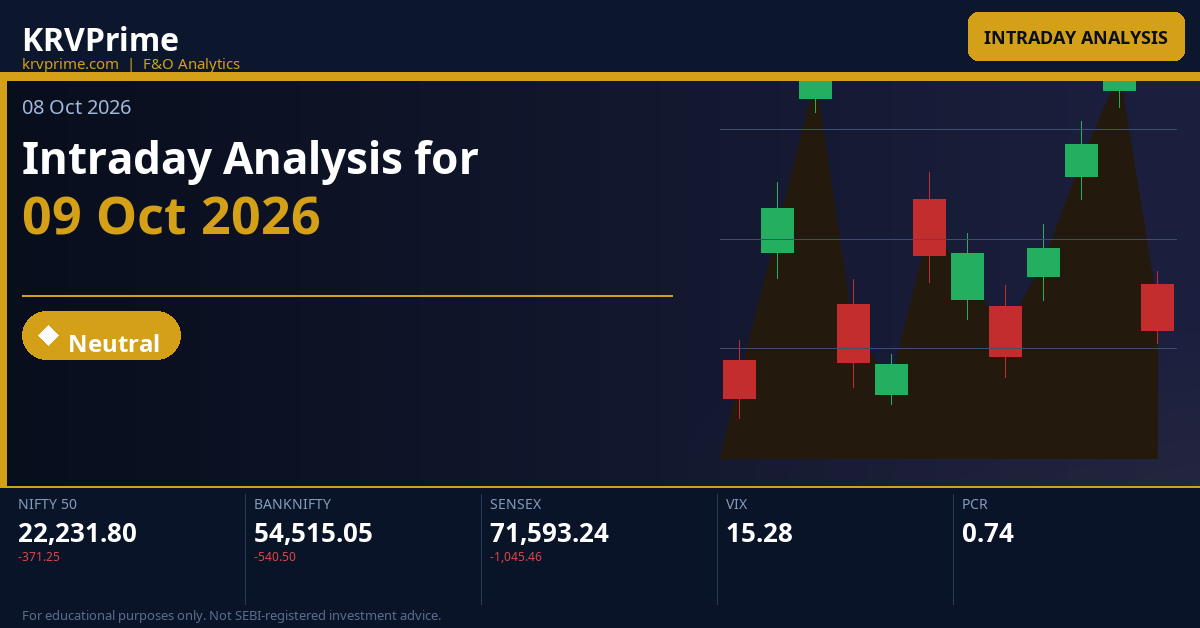
Markets closed sharply lower on 08 Oct 2026, with NIFTY shedding **1.64%** to **22,231.80**, BANKNIFTY falling **0.98%** to **54,515.05**, and SENSEX declining **1.44%** to **71,593.24**, confirming broad-based selling pressure across large-cap indices. India VIX data is unavailable for this session, which limits precise volatility-premium reading; however, the magnitude of the single-day decline — especially NIFTY's near 370-point drop — implies an elevated fear environment and widened option premiums consistent with a spike in implied volatility. All three indices carry **Descending Wide CPR** structures into 09 Oct, meaning the entire CPR band sits below yesterday's close, structurally framing the day as one where bulls must fight back from below the CPR to reclaim control, while bears enjoy overhead resistance from the full CPR band.
Key Market Signals — Intraday Setup
All three indices — NIFTY, BANKNIFTY, and SENSEX — print Descending Wide CPR structures for 09 Oct, placing the full CPR band as overhead resistance and confirming that the prior session's selling momentum is structurally embedded into the next day's pivot architecture. The combination of declining closes, wide CPR bands (NIFTY 0.47%, BANKNIFTY 0.24%, SENSEX 0.39%), and OI walls tightly bracketing current price levels on SENSEX suggests an extremely narrow implied range for the session, demanding disciplined level-by-level trading rather than directional bets.
Deep Technical Analysis & Levels
NIFTY
Descending — Wide (0.47%)
▼ Bearish
Market Structure Sideways or range-bound | Straddle ATM 22,250 straddle at **286.85 pts** (Call 135.35 + Put 151.5) implies an expected intraday move of approximately ±286 points, placing the session range between roughly **21,965 and 22,537** — note that the downside implied move nearly reaches the weekly OI support at 21,000 on an extended move, while the upside implied boundary sits well below the Descending CPR's TC at 22,389.47, confirming a bearish premium skew with Put LTP exceeding Call LTP. | Max Pain Weekly Max Pain at **22,400** (expiry 13-Oct-2026) lies comfortably above the current close of 22,231.80, suggesting option writers are positioned to gravitate price toward 22,400 over the week — this creates a natural magnet roughly **168 points above** the previous close, implying mild upward pull from the options market over the remaining weekly expiry cycle but not sufficient to override bearish CPR structure on a single session. |
Tomorrow's Complete Level Map
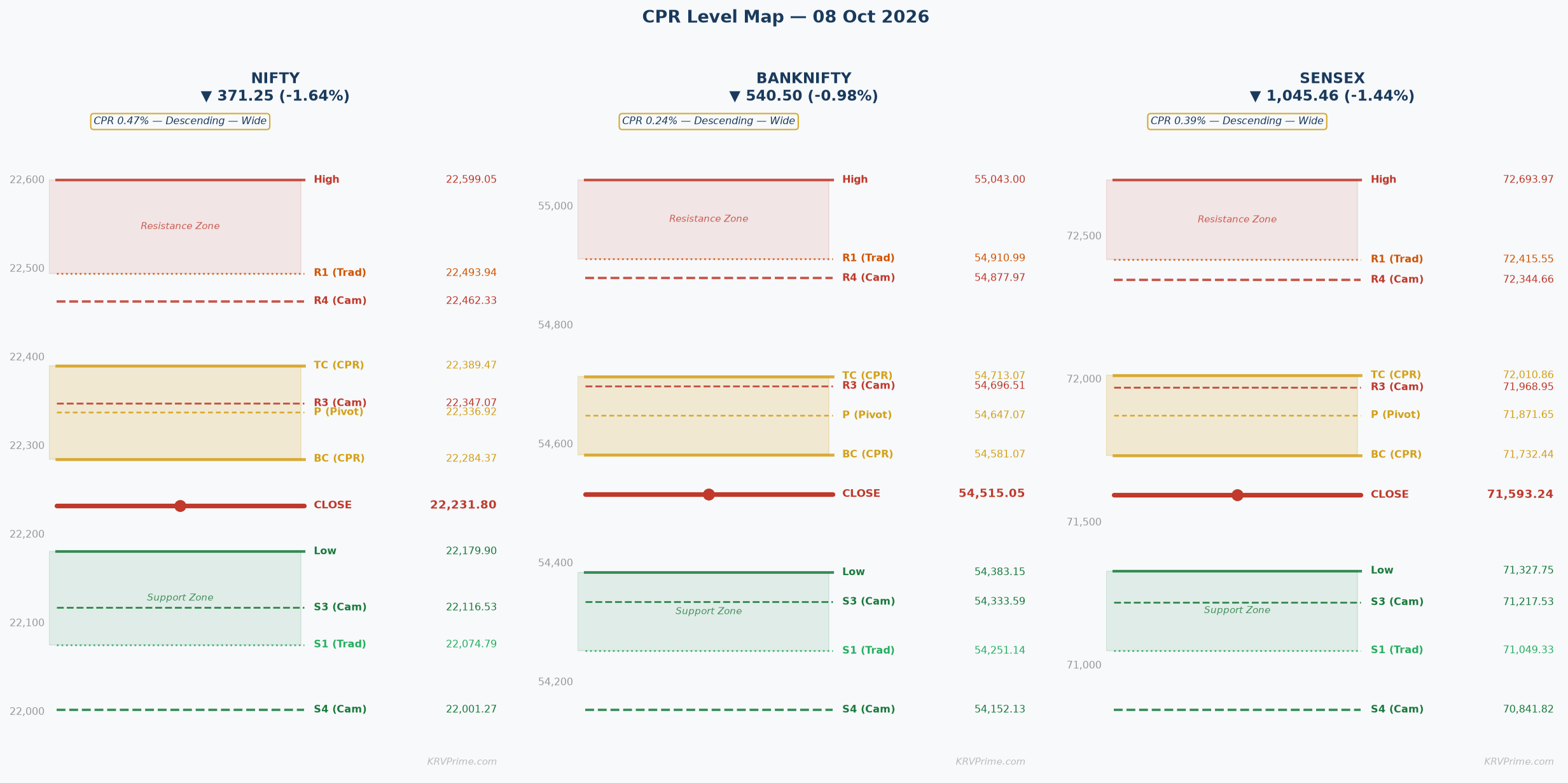
OI-R: 23,000 R3: 22,913.09 H6: 22,651.93 H5: 22,596.95 R2: 22,756.07 H4 ▶: 22,462.33 R1: 22,493.94 PDH: 22,599.05 H3 ↩: 22,347.07
TC: 22,389.47 P: 22,336.92 BC: 22,284.37
L3 ↩: 22,116.53 PDL: 22,179.90 S1: 22,074.79 L4 ▶: 22,001.27 S2: 21,917.77 L5: 21,866.65 L6: 21,811.67 S3: 21,655.64 OI-S: 21,000
↩ = Camarilla reversal point | ▶ = Camarilla breakout/breakdown trigger | OI-R/OI-S = Options wall (CE/PE max OI)
▲ Higher Open (Gap Up) — Open > Prev Close
↕ Conflicted
Open lands: For a Descending Wide CPR, a gap-up open places NIFTY above the previous close of 22,231.80 and potentially inside or above the CPR band (BC 22,284.37 to TC 22,389.47). A minor gap up opens price near or just inside the lower CPR band around BC 22,284.37; a significant gap up (~0.25–0.5%) opens inside the CPR band between BC and TC; a large gap up (>0.5%) opens above TC 22,389.47, effectively above the entire Descending CPR, which is the strongest structural reversal signal for the bull side.
CPR role: In a Descending Wide CPR gap-up scenario, the CPR band (BC 22,284.37 to TC 22,389.47) initially acts as a **launch pad** if sustained above BC, but given the wide nature (0.47%), two 30-min closes are required to confirm genuine breakout — until then, the band acts as a **trap door** where price can rapidly reverse back below BC and resume the prior bearish trend.
Minor Gap (0.05–0.25%) — Structure Dominant
A minor gap up of 0.05–0.25% opens NIFTY approximately between 22,243 and 22,287, landing right at or fractionally above BC 22,284.37 — this is the most dangerous opening zone for bulls as price straddles the bottom of the Descending CPR with no clear directional commitment. The Descending Wide CPR structure remains firmly bearish in this scenario, and the minor gap adds only a slight upward lean that is completely overwhelmed by the structural overhead of P 22,336.92 and TC 22,389.47 acting as sequential resistance levels where sellers will likely emerge. Traders should wait for two consecutive 30-min closes above BC 22,284.37 before considering any long positions, targeting H3 22,347.07 as the first intraday upside reference, with failure below BC reverting to the bear path toward L3 22,116.53.
Significant Gap (0.25–0.5%) — Balanced
A significant gap up of 0.25–0.5% opens NIFTY approximately between 22,287 and 22,343, squarely inside the CPR band between BC 22,284.37 and P 22,336.92, placing price in the core decision zone of the Descending structure. Gap-fill risk is asymmetric here — the prior day's close at 22,231.80 is just 55–112 points below, and without volume confirmation, delta-hedging flows from market makers adjusting short-gamma positions can pull price back to PDC rapidly; two 30-min closes inside the band without deterioration would be needed before targeting TC 22,389.47 and then H4 22,462.33. On the upside, a clean sustained trade above P 22,336.92 opens the path toward TC 22,389.47 and subsequently R1 22,493.94, while any failure to hold P reverts bearish bias toward L3 22,116.53.
Large Gap (>0.5%) — Gap Direction Dominant
A large gap up exceeding 0.5% opens NIFTY above 22,343, potentially clearing TC 22,389.47 and entering the zone above the entire Descending CPR — this would be the single most bullish structural signal for the session, suggesting that overnight buying pressure has overridden the prior day's bearish momentum. However, given the wide CPR width (0.47%) and the fact that PDH 22,599.05 and H5 22,596.95 cluster tightly just overhead, the straddle-implied move of 286.85 points from 22,250 ATM caps the upside expectation around 22,537 in a normal volatility environment, making PDH/H5 zone a natural fade target for experienced traders. Confirmation requires two 30-min closes above TC 22,389.47 before committing to longs targeting H4 22,462.33 and R1 22,493.94; abort level is a fall back below TC 22,389.47 which converts the gap to a bull trap and resumes selling toward BC 22,284.37.
|
▲ Upside Path → OI-R Confirmed bull path progresses from TC **22,389.47** → H3 **22,347.07** (Camarilla mean-reversion first stall, watch for sellers here) → H4 **22,462.33** (Camarilla breakout trigger, requires volume expansion to clear) → R1 **22,493.94** (Traditional first partial profit target) → H5 **22,596.95** / PDH **22,599.05** (Camarilla upside zone confluent with prior day high — major supply zone) → OI-R **23,000** (CE max OI wall, the hard ceiling where aggressive call writers defend). Each level should be monitored for 15-min candle acceptance before pressing further; volume must expand meaningfully at each Camarilla level to confirm genuine institutional buying rather than short-covering. |
▼ Downside Path → OI-S Failure in the gap-up scenario sees price retreat from TC **22,389.47** → P **22,336.92** (pivot mean-reversion) → BC **22,284.37** (CPR base — loss of BC converts gap to bull trap) → L3 **22,116.53** (Camarilla mean-reversion stall zone, first bear target) → PDL **22,179.90** (prior day low — a test of this level triggers fresh stop-losses from overnight longs) → S1 **22,074.79** (Traditional first bear target and partial cover zone) → L4 **22,001.27** (Camarilla breakdown trigger below which momentum accelerates) → OI-S **21,000** (weekly PE max OI floor — extreme downside boundary for the week). |
| 🔴 OI-R: OI-R at **23,000** represents the highest CE open interest strike for the weekly series and functions as the session's hard ceiling — aggressive call writers at this level have created a gamma wall that caps upside, and any approach toward 23,000 on a gap-up day would require an extraordinary move of ~770 points from the prior close, well beyond the straddle-implied move of 286.85 pts, making it a theoretical rather than practical session target. In practical terms, the OI-R at 23,000 serves as a psychological anchor for option sellers who will defend any rally aggressively, and its distance from current price means it becomes relevant only in the context of multi-day trend reversal rather than intraday action on 09 Oct. | 🟢 OI-S: OI-S at **21,000** represents the weekly PE max OI strike and serves as the ultimate downside floor for the weekly expiry — in a gap-up scenario, this level is largely irrelevant for intraday traders on 09 Oct as it sits more than 1,230 points below the previous close and is beyond any realistic single-session move. However, the PUT writing concentration at 21,000 confirms that institutional option writers have defined the downside boundary at this level for the week, providing a broad floor that would only be tested under extreme panic conditions far outside the straddle-implied range. |
⚡ Key Trigger: The primary directional trigger is a **two consecutive 30-min candle close above TC 22,389.47** — only this confirms that the Descending Wide CPR has been overcome and that bulls have genuine session control, with next targets at H4 22,462.33 and R1 22,493.94. A failure to achieve two such closes and any retreat below BC 22,284.37 nullifies the gap-up bull case entirely, re-establishes the Descending CPR as overhead resistance, and shifts the session back to bearish mode targeting L3 22,116.53 and S1 22,074.79.
▼ Lower Open (Gap Down) — Open < Prev Close
▼ Bearish
Open lands: For a Descending Wide CPR, a gap-down open on 09 Oct places NIFTY below the previous close of 22,231.80 and inside or below the CPR band (BC 22,284.37 to TC 22,389.47) — specifically, the entire CPR band sits above the previous close in a Descending structure, so any gap-down opens price further below BC 22,284.37, deepening the bearish structural bias. A minor gap down opens near 22,187–22,220; a significant gap down opens near 22,120–22,175 near L3 22,116.53; a large gap down opens below L3 22,116.53 and tests PDL 22,179.90 or lower territory.
CPR role: The Descending Wide CPR band (BC 22,284.37 to TC 22,389.47) acts as **overhead resistance** in all gap-down scenarios — price is already below the entire CPR, and the band now functions as a ceiling that bulls must reclaim for any meaningful recovery. Given the wide width of 0.47%, the resistance zone spans over 100 points, making it exceptionally difficult to reclaim intraday without strong catalyst-driven volume.
Minor Gap (0.05–0.25%) — Structure Dominant
A minor gap down of 0.05–0.25% opens NIFTY approximately between 22,176 and 22,220, landing just below the previous close of 22,231.80 and in the vicinity of PDL 22,179.90 — this is a high-tension opening where the prior day's low acts as the immediate support test. Minor gaps in a Descending Wide CPR context have moderate gap-fill probability (30–45 min), but the CPR band sits overhead at BC 22,284.37, making any recovery attempt a multi-step grind through 50+ points of resistance before even reaching the CPR base. Bears should watch for a failed gap-fill attempt below BC 22,284.37 as the trigger to short toward L3 22,116.53 and S1 22,074.79, with the 30-min close below PDL 22,179.90 accelerating the downside move.
Significant Gap (0.25–0.5%) — Balanced
A significant gap down of 0.25–0.5% opens NIFTY approximately between 22,120 and 22,176, placing price directly at or just above the Camarilla L3 mean-reversion level of **22,116.53** — this is the session's most critical support zone and the first natural bounce attempt location. The 30-min reclaim rule applies: if NIFTY fails to reclaim BC 22,284.37 within 30 minutes of open, the resumption of the bearish trend is confirmed and targets shift to L4 22,001.27 and S1 22,074.79; PUT writing concentration at 21,000 (OI-S) confirms institutional comfort below current levels, reducing the urgency of a bounce. Conversely, a sharp V-shaped recovery reclaiming L3 22,116.53 → PDL 22,179.90 → BC 22,284.37 within 45 minutes would indicate aggressive short-covering, making the CPR band the battleground for the rest of the session.
Large Gap (>0.5%) — Gap Direction Dominant
A large gap down exceeding 0.5% opens NIFTY below 22,120, potentially at or below L3 22,116.53 — 22,001 zone, breaching the Camarilla mean-reversion zone outright and signaling panic-selling continuation from the prior day's 1.64% decline. In this scenario, the straddle's PUT leg (151.50 pts) begins monetising rapidly, and VIX (unavailable but impliedly elevated) would be expected to spike further, compressing call premiums while inflating put premiums — the first 30-min candle becomes critical: a bearish engulf that closes below L3 22,116.53 accelerates toward L4 22,001.27 and S1 22,074.79. Recovery would require reclaiming PDL 22,179.90 first, then BC 22,284.37 on two successive 30-min closes; absent that, L5 21,866.65 and S2 21,917.77 become realistic intraday targets on sustained selling.
|
▲ Upside Path → OI-R Bull recovery path in a gap-down scenario begins with reclaiming PDL **22,179.90** (critical prior session anchor — must hold as new support) → BC **22,284.37** (CPR base reclaim — first confirmation of recovery, requires two 30-min closes) → P **22,336.92** (pivot mean — second confirmation of strength) → TC **22,389.47** (CPR top — full band reclaim converts session to neutral/mildly bullish) → H3 **22,347.07** / H4 **22,462.33** (Camarilla upside targets) → R1 **22,493.94** (Traditional target, partial profit zone on any intraday recovery). Each step requires volume expansion and two 30-min candle closes to confirm genuine buying versus mechanical short-covering bounce. |
▼ Downside Path → OI-S Bear continuation path progresses from open below BC → L3 **22,116.53** (Camarilla mean-reversion stall — first profit target for bears, expect a bounce attempt here) → PDL **22,179.90** acts as overhead resistance on any bounce → S1 **22,074.79** (Traditional S1 — second bear target, retail stop-losses cluster below this level) → L4 **22,001.27** (Camarilla breakdown trigger — loss of 22,000 psychological level accelerates momentum) → S2 **21,917.77** (Traditional second target) → L5 **21,866.65** (Camarilla extended downside zone) → OI-S **21,000** (weekly PE max OI wall — the absolute session floor, where PUT monetisation peaks and covering begins). |
| 🔴 OI-R: OI-R at **23,000** functions as the distant overhead ceiling held by aggressive CE writers defending the weekly expiry — in a gap-down scenario on 09 Oct, this level is completely irrelevant for intraday trading as price would need to rally over 770 points from the prior close just to approach it, far exceeding any realistic session range. The CE writing at 23,000 does, however, confirm that institutional participants are not expecting a significant upside surprise this week, reinforcing the bearish structural bias of the Descending CPR. | 🟢 OI-S: OI-S at **21,000** is the weekly PE max OI strike and represents the primary PUT monetisation floor — in a gap-down scenario, this level becomes the medium-term bear target if institutional selling escalates, and the heavy PE open interest here means option writers are defending this level aggressively, suggesting that any approach toward 21,000 would trigger mass PE covering and a potential sharp reversal. For intraday traders on 09 Oct, S2 21,917.77 and L5 21,866.65 serve as more practical intraday downside targets before considering OI-S as the terminal bear level. |
⚡ Key Trigger: The primary trigger in all gap-down scenarios is **failure to reclaim BC 22,284.37 within the first 30 minutes** — if NIFTY opens below BC and cannot close above it in two 30-min candles, the Descending Wide CPR acts as a confirmed ceiling, validating the bearish thesis with targets at L3 22,116.53, S1 22,074.79, and L4 22,001.27. The bull recovery trigger is a two consecutive 30-min candle close above BC 22,284.37, which would neutralise the gap-down pressure and set up a CPR-band-fill trade targeting P 22,336.92 and TC 22,389.47 as profit-take zones.
◆ Near Flat Open — Open ≈ Prev Close (±0.05%)
◆ Neutral
Open lands: A flat open within ±0.05% of 22,231.80 places NIFTY at approximately 22,220–22,243 — this is entirely below the full Descending Wide CPR band (BC 22,284.37 to TC 22,389.47), with the open sitting roughly 40–65 points below BC. In a Descending CPR flat-open scenario, price opens at the TC's reference zone (near prev_close), making the entire CPR band overhead resistance from the first tick.
CPR role: The Descending Wide CPR acts as a **decision zone from above** — the CPR band (BC 22,284.37 to TC 22,389.47) is overhead, and a flat open means bulls need to rally ~52–157 points just to reach the CPR base, while bears need only defend the band to maintain structural control. Given the Wide designation (0.47%) and the Sideways market structure, this is a classic fade-the-range setup where the CPR serves as the ceiling that defines the upper boundary of an anticipated intraday range.
Near Flat (±0.05%)
A flat open near 22,231.80 in the context of a Descending Wide CPR is a high-information setup where the CPR band sitting entirely overhead creates an immediate structural test — the opening 15–30 minutes will reveal whether buyers have the conviction to stage a meaningful recovery toward BC 22,284.37 or whether sellers cap any attempt and resume the prior day's decline toward L3 22,116.53. The CPR band spans BC **22,284.37** to TC **22,389.47** (105 points wide), meaning that a hold below BC for two consecutive 30-min candles constitutes a bearish confirmation, while a sustained move above BC followed by acceptance above P **22,336.92** shifts the session to a recovery mode targeting TC 22,389.47. The Sideways market structure note in the data adds a further nuance — the overall trend is not decisively directional, so the session is likely to test both the downside (L3 22,116.53) and any rally attempt toward BC 22,284.37 before settling into a range; in this environment, range-fading strategies between PDL 22,179.90 and BC 22,284.37 are more reliable than directional trend-following. For precise triggers: a two 30-min close above BC **22,284.37** = bull activation targeting P 22,336.92 → TC 22,389.47 → H3 22,347.07; a 30-min close below PDL **22,179.90** = bear activation targeting L3 22,116.53 → S1 22,074.79 → L4 22,001.27.
|
▲ Upside Path → OI-R Bull path from flat open: BC **22,284.37** (CPR base reclaim, two 30-min closes needed) → H3 **22,347.07** (Camarilla mean-reversion stall zone, first partial profit on any long) → P **22,336.92** (pivot confirmation of mid-CPR acceptance) → TC **22,389.47** (CPR top, full band reclaim — most significant bull confirmation for the session) → H4 **22,462.33** (Camarilla breakout trigger, requires strong volume to sustain) → R1 **22,493.94** (Traditional first target, take partial profits here) → OI-R **23,000** (CE max OI wall, the week's structural ceiling — relevant only on multi-session scale). |
▼ Downside Path → OI-S Bear path from flat open: PDL **22,179.90** (prior session low breach — 30-min close below triggers bear momentum) → L3 **22,116.53** (Camarilla mean-reversion bear zone, first significant support and natural bounce point — partial profit for shorts) → S1 **22,074.79** (Traditional first bear target — take partial profits, watch for PE-writer support emerging) → L4 **22,001.27** (Camarilla breakdown level — loss of 22,000 psychological level triggers acceleration) → S2 **21,917.77** → L5 **21,866.65** (Camarilla extended downside zone) → OI-S **21,000** (weekly PE max OI floor — terminal bear target for the week). |
| 🔴 OI-R: OI-R at **23,000** (CE max OI for the weekly series) represents the hard ceiling installed by CE writers and is approximately 768 points above the previous close — in a flat-open scenario, this level exerts a psychological gravitational pull downward, as the CE writing at 23,000 signals institutional consensus that a rally of this magnitude is not expected for the week, reinforcing the Descending CPR's bearish structure and reducing the probability that any intraday recovery extends beyond the CPR band on 09 Oct. The practical implication for flat-open traders is that upside targets should be capped at R1 **22,493.94** or H4 **22,462.33** for intraday purposes, with OI-R at 23,000 serving as the weekly options expiry magnet rather than an intraday target. | 🟢 OI-S: OI-S at **21,000** (PE max OI for the weekly series) represents the institutional floor below which PUT writers are actively defending — in a flat-open scenario, this level is over 1,230 points below the previous close, making it a weekly expiry context level rather than an actionable intraday target on 09 Oct. However, the heavy PE open interest at 21,000 confirms that institutional participants have defined the downside boundary for the week at this level, and any approach toward intermediate supports like S1 **22,074.79** or L4 **22,001.27** would trigger partial PE monetisation flows, potentially creating sharp counter-trend bounces that flat-open range traders should account for. |
⚡ Key Trigger: **Bull trigger:** Two consecutive 30-min candle closes above BC **22,284.37** confirm that buyers have absorbed overhead supply and are willing to challenge the CPR band, with the next checkpoint being P **22,336.92** and TC **22,389.47** — this setup works because BC is the structural floor of the CPR, and holding above it in a Descending structure signals that the prior day's bearish momentum is being absorbed. **Bear trigger:** A single 30-min candle close below PDL **22,179.90** confirms that the prior day's low is being undercut and that sellers remain in full control of the session, activating the bear path toward L3 **22,116.53** — the psychological significance of breaking the prior day's low in a flat-open, Descending CPR context typically triggers programmatic sell orders and retail stop-losses simultaneously.
BANKNIFTY
Descending — Wide (0.24%)
▼ Bearish
Market Structure Sideways or range-bound | Straddle ATM 54,500 monthly straddle at **1,619.05 pts** (Call 898.20 + Put 720.85) implies an expected monthly move of approximately ±1,619 points from the 54,500 strike — for intraday purposes, the daily implied move is approximately 1,619 / √21 ≈ **353 points**, placing the session range roughly between **54,162 and 54,868**. The Call LTP of 898.20 significantly exceeds Put LTP of 720.85, creating a notable positive skew that suggests option writers are collecting more premium on the call side, implying institutional expectation of range-bound to mild downside action. | Max Pain Monthly Max Pain at **55,500** (expiry 27-Oct-2026) sits approximately **985 points above** the previous close of 54,515.05, suggesting that option writers are positioned to grind price higher toward 55,500 over the remaining monthly expiry cycle — this upward gravitational pull from max pain is in direct conflict with the Descending Wide CPR's bearish structure, creating a **conflicted medium-term outlook** where short-term structure is bearish but monthly options positioning favors recovery. |
Tomorrow's Complete Level Map
OI-R: 56,000 R3: 55,570.84 H6: 55,176.50 H5: 55,089.92 R2: 55,306.92 H4 ▶: 54,877.97 R1: 54,910.99 PDH: 55,043.00 H3 ↩: 54,696.51
TC: 54,713.07 P: 54,647.07 BC: 54,581.07
L3 ↩: 54,333.59 PDL: 54,383.15 S1: 54,251.14 L4 ▶: 54,152.13 S2: 53,987.22 L5: 53,940.18 L6: 53,853.60 S3: 53,591.29 OI-S: 52,000
↩ = Camarilla reversal point | ▶ = Camarilla breakout/breakdown trigger | OI-R/OI-S = Options wall (CE/PE max OI)
▲ Higher Open (Gap Up) — Open > Prev Close
↕ Conflicted
Open lands: For BANKNIFTY's Descending Wide CPR (0.24%), a gap-up open above the previous close of 54,515.05 brings price toward or into the CPR band (BC 54,581.07 to TC 54,713.07). A minor gap up (0.05–0.25%) opens between 54,542 and 54,651, landing inside the CPR band between BC and TC; a significant gap up (0.25–0.5%) opens between 54,651 and 54,787, potentially above TC 54,713.07; a large gap up (>0.5%) opens above 54,787, well clear of TC and approaching H4 54,877.97 territory.
CPR role: In a Descending Wide CPR gap-up, the CPR band (BC 54,581.07 to TC 54,713.07) transitions from a pure overhead resistance to a **contested battleground** — price opens inside or above the band, and the 0.24% wide designation requires two consecutive 30-min closes above TC 54,713.07 before confirming bull control, making the band a potential **trap door** where premature longs get caught if sellers re-emerge within the first 60 minutes.
Minor Gap (0.05–0.25%) — Structure Dominant
A minor gap up of 0.05–0.25% opens BANKNIFTY approximately between 54,542 and 54,651, placing price inside the CPR band between BC **54,581.07** and P **54,647.07** — this is an extremely important opening zone because the CPR width of only 0.24% means even a minor gap can land price deep inside the band. The Descending Wide CPR structure remains bearish-leaning despite the gap, as TC **54,713.07** and H3 **54,696.51** cluster closely overhead to create a dense resistance zone within just 45–70 points of the open — both levels are likely to attract aggressive selling from participants who missed yesterday's decline. Bulls need two 30-min closes above TC **54,713.07** to validate the gap-up, with H3 **54,696.51** being the first Camarilla mean-reversion stall test and H4 **54,877.97** the key breakout trigger above which R1 **54,910.99** becomes the first traditional target.
Significant Gap (0.25–0.5%) — Balanced
A significant gap up of 0.25–0.5% opens BANKNIFTY approximately between 54,651 and 54,787, opening above TC **54,713.07** and potentially reaching toward H3 **54,696.51** or H4 **54,877.97** — this scenario creates the clearest structural bull signal for the session as price opens above the entire Descending CPR band, temporarily negating the bearish structure. Gap-fill risk is moderate to high: the prior close at 54,515.05 is 136–272 points below, and absent fresh positive catalysts, delta-hedging from short-gamma market makers tends to fill significant gaps within 45–90 minutes on BANKNIFTY; however, if monthly max pain at 55,500 is beginning to exert gravitational pull, the gap may sustain and push toward H4 **54,877.97** and R1 **54,910.99**. Two 30-min closes above TC **54,713.07** confirm the bull scenario targeting H4 **54,877.97** → R1 **54,910.99** → H5 **55,089.92** → OI-R **56,000** over multiple sessions.
Large Gap (>0.5%) — Gap Direction Dominant
A large gap up exceeding 0.5% opens BANKNIFTY above 54,787, potentially approaching H4 **54,877.97** or even PDH **55,043.00** from the opening bell — this would be a high-conviction bull signal that could trigger significant short-covering from bears who shorted the prior day's decline. In this scenario, the straddle-implied daily move of ~353 points from 54,500 caps the realistic upside at approximately 54,853 for the day, meaning a large gap up opening near H4 **54,877.97** would immediately be at or beyond the day's expected range, creating a high probability of a fade trade targeting gap-fill toward TC **54,713.07** and P **54,647.07**. Confirmation for continuation requires two 30-min closes above PDH **55,043.00** targeting H5 **55,089.92** and H6 **55,176.50**; the abort level is a fall back below TC **54,713.07** which confirms a bull trap and targets BC **54,581.07** and L3 **54,333.59** on reversal.
|
▲ Upside Path → OI-R Confirmed bull path: TC **54,713.07** (two 30-min close confirmation) → H3 **54,696.51** (Camarilla mean-reversion stall — note this sits just below TC, so clearing TC effectively clears H3 simultaneously, a bullish nuance) → H4 **54,877.97** (Camarilla breakout trigger — strong volume expansion required here) → R1 **54,910.99** (Traditional first target, partial profit) → PDH **55,043.00** (prior session high resistance) → H5 **55,089.92** (Camarilla upside zone) → H6 **55,176.50** → R2 **55,306.92** → OI-R **56,000** (CE max OI wall — the monthly structural ceiling and primary upside cap). |
▼ Downside Path → OI-S Failure path: rejection at TC **54,713.07** → P **54,647.07** (pivot mean, first recovery support) → BC **54,581.07** (CPR base breach = bull trap confirmed) → L3 **54,333.59** (Camarilla mean-reversion bear zone — first significant support and partial profit for shorts) → PDL **54,383.15** (prior day low zone) → S1 **54,251.14** (Traditional first bear target) → L4 **54,152.13** (Camarilla breakdown trigger) → S2 **53,987.22** → L5 **53,940.18** → OI-S **52,000** (PE max OI monthly floor). |
| 🔴 OI-R: OI-R at **56,000** represents the monthly CE max OI strike and functions as the supreme upside ceiling for the October expiry cycle — in a gap-up scenario on 09 Oct, this level is approximately 1,485 points above the prior close and is the target that options writers will defend across multiple sessions, making it effectively unreachable in a single intraday move on 09 Oct. The CE writing concentration at 56,000 confirms that institutional call sellers have defined the upper boundary of the trading range for October, and any sustained rally above H5 **55,089.92** and H6 **55,176.50** would face escalating gamma pressure from delta-hedging as price approaches 56,000. | 🟢 OI-S: OI-S at **52,000** represents the monthly PE max OI strike and is approximately 2,515 points below the prior close — in a gap-up scenario, this level is entirely irrelevant for intraday trading on 09 Oct and serves purely as the weekly/monthly downside floor established by PUT writers. The heavy PE OI at 52,000 confirms that institutional participants are not expecting catastrophic downside within the October cycle, providing a broad safety net that reduces panic-selling risk in moderate gap-up environments. |
⚡ Key Trigger: The primary directional trigger is **two consecutive 30-min candle closes above TC 54,713.07** — this confirms that the Descending Wide CPR has been overcome in the gap-up scenario and that BANKNIFTY has genuine session bull control, unlocking H4 **54,877.97** as the next Camarilla breakout trigger and R1 **54,910.99** as the first traditional profit-take target. Any failure to sustain two closes above TC **54,713.07** and subsequent breach below BC **54,581.07** confirms the CPR as a trap door, re-establishing the bearish Descending structure and targeting L3 **54,333.59** as the first meaningful support below.
▼ Lower Open (Gap Down) — Open < Prev Close
▼ Bearish
Open lands: In BANKNIFTY's Descending Wide CPR structure, the entire CPR band (BC 54,581.07 to TC 54,713.07) already sits above the previous close of 54,515.05 — any gap down opens price further below BC 54,581.07, deepening the bearish structural gap. A minor gap down opens near 54,460–54,488; a significant gap down opens near 54,379–54,461, near PDL 54,383.15; a large gap down opens below 54,379, breaching PDL 54,383.15 and entering L3 54,333.59 territory.
CPR role: The Descending Wide CPR band (BC 54,581.07 to TC 54,713.07) acts as pure **overhead resistance** in all gap-down scenarios — the CPR is already elevated above the prior close, and a gap down extends the distance from CPR to open price, making any recovery attempt a multi-level grind through significant resistance. The wide 0.24% band requires two 30-min closes above BC 54,581.07 for any bull recovery signal to be valid.
Minor Gap (0.05–0.25%) — Structure Dominant
A minor gap down of 0.05–0.25% opens BANKNIFTY approximately between 54,461 and 54,488, placing price midway between the previous close of 54,515.05 and PDL **54,383.15** — this opening zone lacks immediate support until PDL 54,383.15 below and faces overhead resistance from BC **54,581.07** just 93–120 points above. Minor gaps in a Descending Wide CPR context have moderate gap-fill probability (30–60 min) given BANKNIFTY's typical volatility, but the CPR band overhead at BC **54,581.07** means any recovery attempt faces two 30-min close hurdles before achieving structural validation. Bears should wait for a 30-min close below PDL **54,383.15** to confirm resumption of downside targeting L3 **54,333.59** and S1 **54,251.14**, while bulls need two 30-min closes above BC **54,581.07** for recovery conviction.
Significant Gap (0.25–0.5%) — Balanced
A significant gap down of 0.25–0.5% opens BANKNIFTY approximately between 54,379 and 54,379, directly at or just above PDL **54,383.15** — this is a critical support test from the opening bell, as the prior day's low is immediately in play. The 30-min reclaim rule is paramount: if BANKNIFTY cannot reclaim L3 **54,333.59** (in this case, an immediate bounce from PDL zone) and then BC **54,581.07** within 45 minutes, the bear thesis is confirmed and targets shift to L4 **54,152.13**, S1 **54,251.14**, and L5 **53,940.18** — PUT writing at monthly OI-S **52,000** confirms institutional comfort with downside at these levels. A significant gap down that holds PDL **54,383.15** and bounces is a classic gap-fill setup targeting BC **54,581.07** as the recovery ceiling, with L3 **54,333.59** as the abort level on failure.
Large Gap (>0.5%) — Gap Direction Dominant
A large gap down exceeding 0.5% opens BANKNIFTY below 54,243, breaching both PDL **54,383.15** and L3 **54,333.59** simultaneously — this is a high-momentum bear opening that invalidates both prior session support levels immediately and signals institutional or foreign participant-driven selling. In this extreme scenario, VIX (impliedly elevated from NIFTY's 1.64% decline context) would be expected to spike further, inflating PUT premiums and making straddle monetisation from the 54,500 ATM PUT at 720.85 attractive in the opening 30 minutes; L4 **54,152.13** becomes the first realistic intraday bear target with S1 **54,251.14** serving as an interim resistance. Recovery from a large gap down requires reclaiming L3 **54,333.59** first on a 15-min candle close, then PDL **54,383.15**, then mounting a sustained attempt at BC **54,581.07** — absent these sequential recoveries, L5 **53,940.18** and S2 **53,987.22** become realistic intraday targets.
|
▲ Upside Path → OI-R Bull recovery path: PDL **54,383.15** (prior session low — must become new support) → L3 **54,333.59** (Camarilla mean-reversion zone — if held as support, confirms bounce quality) → BC **54,581.07** (CPR base, two 30-min closes above = recovery confirmed) → P **54,647.07** (pivot, partial profit on recovery longs) → TC **54,713.07** (CPR top — full band reclaim is the session's primary bull target) → H3 **54,696.51** → H4 **54,877.97** (Camarilla breakout trigger, volume must expand) → R1 **54,910.99** (Traditional first target) → OI-R **56,000** (monthly CE wall). |
▼ Downside Path → OI-S Bear continuation: breach of PDL **54,383.15** → L3 **54,333.59** (first Camarilla bear target, partial profit zone) → S1 **54,251.14** (Traditional first target) → L4 **54,152.13** (Camarilla breakdown trigger — loss of this level accelerates selling momentum) → L5 **53,940.18** / S2 **53,987.22** (Camarilla extended downside zone and Traditional second target cluster) → L6 **53,853.60** → S3 **53,591.29** (Traditional third bear target) → OI-S **52,000** (monthly PE max OI floor — the ultimate intraday abort level for bears). |
| 🔴 OI-R: OI-R at **56,000** functions as the monthly CE max OI resistance and in a gap-down scenario serves as the distant overhead ceiling that confirms institutional shorts are not under squeeze pressure — the 1,485-point distance from the prior close to OI-R at 56,000 means option writers at this level are comfortable and not rushing to delta-hedge, which removes upside gamma squeeze risk for the session. This level is therefore structurally confirming of the bearish bias on 09 Oct rather than being an actionable intraday resistance target. | 🟢 OI-S: OI-S at **52,000** is the monthly PE max OI strike and represents the terminal downside floor for the October expiry — in a gap-down scenario, this level is approximately 2,515 points below the prior close, making it a multi-week bear target rather than an intraday level for 09 Oct. However, the heavy PUT open interest at 52,000 creates a structural floor that prevents runaway downside, and any approach toward S3 **53,591.29** or below would likely trigger significant PUT monetisation flows and short-covering by option writers protecting their positions. |
⚡ Key Trigger: The primary trigger in gap-down scenarios is **failure to reclaim BC 54,581.07 within two 30-min candle closes** — this confirms that the Descending Wide CPR remains as overhead resistance and that the session's directional bias is firmly bearish, activating targets at L3 **54,333.59**, S1 **54,251.14**, and L4 **54,152.13**. The bull recovery trigger is a two consecutive 30-min candle close above BC **54,581.07**, which neutralises the gap-down pressure and activates the CPR-band-fill trade targeting P **54,647.07** and TC **54,713.07** as the session's recovery ceiling — note that this bull trigger is especially powerful if it coincides with monthly max pain gravitational pull toward 55,500.
◆ Near Flat Open — Open ≈ Prev Close (±0.05%)
◆ Neutral
Open lands: A flat open within ±0.05% of 54,515.05 places BANKNIFTY at approximately 54,488–54,542, which is below BC **54,581.07** and below the entire Descending Wide CPR band (BC 54,581.07 to TC 54,713.07). The CPR band sits approximately 39–198 points above the flat opening price, confirming that bulls are immediately disadvantaged and must fight upward through 0.24% of CPR width to achieve structural neutrality.
CPR role: The Descending Wide CPR (BC 54,581.07 to TC 54,713.07) functions as an **overhead decision zone** — the flat open below BC means the CPR band is the day's most important battleground, and price must climb into and through it before any bullish bias is warranted. In BANKNIFTY's context, the 0.24% width (approximately 132 points) requires two 30-min candle closes above BC 54,581.07 for a bull signal, making the first hour the defining directional period.
Near Flat (±0.05%)
A flat open near 54,515.05 in BANKNIFTY's Descending Wide CPR context is a textbook indecision setup where the prior day's bearish momentum is not being confirmed with follow-through selling, yet bulls lack the conviction to gap above the CPR — the first 30–60 minutes will be the most critical as both sides test their resolve. The CPR band with BC at **54,581.07** and TC at **54,713.07** creates a 132-point resistance zone overhead, and the fact that H3 **54,696.51** clusters near TC means that the upper CPR boundary is reinforced by Camarilla mean-reversion resistance, creating an exceptionally dense supply zone between 54,696 and 54,713. Monthly max pain at **55,500** provides an important context signal — if the session shows any signs of stability or accumulation near the flat open, the max pain gravitational pull could trigger a multi-day recovery toward 55,500, making an initial range-bound session on 09 Oct a potential accumulation opportunity for positional bulls. For precise triggers: two 30-min closes above BC **54,581.07** = bull activation targeting P **54,647.07** → TC **54,713.07** → H4 **54,877.97** → R1 **54,910.99**; a 30-min close below PDL **54,383.15** = bear activation targeting L3 **54,333.59** → L4 **54,152.13** → S1 **54,251.14**.
|
▲ Upside Path → OI-R Bull path from flat open: BC **54,581.07** (first CPR hurdle, two 30-min closes required) → P **54,647.07** (pivot midpoint, partial profit on recovery long) → H3 **54,696.51** / TC **54,713.07** (Camarilla mean-reversion zone confluent with CPR top — dense resistance, require volume surge to clear) → H4 **54,877.97** (Camarilla breakout trigger — full bull session confirmed above this level) → R1 **54,910.99** (Traditional first target, take partial profits) → PDH **55,043.00** → H5 **55,089.92** → OI-R **56,000** (monthly CE wall, weekly/monthly ceiling). |
▼ Downside Path → OI-S Bear path from flat open: PDL **54,383.15** (prior day low — 30-min close below triggers bear run) → L3 **54,333.59** (Camarilla mean-reversion bear zone, first target and bounce point — partial profit for shorts) → S1 **54,251.14** (Traditional first bear target) → L4 **54,152.13** (Camarilla breakdown trigger, loss of this level accelerates to L5) → L5 **53,940.18** / S2 **53,987.22** (Camarilla extended downside and Traditional second target) → L6 **53,853.60** → S3 **53,591.29** → OI-S **52,000** (monthly PE max OI floor). |
| 🔴 OI-R: OI-R at **56,000** (monthly CE max OI) is the supreme overhead ceiling for the October expiry cycle and in a flat-open scenario serves as the directional anchor for call writers who are aggressively defending this strike — the 1,485-point distance from the prior close to 56,000 means this level will not be tested on 09 Oct, but it confirms that any rally should be capped at R1 **54,910.99** or PDH **55,043.00** for practical intraday purposes, as option writers see 56,000 as the outer boundary of the October range. Flat-open traders should use OI-R at 56,000 as confirmation that the ceiling is well-established and that scalp longs should target H4 **54,877.97** to R1 **54,910.99** as maximum intraday upside rather than extending toward monthly targets. | 🟢 OI-S: OI-S at **52,000** (monthly PE max OI) establishes the downside floor for October and in a flat-open scenario confirms that PUT writers have defined 52,000 as the terminal risk level — at approximately 2,515 points below the prior close, this level is not actionable for intraday trading on 09 Oct but provides important context that institutional participants are comfortable with the current price zone relative to their PUT positions. The PE writing at 52,000 creates a structural support architecture that makes extreme downside moves highly unlikely within the current expiry cycle, suggesting that any intraday decline toward S1 **54,251.14** or L4 **54,152.13** would likely attract institutional buying or PUT-writer hedging support. |
⚡ Key Trigger: **Bull trigger:** Two consecutive 30-min candle closes above BC **54,581.07** confirm that buyers are absorbing the Descending CPR's overhead pressure and mounting a genuine recovery — the structural significance of BC reclaim in a Descending Wide CPR cannot be overstated, as it means price is now inside the CPR band and the 0.24% range becomes a launching zone for potential upside toward P **54,647.07** and TC **54,713.07**. **Bear trigger:** A single 30-min candle close below PDL **54,383.15** (the prior day's absolute low) signals that sellers have taken control of both the CPR structure and the prior session's range, activating L3 **54,333.59** as the first bear target — this level is especially significant because breaking PDL in BANKNIFTY typically triggers programmatic selling and concentrated retail stop-losses below round numbers.
SENSEX
Descending — Wide (0.39%)
▼ Bearish
Market Structure Sideways or range-bound | Straddle ATM 71,600 monthly straddle at **2,023.25 pts** (Call 1,100.00 + Put 923.25) implies an expected monthly move of approximately ±2,023 points; for daily purposes, this translates to approximately 2,023 / √21 ≈ **441 points** per session, placing the daily expected range roughly between **71,159 and 72,041**. The weekly straddle at ATM 71,600 shows an extremely compressed 6.85 pts premium (Call 0.05 + Put 6.80) — this near-zero weekly straddle indicates that the weekly SENSEX option series (expiring 08-Oct-2026) has already effectively expired as of 08 Oct, making this data a residual closing snapshot rather than a live forward-looking weekly implied move. OI data shows SENSEX week CE resistance at **71,600** and PE support at **71,400** — SENSEX closed at 71,593.24, virtually pinned between these two OI strikes in a textbook max-pain pinning scenario. | Max Pain Weekly Max Pain at **71,600** with SENSEX closing at **71,593.24** — a mere **6.76 points below** the weekly max pain strike — confirms a near-perfect options pinning phenomenon at the weekly expiry. Monthly Max Pain at **73,000** (expiry 29-Oct-2026) is approximately **1,406.76 points above** the prior close, indicating significant upside gravitational pull from monthly option writers over the remainder of October, creating a strong medium-term recovery bias toward 73,000 even as the day-structure remains bearish on 09 Oct. |
Tomorrow's Complete Level Map
OI-R: 71,600 R3: 73,781.77 H6: 72,964.55 H5: 72,783.49 R2: 73,237.87 H4 ▶: 72,344.66 R1: 72,415.55 PDH: 72,693.97 H3 ↩: 71,968.95
TC: 72,010.86 P: 71,871.65 BC: 71,732.44
L3 ↩: 71,217.53 PDL: 71,327.75 S1: 71,049.33 L4 ▶: 70,841.82 S2: 70,505.43 L5: 70,402.99 L6: 70,221.93 S3: 69,683.11 OI-S: 71,400
↩ = Camarilla reversal point | ▶ = Camarilla breakout/breakdown trigger | OI-R/OI-S = Options wall (CE/PE max OI)
▲ Higher Open (Gap Up) — Open > Prev Close
↕ Conflicted
Open lands: For SENSEX's Descending Wide CPR (0.39%), a gap-up open above the previous close of 71,593.24 immediately confronts the unique OI structure where CE resistance sits at **71,600** — just 7 points above the prior close and effectively at the opening price in any gap-up scenario. A minor gap up (0.05–0.25%) opens between 71,629 and 71,772, clearing OI-R 71,600 but landing between OI-R and BC **71,732.44**; a significant gap up (0.25–0.5%) opens between 71,772 and 71,950, entering the CPR band between BC and P **71,871.65**; a large gap up (>0.5%) opens above 71,950, inside the upper CPR band or above TC **72,010.86**.
CPR role: In SENSEX's unique gap-up scenario, the CPR band (BC 71,732.44 to TC 72,010.86) serves as a **contested launch pad** — but critically, the OI-R at **71,600** sits BELOW BC, meaning any gap-up immediately clears the weekly OI resistance, creating an unusual situation where the OI wall has already been breached at the open. This makes the CPR band (specifically BC 71,732.44) the true first resistance checkpoint, while OI-R at 71,600 transitions to a support role on any pullback in a gap-up session.
Minor Gap (0.05–0.25%) — Structure Dominant
A minor gap up of 0.05–0.25% opens SENSEX approximately between 71,629 and 71,772, clearing OI-R **71,600** (weekly CE max OI) from the open but landing below BC **71,732.44** of the Descending Wide CPR — this creates an extremely interesting structural setup where the session's primary OI ceiling has been cleared but the CPR base has not yet been reclaimed. The Descending Wide CPR remains bearish in structure, and the minor gap does not provide enough momentum to overcome BC **71,732.44** and P **71,871.65** as the next sequential resistance levels; two 30-min closes above BC **71,732.44** are needed to confirm any bull bias. On failure, OI-R **71,600** which was the prior CE wall now transitions to intraday support — a retreat below 71,600 in a minor gap-up scenario would indicate that the gap has failed and bearish pressure toward L3 **71,217.53** is resuming.
Significant Gap (0.25–0.5%) — Balanced
A significant gap up of 0.25–0.5% opens SENSEX approximately between 71,772 and 71,950, placing price inside the CPR band between BC **71,732.44** and TC **72,010.86** and above OI-R **71,600** — this is structurally the most interesting SENSEX opening scenario as it places price inside the full CPR decision zone. Gap-fill risk is present: prior close at 71,593.24 is 179–357 points below the open, and with the weekly OI structure (CE at 71,600, PE at 71,400) already in the rearview mirror (weekly expiry on 08 Oct), the primary OI anchors shift to the monthly structure (OI-S **71,400** — note this is week PE which expires 08 Oct — and monthly OI-S **70,000**, OI-R **73,000**). Two 30-min closes inside the CPR band target TC **72,010.86** and H3 **71,968.95** as the first intraday upside reference, with H4 **72,344.66** and R1 **72,415.55** as the extended targets.
Large Gap (>0.5%) — Gap Direction Dominant
A large gap up exceeding 0.5% opens SENSEX above 71,950, potentially at or above TC **72,010.86** and within striking range of H3 **71,968.95** — this clears the entire Descending Wide CPR band from the opening bell and is the strongest possible bull signal for the session, suggesting overnight buying has fully reversed the prior day's 1.44% decline. The monthly straddle-implied daily move of ~441 points from 71,600 caps realistic upside at approximately 72,041, which happens to align almost perfectly with TC **72,010.86** — this is a remarkable confluence suggesting that a large gap-up to TC would be the maximum expected move for the session, making TC the natural fade zone. Two 30-min closes above TC **72,010.86** targeting H4 **72,344.66** and R1 **72,415.55** confirm the bull scenario; abort on fall back below TC **72,010.86** which targets P **71,871.65** → BC **71,732.44**.
|
▲ Upside Path → OI-R Confirmed bull path: BC **71,732.44** (two 30-min closes above = CPR base reclaim) → H3 **71,968.95** (Camarilla mean-reversion zone, first stall point) → P **71,871.65** (pivot acceptance confirms mid-CPR strength) → TC **72,010.86** (CPR top — full band reclaim, maximum expected daily move from monthly straddle) → H4 **72,344.66** (Camarilla breakout trigger) → R1 **72,415.55** (Traditional first target, partial profit) → PDH **72,693.97** (prior session high, major resistance) → H5 **72,783.49** → monthly OI-R **73,000** (monthly CE wall and max pain target). |
▼ Downside Path → OI-S Failure in gap-up: rejection at BC **71,732.44** → OI-R **71,600** (prior CE wall now support — loss of 71,600 confirms gap failure) → PDC **71,593.24** (prior close — gap-fill confirmed) → PDL **71,327.75** (prior day low) → L3 **71,217.53** (Camarilla mean-reversion bear zone, first significant support) → S1 **71,049.33** (Traditional first bear target) → L4 **70,841.82** (Camarilla breakdown trigger) → monthly OI-S **70,000** (monthly PE max OI floor). |
| 🔴 OI-R: OI-R at **71,600** (weekly CE max OI) is uniquely positioned just 7 points above the prior SENSEX close — in a gap-up scenario, this level is immediately cleared from the opening tick, which means it no longer functions as an overhead ceiling for the session but instead transitions to a **support reference** that must hold on any intraday pullback. The CE writing at 71,600 was the weekly expiry constraint (expiring 08 Oct), meaning its relevance for 09 Oct is diminished — the monthly OI-R at **73,000** becomes the primary overhead ceiling for the new session, providing approximately 1,407 points of upside room above the prior close. | 🟢 OI-S: OI-S at **71,400** (weekly PE max OI, expiring 08 Oct) is approximately 193 points below the prior close and in a gap-up scenario serves as a nearby downside reference — if the gap fails and price retreats below 71,400, it signals that even the weekly PUT writing floor has been breached, which would be an unusually bearish signal. For 09 Oct, the monthly OI-S at **70,000** (PE max OI) is the more relevant downside floor, sitting approximately 1,593 points below the prior close and representing the institutional PUT-writing lower boundary for the October cycle. |
⚡ Key Trigger: The primary bull trigger is **two consecutive 30-min candle closes above BC 71,732.44** — this level is the first meaningful CPR resistance and in any gap-up scenario represents the key structural turning point between a gap-and-trap versus genuine recovery. Note the unique SENSEX dynamic: OI-R at **71,600** (weekly CE) sits below BC, meaning clearing OI-R is only the first hurdle — sustaining above BC **71,732.44** with two 30-min closes is the proper confirmation, and failure at BC in any gap-up converts the session to a bear scenario targeting PDL **71,327.75** and L3 **71,217.53**.
▼ Lower Open (Gap Down) — Open < Prev Close
▼ Bearish
Open lands: A gap down below SENSEX's previous close of 71,593.24 immediately confronts the weekly OI-S at **71,400** (PE max OI), which sits just 193 points below the prior close. A minor gap down (0.05–0.25%) opens between 71,414 and 71,557, approaching or testing OI-S 71,400; a significant gap down (0.25–0.5%) opens between 71,235 and 71,414, breaching OI-S 71,400 and testing L3 **71,217.53**; a large gap down (>0.5%) opens below 71,235, below L3 **71,217.53** and entering the zone toward PDL **71,327.75** and S1 **71,049.33**.
CPR role: The Descending Wide CPR (BC 71,732.44 to TC 72,010.86) sits entirely above the previous close in a gap-down scenario, making it **distant overhead resistance** — in any gap-down opening, the CPR band is at minimum 175–417+ points above the open, making it the recovery ceiling that bears use to define the upper boundary of any bounce attempt. The 0.39% CPR width (approximately 278 points) requires two 30-min closes above BC **71,732.44** for any recovery signal.
Minor Gap (0.05–0.25%) — Structure Dominant
A minor gap down of 0.05–0.25% opens SENSEX approximately between 71,414 and 71,557, placing price dangerously close to the weekly OI-S at **71,400** (PE max OI) — this is SENSEX's most critical near-term support and a breach of 71,400 on 09 Oct (even if this is technically a post-expiry weekly level) would signal that the PUT floor has crumbled. The prior close at 71,593.24 is just 36–179 points above the minor gap open, meaning gap-fill probability is reasonable in the first 30–45 minutes, but the Descending Wide CPR overhead at BC **71,732.44** limits the recovery ceiling to approximately 139–318 points above open — making the session a narrow range sandwiched between OI-S **71,400** and BC **71,732.44**. Bears need a 30-min close below OI-S **71,400** to activate L3 **71,217.53** and PDL **71,327.75** as sequential bear targets; bulls need two 30-min closes above BC **71,732.44** for any recovery conviction.
Significant Gap (0.25–0.5%) — Balanced
A significant gap down of 0.25–0.5% opens SENSEX approximately between 71,235 and 71,414, breaching the weekly OI-S at **71,400** and approaching L3 **71,217.53** — this is a high-tension opening where two critical support levels are immediately in play simultaneously. The 30-min reclaim rule: SENSEX must reclaim OI-S **71,400** (and subsequently PDL **71,327.75**) within 30 minutes to demonstrate bull absorption; failure to reclaim OI-S **71,400** confirms the bear thesis targeting S1 **71,049.33** and L4 **70,841.82**, while the monthly OI-S at **70,000** (PE max OI) frames the extreme downside boundary. A significant gap down that holds L3 **71,217.53** and recovers OI-S **71,400** sets up a gap-fill trade toward PDC **71,593.24** and BC **71,732.44** as the recovery ceiling.
Large Gap (>0.5%) — Gap Direction Dominant
A large gap down exceeding 0.5% opens SENSEX below 71,235, potentially at or below L3 **71,217.53** and PDL **71,327.75** zone — this is a panic-level opening that simultaneously breaches the weekly OI support at **71,400**, the Camarilla mean-reversion zone at L3 **71,217.53**, and potentially tests S1 **71,049.33** in early trade. In this extreme scenario, the monthly straddle PUT leg (923.25 pts from 71,600 ATM) is deep in the money from the first tick, and VIX (impliedly elevated) would make straddle monetisation from PUT positions the primary intraday strategy rather than directional trading; L4 **70,841.82** and S2 **70,505.43** become realistic intraday targets if opening momentum is sustained. Recovery requires reclaiming L3 **71,217.53** on a 15-min candle close, then PDL **71,327.75** on two consecutive 30-min closes, then mounting an attempt at BC **71,732.44** — a sequential, multi-level recovery process that typically takes the full session on SENSEX.
|
▲ Upside Path → OI-R Bull recovery from gap-down: OI-S **71,400** (weekly PE wall — must reclaim for bull signal, 30-min close above) → PDL **71,327.75** (prior session low — becomes new support on recovery) → PDC **71,593.24** (prior close — gap-fill confirmed) → BC **71,732.44** (CPR base, two 30-min closes = recovery confirmed) → P **71,871.65** (pivot acceptance) → H3 **71,968.95** (Camarilla mean-reversion stall) → TC **72,010.86** (CPR top — maximum practical recovery target for gap-down session) → H4 **72,344.66** → R1 **72,415.55** → monthly OI-R **73,000**. |
▼ Downside Path → OI-S Bear continuation: breach of OI-S **71,400** (30-min close below confirms bears) → L3 **71,217.53** (Camarilla mean-reversion bear zone — first significant support, partial profit for shorts) → S1 **71,049.33** (Traditional first bear target) → L4 **70,841.82** (Camarilla breakdown trigger — loss of 70,841 accelerates momentum) → S2 **70,505.43** / L5 **70,402.99** (Traditional second target and Camarilla extended downside zone — cluster of support) → L6 **70,221.93** → S3 **69,683.11** → monthly OI-S **70,000** (monthly PE max OI wall — institutional floor for October). |
| 🔴 OI-R: OI-R at **71,600** (weekly CE max OI, expiring 08 Oct) transitions in the gap-down scenario from an overhead ceiling to a **recovery reference level** that price must reclaim to neutralise the bearish session bias — since this weekly CE strike expires on 08 Oct, its force as an active gamma wall is diminished for 09 Oct, but the level remains psychologically significant as a price anchor for participants who watched SENSEX get pinned here. For practical 09 Oct purposes, the monthly OI-R at **73,000** is the primary overhead ceiling, sitting 1,407 points above the prior close — in a gap-down scenario, this is completely unreachable intraday and simply confirms the upper boundary of the monthly range. | 🟢 OI-S: OI-S at **71,400** (weekly PE max OI) is the most immediately relevant intraday support level in any gap-down scenario — despite being a weekly expiry level from 08 Oct, the PUT concentration here creates a floor that market makers and PUT writers will defend aggressively on 09 Oct as positions roll or are settled, and a clean break below 71,400 with a 30-min close confirmation activates strong bearish momentum toward L3 **71,217.53**. The monthly OI-S at **70,000** (PE max OI for October) serves as the terminal bear target for the expiry cycle, and any approach toward S2 **70,505.43** or L5 **70,402.99** would trigger significant monthly PUT monetisation and potential reversal — intraday bears should take substantial profits near these levels before attempting to target 70,000. |
⚡ Key Trigger: The primary trigger in SENSEX gap-down scenarios is **failure to reclaim OI-S 71,400 within the first 30 minutes** — this weekly PE max OI level (even as it transitions post-expiry) represents the immediate institutional support floor, and a 30-min candle close below 71,400 activates the bear path toward L3 **71,217.53** and S1 **71,049.33** with high conviction. The bull recovery trigger is two consecutive 30-min candle closes above BC **71,732.44** (the CPR base), which would represent a recovery of approximately 139–417 points from the gap-down open and would be an unusually strong reversal signal that targets P **71,871.65** and TC **72,010.86**.
◆ Near Flat Open — Open ≈ Prev Close (±0.05%)
◆ Neutral
Open lands: A flat open within ±0.05% of 71,593.24 places SENSEX at approximately 71,557–71,629, which is fractionally above OI-S **71,400** (weekly PE wall) but approximately 103–175 points below BC **71,732.44** (CPR base). This opening zone is particularly notable because it sits precisely between the weekly OI-S at 71,400 below and OI-R at 71,600 above — with the prior close at 71,593.24 virtually at OI-R 71,600, a flat open essentially places SENSEX in the middle of a 200-point OI bracket (71,400–71,600) that dominated the prior session.
CPR role: The Descending Wide CPR (BC 71,732.44 to TC 72,010.86) acts as **overhead resistance** — the CPR band sits 103–417 points above the flat open, requiring a multi-step rally to even reach BC. The OI bracket (71,400–71,600) that sandwiches the flat open creates an additional layer of complexity, making the first 30–45 minutes a tightly coiled setup where a breach of either OI level initiates directional momentum.
Near Flat (±0.05%)
A flat open near 71,593.24 for SENSEX in a Descending Wide CPR context is one of the most information-rich setups of the three scenarios — the opening price sits precisely at the prior weekly OI-R (**71,600** CE max OI) which is now an expiry-transition level, just 193 points above the weekly PE wall (**71,400** OI-S), and approximately 139 points below the CPR base BC **71,732.44**, creating a sandwich scenario where three critical price references are stacked within 340 points of each other. The Descending Wide CPR (0.39% = 278 points wide) means the two 30-min close confirmation rule applies before any directional trade is valid — and given the Sideways market structure designation in the data, the most probable session outcome from a flat open is continued range-trading between OI-S **71,400** and BC **71,732.44** for the first 60–90 minutes. The monthly max pain at **73,000** being 1,407 points above the prior close suggests that the medium-term resolution of this sideways range is upward, but intraday flat-open trading should respect the Descending CPR structure and wait for two 30-min closes above BC **71,732.44** before committing to recovery longs targeting P **71,871.65** and TC **72,010.86**. Precise triggers: two 30-min closes above BC **71,732.44** = bull activation; 30-min close below OI-S **71,400** = bear activation targeting L3 **71,217.53** → S1 **71,049.33** → L4 **70,841.82**.
|
▲ Upside Path → OI-R Bull path from flat open: OI-R **71,600** (ex-weekly CE, now transition support → confirm hold) → BC **71,732.44** (CPR base, two 30-min closes above = first bull confirmation) → P **71,871.65** (pivot midpoint, partial profit on recovery long) → H3 **71,968.95** (Camarilla mean-reversion stall, watch for selling) → TC **72,010.86** (CPR top, session's primary bull target — aligned with monthly straddle daily implied upper boundary of ~72,041) → H4 **72,344.66** (Camarilla breakout trigger) → R1 **72,415.55** (Traditional first target, partial profit) → PDH **72,693.97** → monthly OI-R **73,000** (ultimate upside ceiling). |
▼ Downside Path → OI-S Bear path from flat open: OI-S **71,400** (weekly PE wall — 30-min close below triggers bear) → L3 **71,217.53** (Camarilla mean-reversion bear zone, first support and partial profit for shorts) → PDL **71,327.75** (prior session low — intermediate resistance on recovery attempts) → S1 **71,049.33** (Traditional first bear target) → L4 **70,841.82** (Camarilla breakdown trigger, high-significance level — loss accelerates to L5) → S2 **70,505.43** / L5 **70,402.99** (clustered second target zone) → L6 **70,221.93** → monthly OI-S **70,000** (monthly PE wall, the terminal bear target for October). |
| 🔴 OI-R: OI-R at **71,600** (weekly CE max OI expiring 08 Oct) in a flat-open scenario for 09 Oct serves a unique transitional role — it was the prior session's ceiling that pinned SENSEX at 71,593.24, and in a flat open it is essentially the opening price itself, meaning it functions as a **neutral reference level** rather than active overhead resistance. For 09 Oct intraday purposes, the monthly OI-R at **73,000** is the true structural ceiling, and the 71,600 level should be watched as a transition support — a sustained hold above 71,600 in the flat-open scenario is mildly bullish, while a fall below it reactivates the OI-S at 71,400 as the next test level. | 🟢 OI-S: OI-S at **71,400** (weekly PE max OI) is the most immediately actionable support level in the flat-open scenario — sitting just 193 points below the prior close, this level defines the lower boundary of the tight OI bracket that controlled the prior session, and in a flat open it becomes the first bear trigger on 09 Oct. The monthly OI-S at **70,000** (PE max OI for October) provides the ultimate institutional floor, but for intraday flat-open trading on 09 Oct, the 71,400 level is the critical reference: hold above = range-bound with bullish bias; break below with 30-min close = bear session activating L3 **71,217.53** and S1 **71,049.33** as primary targets. |
⚡ Key Trigger: **Bull trigger:** Two consecutive 30-min candle closes above BC **71,732.44** confirm that SENSEX has absorbed the Descending CPR's overhead pressure and is mounting a genuine recovery — this level represents the base of the CPR band and its reclaim is structurally significant because it means price is now inside the CPR zone where both buyers and sellers contest direction, with the next structural milestone being TC **72,010.86** which aligns with the monthly straddle's daily implied upper boundary. **Bear trigger:** A single 30-min candle close below OI-S **71,400** (weekly PE max OI) signals that institutional support at the PUT wall has been overwhelmed, activating L3 **71,217.53** as the first bear target — this is the more dangerous trigger in the context of SENSEX's 1.44% prior decline, as a break of 71,400 on a flat-open day would suggest two consecutive sessions of distributional selling.
📊 VIX Insight: India VIX data is unavailable for the 08 Oct 2026 session, which prevents precise volatility-premium calibration for 09 Oct — however, the magnitude of declines (NIFTY -1.64%, SENSEX -1.44%, BANKNIFTY -0.98%) strongly implies that implied volatility spiked during the prior session, inflating option premiums across all three indices. Traders entering 09 Oct should treat options as relatively expensive in absolute terms and consider the elevated premium environment when sizing straddles or directional option positions — the NIFTY weekly straddle at 286.85 pts and SENSEX monthly straddle at 2,023.25 pts should be treated as upper bounds of expected moves, and strategies that sell elevated premium (iron condors, short strangles outside OI-R/OI-S walls) have a statistical edge if VIX begins mean-reverting on 09 Oct. Without confirmed VIX data, the default assumption for 09 Oct is a moderately elevated volatility environment where wide CPR structures (0.24–0.47%) and sideways market structure designations across all three indices favour range-trading and fade strategies rather than aggressive directional trend-following.
Overall View:
All three indices — NIFTY, BANKNIFTY, and SENSEX — enter 09 Oct 2026 with **Descending Wide CPR structures**, meaning the entire CPR band acts as overhead resistance from the first tick, structurally favouring bears in the absence of a large gap-up catalyst. The unique SENSEX OI dynamic (weekly CE at 71,600 and PE at 71,400 effectively sandwiching the prior close, with monthly max pain at 73,000 and BANKNIFTY monthly max pain at 55,500 providing medium-term upward gravitational pull) creates a situation where intraday structure is bearish but multi-session options positioning is recovery-oriented — traders should lean short on 09 Oct unless two consecutive 30-min closes above the respective CPR bases (NIFTY BC 22,284.37, BANKNIFTY BC 54,581.07, SENSEX BC 71,732.44) are achieved with expanding volume. The most actionable high-probability setups for 09 Oct are: (1) **fade any gap-up to the CPR TC levels** (NIFTY 22,389.47, BANKNIFTY 54,713.07, SENSEX 72,010.86) targeting prior-close gap-fill; (2) **short on failure below respective PDLs** (NIFTY 22,179.90, BANKNIFTY 54,383.15, SENSEX 71,327.75) targeting Camarilla L3 and Traditional S1 as initial profit zones; all with position sizes calibrated to the wide CPR risk parameters requiring two 30-min close confirmations.
All three indices — NIFTY, BANKNIFTY, and SENSEX — enter 09 Oct 2026 with **Descending Wide CPR structures**, meaning the entire CPR band acts as overhead resistance from the first tick, structurally favouring bears in the absence of a large gap-up catalyst. The unique SENSEX OI dynamic (weekly CE at 71,600 and PE at 71,400 effectively sandwiching the prior close, with monthly max pain at 73,000 and BANKNIFTY monthly max pain at 55,500 providing medium-term upward gravitational pull) creates a situation where intraday structure is bearish but multi-session options positioning is recovery-oriented — traders should lean short on 09 Oct unless two consecutive 30-min closes above the respective CPR bases (NIFTY BC 22,284.37, BANKNIFTY BC 54,581.07, SENSEX BC 71,732.44) are achieved with expanding volume. The most actionable high-probability setups for 09 Oct are: (1) **fade any gap-up to the CPR TC levels** (NIFTY 22,389.47, BANKNIFTY 54,713.07, SENSEX 72,010.86) targeting prior-close gap-fill; (2) **short on failure below respective PDLs** (NIFTY 22,179.90, BANKNIFTY 54,383.15, SENSEX 71,327.75) targeting Camarilla L3 and Traditional S1 as initial profit zones; all with position sizes calibrated to the wide CPR risk parameters requiring two 30-min close confirmations.
Disclaimer: KRV Prime provides educational and informational content relating to financial markets. Articles, research, examples, charts, strategies and tools are provided for educational purposes and should not be interpreted as personalised investment advice or a guarantee of financial performance. Markets involve risk, including possible loss of capital. Past performance does not guarantee future results. KRV Prime is not a SEBI Registered Investment Adviser or Research Analyst.