
Market Participants Analysis dated 18.09.2026
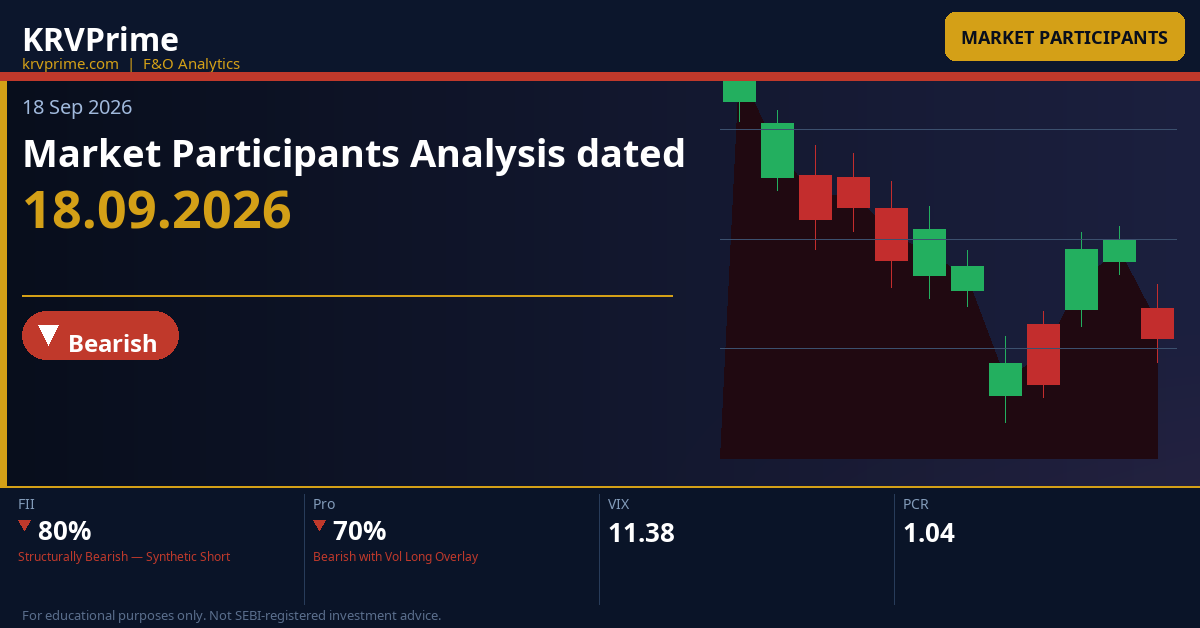
KRVPrime — Daily Market Outlook
Key Market Signals — Data: 18 Sep 2026
NIFTY 50 23,346.40 ▲ +75.80 (+0.33%) | BANK NIFTY 56,358.70 ▲ +302.95 (+0.54%) | SENSEX 74,294.96 ▼ -19.63 (-0.03%) |
OVERALL PCR 1.04 ▲ +0.07 (+7.74%) PCR above 1.00 reflects more put writing than call writing — moderately bullish options sentiment. | INDIA VIX 11.38 ▼ -0.91 (-7.36%) VIX at 11.38 is deep in the complacency zone — markets pricing near-zero fear premium. | TOTAL OI CHANGE 52,683,106 ▲ +2,248,712 (+4.46%) Significant OI expansion of +4.46% signals strong new positioning, not rollover activity alone. |
FUTURES OI 903,458 ▲ +532 (+0.06%) Near-flat futures OI indicates no directional conviction shift in the futures book today. | CALL OI CHANGE 10,830,805 ▲ +613,083 (+6.00%) Call OI expanding +6.00% — fresh call writing and buying both active, capping upside at key strikes. | PUT OI CHANGE 11,285,769 ▲ +1,404,387 (+14.21%) Put OI surging +14.21% — aggressive put buying and writing signals elevated two-way hedging demand. |
Participant-wise Key Points
FII Cautiously Bearish — Hedged Futures Short with Aggressive Put Accumulation
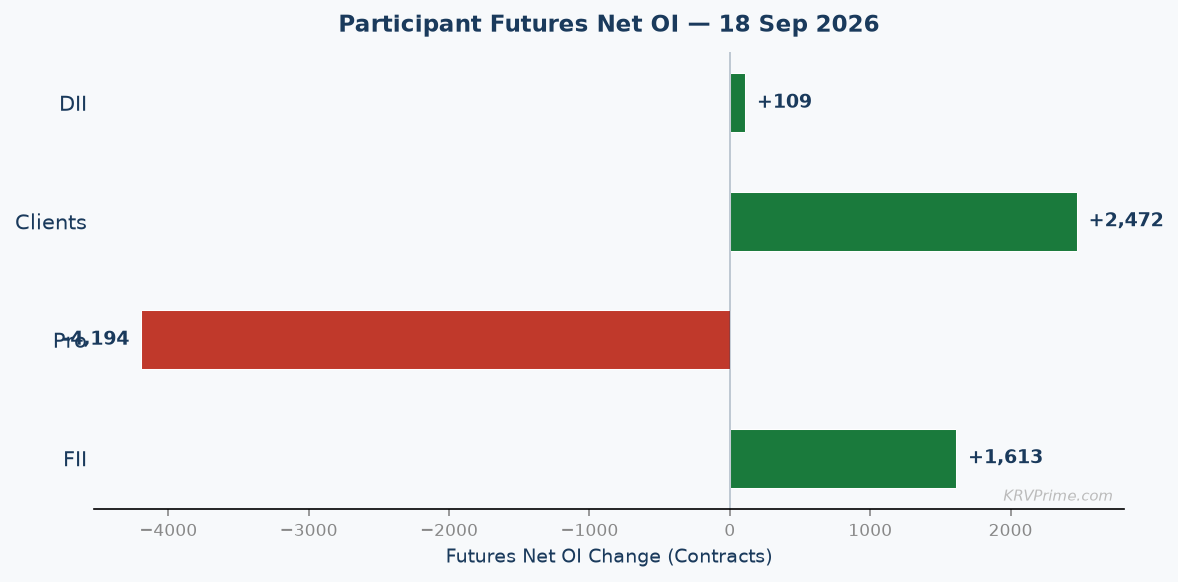
- Futures net improved marginally from -290,041 to -288,428 (net change +1,613 contracts). On the long side, FIIs added 858 contracts (prev 47,548 → today 48,406, +1.80%) tagged as [Long Buildup - Low Vol], and on the short side they covered a modest 755 contracts (prev 337,589 → today 336,834, -0.22%) tagged as [Short Covering - Low Vol]. Both confirmation tags carry the Low Vol qualifier, meaning neither the long addition nor the short cover reflects high-conviction directional intent — these are marginal adjustments rather than a thesis reversal. The gross short-to-long ratio stands at an imposing 6.96:1 (336,834 shorts versus 48,406 longs), confirming that FIIs remain overwhelmingly net short in futures with no meaningful sign of covering despite Nifty's +0.33% close today.
- FII Long PCR improved from 1.84 to 1.88 (+2.32%) and Short PCR surged from 0.62 to 0.70 (+12.77%). A Long PCR of 1.88 means FIIs hold 88% more put longs than call longs — this is an intensely defensive posture, either hedging a large underlying equity book or expressing a directional bearish view through the options book. The sharp rise in Short PCR from 0.62 to 0.70 (+12.77%) is particularly telling: FIIs are now writing far more puts on the short side relative to calls, which could indicate they are monetising near-term downside or constructing a short strangle architecture where the put-short leg limits cost. The dominant signal today is the rising Long PCR, which reinforces the bearish/hedged thesis rather than contradicting it — FIIs are not reducing their put-long hedge despite the market ticking up.
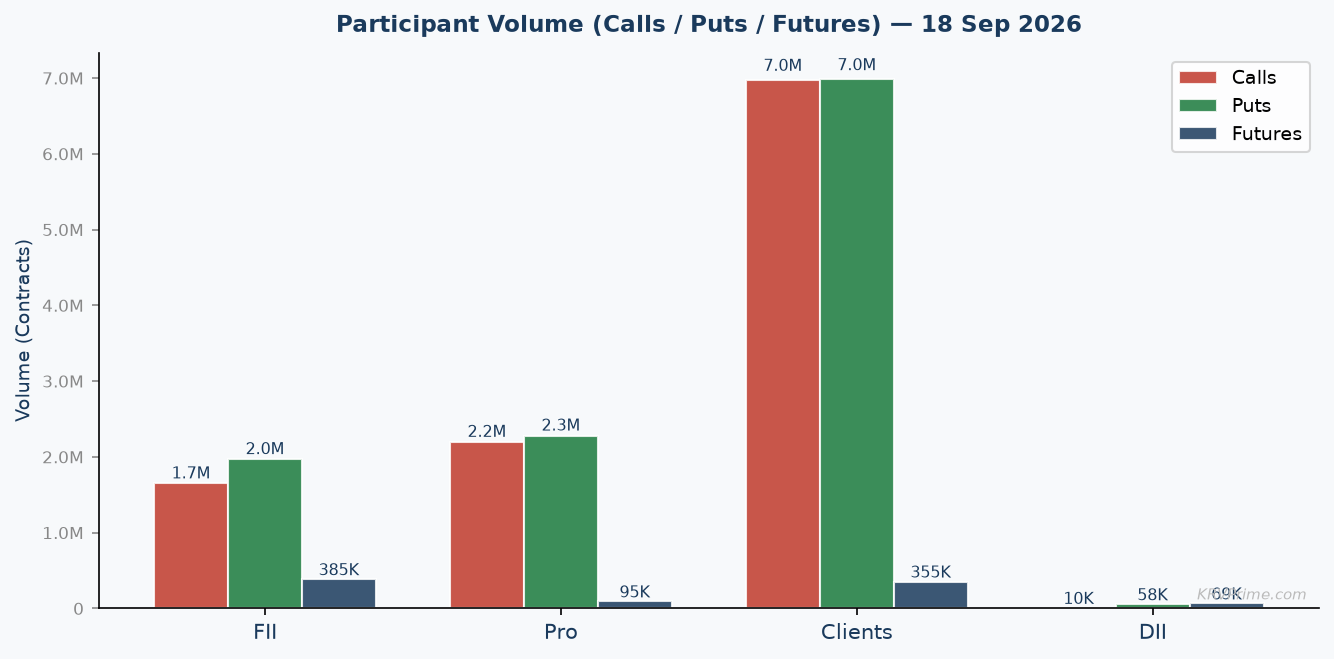
- Call OI net improved from -282,892 to -268,402 (net change +14,490). FIIs added 45,152 call longs (prev 645,825 → today 690,977, +6.99%, [Long Buildup - Low Vol]) and 30,662 call shorts (prev 928,717 → today 959,379, +3.30%, [Short Buildup - Low Vol]). Put OI net improved from +612,710 to +630,453 (net change +17,743). FIIs added an enormous 112,453 put longs (prev 1,186,632 → today 1,299,085, +9.48%, [Long Buildup - Low Vol]) alongside 94,710 put shorts (prev 573,922 → today 668,632, +16.50%, [Short Buildup - Low Vol]). The architecture remains a net short calls + net long puts combination — this is a classic synthetic short or protective collar — but the aggressive expansion of both put longs and put shorts simultaneously (building a put spread or bull-put risk reversal structure) suggests FIIs are paying to own downside protection while partially funding it through put writing at lower strikes.
- Synthesis — FII Dual-Leg Bearish Hedging Architecture: FIIs present a coherent but nuanced picture today — their futures net of -288,428 remains dominant and directionally bearish, their Long PCR of 1.88 signals deep defensive hedging, and their net options posture (net short 268,402 calls, net long 630,453 puts) maintains the synthetic short architecture established in prior sessions. However, the Low Vol tags across all four options legs suggest this is a managed, deliberate repositioning rather than panic hedging — FIIs appear to be maintaining conviction while managing cost through put spreads (buying put longs at upper strikes, writing put shorts at lower strikes). The fact that they added 112,453 put longs on a day Nifty rose +0.33% and VIX fell -7.36% is a contrarian data point of the highest order — this is not reactive hedging, it is proactive positioning for a downside event. The only internal nuance is the concurrent put short addition (+94,710), which indicates a spread rather than outright directional put buying, limiting their maximum gain but also their premium cost. Compared to the prior session, the net futures short has barely moved (-1,613 net improvement) while the options book has expanded significantly — FIIs are expressing their bearish view increasingly through options rather than futures.
- Forward trigger: Watch whether FII futures net crosses above -280,000 in tomorrow's data — that would signal the first meaningful short-covering event and a potential thesis pivot. If instead the net futures short deepens below -295,000 alongside a further rise in Long PCR above 1.95, the full synthetic short thesis accelerates and the 23,300 PE support level (NIFTY weekly) becomes the first structural target. The critical session watch level for FII positioning is whether their gross put long book expands beyond 1,350,000 contracts, which would mark a structural commitment to a downside event in the near term.
DII Cautiously Bullish — Steady Long Futures with Expanding Put Hedge
- Futures net improved marginally from +12,858 to +12,967 (net change +109 contracts). On the long side, DIIs added a thin 119 contracts (prev 40,622 → today 40,741, +0.29%, [Long Buildup - Low Vol]), and on the short side they added an almost negligible 10 contracts (prev 27,764 → today 27,774, +0.04%, [Short Buildup - Low Vol]). Both legs carry the Low Vol tag, confirming this is a day of holding pattern rather than directional commitment — DIIs are maintaining their existing net long futures exposure of +12,967 without scaling aggressively in either direction. The gross long-to-short ratio is 1.47:1 (40,741 longs versus 27,774 shorts), which is a modest but clear net long tilt, and the stability of this ratio across sessions tells us DII futures conviction is steady but not expanding.
- DII does not have a separately reported Long PCR or Short PCR in today's data, so PCR inference is drawn from their options net OI changes. The expansion of DII put longs from 54,885 to 57,485 (+2,600 contracts, +4.74%) alongside the simultaneously rising call longs from 6,939 to 8,009 (+1,070, +15.42%) tells us DIIs are adding to hedges on both sides, but the put-long book dwarfs the call-long book (57,485 vs 8,009), implying an implicit Long PCR well above 7.0 — an extraordinarily defensive put-heavy options book relative to calls. The absence of a formal reported PCR for DIIs does not reduce the signal: the raw put/call long ratio of 57,485:8,009 = 7.18:1 confirms that DIIs hold put protection as the dominant options instrument, consistent with their institutional mandate to protect large equity AUM.
- Call OI net improved from +4,249 to +5,619 (net change +1,370). DIIs added 1,070 call longs (prev 6,939 → today 8,009, +15.42%, [Long Buildup - Avg Vol]) while covering 300 call shorts (prev 2,690 → today 2,390, -11.15%, [Short Covering - Low Vol]). Put OI net improved from +54,835 to +57,285 (net change +2,450). DIIs added 2,600 put longs (prev 54,885 → today 57,485, +4.74%, [Long Buildup - Low Vol]) and initiated a small but notable 150 new put shorts (prev 50 → today 200, +300.00%, [Short Buildup - Low Vol]). The architecture is a net long calls + net long puts combination — this is a classic long straddle or protective hedge posture where DIIs are protecting against both upside surprise (call longs) and downside risk (put longs) simultaneously. The Avg Vol tag on call long buildup is notable — it signals routine, planned execution rather than reactive positioning, consistent with DII's institutional inflow-driven mandate.
- Synthesis — DII Steady Long with Protective Straddle Architecture: DIIs maintain a coherent and internally consistent picture: a net long futures position of +12,967, a call-long expansion of +1,070 contracts, and a dominant put-long book of 57,485 contracts that vastly outweighs all other options legs. This is not a speculative positioning — this is textbook institutional equity book protection, where futures long reflects net inflow deployment and the giant put-long book reflects systematic downside hedging on the AUM. The short covering of 300 call shorts (prev 2,690 → today 2,390) while simultaneously adding call longs is a subtle but important shift — it reduces their call-writing income trade and replaces it with outright call long exposure, nudging the options book slightly more bullish at the margin. The Low Vol tags on the put long and put short additions suggest today's options activity is routine rebalancing rather than stressed hedging. Compared to FIIs, DIIs are polar opposites in futures sentiment — DII net long +12,967 versus FII net short -288,428 — and this divergence is a defining structural feature of the current market: domestic institutional buyers are absorbing the directional supply that FIIs are creating through their short book.
- Forward trigger: The key watch metric for DIIs tomorrow is whether their futures net long expands above +14,000 contracts, which would signal accelerating domestic inflow deployment. If the put-long book expands beyond 60,000 contracts in parallel, it would indicate DIIs are hedging against a potential downside event even as they deploy inflows — a cautiously bullish but defensively managed posture. A decline in DII futures net below +10,000 would be the first warning that domestic buying pressure is easing, which would remove one of the key bullish counterweights to FII short pressure at the 23,300 Nifty weekly put support level.
Pro Increasingly Bearish — Unwinding Longs, Building Shorts, Aggressive Put Accumulation
- Futures net deteriorated from +38,235 to +34,041 (net change -4,194 contracts). Pros aggressively unwound 3,576 long contracts (prev 68,177 → today 64,601, -5.25%, [Long Unwinding - Low Vol]) and simultaneously added 618 short contracts (prev 29,942 → today 30,560, +2.06%, [Short Buildup - Low Vol]). The confirmation tag [Long Unwinding - Low Vol] on the long side signals a deliberate reduction in long exposure — though Low Vol indicates this was executed without aggressive volume, the -5.25% decline in a single session is a meaningful directional shift for Pros. The gross long-to-short ratio now stands at 2.11:1 (64,601 longs versus 30,560 shorts), down from yesterday's 2.28:1, showing a compression of the long bias that warrants attention — Pros appear to be rotating away from net-long directional exposure and toward a more hedged or mildly bearish futures stance.
- Pro Long PCR surged from 0.96 to 1.07 (+11.50%) and Short PCR jumped from 0.91 to 1.00 (+10.05%). The move in Long PCR from 0.96 to 1.07 is highly significant — Pros have crossed above the 1.0 threshold, meaning they now hold more put longs than call longs for the first time, a clear shift from previously balanced to net-bearish options hedging. The Short PCR moving from 0.91 to 1.00 signals that on the writing side, Pros are now writing puts and calls in near-equal measure — this is consistent with a short strangle or range-bound income strategy rather than outright directional writing. The combination of a rising Long PCR (more defensive put longs) and a rising Short PCR (more put writing) creates an internally complex picture where Pros are simultaneously buying protection and selling it at different strikes — a classic risk-reversal or put spread architecture. The dominant signal is the Long PCR crossing 1.0, which confirms Pros are tilting bearish in their options book even as they retain a net long futures position.
- Call OI net swung from -11,755 to +29,767 (net change +41,522). Pros added 49,185 call longs (prev 1,062,451 → today 1,111,636, +4.63%, [Long Buildup - Low Vol]) versus only 7,663 call shorts (prev 1,074,206 → today 1,081,869, +0.71%, [Short Buildup - Low Vol]), flipping the call net from marginally short to strongly net long +29,767. Put OI net surged from +44,633 to +108,858 (net change +64,225). Pros added a massive 170,153 put longs (prev 1,021,913 → today 1,192,066, +16.65%, [Long Buildup - Low Vol]) and 105,928 put shorts (prev 977,280 → today 1,083,208, +10.84%, [Short Buildup - Low Vol]). The architecture has shifted dramatically: from near-neutral (net call -11,755, net put +44,633) to net long calls (+29,767) + net long puts (+108,858) — this is a long straddle or synthetic strangle posture where Pros are positioned for a significant move in either direction, with a tilt toward the downside given the larger put net. The +16.65% expansion in put longs is the largest single-session put accumulation across all participants and signals Pros expect a volatility event even as VIX sits at a complacent 11.38.
- Synthesis — Pro Volatility Play with Bearish Tilt: Pros present the most dramatic repositioning story of the session. Their futures net declined sharply by -4,194 contracts to +34,041 through long unwinding (-5.25% on the long leg), their Long PCR crossed above 1.0 for the first time (now 1.07), and their options book has exploded with 170,153 new put longs and 49,185 new call longs — building a massive long straddle/strangle architecture. This is the signature of a participant who believes current VIX at 11.38 is significantly mispriced relative to actual risk — Pros are buying volatility on both sides while the market sleeps. The bearish tilt is confirmed by the put net of +108,858 dwarfing the call net of +29,767, and by the futures long unwinding happening concurrently. The Low Vol tags across all legs suggest this is a methodical, planned position build rather than reactive panic — Pros are entering a calculated volatility-long trade with a directional lean toward the downside. Compared to the prior session, this is an acceleration: the net put long has more than doubled from +44,633 to +108,858 in a single day, which is an extraordinary expansion that rivals FII's own bearish options architecture in scale.
- Forward trigger: The critical level to watch for Pros is whether their futures net long falls below +30,000 contracts in tomorrow's data — that would signal a full reversal from the previous long bias and the first meaningful bearish futures commitment from this cohort. If simultaneously their put OI net expands beyond +130,000 contracts, Pros would be building one of the largest put-long positions in the current cycle, pointing to a target zone around the 23,000 Nifty monthly PE support level. A scenario where their Long PCR rises further above 1.10 while VIX remains below 12.00 would confirm this is a deliberate volatility-long bet, not stress-driven hedging.
Client Conflicted — Bullish Futures but Aggressively Selling Puts and Buying Puts Simultaneously
- Futures net improved from +238,948 to +241,420 (net change +2,472 contracts). Clients added 2,865 long contracts (prev 295,116 → today 297,981, +0.97%, [Long Buildup - Avg Vol]) and 393 short contracts (prev 56,168 → today 56,561, +0.70%, [Short Buildup - Low Vol]). The Avg Vol tag on the long buildup is notable — unlike FIIs and Pros whose Low Vol tags signal hesitant moves, Clients executed their long addition with above-average volume, indicating retail and non-institutional participants remain actively and confidently adding long futures exposure at these levels. The gross long-to-short ratio stands at 5.27:1 (297,981 longs versus 56,561 shorts), confirming Clients are the most aggressively net-long futures participant in today's market — a stark contrast to FII's 6.96:1 net short ratio, creating the key structural tension in the futures book.
- Client Long PCR improved from 0.79 to 0.86 (+8.81%) and Short PCR rose from 1.09 to 1.15 (+5.65%). A Long PCR of 0.86 means Clients hold 86% as many put longs as call longs — they own slightly more calls than puts on the long side, which is a modestly bullish options buying posture. The Short PCR of 1.15 means Clients are writing 15% more puts than calls on the short side — this is a critical data point: Clients are selling puts, which is a bullish bet (put sellers profit when the market does not fall below the strike). However, the simultaneous rise in both Long PCR and Short PCR tells a nuanced story — Clients are also adding put longs (Long PCR rising from 0.79 to 0.86), suggesting a subset of clients is hedging their net long futures book via put buying even as another subset writes puts for premium income. This internal contradiction between put buying and put selling within the same participant cohort is typical of the heterogeneous retail-dominated client category.
- Call OI net deteriorated from +290,398 to +233,015 (net change -57,383). Clients added a large 211,134 call longs (prev 3,393,646 → today 3,604,780, +6.22%, [Long Buildup - Avg Vol]) but added an even larger 268,517 call shorts (prev 3,103,248 → today 3,371,765, +8.65%, [Short Buildup - Avg Vol]), resulting in the net call position shrinking to +233,015 from +290,398. Both call legs carry Avg Vol tags, confirming active, above-average-volume participation. Put OI net deteriorated from -712,178 to -796,597 (net change -84,419). Clients added 416,987 put longs (prev 2,677,261 → today 3,094,248, +15.58%, [Long Buildup - Low Vol]) and an enormous 501,406 put shorts (prev 3,389,439 → today 3,890,845, +14.79%, [Short Buildup - Low Vol]). The architecture remains net long calls (+233,015) + net short puts (-796,597) — this is a classic synthetic long structure where Clients are buying calls and writing puts, effectively leveraging upside exposure. However, the put-short net of -796,597 is the most exposed position in the entire market today, placing Clients at significant risk if Nifty breaks below key put-support strikes.
- Synthesis — Client Synthetic Long with Hidden Fragility: Clients present the most internally complex and structurally fragile positioning of the day. On the surface, a net long futures position of +241,420, net long calls of +233,015, and Avg Vol execution tags suggest confident bullish participation. However, the net short puts position of -796,597 is an enormous tail-risk liability — if Nifty breaks below the 23,300 weekly PE support level (or worse, the 23,000 monthly PE support), Client put shorts would suffer accelerating mark-to-market losses, potentially triggering forced covering that amplifies the downside. The +15.58% expansion in put longs (416,987 new contracts) alongside the +14.79% expansion in put shorts (501,406 new contracts) shows Clients added more put shorts than put longs in absolute terms today — net -84,419 put deterioration — which means the risk is growing, not shrinking. Compared to FIIs and Pros who are building defensive and bearish architectures, Clients are the structural counterparty to both — they are the ones writing the puts that FIIs and Pros are buying. This is a classic informed versus uninformed capital dynamic: FIIs and Pros are paying to protect against a fall; Clients are collecting that premium and bearing the risk.
- Forward trigger: The key risk threshold for Client positioning is a Nifty close below 23,300 (the weekly PE OI support level) — at that point, the 3,890,845 put shorts held by Clients begin suffering in-the-money losses that could trigger a forced-covering cascade. Watch whether Client put net short deteriorates beyond -850,000 contracts in tomorrow's data — that would signal further risk accumulation. Conversely, if the market holds above 23,300 and the Short PCR rises further above 1.20, it would indicate Clients are successfully monetising put writing and their synthetic long thesis is working — a bullish self-reinforcing signal in the near term.
Bull vs Bear Strength by Participant
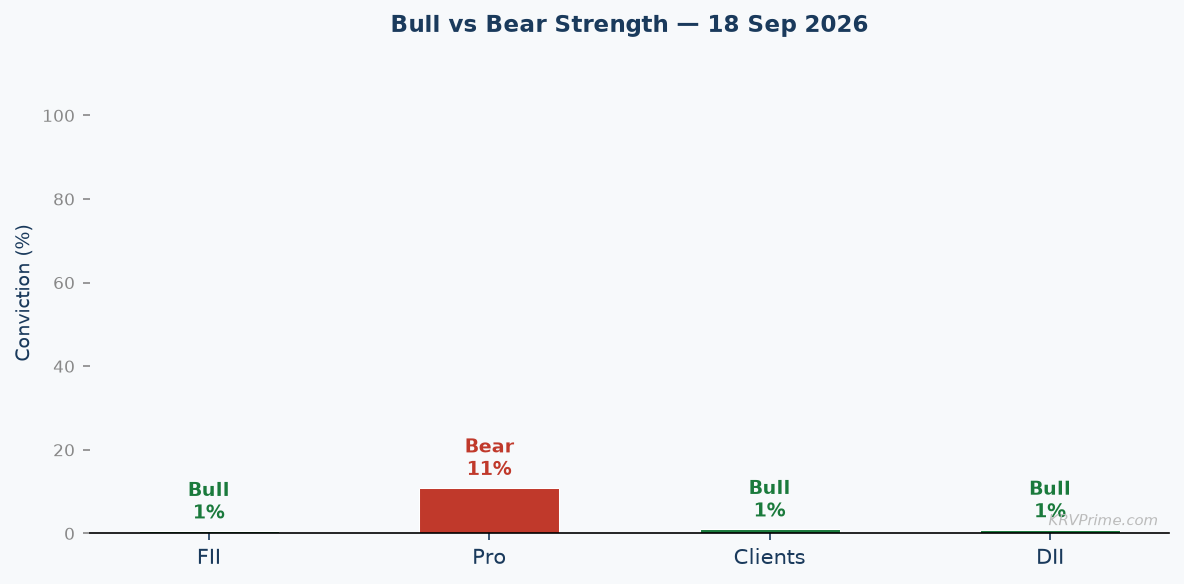
FII Structurally Bearish — Synthetic Short 80% ▼▼ | Pro Bearish with Vol Long Overlay 70% ▼ | Client Bullish / Fragile Synthetic Long 60% ▲ | DII Cautiously Bullish — Steady Deploy 55% ▲ |
Conclusion — Market Outlook for Tomorrow (19 Sep 2026)
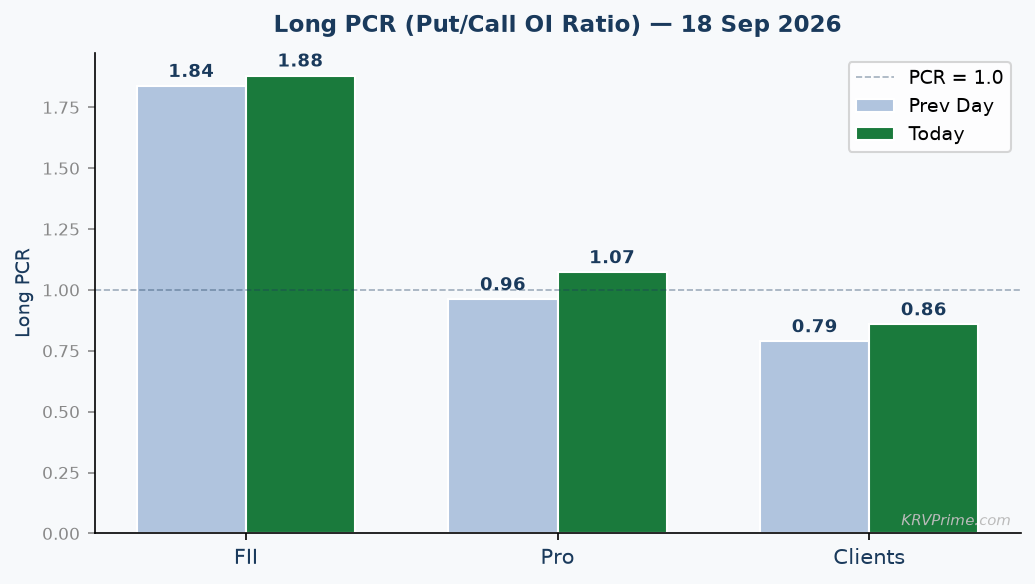
The collective participant positioning on 18 Sep 2026 reveals a market in structural tension. FIIs maintain an overwhelming net futures short of -288,428 contracts at a 6.96:1 short-to-long ratio and hold 1,299,085 put longs in an expanding synthetic short architecture, while Pros have dramatically accelerated their own put-long book by +170,153 contracts in a single session, pushing their net put position to +108,858. On the other side, Clients hold a net long futures position of +241,420 and a deeply exposed net short put book of -796,597 contracts, making them the primary counterparty bearing the tail risk that FIIs and Pros are buying. DIIs provide the only stable bullish anchor with a net long futures position of +12,967 and systematic equity inflow deployment, but their scale is insufficient to offset the combined bearish options architecture of FIIs and Pros. The market is thus characterised by large informed participants (FII + Pro) paying to own downside while retail-dominated Clients collect that premium — a setup that historically resolves in favour of the informed side.
The overall PCR rising sharply from 0.97 to 1.04 (+7.74%) alongside the massive put OI expansion of +14.21% tells a dual story: both put buying and put writing are active, but the dominant driver is protective/directional put accumulation at the FII and Pro level rather than bullish put selling. India VIX collapsing to 11.38 (-7.36%) creates a paradox — option premium is near-historically cheap at the same time FIIs and Pros are aggressively buying put protection, suggesting they believe VIX is significantly underpriced relative to the risk they see ahead. When sophisticated participants buy volatility at low VIX levels, it is a historically reliable leading signal of an impending vol expansion event. The 23,300 weekly PE OI support and 23,000 monthly PE OI support are the structural floors that must hold — a breach of 23,300 would trigger the Client put-short covering cascade and accelerate the FII and Pro put-long monetisation, creating a self-reinforcing downside feedback loop.
The bull thesis would be preserved only if DIIs accelerate domestic inflow deployment into futures beyond +15,000 net contracts while the overall PCR holds above 1.05 and FIIs reduce their gross short meaningfully below -280,000. The bear thesis will be confirmed if VIX breaks above 12.50 tomorrow — any mean-reversion in VIX from the complacent 11.38 level toward 13.00 would immediately mark-to-market the FII and Pro put-long books into significant profits while simultaneously pressuring Client put shorts. The next session is a binary setup: stability at or above 23,300 Nifty sustains the Client premium-collection trade; a decisive break below it triggers the informed-participant payoff and a potentially sharp downside move.
Scenario 1 — Bull case:
FII futures net improves above -280,000 (short covering of at least 8,000 contracts) while the overall PCR rises above 1.10, signalling that put writing is absorbing supply and the market is range-bound rather than breaking down. If VIX stays below 11.50 and Client Short PCR rises further to 1.20+ (more put writing = bullish income trade), the synthetic long architecture holds and Nifty consolidates above 23,300 weekly PE support with upside potential toward the 24,000 CE resistance wall where call writers are concentrated.
Scenario 2 — Bear case:
FII futures net deepens below -295,000 (fresh shorting) while Pro put OI net expands above +130,000 contracts — both confirming acceleration of the bearish informed-capital thesis. A VIX spike above 12.50 (from the current 11.38) would mark-to-market the Client put-short book of 3,890,845 contracts into loss territory, triggering forced covering. A close below the 23,300 Nifty weekly PE OI support level would be the structural trigger for this cascade, with the next OI floor at 23,000 monthly PE support as the bear-case target zone.
Key Resistance 24,000 (Nifty weekly + monthly CE OI resistance) — This is where the largest call-writing concentration sits. FIIs hold 959,379 call shorts and Clients hold 3,371,765 call shorts, together creating a formidable supply wall. Pros have turned net call long (+29,767) suggesting some participants expect a test of this level, but the aggregate call-writing supply at 24,000 is the dominant force capping upside. | Key Support 23,300 (Nifty weekly PE OI support) and 23,000 (Nifty monthly PE OI support) — FIIs hold 1,299,085 put longs and Pros hold 1,192,066 put longs, both heavily concentrated in the protection band around these strikes. A break of 23,300 triggers immediate put-long monetisation for FIIs and Pros while simultaneously pressuring Client put shorts (3,890,845 contracts net short puts), creating a self-reinforcing downside accelerant. | Trigger to Watch India VIX recrossing above 12.29 (previous session level) — A VIX recovery above 12.29 from today's 11.38 would confirm that the complacency phase is ending and volatility is re-pricing. This would immediately benefit FII put longs (1,299,085 contracts) and Pro put longs (1,192,066 contracts) while marking Client put shorts (3,890,845 contracts) to loss, confirming the informed-capital bear thesis and making the 23,300 weekly support the immediate risk level to defend. |