
Index Analysis
Intraday Analysis for 04 Sep 2026
KRV Prime13 September 202650 min
Educational/Derived AnalysisSource: KRV Prime Market Insights (End-of-Day)As of 13 Sep 2026, 05:11 PM IST
Intraday Analysis for 04 Sep 2026
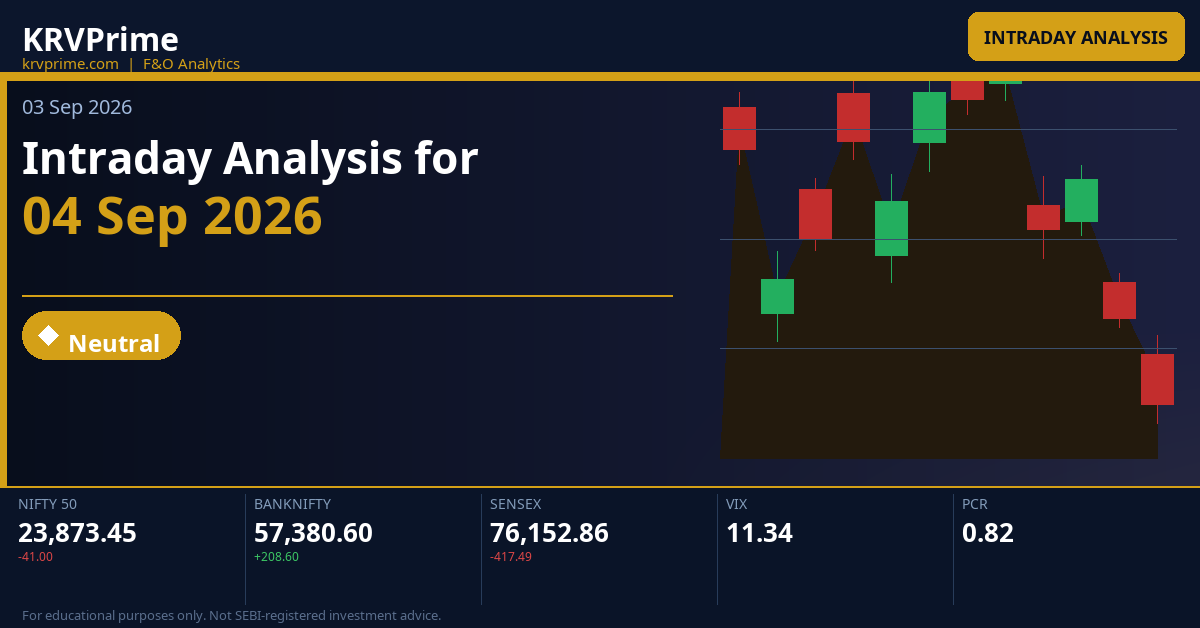
Markets closed mixed on 03 Sep 2026, with NIFTY shedding 0.17% to 23,873.45 and SENSEX down 0.55% to 76,152.86, while BANKNIFTY bucked the trend with a modest +0.36% gain to close at 57,380.60. India VIX data is unavailable for this session, which limits precise volatility-calibrated position sizing — traders should assume moderate implied volatility and rely heavily on CPR band widths (0.21–0.34%) and straddle premiums to gauge expected move. All three indices carry Ascending or Outside Wide CPR structures for 04 Sep, meaning the CPR bands sit above yesterday's closing prices and will act as first resistance zones, requiring two 30-minute confirmatory closes before directional trades are initiated.
Key Market Signals — Intraday Setup
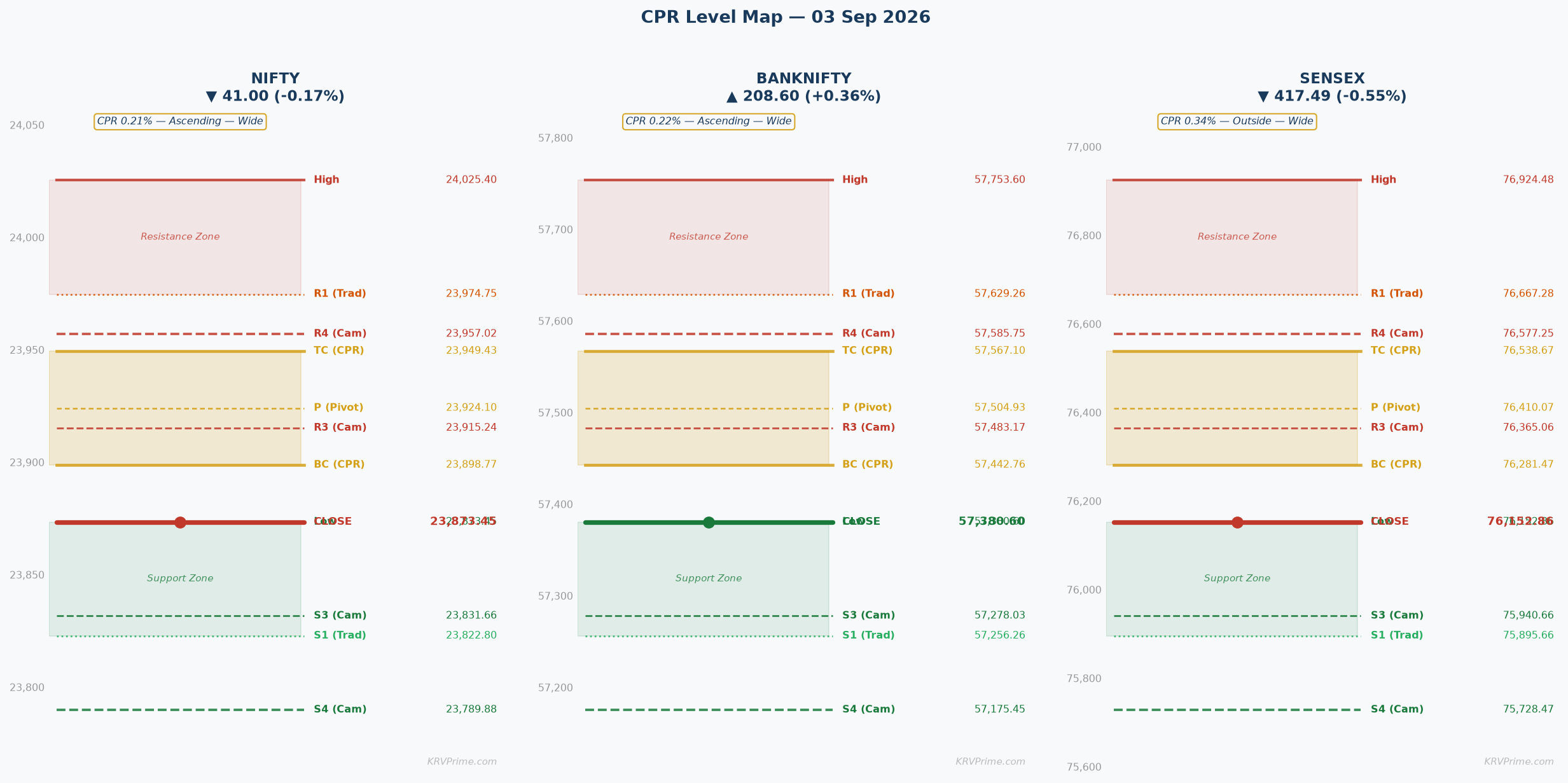
All three indices are trading below their respective Day CPR bands (NIFTY below BC 23,898.77; BANKNIFTY below BC 57,442.76; SENSEX below TC 76,538.67) after yesterday's close, signalling broad market weakness and placing the CPR band as immediate overhead resistance for 04 Sep. With SENSEX carrying an Outside CPR that engulfs the previous day's range and NIFTY/BANKNIFTY both printing Ascending Wide CPRs, the consensus bias favours sellers unless price decisively reclaims the respective BC levels within the first 30 minutes of trade.
Deep Technical Analysis & Levels
NIFTY
Ascending — Wide (0.21%)
▼ Bearish
Market Structure Sideways or range-bound | Straddle ATM 23850 weekly straddle = **218.6 points** (Call 128.9 + Put 89.7), implying a one-sigma expected move of approximately ±109 points from ATM, keeping NIFTY within a roughly 23741–23959 band for the weekly expiry. The put premium being notably lower than the call suggests mild directional skew to the upside, but the absolute straddle size of 218.6 points is relatively contained and signals a low-volatility, range-bound expiry expectation. | Max Pain Week max pain at **23,950** (expiry 08-Sep-2026) sits 76.55 points above yesterday's close of 23,873.45, implying option sellers will work to drift price toward 23,950 into expiry — this creates a gravitational pull upward during the week but does not negate intraday bearish CPR dynamics on 04 Sep. |
Tomorrow's Complete Level Map
OI-R: 24,000 R3: 24,126.70 H6: 24,025.40 H5: 24,005.82 R2: 24,076.05 H4 ▶: 23,957.02 R1: 23,974.75 PDH: 24,025.40 H3 ↩: 23,915.24
TC: 23,949.43 P: 23,924.10 BC: 23,898.77
L3 ↩: 23,831.66 PDL: 23,873.45 S1: 23,822.80 L4 ▶: 23,789.88 S2: 23,772.15 L5: 23,741.08 L6: 23,721.50 S3: 23,670.85 OI-S: 23,000
↩ = Camarilla reversal point | ▶ = Camarilla breakout/breakdown trigger | OI-R/OI-S = Options wall (CE/PE max OI)
▲ Higher Open (Gap Up) — Open > Prev Close
▲ Bullish
Open lands: With an Ascending Wide CPR (BC 23,898.77 / TC 23,949.43 sitting above yesterday's close of 23,873.45), a gap-up open places price inside the CPR band (between BC 23,898.77 and TC 23,949.43 for a minor gap) or above TC 23,949.43 for a significant-to-large gap. The CPR band is positioned entirely above yesterday's close, so any upward gap immediately runs into the band as the first test zone.
CPR role: Launch pad if price holds above TC 23,949.43 with two 30-minute closes; overhead resistance and potential trap door if price opens inside the band but fails to sustain above TC 23,949.43.
Minor Gap (0.05–0.25%) — Structure Dominant
A minor gap of 0.05–0.25% would open NIFTY in the range of approximately 23,885–23,933, likely placing price inside the CPR band between BC 23,898.77 and near the Pivot 23,924.10. At this opening, the CPR Wide structure (0.21%) mandates a stricter confirmation rule — two 30-minute candle closes are required above TC 23,949.43 before any long position is initiated, as Wide CPRs are prone to false breakouts and fade moves. The first meaningful upside target on confirmation is R1 23,974.75, followed by the Camarilla H4 23,957.02 cluster and the critical OI resistance wall at 24,000 (CE max OI strike) which will absorb fresh buying pressure from CE writers defending that level. Failure to reclaim TC 23,949.43 within the first 30 minutes after a minor gap-up converts the CPR band from a launch pad into a trap — prices would then revert toward BC 23,898.77 and subsequently test Camarilla L3 23,831.66.
Significant Gap (0.25–0.5%) — Balanced
A significant gap of 0.25–0.50% opens NIFTY near 23,933–23,992, placing price inside the upper portion of the CPR band or just above TC 23,949.43 — directly into the congestion zone between TC 23,949.43, Camarilla H3 23,915.24 (already below TC here, so H3 acts as intraband support), H4 23,957.02, and the formidable OI-R wall at 24,000. Gap-fill risk is moderate at this size — a significant gap in a Wide CPR structure tends to attract profit-taking from overnight longs near the Camarilla H4 23,957.02 and OI-R 24,000 cluster, especially since delta-hedging flows from CE writers at 24,000 create synthetic selling pressure as price approaches that strike. The ideal trade sequence is: wait for two 30-minute closes above TC 23,949.43, enter long with first partial profit at R1 23,974.75, second partial at H5 24,005.82 or OI-R 24,000 (whichever is touched first), and exit fully at OI-R 24,000 — do not trail beyond OI-R given Wide CPR rules.
Large Gap (>0.5%) — Gap Direction Dominant
A large gap exceeding 0.50% opens NIFTY above 23,992, potentially at or above the critical OI resistance zone of 24,000 and near the Camarilla H5 24,005.82 and PDH 24,025.40 / H6 24,025.40 cluster. At this opening, the gap-dominant rule applies — but the Wide CPR structure tempers aggressive follow-through, and opening directly at or above OI-R 24,000 creates an immediate CE writer delta-hedge induced ceiling. The probability of a gap-fill back to TC 23,949.43 and even the Pivot 23,924.10 increases significantly when opening above OI-R 24,000, as CE writers at 24,000 will aggressively sell futures/CE to hedge, suppressing upside momentum. Traders should fade the opening spike toward 24,025.40 (PDH/H6) with a target of 23,974.75 (R1) on the way down, using the weekly straddle's implied move of 218.6 points as a boundary check — a straddle of this size simply does not price in sustained moves above 24,070 on an intraday basis.
|
▲ Upside Path → OI-R Confirmed bullish path: TC 23,949.43 → Camarilla H3 23,915.24 (already breached to the upside, now support on pullbacks) → H4 23,957.02 → R1 23,974.75 (first partial profit, Wide CPR rule) → H5 24,005.82 → OI-R 24,000 (primary ceiling / exit zone). The move from TC to OI-R covers approximately 50 points — genuine momentum is confirmed when each of these levels is taken out on above-average volume with no more than a 10-point retracement on the 5-minute chart; sustained buying above H4 23,957.02 signals that CE writers at 24,000 are being overwhelmed, which can trigger a short-covering spike toward H5 24,005.82 and H6 24,025.40. |
▼ Downside Path → OI-S Failure path from a gap-up open: inability to sustain above TC 23,949.43 after two 30-minute attempts flips the Wide CPR band from launch pad to trap door, driving price back to Pivot 23,924.10 and then BC 23,898.77. A 30-minute close below BC 23,898.77 then triggers the bearish continuation sequence: L3 23,831.66 (Camarilla mean-reversion first stall) → S1 23,822.80 → L4 23,789.88 (Camarilla breakdown trigger, key stop-loss cluster for longs) → S2 23,772.15 → L5 23,741.08 → OI-S 23,000 (PE max OI — this is a distant but structural floor representing massive PE writing interest that provides a hard bid). |
| 🔴 OI-R: OI-R at the **24,000 CE strike** is the primary upside ceiling for 04 Sep — CE writers at this strike have created a significant synthetic supply zone through which fresh longs must absorb before price can sustain above 24,000. As price approaches 24,000 from below, CE writers delta-hedge by selling Nifty futures, creating real-time selling pressure that decelerates upward momentum; this is why Wide CPR rules mandate taking partial profit at R1 23,974.75 before the OI-R 24,000 wall, rather than trying to break through it on first contact. | 🟢 OI-S: OI-S at the **23,000 PE strike** is structurally a distant floor for intraday trading — PE writers at 23,000 have built a massive base that makes a same-day breakdown to 23,000 extremely unlikely given yesterday's close at 23,873.45. However, its relevance in a gap-up scenario is as an abort reference: if the gap-up completely fails and price cascades below L4 23,789.88, the PE base at 23,000 signals that the market still prices catastrophic downside as very low probability, meaning recoveries from deep intraday lows are likely to be sharp and aggressive. |
⚡ Key Trigger: The critical trigger for the bullish scenario is **two consecutive 30-minute candle closes above TC 23,949.43** — this is the Wide CPR confirmation rule and cannot be substituted with a single candle, as the 0.21% width creates enough noise for false breakouts to trap early longs. A confirmed hold above TC 23,949.43 signals institutional acceptance of the higher CPR band, activating R1 23,974.75 as the first target, then H4 23,957.02 / OI-R 24,000 as the primary ceiling; conversely, any 30-minute close back below BC 23,898.77 after a gap-up negates the bullish case entirely and switches the day's directional bias to bearish with L3 23,831.66 as the immediate downside target.
▼ Lower Open (Gap Down) — Open < Prev Close
▼ Bearish
Open lands: In an Ascending Wide CPR structure where BC 23,898.77 already sits above yesterday's close of 23,873.45, any gap-down open places NIFTY below the entire CPR band — the gap merely determines HOW FAR below BC 23,898.77 the opening occurs. A minor gap opens near 23,850–23,873; a significant gap opens near 23,813–23,850; a large gap opens below 23,813 toward Camarilla L3 23,831.66 or lower.
CPR role: Overhead resistance and battleground — the entire CPR band (BC 23,898.77 to TC 23,949.43) acts as a ceiling that bears will defend and bulls must reclaim to change the day's directional bias.
Minor Gap (0.05–0.25%) — Structure Dominant
A minor gap down of 0.05–0.25% opens NIFTY in the range of approximately 23,814–23,873, placing price just below yesterday's PDL 23,873.45 and the Camarilla L3 23,831.66 zone. The Ascending Wide CPR sitting entirely above the open (BC 23,898.77 is the nearest overhead level) means the CPR band immediately becomes a ceiling, requiring a full reclaim of BC 23,898.77 — two 30-minute closes above it — before any long bias is restored. The first bear target on continuation is L3 23,831.66, then S1 23,822.80 — a breach of S1 on 30-minute close opens the way to L4 23,789.88 and S2 23,772.15, while the weekly straddle's expected move of 218.6 points from ATM 23,850 places the lower boundary near 23,741, coinciding precisely with L5 23,741.08.
Significant Gap (0.25–0.5%) — Balanced
A significant gap down of 0.25–0.50% opens NIFTY near 23,813–23,814 to 23,814, directly at or below Camarilla L3 23,831.66 — a structurally important mean-reversion zone where first stalls and recovery attempts are expected. At this opening, the failure-and-resume pattern is the primary risk: a 30-minute bounce from L3 23,831.66 toward BC 23,898.77 that fails to sustain above BC constitutes the 'failure' leg, after which the 'resume' leg drives price to L4 23,789.88 (Camarilla breakdown trigger) and S2 23,772.15. PUT writing interest is concentrated at OI-S 23,000 (PE max OI), which creates a very slow bleed rather than a crash — bear trades should target L4 23,789.88 and L5 23,741.08 for the day, not OI-S 23,000 which requires multiple sessions of sustained selling.
Large Gap (>0.5%) — Gap Direction Dominant
A large gap down exceeding 0.50% opens NIFTY below 23,813, breaching both PDL 23,873.45 and potentially Camarilla L3 23,831.66 simultaneously — panic conditions with possible testing of L4 23,789.88 at the open. The panic-versus-recovery dynamic is crucial: with India VIX data unavailable, traders must assess whether the gap-down is macro-driven (global overnight selloff) or domestic (stock-specific news); in either case, the Wide CPR rule prevents chasing the gap down — instead, wait for a 30-minute stabilisation candle near L4 23,789.88 or S2 23,772.15 before short entry. Straddle monetisation timing is optimal 20–30 minutes after open when IV begins to compress from the spike; the weekly straddle at 218.6 points implies L5 23,741.08 is the outermost intraday range expectation, making L5 the primary profit target for short positions initiated after the stabilisation candle.
|
▲ Upside Path → OI-R Recovery path: L3 23,831.66 (stabilisation zone) → BC 23,898.77 (first resistance to reclaim, Wide CPR requires two 30-min closes) → Pivot 23,924.10 → TC 23,949.43 → H3 23,915.24 (Camarilla mean-reversion, now acting as intraband support on recovery) → R1 23,974.75 → OI-R 24,000. Volume confirmation of genuine recovery is when BC 23,898.77 is reclaimed with above-average 15-minute volume and price does not retrace below it on the subsequent candle — false recoveries typically see a quick spike above BC followed by a decisive failure. |
▼ Downside Path → OI-S Bear continuation path: L3 23,831.66 (first stall / Camarilla mean-reversion — where retail buyers will enter, creating a temporary pause) → S1 23,822.80 → L4 23,789.88 (Camarilla breakdown trigger — retail stop-losses below this level from yesterday's longs will be hit, accelerating the move with a potential 30–50 point flush) → S2 23,772.15 → L5 23,741.08 (weekly straddle lower boundary) → L6 23,721.50 → S3 23,670.85. OI-S at 23,000 remains the structural floor for the weekly expiry but is not a realistic intraday target unless a catastrophic macro event occurs. |
| 🔴 OI-R: OI-R at **24,000** functions as a distant but powerful ceiling in a gap-down scenario — CE writers at 24,000 have no delta-hedge pressure when price is trading well below 24,000, meaning they are entirely comfortable letting price drift lower. The OI-R 24,000 wall actually reinforces the bearish bias in a gap-down by signalling that the market's own options architecture does not expect price to reach 24,000 on this expiry, removing any gamma-squeeze potential that might otherwise support an aggressive recovery. | 🟢 OI-S: OI-S at **23,000 PE strike** represents massive PUT writing interest that signals institutional conviction that NIFTY will NOT breach 23,000 this week — this acts as a psychological and structural floor that prevents panic selling below 23,000. For intraday traders in a gap-down, OI-S 23,000 provides comfort for PUT buyers targeting intraday lows: it tells you where the writing desk will begin aggressively buying back puts (near expiry or near 23,000), creating sharp intraday reversals from deep lows. |
⚡ Key Trigger: The dual trigger for the gap-down scenario is: **bear confirmation** = 30-minute close below L3 23,831.66 with no recovery toward BC 23,898.77 within 30 minutes of open, activating L4 23,789.88 as the immediate target; **bull recovery trigger** = two 30-minute closes back above BC 23,898.77, which signals aggressive buying has overcome the Ascending CPR overhead resistance and reopens the path to Pivot 23,924.10 and TC 23,949.43. Time is critical in a gap-down — failure to reclaim BC 23,898.77 within the first 60 minutes should be treated as bearish confirmation regardless of intraday bounces.
◆ Near Flat Open — Open ≈ Prev Close (±0.05%)
◆ Neutral
Open lands: A flat open of ±0.05% places NIFTY within 23,861–23,885, which is below BC 23,898.77 — the entire Ascending Wide CPR band (BC 23,898.77 to TC 23,949.43) sits above the flat open, making the CPR a pure overhead resistance structure for the session.
CPR role: Decision zone and overhead resistance — the CPR band sits above the flat open, creating a clear binary: bulls must push price into and above the band, while bears use BC 23,898.77 as the first line of defence.
Near Flat (±0.05%)
Flat opens in an Ascending Wide CPR structure are deceptively complex setups — the CPR band sitting entirely above the open means the first 30-60 minutes will reveal whether buyers have conviction to chase price into the wide band or whether gravity keeps price below BC 23,898.77. The specific values are: BC 23,898.77 is the immediate upside resistance (lower edge of the CPR band), Pivot 23,924.10 is the midpoint gravitational level, and TC 23,949.43 is the upper edge that separates a bullish trending day from a range-bound session — two 30-minute closes above TC 23,949.43 would confirm the bullish case. The CPR width at 0.21% (Wide) significantly reduces the probability of a trending day — Wide CPRs statistically produce range-bound sessions, which means the primary trading approach is to fade moves: sell near BC 23,898.77 / TC 23,949.43 targeting L3 23,831.66, or buy near L3 23,831.66 targeting BC 23,898.77, keeping position sizes modest. Both bull and bear triggers must be respected: bull trigger = two 30-minute closes above TC 23,949.43 activates R1 23,974.75 and OI-R 24,000 as targets; bear trigger = 30-minute close below PDL 23,873.45 (yesterday's low, which equals the flat open zone) activates L3 23,831.66 and S1 23,822.80 as immediate targets.
|
▲ Upside Path → OI-R Flat bull path: Open near 23,873 → BC 23,898.77 (first resistance, CPR lower edge, requires two 30-min closes above) → Pivot 23,924.10 → TC 23,949.43 (CPR upper edge, Wide CPR confirmation threshold) → Camarilla H3 23,915.24 (already inside CPR, now acts as pullback support once TC is cleared) → H4 23,957.02 → R1 23,974.75 (first partial profit per Wide CPR rules) → OI-R 24,000 (final target and exit zone — do NOT trail beyond OI-R per Wide CPR protocol). The full upside from flat open to OI-R covers approximately 127 points, achievable only on a genuine trend day which is statistically unlikely given the Wide CPR structure. |
▼ Downside Path → OI-S Flat bear path: Open near 23,873 → PDL 23,873.45 (trigger for bearish continuation on 30-min close below) → L3 23,831.66 (Camarilla mean-reversion zone, first stall expected with retail buyers absorbing, partial covers here) → S1 23,822.80 → L4 23,789.88 (Camarilla breakdown trigger, the most important bear-continuation level — a 15-min close below L4 23,789.88 signals institutional stop-hunt completion and opens L5 23,741.08) → S2 23,772.15 → L5 23,741.08 (weekly straddle lower implied boundary) → OI-S 23,000 (structural PE floor, not an intraday target). |
| 🔴 OI-R: OI-R at **24,000** in a flat-open scenario acts as the absolute CE-writing ceiling for the weekly expiry — CE writers at 24,000 will sell futures aggressively as price approaches 24,000 from below, meaning that even in a bullish flat-open day, price reaching 24,000 faces insurmountable synthetic supply. Traders should treat OI-R 24,000 as a hard profit-booking level and NOT hold longs through it without an extraordinary catalyst, as the gamma pressure from CE writers creates a self-reinforcing reversal mechanism. | 🟢 OI-S: OI-S at **23,000 PE strike** provides a strong structural base that makes sustained bearish moves toward 23,000 on a single intraday session extremely unlikely — PE writers at 23,000 represent institutional conviction that this expiry cycle's downside is bounded. In a flat-open context, OI-S 23,000 tells intraday traders that even in a bear scenario, the maximum realistic intraday target is L5 23,741.08 or at most L6 23,721.50, not 23,000 — this limits the risk-reward for aggressive PUT longs bought at-the-money in a flat session. |
⚡ Key Trigger: **Bull trigger**: Two consecutive 30-minute candle closes above TC 23,949.43 on above-average volume signal that institutional buyers have absorbed the Wide CPR overhead supply and are committing to the long side, activating R1 23,974.75 → OI-R 24,000 as the day's trading range upper boundary. **Bear trigger**: A clean 30-minute close below PDL 23,873.45 (which coincides with the flat open zone) on above-average volume signals that the Ascending CPR overhead resistance has repelled buyers and bearish momentum is taking hold, activating L3 23,831.66 → L4 23,789.88 as immediate downside targets — this level is the structural fulcrum because it represents both yesterday's low and the CPR's failure point in a flat-open context.
BANKNIFTY
Ascending — Wide (0.22%)
▼ Bearish
Market Structure Sideways or range-bound | Straddle ATM 57400 monthly straddle = **1,397.7 points** (Call 828.7 + Put 569.0), implying a one-sigma expected move of approximately ±699 points from ATM, keeping BANKNIFTY within a roughly 56,700–58,100 band for the monthly expiry on 29-Sep-2026. The call premium being significantly higher than the put (828.7 vs 569.0) reflects a mild upside skew, consistent with BANKNIFTY's +0.36% positive close — but the wide straddle also signals elevated intraday swings are expected. | Max Pain Monthly max pain at **57,600** (expiry 29-Sep-2026) sits 219.4 points above yesterday's close of 57,380.60, suggesting a gravitational pull toward 57,600 over the remaining expiry cycle — this broadly aligns with the CPR TC 57,567.10 and Camarilla H4 57,585.75 cluster, creating a confluence zone that option sellers will attempt to pin price near. |
Tomorrow's Complete Level Map
OI-R: 57,500 R3: 58,002.26 H6: 57,753.60 H5: 57,705.56 R2: 57,877.93 H4 ▶: 57,585.75 R1: 57,629.26 PDH: 57,753.60 H3 ↩: 57,483.17
TC: 57,567.10 P: 57,504.93 BC: 57,442.76
L3 ↩: 57,278.03 PDL: 57,380.60 S1: 57,256.26 L4 ▶: 57,175.45 S2: 57,131.93 L5: 57,055.64 L6: 57,007.60 S3: 56,883.26 OI-S: 57,000
↩ = Camarilla reversal point | ▶ = Camarilla breakout/breakdown trigger | OI-R/OI-S = Options wall (CE/PE max OI)
▲ Higher Open (Gap Up) — Open > Prev Close
↕ Conflicted
Open lands: With an Ascending Wide CPR (BC 57,442.76 / TC 57,567.10 sitting above yesterday's close of 57,380.60), a gap-up open places BANKNIFTY inside the CPR band (between BC 57,442.76 and TC 57,567.10) for a minor gap, or above TC 57,567.10 for a significant-to-large gap. The entire CPR band sits above the close, so a gap-up immediately tests CPR resistance — BANKNIFTY's higher beta nature means the gap can be volatile and quickly reverse from CPR resistance.
CPR role: Launch pad if TC 57,567.10 is cleared with two 30-minute closes; overhead resistance and trap door if price opens inside the band but stalls at OI-R 57,500 (which sits INSIDE the CPR band) and fails to hold.
Minor Gap (0.05–0.25%) — Structure Dominant
A minor gap of 0.05–0.25% would open BANKNIFTY in the range of approximately 57,409–57,524, placing price between BC 57,442.76 and just above OI-R 57,500 — a critically important observation because OI-R 57,500 (CE max OI) sits INSIDE the CPR band, meaning the gap-up immediately encounters the primary CE-writing wall before even reaching the CPR Pivot 57,504.93. The Wide CPR confirmation rule (two 30-minute closes required) is especially important here because the OI-R 57,500 creates a synthetic ceiling that CE writers will defend aggressively with futures selling, turning the BC-to-TC band into a volatile battleground rather than a clean launch pad. On confirmation above TC 57,567.10, the first target is Camarilla H4 57,585.75 and R1 57,629.26, but the dominant force of CE writers at 57,500 means that minor-gap opens should primarily be traded as fade setups: sell near OI-R 57,500 / TC 57,567.10 targeting L3 57,278.03 on failure.
Significant Gap (0.25–0.5%) — Balanced
A significant gap of 0.25–0.50% opens BANKNIFTY near 57,524–57,668, placing price above TC 57,567.10 and immediately testing the confluence of TC, Camarilla H4 57,585.75, and max pain 57,600 — a powerful triple-resistance cluster. Gap-fill risk is elevated at this opening because opening into the max pain / H4 / TC confluence (57,567–57,600) represents a zone where option sellers have maximum incentive to suppress price, and delta-hedging from CE writers at OI-R 57,500 (now below the open) creates a downward pull. The preferred trade sequence is: watch for two 30-minute closes above H4 57,585.75 before initiating long, with first partial at R1 57,629.26, exit at H5 57,705.56 or PDH 57,753.60 (H6); if two 30-minute closes FAIL above H4 57,585.75, initiate short targeting TC 57,567.10 → Pivot 57,504.93 → OI-R 57,500 → BC 57,442.76 → L3 57,278.03.
Large Gap (>0.5%) — Gap Direction Dominant
A large gap exceeding 0.50% opens BANKNIFTY above 57,668, near or above Camarilla H5 57,705.56 and approaching PDH 57,753.60 / H6 57,753.60 — this is gap-dominant territory where the Wide CPR rule is balanced by the sheer momentum of the open. Opening above H5 57,705.56 in a Wide Ascending CPR creates an immediate gap-fill probability toward TC 57,567.10 and max pain 57,600, as CE writers at 57,500 and institutional shorts near PDH 57,753.60 create converging selling pressure. Fade the gap toward H5 57,705.56 / R1 57,629.26 → TC 57,567.10 → OI-R 57,500 is the preferred strategy; the monthly straddle at 1,397.7 points implies a daily expected move of roughly 420–450 points (straddle / 3.3 trading days remaining factor), making H5 57,705.56 to BC 57,442.76 a realistic intraday range.
|
▲ Upside Path → OI-R Confirmed bullish path: Open → TC 57,567.10 (first cleared) → H4 57,585.75 (Camarilla breakout trigger, second confirmation threshold) → R1 57,629.26 (first partial profit per Wide CPR rules) → H5 57,705.56 (second partial profit) → H6 57,753.60 / PDH 57,753.60 (exit zone and day's upper range target). Volume confirmation is essential: H4 57,585.75 must be taken with a clear 5-minute candle close showing expanding volume and no wicks back below 57,567.10, signalling institutional participation rather than retail chasing. |
▼ Downside Path → OI-S Failure path: gap-up open into CPR → stall at OI-R 57,500 / TC 57,567.10 → 30-minute close below BC 57,442.76 (Wide CPR failure signal) → L3 57,278.03 (Camarilla mean-reversion, first stall with retail buyers) → S1 57,256.26 → L4 57,175.45 (Camarilla breakdown trigger — retail stop-losses from yesterday's longs cluster here, and a break below L4 57,175.45 can generate a 100–120 point flush toward S2 57,131.93) → L5 57,055.64 → OI-S 57,000 (PE max OI — primary structural support). |
| 🔴 OI-R: OI-R at **57,500 CE strike** is the most critical level in BANKNIFTY's gap-up scenario because it sits INSIDE the CPR band (between BC 57,442.76 and TC 57,567.10), creating an unusual situation where CE writing pressure is concentrated within the CPR rather than above it — this means the band's natural support role (for Ascending CPRs) is partially neutralised by CE writers selling at 57,500. CE writers at 57,500 will delta-hedge by selling BANKNIFTY futures as price approaches 57,500 from below, creating a self-reinforcing ceiling that must be thoroughly absorbed before any genuine CPR-band-support dynamic can emerge. | 🟢 OI-S: OI-S at **57,000 PE strike** provides the monthly expiry's structural PE writing floor — PE writers at 57,000 signal institutional conviction that BANKNIFTY will not close below 57,000 on the 29-Sep-2026 expiry, making it an effective intraday panic absorber. In a gap-up scenario, OI-S 57,000 is relevant only as an abort reference: if BANKNIFTY gaps up and then completely collapses below 57,000, it signals a catastrophic macro event that invalidates all CPR-based analysis for the session. |
⚡ Key Trigger: The critical trigger for the gap-up bullish scenario is **two consecutive 30-minute candle closes above TC 57,567.10 AND above Camarilla H4 57,585.75** — this double confirmation is required because OI-R 57,500 sits inside the CPR band and may create false TC breakouts that reverse sharply as CE writers defend. A confirmed two-candle hold above H4 57,585.75 signals that CE writers are being overwhelmed and activates R1 57,629.26 → H5 57,705.56 → PDH/H6 57,753.60 as the upside sequence; conversely, a 30-minute close back below OI-R 57,500 after a gap-up negates the bullish case and confirms the gap-up was a CE-writer trap.
▼ Lower Open (Gap Down) — Open < Prev Close
▼ Bearish
Open lands: An Ascending Wide CPR where BC 57,442.76 sits above yesterday's close of 57,380.60 means any gap-down opens BANKNIFTY below the entire CPR band — a minor gap opens near 57,200–57,380; a significant gap opens near 57,093–57,238; a large gap opens below 57,093, approaching OI-S 57,000 territory.
CPR role: Overhead resistance — the entire CPR band (BC 57,442.76 to TC 57,567.10) plus OI-R 57,500 inside it creates a multi-layered ceiling that bears will use as their defence. Recovery attempts must overcome OI-R 57,500, BC 57,442.76, Pivot 57,504.93, and TC 57,567.10 sequentially.
Minor Gap (0.05–0.25%) — Structure Dominant
A minor gap down of 0.05–0.25% opens BANKNIFTY in the range of approximately 57,238–57,380, placing price below PDL 57,380.60 and in the vicinity of Camarilla L3 57,278.03 — an important mean-reversion stall zone where the first recovery attempt is expected. The Ascending Wide CPR above (BC 57,442.76 being the nearest ceiling) adds to the bearish bias, as any recovery rally must traverse approximately 162 points from L3 57,278.03 to BC 57,442.76 before reaching the CPR band — and then must overcome OI-R 57,500 inside the band. If L3 57,278.03 holds as support on a 30-minute close basis, a range trade between L3 57,278.03 and BC 57,442.76 is the primary setup; if L3 57,278.03 is breached on 30-minute close, the bear continuation targets are S1 57,256.26 → L4 57,175.45 → S2 57,131.93.
Significant Gap (0.25–0.5%) — Balanced
A significant gap down of 0.25–0.50% opens BANKNIFTY near 57,093–57,237, approaching Camarilla L4 57,175.45 (Camarilla breakdown trigger) and the critical monthly OI-S 57,000 boundary — this is a high-intensity bear scenario where institutional PUT holders will be monetising rapidly. The failure-and-resume pattern here is particularly dangerous: a 30-minute bounce from near L4 57,175.45 toward L3 57,278.03 that fails at L3 57,278.03 constitutes bear resumption, with L5 57,055.64 and OI-S 57,000 as the next targets — and a break of OI-S 57,000 (PE strike) would force PE writers to delta-hedge by selling futures, creating an accelerated flush toward L6 57,007.60 and S3 56,883.26. PUT writing at 57,000 means reaching this level intraday could trigger aggressive PE buyback creating sharp recoveries, so short traders should take partial profits near L5 57,055.64 before attempting to hold through OI-S 57,000.
Large Gap (>0.5%) — Gap Direction Dominant
A large gap down exceeding 0.50% opens BANKNIFTY below 57,093, likely near or below OI-S 57,000 — a PE-wall breach that represents a panic event. PE writers at 57,000 will immediately begin delta-hedging by selling BANKNIFTY futures, paradoxically adding to the downward momentum in the short term before eventual covering creates a sharp V-shaped reversal. The straddle at 1,397.7 points (daily equivalent ~420 points) suggests that opening below 57,000 is within the monthly implied range but at the extreme end for a single intraday session — traders should wait for the first 30-minute stabilisation candle near L5 57,055.64 or L6 57,007.60 before any trade entry, targeting a recovery toward L3 57,278.03 on the long side or S3 56,883.26 as the ultimate bear target if 57,000 fails to hold.
|
▲ Upside Path → OI-R Recovery path: L3 57,278.03 (stabilisation anchor) → PDL 57,380.60 → BC 57,442.76 (CPR lower edge, first reclaim target) → OI-R 57,500 (must be absorbed, not avoided — CE writers at 57,500 will provide resistance even on recovery) → Pivot 57,504.93 → TC 57,567.10 (Wide CPR confirms recovery only on two 30-min closes) → H4 57,585.75 → R1 57,629.26. A genuine recovery from a gap-down is confirmed when BANKNIFTY holds above OI-R 57,500 on a 30-minute close after initial reclaim — this is the single most important filter for distinguishing dead-cat bounce from genuine reversal. |
▼ Downside Path → OI-S Bear continuation path: L3 57,278.03 (first stall / retail buyer entry, creates a temporary pause of 15–30 minutes before continuation) → S1 57,256.26 → L4 57,175.45 (Camarilla breakdown trigger — stop-losses from yesterday's banking long positions cluster here, and a break generates 100–150 point acceleration) → S2 57,131.93 → L5 57,055.64 → L6 57,007.60 → OI-S 57,000 (PE max OI — reaching this level triggers PE writer delta-hedge selling in the short term followed by aggressive reversal as PE writers begin covering). |
| 🔴 OI-R: OI-R at **57,500** in a gap-down scenario acts as a layered overhead resistance that reinforces the bearish structure — CE writers at 57,500 do not need to delta-hedge when price is below 57,500, as their short CE positions are safely out-of-the-money. However, as recovery rallies push price toward 57,500, CE writers will begin selling futures to hedge their delta exposure, making 57,500 a dynamic resistance level that gets stronger the closer price approaches it from below — bears should use failed recovery rallies stalling at 57,500 as short entry triggers targeting L3 57,278.03. | 🟢 OI-S: OI-S at **57,000 PE strike** is the primary monthly PUT writing floor and the most important level in a gap-down scenario for BANKNIFTY — PE writers at 57,000 have committed significant capital to the thesis that BANKNIFTY closes above 57,000 on 29-Sep-2026, making them aggressive buyers of BANKNIFTY futures near 57,000. Reaching 57,000 intraday will trigger PE writer delta-hedging (selling of futures in the short term to hedge delta) followed by aggressive covering as PE writers defend their position — this creates a volatile bounce from 57,000 that short-sellers must anticipate by taking partial profits at L5 57,055.64 before the reversal. |
⚡ Key Trigger: **Bear confirmation**: 30-minute close below L3 57,278.03 (Camarilla mean-reversion first stall) with no recovery back above PDL 57,380.60 within the first 60 minutes confirms bearish momentum is dominant, activating L4 57,175.45 → S2 57,131.93 → L5 57,055.64 → OI-S 57,000 as the day's downside sequence. **Bull recovery trigger**: Two 30-minute closes back above BC 57,442.76 AND through OI-R 57,500 — this double requirement is mandatory because OI-R 57,500 sits inside the CPR and will create resistance even after BC 57,442.76 is reclaimed; only a clean hold above 57,500 signals genuine recovery with TC 57,567.10 and H4 57,585.75 as the next targets.
◆ Near Flat Open — Open ≈ Prev Close (±0.05%)
◆ Neutral
Open lands: A flat open of ±0.05% places BANKNIFTY within 57,352–57,409, which is below BC 57,442.76 — the entire Ascending Wide CPR band (BC 57,442.76 to TC 57,567.10) plus OI-R 57,500 (inside the band) sit above the flat open, creating a complex overhead resistance structure.
CPR role: Decision zone and overhead resistance with embedded OI-R 57,500 — the CPR band's natural Ascending support function is complicated by OI-R 57,500 sitting inside it, requiring price to break through two layers of resistance (BC 57,442.76 and OI-R 57,500) before reaching TC 57,567.10.
Near Flat (±0.05%)
Flat opens in an Ascending Wide CPR structure where the band sits entirely above the open create a high-information binary trade setup — but BANKNIFTY's flat-open complexity is amplified by the unique positioning of OI-R 57,500 INSIDE the CPR band (between BC 57,442.76 and TC 57,567.10), meaning bulls must fight through CE writer resistance before the CPR band can provide its natural Ascending support function. The specific battle zones are: BC 57,442.76 (first resistance, approximately 62 points above a flat open at 57,380), OI-R 57,500 (CE writing wall, 58 points above BC), TC 57,567.10 (CPR upper edge, 67 points above OI-R) — this three-tier resistance structure above the flat open makes aggressive long-side trades before TC confirmation extremely risky. BANKNIFTY's Wide CPR (0.22%) statistically produces range-bound sessions, and with max pain at 57,600 (approximately TC 57,567.10 cluster), the likely range for a flat-open day is L3 57,278.03 to TC 57,567.10 / R1 57,629.26, offering approximately 289–351 points of range. Bull trigger: two 30-minute closes above TC 57,567.10 AND above OI-R 57,500 (both required) activates H4 57,585.75 → R1 57,629.26 → H5 57,705.56; Bear trigger: 30-minute close below PDL 57,380.60 (flat open zone) activates L3 57,278.03 → S1 57,256.26 → L4 57,175.45.
|
▲ Upside Path → OI-R Flat bull path: Open near 57,380 → BC 57,442.76 (CPR lower edge, first resistance) → OI-R 57,500 (CE writing wall, second resistance — requires persistent buying to absorb) → TC 57,567.10 (CPR upper edge, two 30-min close confirmation required) → H4 57,585.75 → R1 57,629.26 (first partial profit, Wide CPR rule) → H5 57,705.56 (second partial / exit zone) → OI-R capped at 57,500 for counter-trend; exit fully at H5 57,705.56 or PDH 57,753.60. Genuine upside momentum in this structure is confirmed when price holds above OI-R 57,500 on two consecutive 5-minute candle closes without reverting below TC 57,567.10. |
▼ Downside Path → OI-S Flat bear path: Open near 57,380 → PDL 57,380.60 (trigger threshold) → L3 57,278.03 (Camarilla first stall, 102-point move from flat open — retail longs will enter here creating bounce, partial cover recommended) → S1 57,256.26 → L4 57,175.45 (Camarilla breakdown trigger, 103-point further move — institutional stop-losses below this level create acceleration) → S2 57,131.93 → L5 57,055.64 → L6 57,007.60 → OI-S 57,000 (PE max OI, primary structural floor for the month). |
| 🔴 OI-R: OI-R at **57,500** in a flat-open scenario is uniquely positioned INSIDE the CPR band, creating an extraordinary situation where CE writer resistance is embedded within the normally bullish Ascending CPR support zone — this makes BANKNIFTY's flat-open setup more bearish than a standard Ascending Wide CPR because the band's natural support function is neutralised by the OI wall sitting within it. In practical terms, any flat-open rally that stalls at OI-R 57,500 while still inside the CPR band is a high-probability fade setup targeting L3 57,278.03. | 🟢 OI-S: OI-S at **57,000 PE strike** in a flat-open scenario provides the monthly expiry's structural floor — PE writers at 57,000 create a synthetic bid that keeps BANKNIFTY above 57,000 unless a macro catastrophe occurs. For flat-open intraday traders, OI-S 57,000 defines the maximum realistic bear target for the session and provides a hard stop-loss reference for short positions initiated at BC 57,442.76 or L3 57,278.03 — shorts entered above 57,278 with OI-S 57,000 as the target offer a reasonable 278-point risk-reward that aligns with the straddle's implied daily range. |
⚡ Key Trigger: **Bull trigger**: Two consecutive 30-minute candle closes above both OI-R 57,500 AND TC 57,567.10 (this combined requirement accounts for the embedded CE writing wall inside the CPR band) signals institutional absorption of CE writer supply, activating H4 57,585.75 → R1 57,629.26 → H5 57,705.56 as the upside sequence for the session. **Bear trigger**: 30-minute close below PDL 57,380.60 on above-average volume signals that the market is rejecting the Ascending CPR overhead structure and activates L3 57,278.03 → L4 57,175.45 → OI-S 57,000 as the bear sequence — this is the structural fulcrum because PDL 57,380.60 represents yesterday's low and the flat open zone simultaneously, making a breach of this level a clear 'new lows' signal.
SENSEX
Outside — Wide (0.34%)
▼ Bearish
Market Structure Sideways or range-bound | Straddle ATM 76200 monthly straddle = **1,595.0 points** (Call 1,115.45 + Put 479.55), implying a one-sigma expected move of approximately ±797 points from ATM, keeping SENSEX within a roughly 75,403–76,997 band for the monthly expiry on 24-Sep-2026. The call premium being more than double the put premium (1,115.45 vs 479.55) signals strong upside skew pricing — but note the ATM 76200 weekly call at just 0.05 points, indicating the 03-Sep-2026 WEEKLY expiry effectively closed worthless, leaving the monthly straddle as the dominant structure. | Max Pain Monthly max pain at **77,500** (expiry 24-Sep-2026) sits 1,347.14 points above yesterday's close of 76,152.86, a substantial distance that creates a strong gravitational pull for option sellers over the remaining expiry but has limited intraday relevance for 04 Sep — however, it confirms that the overall monthly option structure is positioned for a recovery, making extreme bearish intraday trades below 76,000 lower probability from a max pain perspective. |
Tomorrow's Complete Level Map
OI-R: 76,200 R3: 77,438.90 H6: 76,924.48 H5: 76,825.09 R2: 77,181.69 H4 ▶: 76,577.25 R1: 76,667.28 PDH: 76,924.48 H3 ↩: 76,365.06
TC: 76,538.67 P: 76,410.07 BC: 76,281.47
L3 ↩: 75,940.66 PDL: 76,152.86 S1: 75,895.66 L4 ▶: 75,728.47 S2: 75,638.45 L5: 75,480.63 L6: 75,381.24 S3: 75,124.04 OI-S: 76,100
↩ = Camarilla reversal point | ▶ = Camarilla breakout/breakdown trigger | OI-R/OI-S = Options wall (CE/PE max OI)
▲ Higher Open (Gap Up) — Open > Prev Close
↕ Conflicted
Open lands: SENSEX carries an Outside Wide CPR (0.34%) that engulfs yesterday's entire range (PDH 76,924.48 to PDL 76,152.86 falls within BC 76,281.47 to TC 76,538.67 range — note the Outside CPR envelopes yesterday's close 76,152.86 below BC 76,281.47). A gap-up open of any size keeps price inside or above the wide Outside CPR band, as the band's BC 76,281.47 sits above yesterday's close 76,152.86. A minor gap opens near 76,190–76,229 (below BC 76,281.47); a significant gap opens near 76,229–76,343 (approaching or inside the band); a large gap opens above 76,343 and into the CPR interior.
CPR role: Decision zone for Outside Wide CPR — the wide band (76,281.47 to 76,538.67) engulfs the previous range and creates a balanced battleground. OI-R 76,200 and OI-S 76,100 both sit BELOW BC 76,281.47 in a tightly compressed 100-point range, making the zone 76,100–76,300 a critical OI-dominated battlefield.
Minor Gap (0.05–0.25%) — Structure Dominant
A minor gap of 0.05–0.25% opens SENSEX in the range of approximately 76,190–76,342, placing price in the extraordinary situation of opening between OI-R 76,200 and BC 76,281.47 (for the lower end of the minor gap) or between BC 76,281.47 and Camarilla H3 76,365.06 (for the upper end) — the OI wall cluster of OI-S 76,100 and OI-R 76,200 being separated by only 100 points creates a compressed OI battleground directly at the opening zone. The Outside Wide CPR structure means minor gaps stay inside the wide band (per the framework's Outside CPR rule), giving neither clear bull nor bear advantage at the open — the first 30-minute candle direction is critical as the framework mandates two 30-minute closes before directional commitment. First upside target on holding above BC 76,281.47 is Camarilla H3 76,365.06 → H4 76,577.25; first downside target on failure below BC 76,281.47 is OI-R 76,200 → OI-S 76,100 → L3 75,940.66 — the compressed OI cluster at 76,100–76,200 means a breach of OI-S 76,100 can trigger rapid 240-point move to L3 75,940.66.
Significant Gap (0.25–0.5%) — Balanced
A significant gap of 0.25–0.50% opens SENSEX near 76,342–76,534, placing price between Camarilla H3 76,365.06 and TC 76,538.67 — directly inside the upper portion of the Outside Wide CPR band, above the OI-R 76,200 and OI-S 76,100 cluster. Gap-fill risk toward OI-R 76,200 and OI-S 76,100 is elevated at this opening because the Outside CPR's wide band creates a balanced environment where price tends to oscillate within the band rather than trend, and the OI cluster just 165–342 points below the open creates gravitational pull. The Wide CPR rule (two 30-minute closes above TC 76,538.67 for bull confirmation) applies strictly — before that confirmation, the preferred trade is a fade from Camarilla H3 76,365.06 / Pivot 76,410.07 toward OI-R 76,200, with a target of OI-S 76,100 as the daily range lower boundary.
Large Gap (>0.5%) — Gap Direction Dominant
A large gap exceeding 0.50% opens SENSEX above 76,534, near TC 76,538.67 or above it — potentially near R1 76,667.28 or Camarilla H4 76,577.25. At this opening, the gap-dominant rule applies and SENSEX opens above TC 76,538.67, which in an Outside CPR represents a potential breakout from the upper edge of the wide band. However, the Outside Wide CPR (0.34%) is extremely fade-prone, and a large gap above TC 76,538.67 with the OI cluster at 76,100–76,200 creates a 300–500 point potential retracement back into the band — the monthly straddle at 1,595.0 points implies a daily move of roughly 465 points, making a gap to TC 76,538.67 and a fade back to OI-R 76,200 a well-contained, high-probability fade trade. Abort the fade only if price sustains two 30-minute closes above H4 76,577.25 and R1 76,667.28 simultaneously.
|
▲ Upside Path → OI-R Confirmed bullish path: TC 76,538.67 → H4 76,577.25 (Camarilla breakout trigger) → R1 76,667.28 (first partial profit, Wide CPR rule — do not trail beyond in Outside Wide) → H5 76,825.09 (second partial) → H6 76,924.48 / PDH 76,924.48 (exit zone). Note that R1 76,667.28 is the Wide CPR profit-taking level and should not be overridden in favor of chasing H5 76,825.09 unless volume is extraordinarily strong and two 30-minute closes above R1 are confirmed — Outside Wide CPRs are high-fade environments. |
▼ Downside Path → OI-S Failure path from gap-up: stall at Pivot 76,410.07 or BC 76,281.47 → 30-minute close below BC 76,281.47 → OI-R 76,200 (CE writing wall, first major support below BC) → OI-S 76,100 (PE writing wall, 100 points below OI-R, creating a compressed support band) → L3 75,940.66 (Camarilla mean-reversion zone, 160 points below OI-S 76,100 — retail stop-losses from overnight longs cluster here) → S1 75,895.66 → L4 75,728.47. |
| 🔴 OI-R: OI-R at **76,200** is uniquely positioned BELOW BC 76,281.47 in SENSEX's Outside Wide CPR structure, creating an inverse dynamic: CE writers at 76,200 are defending a strike that is below the CPR band's lower edge. This means that in a gap-up scenario, OI-R 76,200 acts as a backstop support on the downside (CE writers buying back deltas as price falls below 76,200) rather than a traditional overhead ceiling — traders should treat 76,200 as a key intraday pivot: above it is 'inside the CPR zone,' below it triggers the OI-S 76,100 test. | 🟢 OI-S: OI-S at **76,100** is the PE writing floor that sits just 100 points below OI-R 76,200, forming a hyper-compressed OI sandwich between 76,100 and 76,200 — PE writers at 76,100 have built a structural support that absorbs intraday selling from as far as 400–500 points above. In a gap-up scenario where price is well above 76,100, OI-S 76,100 is irrelevant until price retraces below OI-R 76,200; once OI-R 76,200 is breached, OI-S 76,100 becomes the next critical support and a breach below OI-S 76,100 would force PE writers to delta-hedge by selling futures, creating accelerated downside toward L3 75,940.66. |
⚡ Key Trigger: The critical trigger for SENSEX gap-up is **two consecutive 30-minute candle closes above TC 76,538.67** for the bullish case, activating H4 76,577.25 → R1 76,667.28 → H5 76,825.09 as the sequence — this is the Outside Wide CPR's upper-band breakout confirmation that signals genuine buying absorption. The bear trigger (which is actually the higher-probability scenario for an Outside Wide CPR gap-up) is: failure to sustain any 30-minute close above Pivot 76,410.07, which confirms a fade trade with BC 76,281.47 → OI-R 76,200 → OI-S 76,100 → L3 75,940.66 as the downside sequence.
▼ Lower Open (Gap Down) — Open < Prev Close
▼ Bearish
Open lands: A gap-down from SENSEX's close of 76,152.86 opens price below yesterday's PDL 76,152.86, approaching or breaching OI-R 76,200 (already below yesterday's close) and OI-S 76,100. The Outside Wide CPR (BC 76,281.47 to TC 76,538.67) sits entirely above the gap-down open, making the entire CPR band overhead resistance. A minor gap opens near 76,076–76,153; a significant gap opens near 75,962–76,076; a large gap opens below 75,962 toward Camarilla L3 75,940.66.
CPR role: Pure overhead resistance — BC 76,281.47 is the first ceiling to overcome on recovery, with the entire Outside Wide band (76,281.47 to 76,538.67) acting as an institutional resistance zone. OI-R 76,200 and OI-S 76,100 now sit above the open (in gap-down scenarios below 76,100), making the OI cluster itself an overhead resistance rather than support.
Minor Gap (0.05–0.25%) — Structure Dominant
A minor gap down of 0.05–0.25% opens SENSEX near 76,076–76,153, placing price immediately below OI-S 76,100 (for the lower end) or between OI-S 76,100 and OI-R 76,200 (for the upper end of the minor gap range) — the OI cluster of 76,100–76,200 is directly at the opening zone, creating an immediate test of whether PE writers at 76,100 will defend or capitulate. The Outside Wide CPR rule keeps minor gaps inside the wide band (which extends from 76,281.47 to 76,538.67 above), so the CPR itself remains a ceiling — but the OI sandwich at 76,100–76,200 provides the first meaningful intraday support test. If OI-S 76,100 holds on a 30-minute close basis, a range trade between OI-S 76,100 and BC 76,281.47 is the dominant setup; if OI-S 76,100 fails on a 30-minute close, L3 75,940.66 becomes the immediate bear target followed by S1 75,895.66.
Significant Gap (0.25–0.5%) — Balanced
A significant gap down of 0.25–0.50% opens SENSEX near 75,962–76,076, at or near Camarilla L3 75,940.66 — a powerful mean-reversion zone where institutional buyers typically step in for the first recovery attempt. The PE writer floor at OI-S 76,100 now sits above the opening price, converting it from a support to an overhead resistance — PE writers will begin delta-hedging (selling futures) as price falls below 76,100, adding to downward momentum in the first 15 minutes before covering. The failure-and-resume sequence: bounce from L3 75,940.66 toward OI-S 76,100 that fails below OI-S 76,100 confirms bear resumption with L4 75,728.47 and S2 75,638.45 as the next targets; recovery above OI-S 76,100 on two 30-minute closes (per Outside Wide rule) restores the range-bound scenario with BC 76,281.47 as the next ceiling.
Large Gap (>0.5%) — Gap Direction Dominant
A large gap exceeding 0.50% opens SENSEX below 75,962, breaching Camarilla L3 75,940.66 at the open — a panic scenario that immediately tests S1 75,895.66 and potentially L4 75,728.47 in the first 30 minutes. The Outside Wide CPR band (76,281.47 to 76,538.67) becomes a distant overhead ceiling, and the monthly straddle at 1,595 points (daily equivalent ~465 points) suggests L4 75,728.47 is at the outer edge of a single day's implied move from the 76,200 ATM. Straddle monetisation timing: IV spike on large gap-down creates premium inflation in both puts and calls — optimal to initiate straddle/strangle SELL 20–30 minutes after open once IV begins compressing; meanwhile, directional traders should wait for a 30-minute stabilisation candle near L4 75,728.47 before initiating recovery longs targeting L3 75,940.66 → OI-S 76,100.
|
▲ Upside Path → OI-R Recovery path: L3 75,940.66 (stabilisation anchor with retail buyers) → OI-S 76,100 (PE wall reclaim, first critical milestone) → OI-R 76,200 (CE wall reclaim, second milestone) → BC 76,281.47 (CPR lower edge, Outside Wide requires two 30-min closes for confirmation) → H3 76,365.06 → Pivot 76,410.07 → TC 76,538.67 → H4 76,577.25 → R1 76,667.28. The 177-point move from OI-S 76,100 to BC 76,281.47 is the key recovery leg to monitor — genuine recovery is confirmed when this move is completed in less than 60 minutes on above-average volume without retracing below OI-S 76,100. |
▼ Downside Path → OI-S Bear continuation: OI-S 76,100 (PE floor breach triggers cascade) → L3 75,940.66 (Camarilla mean-reversion, first stall with retail longs absorbing — partial cover recommended as BANKNIFTY's OI-S 57,000 proximity may synchronise a bounce) → S1 75,895.66 → L4 75,728.47 (Camarilla breakdown trigger — institutional stop-losses from swing longs below PDL 76,152.86 activate here, generating 150-point acceleration) → S2 75,638.45 → L5 75,480.63 → L6 75,381.24 → S3 75,124.04. |
| 🔴 OI-R: OI-R at **76,200** in a gap-down scenario shifts from an upside ceiling to an overhead recovery resistance — CE writers at 76,200 no longer need to delta-hedge (their short calls are further out-of-the-money after the gap), but as recovery rallies push price back toward 76,200, CE writers will reinstate their hedges by selling futures, making 76,200 a dynamic resistance on the upside. For bear-side traders in a gap-down, OI-R 76,200 failing to be reclaimed on two 30-minute closes is the confirmation that the bear trend is intact and L3 75,940.66 is the next systematic target. | 🟢 OI-S: OI-S at **76,100** in a gap-down scenario is the most critical level of the session — PE writers at 76,100 who sold puts at this strike are now near-the-money or in-the-money if SENSEX gaps below 76,100, forcing delta-hedge selling that paradoxically accelerates the move below 76,100 before eventual covering. Intraday traders must monitor whether SENSEX stabilises and closes a 30-minute candle ABOVE 76,100 (PE writers covering, recovery likely) or closes BELOW 76,100 (PE writers forced to sell more, cascade likely toward L3 75,940.66) — this binary outcome at OI-S 76,100 is the single most actionable trigger for 04 Sep SENSEX in a gap-down scenario. |
⚡ Key Trigger: **Bear confirmation**: 30-minute close below OI-S 76,100 (PE writing floor breach) activates L3 75,940.66 → S1 75,895.66 → L4 75,728.47 as the primary bear sequence — this is the single most important level in SENSEX's gap-down scenario because breaching the PE writing floor at 76,100 forces PE writers to hedge, creating a self-reinforcing downward cascade. **Bull recovery trigger**: Two 30-minute closes above OI-R 76,200 AND BC 76,281.47 (both required, per Outside Wide CPR and OI confluence rule) signal that the OI sandwich has been reclaimed and the CPR band is within reach, activating H3 76,365.06 → Pivot 76,410.07 → TC 76,538.67 as the recovery sequence.
◆ Near Flat Open — Open ≈ Prev Close (±0.05%)
◆ Neutral
Open lands: A flat open of ±0.05% places SENSEX within 76,114–76,191, which sits between OI-S 76,100 and OI-R 76,200 — directly inside the 100-point OI sandwich. The entire Outside Wide CPR band (BC 76,281.47 to TC 76,538.67) remains as overhead resistance above the flat open, while OI-S 76,100 sits just 14–52 points below the flat open zone.
CPR role: Hyper-compressed decision zone — the flat open lands directly inside the 76,100–76,200 OI sandwich, below the entire Outside Wide CPR band. The CPR's Outside structure means the band engulfs the previous day's range, creating a wide neutral zone (76,281.47 to 76,538.67) that acts as the day's magnet if price can breach BC 76,281.47.
Near Flat (±0.05%)
SENSEX's flat-open scenario is one of the most information-rich setups of the day — opening directly inside the 76,100–76,200 OI sandwich means the first 30-minute candle will reveal which OI wall (PE at 76,100 or CE at 76,200) is dominant, with a breach of either triggering a 160–340 point directional move. The Outside Wide CPR (0.34% width, BC 76,281.47 / TC 76,538.67) sits entirely above the flat open, meaning the CPR band is 90–300+ points away — the CPR band's Outside structure does NOT compress today's range into the band when the open is below BC; instead, it makes BC 76,281.47 the first major overhead resistance requiring two 30-minute closes to confirm a bullish bias. The bear trigger is unambiguous: 30-minute close below OI-S 76,100 (approximately 52–90 points below flat open) forces PE writer delta-hedge selling and activates L3 75,940.66 → S1 75,895.66 → L4 75,728.47; the bull trigger is equally clear: two 30-minute closes above OI-R 76,200 AND BC 76,281.47 activates H3 76,365.06 → Pivot 76,410.07 → TC 76,538.67 → H4 76,577.25 → R1 76,667.28. In the absence of a clear breach of either OI wall in the first 30 minutes, expect a range-bound session between OI-S 76,100 and BC 76,281.47 — a 181-point range that suits scalpers but not directional option buyers.
|
▲ Upside Path → OI-R Flat bull path: Open 76,114–76,191 → OI-R 76,200 (first breach, CE wall overcoming — requires sustained buying) → BC 76,281.47 (Outside CPR lower edge, two 30-min close confirmation needed) → H3 76,365.06 (Camarilla intraband reference, now support on pullbacks within CPR) → Pivot 76,410.07 → TC 76,538.67 (Outside CPR upper edge, full CPR range traversal) → H4 76,577.25 → R1 76,667.28 (first partial profit per Wide CPR rule) → H5 76,825.09 → exit at OI resistance zone. The entire move from flat open to R1 76,667.28 covers approximately 476–553 points — achievable only on a genuine trend day with consistent volume, which the Outside Wide CPR structure makes statistically less likely than a range-bound outcome. |
▼ Downside Path → OI-S Flat bear path: Open 76,114–76,191 → OI-S 76,100 (PE floor, 14–91 points from open — proximity makes this the first trigger) → L3 75,940.66 (Camarilla mean-reversion, 160-point move from OI-S, retail long buyers absorb here creating a 50–80 point bounce before continuation) → S1 75,895.66 → L4 75,728.47 (Camarilla breakdown trigger, most important bear-continuation level — institutional stop-losses activate a 150-point acceleration below L4) → S2 75,638.45 → L5 75,480.63 → L6 75,381.24. The monthly straddle implies ±797 points from ATM 76,200, making L4 75,728.47 (472 points below ATM) well within the monthly implied range — this supports a full-day bear trend targeting L4 if OI-S 76,100 is breached cleanly. |
| 🔴 OI-R: OI-R at **76,200** in a flat-open scenario is the primary upside pivot — it sits just 9–86 points above the flat open zone, meaning the very first upward movement tests the CE writing wall immediately. CE writers at 76,200 are still in-the-money (SENSEX below 76,200) and will sell futures aggressively as price approaches 76,200 from below, making the first test of 76,200 typically a rejection; only when sustained buying pressure from institutional buyers absorbs multiple CE writer hedge-selling rounds will 76,200 be convincingly breached, making the two 30-minute close rule above OI-R 76,200 the highest-confidence bull filter available for 04 Sep SENSEX. | 🟢 OI-S: OI-S at **76,100** in a flat-open scenario is the most proximate and critical level of the day — sitting just 14–91 points below the flat open, any intraday dip of modest magnitude reaches 76,100 and tests PE writer conviction. PE writers at 76,100 currently have in-the-money PUTs (SENSEX at 76,152.86 is only 52.86 points above 76,100), meaning they are already actively delta-hedging and their hedging flows are already suppressing any upside; a breach below 76,100 forces these writers to accelerate hedging sales, while a recovery above 76,200 would see them buy back hedges creating upside momentum — this makes the 76,100–76,200 OI band a live two-way gamma battlefield that will drive the first 60 minutes of SENSEX trading on 04 Sep. |
⚡ Key Trigger: **Bull trigger**: Two consecutive 30-minute candle closes above both OI-R 76,200 (CE wall breach) AND BC 76,281.47 (Outside CPR lower edge reclaim) signal that CE writers are being absorbed and the wide CPR band is acting as a target — this activates H3 76,365.06 → Pivot 76,410.07 → TC 76,538.67 → R1 76,667.28 as the day's trading range, with max pain 77,500 as the weekly gravitational anchor. **Bear trigger**: 30-minute close below OI-S 76,100 on above-average volume is the critical structural fulcrum — PE writers at 76,100 will be forced to hedge by selling futures, creating a self-reinforcing move toward L3 75,940.66 → S1 75,895.66 → L4 75,728.47 that can accelerate beyond fundamental selling; this makes the breach of OI-S 76,100 the single most actionable level for 04 Sep SENSEX flat-open traders.
📊 VIX Insight: India VIX data is unavailable for 03 Sep 2026's closing session, which is an unusual data gap that prevents precise volatility-adjusted position sizing for 04 Sep. In the absence of VIX data, traders should calibrate expected move using the straddle premiums as a substitute: NIFTY weekly straddle at 218.6 points implies ±109 points from ATM 23,850 (range: 23,741–23,959); BANKNIFTY monthly straddle at 1,397.7 points implies ±699 points from ATM 57,400 (range: 56,701–58,099); SENSEX monthly straddle at 1,595 points implies ±797 points from ATM 76,200 (range: 75,403–76,997). These straddle-implied boundaries should be treated as the session's outer range limits — directional trades should only be initiated within these boundaries, and trades outside these ranges carry elevated gap-fill and mean-reversion risk.
Overall View:
All three indices closed below their respective Day CPR lower bands on 03 Sep 2026 — NIFTY below BC 23,898.77, BANKNIFTY below BC 57,442.76, and SENSEX below BC 76,281.47 — creating a uniformly bearish opening structure for 04 Sep where the CPR bands act as overhead resistance across the board. The critical OI dynamics add further complexity: BANKNIFTY's OI-R 57,500 sits inside its CPR band creating an embedded ceiling, and SENSEX's OI-R 76,200 and OI-S 76,100 sit in a compressed 100-point sandwich just above yesterday's close, making SENSEX's first 30 minutes the highest-information session of the three. Traders should prioritise two 30-minute candle confirmation rules strictly across all three indices before committing to directional trades, with max pain levels (NIFTY 23,950; BANKNIFTY 57,600; SENSEX 77,500 monthly) suggesting the medium-term gravitational pull favours a recovery from current depressed levels — but the intraday structure on 04 Sep is unambiguously bearish unless CPR bands are reclaimed.
All three indices closed below their respective Day CPR lower bands on 03 Sep 2026 — NIFTY below BC 23,898.77, BANKNIFTY below BC 57,442.76, and SENSEX below BC 76,281.47 — creating a uniformly bearish opening structure for 04 Sep where the CPR bands act as overhead resistance across the board. The critical OI dynamics add further complexity: BANKNIFTY's OI-R 57,500 sits inside its CPR band creating an embedded ceiling, and SENSEX's OI-R 76,200 and OI-S 76,100 sit in a compressed 100-point sandwich just above yesterday's close, making SENSEX's first 30 minutes the highest-information session of the three. Traders should prioritise two 30-minute candle confirmation rules strictly across all three indices before committing to directional trades, with max pain levels (NIFTY 23,950; BANKNIFTY 57,600; SENSEX 77,500 monthly) suggesting the medium-term gravitational pull favours a recovery from current depressed levels — but the intraday structure on 04 Sep is unambiguously bearish unless CPR bands are reclaimed.
Disclaimer: KRV Prime provides educational and informational content relating to financial markets. Articles, research, examples, charts, strategies and tools are provided for educational purposes and should not be interpreted as personalised investment advice or a guarantee of financial performance. Markets involve risk, including possible loss of capital. Past performance does not guarantee future results. KRV Prime is not a SEBI Registered Investment Adviser or Research Analyst.