
Index Analysis
Intraday Analysis for 07 Sep 2026
KRV Prime14 September 202653 min
Educational/Derived AnalysisSource: KRV Prime Market Insights (End-of-Day)As of 14 Sep 2026, 07:11 AM IST
Intraday Analysis for 07 Sep 2026
Markets closed the 04 Sep 2026 session in a broadly consolidative tone — NIFTY added a nominal +0.10% to settle at **23,897.70**, BANKNIFTY was virtually unchanged at **57,369.65** (-0.02%), while SENSEX outperformed slightly with a +0.48% gain to close at **76,515.43**. India VIX data was unavailable for this session, which warrants caution — traders should treat option premiums as the de-facto volatility guide, with NIFTY's weekly straddle at **176.15 points** and BANKNIFTY's monthly straddle at **1,348.20 points** defining the expected intraday ranges for 07 Sep. All three indices present Overlapping or Ascending Medium-width CPRs for Monday, signalling a balanced, transitional market where the first confirmed directional break of the CPR band will be the dominant trade of the session.
Key Market Signals — Intraday Setup
All three indices closed below their respective Weekly CPR bands — NIFTY below Weekly P at **24,210.37**, BANKNIFTY below Weekly P at **57,579.98**, and SENSEX below Weekly P at **77,394.98** — indicating broad weekly bearish positioning heading into Monday. With India VIX absent and Max Pain levels sitting meaningfully above Friday's closes (NIFTY Max Pain **24,000**, SENSEX Max Pain **76,700**), option sellers are positioned for a modest recovery, making the CPR breakout direction on Monday's open the most critical signal of the week.
Deep Technical Analysis & Levels
NIFTY
Overlapping — Medium (Width 0.15%)
◆ Neutral
Market Structure Balanced or transitional | Straddle ATM 23900 weekly straddle = **176.15 points** (Call 119.60 + Put 56.55), implying an expected intraday move of approximately ±176 points from 23,900, defining a session range of roughly **23,724 to 24,076**. The asymmetric premium (calls at 119.60 vs puts at 56.55) suggests mild upside skew, consistent with Max Pain at **24,000** pulling price higher. | Max Pain NIFTY Week Max Pain = **24,000** (expiry 08 Sep 2026) — this is just 102 points above Friday's close of 23,897.70, meaning option sellers benefit from a slow drift upward toward 24,000 into Monday's expiry. Any sustained trade above **24,000** would begin causing CE seller pain, while a breakdown below **23,800** would stress PE sellers significantly. |
Tomorrow's Complete Level Map
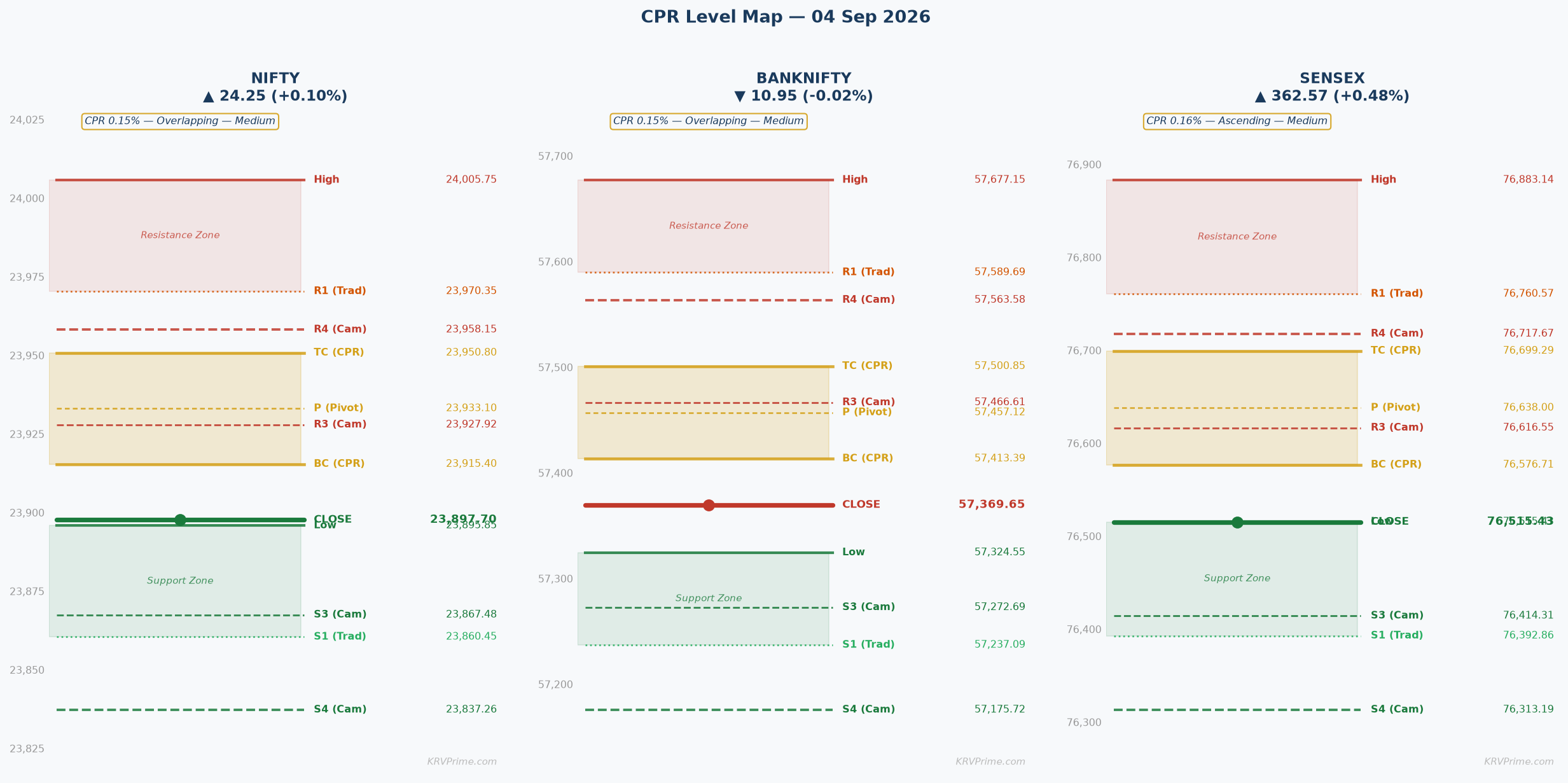
OI-R: 24,000 R3: 24,080.25 H6: 24,007.61 H5: 23,993.46 R2: 24,043.00 H4 ▶: 23,958.15 R1: 23,970.35 PDH: 24,005.75 H3 ↩: 23,927.92
TC: 23,950.80 P: 23,933.10 BC: 23,915.40
L3 ↩: 23,867.48 PDL: 23,895.85 S1: 23,860.45 L4 ▶: 23,837.26 S2: 23,823.20 L5: 23,801.96 L6: 23,787.79 S3: 23,750.55 OI-S: 23,000
↩ = Camarilla reversal point | ▶ = Camarilla breakout/breakdown trigger | OI-R/OI-S = Options wall (CE/PE max OI)
▲ Higher Open (Gap Up) — Open > Prev Close
▲ Bullish
Open lands: With NIFTY's Overlapping Medium CPR having BC at **23,915.40** and TC at **23,950.80**, and Friday's close at **23,897.70**, a gap-up open places price inside the CPR band — specifically between BC and TC — since the CPR band overlaps with the previous session's price range. A minor gap (+0.05% to +0.25%) would open between **23,909 and 23,957**, placing it squarely inside the CPR band. A significant gap (+0.25% to +0.50%) of roughly **+60 to +120 points** would open near or just above TC at **23,950.80 to 24,017**. A large gap (>+0.50%) would open above TC and potentially challenge the OI resistance wall at **24,000**.
CPR role: In a gap-up scenario, the Overlapping Medium CPR band (BC **23,915.40** to TC **23,950.80**) acts as a **launch pad** — if price opens inside the band and holds above P at **23,933.10**, bulls have structural control and the band provides immediate support beneath. However, if price opens above TC and fails to sustain, the entire band flips to overhead resistance, making it a **trap door** for premature longs.
Minor Gap (0.05–0.25%) — Structure Dominant
A minor gap-up of +0.05% to +0.25% (approximately +12 to +60 points) would place NIFTY's open between roughly **23,910 and 23,957**, landing inside the CPR band between BC **23,915.40** and TC **23,950.80**. The Overlapping Medium CPR structure means this open is not a clean breakout — price is within the decision zone, and the CPR acts as a compression band requiring a confirmed 30-minute close to assign directional bias. The first target on continuation above TC **23,950.80** is H4 at **23,958.15** followed by R1 at **23,970.35**, while a failure to hold BC **23,915.40** would shift the session bearish toward L3 at **23,867.48**; the Medium width confirmation rule requires a 30-minute candle close above TC before initiating fresh longs.
Significant Gap (0.25–0.5%) — Balanced
A significant gap-up of +0.25% to +0.50% (approximately +60 to +120 points) would open NIFTY between **23,957 and 24,017**, pushing price at or above TC **23,950.80** and directly into the OI resistance zone at **24,000** — a critical confluence of PDH at **24,005.75**, H6 at **24,007.61**, and the CE max-OI wall at **24,000**. The gap-fill risk is moderate to high since price would be opening into a zone where CE writers have built significant resistance; delta-hedging flows from market makers would suppress upside unless accompanied by strong cash market buying. The primary upside target is R2 at **24,043** only on a clean 30-minute close above **24,000**, while gap-fill downside targets are TC **23,950.80** then P **23,933.10** then BC **23,915.40** in succession.
Large Gap (>0.5%) — Gap Direction Dominant
A large gap-up exceeding +0.50% (+120 points or more) would open NIFTY above **24,017**, breaching both PDH **24,005.75** and the OI-R wall at **24,000**, opening directly into R2 territory at **24,043** and beyond. At these levels, the probability of a gap-fill back toward TC **23,950.80** is elevated since CE sellers at **24,000** would aggressively hedge by selling futures, creating mechanical overhead pressure. However, if Monday's opening sustains above **24,007.61** (H6) for two consecutive 30-minute closes, the structure becomes momentum-driven targeting R3 at **24,080.25**; the abort level for any long entered at the open would be a fall back below H5 **23,993.46**, and the weekly straddle of **176.15 points** already captures the theoretical maximum move, making chasing above **24,080** extremely high risk.
|
▲ Upside Path → OI-R Confirmed upside path: TC **23,950.80** → H4 **23,958.15** → R1 **23,970.35** → H5 **23,993.46** → OI-R **24,000** (PDH **24,005.75** / H6 **24,007.61**) → R2 **24,043**; each level must show price acceptance (minimum one 15-minute candle hold) before pressing the next, as the OI resistance at **24,000** is the primary ceiling where CE writing pressure is heaviest and partial profits should be booked. Genuine momentum is confirmed when R1 **23,970.35** is crossed with expanding volume and RSI divergence does not appear — in that case, the R2 **24,043** to R3 **24,080.25** zone becomes the session target, but note that Max Pain at **24,000** creates gravitational pull for Monday's weekly expiry. |
▼ Downside Path → OI-S If the gap-up fails and price breaks below BC **23,915.40** on a 30-minute close, the session structure turns bearish and the downside path accelerates through L3 **23,867.48** (first Camarilla support and mean-reversion zone), then S1 **23,860.45**, followed by L4 **23,837.26** which is the breakdown trigger — retail stop-losses cluster just below L3 and their triggering would mechanically push price toward L4 then L5 **23,801.96**. A loss of BC **23,915.40** fundamentally changes the CPR from launch pad to overhead resistance, invalidating the bullish thesis entirely for the session. |
| 🔴 OI-R: The OI resistance at **24,000** (CE max OI for the week) is the most critical ceiling for any gap-up scenario — CE writers have positioned their maximum concentration here, and as price approaches **24,000**, the gamma exposure of these short calls forces delta-neutral market makers to sell futures aggressively, creating a natural ceiling that is difficult to breach without a genuine fundamental catalyst. In a gap-up scenario where price opens near **24,000**, the OI-R acts as a **fade zone** — the optimal trade is to partially book longs at first touch of **24,000** and only press further if two 30-minute closes sustain above **24,007.61** (H6), because a sustained breach would trigger short-covering in CE positions, accelerating the move to R2 **24,043**. | 🟢 OI-S: The OI support at **23,000** (PE max OI) is entirely irrelevant as an intraday target in a gap-up scenario — it is approximately 900 points below Friday's close and represents a structural long-term put base, not a session-level concern. PE writers at **23,000** are deeply out-of-the-money and their positioning actually provides a broad macro floor for the market, meaning any intraday dip will find incremental buying interest well before approaching this level, effectively making it a distant backstop rather than a tactical reference. |
⚡ Key Trigger: The key trigger for a gap-up scenario is a **first 30-minute candle close above TC at 23,950.80** on above-average volume — this is the Medium CPR confirmation rule and it establishes that buyers have absorbed the CPR overhead and the band has transitioned from resistance to support. A failure to close above TC **23,950.80** within the first 30 minutes, with price slipping back below P at **23,933.10**, signals a gap-up fade and the bear trigger activates, targeting L3 at **23,867.48** and S1 at **23,860.45** as the first downside destinations.
▼ Lower Open (Gap Down) — Open < Prev Close
▼ Bearish
Open lands: With Friday's close at **23,897.70** and the CPR band sitting at BC **23,915.40** to TC **23,950.80** — entirely above the previous close — a gap-down open places NIFTY below BC **23,915.40** and below the entire CPR band. Even a near-flat open of -0.05% would land at approximately **23,886**, which is still below BC **23,915.40** by roughly 29 points, meaning the Overlapping CPR band is entirely overhead resistance in any gap-down scenario. The CPR band transitions to a **resistance ceiling** that bulls must reclaim on confirmation, and bears hold structural advantage below BC **23,915.40**.
CPR role: The CPR band (BC **23,915.40** to TC **23,950.80**) functions as **overhead resistance** in a gap-down scenario — bulls must fight their way back through BC, then P **23,933.10**, then TC **23,950.80** to neutralize the bearish structure, and each sub-level within the band acts as a successive hurdle. The CPR band becomes a **battleground zone** where the 30-minute reclaim rule determines the session character — failure to reclaim BC within the first 30 minutes confirms bears are in control for the day.
Minor Gap (0.05–0.25%) — Structure Dominant
A minor gap-down of -0.05% to -0.25% (-12 to -60 points) places NIFTY's open between roughly **23,838 and 23,886**, below BC **23,915.40** but above the PDL of **23,895.85** for the smallest gaps — notably, even the smallest gap-down opens below BC, making the CPR band fully overhead. Minor gaps have a historically high gap-fill probability of 60-70%, meaning price often attempts to reclaim BC **23,915.40** within the first 30-60 minutes; the bear case requires holding below BC for 30 minutes, after which L3 at **23,867.48** becomes the primary target followed by S1 at **23,860.45**.
Significant Gap (0.25–0.5%) — Balanced
A significant gap-down of -0.25% to -0.50% (-60 to -120 points) places NIFTY's open between **23,778 and 23,838**, breaking below PDL **23,895.85**, approaching the L4 **23,837.26** breakdown trigger zone and S2 **23,823.20**. At these levels, the gap-fill probability reduces and the failure-and-resume pattern is more likely — price may attempt a dead-cat bounce toward BC **23,915.40** in the first 15 minutes but if the 30-minute candle fails to close above BC, the resumption of the downtrend toward L4 **23,837.26** and L5 **23,801.96** becomes the high-probability path. PUT writers at **23,000** remain unconcerned, but fresh put buyers at strikes **23,800-23,850** would benefit from this scenario, and the weekly straddle of **176.15 points** means the downside theoretical range extends to approximately **23,724**, making L5 **23,801.96** a realistic bear target.
Large Gap (>0.5%) — Gap Direction Dominant
A large gap-down exceeding -0.50% (-120+ points) opens NIFTY below **23,778**, breaching L5 **23,801.96** at the open and entering a panic territory where stop-loss triggers from retail and algorithmic systems dominate the first 15 minutes. The L6 level at **23,787.79** becomes an immediate reference, and the psychological impact of opening below **23,800** would likely trigger additional selling as weekly put holders monetize their gains; however, large gap-downs in a balanced market structure (as flagged for NIFTY) often produce sharp V-shaped reversals within 45 minutes as value buyers emerge near L5-L6 and the straddle's put premium becomes expensive to hold. The recovery watch level is BC **23,915.40** — any two 30-minute closes back above this level signal a full gap-fill attempt targeting TC **23,950.80** and R1 **23,970.35**.
|
▲ Upside Path → OI-R Recovery upside path: BC **23,915.40** (30-min reclaim trigger) → P **23,933.10** → TC **23,950.80** → H3 **23,927.92** → H4 **23,958.15** → R1 **23,970.35** → OI-R **24,000**; each level in the CPR band acts as a successive resistance hurdle, and the recovery is only confirmed as genuine (vs dead-cat bounce) when price closes a 30-minute candle above TC **23,950.80** with volume exceeding the morning session average. A gap-fill trade that reclaims BC and TC by midday would target Max Pain at **24,000** as the session high, perfectly aligned with weekly expiry gravitational pull. |
▼ Downside Path → OI-S Confirmed bear downside path: L3 **23,867.48** (mean-reversion zone, first stall) → S1 **23,860.45** → L4 **23,837.26** (breakdown trigger where retail stops cluster) → S2 **23,823.20** → L5 **23,801.96** → L6 **23,787.79**; the acceleration between L3 and L4 is typically rapid as algorithmic stop-loss sweeping takes over once the Camarilla mean-reversion support fails. OI-S at **23,000** is a distant structural floor, not an intraday target, but weekly put buyers at **23,800** strikes would benefit significantly from a large gap-down session. |
| 🔴 OI-R: In a gap-down scenario, the OI resistance at **24,000** (CE max OI) shifts to an even more dominant ceiling — CE writers at **24,000** who are well out-of-the-money have no incentive to cover, meaning their gamma-neutral hedging involves selling rallies, which suppresses any recovery attempt from reaching above **24,000** without an extraordinary catalyst. The OI-R at **24,000** effectively caps the theoretical upside for any intraday recovery, making R1 **23,970.35** the realistic recovery target rather than the OI wall itself. | 🟢 OI-S: The OI support at **23,000** (PE max OI) is the primary structural put base — PE writers at this strike have a vested interest in defending **23,000** and will begin delta-hedging (buying futures) as price falls toward this level, creating a mechanical support floor; however, at roughly 900 points below the current price, this level is relevant only in extreme tail-risk scenarios and not as an intraday tactical reference. What matters more for a gap-down session is the **23,800** put OI concentration (if any from the weekly chain), which would be the nearer-term support that PE writers defend actively. |
⚡ Key Trigger: The key trigger in a gap-down scenario is **failure to reclaim BC at 23,915.40 within the first 30 minutes** — this is the defining line between a recoverable gap and a genuine bearish session. For bulls, the trigger is a 30-minute close back above BC **23,915.40** with expanding volume, which signals institutional buying at discount and targets P **23,933.10** then TC **23,950.80**; for bears, the trigger is a 30-minute close below L3 **23,867.48**, which confirms that selling pressure exceeds the Camarilla mean-reversion support and acceleration toward S1 **23,860.45** and L4 **23,837.26** is imminent.
◆ Near Flat Open — Open ≈ Prev Close (±0.05%)
◆ Neutral
Open lands: A ±0.05% flat open places NIFTY between approximately **23,886 and 23,910** — critically, this entire range sits **below BC at 23,915.40**, meaning even a flat open lands below the CPR band. The Overlapping CPR (BC **23,915.40** to TC **23,950.80**) is entirely overhead for a flat open, making the CPR band the overhead resistance structure that bulls must reclaim while bears hold positional advantage at the open.
CPR role: The CPR band functions as a **decision zone and overhead resistance** for a flat open — the 35-point wide band from BC **23,915.40** to TC **23,950.80** defines the battleground, and the first directional break with a 30-minute confirmation is the primary trade of the session. Since price opens below BC, the CPR is initially a **resistance ceiling**, but a sustained move back inside the band (above BC) would flip it to a **launch pad** for the session.
Near Flat (±0.05%)
A flat open in a Medium-width Overlapping CPR is a textbook high-information setup — the price opens below the entire CPR band (below BC **23,915.40**), creating an immediate structural test where the CPR acts as overhead resistance and the Camarilla L3 at **23,867.48** acts as the downside anchor. The critical levels are BC **23,915.40** as the bulls' first reclaim target and TC **23,950.80** as the bulls' session control level — a sustained trade above TC for one 30-minute candle confirms bullish control and targets R1 **23,970.35** and the OI resistance at **24,000**, while a sustained trade below BC after one 30-minute period confirms bearish control targeting L3 **23,867.48** and S1 **23,860.45**. Since the CPR width is 0.15% (Medium), this session has a moderate probability of trending in one direction once the CPR band is resolved — it is not a narrow CPR trend-day setup, but a consolidated range that will break with conviction once the 30-minute decision period ends. Traders should wait for the 09:45 IST candle close before entering — if above TC **23,950.80**, go long targeting H4 **23,958.15** then R1 **23,970.35** with stop below BC **23,915.40**; if below BC **23,915.40**, go short targeting L3 **23,867.48** then S1 **23,860.45** with stop above TC **23,950.80**.
|
▲ Upside Path → OI-R Upside path from flat open: BC **23,915.40** (reclaim entry) → P **23,933.10** → TC **23,950.80** (30-min confirmation close) → H3 **23,927.92** (note: H3 is inside the CPR band, confirming Camarilla mean sits within the band) → H4 **23,958.15** → R1 **23,970.35** → H5 **23,993.46** → OI-R **24,000** (Max Pain alignment for weekly expiry on 08 Sep) → R2 **24,043**; the OI-R at **24,000** is the session ceiling where partial exits are mandatory given CE writing concentration and Max Pain gravitational pull. |
▼ Downside Path → OI-S Downside path from flat open: BC **23,915.40** (30-min rejection confirmation) → L3 **23,867.48** (first Camarilla support, expect a stall here) → PDL **23,895.85** (note: PDL sits between BC and L3, providing minor interim support) → S1 **23,860.45** → L4 **23,837.26** (breakdown trigger — if crossed, algo stop-sweeps accelerate to L5) → S2 **23,823.20** → L5 **23,801.96** → L6 **23,787.79**; OI-S at **23,000** remains a distant structural floor not relevant for flat-open intraday sessions. |
| 🔴 OI-R: The OI resistance at **24,000** (CE max OI for the week expiring 08 Sep) is the dominant ceiling in a flat-open scenario — CE writers at this strike are maximally exposed and will aggressively delta-hedge by selling futures as price approaches, creating a mechanical resistance that is especially powerful the day before expiry when gamma is at its highest for near-term strikes. Traders should treat **24,000** as a mandatory partial-profit zone on any long trade — only hold above **24,000** for the final target of R2 **24,043** if two consecutive 30-minute candles close and sustain above the OI wall. | 🟢 OI-S: The OI support at **23,000** (PE max OI for the week) provides a broad macro psychological floor — put writers at **23,000** are deeply in profit on this position and have little reason to delta-hedge unless NIFTY falls catastrophically, making their contribution to intraday support minimal. In the context of a flat open with CPR as the primary battleground, OI-S at **23,000** is best treated as the **ultimate abort level** for weekly shorts — its distance from current price (~900 points) means it functions as a confidence anchor for medium-term bulls rather than an intraday reference level. |
⚡ Key Trigger: Bull trigger: **First 30-minute close above TC at 23,950.80** on above-average volume, confirming that the CPR band has been fully reclaimed and is now acting as support — this targets H4 **23,958.15**, R1 **23,970.35**, and ultimately Max Pain and OI-R at **24,000**. Bear trigger: **First 30-minute close below BC at 23,915.40** (which is essentially a hold at the open level), combined with increasing volume to the downside, confirms the CPR overhead resistance is holding and the session is bearish — targeting L3 **23,867.48** and S1 **23,860.45** in the first hour.
BANKNIFTY
Overlapping — Medium (Width 0.15%)
◆ Neutral
Market Structure Balanced or transitional | Straddle ATM 57400 monthly straddle = **1,348.20 points** (Call 855.20 + Put 493.00), implying an expected monthly move of approximately ±1,348 points — for an intraday session, traders typically apply 20-30% of this as the daily expected range, suggesting **±270 to ±400 points** as the intraday move expectation. The asymmetric premium structure (calls at 855.20 vs puts at 493.00) reflects a mild upside bias in BANKNIFTY option positioning, consistent with Max Pain at **57,500** being just above Friday's close of **57,369.65**. | Max Pain BANKNIFTY Month Max Pain = **57,500** (expiry 29 Sep 2026) — sitting only 130 points above Friday's close of **57,369.65**, this is an extremely tight Max Pain alignment that creates strong gravitational pull toward **57,500** for the near term. Option sellers face minimum loss at **57,500**, and the TC of Monday's CPR at **57,500.85** is virtually identical to the Max Pain strike, creating an extraordinary confluence that makes the **57,500** level the single most critical pivot of the session. |
Tomorrow's Complete Level Map
OI-R: 57,500 R3: 57,942.29 H6: 57,722.53 H5: 57,676.84 R2: 57,809.72 H4 ▶: 57,563.58 R1: 57,589.69 PDH: 57,677.15 H3 ↩: 57,466.61
TC: 57,500.85 P: 57,457.12 BC: 57,413.39
L3 ↩: 57,272.69 PDL: 57,324.55 L4 ▶: 57,175.72 L5: 57,062.46 L6: 57,016.77 OI-S: 57,000
↩ = Camarilla reversal point | ▶ = Camarilla breakout/breakdown trigger | OI-R/OI-S = Options wall (CE/PE max OI)
▲ Higher Open (Gap Up) — Open > Prev Close
▲ Bullish
Open lands: BANKNIFTY's Overlapping Medium CPR has BC at **57,413.39** and TC at **57,500.85**, with Friday's close at **57,369.65** — the entire CPR band is above the previous close, meaning any gap-up open lifts price into or above the CPR band. A minor gap-up (+0.05% to +0.25%) of approximately **+29 to +143 points** would open between **57,399 and 57,513**, placing price inside the CPR band from BC to just above TC. A significant gap (+0.25% to +0.50%) of **+143 to +287 points** would open between **57,513 and 57,657**, above TC **57,500.85** and approaching PDH **57,677.15**. A large gap (>+0.50%) would open above **57,657**, near or above the PDH and H5 **57,676.84**.
CPR role: In a gap-up scenario, the CPR band (BC **57,413.39** to TC **57,500.85**) acts as a **launch pad** when price opens inside it and holds — given the extraordinary Max Pain and OI-R confluence at **57,500**, the TC level **57,500.85** is simultaneously the CPR top and the OI resistance ceiling, creating an unusually powerful resistance that makes TC a **potential trap door** for bulls who chase above it without volume confirmation. The CPR band support at BC **57,413.39** is the line that defines whether the gap-up is sustainable or a fade.
Minor Gap (0.05–0.25%) — Structure Dominant
A minor gap-up of +0.05% to +0.25% (+29 to +143 points) would open BANKNIFTY between approximately **57,399 and 57,513**, placing it inside the CPR band between BC **57,413.39** and TC **57,500.85** — this is the most likely gap scenario given Friday's near-flat close and balanced market structure. The critical observation is that the OI resistance at **57,500** (CE max OI) coincides virtually exactly with TC **57,500.85**, meaning the top of the CPR band is simultaneously the options wall, creating double resistance at this level; the 30-minute confirmation rule requires a close above **57,500.85** before treating it as a breakout. The first target above TC is H4 **57,563.58** then R1 **57,589.69**, while below BC **57,413.39** the first bear target is L3 **57,272.69** and S1 **57,237.09**.
Significant Gap (0.25–0.5%) — Balanced
A significant gap-up of +0.25% to +0.50% (+143 to +287 points) would open BANKNIFTY between **57,513 and 57,657**, breaching TC **57,500.85** and the OI-R at **57,500** simultaneously at the open — this is an extremely high-risk opening configuration because price would gap directly through the OI resistance wall, triggering immediate CE short-covering (delta-hedging by market makers selling futures to remain neutral) that could rapidly reverse the gap. The gap-fill probability in this scenario is elevated to 65-75%, with BC **57,413.39** as the primary fill target; traders should wait for a two-candle sustained close above **57,500.85** before entering longs, as premature buying at the open into OI-R resistance often results in being trapped. If the gap holds above **57,513** for 30 minutes, the next target is PDH **57,677.15** then H5 **57,676.84**, but the OI-R at **57,500** must be confirmed as support (not resistance) first.
Large Gap (>0.5%) — Gap Direction Dominant
A large gap-up exceeding +0.50% (+287+ points) opens BANKNIFTY above **57,657**, breaching PDH **57,677.15** and H5 **57,676.84** at the open — this would place price in territory that was only visited intraday on Friday, creating an immediate overbought signal relative to the session's expected range defined by the monthly straddle. Large gap-ups of this magnitude into PDH resistance almost always produce at minimum a 50% gap-fill in BANKNIFTY's historically volatile sessions; the gap-fill target would be TC **57,500.85** at minimum, with full fill back to P **57,457.12** being common. Only a two 30-minute close sequence above H6 **57,722.53** would justify holding longs in a large gap-up, as this confirms genuine institutional demand and not just short-covering; the abort for any post-gap long is a fall back below TC **57,500.85**.
|
▲ Upside Path → OI-R Confirmed upside path: TC **57,500.85** (30-min breakout close) → H4 **57,563.58** (Camarilla breakout trigger, first acceleration zone) → R1 **57,589.69** (Traditional first target, partial profit zone) → PDH **57,677.15** / H5 **57,676.84** (second major resistance cluster, Friday's high) → H6 **57,722.53** → R2 **57,809.72** (only on extraordinary momentum). Volume must expand at each level — BANKNIFTY's typically wide intraday swings mean that a move from TC to R1 of approximately **89 points** is achievable in a single 30-minute candle, but H5 to H6 zone near **57,722** would represent the full bullish extension of the session. |
▼ Downside Path → OI-S Failure downside path: Rejection at TC **57,500.85** → P **57,457.12** → BC **57,413.39** → L3 **57,272.69** (Camarilla mean-reversion, strong stall expected) → PDL **57,324.55** (interim support between BC and L3) → S1 **57,237.09** → L4 **57,175.72** → OI-S **57,000** (PE max OI structural floor); the L3 at **57,272.69** is particularly important because it sits near PDL **57,324.55** and represents a zone where mean-reversion buyers typically enter aggressively in BANKNIFTY — only a close below L4 **57,175.72** signals a genuine breakdown toward the OI-S at **57,000**. |
| 🔴 OI-R: The OI resistance at **57,500** (CE max OI for the month) is uniquely powerful in BANKNIFTY because it aligns within 0.85 points of TC at **57,500.85** — this creates a scenario where the CPR top and the options wall are effectively the same level, meaning CE writers and CPR resistance reinforce each other simultaneously. Any gap-up that opens above **57,500** faces the combined mechanical selling pressure of CE delta-hedgers and CPR overhead — this dual force makes **57,500** one of the strongest resistance levels in recent BANKNIFTY history for this session, and CE writer pain only begins above **57,677** (PDH/H5) where in-the-money call losses start accumulating. | 🟢 OI-S: The OI support at **57,000** (PE max OI for the month) is approximately **370 points** below Friday's close, making it an intraday reachable level only in a large gap-down session — in a gap-up scenario, it is irrelevant as a downside target but provides a macro confidence floor for bulls. PE writers at **57,000** will begin delta-hedging (buying futures) if BANKNIFTY falls toward this level, providing a systematic support mechanism, and their continued presence ensures that any intraday dip in a gap-up session is met with incremental buying well above **57,000**. |
⚡ Key Trigger: The definitive key trigger for any gap-up in BANKNIFTY is a **first 30-minute candle close above TC at 57,500.85** — this is simultaneously the CPR breakout confirmation and the OI resistance breach signal, making it the most powerful directional trigger of the session. A 30-minute close above **57,500.85** with volume exceeding the opening 15-minute period activates the bull path toward H4 **57,563.58** and R1 **57,589.69**; failure to hold TC and a reversal below P **57,457.12** signals an aggressive fade back toward BC **57,413.39** and L3 **57,272.69**.
▼ Lower Open (Gap Down) — Open < Prev Close
▼ Bearish
Open lands: With Friday's close at **57,369.65** and BC at **57,413.39** and TC at **57,500.85** — both above the close — any gap-down opens BANKNIFTY further below BC, deepening the bearish positioning relative to the CPR. A minor gap-down (-0.05% to -0.25%) opens between **57,341 and 57,227**, below PDL **57,324.55** for gaps beyond -0.08%. A significant gap-down (-0.25% to -0.50%) of **-143 to -287 points** opens between **57,227 and 57,083**, approaching the OI support level at **57,000** and L6 **57,016.77** for the largest significant gaps. The Overlapping CPR band is entirely overhead in all gap-down scenarios, making bears structurally dominant at the open.
CPR role: The CPR band (BC **57,413.39** to TC **57,500.85**) acts as a **distant overhead resistance ceiling** in a gap-down — price must travel upward through BC, P **57,457.12**, and TC **57,500.85** sequentially to neutralize the bearish structure. The CPR band becomes a **recovery battleground** — each sub-level recovered (BC, P, TC) adds incremental bullish confidence, but failing to reclaim BC **57,413.39** on the first 30-minute candle confirms bears have full control for the session.
Minor Gap (0.05–0.25%) — Structure Dominant
A minor gap-down of -0.05% to -0.25% (-29 to -143 points) opens BANKNIFTY between approximately **57,227 and 57,341**, with the lower end of this range breaching PDL **57,324.55** and entering L3 **57,272.69** territory — the Camarilla mean-reversion support zone where institutional mean-reversion buyers are expected to step in. Minor gap-downs in BANKNIFTY have a 55-65% gap-fill probability given the index's liquidity and institutional participation; the CPR reclaim trade begins at BC **57,413.39** with a 30-minute close confirmation. If BC fails to reclaim, L3 **57,272.69** holds as mean-reversion support and S1 **57,237.09** becomes the first bear extension target.
Significant Gap (0.25–0.5%) — Balanced
A significant gap-down of -0.25% to -0.50% (-143 to -287 points) opens BANKNIFTY between **57,083 and 57,227**, breaching L3 **57,272.69** at the open and approaching the critical OI support zone at **57,000** — at these levels, PE writers at **57,000** begin systematic delta-hedging (futures buying) that creates a mechanical bid below **57,100**. The failure-and-resume analysis here is complex: price opens near L5 **57,062.46** or L4 **57,175.72** depending on exact gap size, and the 30-minute reclaim of L4 **57,175.72** followed by L3 **57,272.69** would signal a recovery; but sustained trade below L3 after 30 minutes confirms accelerated selling toward L5 **57,062.46** and OI-S **57,000**. The monthly straddle of **1,348.20 points** confirms that moves of this magnitude are within the statistically expected range for BANKNIFTY.
Large Gap (>0.5%) — Gap Direction Dominant
A large gap-down exceeding -0.50% (-287+ points) opens BANKNIFTY below **57,083**, breaching L5 **57,062.46** and potentially L6 **57,016.77**, placing price at or below the OI support level at **57,000** at the open — a catastrophic gap-down scenario that would trigger panic selling from leveraged long positions and weekly option holders. At the **57,000** OI-S level, PE writers face maximum stress and are forced to buy futures aggressively, creating a sharp mechanical bid that often produces a V-shaped recovery — the straddle play here is to wait for the first 15-minute capitulation, then buy BANKNIFTY above L5 **57,062.46** targeting BC **57,413.39** as the recovery destination. The abort for any counter-trend recovery long is a sustained close below L6 **57,016.77**, which would indicate an extraordinary breakdown beyond any scenario the CPR structure anticipates.
|
▲ Upside Path → OI-R Recovery upside path: L3 **57,272.69** (mean-reversion stabilization) → PDL **57,324.55** → BC **57,413.39** (30-min reclaim confirmation, critical bull trigger) → P **57,457.12** → H3 **57,466.61** → TC **57,500.85** / OI-R **57,500** (Max Pain convergence target) → H4 **57,563.58** → R1 **57,589.69**; the Max Pain at **57,500** makes TC the ultimate recovery target since option sellers benefit from price gravitating here, and a recovery to TC from a gap-down constitutes a complete reversal of the gap-down thesis. |
▼ Downside Path → OI-S Confirmed bear downside path: PDL **57,324.55** (interim support, minor stall) → L3 **57,272.69** (mean-reversion support zone, expect 5-10 minute consolidation) → S1 **57,237.09** → L4 **57,175.72** (breakdown trigger, algo stop-sweeps accelerate below here) → S2 **57,104.52** → L5 **57,062.46** → L6 **57,016.77** → OI-S **57,000** (PE max OI, PE writer delta-hedging creates mechanical bid); the OI-S at **57,000** is the primary downside floor and the most likely reversal point even in an extreme gap-down. |
| 🔴 OI-R: The OI resistance at **57,500** (CE max OI) acts as a powerful **overhead ceiling** in a gap-down scenario — CE writers at **57,500** are deeply in profit on their positions and have no gamma pressure to cover, meaning their delta-neutral hedging involves selling any futures rallies toward this level. This makes **57,500** (TC **57,500.85**) the maximum realistic recovery target for any gap-down session — traders executing the CPR reclaim trade should use **57,500** as their profit exit level rather than expecting further upside. | 🟢 OI-S: The OI support at **57,000** (PE max OI) is the **primary downside target and mechanical reversal zone** in a significant or large gap-down — PE writers at **57,000** begin systematic futures buying as price approaches this level to delta-hedge their short put positions, creating a bid that becomes increasingly powerful the closer price gets to **57,000**. The **57,000** level also represents a major round-number psychological support that retail traders treat as a stop-loss reference, meaning a touch of this level in a gap-down would simultaneously trigger PE writer hedging and retail stop-loss orders, creating both selling (stops being triggered) and buying (PE writer hedging) that typically results in a sharp reversal. |
⚡ Key Trigger: The key trigger in a BANKNIFTY gap-down is **failure to reclaim BC at 57,413.39 on the first 30-minute candle** — this is the definitive bear confirmation, signalling that institutional money is not stepping in for the recovery and the CPR band remains fully overhead. The bull recovery trigger requires a 30-minute close above BC **57,413.39** with BANKNIFTY volume exceeding the session opening average, after which P **57,457.12** and TC **57,500.85** become sequential targets in a step-by-step recovery that also serves as a Max Pain convergence trade.
◆ Near Flat Open — Open ≈ Prev Close (±0.05%)
◆ Neutral
Open lands: A ±0.05% flat open places BANKNIFTY between approximately **57,341 and 57,398** — the entire range sits below BC **57,413.39**, meaning even a flat open is structurally bearish relative to the CPR band. The CPR band (BC **57,413.39** to TC **57,500.85**) is entirely overhead, and the flat open places price 15-72 points below BC, making the CPR a clear overhead resistance structure that bears can lean against without confirmation while bulls need a 30-minute reclaim of BC to establish control.
CPR role: The CPR band acts as a **decision zone ceiling** — price opens below the band, and the first 30-minute candle determines whether bulls can reclaim BC **57,413.39** or bears press the advantage toward L3 **57,272.69**. The band's role transitions from resistance ceiling to launch pad only when BC is closed above on a 30-minute basis, after which the P **57,457.12** and TC **57,500.85** / OI-R **57,500** cluster become the primary bull targets.
Near Flat (±0.05%)
A flat open in BANKNIFTY's Medium Overlapping CPR is a high-probability directional setup once the 30-minute period resolves — price opens below BC **57,413.39** (entire CPR is overhead), making the initial structural bias bearish but with the Max Pain gravitational pull at **57,500** (TC **57,500.85**) creating a strong incentive for option sellers to engineer an upward drift. The critical decision levels are BC **57,413.39** (bull reclaim trigger) and L3 **57,272.69** (bear acceleration trigger) — a flat open approximately **57,370** is 43 points below BC and 98 points above L3, placing price in a mid-range zone where the first 30-minute directional move has maximum follow-through potential. The CPR width of 0.15% (Medium) means this is not a high-probability single-direction trend day, but rather a session where the direction of the CPR breakout (up through TC **57,500.85** or down through L3 **57,272.69**) sets up a sustained 2-hour directional move before mean-reversion. Both triggers must be traded with the first 30-minute confirmation rule: bull entry above BC **57,413.39** targeting TC **57,500.85** and H4 **57,563.58**, with stop below PDL **57,324.55**; bear entry below L3 **57,272.69** targeting S1 **57,237.09** and L4 **57,175.72**, with stop above BC **57,413.39**.
|
▲ Upside Path → OI-R Flat open bull upside path: BC **57,413.39** (30-min reclaim) → P **57,457.12** → H3 **57,466.61** (Camarilla mean, inside CPR band) → TC **57,500.85** / OI-R **57,500** (Max Pain = TC = OI-R — triple confluence, mandatory partial exit) → H4 **57,563.58** → R1 **57,589.69** → PDH **57,677.15** / H5 **57,676.84** (only on extraordinary volume and second 30-min close above H4). The TC/OI-R/Max Pain triple confluence at **57,500** is the primary take-profit level and should be treated as a full exit zone unless two 30-minute candles sustain above **57,500.85**. |
▼ Downside Path → OI-S Flat open bear downside path: PDL **57,324.55** (first interim support between open and L3) → L3 **57,272.69** (30-min break confirmation, bear acceleration trigger) → S1 **57,237.09** → L4 **57,175.72** (Camarilla breakdown level, algo selling activates) → S2 **57,104.52** → L5 **57,062.46** → L6 **57,016.77** → OI-S **57,000** (PE max OI systematic bid); the L3 to L4 zone of approximately **97 points** is the highest-probability single move in a bear session, as it represents the Camarilla stall-to-breakdown transition that BANKNIFTY is known for executing rapidly. |
| 🔴 OI-R: The OI resistance at **57,500** (CE max OI) is simultaneously the Max Pain strike and virtually identical to TC **57,500.85** — this makes **57,500** the most powerful single level in Monday's BANKNIFTY session, acting as a triple-force ceiling (CE writing pressure + CPR resistance + Max Pain gravitational convergence). In a flat-open scenario, **57,500** is the ideal target for a CE-writing strangle strategy that benefits from price gravitating toward this level — traders who sell the 57500 CE and the 57000 PE are aligned with option seller interests, but directional traders should treat **57,500.85** as the maximum long exit unless the breakout is confirmed by two 30-minute closes. | 🟢 OI-S: The OI support at **57,000** (PE max OI) provides a structural floor approximately **370 points** below the flat open — PE writers at **57,000** are positioned to benefit from any session that avoids reaching this level, meaning their delta-hedging (futures buying near **57,000**) creates a mechanical support that makes the **57,000** level extremely difficult to breach without an extraordinary catalyst. In a flat-open session, OI-S at **57,000** is best used as the **stop-loss anchor for short positions** — any short entered at L3 **57,272.69** should not be held below OI-S **57,000** since PE writer buying at this level creates aggressive reversal moves. |
⚡ Key Trigger: Bull trigger: **First 30-minute candle close above BC at 57,413.39**, confirming institutional buying at the CPR lower band and targeting P **57,457.12** then TC **57,500.85** (which also equals OI-R and Max Pain — the most powerful confluence in today's data). Bear trigger: **First 30-minute candle close below L3 at 57,272.69**, which confirms that mean-reversion support has failed and the Camarilla breakdown path is active, targeting S1 **57,237.09** and L4 **57,175.72** in quick succession as retail stop-losses below L3 amplify the move.
SENSEX
Ascending — Medium (Width 0.16%)
▲ Bullish
Market Structure Balanced or transitional | Straddle ATM 76500 weekly straddle = **815.20 points** (Call 538.45 + Put 276.75), implying an expected intraday move of approximately ±815 points from 76,500 for the week — on a single session basis this implies approximately **±163 to ±245 points** as the intraday range estimate. The asymmetric premium structure (calls at 538.45 vs puts at 276.75) reveals a strong upside skew — CE premium is nearly double PE premium — indicating that option participants are paying significantly more to hedge or speculate on upside, consistent with the Ascending CPR structure and the Max Pain at **76,700** being above Friday's close. | Max Pain SENSEX Week Max Pain = **76,700** (expiry 10 Sep 2026) — sitting **184.57 points** above Friday's close of **76,515.43**, this creates meaningful gravitational pull toward **76,700** for the Wednesday expiry. The Ascending CPR's TC at **76,699.29** is virtually identical to the Max Pain strike at **76,700**, creating an extraordinary dual-force confluence — option sellers benefit from price converging at **76,699-76,700**, making this the session's primary target in any bullish scenario. |
Tomorrow's Complete Level Map
OI-R: 77,000 R3: 77,128.28 H6: 76,883.14 H5: 76,835.78 R2: 77,005.71 H4 ▶: 76,717.67 R1: 76,760.57 PDH: 76,883.14 H3 ↩: 76,616.55
TC: 76,699.29 P: 76,638.00 BC: 76,576.71
L3 ↩: 76,414.31 PDL: 76,515.43 L4 ▶: 76,313.19 L5: 76,195.08 L6: 76,147.72 OI-S: 75,000
↩ = Camarilla reversal point | ▶ = Camarilla breakout/breakdown trigger | OI-R/OI-S = Options wall (CE/PE max OI)
▲ Higher Open (Gap Up) — Open > Prev Close
▲ Bullish
Open lands: SENSEX has an Ascending CPR where BC **76,576.71** > Friday's close of **76,515.43** (PDC = PDL, meaning Friday closed at the day's low). For an Ascending CPR, a flat open would be near BC and a gap-up would push price inside the CPR band or above TC **76,699.29**. A minor gap-up of +0.05% to +0.25% (+38 to +191 points) opens between **76,553 and 76,706**, landing inside the CPR band between BC **76,576.71** and TC **76,699.29** or just above TC. A significant gap (+0.25% to +0.50%) of **+191 to +383 points** opens between **76,706 and 76,898**, above TC and approaching or above PDH **76,883.14**. A large gap (>+0.50%) would open above **76,898** and potentially approach R1 **76,760.57** or beyond.
CPR role: In a gap-up scenario for an Ascending CPR, the band (BC **76,576.71** to TC **76,699.29**) acts as a **launch pad** — the Ascending structure means the CPR is positioned above the previous close by design, and a gap-up that opens inside or above TC confirms the ascending trend is accelerating. The TC at **76,699.29** (virtually identical to Max Pain **76,700**) makes it simultaneously the CPR top and the options gravitational center — a gap-up that holds above TC is an extraordinarily bullish configuration.
Minor Gap (0.05–0.25%) — Structure Dominant
A minor gap-up of +0.05% to +0.25% (+38 to +191 points) opens SENSEX between approximately **76,553 and 76,706**, placing it inside the Ascending CPR band between BC **76,576.71** and TC **76,699.29** — an ideal setup for the Ascending CPR launch pad scenario where price opens inside the band with the bullish structure fully intact. The 30-minute confirmation rule for Medium CPR requires a close above TC **76,699.29** (also Max Pain **76,700**) before initiating new longs, as the first 30 minutes will determine if the ascending structure holds or if the close at the day's low on Friday signals residual selling pressure. On confirmation above TC **76,699.29**, targets are H4 **76,717.67**, R1 **76,760.57**, H5 **76,835.78**, and PDH **76,883.14** in sequence; below BC **76,576.71**, the ascending CPR's launch pad premise is invalidated and the bear path targets L3 **76,414.31**.
Significant Gap (0.25–0.5%) — Balanced
A significant gap-up of +0.25% to +0.50% (+191 to +383 points) opens SENSEX between **76,706 and 76,898**, above TC **76,699.29** and Max Pain **76,700**, entering the zone between H4 **76,717.67** and PDH **76,883.14** / H6 **76,883.14** — a zone that constitutes Friday's full intraday range upper boundary. Opening above TC in an Ascending CPR is the most bullish configuration possible — price opens above the entire CPR band, confirming the ascending trend with strong momentum; however, the gap-fill risk toward TC **76,699.29** is moderate, and delta-hedging from CE writers near the OI-R at **77,000** will begin applying pressure as price approaches R1 **76,760.57**. The first 30-minute candle behavior above TC **76,699.29** is critical — hold and expand = target R1 **76,760.57** then R2 **77,005.71**; reversal and gap-fill = BC **76,576.71** as minimum fill target.
Large Gap (>0.5%) — Gap Direction Dominant
A large gap-up exceeding +0.50% (+383+ points) would open SENSEX above **76,898**, effectively opening at or above PDH **76,883.14** / H6 **76,883.14**, which is Friday's absolute high and a maximum stress point for daily bearish options positions. This is a gap into completely untraded territory from Friday's session, and while the Ascending CPR structure is maximally bullish, the gap premium (measured by comparing opening to straddle cost of **815.20 points**) would be extreme — any single-session gap-up exceeding 0.50% in SENSEX consumes most of the week's straddle range in one move. Two 30-minute closes above H6 **76,883.14** are required to confirm genuine momentum rather than a short-squeeze; the primary target in a large gap-up is OI-R **77,000** which aligns with R2 **77,005.71**, and the abort level is TC **76,699.29** / Max Pain **76,700**.
|
▲ Upside Path → OI-R Confirmed upside path: TC **76,699.29** / Max Pain **76,700** (30-min hold above = launch confirmation) → H4 **76,717.67** (Camarilla breakout trigger) → R1 **76,760.57** (first traditional target, partial profit) → H5 **76,835.78** → PDH **76,883.14** / H6 **76,883.14** (Friday's high cluster, second partial exit) → OI-R **77,000** / R2 **77,005.71** (OI resistance wall and second traditional target, full exit zone). Volume confirmation at each level is essential — SENSEX requires stronger cash market volume than Friday's session to break above PDH **76,883.14**, and OI-R **77,000** has CE writer concentration that makes it a mandatory full exit unless month-end institutional flows are driving the move. |
▼ Downside Path → OI-S Gap-up failure downside path: Rejection at TC **76,699.29** → P **76,638.00** → BC **76,576.71** (30-min close below = ascending CPR premise destroyed) → PDL **76,515.43** (Friday's close = ascending CPR's absolute support) → L3 **76,414.31** (Camarilla mean-reversion, first stall) → S1 **76,392.86** → L4 **76,313.19** → OI-S **75,000** (distant PE floor). A break below PDL **76,515.43** in a gap-up session is particularly bearish for SENSEX as it means price has not only failed to follow through but has breached the previous session's low on a day that opened higher — a classic bull trap signal. |
| 🔴 OI-R: The OI resistance at **77,000** (CE max OI for SENSEX week and month) is the definitive session ceiling — CE writers at **77,000** have concentrated their positions here, and as price approaches, gamma hedging forces market makers to sell futures, creating mechanical resistance that grows exponentially as price nears **77,000**. In a gap-up scenario, **77,000** is the ultimate target but also the mandatory full-exit zone — it aligns with R2 **77,005.71**, making the **77,000-77,006** band the highest-probability reversal zone of the session where longs should be fully exited and CE sellers can initiate new shorts. | 🟢 OI-S: The OI support at **75,000** (PE max OI for both SENSEX week and month) is approximately **1,515 points** below Friday's close — in a gap-up scenario it is entirely irrelevant as a downside target but provides an enormous macro confidence floor for SENSEX bulls. PE writers at **75,000** are deeply in profit and their systematic delta-hedging creates a mechanical bid far below current prices, confirming that any dip during a gap-up session will find incremental institutional buying well before approaching **75,000**, making this OI-S level the ultimate long-term support anchor. |
⚡ Key Trigger: The key trigger for any gap-up in SENSEX is a **first 30-minute candle close above TC at 76,699.29** — this level is uniquely powerful because it simultaneously represents the Ascending CPR top, the Max Pain strike (**76,700**), and the transition from CPR band to free-running bullish territory, making it the most information-rich single level in Monday's SENSEX session. A confirmed close above **76,699.29** establishes TC as support, activates the bullish Ascending CPR trajectory, and targets H4 **76,717.67**, R1 **76,760.57**, and ultimately OI-R **77,000** / R2 **77,005.71**; rejection at TC and a 30-minute close below BC **76,576.71** invalidates the ascending thesis and triggers a bearish reversal targeting L3 **76,414.31**.
▼ Lower Open (Gap Down) — Open < Prev Close
▼ Bearish
Open lands: SENSEX has an Ascending CPR where BC **76,576.71** is above Friday's close of **76,515.43** (PDC = PDL). For the Ascending CPR framework, a gap-down open places price further below BC — amplifying the bearish positioning below the entire ascending band. A minor gap-down (-0.05% to -0.25%) of -38 to -191 points opens between **76,324 and 76,477**, below both PDL **76,515.43** and BC **76,576.71**. A significant gap-down (-0.25% to -0.50%) opens between **76,133 and 76,324**, approaching L4 **76,313.19** territory. A large gap-down exceeds **-383 points**, opening below **76,133** near L5 **76,195.08** or L6 **76,147.72**.
CPR role: The Ascending CPR band (BC **76,576.71** to TC **76,699.29**) is an **overhead resistance ceiling** in a gap-down — the ascending structure means the entire band was designed to be above yesterday's price, and a gap-down moves price even further below BC, giving bears maximum structural control. The CPR band role in this scenario is a **distant recovery target** — reclaiming BC **76,576.71** is the minimum required for bulls to argue the ascending structure is intact; below BC, the ascending CPR's bullish premise is entirely negated for the session.
Minor Gap (0.05–0.25%) — Structure Dominant
A minor gap-down of -0.05% to -0.25% (-38 to -191 points) opens SENSEX between approximately **76,324 and 76,477**, below PDL **76,515.43** (Friday's close = Friday's low = the day's absolute low) — opening below the previous session's low on a gap-down in an Ascending CPR is an immediate bearish signal. The gap-fill probability toward BC **76,576.71** remains moderate at 50-60% given SENSEX's mean-reverting tendency; the 30-minute reclaim of PDL **76,515.43** followed by BC **76,576.71** is the recovery sequence, while failure to reclaim PDL on the 30-minute candle confirms the bear path toward L3 **76,414.31** and S1 **76,392.86**. The Ascending CPR structure means two consecutive sessions would be below the ascending band — a structural warning that the ascending multi-day trend may be reversing.
Significant Gap (0.25–0.5%) — Balanced
A significant gap-down of -0.25% to -0.50% (-191 to -383 points) opens SENSEX between **76,133 and 76,324**, breaching L4 **76,313.19** at the open for larger gaps and approaching L5 **76,195.08** — at these levels, the Ascending CPR structure is severely damaged as price is now approximately 500+ points below TC **76,699.29**. The failure-and-resume probability is elevated in this range: SENSEX often produces a sharp 15-minute spike low followed by a recovery attempt toward PDL **76,515.43** and BC **76,576.71**, driven by large-cap stock-specific buying (SBI, RELIANCE, HDFC Bank adjustments); traders should wait for the 30-minute candle before entering recovery longs, using L4 **76,313.19** as the stop for any long position. If 30-minute close holds below L3 **76,414.31**, the bear path targets S1 **76,392.86**, L4 **76,313.19**, S2 **76,270.29**, and L5 **76,195.08** in rapid succession.
Large Gap (>0.5%) — Gap Direction Dominant
A large gap-down exceeding -0.50% (-383+ points) would open SENSEX below **76,133**, near or below L6 **76,147.72** and L5 **76,195.08** — entering territory that represents an extreme tail-risk scenario for the index. Panic selling dynamics dominate the first 15 minutes, with SENSEX futures gap arbitrage with underlying stocks creating additional volatility; the straddle at **815.20 points** would be largely monetized on the opening 15-minute candle, making weekly straddle holders the primary beneficiaries. Recovery above L4 **76,313.19** on two 30-minute closes is the minimum required to declare the panic is over, targeting L3 **76,414.31** and PDL **76,515.43** as successive recovery waypoints; any short entered at the open should be covered at L5 **76,195.08** as PE writer delta-hedging near OI-S **75,000** creates a systematic bid that prevents catastrophic single-session collapses below key support clusters.
|
▲ Upside Path → OI-R Recovery upside path: PDL **76,515.43** (first reclaim waypoint) → BC **76,576.71** (30-min reclaim = ascending CPR restored as support) → P **76,638.00** → H3 **76,616.55** (Camarilla mean, inside band) → TC **76,699.29** / Max Pain **76,700** (primary recovery target and mandatory partial exit) → H4 **76,717.67** → R1 **76,760.57**; the TC/Max Pain convergence at **76,699-76,700** is the most realistic maximum recovery target in a gap-down session as option seller positioning creates strong resistance at this level that is difficult to push through without fresh institutional buying. |
▼ Downside Path → OI-S Bear downside path: PDL **76,515.43** (rejection zone) → L3 **76,414.31** (30-min close below confirms bear acceleration) → S1 **76,392.86** → L4 **76,313.19** (Camarilla breakdown trigger, stop-loss cascade zone) → S2 **76,270.29** → L5 **76,195.08** → L6 **76,147.72** → OI-S **75,000** (distant PE floor, systematic bid); the L3 to L4 range of approximately **101 points** is the highest-conviction single-move in a SENSEX bear session, as Camarilla mean-reversion failure between L3 and L4 activates systematic selling algorithms that drive rapid price discovery toward S2 and L5. |
| 🔴 OI-R: The OI resistance at **77,000** (CE max OI) is a distant and irrelevant level in a significant or large gap-down scenario — CE writers at **77,000** are deeply in profit and have no hedging pressure, meaning they are not active sellers in the session; their positions are beneficial for the market in a gap-down scenario as the deeply OTM calls reduce the effective gamma risk in the overall options portfolio. In a minor gap-down where recovery toward **76,700-77,000** is plausible, **77,000** (R2 **77,005.71**) serves as the maximum theoretical recovery ceiling — traders executing the CPR reclaim trade should use TC **76,699.29** (Max Pain) as the exit rather than targeting OI-R **77,000** on a gap-down recovery day. | 🟢 OI-S: The OI support at **75,000** (PE max OI for week and month) is the most powerful structural floor in SENSEX — PE writers at **75,000** have the largest concentration of put positions, and their delta-hedging (systematic futures buying as price falls toward **75,000**) creates an increasingly powerful bid that makes a sustained breach below **75,000** essentially impossible in a single session without a market-wide catastrophe. In a gap-down scenario, traders should take comfort from the OI-S at **75,000** providing a macro backstop approximately **1,515 points** below current price — this means even the most severe single-session sell-off would not threaten the structural PE support, and bears should target only L5 **76,195.08** to L6 **76,147.72** as realistic downside rather than any expectation of approaching **75,000** intraday. |
⚡ Key Trigger: The key trigger in a SENSEX gap-down is **reclaim or rejection at PDL 76,515.43 on the first 30-minute candle** — since Friday closed at the day's low (PDC = PDL), this level represents the last price transacted on Friday and is the most recent market consensus price; a reclaim signals buyers are absorbing the gap-down at fair value, while rejection confirms the gap-down has merit and bears control. Bull recovery trigger: 30-minute close above PDL **76,515.43** then BC **76,576.71**, targeting P **76,638.00** and TC **76,699.29** (Max Pain **76,700**); bear continuation trigger: 30-minute close below L3 **76,414.31**, targeting S1 **76,392.86** and L4 **76,313.19**.
◆ Near Flat Open — Open ≈ Prev Close (±0.05%)
◆ Neutral
Open lands: A ±0.05% flat open places SENSEX between approximately **76,477 and 76,554** — below BC **76,576.71**, meaning even a flat open lands below the Ascending CPR band. Crucially, Friday's close was at **76,515.43** which equalled the day's low (PDL = PDC), so a flat open at approximately **76,515** is at a structurally weak level — the last price on Friday was the lowest of the session. The Ascending CPR (BC **76,576.71** to TC **76,699.29**) sits entirely overhead, making the flat open the most nuanced setup — the ascending structure implies bullish intent but the previous close at the day's low implies exhaustion.
CPR role: The Ascending CPR band acts as a **decision zone with bullish intent but bearish open** — the ascending structure is designed to pull price upward into the BC **76,576.71** to TC **76,699.29** band, creating a natural gravitational pull toward P **76,638.00** and the Max Pain/TC confluence at **76,699-76,700**. However, price opening below BC in an ascending CPR means it opens as a **recovery setup** — BC **76,576.71** is the first resistance that bulls must clear, and clearing it transitions the band from overhead resistance to a launch pad for the Max Pain convergence trade.
Near Flat (±0.05%)
A flat open in SENSEX's Ascending Medium CPR is a high-information setup where the structural tension between the ascending CPR (bullish design) and the flat open below BC (bearish positioning at the open) creates a clear two-way trade with well-defined triggers. The critical levels are BC **76,576.71** (bull reclaim trigger), PDL **76,515.43** (the previous session's low which is also Friday's close — a key psychological reference), and L3 **76,414.31** (the bear acceleration trigger below which Camarilla mean-reversion fails); traders must wait for the 30-minute candle to establish the session direction since a flat open inside a balanced structure lacks momentum bias. The TC **76,699.29** / Max Pain **76,700** confluence is the most important target level in Monday's SENSEX session — option sellers need price at **76,699-76,700** to minimize losses, creating systematic buying pressure throughout the session that makes a drift toward TC the highest-probability single outcome. The trading plan: wait for 30-minute candle close — if above BC **76,576.71**, go long targeting P **76,638.00**, TC **76,699.29** (Max Pain, primary exit), and H4 **76,717.67** with stop below PDL **76,515.43**; if 30-minute candle fails to reach BC and closes below PDL **76,515.43**, initiate short targeting L3 **76,414.31** and S1 **76,392.86** with stop above BC **76,576.71**.
|
▲ Upside Path → OI-R Flat open bull upside path: PDL **76,515.43** (open reference, hold above confirms no further selling) → BC **76,576.71** (30-min close above = primary bull trigger) → H3 **76,616.55** (Camarilla mean, first stall inside CPR band) → P **76,638.00** → TC **76,699.29** / Max Pain **76,700** (primary target, mandatory partial or full exit — TC = Max Pain = CPR top, triple force) → H4 **76,717.67** (Camarilla breakout trigger, only on two 30-min closes above TC) → R1 **76,760.57** → H5 **76,835.78** → PDH **76,883.14** / H6 **76,883.14** → OI-R **77,000** / R2 **77,005.71** (maximum session ceiling). The TC/Max Pain at **76,699.29** is the single most important profit-taking level — it represents where option sellers need price to be and is the dominant gravitational force in the session. |
▼ Downside Path → OI-S Flat open bear downside path: PDL **76,515.43** (first bear confirmation close below) → L3 **76,414.31** (Camarilla mean-reversion zone, 30-min close below = full bear confirmation) → S1 **76,392.86** → L4 **76,313.19** (Camarilla breakdown trigger, stop-cascade activation) → S2 **76,270.29** → L5 **76,195.08** → L6 **76,147.72** → OI-S **75,000** (distant PE floor, systematic PE writer bid activates near this level). Note that the descending Camarilla sequence from L3 to L4 spans approximately **101 points** in SENSEX — this constitutes approximately 12% of the weekly straddle cost of **815.20 points**, making it a meaningful but not extreme move within the session's expected range. |
| 🔴 OI-R: The OI resistance at **77,000** (CE max OI for both SENSEX week and month — a dual-expiry concentration) is the dominant ceiling for the entire weekly series through 10 Sep 2026 — CE writers have concentrated their maximum exposure at **77,000**, and the gamma pressure from these short calls means any approach toward **77,000** triggers mechanical selling from market-maker delta-hedging. In a flat-open scenario where the primary target is TC/Max Pain at **76,699-76,700**, the OI-R at **77,000** is a secondary ceiling that only becomes relevant on an exceptionally strong bullish session — it aligns with R2 **77,005.71**, making **77,000-77,006** a mandatory full-exit zone that should not be chased under any circumstances in a flat-open balanced session. | 🟢 OI-S: The OI support at **75,000** (PE max OI for SENSEX week and month) is the structural anchor of the entire SENSEX option market for the current monthly cycle — PE writers at **75,000** are the most profitable positioned participants and their systematic buying on any dip toward **75,000** creates an increasingly powerful mechanical floor. In a flat-open session for SENSEX, the OI-S at **75,000** provides psychological confidence for medium-term bulls and keeps the overall options market calibrated toward a bullish bias — the gap between current prices (~76,515) and OI-S (75,000) of approximately **1,515 points** means the market is currently pricing in only modest downside risk, supporting the thesis that flat-open sessions in this configuration should ultimately drift toward Max Pain at **76,700** rather than toward the downside. |
⚡ Key Trigger: Bull trigger: **First 30-minute candle close above BC at 76,576.71** with expanding volume — this is the Ascending CPR reclaim signal that confirms the bullish multi-session structure is intact and price is following the ascending design toward TC **76,699.29** (Max Pain **76,700**). Bear trigger: **First 30-minute candle close below PDL at 76,515.43** (Friday's low) — a close below the previous session's absolute low in an ascending CPR structure is a structural reversal signal, confirming that the ascending trend has failed and the session is bearish, targeting L3 **76,414.31** and S1 **76,392.86**; this is a more aggressive bear trigger than BC since PDL provides earlier confirmation.
📊 VIX Insight: India VIX data was unavailable for the 04 Sep 2026 session, which itself is a noteworthy signal — the absence of VIX data prevents precise calibration of option premium richness or cheapness, and traders should therefore rely entirely on straddle pricing as the surrogate volatility measure. With NIFTY's weekly straddle at **176.15 points** (±0.74% of ATM), BANKNIFTY's monthly straddle at **1,348.20 points** (±2.35% of ATM), and SENSEX's weekly straddle at **815.20 points** (±1.07% of ATM), implied volatility appears moderate — consistent with a consolidative pre-holiday or pre-event positioning environment where neither strong fear nor extreme complacency is evident. For Monday 07 Sep 2026, the absence of VIX should prompt traders to size positions conservatively (reduce leverage by 15-20% versus a VIX-confirmed session) and to treat the straddle values as hard boundary markers for defining stop-loss levels and target distances.
Overall View:
All three indices head into Monday 07 Sep 2026 with a structurally identical challenge — their respective CPR bands for Monday are positioned entirely or largely above Friday's closes, placing the opening bias below overhead resistance in every case. NIFTY and BANKNIFTY carry Overlapping Medium CPRs (both 0.15% width) with balanced market structures, while SENSEX has the most bullish configuration with an Ascending Medium CPR (0.16% width) whose TC at **76,699.29** virtually perfectly aligns with Max Pain at **76,700** and OI-R at **77,000** — making SENSEX the index with the strongest gravitational pull toward a defined target. The cross-index directional trade for Monday is to watch BANKNIFTY's TC/**57,500.85** (also Max Pain and OI-R — a triple confluence) as the session's leading indicator — if BANKNIFTY sustains above **57,500** on the first 30-minute candle, expect NIFTY to challenge its OI-R at **24,000** and SENSEX to press toward **76,700**, creating a broad market recovery toward Max Pain levels across all three indices simultaneously.
All three indices head into Monday 07 Sep 2026 with a structurally identical challenge — their respective CPR bands for Monday are positioned entirely or largely above Friday's closes, placing the opening bias below overhead resistance in every case. NIFTY and BANKNIFTY carry Overlapping Medium CPRs (both 0.15% width) with balanced market structures, while SENSEX has the most bullish configuration with an Ascending Medium CPR (0.16% width) whose TC at **76,699.29** virtually perfectly aligns with Max Pain at **76,700** and OI-R at **77,000** — making SENSEX the index with the strongest gravitational pull toward a defined target. The cross-index directional trade for Monday is to watch BANKNIFTY's TC/**57,500.85** (also Max Pain and OI-R — a triple confluence) as the session's leading indicator — if BANKNIFTY sustains above **57,500** on the first 30-minute candle, expect NIFTY to challenge its OI-R at **24,000** and SENSEX to press toward **76,700**, creating a broad market recovery toward Max Pain levels across all three indices simultaneously.
Disclaimer: KRV Prime provides educational and informational content relating to financial markets. Articles, research, examples, charts, strategies and tools are provided for educational purposes and should not be interpreted as personalised investment advice or a guarantee of financial performance. Markets involve risk, including possible loss of capital. Past performance does not guarantee future results. KRV Prime is not a SEBI Registered Investment Adviser or Research Analyst.