
Index Analysis
Intraday Analysis for 16 Sep 2026
KRV Prime16 September 202657 min
Educational/Derived AnalysisSource: KRV Prime Market Insights (End-of-Day)As of 16 Sep 2026, 04:20 PM IST
Intraday Analysis for 16 Sep 2026
Markets ended sharply lower on 15 Sep 2026 with NIFTY shedding 1.19% to close at 23,118.60, BANKNIFTY falling 1.43% to 55,794.75, and SENSEX declining 1.04% to 74,003.82 — all three indices closing at or near their session lows, a sign of sustained intraday selling with no meaningful recovery. India VIX data was unavailable for this session, which limits precise volatility-based sizing guidance; however, the sheer magnitude of the sell-off across all indices, combined with NIFTY closing exactly at its PDL and BANKNIFTY also closing at its PDL, implies heightened fear and potential overnight continuation risk. Options markets reinforce caution: NIFTY weekly straddle at just 18.55 points signals near-expiry pin risk around 23,100, while monthly straddle at 490.5 points frames the broader expected move — traders should treat any gap below OI support at 23,100 (weekly PE) with extreme seriousness entering 16 Sep.
Key Market Signals — Intraday Setup
All three indices — NIFTY, BANKNIFTY, and SENSEX — closed at or near their respective PDLs on 15 Sep 2026, with every index trading well below its daily CPR band and weekly CPR, confirming broad-based bearish momentum. The combination of wide Overlapping CPR structures on NIFTY and BANKNIFTY (suggesting range-bound expectations that have now been violated to the downside) and an Outside Wide CPR on SENSEX creates a high-uncertainty environment for 16 Sep where the first 30 minutes of trade will be decisive for directional commitment.
Deep Technical Analysis & Levels
NIFTY
Overlapping — Wide (0.68%)
▼ Bearish
Market Structure Sideways or range-bound | Straddle NIFTY Weekly ATM 23100 straddle = 18.55 points (Call 18.5 + Put 0.05), implying a virtually exhausted weekly move with near-zero put premium — market is nearly pinned at 23,100 on expiry week, meaning sellers control the tape and any move below 23,100 faces only minuscule put support. NIFTY Monthly ATM 23100 straddle = 490.5 points (Call 307.0 + Put 183.5), framing a monthly expected move of roughly ±490 points, which places the upper bound near 23,590 (close to PDH 23,592.85) and lower bound near 22,610 (near L6 22,644.35) — an important range for the next two weeks. | Max Pain NIFTY Weekly Max Pain = 23,150 — option sellers benefit most if NIFTY closes at or near 23,150 on 15-Sep-2026 expiry; given today's close of 23,118.60, price is just 31.4 points below max pain, suggesting gravitational pull toward 23,150 could create a mild recovery attempt at open, but any failure to reclaim it would confirm bearish expiry dynamics. NIFTY Monthly Max Pain = 24,000 — a massive 881.4 points above current close, confirming that monthly option writers are positioned for a significant higher close by 29-Sep-2026 expiry, but this distance also warns against chasing intraday longs without structural confirmation. |
Tomorrow's Complete Level Map
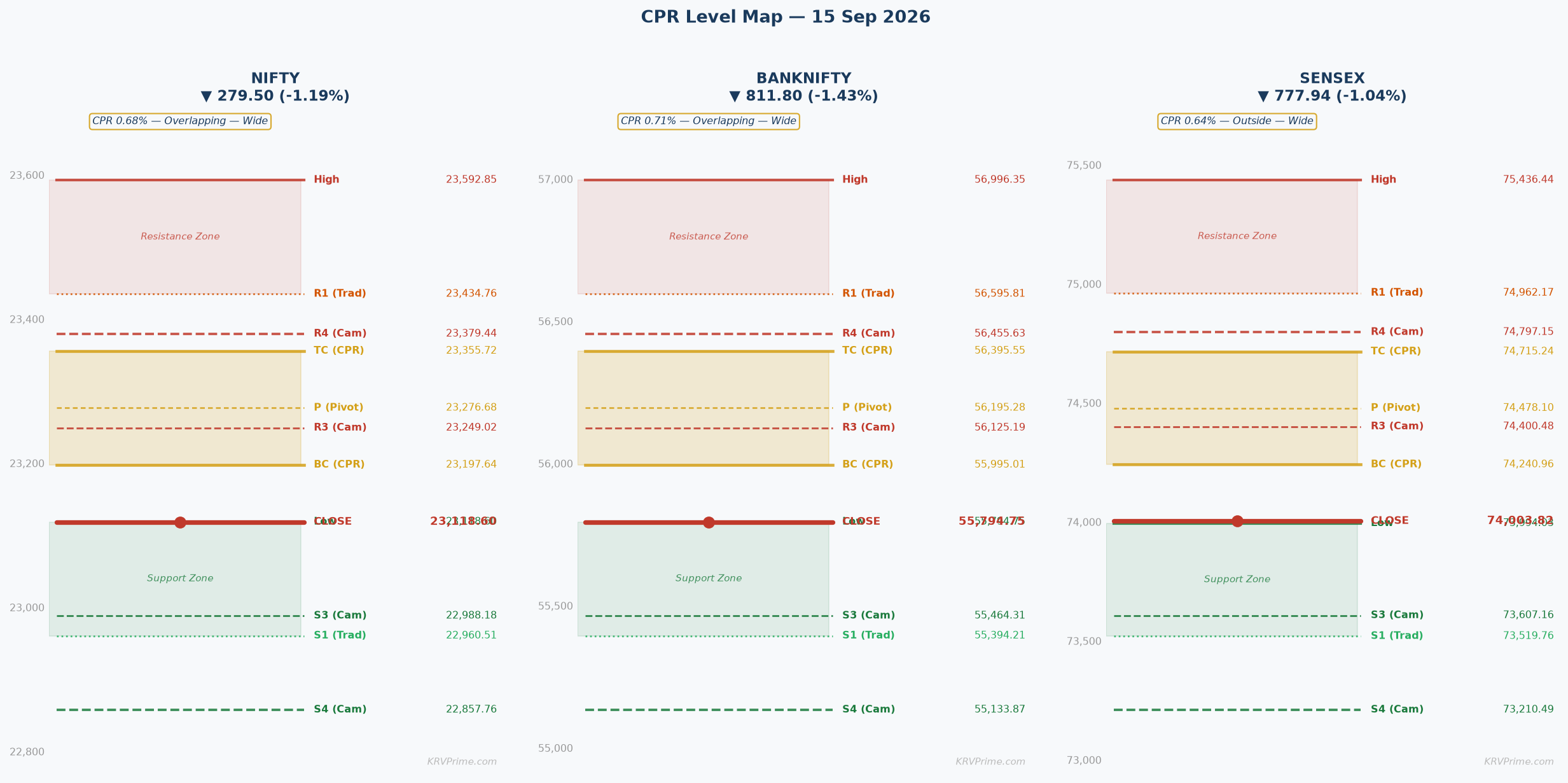
OI-R: 23,300 R3: 23,909.01 H6: 23,592.85 H5: 23,531.77 R2: 23,750.93 H4 ▶: 23,379.44 R1: 23,434.76 PDH: 23,592.85 H3 ↩: 23,249.02
TC: 23,355.72 P: 23,276.68 BC: 23,197.64
L3 ↩: 22,988.18 PDL: 23,118.60 S1: 22,960.51 L4 ▶: 22,857.76 S2: 22,802.43 L5: 22,705.43 L6: 22,644.35 S3: 22,486.26 OI-S: 23,100
↩ = Camarilla reversal point | ▶ = Camarilla breakout/breakdown trigger | OI-R/OI-S = Options wall (CE/PE max OI)
▲ Higher Open (Gap Up) — Open > Prev Close
↕ Conflicted
Open lands: With NIFTY's prev_close at 23,118.60 and the day's CPR being Overlapping Wide (BC 23,197.64, TC 23,355.72), a gap-up open places price inside the lower portion of the CPR band if the gap is minor (opening near 23,150–23,197), approaching BC 23,197.64 or into the band's lower half. A significant gap up would push the open toward H3 23,249.02 or the Pivot 23,276.68, while a large gap up could bring price near TC 23,355.72 or beyond. Because the CPR is Overlapping and Wide (0.68%), the band itself is the primary battleground — price has not recently traded above BC 23,197.64 and opening inside this band creates a compression scenario where every candle close matters.
CPR role: Overhead resistance and decision zone — the entire CPR band (BC 23,197.64 to TC 23,355.72) represents 158 points of supply built from yesterday's session, acting as a contested zone where buyers must force two consecutive 30-min candle closes above TC 23,355.72 to claim control, otherwise the band traps price and sellers will reload at H3 23,249.02 and TC 23,355.72.
Minor Gap (0.05–0.25%) — Structure Dominant
A minor gap up of 0.05–0.25% would place NIFTY's open in the range of approximately 23,130–23,176, which remains below BC 23,197.64 — meaning price opens below the entire CPR band despite the gap, maintaining a structurally bearish posture even as sentiment appears briefly relieved. The Wide Overlapping CPR (0.68%) acts as overhead resistance from BC 23,197.64 upward, and the gap's proximity to OI-S 23,100 (weekly PE wall) means the open is sandwiched between marginal put support below and a thick CPR supply zone above — a dangerous location for premature long entries. The first actionable target for bears is L3 22,988.18 if the gap fades immediately, while bulls must reclaim BC 23,197.64 (confirmed by a 30-min close above it) before targeting H3 23,249.02 and OI-R 23,300 — without that close above BC, the gap-up is merely a scalp opportunity for sellers at the band's base.
Significant Gap (0.25–0.5%) — Balanced
A significant gap up of 0.25–0.5% would open NIFTY near 23,176–23,234, placing the open right at or marginally inside the CPR band around BC 23,197.64 to H3 23,249.02 — this is a critical zone because price is now inside the Wide CPR for the first time since yesterday's slide, and the question becomes whether this is a genuine re-entry into the band or a gap-fill trap. Delta-hedging by market makers with short gamma at 23,200–23,300 (near the weekly CE OI wall at 23,300) could create temporary intraday selling pressure as CE writers defend their 23,300 strike, making the path from 23,234 to OI-R 23,300 especially contested and requiring confirmed volume. For bulls, two consecutive 30-min candle closes inside the CPR band (above BC 23,197.64 and then above H3 23,249.02) are required before targeting OI-R 23,300 and then R1 23,434.76; for bears, any single 30-min close back below BC 23,197.64 signals the gap-fill has failed and L3 22,988.18 becomes the next target.
Large Gap (>0.5%) — Gap Direction Dominant
A large gap up exceeding 0.5% would open NIFTY above 23,234, potentially as high as TC 23,355.72 or even near H4 23,379.44 and R1 23,434.76, and in this scenario the gap dominates all other signals — price has leapt above the Wide Overlapping CPR in a single move, triggering short-covering and call-buying that can push toward PDH 23,592.85 intraday. However, the OI-R at 23,300 is an immediate ceiling where CE writers have maximum open interest, and any open above 23,300 will face gamma-driven selling that has historically capped intraday advances on weekly expiry days — the NIFTY weekly straddle's near-zero put value (Put LTP 0.05) means the market is already treating 23,100 as a floor, and a large gap up above 23,300 reverses this dynamic sharply. The abort level for any long entered on a large gap up is a 30-min close below TC 23,355.72 (or BC 23,197.64 if the gap opens near TC), and targets in order are H5 23,531.77, H6 23,592.85 (which equals PDH), and ultimately R1 23,434.76 as a more conservative partial-profit zone — straddle context suggests the monthly expected move upper bound near 23,590 aligns with H5–H6 zone, making that a natural exit.
|
▲ Upside Path → OI-R From BC 23,197.64, the upside path progresses to H3 23,249.02 (Camarilla mean-reversion first stall), then OI-R 23,300 (weekly CE OI wall — primary ceiling), followed by H4 23,379.44 (Camarilla breakout trigger), R1 23,434.76 (first Traditional target, ideal partial-profit zone), and H5 23,531.77 / H6 23,592.85 (Camarilla upside target zone, equivalent to PDH) — each level should be treated as a partial-exit point, with volume confirmation required at every step, particularly at OI-R 23,300 where CE writing creates natural resistance. Genuine upside momentum is confirmed when price breaks OI-R 23,300 on above-average volume with no wick rejection, transforming CE writers into forced hedgers and accelerating the move toward R1 23,434.76 and H4 23,379.44. |
▼ Downside Path → OI-S On failure to hold BC 23,197.64, the downside path unfolds via PDL 23,118.60 (yesterday's low as first intraday support), then L3 22,988.18 (Camarilla mean-reversion zone — first meaningful bear target), L4 22,857.76 (Camarilla breakdown trigger — if reached, retail stops activate), S1 22,960.51 (Traditional first support), S2 22,802.43 (second Traditional support), and finally OI-S 23,100 (weekly PE wall — though price is already near here, so effective bear target is L3 22,988.18 then L4 22,857.76). The gap-up failure pattern is particularly dangerous on wide CPR days because buying interest evaporates quickly once BC 23,197.64 fails, leaving air pockets all the way to L3 22,988.18 with no meaningful pivot support in between. |
| 🔴 OI-R: OI-R at 23,300 (weekly CE max OI) is the primary upside ceiling for 16 Sep — CE writers with maximum exposure at this strike will actively sell delta-hedged calls into any rally approaching 23,300, creating mechanical selling pressure that is extremely difficult to overcome on a weekly expiry day when gamma is near-zero for far-OTM strikes. On a gap-up scenario, 23,300 is both the momentum target (if price reaches it with volume) and the most likely rejection zone (if price stalls within 20–30 points of it), meaning traders should take partial profits at 23,280–23,300 rather than holding for a clean breakout unless two 30-min closes above 23,300 confirm CE writers are being overwhelmed. | 🟢 OI-S: OI-S at 23,100 (weekly PE max OI) is the gravitational anchor for 16 Sep — with Put LTP at just 0.05 paise, PE writers at 23,100 face virtually no downside risk and have strong incentive to keep NIFTY above this level into expiry, providing a soft floor that may absorb selling around PDL 23,118.60. However, if price breaks decisively below 23,100 with volume, PE writers begin losing premium and will unwind longs, removing this support layer and potentially accelerating the decline toward L3 22,988.18 — making 23,100 a critical line in the sand for intraday bulls. |
⚡ Key Trigger: The primary trigger for confirming bullish intent on a gap-up is two consecutive 30-min candle closes above TC 23,355.72 — this Wide CPR requires the stricter two-bar confirmation rule (Width 0.68%), and TC 23,355.72 is the structural fulcrum because it represents the top of the contested CPR band; a close above it flips the band from resistance to support and invites momentum buyers targeting R1 23,434.76 and H4 23,379.44. Conversely, a failure to hold BC 23,197.64 on any intraday 30-min bar after opening higher signals that the gap-up is a trap and the dominant flow remains selling, with L3 22,988.18 as the immediate downside target and OI-S 23,100 acting as a final weekly pin zone.
▼ Lower Open (Gap Down) — Open < Prev Close
▼ Bearish
Open lands: NIFTY closing at 23,118.60 (its PDL) means any gap-down open moves below both the PDL and the OI-S at 23,100 — price would open entirely below the CPR band (BC 23,197.64, TC 23,355.72), with the entire CPR structure acting as overhead resistance. The proximity to OI-S 23,100 means even a minor gap down of 0.1% opens at approximately 23,095, breaching the key weekly PE support strike and triggering a structurally bearish environment from the first trade.
CPR role: Overhead resistance and recovery hurdle — the CPR band (BC 23,197.64 to TC 23,355.72) sits entirely above the gap-down open, acting as a triple-layered resistance zone (BC, Pivot 23,276.68, TC) that would need to be reclaimed for any meaningful bull recovery; without BC reclaim, the band functions as a ceiling that traps sellers below it.
Minor Gap (0.05–0.25%) — Structure Dominant
A minor gap down of 0.05–0.25% opens NIFTY near 23,060–23,095, which is below OI-S 23,100 (weekly PE max OI) but above L3 22,988.18 — this is a psychologically significant breach because the weekly put writers at 23,100 are now under pressure, yet the gap is small enough that a recovery back above 23,100 within the first 30 minutes is plausible if buying interest emerges from PE writers defending their position. BC 23,197.64 functions as overhead resistance on any minor-gap recovery attempt, and a 30-min candle close above BC 23,197.64 would be the minimum requirement to consider a gap-fill trade toward H3 23,249.02 and OI-R 23,300; without that BC reclaim, the bear thesis remains dominant with L3 22,988.18 as the first downside target followed by S1 22,960.51.
Significant Gap (0.25–0.5%) — Balanced
A significant gap down of 0.25–0.5% opens NIFTY near 22,976–23,060, placing price below OI-S 23,100 AND below L3 22,988.18 simultaneously — this is a structurally severe start because the Camarilla mean-reversion level (L3) has been breached at the open, signaling that the market expects more than just a gap fill and could test L4 22,857.76 (Camarilla breakdown trigger). A 30-min candle reclaim above L3 22,988.18 is the recovery trigger, but if L3 remains resistance, the PUT writing at OI-S 23,100 will unwind rapidly and the next logical destination is L4 22,857.76 and S1 22,960.51, with S2 22,802.43 as the extended bear target on high-volume continuation; delta-hedging by PE writers who are now deep ITM at 23,100 will add mechanical selling to the tape.
Large Gap (>0.5%) — Gap Direction Dominant
A large gap down exceeding 0.5% opens NIFTY below 22,976, potentially near L4 22,857.76 or even approaching L5 22,705.43 — at this point VIX would presumably spike sharply (even without confirmed VIX data, the price action implies volatility expansion), and the dynamics shift from technical analysis to panic management where intraday recovery trades are extremely high risk. The straddle context is critical here: the monthly straddle of 490.5 points implies the market collectively expected this range, and a large gap below 22,976 begins to approach the monthly lower bound (23,100 - 490 = ~22,610, near L6 22,644.35), suggesting institutional players may begin monetising put positions near L4–L5 rather than chasing new shorts. Recovery levels to watch are L3 22,988.18 (first reclaim signal), then OI-S 23,100 (whether it becomes resistance on recovery), while the abort level for any counter-trend long is a 30-min close below L4 22,857.76, which would signal L5 22,705.43 and L6 22,644.35 are in play.
|
▲ Upside Path → OI-R The recovery path on a gap-down starts with reclaiming OI-S 23,100 (weekly PE wall) as support, then L3 22,988.18 (if opened below it, this becomes the first recovery confirmation), followed by BC 23,197.64 (bottom of CPR — critical reclaim), Pivot 23,276.68 (mid-CPR), and TC 23,355.72 (full CPR recovery target) — any recovery reaching TC 23,355.72 after a gap-down would be exceptional and likely limited to minor-gap-down scenarios only. Volume confirmation on the L3 22,988.18 reclaim candle is mandatory; a low-volume bounce at this level is a dead-cat pattern and should not be traded long. |
▼ Downside Path → OI-S The bear path from a gap-down accelerates once L3 22,988.18 fails on a 30-min close — retail stop-losses cluster just below L3 (typically placed at round numbers near 22,950–22,980), and their activation drives price rapidly toward S1 22,960.51 and L4 22,857.76 (Camarilla breakdown trigger); once L4 22,857.76 breaks on volume, L5 22,705.43 and L6 22,644.35 become the session targets with S2 22,802.43 as an intermediate Traditional support. The weekly put OI at 23,100 losing its support role also means institutional PE longs begin to take profit, which paradoxically reduces the put floor and allows the market to fall faster toward these lower Camarilla levels. |
| 🔴 OI-R: OI-R at 23,300 (weekly CE max OI) is extremely remote on a gap-down scenario — it functions as a macro ceiling that confirms bears control the tape, and CE writers at 23,300 are deeply profitable, meaning they have no reason to hedge or cover, removing any mechanical upward pressure from that strike. The 182-point distance from prev_close (23,118.60) to OI-R (23,300) becomes even more daunting post-gap-down, and traders should treat any approach toward 23,300 on a gap-down day as a high-probability fade opportunity rather than a breakout. | 🟢 OI-S: OI-S at 23,100 (weekly PE max OI) is the most critical level of the entire session on a gap-down — PE writers who sold puts at 23,100 are now watching their positions go ITM and face a binary choice: defend by buying futures (creating support) or cut losses (accelerating the fall). If the open is between 23,060–23,095, PE writer hedging activity typically provides a 15–30 minute period of support around 23,100 before a direction is established; if OI-S 23,100 fails definitively (30-min close below), the unwinding creates a mechanical selling cascade that historically amplifies intraday moves by 0.3–0.5% beyond the initial gap. |
⚡ Key Trigger: The dual trigger structure on a gap-down is: **Bear confirmation** = failure to reclaim OI-S 23,100 (weekly PE wall) within the first 30 minutes confirms put writers are abandoning support and L3 22,988.18 is the first target; **Bull trigger** = a 30-min candle close back above L3 22,988.18 followed by a second close above OI-S 23,100 indicates short-covering and PE writer defense, opening the path toward BC 23,197.64 and potentially the Pivot 23,276.68. These two specific levels (23,100 and L3 22,988.18) are the structural fulcrum for all intraday decisions on a gap-down day — either price stabilises above them (recovery) or confirms below them (continuation), and traders should avoid mid-range positions between these two levels.
◆ Near Flat Open — Open ≈ Prev Close (±0.05%)
◆ Neutral
Open lands: A flat open of ±0.05% places NIFTY near 23,107–23,130, which is at or marginally above PDL 23,118.60 but still 79–91 points below BC 23,197.64 — meaning price opens below the entire Wide Overlapping CPR band. This is a textbook Overlapping CPR below-band flat open: the CPR band (BC 23,197.64 to TC 23,355.72) is entirely overhead, OI-S 23,100 is just 18 points below the open, and the structure provides no immediate support layer between current price and L3 22,988.18.
CPR role: Decision zone with overhead resistance bias — the CPR band (BC 23,197.64 to TC 23,355.72) acts as a definitive overhead resistance structure in a flat-open scenario; with price below BC and the band unreclaimed, bears have structural advantage, and the CPR band is the ceiling that defines the maximum expected recovery on a rangebound day. The Pivot 23,276.68 acts as the mid-band decision level: any intraday touch of 23,276.68 that fails to hold becomes a confirmation of the range top.
Near Flat (±0.05%)
A flat open below the Wide Overlapping CPR (BC 23,197.64, TC 23,355.72) is one of the highest-information setups of the session — NIFTY opening near 23,118.60 with zero gap means the first 30-minute candle (Wide CPR rule requires two 30-min closes for confirmation) is the primary directional signal, and traders should NOT pre-position but wait for the structure to declare itself. The CPR band's width of 0.68% (roughly 158 points) means it is a substantial supply zone: BC 23,197.64 is the bear's line — as long as price cannot close above it on two consecutive 30-min bars, the entire day's bias is short; TC 23,355.72 is the bull's line — two 30-min closes above TC flip the session to an aggressive recovery with OI-R 23,300 already cleared. Below the open, OI-S 23,100 is the single most important support level for the session — the weekly PE wall at 23,100 acts as a gravitational pin that could hold price in a 23,100–23,197 dead-zone for the bulk of the session if neither bulls nor bears commit. The bull trigger is two consecutive 30-min closes above BC 23,197.64 (confirming CPR reclaim — targets H3 23,249.02, OI-R 23,300, and R1 23,434.76 in sequence), while the bear trigger is a single 30-min close below OI-S 23,100 (confirming the weekly PE wall has failed — targets L3 22,988.18, L4 22,857.76, and S1 22,960.51).
|
▲ Upside Path → OI-R Bull path from the flat open: BC 23,197.64 (CPR reclaim — first confirmation) → H3 23,249.02 (Camarilla mean-reversion stall, potential partial exit for fast scalps) → OI-R 23,300 (weekly CE wall — primary ceiling, take partial profits here) → H4 23,379.44 (Camarilla breakout trigger, only pursue on strong volume after OI-R 23,300 is cleared) → R1 23,434.76 (first Traditional target, maximum intraday bull target on a flat-open day). Volume confirmation at every step is mandatory; thin-volume penetration of OI-R 23,300 is a fade, not a breakout. |
▼ Downside Path → OI-S Bear path from the flat open: OI-S 23,100 (first support to break — triggers the cascade) → L3 22,988.18 (Camarilla mean-reversion zone — first bear target, retail stop-losses activate here) → S1 22,960.51 (Traditional first support, brief stabilisation possible) → L4 22,857.76 (Camarilla breakdown trigger — if reached, the session becomes a trending bear day with L5 22,705.43 and L6 22,644.35 as extended targets). The ~212 point distance from open to L3 22,988.18 is significant — on a flat-open day without VIX spike, this journey typically takes 60–90 minutes of sustained selling, giving traders adequate confirmation time. |
| 🔴 OI-R: OI-R at 23,300 (weekly CE max OI) is the absolute ceiling on a flat-open day — CE writers who sold 23,300 calls when NIFTY was trading near 23,500+ are now far profitable and will aggressively sell any rally toward 23,300, making it an institutionally-defended short zone. In a flat-open scenario where price is 181 points below OI-R, the 23,300 CE wall creates a natural range ceiling that aligns with H3 23,249.02 and is well within the CPR band — traders should treat OI-R 23,300 as the definitive profit-target for any long initiated from BC 23,197.64 reclaim. | 🟢 OI-S: OI-S at 23,100 (weekly PE max OI) is the single most critical support level on a flat-open day — with the weekly Put LTP at just 0.05 paise, PE writers at 23,100 face near-zero premium income but significant delta risk if NIFTY trades below 23,100, creating strong incentive to buy futures as a hedge and temporarily support price. This PE writer support is conditional and time-limited (weakens as expiry approaches throughout the 16 Sep session), meaning the OI-S 23,100 floor becomes progressively less reliable as the trading day advances — intraday traders should prioritise the morning session for PE-support-driven bounces and be cautious about trusting 23,100 as a floor after 1:30 PM. |
⚡ Key Trigger: **Bull trigger**: Two consecutive 30-min candle closes above BC 23,197.64 with above-average volume — this is the structural reclaim of the CPR band's base and signals that overnight sellers are absorbing buying interest, opening H3 23,249.02 and OI-R 23,300 as the next stops. **Bear trigger**: A single 30-min close below OI-S 23,100 — because this violates the weekly PE writer's defense level, it creates a mechanical cascade as PE longs are forced to hedge via futures selling, targeting L3 22,988.18 within the next 30–60 minutes and confirming that the flat open was merely a consolidation before the next leg lower.
BANKNIFTY
Overlapping — Wide (0.71%)
▼ Bearish
Market Structure Sideways or range-bound | Straddle BANKNIFTY Monthly ATM 55800 straddle = 1342.7 points (Call 782.75 + Put 559.95), implying a monthly expected move of approximately ±1,342 points from the ATM strike, placing the upper bound near 57,143 (close to OI-R 57,500) and lower bound near 54,457 (between L4 55,133.87 and L5 54,747.92) — this is a wide monthly range that suggests institutional players expect significant volatility between now and 29-Sep-2026 expiry. The elevated put premium (559.95 vs call 782.75) shows mild call bias in writing but meaningful put buying, consistent with the bearish close at PDL 55,794.75. | Max Pain BANKNIFTY Monthly Max Pain = 57,100 — this is 1,305.25 points above the current close of 55,794.75, indicating that monthly option sellers are positioned for a significant recovery by 29-Sep-2026 expiry; however, the current price action (close at PDL, -1.43%) suggests that 57,100 max pain is a distant target and that any single-session move toward it would require extraordinary buying. For intraday traders on 16 Sep, max pain at 57,100 is less relevant than the daily CPR and OI levels, but it confirms that the intermediate-term skew is toward recovery — meaning aggressive intraday shorts below 55,000 should be sized carefully against potential weekly recovery flows. |
Tomorrow's Complete Level Map
OI-R: 57,500 R3: 57,797.41 H6: 56,996.35 H5: 56,841.58 R2: 57,396.88 H4 ▶: 56,455.63 R1: 56,595.81 PDH: 56,996.35 H3 ↩: 56,125.19
TC: 56,395.55 P: 56,195.28 BC: 55,995.01
L3 ↩: 55,464.31 PDL: 55,794.75 S1: 55,394.21 L4 ▶: 55,133.87 S2: 54,993.68 L5: 54,747.92 L6: 54,593.15 S3: 54,192.61 OI-S: 54,000
↩ = Camarilla reversal point | ▶ = Camarilla breakout/breakdown trigger | OI-R/OI-S = Options wall (CE/PE max OI)
▲ Higher Open (Gap Up) — Open > Prev Close
↕ Conflicted
Open lands: With prev_close at 55,794.75 (also the PDL) and the CPR being Overlapping Wide (BC 55,995.01, TC 56,395.55), a gap-up open of any size would lift price toward the CPR band. A minor gap up opens near 55,822–55,934 (below BC 55,995.01), a significant gap opens near 55,934–56,074 (near BC 55,995.01 or just inside the band), and a large gap up opens near 56,074 or above, potentially reaching H3 56,125.19 or the Pivot 56,195.28 — all scenarios involve price approaching or entering the contested Overlapping Wide CPR band from below.
CPR role: Overhead resistance zone and recovery battleground — the CPR band (BC 55,995.01 to TC 56,395.55) spans 400.54 points (0.71% of index) and represents a thick supply cluster built from yesterday's 1.43% decline; bulls must force two consecutive 30-min candle closes above TC 56,395.55 to claim control, while any rejection inside the band confirms sellers are absorbing the gap-up.
Minor Gap (0.05–0.25%) — Structure Dominant
A minor gap up of 0.05–0.25% opens BANKNIFTY near 55,822–55,934, which remains below BC 55,995.01 — the entire CPR band is still overhead, and the gap does not provide sufficient momentum to challenge even the band's base (BC 55,995.01), maintaining a structurally bearish posture. The Wide Overlapping CPR (0.71%) adds supply density in the 55,995–56,395 zone, and the 173-point distance from the minor-gap open to OI-S 54,000 is misleading — the more immediate bear target if the gap fades is L3 55,464.31, which is only 358–470 points below the minor-gap open, making it a realistic intraday destination on a weak bounce day. Bulls must secure a 30-min close above BC 55,995.01 before targeting H3 56,125.19 and Pivot 56,195.28; otherwise, fading the gap at or below BC 55,995.01 with a target of L3 55,464.31 is the higher-probability intraday trade.
Significant Gap (0.25–0.5%) — Balanced
A significant gap up of 0.25–0.5% opens BANKNIFTY near 55,934–56,074, placing price at or marginally inside the CPR band around BC 55,995.01 — this is the most critical scenario because price opens at the CPR band's lower boundary, and two-bar confirmation (two 30-min closes above BC 55,995.01) would be the required trigger for a genuine CPR reclaim attempt toward H3 56,125.19 and OI-R 57,500. Delta-hedging near OI-R 57,500 (monthly CE wall) is far above current price and unlikely to impact the immediate session, but CE writers at 56,000–56,500 (interim resistance) will sell into the gap-up recovery; the specific H3 56,125.19 level is the first technical stall where intraday longs should take partial profits before seeing if momentum extends toward Pivot 56,195.28. If two consecutive 30-min closes do not materialise above BC 55,995.01 after a significant gap up, the failure confirms bull exhaustion and L3 55,464.31 becomes the target with high probability.
Large Gap (>0.5%) — Gap Direction Dominant
A large gap up exceeding 0.5% opens BANKNIFTY above 56,074, potentially reaching H3 56,125.19, Pivot 56,195.28, or even TC 56,395.55 — at this point the gap is the dominant force, overriding the Wide CPR resistance, but the straddle's monthly expected-move upper bound (~57,143) and OI-R at 57,500 (monthly CE wall) both confirm significant overhead supply well above the open. In a large-gap scenario, shorts from yesterday's massive 1.43% decline will cover aggressively (short-covering rally), pushing price toward H4 56,455.63, R1 56,595.81, and potentially H5 56,841.58 — but any rally approaching H6 56,996.35 (which equals PDH) and R2 57,396.88 will face the combined force of OI-R 57,500 CE writers and monthly put writers who are now significantly ITM at lower strikes and would lock profits. The abort for longs on a large gap up is a 30-min close back below TC 56,395.55, which would signal gap-fill risk toward BC 55,995.01.
|
▲ Upside Path → OI-R From BC 55,995.01, the confirmed upside path is: H3 56,125.19 (Camarilla mean-reversion stall — first partial exit) → Pivot 56,195.28 (mid-CPR, momentum confirmation) → TC 56,395.55 (top of CPR band, second partial) → H4 56,455.63 (Camarilla breakout trigger) → R1 56,595.81 (Traditional first target, strong partial-profit zone) → H5 56,841.58 / H6 56,996.35 (Camarilla target zone — also PDH, maximum intraday bull target). Volume must be above-average at H3 56,125.19 and TC 56,395.55 to confirm genuine momentum; thin-volume advances stall at Pivot 56,195.28. |
▼ Downside Path → OI-S On gap-up failure (30-min close below BC 55,995.01), the bear path is: PDL 55,794.75 (yesterday's close and PDL — immediate support test) → L3 55,464.31 (Camarilla mean-reversion zone — primary bear target, retail longs cut here) → S1 55,394.21 (Traditional first support) → L4 55,133.87 (Camarilla breakdown trigger — if breached, S2 54,993.68 and then OI-S 54,000 become targets) → L5 54,747.92 / L6 54,593.15 (Camarilla downside target zone). The gap-up failure pattern in BANKNIFTY is particularly sharp given its 1.43% prior-day decline and high beta — once BC fails, the 531-point journey to L3 55,464.31 can happen within a single 30-minute candle in high-volatility sessions. |
| 🔴 OI-R: OI-R at 57,500 (monthly CE max OI) is a distant but powerful ceiling on a gap-up day — CE writers at 57,500 are sitting on substantial profits from yesterday's decline and have no immediate reason to hedge, meaning this level will not create mechanical buying pressure from short-covering until price is within 300–400 points of 57,500. On a gap-up day opening near 55,800–56,100, OI-R 57,500 is approximately 1,400–1,700 points away — it functions as the macro bull target that shows where the session can theoretically travel, but intraday traders should use H5 56,841.58 and H6 56,996.35 as practical targets rather than OI-R 57,500. | 🟢 OI-S: OI-S at 54,000 (monthly PE max OI) is the macro bear floor on a gap-up scenario — it is 1,794.75 points below yesterday's close, making it irrelevant for an immediate gap-up session unless BANKNIFTY is simultaneously gapping up while broader macro events signal a catastrophic move. In a gap-up scenario, OI-S 54,000 serves as a confidence reference: PE writers at 54,000 are deeply OTM and profitable, so they have strong balance-sheet support that eventually underpins the index, giving bulls macro backstop confidence even if price tests lower Camarilla levels intraday. |
⚡ Key Trigger: The critical bull trigger on a gap-up is two consecutive 30-min closes above TC 56,395.55 (Wide CPR rule strictly applied) — TC 56,395.55 is the structural line that separates the CPR resistance zone from bull-controlled territory, and two bars above it triggers momentum buying toward H4 56,455.63, R1 56,595.81, and then H5 56,841.58. The bear alternative trigger is a 30-min close back below BC 55,995.01 after an initial gap-up test — this signals that sellers dominated the CPR band test and L3 55,464.31 is the day's primary downside target, with the gap-up serving only as a selling opportunity for informed traders.
▼ Lower Open (Gap Down) — Open < Prev Close
▼ Bearish
Open lands: With prev_close/PDL at 55,794.75, any gap-down open takes BANKNIFTY below PDL and immediately tests L3 55,464.31 proximity (329.75 points below PDL) — a minor gap down opens near 55,711–55,766, a significant gap opens near 55,655–55,655, and a large gap down (>0.5% = >279 points) opens at 55,515 or below, potentially within striking distance of L3 55,464.31. The CPR band (BC 55,995.01 to TC 56,395.55) is 200–930 points above the gap-down open, making full CPR reclaim a non-trivial intraday task.
CPR role: Remote overhead resistance — on a gap-down day, the CPR band (BC 55,995.01 to TC 56,395.55) is so far above the open that it functions as an unreachable ceiling for most of the session, confirming that sellers remain in structural control and any intraday recovery targeting BC 55,995.01 is a high-conviction trade requiring multiple confirmation bars.
Minor Gap (0.05–0.25%) — Structure Dominant
A minor gap down of 0.05–0.25% opens BANKNIFTY near 55,655–55,766, which is below PDL 55,794.75 but above L3 55,464.31 — the gap down is large enough to signal bearish continuation but small enough that a gap-fill back to 55,794.75 (PDL reclaim) within 30 minutes is possible if PE writers at lower strikes defend aggressively. BC 55,995.01 (CPR bottom) functions as the ceiling for any recovery attempt, and a 30-min close above BC 55,995.01 would require a 229–340 point intraday recovery from the gap-down open — unlikely on a minor gap unless a strong macro positive develops. The primary bear scenario is that price drifts toward L3 55,464.31 (Camarilla stall) and S1 55,394.21 (Traditional support) throughout the session, with BC 55,995.01 never being challenged.
Significant Gap (0.25–0.5%) — Balanced
A significant gap down of 0.25–0.5% opens BANKNIFTY near 55,515–55,655, bringing price close to or at L3 55,464.31 (Camarilla mean-reversion zone) at the open — when price opens at a Camarilla extreme level, the mean-reversion playbook applies: if L3 55,464.31 holds for two consecutive 30-min bars, a recovery toward BC 55,995.01 is the counter-trend target (using the Wide CPR two-bar rule in reverse). However, if L3 55,464.31 fails on the first 30-min close, the gap becomes a directional breakdown with L4 55,133.87 (Camarilla breakdown trigger) as the next key level; PUT writers at OI-S 54,000 (monthly PE wall) will begin delta-hedging by buying futures if L4 55,133.87 is threatened, providing a mechanical floor near that level. The specific S1 55,394.21 (Traditional support between L3 and L4) offers a brief stabilization zone but is not robust enough to reverse a significant gap-down on its own.
Large Gap (>0.5%) — Gap Direction Dominant
A large gap down exceeding 0.5% opens BANKNIFTY below 55,515, potentially at or below L3 55,464.31 — this is a structural breakdown signal where the overnight flow has decided that 55,794 is not the floor, and intraday recovery attempts face both the CPR overhead (BC 55,995.01, 530+ points above) and the structural damage of opening below Camarilla mean-reversion (L3 55,464.31). The monthly straddle lower bound (~54,457, near L5 54,747.92) suggests that a large gap down begins approaching the boundary of the straddle-implied range, meaning options sellers become aggressive buyers of futures at these levels to defend their short-put book — this creates a potential mechanical support zone between L4 55,133.87 and L5 54,747.92. VIX expansion (implied given the price action, even without confirmed data) would justify wider stops on all positions; the abort for any counter-trend long on a large gap down is a 30-min close below L4 55,133.87, which triggers L5 54,747.92, L6 54,593.15, and S2 54,993.68 as targets in that order.
|
▲ Upside Path → OI-R Recovery path: PDL 55,794.75 (first reclaim confirmation) → BC 55,995.01 (CPR band base — critical overhead) → H3 56,125.19 (Camarilla mean-reversion stall) → Pivot 56,195.28 (mid-CPR momentum check) → TC 56,395.55 (full CPR recovery — exceptional achievement on gap-down day). Each level above requires two 30-min confirmations given the Wide CPR structure; partial profits at BC 55,995.01 and H3 56,125.19 are the disciplined recovery trade. |
▼ Downside Path → OI-S Bear continuation path: L3 55,464.31 (Camarilla mean-reversion — first bear target, retail longs stop out) → S1 55,394.21 (Traditional first support — brief stabilisation) → L4 55,133.87 (Camarilla breakdown trigger — retail and algo stop-loss cascade) → S2 54,993.68 (Traditional second support) → L5 54,747.92 (Camarilla target zone) → L6 54,593.15 (extreme Camarilla target) → OI-S 54,000 (monthly PE wall — multi-session institutional support). The approximately 1,794 points from yesterday's close to OI-S 54,000 means this is not a single-session destination but rather a multi-day bear scenario if L4 55,133.87 breaks convincingly. |
| 🔴 OI-R: OI-R at 57,500 (monthly CE max OI) is completely irrelevant on a gap-down day in BANKNIFTY — it is 1,705+ points above the gap-down open and represents territory that bulls would need days, not hours, to reclaim. Its only relevance is as a confidence indicator for bears: CE writers at 57,500 are maximally profitable and have zero reason to cover, meaning there is no short-covering anchor from this level — bears can extend their positions without fear of forced covering from this OI concentration point. | 🟢 OI-S: OI-S at 54,000 (monthly PE max OI) is the most important intraday reference on a gap-down day — monthly PE writers with maximum OI at 54,000 are sitting on substantial premium (monthly straddle put at 559.95) and will begin delta-hedging via futures buying as price approaches the 54,500–55,000 zone, creating organic institutional support that grows stronger as 54,000 approaches. Intraday traders should watch for the rate-of-decline to slow significantly near L4 55,133.87–L5 54,747.92, as this is where PE writer futures-buying creates a mechanical absorption zone ahead of the 54,000 wall. |
⚡ Key Trigger: **Bear confirmation**: A 30-min close below L3 55,464.31 confirms structural breakdown and targets L4 55,133.87, S1 55,394.21, and eventually OI-S 54,000 on a multi-session basis — this is the trigger that signals PE writers have stopped defending and the index is entering a new lower range. **Bull recovery trigger**: Two consecutive 30-min closes above PDL 55,794.75 (recovering the prior session low as support) confirm that the gap-down was a shakeout, opening BC 55,995.01 and Pivot 56,195.28 as the recovery targets; this trigger requires patience — the first candle above PDL 55,794.75 is not sufficient given the Wide CPR rule.
◆ Near Flat Open — Open ≈ Prev Close (±0.05%)
◆ Neutral
Open lands: A flat open of ±0.05% places BANKNIFTY near 55,766–55,823, which is at PDL 55,794.75 — directly below BC 55,995.01 by approximately 172–229 points. The entire Wide Overlapping CPR band (BC 55,995.01 to TC 56,395.55) is overhead, and the flat open below BC confirms that the index begins the session in structurally bearish territory without any CPR support beneath it.
CPR role: Overhead resistance and sessions-defining decision band — the CPR band (BC 55,995.01 to TC 56,395.55) is the dominant architectural feature of the flat-open scenario, sitting 172–601 points above the open; the flat open creates a 'wait-and-see' dynamic where the first 30–60 minutes determine whether sellers re-engage (targeting L3 55,464.31) or buyers attempt a CPR reclaim (targeting BC 55,995.01).
Near Flat (±0.05%)
A flat open in BANKNIFTY below the Wide Overlapping CPR (BC 55,995.01, TC 56,395.55) is a high-stakes setup because the index has closed at its PDL for the second consecutive session (if confirmed), and a flat open signals that overnight participants have neither conviction to sell further nor confidence to buy back — this is a compression point that typically resolves with a sharp directional move once the first 30-minute candle closes. The CPR band's BC 55,995.01 is the defining level: any sustained trade above it (two 30-min closes per Wide CPR rule) would represent a genuine structural recovery targeting H3 56,125.19, Pivot 56,195.28, and then TC 56,395.55; conversely, any 30-min close below PDL 55,794.75 (essentially the open price) confirms bear continuation toward L3 55,464.31. OI-S 54,000 (monthly PE wall) is 1,794.75 points below — its distance means it is not an immediate intraday concern for flat-open scenarios, but traders should note that the L4 55,133.87 level (660 points below the flat open) is the true Camarilla breakdown trigger that would signal an institutional-level structural change. The bull trigger requires patience — two consecutive 30-min closes above BC 55,995.01 are mandatory (Wide CPR rule), while the bear trigger is simply a single 30-min close below PDL 55,794.75, making the risk-reward clearly asymmetric in favour of bears on a flat-open day below the CPR.
|
▲ Upside Path → OI-R Bull recovery from flat open: BC 55,995.01 (CPR base reclaim — first major hurdle, two 30-min closes needed) → H3 56,125.19 (Camarilla mean-reversion zone — first partial-profit level for intraday longs, potential stall here) → Pivot 56,195.28 (mid-CPR, momentum confirmation on above-average volume) → TC 56,395.55 (full CPR reclaim — exceptional bull achievement from a flat-at-PDL open) → H4 56,455.63 (Camarilla breakout trigger — only pursue if TC 56,395.55 is cleanly cleared on two bars). Volume at BC 55,995.01 on the breakout candle must be meaningfully above 30-min average; a quiet, low-volume drift above BC is a trap. |
▼ Downside Path → OI-S Bear continuation from flat open: PDL 55,794.75 (first line — break signals bear resumption) → L3 55,464.31 (Camarilla mean-reversion zone — primary bear target, 330-point move, achievable within 60–90 minutes of sustained selling) → S1 55,394.21 (Traditional first support — brief stabilisation before next leg) → L4 55,133.87 (Camarilla breakdown trigger — institutional-level stop-outs, 660-point move from open — signals a trending bear day) → S2 54,993.68 (second Traditional support) → L5 54,747.92 (Camarilla target zone on a strong bear trending day). Each level should be treated as a partial-profit zone on short positions. |
| 🔴 OI-R: OI-R at 57,500 (monthly CE max OI) acts as a distant but directionally confirming ceiling on a flat-open day — the fact that BANKNIFTY is trading 1,705 points below the monthly CE wall confirms that CE writers are fully in control with no pressure to hedge, meaning there is zero mechanical buying support from OI-R 57,500 in today's session. This absence of CE-writer short-covering is a subtle but important bear signal: the only mechanical buying that matters today comes from below (OI-S 54,000 PE writer hedging), not from above, tilting the session's natural flow toward the downside. | 🟢 OI-S: OI-S at 54,000 (monthly PE max OI) is the multi-session institutional support anchor that defines the absolute floor for BANKNIFTY in September 2026 — on a flat-open day, it is too distant to influence intraday price action directly, but traders should understand that PE writers with maximum OI at 54,000 are earning substantial premium (559.95 per lot in the ATM straddle) and will defend this level aggressively if approached in multi-day selling. For 16 Sep specifically, OI-S 54,000 sets the boundary for bear conviction: shorts are viable between current price and 54,000, but initiating fresh shorts within 300 points of 54,000 without confirmation would be fighting institutional PUT writer hedging flows. |
⚡ Key Trigger: **Bull trigger**: Two consecutive 30-min candle closes above BC 55,995.01 with volume above yesterday's 30-min average — this confirms CPR band reclaim and opens H3 56,125.19 as the next momentum target, with Pivot 56,195.28 and TC 56,395.55 following in sequence. **Bear trigger**: A single 30-min close below PDL 55,794.75 (the flat-open level) — because price is opening at a structural low (PDL), any failure to hold this level within the session's first hour signals that even the overnight equilibrium price is too high, with L3 55,464.31 becoming the immediate target and the Wide CPR two-bar rule confirming bear dominance.
SENSEX
Outside — Wide (0.64%)
▼ Bearish
Market Structure Sideways or range-bound | Straddle SENSEX Weekly ATM 74000 straddle = 739.35 points (Call 409.45 + Put 329.9), implying a weekly expected move of approximately ±739 points from 74,000, placing the upper bound near 74,739 (near H3 74,400.48 and H4 74,797.15 on the upside) and lower bound near 73,261 (below S1 73,519.76 and near L3 73,607.16). SENSEX Monthly ATM 74000 straddle = 1,320.7 points (Call 777.2 + Put 543.5), framing a monthly expected move of ±1,320.7 points, with the upper bound near 75,321 (near H5 75,260.46) and lower bound near 72,679 (between L5 72,747.18 and L6 72,561.22) — the elevated call premium over put (777.2 vs 543.5) suggests a mild upside bias in monthly options despite the bearish price action. | Max Pain SENSEX Weekly Max Pain = 74,500 — with current close at 74,003.82, SENSEX is just 496.18 points below weekly max pain at 74,500, creating gravitational pull toward 74,500 for the weekly expiry on 17-Sep-2026 (tomorrow). This is the most immediately relevant max pain across all three indices — SENSEX expires weekly on 17 Sep, meaning today's intraday session IS the pre-expiry day, and the 74,500 max pain creates strong incentive for option sellers to pin price toward this level, making any recovery toward H4 74,797.15 and the CPR band (BC 74,240.96 to TC 74,715.24) highly plausible. SENSEX Monthly Max Pain = 75,100 — 1,096.18 points above current close, aligning with R1 74,962.17 and H5 75,260.46 as medium-term targets for monthly option sellers. |
Tomorrow's Complete Level Map
OI-R: 77,000 R3: 76,404.58 H6: 75,446.42 H5: 75,260.46 R2: 75,920.51 H4 ▶: 74,797.15 R1: 74,962.17 PDH: 75,436.44 H3 ↩: 74,400.48
TC: 74,715.24 P: 74,478.10 BC: 74,240.96
L3 ↩: 73,607.16 PDL: 73,994.03 S1: 73,519.76 L4 ▶: 73,210.49 S2: 73,035.69 L5: 72,747.18 L6: 72,561.22 S3: 72,077.35 OI-S: 71,000
↩ = Camarilla reversal point | ▶ = Camarilla breakout/breakdown trigger | OI-R/OI-S = Options wall (CE/PE max OI)
▲ Higher Open (Gap Up) — Open > Prev Close
↕ Conflicted
Open lands: The SENSEX CPR is Outside — Wide (0.64%), meaning the CPR band (BC 74,240.96 to TC 74,715.24) engulfs yesterday's range (PDH 75,436.44 to PDL 73,994.03) — wait, correcting the framework: Outside CPR means today's CPR range is wider than yesterday's candle range. Prev_close 74,003.82 sits just above PDL 73,994.03. With BC 74,240.96 being 237.14 points above prev_close, a minor gap up opens near 74,040–74,078 (still below BC 74,240.96 and inside the wide CPR band by definition), a significant gap up opens near 74,078–74,188 (approaching BC 74,240.96), and a large gap up exceeding 0.5% opens near 74,374+ (inside the CPR band, between BC 74,240.96 and Pivot 74,478.10). Given the Outside Wide CPR structure, minor and significant gaps are expected to open inside the CPR band's effective range — confirming the 'stays inside band' rule.
CPR role: Containment zone and decision band — the Outside Wide CPR (BC 74,240.96 to TC 74,715.24) is designed to contain price within its boundaries as it engulfs the prior session's range; on a gap-up, the band acts as both a recovery floor (if open is above BC 74,240.96) and a distribution trap (if price fails to sustain above BC), with weekly max pain at 74,500 creating a magnetic pull toward the Pivot 74,478.10 on pre-expiry trading.
Minor Gap (0.05–0.25%) — Structure Dominant
A minor gap up of 0.05–0.25% opens SENSEX near 74,040–74,078, which remains below BC 74,240.96 but is inside the Outside Wide CPR's effective range — critically, this is also the zone just above PDL 73,994.03, and given that SENSEX expires weekly on 17 Sep with max pain at 74,500, a minor gap up creates a pre-expiry recovery dynamic where option sellers have strong incentive to push price toward 74,500 throughout the session. The CPR band's BC 74,240.96 is the first recovery confirmation level — a 30-min close above BC 74,240.96 targets H3 74,400.48 and then Pivot 74,478.10 (which is very close to weekly max pain 74,500, making it a combined technical and options-flow target). Bear risk on a minor gap up exists below PDL 73,994.03 — any failure to hold PDL (73,994.03) on the first 30 minutes signals the gap-up has failed and L3 73,607.16 becomes the immediate bear target.
Significant Gap (0.25–0.5%) — Balanced
A significant gap up of 0.25–0.5% opens SENSEX near 74,188–74,374, placing the open inside the CPR band between BC 74,240.96 and Pivot 74,478.10 — this is the most bullish gap-up scenario for a pre-expiry day because price opens inside the Outside Wide CPR and near weekly max pain 74,500, creating alignment between technical structure and options flow. Delta-hedging near H3 74,400.48 and Pivot 74,478.10 creates temporary resistance as option sellers position for the max pain pin at 74,500; however, if two 30-min closes above Pivot 74,478.10 materialise, the next target is TC 74,715.24 (top of CPR) and then H4 74,797.15 (Camarilla breakout trigger), with R1 74,962.17 as the extended bull target. On a significant gap, traders should watch whether SENSEX can hold above BC 74,240.96 on any intraday pullback — a 30-min close below BC 74,240.96 after a significant gap up is a powerful fade signal targeting L3 73,607.16.
Large Gap (>0.5%) — Gap Direction Dominant
A large gap up exceeding 0.5% opens SENSEX above 74,374, potentially inside the CPR band between Pivot 74,478.10 and TC 74,715.24 — on a pre-weekly-expiry day, a large gap up near 74,500 (max pain level) would create extreme short-covering from option sellers who have positioned below this level, amplifying the initial move. However, TC 74,715.24 and H4 74,797.15 represent a formidable resistance cluster within 300–400 points of a large-gap open, and with the Outside Wide CPR structure containing price, the probability of a gap-fill from TC toward Pivot or BC increases once the initial short-covering exhausts itself — two 30-min closes above TC 74,715.24 are required (Wide CPR rule) before targeting H5 75,260.46 and PDH 75,436.44. Abort for large-gap longs is a 30-min close below Pivot 74,478.10, which signals gap-fill risk toward BC 74,240.96 and ultimately L3 73,607.16.
|
▲ Upside Path → OI-R Confirmed upside path: BC 74,240.96 (CPR band entry/reclaim) → H3 74,400.48 (Camarilla stall, partial profit for fast scalps) → Pivot 74,478.10 / Weekly Max Pain 74,500 (primary target and pre-expiry pin zone — option sellers defend here) → TC 74,715.24 (CPR top, two-bar breakout needed) → H4 74,797.15 (Camarilla breakout trigger) → R1 74,962.17 (Traditional first target, strong partial-profit zone) → H5 75,260.46 (Camarilla target zone, monthly max pain alignment zone at 75,100). Volume must be convincing at each level; the weekly max pain 74,500 zone near Pivot 74,478.10 is the most important anchor. |
▼ Downside Path → OI-S Gap-up failure path: BC 74,240.96 (first support on failure — 30-min close below signals gap trap) → PDL 73,994.03 (prior session low, structural support) → L3 73,607.16 (Camarilla mean-reversion zone — primary bear target if gap fails decisively) → S1 73,519.76 (Traditional first support) → L4 73,210.49 (Camarilla breakdown trigger) → S2 73,035.69 (Traditional second support) → OI-S 71,000 (monthly PE wall — multi-session bear target, not intraday). The 396-point distance from PDL 73,994.03 to L3 73,607.16 means the gap-up failure trade is a meaningful move with clear risk levels. |
| 🔴 OI-R: OI-R at 77,000 (SENSEX week CE max OI) is 2,996.18 points above current close — this is an extremely distant ceiling that confirms CE writers are controlling the macro tape with zero hedging pressure, and any single-day move toward 77,000 is essentially impossible. On a gap-up day, OI-R 77,000's primary role is to confirm that there is no structural resistance between current price and H5 75,260.46 / PDH 75,436.44 / H6 75,446.42 from an options flow perspective — bulls can target these levels without facing OI-driven ceiling pressure, though traditional Camarilla and weekly max pain levels remain the practical intraday caps. | 🟢 OI-S: OI-S at 71,000 (SENSEX week PE max OI) is 3,003.82 points below current close — also extremely distant on a gap-up day, confirming that PE writers at 71,000 have no immediate need to hedge and their mechanical buying pressure is irrelevant for the session. On a gap-up day, OI-S 71,000 serves as psychological confidence for bulls: the institutional put floor is far below, giving option sellers incentive to maintain a bullish tilt and defending any weakness above 73,500–74,000 rather than allowing a cascade toward the OI-S. |
⚡ Key Trigger: The primary bull trigger on a gap-up is two consecutive 30-min closes above TC 74,715.24 (Wide Outside CPR rule — TC is the upper boundary of the containment band, and clearing it with two bars confirms price has escaped the Outside CPR trap and targets H4 74,797.15 and R1 74,962.17). The secondary, pre-expiry-specific trigger is sustained trade above weekly max pain 74,500 (near Pivot 74,478.10) for two consecutive 30-min bars — this activates option-seller delta-hedging that mechanically supports price above 74,500 into the 17 Sep expiry, making the Pivot 74,478.10 the most important single level for 16 Sep pre-expiry trading.
▼ Lower Open (Gap Down) — Open < Prev Close
▼ Bearish
Open lands: With prev_close 74,003.82 just above PDL 73,994.03, any gap-down open pushes SENSEX below both prev_close AND PDL 73,994.03 — and given the Outside Wide CPR structure, the gap-down open remains inside the wide CPR band's effective range for minor and significant gaps. A minor gap down opens near 73,930–73,966 (below PDL but inside the extended CPR context), a significant gap down opens near 73,819–73,819 (approaching L3 73,607.16 from above), and a large gap down exceeding 0.5% opens near 73,633 or below (at or near L3 73,607.16).
CPR role: Remote overhead resistance — the CPR band (BC 74,240.96 to TC 74,715.24) is 237–711 points above the gap-down open, making it a distant recovery target rather than an immediate trading zone; on a gap-down day, the CPR band functions as the ceiling that defines the maximum expected recovery, and the weekly max pain at 74,500 (near Pivot 74,478.10) provides a second ceiling just inside the CPR band.
Minor Gap (0.05–0.25%) — Structure Dominant
A minor gap down of 0.05–0.25% opens SENSEX near 73,930–73,966, which is below PDL 73,994.03 but only marginally so — this creates a critical pre-expiry dynamic for 16 Sep where weekly max pain at 74,500 is 534–570 points above the open, and option sellers have strong incentive to lift price throughout the session toward that level, potentially turning a gap-down into a recovery day. The key confirmation is a 30-min candle close back above PDL 73,994.03 — if price reclaims PDL within the first 30 minutes, BC 74,240.96 becomes the next target in what would be a classic pre-expiry gap-fill recovery; if PDL 73,994.03 acts as resistance on the first recovery attempt, L3 73,607.16 (Camarilla mean-reversion zone) is the bear target at approximately 327–360 points below the gap-down open. The Outside Wide CPR framework suggests minor gaps stay inside the band's effective range, meaning the recovery probability is elevated versus other CPR types on a minor gap down.
Significant Gap (0.25–0.5%) — Balanced
A significant gap down of 0.25–0.5% opens SENSEX near 73,819–73,930, bringing price within 212–400 points of L3 73,607.16 (Camarilla mean-reversion zone) and approaching the lower boundary of the Outside Wide CPR's effective range — this is a structurally important gap that tests whether the 74,000 level is a genuine support or merely a coincidental closing price. The weekly max pain at 74,500 is now 570–681 points above the open, still within pre-expiry gravitational range but requiring more effort from option sellers to achieve; a 30-min close back above PDL 73,994.03 is the recovery trigger, but a single close below the open confirms L3 73,607.16 is the intraday target with S1 73,519.76 providing interim support. PUT writing at OI-S 71,000 (monthly PE wall) implies deep-pocketed institutional support that will prevent catastrophic intraday declines, but does not preclude reaching L3 73,607.16 or L4 73,210.49 within the session.
Large Gap (>0.5%) — Gap Direction Dominant
A large gap down exceeding 0.5% opens SENSEX below 73,633, at or near L3 73,607.16 (Camarilla mean-reversion zone) — this is a structurally extreme start where the overnight flow has decisively rejected the 74,000 level and the Camarilla L3 is being tested at the open. In this scenario, the weekly straddle lower bound (~73,261) and L3 73,607.16 are simultaneously relevant: if L3 73,607.16 holds for two 30-min bars, a mean-reversion recovery toward PDL 73,994.03 and then BC 74,240.96 is the counter-trend trade; if L3 73,607.16 fails on the opening 30-min bar, S1 73,519.76 and L4 73,210.49 become the targets, with L4 73,210.49 being the critical Camarilla breakdown trigger below which panic selling accelerates toward L5 72,747.18 and L6 72,561.22. Pre-expiry dynamics complicate the large-gap scenario: CE writers at weekly max pain 74,500 are deeply profitable and will not cover, but PE writers at the 74,000 level (OI-S monthly 74,000 per data) face losses and may unwind longs mechanically, creating a potential dual selling pressure.
|
▲ Upside Path → OI-R Recovery path on gap-down: PDL 73,994.03 (first reclaim — critical, must hold as support on pullback) → BC 74,240.96 (CPR band base — first significant recovery target, two 30-min closes needed) → H3 74,400.48 (Camarilla stall — partial exit) → Pivot 74,478.10 / Weekly Max Pain 74,500 (primary pre-expiry target — option seller anchor, most likely intraday destination on recovery) → TC 74,715.24 (CPR top, exceptional recovery achievement) → H4 74,797.15 (Camarilla breakout trigger, only if TC is cleanly cleared). The pre-expiry context makes Pivot 74,478.10 / max pain 74,500 the single most important recovery target. |
▼ Downside Path → OI-S Bear continuation: L3 73,607.16 (Camarilla mean-reversion — first bear target, 387 points below prev_close) → S1 73,519.76 (Traditional first support — brief stabilisation) → L4 73,210.49 (Camarilla breakdown trigger — 793 points below prev_close, retail stop-loss cascade here) → S2 73,035.69 (Traditional second support) → L5 72,747.18 (Camarilla target zone — approaches weekly straddle lower bound) → L6 72,561.22 (extreme Camarilla target) → OI-S 71,000 (monthly PE wall — multi-session institutional floor, 3,003 points below prev_close). L4 73,210.49 is the critical breakdown level — its breach signals a trending bear day in SENSEX. |
| 🔴 OI-R: OI-R at 77,000 (weekly CE max OI) is 2,996.18 points above prev_close and completely irrelevant on a gap-down day — CE writers at 77,000 are at maximum profitability and will not cover, providing zero mechanical buying support. The only relevance of OI-R 77,000 on a gap-down day is as a reminder of how extreme the distance to supply is — it confirms that there is no overhead options-driven ceiling between current price and 77,000, meaning any recovery is technically unlimited until R3 76,404.58, but the pre-expiry max pain at 74,500 is the practical ceiling that option sellers will defend. | 🟢 OI-S: OI-S at 71,000 (monthly PE max OI) is 3,003.82 points below prev_close, making it a multi-session anchor rather than an intraday target — however, on a gap-down day, the monthly SENSEX OI data shows a second support cluster at 74,000 (monthly PE max OI), which is much more relevant at just 3.82 points below prev_close. The 74,000 monthly PE support is effectively at the current price level, meaning PE writers at 74,000 (monthly expiry 24 Sep) are deeply invested in maintaining price above this level and will provide mechanical futures-buying support — this is the primary intraday support that SENSEX traders must monitor, and its failure would be a significant bearish signal for both the weekly expiry and the broader monthly picture. |
⚡ Key Trigger: **Bear confirmation**: A 30-min close below L3 73,607.16 (Camarilla mean-reversion zone) confirms that even the technical reversion level has failed, and targets S1 73,519.76 → L4 73,210.49 → S2 73,035.69 in sequence — this is the trigger that signals pre-expiry pin at 74,500 will NOT materialise and bears are fully in control. **Bull pre-expiry trigger**: A 30-min close back above PDL 73,994.03 with above-average volume signals option sellers are buying futures to pin price toward weekly max pain 74,500, targeting BC 74,240.96 → Pivot 74,478.10 → weekly max pain 74,500 as the session trajectory; the two-bar rule then applies for any attempt beyond Pivot 74,478.10.
◆ Near Flat Open — Open ≈ Prev Close (±0.05%)
◆ Neutral
Open lands: A flat open of ±0.05% places SENSEX near 73,966–74,041, at or just above PDL 73,994.03 and 200–275 points below BC 74,240.96 (bottom of the Outside Wide CPR band). The Outside Wide CPR (0.64%) encompasses yesterday's entire range (PDH 75,436.44 to PDL 73,994.03), and prev_close 74,003.82 sits near the very bottom of this outside band — meaning a flat open places price at the lower boundary of the CPR's effective containment zone.
CPR role: Decision zone with pre-expiry max pain magnet — the Outside Wide CPR (BC 74,240.96 to TC 74,715.24) sits entirely above the flat open but functions as a recovery target band; critically, the weekly max pain at 74,500 (near Pivot 74,478.10) creates an additional upward magnetic force on pre-expiry day 16 Sep, making the CPR band's interior a high-probability destination for any bullish scenario. The BC 74,240.96 is the battleground level: hold above it, and pre-expiry pin mechanics drive price toward Pivot 74,478.10 and TC 74,715.24; fail to reach it, and L3 73,607.16 beckons.
Near Flat (±0.05%)
A flat open in SENSEX at or near prev_close 74,003.82 on a pre-weekly-expiry day (17 Sep expiry) is an exceptionally high-information scenario — the Outside Wide CPR (BC 74,240.96, TC 74,715.24) and weekly max pain at 74,500 create a clear gravitational script: option sellers at 74,500 CE and put writers at 74,000 (monthly PE) both have incentive to push price toward 74,400–74,500, making the zone between Pivot 74,478.10 and H3 74,400.48 the day's most probable destination in a flat-open scenario. The Outside Wide CPR structure (which engulfs yesterday's entire range) means that the CPR band acts as a containment and recovery band simultaneously — price at the bottom of the band (near prev_close 74,003.82) has 711 points of potential CPR travel to TC 74,715.24, and two 30-min closes above BC 74,240.96 confirm the CPR recovery trade targeting Pivot 74,478.10. The bear scenario requires a single 30-min close below PDL 73,994.03 (just 9.82 points below the flat open) — this narrow gap between the flat-open level and PDL makes the bear trigger extremely easy to confirm or deny in the first 5-10 minutes of trade, and traders should set alerts precisely at 73,994 for the opening session. Both bull trigger (two 30-min closes above BC 74,240.96, targeting Pivot 74,478.10 → TC 74,715.24 → H4 74,797.15) and bear trigger (single 30-min close below PDL 73,994.03, targeting L3 73,607.16 → S1 73,519.76 → L4 73,210.49) are clearly defined — the pre-expiry context and monthly PE OI at 74,000 give the bull trigger a slightly higher probability on flat-open days.
|
▲ Upside Path → OI-R Bull path from flat open: BC 74,240.96 (CPR base reclaim — first key confirmation, two 30-min closes) → H3 74,400.48 (Camarilla mean-reversion stall — first partial profit for scalpers, also near weekly max pain zone) → Pivot 74,478.10 / Weekly Max Pain 74,500 (primary pre-expiry pin target — the most important intraday level on 16 Sep, partial profit here) → TC 74,715.24 (CPR top, second partial profit for swing longs) → H4 74,797.15 (Camarilla breakout trigger, pursue only on two-bar breakout above TC) → R1 74,962.17 (Traditional first target, extended bull target aligned with monthly max pain direction at 75,100). The weekly max pain at 74,500 is the dominant anchor for pre-expiry trading. |
▼ Downside Path → OI-S Bear path from flat open: PDL 73,994.03 (first bear trigger — breach with single 30-min close) → L3 73,607.16 (Camarilla mean-reversion zone — primary bear target, 387 points from PDL, first major partial profit for shorts) → S1 73,519.76 (Traditional first support — brief stabilisation, 475 points from PDL) → L4 73,210.49 (Camarilla breakdown trigger — 784 points from PDL, signals trending bear day and triggers L5 72,747.18 → L6 72,561.22 → S2 73,035.69 targets). The proximity of the flat-open to PDL 73,994.03 makes the bear trigger among the fastest to fire of any intraday scenario — traders must act decisively on the first 30-min confirmation candle. |
| 🔴 OI-R: OI-R at 77,000 (weekly CE max OI) is 2,996.18 points above current price — on a flat-open pre-expiry day, OI-R 77,000 is entirely irrelevant as an intraday ceiling, but its distance from current price confirms that CE writers are maximally profitable and will mechanically sell any significant gap toward 75,000–76,000 if it were to occur, acting as a structural ceiling for swing positions. For 16 Sep intraday purposes, the weekly max pain 74,500 (at Pivot 74,478.10) is the functionally relevant 'ceiling' that option sellers will defend — it replaces OI-R 77,000 as the practical upside target on pre-expiry day. | 🟢 OI-S: OI-S at 71,000 (weekly PE max OI) is the extreme downside anchor for SENSEX's weekly expiry — 3,003.82 points below current price, it is a multi-session bear scenario destination rather than an intraday target. More relevant for 16 Sep is the monthly PE OI at 74,000 (SENSEX month OI-S from data), which is only 3.82 points below the flat-open level — PE writers at 74,000 (monthly) have strong incentive to buy futures and prevent a close below 74,000 for the 24-Sep monthly expiry, creating a mechanical support floor that coincides almost exactly with the flat-open price and PDL 73,994.03, reinforcing the bull case for a recovery toward weekly max pain 74,500. |
⚡ Key Trigger: **Bull trigger**: Two consecutive 30-min candle closes above BC 74,240.96 — this confirms CPR band reclaim and activates pre-expiry max pain mechanics toward Pivot 74,478.10 / weekly max pain 74,500; on a pre-expiry day, this trigger can be self-reinforcing as option sellers buy futures to delta-hedge and push toward max pain. **Bear trigger**: A single 30-min close below PDL 73,994.03 — because PDL 73,994.03 is only 9.82 points below the flat-open level, this trigger fires quickly if selling emerges at the open, and its confirmation immediately targets L3 73,607.16 (387 points below PDL) with no meaningful technical support between PDL and L3.
📊 VIX Insight: India VIX data was unavailable for the 15-Sep-2026 session, which prevents precise volatility-based position sizing and premium-pricing confirmation. However, the magnitude of today's declines — NIFTY -1.19%, BANKNIFTY -1.43%, SENSEX -1.04%, all closing at or near their PDLs — strongly implies that implied volatility expanded during the session (as it characteristically does during sharp directional sell-offs), and traders should assume an elevated VIX environment for 16 Sep until confirmed otherwise. Without VIX confirmation, the prudent approach is to widen stops by 10-15% from Camarilla levels (particularly L3/H3), treat all CPR breakouts with the Wide CPR two-bar rule strictly (rather than attempting single-bar entries), and size all straddle-based strategies conservatively given the asymmetric uncertainty in premium valuation.
Overall View:
All three indices — NIFTY (23,118.60), BANKNIFTY (55,794.75), and SENSEX (74,003.82) — closed at their respective PDLs on 15 Sep 2026, each with Wide Overlapping or Outside CPR structures overhead, confirming broad-based bearish momentum heading into 16 Sep with no technical support beneath the close levels until the respective Camarilla L3 zones (NIFTY 22,988.18, BANKNIFTY 55,464.31, SENSEX 73,607.16). The most actionable pre-expiry dynamic belongs to SENSEX, which expires weekly on 17 Sep with max pain at 74,500 creating a strong 496-point recovery magnet that option sellers will mechanically defend throughout 16 Sep — making a flat-open recovery toward Pivot 74,478.10 the highest-probability single-index scenario. Across all three indices, the dual-trigger structure (BC reclaim for bulls, PDL breach for bears) is the disciplined framework: bulls must prove themselves above the CPR band on two consecutive 30-min closes, while bears hold structural advantage until this reclaim occurs.
All three indices — NIFTY (23,118.60), BANKNIFTY (55,794.75), and SENSEX (74,003.82) — closed at their respective PDLs on 15 Sep 2026, each with Wide Overlapping or Outside CPR structures overhead, confirming broad-based bearish momentum heading into 16 Sep with no technical support beneath the close levels until the respective Camarilla L3 zones (NIFTY 22,988.18, BANKNIFTY 55,464.31, SENSEX 73,607.16). The most actionable pre-expiry dynamic belongs to SENSEX, which expires weekly on 17 Sep with max pain at 74,500 creating a strong 496-point recovery magnet that option sellers will mechanically defend throughout 16 Sep — making a flat-open recovery toward Pivot 74,478.10 the highest-probability single-index scenario. Across all three indices, the dual-trigger structure (BC reclaim for bulls, PDL breach for bears) is the disciplined framework: bulls must prove themselves above the CPR band on two consecutive 30-min closes, while bears hold structural advantage until this reclaim occurs.
Disclaimer: KRV Prime provides educational and informational content relating to financial markets. Articles, research, examples, charts, strategies and tools are provided for educational purposes and should not be interpreted as personalised investment advice or a guarantee of financial performance. Markets involve risk, including possible loss of capital. Past performance does not guarantee future results. KRV Prime is not a SEBI Registered Investment Adviser or Research Analyst.