
Index Analysis
Intraday Analysis for 23 Sep 2026
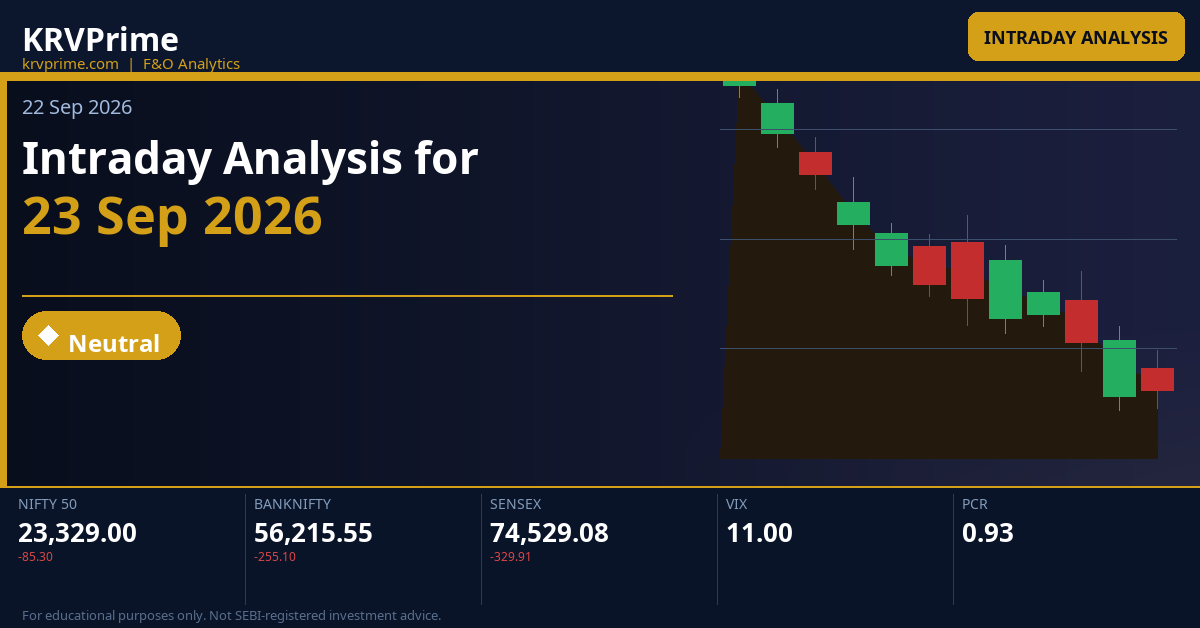
KRV Prime22 September 202649 min
Educational/Derived AnalysisSource: KRV Prime Market Insights (End-of-Day)As of 22 Sep 2026, 04:21 PM IST
Intraday Analysis for 23 Sep 2026
Markets closed on a weak note on 22 Sep 2026 with NIFTY shedding 0.36% to 23,329, BANKNIFTY falling 0.45% to 56,215.55, and SENSEX declining 0.44% to 74,529.08, all three indices printing bearish closes into descending or overlapping CPR structures for the next session. India VIX data is unavailable for this session, which makes it critical to rely on straddle pricing and OI positioning as the primary volatility proxies — NIFTY's weekly straddle at just 21 points signals near-zero expected move for the expiry day, while the monthly straddle at 262.9 points and BANKNIFTY monthly at 784.2 points suggest broader uncertainty remains. With NIFTY's weekly max pain anchored at 23,350 and the OI resistance wall sitting right at 23,350 CE, options sellers are defending an exceptionally tight range, making 23 Sep 2026 a high-compression, high-sensitivity session where even minor directional breaks could trigger outsized moves.
Key Market Signals — Intraday Setup
All three indices — NIFTY, BANKNIFTY, and SENSEX — are trading below their respective daily CPR bands heading into 23 Sep, with descending and overlapping CPR structures confirming multi-session bearish drift; the weekly CPR for NIFTY is an ultra-narrow overlapping band (0.02% width) which historically flags a trending day, meaning the first directional break on 23 Sep could set the weekly trend with high conviction.
Deep Technical Analysis & Levels
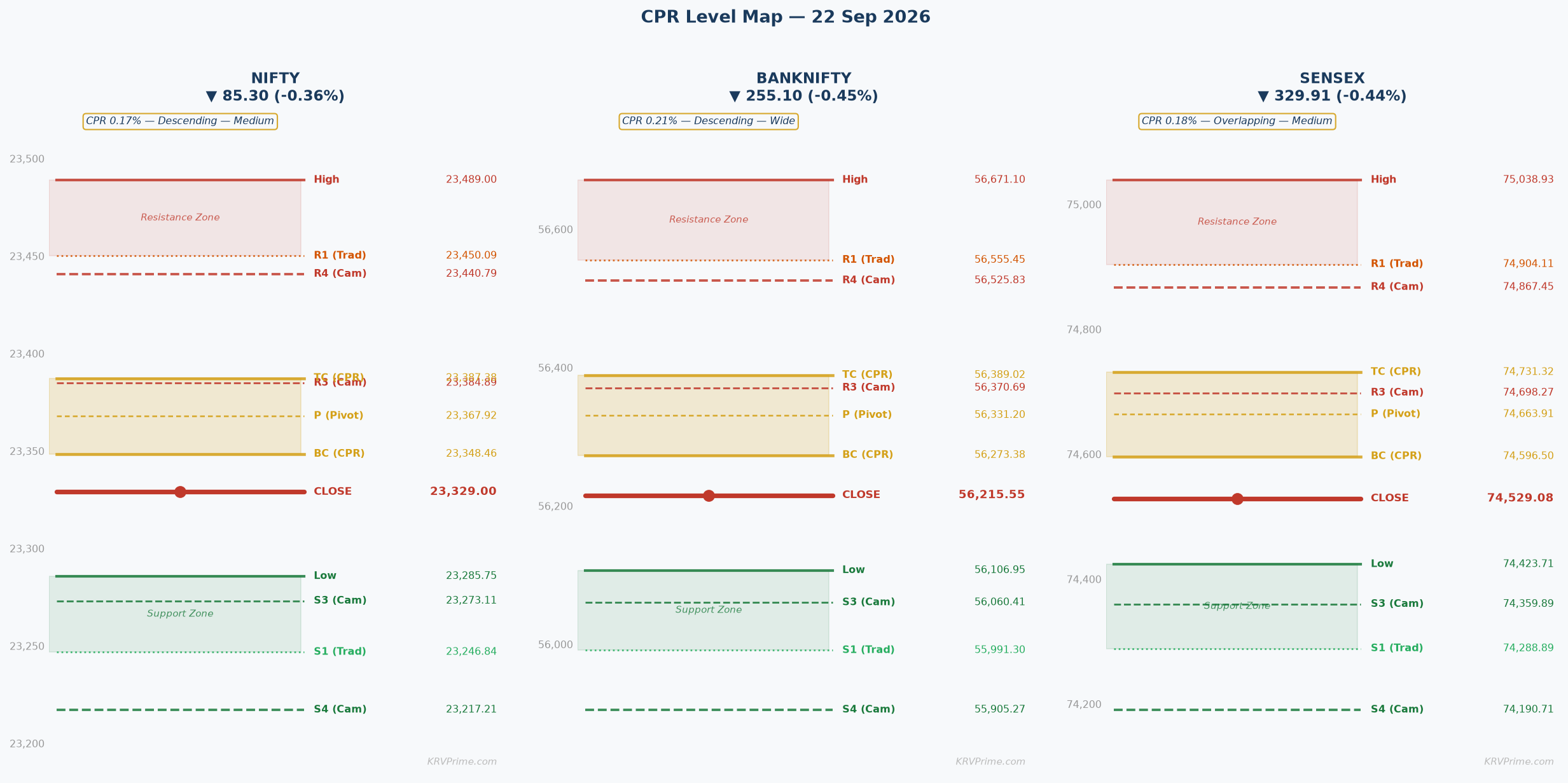
NIFTY
Descending — Medium (Width 0.17%)
▼ Bearish
Market Structure Balanced or transitional | Straddle Weekly ATM 23350 straddle = **21.0 pts** (Call 0.05 + Put 20.95), implying an expected move of just ±21 pts from 23350 for the weekly expiry — an extraordinarily compressed range suggesting the market is pricing near-zero probability of a large move on the expiry day; Monthly ATM 23350 straddle = **262.9 pts** (Call 160.05 + Put 102.85), indicating broader uncertainty over the monthly cycle with a meaningful ±1.1% expected move. | Max Pain Weekly max pain = **23,350** and Monthly max pain = **23,500**; the weekly max pain at 23,350 aligns precisely with the OI resistance wall (CE max OI at 23,350), meaning option sellers will exert maximum gravitational pull toward this strike on expiry day — any close above 23,350 on the weekly expiry works against call writers, while a close below begins to hurt put writers at 23,300. |
Tomorrow's Complete Level Map
OI-R: 23,350 R3: 23,653.34 H6: 23,532.63 H5: 23,506.08 R2: 23,571.17 H4 ▶: 23,440.79 R1: 23,450.09 PDH: 23,489 H3 ↩: 23,384.89
TC: 23,387.38 P: 23,367.92 BC: 23,348.46
L3 ↩: 23,273.11 PDL: 23,285.75 S1: 23,246.84 L4 ▶: 23,217.21 S2: 23,164.67 L5: 23,151.92 L6: 23,125.37 S3: 23,043.59 OI-S: 23,300
↩ = Camarilla reversal point | ▶ = Camarilla breakout/breakdown trigger | OI-R/OI-S = Options wall (CE/PE max OI)
▲ Higher Open (Gap Up) — Open > Prev Close
▲ Bullish
Open lands: With a Descending CPR (TC=23,387.38 is below yesterday's BC), a gap-up open above yesterday's close of 23,329 places price ABOVE TC (23,387.38) — this is a 'Desc. Trend Reversal' setup where price opens above the entire descending CPR band, a structurally bullish surprise that invalidates the session's primary bearish lean.
CPR role: Launch pad / support zone — the CPR band (BC=23,348.46 to TC=23,387.38) transforms into a support base that bulls must defend; as long as price holds above TC=23,387.38, the CPR is acting as a floor and bullish control is confirmed.
Minor Gap (0.05–0.25%) — Structure Dominant
A minor gap up of 0.05–0.25% would open NIFTY approximately in the 23,341–23,387 zone, which places price inside or just at the TC of the descending CPR band at 23,387.38, creating an immediate test of the OI resistance wall at 23,350 which is almost coincident with BC at 23,348.46. The CPR structure, being Descending — Medium (0.17%), provides a conflicted signal here: the gap barely lifts price above the bears' territory but the Medium width demands a first 30-minute close for confirmation, meaning the open itself is not actionable until price either holds above TC=23,387.38 or fails back below BC=23,348.46. The first target on a confirmed hold above TC=23,387.38 would be H3=23,384.89 (already near TC) then the Camarilla H4=23,440.79 and Traditional R1=23,450.09, but given the OI-R wall at 23,350 acting as an immediate overhead ceiling where CE writers are aggressively positioned, even a minor gap may face selling pressure right at the open.
Significant Gap (0.25–0.5%) — Balanced
A significant gap up of 0.25–0.50% opens NIFTY in the 23,387–23,446 range, placing price clearly above TC=23,387.38 and potentially threatening H4=23,440.79 and R1=23,450.09 simultaneously — this is a structurally meaningful breakout above the descending CPR. However, the OI resistance at 23,350 has already been breached (price is above it), which triggers delta-hedging by CE writers who were not expecting this move, potentially creating a short-squeeze dynamic that accelerates price toward H4=23,440.79 and R1=23,450.09 in the first 30 minutes. Gap-fill risk is moderate at this size: the nearest CPR support is TC=23,387.38 and then BC=23,348.46, and a pullback to TC before resuming higher is a classic breakout-retest pattern that would offer the best risk-reward long entry; the first 30-minute close above TC=23,387.38 is the Medium-width confirmation rule that converts this from a gap play into a session trend.
Large Gap (>0.5%) — Gap Direction Dominant
A large gap up exceeding 0.50% opens NIFTY above 23,446, placing price near or above PDH=23,489 and directly challenging R1=23,450.09 and H4=23,440.79 — at this level, the gap is dominant and overrides the descending CPR structure's residual bearish bias. The probability of immediate gap-fill is lower but the risk is that price opens into an area of very thin OI support (the OI-S wall at 23,300 is 150+ pts below and OI-R at 23,350 is already breached), meaning that if the gap fails to attract follow-through buying, a swift reversal from H5=23,506.08 or H6=23,532.63 toward TC=23,387.38 is the dominant risk. The weekly straddle of just 21 points confirms that the market was not pricing this scenario at all, making a large gap up an extreme outlier where straddle sellers face mark-to-market losses and scramble to delta-hedge, temporarily amplifying the upside move before mean-reversion sets in.
|
▲ Upside Path → OI-R On confirmation above TC=23,387.38, the upside path progresses: H3=23,384.89 (already breached given open above TC) → H4=23,440.79 (Camarilla breakout trigger, first meaningful resistance) → R1=23,450.09 (Traditional first partial profit, take 50% here) → H5=23,506.08 and H6=23,532.63 (Camarilla target zone aligning with PDH=23,489) → R2=23,571.17; the OI-R at 23,350 is already below price in a gap-up, so it acts as a backstop support rather than a ceiling. Each successive Camarilla level requires a 15-minute candle hold to confirm genuine momentum, and volume expanding above the 10-day average at H4=23,440.79 is the signal that institutional participation has joined the move. |
▼ Downside Path → OI-S If the gap-up fails and price reverses below TC=23,387.38, the first failure target is P=23,367.92 then BC=23,348.46 which coincides with the OI-R wall at 23,350 — a close below BC=23,348.46 on the 30-minute chart means the gap-up was a distribution event and the session's bearish bias from the descending CPR structure is back in full force. From BC=23,348.46, the bear path accelerates toward L3=23,273.11 (Camarilla mean-reversion zone, first stall point), then PDL=23,285.75 (yesterday's low as reference), then L4=23,217.21 (Camarilla breakdown trigger) and finally S1=23,246.84 → OI-S=23,300 (which sits between L3 and BC, acting as the primary PE-defended floor). |
| 🔴 OI-R: The OI-R at **23,350** (CE max OI strike) sits BELOW the gap-up open in this scenario, which means it transitions from an overhead ceiling to a backstop support — CE writers who sold calls at 23,350 are now delta-positive and may actually support the market at this level if price pulls back, creating a temporary demand zone. However, if the overall market sentiment turns and price falls back to 23,350, the CE writers will no longer defend it aggressively, making a clean break below 23,350 a signal that the entire options structure has flipped bearish. | 🟢 OI-S: The OI-S at **23,300** (PE max OI strike) is the primary downside floor and in a gap-up scenario it represents the maximum bearish case for the day — only if the gap-up completely fails and price collapses below BC=23,348.46 and L3=23,273.11 does the 23,300 PE wall come into play as the terminal support where put writers will defend aggressively. In the gap-up scenario, OI-S at 23,300 is essentially irrelevant unless the session turns into a dramatic reversal, at which point PE monetisation accelerates near this strike. |
⚡ Key Trigger: The exact trigger for the gap-up scenario is a **first 30-minute candle close above TC=23,387.38** on above-average volume, which per the Medium-width CPR rule (0.17%) is the minimum confirmation required before initiating longs — this level is the structural fulcrum because TC is the ceiling of the descending CPR and holding above it means the bearish architecture of the session has been broken and bulls have seized control. If the 30-minute close is BELOW TC=23,387.38 (especially below P=23,367.92 or BC=23,348.46), the gap-up is a bull trap and the descending CPR reasserts overhead pressure, making a fade of the open toward L3=23,273.11 the high-probability trade.
▼ Lower Open (Gap Down) — Open < Prev Close
▼ Bearish
Open lands: With a Descending CPR (TC=23,387.38 below yesterday's BC), a gap-down open below yesterday's close of 23,329 places price INSIDE the CPR band or BELOW BC=23,348.46 — in the Descending CPR framework, a flat or gap-down open is the most natural outcome where the entire CPR acts as overhead resistance above the open.
CPR role: Overhead resistance / trap door — the CPR band (BC=23,348.46 to TC=23,387.38) sits above the gap-down open and acts as a ceiling that bears will defend; any rally toward BC=23,348.46 without a 30-minute close above it is a sell-the-rally setup.
Minor Gap (0.05–0.25%) — Structure Dominant
A minor gap down of 0.05–0.25% opens NIFTY in the 23,271–23,329 zone, placing price at or just below BC=23,348.46, very near the OI-S wall at 23,300 and approaching L3=23,273.11 — this is the most natural expression of the Descending — Medium CPR structure where price opens slightly below the CPR band and the band itself acts as resistance above. The Medium CPR width (0.17%) requires a first 30-minute close to confirm direction: if price manages to reclaim BC=23,348.46 within the first 30 minutes, a minor gap fill toward P=23,367.92 and TC=23,387.38 is probable; if it fails, the OI-S wall at 23,300 is the immediate downside magnet where put writers are positioned. The bear target on failure to reclaim BC is L3=23,273.11 (Camarilla mean-reversion zone and first institutional stall point), with PDL=23,285.75 serving as a near-term reference.
Significant Gap (0.25–0.5%) — Balanced
A significant gap down of 0.25–0.50% opens NIFTY in the 23,212–23,271 range, placing price below L3=23,273.11 and approaching L4=23,217.21 — at this level, the Camarilla breakdown structure is already activated and the descending CPR at BC=23,348.46 is a full 100+ points overhead, making recovery unlikely in the first hour. The 30-minute reclaim rule becomes critical: price must close a 30-minute candle above BC=23,348.46 to negate the bearish thesis, and failure to do so within 60 minutes of open signals that institutional players are using the CPR band as a distribution zone with sustained directional selling. Bear targets progress from L3=23,273.11 → L4=23,217.21 (Camarilla breakdown trigger, where retail stop-losses cluster) → S1=23,246.84 → OI-S=23,300 (already above open, acting as a recovered resistance), and PUT writers who sold 23,300 puts begin to see mark-to-market gains that reduce their motivation to defend.
Large Gap (>0.5%) — Gap Direction Dominant
A large gap down exceeding 0.50% opens NIFTY below 23,212, breaching L4=23,217.21 and approaching S1=23,246.84 from above — this is a panic-grade open where the descending CPR structure's entire architecture is overwhelmed by selling and the OI-S wall at 23,300 is already above the open, meaning PE writers face immediate losses. The psychology shifts from 'will bears defend BC' to 'can buyers absorb panic selling near L5=23,151.92 and L6=23,125.37', making the weekly straddle's 21-point expected move completely redundant and straddle sellers forced to delta-hedge aggressively by buying put futures — this secondary buying can create sharp intraday bounces from L4=23,217.21 or L5=23,151.92 that look like recoveries but are structural gap-fill attempts. The abort level for aggressive bears is a 30-minute close above BC=23,348.46; the target cascade on continuation is L5=23,151.92 → L6=23,125.37 → S3=23,043.59.
|
▲ Upside Path → OI-R The recovery path in a gap-down scenario is: first reclaim BC=23,348.46 (30-minute close needed) → then P=23,367.92 (midpoint confirms balance restoration) → then TC=23,387.38 (full CPR recovery, 30-min close needed for confirmation) → H3=23,384.89 → H4=23,440.79 → R1=23,450.09. A genuine recovery versus a dead-cat bounce is confirmed when price closes a 30-minute candle above TC=23,387.38 with volume above the session average, because this means the CPR band has flipped from resistance to support. |
▼ Downside Path → OI-S The bear continuation path from a gap-down open is: open below BC=23,348.46 → L3=23,273.11 (first stall, Camarilla mean-reversion zone, partial cover for aggressive shorts) → PDL=23,285.75 (yesterday's low, psychological reference) → L4=23,217.21 (Camarilla breakdown trigger, retail stop-loss zone, retail buying exhausted) → S1=23,246.84 → L5=23,151.92 → OI-S=23,300 (already above from this level, note OI-S acts as resistance on recovery, not support on the way down once broken). Retail stop-losses below L3=23,273.11 accelerate the move to L4=23,217.21 because systematic stop-hunters and algo-driven futures selling activate once the Camarilla first defence zone breaks. |
| 🔴 OI-R: The OI-R at **23,350** acts as a strong overhead ceiling in the gap-down scenario — CE writers who sold 23,350 calls are deeply in profit and have no incentive to buy back positions, while new call writers may add at this level on any bounce, creating a layered supply wall that makes recovery above 23,350 extremely difficult without a fundamental positive catalyst. The gamma pressure from CE writers is bearish directional: as the underlying approaches 23,350 from below, delta-hedging activity involves selling futures, which mechanically resists recovery. | 🟢 OI-S: The OI-S at **23,300** (PE max OI) is the primary downside target in a gap-down scenario — put writers who sold 23,300 puts are facing mounting losses and will attempt to defend this level by buying futures aggressively near 23,300, creating temporary support. However, if the gap-down is large enough that price opens BELOW 23,300, the put writers' defense fails and panic covering accelerates the decline toward L3=23,273.11 and L4=23,217.21, making 23,300 a broken floor rather than a support. |
⚡ Key Trigger: The critical trigger in a gap-down scenario is **failure to reclaim BC=23,348.46 within the first 30 minutes** — if the first or second 30-minute candle closes below BC=23,348.46, it confirms that the descending CPR is functioning as a hard ceiling and the session will trend lower toward L3=23,273.11 and L4=23,217.21. The bull trigger (recovery) requires a 30-minute close ABOVE TC=23,387.38 with expanding volume, which would signal that the gap was a shakeout engineered by operators and that the OI support at 23,300 held firm enough to attract aggressive buying.
◆ Near Flat Open — Open ≈ Prev Close (±0.05%)
◆ Neutral
Open lands: A ±0.05% open places NIFTY in the 23,317–23,341 zone, which is BELOW BC=23,348.46 — for a Descending CPR, this is the 'flat = near TC' scenario where price opens at or near TC; however, given TC=23,387.38 is meaningfully above 23,329 (prev close), a flat open actually places price BELOW the entire CPR band (BC=23,348.46 is the nearest CPR level above), confirming the Descending CPR's bearish framework where two sessions of closes below CPR increase trend continuation probability.
CPR role: Decision zone with overhead resistance — BC=23,348.46 is the immediate overhead target and resistance; the entire CPR band (23,348.46 to 23,387.38) must be cleared for bulls to regain control, while a flat open below BC keeps the session structurally bearish with the CPR acting as a resistance ceiling.
Near Flat (±0.05%)
A flat open near 23,329 (±0.05%) in the context of a Descending — Medium CPR is a high-information setup precisely because it opens BELOW the entire CPR band (BC=23,348.46 to TC=23,387.38), giving the session a structural bearish lean from the first print — this is NOT a neutral opening despite being 'flat', and the first 30-minute candle will determine whether this is an accumulation base or a distribution platform. The key levels to watch are BC=23,348.46 (the lowest point of the CPR band, first overhead resistance) and the OI-S wall at 23,300 (PE max OI, the primary bear target below), with the OI-R wall at 23,350 coinciding with BC creating a DOUBLE resistance zone that makes any recovery above 23,350 extremely challenging. The Medium CPR width of 0.17% requires at least one 30-minute candle close for directional confirmation: a close above BC=23,348.46 opens the path toward P=23,367.92 and TC=23,387.38 (bull target), while a rejection from BC=23,348.46 or a 30-minute close below the open confirms the Descending CPR bearish structure and triggers a move toward L3=23,273.11 and OI-S=23,300. The bull trigger is a 30-minute candle close above TC=23,387.38 (clearing the entire CPR band) while the bear trigger is a 30-minute close below OI-S=23,300, which would break put writers' defense and open L3=23,273.11 and L4=23,217.21 as the cascade targets.
|
▲ Upside Path → OI-R From the flat open, the bull recovery path is: first clear BC=23,348.46 (30-min close needed) which immediately hits OI-R wall at 23,350 → then P=23,367.92 → TC=23,387.38 (H3=23,384.89 is essentially identical, both acting as the CPR ceiling) → H4=23,440.79 (Camarilla breakout trigger, confirms trend has reversed) → R1=23,450.09 (Traditional first target, take partial profits here). Volume must expand significantly on any break above TC=23,387.38 to confirm that the CPR band breakout is institutional and not a retail squeeze. |
▼ Downside Path → OI-S From the flat open, the bear continuation path is: fail at BC=23,348.46 → OI-S=23,300 (PE wall, first major stall) → L3=23,273.11 (Camarilla mean-reversion, partial cover zone) → PDL=23,285.75 (yesterday's low, already approached) → L4=23,217.21 (breakdown trigger, retail stops) → S1=23,246.84 → L5=23,151.92 → S2=23,164.67. The key acceleration point is loss of OI-S=23,300 where put writers who sold 23,300 PE begin forced delta-hedging (selling futures) that mechanically drives price to L3=23,273.11 faster than organic selling alone. |
| 🔴 OI-R: The OI-R at **23,350** (CE max OI) sits literally AT BC=23,348.46, creating a DOUBLE overhead resistance in the flat-open scenario — call writers who sold 23,350 CE are in profit and will sell futures on any rally toward this level to delta-hedge, mechanically capping the market and making BC the hardest resistance of the session. This CE-writing ceiling means that in a flat open, the probability of simply grinding from 23,329 to 23,350+ is low without a macro catalyst, as every 5-point rally invites incremental CE writer hedging that suppresses momentum. | 🟢 OI-S: The OI-S at **23,300** (PE max OI) is the primary downside anchor in the flat-open scenario — put writers who sold 23,300 PE have a strong incentive to buy futures near 23,300 to defend their position, creating a meaningful demand zone approximately 29 points below the flat open. In the flat-open context, this means the market is essentially boxed between OI-S=23,300 (support from PE writers) and OI-R=23,350/BC=23,348.46 (resistance from CE writers), creating an extremely tight 50-point intraday range that will only break with significant volume or news flow. |
⚡ Key Trigger: The exact triggers are: **Bull** — first 30-minute candle close above TC=23,387.38 signals CPR band cleared and bullish control established, targeting H3=23,384.89 → H4=23,440.79 → R1=23,450.09; **Bear** — first 30-minute candle close below BC=23,348.46 (which is also OI-R at 23,350 and OI-S at 23,300) — specifically a close below 23,300 (OI-S) is the high-conviction bear signal. These are the structural fulcrums because BC=23,348.46 and OI-R=23,350 create a triple-layered resistance (CPR bottom + call OI wall + weekly max pain) that, if breached, confirms full bearish institutional positioning for the session.
BANKNIFTY
Descending — Wide (Width 0.21%)
▼ Bearish
Market Structure Sideways or range-bound | Straddle Monthly ATM 56200 straddle = **784.2 pts** (Call 550.85 + Put 233.35), implying a ±784.2 point expected move (~±1.4%) from 56200 for the monthly expiry — the heavily skewed straddle (calls worth 2.36x puts) signals that upside uncertainty is priced far higher than downside, reflecting a market that fears a squeeze toward 57,000 max pain more than a collapse, yet current positioning remains bearish. | Max Pain Monthly max pain = **57,000**; with BANKNIFTY closing at 56,215.55, max pain is 784 points above the current price, creating powerful gravitational pull toward 57,000 as the expiry approaches — this means option writers will collectively benefit most if BANKNIFTY drifts higher toward 57,000 by 29 Sep, and any gap-down that moves price away from max pain will be aggressively faded by option sellers who have strong incentive to keep the index near 57,000. |
Tomorrow's Complete Level Map
OI-R: 58,000 R3: 57,119.60 H6: 56,780.79 H5: 56,707.03 R2: 56,895.35 H4 ▶: 56,525.83 R1: 56,555.45 PDH: 56,671.10 H3 ↩: 56,370.69
TC: 56,389.02 P: 56,331.20 BC: 56,273.38
L3 ↩: 56,060.41 PDL: 56,106.95 S1: 55,991.30 L4 ▶: 55,905.27 S2: 55,767.05 L5: 55,724.07 L6: 55,650.31 S3: 55,427.15 OI-S: 55,000
↩ = Camarilla reversal point | ▶ = Camarilla breakout/breakdown trigger | OI-R/OI-S = Options wall (CE/PE max OI)
▲ Higher Open (Gap Up) — Open > Prev Close
↕ Conflicted
Open lands: With a Descending CPR (TC=56,389.02 is below yesterday's BC), a gap-up open above yesterday's close of 56,215.55 places price inside the CPR band (between BC=56,273.38 and TC=56,389.02) or above TC=56,389.02 depending on gap size — for the Descending CPR, a gap-up is a structural surprise that brings the open into or above the resistance band.
CPR role: Battleground / overhead resistance — the CPR band (BC=56,273.38 to TC=56,389.02) is the immediate test zone; a gap-up into the band means the session opens inside contested territory where bears expect to sell and bulls expect to breakthrough.
Minor Gap (0.05–0.25%) — Structure Dominant
A minor gap up of 0.05–0.25% opens BANKNIFTY in the 56,244–56,356 zone, placing price inside the CPR band (BC=56,273.38 to TC=56,389.02) or just above BC — this is an inside-band open where neither bulls nor bears have immediate control and the Wide CPR (0.21%) demands TWO 30-minute candle closes for directional confirmation, meaning the first hour of trade is essentially a data-gathering exercise. The CPR band's Wide nature (0.21%) creates a range-bound intraday expectation: fade moves toward H3=56,370.69 (Camarilla mean-reversion, just inside TC) and L3=56,060.41, with profit-taking at the first Traditional target R1=56,555.45 or S1=55,991.30 — do NOT trail beyond R1/S1 per the Wide CPR rule. The max pain pull at 57,000 adds a mild bullish bias for the monthly cycle, meaning minor gap-ups that hold BC=56,273.38 on a 30-minute basis are more likely to grind toward P=56,331.20 and TC=56,389.02 than to reverse sharply.
Significant Gap (0.25–0.5%) — Balanced
A significant gap up of 0.25–0.50% opens BANKNIFTY in the 56,356–56,497 zone, placing price at or above TC=56,389.02 and approaching H3=56,370.69 territory — at this level, the gap has breached the descending CPR ceiling and the balance of power has tilted toward bulls, though the Wide CPR demands two 30-minute closes for confirmation before committing to a directional trade. Gap-fill risk is moderate: TC=56,389.02 and P=56,331.20 are the nearest retracement levels, and a pullback to BC=56,273.38 before resuming is the classic breakout-retest pattern for the Wide CPR structure where fade extremes is the dominant strategy. If the gap holds above TC on two consecutive 30-minute closes, the upside targets are H3=56,370.69 → H4=56,525.83 → R1=56,555.45 (first partial exit per Wide rule) → H5=56,707.03 → PDH=56,671.10 with OI-R at 58,000 being the distant ceiling that won't be tested intraday.
Large Gap (>0.5%) — Gap Direction Dominant
A large gap up exceeding 0.50% opens BANKNIFTY above 56,497, potentially approaching H4=56,525.83 or R1=56,555.45 — at this level the gap overrides the Descending CPR structure and price has opened well above the entire CPR band, making the session potentially trending. However, the Wide CPR (0.21%) exception does NOT apply here (Wide exception is only for Inside CPR type), so two 30-minute closes above TC=56,389.02 are still required before trailing positions, and profit must be taken at R1=56,555.45 without exception. The max pain magnet at 57,000 and OI-R at 58,000 create a very wide corridor for BANKNIFTY to operate in, meaning a large gap-up could genuinely sustain toward R2=56,895.35 and even R3=57,119.60 (near max pain) if market breadth confirms.
|
▲ Upside Path → OI-R On two 30-minute closes above TC=56,389.02: H3=56,370.69 (already at TC level, first camarilla reference) → H4=56,525.83 (Camarilla breakout trigger, key level for adding positions) → R1=56,555.45 (Traditional first target, MANDATORY partial exit per Wide CPR rule — do NOT trail beyond this) → H5=56,707.03 → PDH=56,671.10 → H6=56,780.79 → R2=56,895.35 → R3=57,119.60 (near monthly max pain of 57,000, exit all by here). The OI-R at 58,000 is a distant ceiling that will not be challenged intraday; exit all positions no later than R3=57,119.60. |
▼ Downside Path → OI-S If the gap-up fails and price reverses below TC=56,389.02, the failure path is: TC=56,389.02 → P=56,331.20 (midpoint recovery fails) → BC=56,273.38 (gap filled, 30-min close below signals bear control) → L3=56,060.41 (Camarilla mean-reversion, first stall) → PDL=56,106.95 (yesterday's low acts as reference) → S1=55,991.30 (Traditional first support). A failure of the gap-up in BANKNIFTY is particularly dangerous given the Sideways or range-bound market structure, as the subsequent reversal can be swift and retrace the full gap size within the next 60 minutes. |
| 🔴 OI-R: The OI-R at **58,000** (CE max OI) is a very distant ceiling — approximately 1,785 points above the current close of 56,215.55 — meaning it is NOT an intraday target and will not influence price action on 23 Sep unless there is an extraordinary macro event. In the gap-up scenario, 58,000 CE writers are deeply profitable and exert zero gamma pressure on the current session, making the Camarilla H5=56,707.03 and H6=56,780.79 the practical upside limits for intraday trading. | 🟢 OI-S: The OI-S at **55,000** (PE max OI) is approximately 1,215 points below the close, making it a distant floor that is highly unlikely to be tested intraday — in a gap-up scenario it is essentially irrelevant for the session. However, PE writers at 55,000 are sitting on large profits and have no pressure to delta-hedge, meaning the downside cushion from put writing is well below current levels and provides no immediate support in the 56,000–56,500 zone that matters for 23 Sep. |
⚡ Key Trigger: The exact trigger for a gap-up in BANKNIFTY is **two consecutive 30-minute candle closes above TC=56,389.02** per the Wide CPR confirmation rule — this double-confirmation is required because the Wide band (0.21%) signals range-bound behavior where single-candle breakouts frequently fail and return to the CPR midpoint P=56,331.20. If the second 30-minute close also holds above TC=56,389.02, the directional bias is confirmed bullish and H3=56,370.69 → H4=56,525.83 → R1=56,555.45 become the structured targets with hard exit at R1.
▼ Lower Open (Gap Down) — Open < Prev Close
▼ Bearish
Open lands: A gap-down open below 56,215.55 in the context of a Descending CPR places price BELOW the entire CPR band (BC=56,273.38 to TC=56,389.02), which is the most natural and bearish expression of the Descending CPR framework — the CPR band sits as a hard ceiling above the open.
CPR role: Overhead resistance — the entire CPR band (BC=56,273.38 to TC=56,389.02) becomes a resistance ceiling above the gap-down open; any rally toward BC=56,273.38 without two 30-minute closes above it is a sell-the-rally setup per the Wide CPR rule.
Minor Gap (0.05–0.25%) — Structure Dominant
A minor gap down of 0.05–0.25% opens BANKNIFTY in the 56,075–56,216 zone, placing price near L3=56,060.41 (Camarilla mean-reversion zone) and the PDL=56,106.95 — this is a structurally weak open where the Descending — Wide CPR places the entire band (BC=56,273.38 to TC=56,389.02) as overhead resistance approximately 60–200 points above. The Wide CPR (0.21%) demands two 30-minute closes for confirmation: if price holds above L3=56,060.41 and rallies to reclaim BC=56,273.38 on two successive 30-minute closes, a gap-fill recovery toward P=56,331.20 and TC=56,389.02 is possible; if L3=56,060.41 breaks on the first 30-minute close, the bear thesis accelerates toward S1=55,991.30. The OI-S wall at 55,000 is distant (1,060+ points below), so there is no immediate PE-writing support in the 56,000 zone, making L3=56,060.41 the critical line between intraday recovery and cascade.
Significant Gap (0.25–0.5%) — Balanced
A significant gap down of 0.25–0.50% opens BANKNIFTY in the 55,935–56,075 zone, breaking below L3=56,060.41 and approaching S1=55,991.30 — at this level, the Camarilla mean-reversion zone has already been breached on the open and the Descending — Wide CPR makes this a confirmed bearish session where all rallies toward BC=56,273.38 are likely to be sold. The 30-minute reclaim rule applies: price must close TWO consecutive 30-minute candles above BC=56,273.38 to negate the bearish thesis, which is an extraordinarily high bar requiring 300+ points of recovery; failure to achieve this within the first 90 minutes confirms the session will trend lower with targets at L4=55,905.27 (Camarilla breakdown trigger) → S1=55,991.30 → L5=55,724.07. PUT writing at 55,000 will not provide support in this range, meaning the bear move from S1=55,991.30 to L4=55,905.27 faces minimal institutional demand.
Large Gap (>0.5%) — Gap Direction Dominant
A large gap down exceeding 0.50% opens BANKNIFTY below 55,935, approaching L4=55,905.27 or even L5=55,724.07 — this is a panic-grade open that fully validates the Descending — Wide CPR's bearish structure and places the CPR band 350–700+ points overhead. The max pain at 57,000 creates an extreme disconnect (price opening 1,065+ points below max pain), which could trigger aggressive option seller defense through futures buying near L4=55,905.27, creating violent intraday bounces that may retrace 300–400 points before resuming lower — these bounces are dead-cat recoveries unless two 30-minute candles close above BC=56,273.38. The straddle's 784.2-point expected move means that a large gap-down alone exhausts most of the monthly expected move, making fade-and-recover strategies more viable for aggressive traders near L5=55,724.07 → L6=55,650.31 with recovery targets toward S1=55,991.30.
|
▲ Upside Path → OI-R Recovery path from a gap-down: first attempt BC=56,273.38 (two 30-min closes needed) → P=56,331.20 (midpoint confirmation) → TC=56,389.02 (full CPR band reclaim, second trigger confirmation) → H3=56,370.69 → H4=56,525.83 → R1=56,555.45 (mandatory exit per Wide CPR rule). A genuine recovery is confirmed by volume expansion above the daily average during the TC=56,389.02 reclaim candle, signaling institutional participation rather than short-covering. |
▼ Downside Path → OI-S Bear continuation from gap-down: below BC=56,273.38 → L3=56,060.41 (Camarilla mean-reversion, first partial cover for aggressive shorts) → PDL=56,106.95 (yesterday's low, minor reference) → L4=55,905.27 (Camarilla breakdown trigger, retail stop-losses at round 56,000 activate here) → S1=55,991.30 → L5=55,724.07 → L6=55,650.31 → S2=55,767.05 → S3=55,427.15. Retail stop-losses clustered below L3=56,060.41 (specifically below PDL=56,106.95) accelerate the move to L4=55,905.27 because systematic algo selling activates once the prior day's low is decisively broken. |
| 🔴 OI-R: The OI-R at **58,000** (CE max OI) is 1,785 points above the close and in a gap-down scenario is entirely irrelevant for intraday trading — CE writers at 58,000 are in maximum profit territory and exert no gamma pressure whatsoever on the 55,900–56,500 range. The practical ceiling for any intraday recovery in the gap-down scenario is TC=56,389.02 and then R1=56,555.45, far below the 58,000 OI wall. | 🟢 OI-S: The OI-S at **55,000** (PE max OI) is the primary long-term downside floor — 1,215+ points below the close — and while it won't be directly tested intraday, its existence means PUT writers will begin delta-hedging (buying futures) aggressively as price approaches L5=55,724.07 and L6=55,650.31, creating a mechanical demand zone in the 55,650–55,725 region. In a large gap-down scenario where price reaches L4=55,905.27 or L5=55,724.07, the 55,000 PE writers' defensive buying becomes the primary reversal catalyst and intraday longs near L5=55,724.07 with a stop below L6=55,650.31 become viable scalps. |
⚡ Key Trigger: The critical trigger in a BANKNIFTY gap-down is **failure of TWO consecutive 30-minute closes to reclaim BC=56,273.38** — per the Wide CPR rule, this double-failure confirms the descending structure is intact and the session will trend bearish. The bull trigger (recovery) requires two 30-minute closes above TC=56,389.02, which signals a complete CPR band reclaim and bullish reversal; anything between BC=56,273.38 and TC=56,389.02 without two clean closes is indeterminate and best avoided as a directional trade.
◆ Near Flat Open — Open ≈ Prev Close (±0.05%)
◆ Neutral
Open lands: A ±0.05% open places BANKNIFTY in the 56,187–56,244 zone, which is BELOW BC=56,273.38 — for the Descending CPR, a flat open is 'near TC' in the framework, but since TC=56,389.02 is well above the prev close of 56,215.55, a flat open actually sits BELOW the entire CPR band (below BC=56,273.38), confirming the bears are structurally in control with the CPR acting as a 58-170 point overhead resistance ceiling.
CPR role: Overhead resistance / compression zone — BC=56,273.38 is the first hurdle above the flat open (58 points overhead), and the entire CPR band up to TC=56,389.02 must be cleared for bulls to regain control; the Wide CPR (0.21%) means two 30-minute closes are needed for ANY directional confirmation.
Near Flat (±0.05%)
A flat open near 56,215.55 in the context of a Descending — Wide CPR (0.21%) is a genuinely neutral but structurally bearish setup: price opens below the entire CPR band (BC=56,273.38 to TC=56,389.02), and the Wide band width signals range-bound behavior where the first 30 minutes will be indecisive and the definitive session direction emerges only after TWO 30-minute closes confirm. The critical levels to watch are BC=56,273.38 (first overhead resistance, just 58 points above the flat open — an easily reachable level that will be tested early) and L3=56,060.41 (the Camarilla mean-reversion support approximately 155 points below, the first meaningful downside target if bears are in control). The Wide CPR rule mandates that traders should NOT initiate directional positions based on single candle closes: the first 30-minute candle above BC=56,273.38 should be treated skeptically and only the SECOND consecutive close above BC=56,273.38 or TC=56,389.02 warrants a bullish position, while a single 30-minute close below L3=56,060.41 (which breaks the Camarilla mean-reversion zone) begins the confirmation of the bear thesis. The bull trigger is two consecutive 30-minute closes above TC=56,389.02 targeting H3=56,370.69 → H4=56,525.83 → R1=56,555.45 (mandatory exit); the bear trigger is two consecutive 30-minute closes below L3=56,060.41 targeting PDL=56,106.95 → S1=55,991.30 → L4=55,905.27 with the OI-S at 55,000 being the distant terminal support.
|
▲ Upside Path → OI-R From the flat open below BC=56,273.38, the bull path requires: clear BC=56,273.38 (first 30-min, tentative) → two closes above TC=56,389.02 (confirmed) → H3=56,370.69 (already at TC level, minor) → H4=56,525.83 (Camarilla breakout trigger, key institutional level for adding) → R1=56,555.45 (Traditional first target, MANDATORY exit per Wide CPR rule — do not trail further). Volume confirmation at H4=56,525.83 is essential: only expanding volume on the break of H4 justifies continuing toward H5=56,707.03 in an extended bull scenario. |
▼ Downside Path → OI-S From the flat open, the bear path is: reject BC=56,273.38 → L3=56,060.41 (two 30-min closes below = bear confirmed) → PDL=56,106.95 (intraday reference) → S1=55,991.30 (Traditional first target, partial cover) → L4=55,905.27 (Camarilla breakdown, stop-hunt zone below 56,000) → L5=55,724.07 → OI-S=55,000 (distant terminal floor). The bear cascade accelerates sharply at L4=55,905.27 where retail longs who bought near the open have their stops, creating algo-driven selling that can drive 100-point drops within a single 5-minute candle. |
| 🔴 OI-R: The OI-R at **58,000** (CE max OI) is an extremely distant ceiling — 1,784 points above the flat open — and in a flat-open scenario it exerts no gamma pressure on the session whatsoever. The practical ceiling in a flat-open scenario is TC=56,389.02 (CPR top) and then R1=56,555.45 (Traditional first target), both of which are the actual intraday resistance levels; CE writers at 58,000 are passive and do not influence intraday price discovery in the 56,000–56,400 range. | 🟢 OI-S: The OI-S at **55,000** (PE max OI) is approximately 1,215 points below the flat open and serves as a distant backstop rather than an active intraday support — in the flat-open scenario, the practical PE-writing defense begins only as price approaches L5=55,724.07 and L6=55,650.31 where gamma exposure starts to build meaningfully for 55,000 PE writers. The primary lesson from the 55,000 OI-S in the flat-open context is that the downside is structurally capped at 55,000 for the monthly cycle, giving traders who buy near L5/L6 a positively asymmetric risk profile even if intraday continues lower. |
⚡ Key Trigger: The exact triggers for BANKNIFTY in a flat open: **Bull** — two consecutive 30-minute closes above TC=56,389.02 confirm CPR breakout, target H4=56,525.83 and R1=56,555.45 (exit all per Wide rule); **Bear** — two consecutive 30-minute closes below L3=56,060.41 confirm Camarilla breakdown, target S1=55,991.30 and L4=55,905.27. These are the structural fulcrums because the Wide Descending CPR creates a wide indecision zone where single-candle signals are noise — only the double-confirmation reveals genuine institutional directional commitment, and anything between L3=56,060.41 and BC=56,273.38 after two 30-minute candles is a sideways chop that should be avoided.
SENSEX
Overlapping — Medium (Width 0.18%)
◆ Neutral
Market Structure Balanced or transitional | Straddle Weekly ATM 74500 straddle = **609.6 pts** (Call 425.55 + Put 184.05), implying a ±609.6 point expected move from 74,500 for the weekly expiry — the heavy skew toward calls (2.31x puts) reflects significant upside uncertainty or short-covering risk, while the monthly straddle is identical at 609.6 pts, suggesting the weekly and monthly option pricing have converged (same ATM, same premiums), which is unusual and signals options market indecision about the direction. | Max Pain Weekly max pain = **74,700** and Monthly max pain = **74,700**; both weekly and monthly max pain converging at 74,700 creates an exceptionally strong gravitational pull — SENSEX closed at 74,529.08, just 171 points below max pain, meaning option sellers' collective profit maximization point is nearly at current levels and the path of least resistance is a gentle drift toward 74,700 rather than a large directional move. |
Tomorrow's Complete Level Map
OI-R: 75,000 R3: 75,519.33 H6: 75,145.17 H5: 75,065.05 R2: 75,279.13 H4 ▶: 74,867.45 R1: 74,904.11 PDH: 75,038.93 H3 ↩: 74,698.27
TC: 74,731.32 P: 74,663.91 BC: 74,596.50
L3 ↩: 74,359.89 PDL: 74,423.71 S1: 74,288.89 L4 ▶: 74,190.71 S2: 74,048.69 L5: 73,993.11 L6: 73,912.99 S3: 73,673.67 OI-S: 71,000
↩ = Camarilla reversal point | ▶ = Camarilla breakout/breakdown trigger | OI-R/OI-S = Options wall (CE/PE max OI)
▲ Higher Open (Gap Up) — Open > Prev Close
▲ Bullish
Open lands: The SENSEX CPR is Overlapping — Medium (Width 0.18%), with BC=74,596.50 and TC=74,731.32 overlapping with yesterday's range. The prev close of 74,529.08 sits BELOW BC=74,596.50, meaning a gap-up open moves price toward and potentially inside the CPR band; a minor gap puts the open between BC=74,596.50 and TC=74,731.32 (inside band), while a significant or large gap opens above TC=74,731.32.
CPR role: Decision zone / launch pad — the CPR band (BC=74,596.50 to TC=74,731.32) is the key battleground; opening inside or above it is structurally bullish for the Overlapping CPR where the band compresses the previous session's range and a gap-up suggests energy release to the upside.
Minor Gap (0.05–0.25%) — Structure Dominant
A minor gap up of 0.05–0.25% opens SENSEX in the 74,566–74,716 zone, placing price inside the CPR band (BC=74,596.50 to TC=74,731.32) or just approaching TC=74,731.32 — the Overlapping — Medium CPR structure means this inside-band open is a high-energy setup where the first 30-minute candle close determines the day's direction. The max pain at 74,700 sits almost exactly at TC=74,731.32 and P=74,663.91, creating a triple-layered magnetic zone that will attract price in a minor gap-up scenario; traders should watch for a 30-minute close above TC=74,731.32 to confirm bullish control. On confirmation above TC=74,731.32, H3=74,698.27 is immediately at the same level (essentially TC = H3 here), making H4=74,867.45 the first meaningful resistance, followed by R1=74,904.11 and OI-R=75,000 as the session ceiling.
Significant Gap (0.25–0.5%) — Balanced
A significant gap up of 0.25–0.50% opens SENSEX in the 74,716–74,903 zone, placing price at or above TC=74,731.32 and approaching H3=74,698.27 territory, with H4=74,867.45 and R1=74,904.11 in immediate range — this is a meaningful breakout above the Overlapping CPR that places price near the OI-R wall at 75,000 (call writers' ceiling). Gap-fill risk is real: TC=74,731.32 and P=74,663.91 are the nearest retracement levels, and a pullback to BC=74,596.50 before resuming is the classic Overlapping CPR re-test pattern where the entire band becomes support on retest. The first 30-minute close above TC=74,731.32 is the Medium-width confirmation rule; if confirmed, H4=74,867.45 → R1=74,904.11 → OI-R=75,000 form the upside path, but the OI-R at 75,000 is the hard ceiling where CE writers will aggressively sell, limiting upside.
Large Gap (>0.5%) — Gap Direction Dominant
A large gap up exceeding 0.50% opens SENSEX above 74,903, placing price near or above R1=74,904.11, H4=74,867.45, and directly at the OI-R wall at 75,000 — this is an extreme scenario where price opens into the primary CE writing zone. The OI-R at 75,000 (CE max OI for both weekly and monthly) is the dominant resistance that will cap the session; call writers at 75,000 will delta-hedge furiously (selling futures) on a large gap-up open, creating immediate selling pressure that is likely to cap gains and push price back below TC=74,731.32 toward P=74,663.91. The weekly straddle of 609.6 points means this large gap-up has consumed approximately 70%+ of the weekly expected move in the first print, making straddle sellers' mark-to-market losses significant and their delta-hedging activity the dominant intraday force.
|
▲ Upside Path → OI-R On 30-minute confirmation above TC=74,731.32: H3=74,698.27 (essentially at TC, immediately cleared) → H4=74,867.45 (Camarilla breakout trigger, first add/partial target) → R1=74,904.11 (Traditional first target, first partial exit) → OI-R=75,000 (CE writing wall, primary ceiling — take remaining profits here, do NOT hold above 75,000 without enormous volume confirmation) → H5=75,065.05 (only if OI-R=75,000 is cleanly breached with two 30-min closes). The max pain at 74,700 being at TC means the market will naturally gravitate toward TC first, making any gap-up that opens above TC self-fulfilling for the first 30 minutes. |
▼ Downside Path → OI-S If gap-up fails below TC=74,731.32, the reversal path is: TC=74,731.32 (failure to hold) → P=74,663.91 (midpoint, first stall) → BC=74,596.50 (CPR bottom, 30-min close below = bearish confirmation) → L3=74,359.89 (Camarilla mean-reversion, first stall) → PDL=74,423.71 (yesterday's low as reference) → S1=74,288.89 (Traditional first support, partial cover for shorts) → L4=74,190.71 (Camarilla breakdown trigger). A failed gap-up in the Overlapping CPR context is particularly damaging because it confirms that the market used the gap to distribute to retail buyers. |
| 🔴 OI-R: The OI-R at **75,000** (CE max OI for both weekly AND monthly) is the absolute ceiling for SENSEX in the gap-up scenario — this is where CE writers for both expiries have their maximum exposure, creating a combined supply wall from two strike series simultaneously that makes 75,000 the hardest resistance of the year. Delta-hedging by CE writers at 75,000 involves selling SENSEX futures every time price approaches this level, creating a mechanical ceiling where even strong gap-ups fade; only a definitive breach of 75,000 with exceptional volume signals a structural shift. | 🟢 OI-S: The OI-S at **71,000** (PE max OI for both weekly and monthly) is an extremely distant floor — approximately 3,529 points below the close — and is entirely irrelevant for the gap-up intraday scenario. PE writers at 71,000 are deeply in profit and provide no mechanical support in the 74,000–75,000 zone; the nearest PE-related support for the session is the CPR BC=74,596.50 itself, which is supported by the convergence of max pain at 74,700 acting as a magnet. |
⚡ Key Trigger: The exact trigger for the gap-up scenario is a **first 30-minute candle close above TC=74,731.32** per the Medium CPR confirmation rule (0.18%) — TC is simultaneously the CPR ceiling and the max pain zone at 74,700, making it the most critical level of the session where both CPR structure and options positioning converge. A 30-minute close BELOW TC=74,731.32 (especially below P=74,663.91 and BC=74,596.50) after a gap-up signals a bull trap and activates the Overlapping CPR's 'double compression release down' scenario toward L3=74,359.89 and OI-S territory.
▼ Lower Open (Gap Down) — Open < Prev Close
▼ Bearish
Open lands: A gap-down open below 74,529.08 in the context of an Overlapping — Medium CPR places price BELOW BC=74,596.50 (the CPR bottom), which means the open is below the entire overlapping band — this is the 'double compression release down' scenario where an Overlapping CPR combined with a gap-down signals bearish energy release from the compressed band.
CPR role: Overhead resistance / trap door — BC=74,596.50 becomes an immediate overhead resistance above the gap-down open; the entire CPR band (74,596.50 to 74,731.32) acts as a ceiling that bears will defend, and per the Medium width rule (0.18%), a 30-minute close is needed to confirm direction.
Minor Gap (0.05–0.25%) — Structure Dominant
A minor gap down of 0.05–0.25% opens SENSEX in the 74,343–74,529 zone, placing price near L3=74,359.89 (Camarilla mean-reversion zone) or PDL=74,423.71 (yesterday's low) — this is the Overlapping CPR's 'double compression release down' scenario where the gap confirms that the compressed CPR energy has discharged to the downside. The Overlapping CPR's Medium width (0.18%) requires a first 30-minute close to confirm: a 30-minute close below L3=74,359.89 confirms the Camarilla mean-reversion zone has broken and S1=74,288.89 → L4=74,190.71 become the next targets; a recovery above BC=74,596.50 within 30 minutes negates the gap-down and suggests a bull trap was sprung. The max pain at 74,700 (which coincides with P=74,663.91 and TC=74,731.32) acts as a recovery target in the gap-down scenario: if price spends more than 60 minutes below BC=74,596.50 without recovering, the max pain pull becomes irrelevant for that session.
Significant Gap (0.25–0.5%) — Balanced
A significant gap down of 0.25–0.50% opens SENSEX in the 74,156–74,343 zone, breaking below L3=74,359.89 and approaching L4=74,190.71 — this confirms the Overlapping CPR's double compression release to the downside with high conviction, as the Camarilla mean-reversion zone has been breached at the open. The 30-minute reclaim rule requires a close ABOVE BC=74,596.50 to negate the bear thesis, which demands 250–440 points of recovery from the open — an extremely high bar that signals the session will likely trend bearish toward S1=74,288.89 → L4=74,190.71 → S2=74,048.69. OI-S at 71,000 is 3,000+ points away and provides no active support in this range, meaning the bear move from L4=74,190.71 to L5=73,993.11 faces minimal PE-writing defense.
Large Gap (>0.5%) — Gap Direction Dominant
A large gap down exceeding 0.50% opens SENSEX below 74,156, approaching L4=74,190.71 or L5=73,993.11 — this is a panic-grade open that completely invalidates the Overlapping CPR's range-bound expectation and signals a structural breakdown. The weekly straddle of 609.6 points means a large gap-down alone consumes 50%+ of the weekly expected move, making straddle sellers aggressively delta-hedge (sell futures) which temporarily amplifies the downside move before violent bounces emerge near L4=74,190.71 or L5=73,993.11. The max pain at 74,700 creates a 500–700 point recovery potential from a large gap-down — option sellers will buy futures aggressively below L3=74,359.89 to push price back toward max pain, making large gap-downs tradeable recovery setups for nimble traders with entry near L4=74,190.71 and target at S1=74,288.89 → L3=74,359.89.
|
▲ Upside Path → OI-R Recovery path from gap-down: first BC=74,596.50 (30-min close, tentative recovery) → P=74,663.91 (midpoint, max pain zone approaches) → TC=74,731.32 (full CPR reclaim, 30-min close confirms recovery) → H3=74,698.27 (essentially at TC) → H4=74,867.45 → R1=74,904.11 → OI-R=75,000 (ceiling). The recovery is genuine when volume on the BC reclaim candle exceeds the average session volume, indicating institutional buyers have stepped in near the gap-down low rather than retail short-covering. |
▼ Downside Path → OI-S Bear continuation from gap-down: below BC=74,596.50 → L3=74,359.89 (Camarilla mean-reversion, first stall and partial cover) → PDL=74,423.71 (yesterday's low as near-term reference) → S1=74,288.89 (Traditional first support, retail long stop-losses concentrated here) → L4=74,190.71 (Camarilla breakdown trigger, major retail stop-hunt level) → S2=74,048.69 → L5=73,993.11 → L6=73,912.99 → OI-S=71,000 (distant monthly PE floor). The acceleration from S1=74,288.89 to L4=74,190.71 is powered by retail long stop-losses clustered near the 74,300 round level, which when triggered create algo-selling cascades. |
| 🔴 OI-R: The OI-R at **75,000** (combined weekly + monthly CE max OI) is an overwhelming overhead ceiling in the gap-down scenario — it is approximately 471+ points above the prev close, making it an irrelevant intraday target in a gap-down session. However, the existence of the 75,000 CE writing wall means that any recovery attempt will face layered resistance from 74,867.45 (H4) through 74,904.11 (R1) to 75,000 (OI-R), as CE writers at 75,000 have no incentive to unwind and will add fresh shorts on any bounce toward their strike. | 🟢 OI-S: The OI-S at **71,000** (PE max OI for both weekly and monthly) is approximately 3,529 points below the close — a terminal floor that is completely irrelevant for intraday gap-down scenarios. The practical PE-writing defense zone that matters for 23 Sep is the 73,900–74,200 range (L6=73,912.99 to L4=74,190.71), where gamma exposure from lower strikes begins to build; if price reaches these levels, expect violent bounces as option writers synthetically defend through futures purchases, making L4=74,190.71 a potential intraday reversal zone. |
⚡ Key Trigger: The critical trigger in a SENSEX gap-down is **failure to reclaim BC=74,596.50 within the first 30 minutes** — if the first 30-minute candle closes below BC=74,596.50, the Overlapping CPR's double compression release confirms a bearish day with targets at L3=74,359.89 and L4=74,190.71. The bull recovery trigger requires a 30-minute close ABOVE TC=74,731.32 (full CPR band reclaim), which in the context of a gap-down represents a complete reversal of the morning's directional energy and signals that max pain at 74,700 has magnetically pulled price back to the option sellers' optimal zone.
◆ Near Flat Open — Open ≈ Prev Close (±0.05%)
◆ Neutral
Open lands: A ±0.05% open places SENSEX in the 74,492–74,566 zone, which is BELOW BC=74,596.50 — for the Overlapping — Medium CPR, the overlap of today's CPR with yesterday's range means that a flat open below BC=74,596.50 is in the 'Overlapping CPR inside-band' territory but specifically on the bearish side of the band, as prev close (74,529.08) is below BC=74,596.50. This creates the 'Overlapping CPR flat below BC' scenario where CPR acts as an immediate test zone just 67 points above the open.
CPR role: Decision zone / compression band — BC=74,596.50 is the immediate overhead resistance (67 points above the flat open), and the entire band up to TC=74,731.32 is the key battleground; the Overlapping CPR's 0.18% width creates a 135-point compression band that will be tested within the first hour of trade.
Near Flat (±0.05%)
A flat open near 74,529 in the context of an Overlapping — Medium CPR (0.18%) creates the classic 'compression band decision' setup where the first 30-minute candle is the trade setup and NOT the trade itself — the Overlapping CPR means that today's CPR band (BC=74,596.50 to TC=74,731.32) sits just 67–202 points above the open, making it an immediately reachable test zone within the first 30 minutes of trading. The critical levels are BC=74,596.50 (bottom of CPR, first resistance, also aligns with the broader weekly CPR midpoint) and TC=74,731.32 (top of CPR, which is 7 points above the weekly H3=74,698.27 and essentially at the Camarilla mean-reversion zone, creating a convergence of resistance at 74,698–74,731), with the max pain for both weekly and monthly at 74,700 creating a triple-layered magnetic ceiling. The Medium CPR width (0.18%) demands a first 30-minute close for direction: a 30-minute close above TC=74,731.32 with above-average volume is the bull trigger (targeting H4=74,867.45 → R1=74,904.11 → OI-R=75,000), while a 30-minute close below BC=74,596.50 is the bear trigger (targeting L3=74,359.89 → S1=74,288.89 → L4=74,190.71), with the band between BC and TC treated as noise until one side claims it. The convergence of max pain at 74,700, TC at 74,731.32, H3 at 74,698.27, and the weekly CPR midpoint all in the 74,698–74,731 zone means this 33-point cluster is the single most important resistance cluster of the session: clearing it on volume triggers genuine upside momentum, while rejection from it confirms the bearish daily close on 22 Sep will extend into 23 Sep.
|
▲ Upside Path → OI-R From the flat open, the bull path is: first close BC=74,596.50 (30-min, tentative entry with reduced size) → two closes above TC=74,731.32 with H3=74,698.27 cleared simultaneously (confirmed entry, full size) → H4=74,867.45 (Camarilla breakout trigger, add to winners) → R1=74,904.11 (Traditional first target, first partial at 50%) → OI-R=75,000 (weekly + monthly CE wall, take remaining profits here — this is the HARD ceiling) → H5=75,065.05 (only if 75,000 breached with very strong volume). Volume must be above average on the TC=74,731.32 candle for the bull case to be legitimate; thin-volume breakouts above TC in a flat-open Overlapping CPR are the most common bull trap pattern. |
▼ Downside Path → OI-S From the flat open, the bear path is: reject BC=74,596.50 (30-min close below) → L3=74,359.89 (Camarilla mean-reversion, first partial cover, 35% of position) → PDL=74,423.71 (yesterday's low, minor reference) → S1=74,288.89 (Traditional first support, second partial cover) → L4=74,190.71 (Camarilla breakdown trigger, retail stop-loss zone below 74,200) → S2=74,048.69 → L5=73,993.11 (psychological 74,000 breakdown) → L6=73,912.99. The acceleration below L3=74,359.89 is driven by retail long stop-losses and algo-selling at PDL=74,423.71 that triggers a cascade, making L3 the key level where bears should take first partial profits. |
| 🔴 OI-R: The OI-R at **75,000** (CE max OI for BOTH weekly AND monthly expiries simultaneously) is the most powerful CE writing wall in the SENSEX universe for this session — the coincidence of two expiry series both having their maximum CE OI at exactly 75,000 creates a combined gamma exposure that mechanically caps price at 75,000 through delta-hedging by an unusually large number of call writers. In the flat-open scenario, 75,000 is the ultimate bull target but also the ultimate fade level: reaching 75,000 without a macro catalyst will be met with systematic futures selling from call writers at two expiries simultaneously, making 75,000 a fade-only zone rather than a breakout zone. | 🟢 OI-S: The OI-S at **71,000** (PE max OI for both weekly and monthly) is approximately 3,529 points below the flat open — so distant as to be completely irrelevant for intraday trading on 23 Sep. In the flat-open scenario, the OI-S at 71,000 serves only as a psychological reminder that the options market is not pricing any major crash scenario; the practical PE support for the session is centered around L3=74,359.89 and L4=74,190.71 where gamma from lower-priced puts begins to accumulate and option sellers start active delta-hedging to defend monthly theta. |
⚡ Key Trigger: The exact triggers for SENSEX in a flat open: **Bull** — first 30-minute close above TC=74,731.32 (which simultaneously clears H3=74,698.27 and max pain 74,700), targeting H4=74,867.45 and R1=74,904.11 with a second partial at OI-R=75,000; **Bear** — first 30-minute close below BC=74,596.50, targeting L3=74,359.89 and S1=74,288.89 with continuation to L4=74,190.71. The TC=74,731.32 level is the fulcrum because it concentrates CPR structure, Camarilla mean-reversion (H3=74,698.27), max pain (74,700), and the weekly CPR BC (74,432.93) and TC (74,708.89) convergence zone, making it the level where the most institutional participants have pre-positioned and where the session's directional resolution is forced.
📊 VIX Insight: India VIX data is unavailable for 22 Sep 2026, making direct volatility assessment impossible; as a proxy, the NIFTY weekly straddle at just **21.0 points** (±0.09% from ATM=23350) signals near-zero implied volatility for the weekly expiry — an extraordinarily compressed reading that historically precedes either a flat expiry or a sharp volatility expansion if any directional trigger emerges. Traders should treat the absence of VIX data as a reason to rely MORE heavily on OI positioning (OI-R=23350, OI-S=23300 for NIFTY creating a 50-point cage) and CPR structure for session direction, while being prepared for sharper-than-expected moves if the weekly straddle's 21-point range is broken.
Overall View:
All three indices — NIFTY, BANKNIFTY, and SENSEX — closed 22 Sep 2026 with moderate losses and are entering 23 Sep with bearish or neutral CPR structures (NIFTY: Descending Medium, BANKNIFTY: Descending Wide, SENSEX: Overlapping Medium), all with closes below their respective daily CPR bands, suggesting that the path of least resistance heading into the opening is mildly bearish unless a positive global catalyst drives a gap-up. The weekly CPR for NIFTY is an ultra-narrow overlapping band (0.02% width) which is the single most important meta-signal for 23 Sep — an overlapping narrow weekly CPR historically signals a trending week, meaning the first clean directional break on 23 Sep (above 23,387.38 TC or below 23,273.11 L3) could set the trend for the entire week with momentum. For option traders, the convergence of NIFTY weekly max pain at 23,350, OI-R at 23,350, and OI-S at 23,300 in a 50-point window, combined with SENSEX max pain at 74,700 (both weekly and monthly) near TC=74,731.32, suggests the optimal scenario for option sellers is a flat-to-mildly-bullish open that drifts toward max pain levels — traders should respect these OI walls as primary targets rather than trailing beyond them.
All three indices — NIFTY, BANKNIFTY, and SENSEX — closed 22 Sep 2026 with moderate losses and are entering 23 Sep with bearish or neutral CPR structures (NIFTY: Descending Medium, BANKNIFTY: Descending Wide, SENSEX: Overlapping Medium), all with closes below their respective daily CPR bands, suggesting that the path of least resistance heading into the opening is mildly bearish unless a positive global catalyst drives a gap-up. The weekly CPR for NIFTY is an ultra-narrow overlapping band (0.02% width) which is the single most important meta-signal for 23 Sep — an overlapping narrow weekly CPR historically signals a trending week, meaning the first clean directional break on 23 Sep (above 23,387.38 TC or below 23,273.11 L3) could set the trend for the entire week with momentum. For option traders, the convergence of NIFTY weekly max pain at 23,350, OI-R at 23,350, and OI-S at 23,300 in a 50-point window, combined with SENSEX max pain at 74,700 (both weekly and monthly) near TC=74,731.32, suggests the optimal scenario for option sellers is a flat-to-mildly-bullish open that drifts toward max pain levels — traders should respect these OI walls as primary targets rather than trailing beyond them.
Disclaimer: KRV Prime provides educational and informational content relating to financial markets. Articles, research, examples, charts, strategies and tools are provided for educational purposes and should not be interpreted as personalised investment advice or a guarantee of financial performance. Markets involve risk, including possible loss of capital. Past performance does not guarantee future results. KRV Prime is not a SEBI Registered Investment Adviser or Research Analyst.