
Index Analysis
Intraday Analysis for 25 Sep 2026
KRV Prime27 September 202649 min
Educational/Derived AnalysisSource: KRV Prime Market Insights (End-of-Day)As of 27 Sep 2026, 04:41 AM IST
Intraday Analysis for 25 Sep 2026
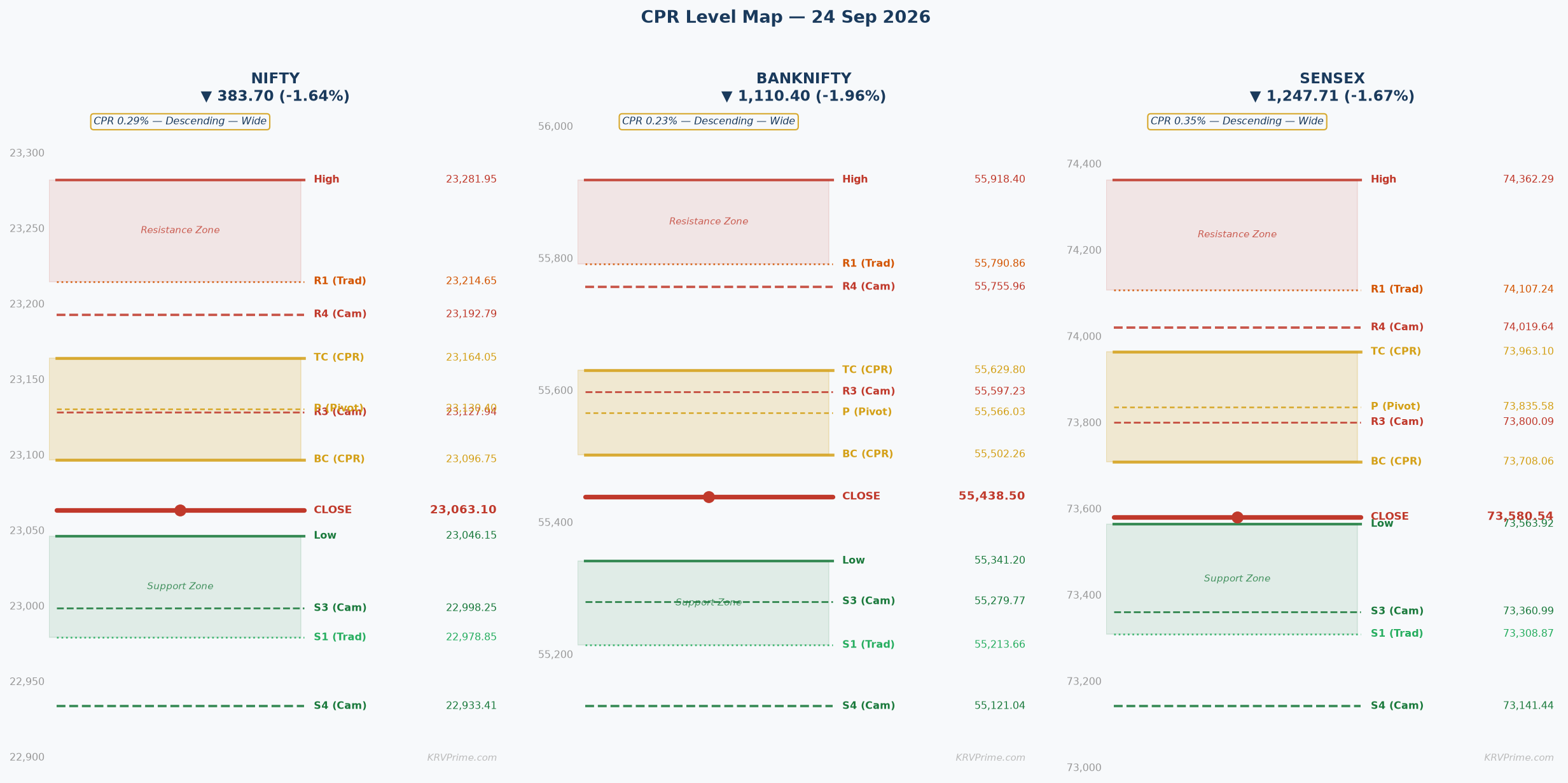
All three benchmark indices — NIFTY, BANKNIFTY and SENSEX — closed sharply lower on 24 Sep 2026, with losses of 1.64%, 1.96% and 1.67% respectively, painting a broadly bearish canvas heading into 25 Sep 2026. India VIX data is unavailable for this session, but the magnitude of the single-day selloff — with NIFTY losing 384 points and BANKNIFTY shedding over 1,100 points — implies elevated intraday volatility and heightened option premiums that traders must factor into their risk-sizing. With all three indices sporting Descending Wide CPR structures for 25 Sep 2026, the dominant opening bias is bearish, and the CPR bands sit well above yesterday's closing prices, making them overhead resistance zones rather than support floors.
Key Market Signals — Intraday Setup
All three indices have closed decisively below their respective daily CPR bands and weekly CPR pivots, confirming multi-session bearish momentum with Descending Wide CPR structures for 25 Sep 2026 across NIFTY, BANKNIFTY and SENSEX simultaneously — a rare alignment that historically precedes either a follow-through selloff or a sharp short-covering bounce. Traders should note that SENSEX OI walls are tightly clustered between 73,500 (PE) and 73,700 (CE) — a mere 200-point band — suggesting extreme positional crowding and the potential for violent intraday reversals around that zone.
Deep Technical Analysis & Levels
NIFTY
Descending — Wide
▼ Bearish
Market Structure Sideways or range-bound | Straddle ATM 23,050 straddle is priced at **259.05 points** (Call LTP 152.55 + Put LTP 106.5), implying a one-standard-deviation expected move of approximately ±259 points from 23,050, giving a probable intraday range of **22,791 to 23,309**. The put premium exceeding the call premium signals directional skew toward the downside, consistent with the bearish CPR alignment. | Max Pain Max Pain for both the weekly and monthly series (expiry 29 Sep 2026) is at **23,300**, which is approximately 237 points above yesterday's close of 23,063.10. This implies significant option-seller interest in gravitating price toward 23,300 by expiry; however, with four trading sessions remaining, intraday moves can deviate sharply before mean-reverting toward max pain — traders should not treat 23,300 as a magnet for today alone. |
Tomorrow's Complete Level Map
OI-R: 24,000 R3: 23,450.45 H6: 23,299.07 H5: 23,268.53 R2: 23,366.20 H4 ▶: 23,192.79 R1: 23,214.65 PDH: 23,281.95 H3 ↩: 23,127.94
TC: 23,164.05 P: 23,130.40 BC: 23,096.75
L3 ↩: 22,998.25 PDL: 23,046.15 S1: 22,978.85 L4 ▶: 22,933.41 S2: 22,894.60 L5: 22,857.68 L6: 22,827.13 S3: 22,743.05 OI-S: 22,000
↩ = Camarilla reversal point | ▶ = Camarilla breakout/breakdown trigger | OI-R/OI-S = Options wall (CE/PE max OI)
▲ Higher Open (Gap Up) — Open > Prev Close
▼ Bearish
Open lands: In a Descending Wide CPR, the entire CPR band (BC 23,096.75 to TC 23,164.05) lies above yesterday's close of 23,063.10. A gap-up open means price lifts above prev close and moves toward or inside the CPR band — a minor gap opens near BC 23,096.75, a significant gap opens inside the band between BC and TC, and a large gap opens above TC 23,164.05, placing price above the entire descending CPR.
CPR role: Overhead resistance and supply zone — the descending CPR acts as a trap door for weak longs; any rally into the band faces aggressive supply from participants who are positioned short from higher levels.
Minor Gap (0.05–0.25%) — Structure Dominant
A minor gap up of 0.05–0.25% from 23,063.10 would open NIFTY in the range of approximately 23,075 to 23,120, placing it just below or at BC 23,096.75 — still below the lower edge of the Descending Wide CPR band. The Descending Wide CPR structure (Width 0.29%) means the entire band above represents overhead supply, and a minor gap merely nudges price toward the lower boundary of that resistance without breaking through it. Traders should watch for two consecutive 30-minute candle closes above BC 23,096.75 to confirm any genuine recovery; the first target on confirmation would be the Pivot 23,130.40, with TC 23,164.05 as secondary — failing either, the day reverts to bearish with L3 22,998.25 as the first downside target.
Significant Gap (0.25–0.5%) — Balanced
A significant gap up of 0.25–0.5% would open NIFTY approximately in the range 23,121 to 23,178, placing it inside the CPR band between BC 23,096.75 and TC 23,164.05 or fractionally above TC. Opening inside a Descending Wide CPR on a significant gap creates immediate gap-fill risk because the wide band (0.29%) acts as a supply sandwich — buyers who chased the gap up find themselves trapped between two walls of seller interest. The key question becomes whether price can sustain two 30-minute closes above TC 23,164.05; only then does H3 23,127.94 (already below TC in this configuration — note H3 falls inside the band) give way to H4 23,192.79 and R1 23,214.65 as sequential targets, otherwise a fade back below BC 23,096.75 exposes L3 22,998.25.
Large Gap (>0.5%) — Gap Direction Dominant
A large gap up exceeding 0.5% would open NIFTY above 23,178, potentially above TC 23,164.05 and approaching H4 23,192.79 or even R1 23,214.65 in an extreme case. While gap dominance overrides CPR structure under normal rules, the Descending Wide CPR means that opening above TC still places price in a zone where multi-session sellers are concentrated, and the PDH 23,281.95 along with H6 23,299.07 form a powerful cluster resistance just 100–118 points above. The straddle premium of 259.05 points implies that a large gap up already consumes a significant portion of the day's expected move, making fresh long entries at the open extremely high-risk; traders should wait for a gap-fill test toward BC 23,096.75 or P 23,130.40 and only buy a successful retest with two 30-minute closes holding above these levels before targeting OI-R at 24,000.
|
▲ Upside Path → OI-R On confirmed breakout above TC 23,164.05 (two 30-min closes), the upside sequence runs: H4 23,192.79 (Camarilla breakout trigger — first partial profit), R1 23,214.65 (Traditional first target — second partial), PDH 23,281.95 (prior day high resistance — strong supply zone), H6 23,299.07, then R2 23,366.20 as the maximum intraday bullish extension. OI-R at 24,000 is the ultimate options wall and is unlikely to be tested in a single session, but represents the structural ceiling where CE writing pressure would aggressively cap any rally. |
▼ Downside Path → OI-S If the gap up fails to hold and price retreats below BC 23,096.75, the Descending Wide CPR confirms as a full overhead resistance structure, and the downside path activates: L3 22,998.25 (Camarilla mean-reversion zone — first stall reference), PDL 23,046.15 (prior day low, a key structural floor), S1 22,978.85 (Traditional first support — partial cover), L4 22,933.41 (Camarilla breakdown trigger — accelerated selling), S2 22,894.60, L5 22,857.68, and ultimately OI-S 22,000 as the week's PE-wall floor. |
| 🔴 OI-R: OI-R at 24,000 represents the dominant Call writing strike for both weekly and monthly series, meaning institutional option sellers have created a massive supply ceiling nearly 937 points above current price — this level will not be relevant for today's intraday trading but acts as the absolute structural cap for the September expiry. In a gap-up scenario, the practical implication is that rallies will face sequential supply at H4 23,192.79, R1 23,214.65, PDH 23,281.95 and R2 23,366.20 long before OI-R is challenged, and delta-hedging by CE writers at 24,000 provides no meaningful gamma pressure at current levels. | 🟢 OI-S: OI-S at 22,000 is the dominant Put writing strike, representing the floor where PE sellers are defending — this level is approximately 1,063 points below current price and represents the maximum bearish scenario for the September expiry rather than an intraday target. In a gap-up scenario, OI-S is effectively irrelevant for the session unless an extraordinary selloff materializes; however, traders should note that strong PE OI at 22,000 provides a structural safety net that limits downside panic beyond that level for the broader market. |
⚡ Key Trigger: The critical trigger for a gap-up scenario is **two consecutive 30-minute candle closes above TC 23,164.05** with expanding volume, which would confirm that the Descending Wide CPR overhead supply has been absorbed and bullish momentum is genuine. Failure to achieve two closes above TC 23,164.05 — or any single 30-minute close back below BC 23,096.75 — flips the structure decisively bearish, activating the downside path toward L3 22,998.25 and S1 22,978.85.
▼ Lower Open (Gap Down) — Open < Prev Close
▼ Bearish
Open lands: In a Descending Wide CPR, a gap-down open from 23,063.10 places price further below the already-elevated CPR band (BC 23,096.75 to TC 23,164.05), deepening the bearish structure. A minor gap down opens near PDL 23,046.15, a significant gap down breaches PDL and approaches L3 22,998.25, and a large gap down opens below L3 22,998.25 and potentially near S1 22,978.85 or L4 22,933.41.
CPR role: Deep overhead resistance — the entire CPR band (BC 23,096.75 to TC 23,164.05) sits more than 30–100 points above the gap-down open, acting as a formidable recovery ceiling that sellers will defend aggressively on any bounce.
Minor Gap (0.05–0.25%) — Structure Dominant
A minor gap down of 0.05–0.25% from 23,063.10 would open NIFTY approximately in the 23,005–23,050 range, very close to the PDL 23,046.15 — a structurally significant level since prior day lows frequently act as intraday magnets in the first 30 minutes. The Descending Wide CPR with BC 23,096.75 now sits 46–91 points above this open, meaning the entire CPR band is overhead resistance and any recovery attempt must reclaim BC with two 30-minute closes to neutralize the bearish structure. The immediate downside reference is L3 22,998.25, which if breached on the first 30-minute candle, activates S1 22,978.85 and L4 22,933.41 as sequential bear targets for the session.
Significant Gap (0.25–0.5%) — Balanced
A significant gap down of 0.25–0.5% would open NIFTY approximately in the 22,948–23,005 range, breaking below PDL 23,046.15 and into the zone between L3 22,998.25 and L4 22,933.41 — this is the Camarilla breakdown zone where mean-reversion sellers and trend-following shorts are both active. The 30-minute reclaim rule is critical here: if NIFTY reclaims BC 23,096.75 within 30 minutes on strong volume, the gap down is classified as a bear trap and a recovery trade toward P 23,130.40 and TC 23,164.05 activates. Failure to reclaim BC 23,096.75 within the first 30 minutes confirms the bearish structure, with L4 22,933.41 as the primary breakdown target, S2 22,894.60 as secondary, and L5 22,857.68 as the session's extended bear target — PUT writers at 22,000 OI-S will absorb eventual selling.
Large Gap (>0.5%) — Gap Direction Dominant
A large gap down exceeding 0.5% would open NIFTY below 22,948, potentially near L4 22,933.41 or even approaching S2 22,894.60 — territory not seen in the recent trading range — triggering both retail stop-losses and institutional delta-hedging on the put side. With the straddle at 259.05 points, a large gap down of, say, 150–200 points from 23,063 would consume the bulk of the put premium instantly, leading to rapid theta decay on ATM puts and a potential snapback as option sellers monetize gains early in the session. Traders should avoid chasing the open on a large gap down; instead, wait for the first 15-minute candle to stabilize and watch for L5 22,857.68 and L6 22,827.13 as intraday support targets if selling continues, or for a recovery above L3 22,998.25 with two 30-minute closes as the signal to exit shorts and consider mean-reversion longs.
|
▲ Upside Path → OI-R Recovery path on a gap-down: L3 22,998.25 (first mean-reversion stabilization zone), then reclaim of PDL 23,046.15 (prior structure), then BC 23,096.75 (lower CPR boundary — critical reclaim), P 23,130.40 (pivot — neutral territory), TC 23,164.05 (full CPR reclaim — bullish signal), then H3 23,127.94 and H4 23,192.79 as the upper recovery targets. Genuine recovery is confirmed only by two 30-minute closes above TC 23,164.05 and is a low-probability scenario given the Descending Wide structure. |
▼ Downside Path → OI-S Primary bear path: PDL 23,046.15 (immediate floor — breach accelerates selling), L3 22,998.25 (Camarilla mean-reversion zone — first major stall reference), S1 22,978.85 (Traditional first support — partial PUT monetization), L4 22,933.41 (Camarilla breakdown trigger — institutional selling accelerates), S2 22,894.60, L5 22,857.68, L6 22,827.13, S3 22,743.05, and ultimately OI-S 22,000 as the September series structural floor — retail stop-losses below L4 22,933.41 provide the fuel for this cascade. |
| 🔴 OI-R: OI-R at 24,000 is completely irrelevant as an intraday target in a gap-down scenario, sitting approximately 952–1,063 points above the opening price range; however, its existence as the dominant CE writing wall means institutional short-sellers have maximum incentive to keep the market below that level, which paradoxically provides no bullish support near current prices and confirms the bearish tilt for the session. The CE wall at 24,000 means delta-hedging flows from CE writers are currently net-short the market, adding structural selling pressure on any recovery. | 🟢 OI-S: OI-S at 22,000 is the dominant PE writing strike representing the maximum downside anchor for the September series — in a large gap-down scenario approaching L4 22,933.41 or L5 22,857.68, the 22,000 PE wall means PUT sellers will aggressively defend this level, likely triggering a technical bounce as PE writers buy futures to delta-hedge their short-put positions. For intraday traders, OI-S at 22,000 represents the ultimate bear target and profit-booking level for any short trade initiated near BC 23,096.75 or TC 23,164.05. |
⚡ Key Trigger: The dual trigger in a gap-down scenario is: **bear confirmation — failure to reclaim BC 23,096.75 within the first 30 minutes** activates the full downside path toward L3 22,998.25 and L4 22,933.41; **bull recovery trigger — two consecutive 30-minute closes above BC 23,096.75** signals a gap-fill attempt toward P 23,130.40 and TC 23,164.05. The CPR pivot at P 23,130.40 is the structural fulcrum — price held above P is neutral-to-bullish, below P is bearish — and traders should use this to size positions directionally.
◆ Near Flat Open — Open ≈ Prev Close (±0.05%)
◆ Neutral
Open lands: A ±0.05% flat open from 23,063.10 places NIFTY in the range of approximately 23,051–23,075, which is below BC 23,096.75 by at least 22 points and below the entire Descending Wide CPR band (BC 23,096.75 to TC 23,164.05). Per the Descending CPR flat-open rule, price opens near prev_close and the CPR acts as resistance above — this is a classic 'ceiling open' where the prior session's CPR sits overhead like a trap door.
CPR role: Decision zone overhead — the CPR band (BC 23,096.75 to TC 23,164.05) sits above the flat open and acts as the primary resistance structure; price must mount this band convincingly (two 30-min closes above TC) to flip the bias bullish, while failure to do so keeps the bearish structure intact with downside targets activating.
Near Flat (±0.05%)
A flat open near 23,063.10 (±0.05%) in a Descending Wide CPR context is a high-information setup because the CPR band (BC 23,096.75 to TC 23,164.05) sits entirely above the open, and the first 30-minute candle's relationship to BC 23,096.75 will definitively determine the day's directional structure. The Wide CPR (0.29%) confirmation rule mandates two consecutive 30-minute closes above TC 23,164.05 for a bullish bias, or a sustained 30-minute close below current levels (near PDL 23,046.15) for bearish confirmation — there is no shortcut. If price drifts toward BC 23,096.75 and fails to break above on the first attempt, the CPR band acts as a 'trap door' ceiling that rejections price back toward L3 22,998.25 and S1 22,978.85 — the Wide CPR means fading extremes is the preferred strategy, not trending. The bull trigger is **two 30-minute closes above TC 23,164.05** targeting H4 23,192.79 and R1 23,214.65; the bear trigger is **two 30-minute closes below PDL 23,046.15** targeting L3 22,998.25 and L4 22,933.41 — in between these two triggers, price action is pure range-bound noise best traded by scalpers rather than directional traders.
|
▲ Upside Path → OI-R Bull path from flat open: BC 23,096.75 (first resistance — must be crossed), P 23,130.40 (pivot confirmation zone), TC 23,164.05 (full CPR breakout — two 30-min closes required), H3 23,127.94 (note: H3 falls inside the CPR band here, serving as a minor speed bump), H4 23,192.79 (Camarilla breakout trigger — first partial profit target), R1 23,214.65 (Traditional first target — second partial), PDH 23,281.95, H6 23,299.07, R2 23,366.20, and OI-R 24,000 as the distant options wall ceiling. Genuine bullish momentum requires volume expansion on each successive level breach. |
▼ Downside Path → OI-S Bear path from flat open: PDL 23,046.15 (prior day low — first structural floor, breach triggers further selling), L3 22,998.25 (Camarilla mean-reversion zone — first meaningful support, likely sees buying interest), S1 22,978.85 (Traditional first support — partial short-cover zone), L4 22,933.41 (Camarilla breakdown trigger — retail stop-losses cluster below here accelerating the move), S2 22,894.60, L5 22,857.68, L6 22,827.13, S3 22,743.05, and OI-S 22,000 as the September series put-writing wall and maximum structural support. |
| 🔴 OI-R: OI-R at 24,000 represents the dominant CE writing concentration for the September series and sits approximately 937 points above the flat-open price, making it structurally irrelevant as an intraday target in a sideways-to-bearish Descending Wide CPR setup. The significance of OI-R 24,000 in a flat-open scenario is that CE writers at this strike have maximum theta advantage and will not be net delta-hedging (buying futures) at current levels, meaning there is no gamma-driven upside flow to assist a rally — the market is on its own for any recovery. | 🟢 OI-S: OI-S at 22,000 is the dominant PE writing strike and represents the structural floor of the September expiry cycle — in a flat-open scenario drifting lower, this level creates a gravitational pull only if the session's selloff accelerates past L4 22,933.41 and L5 22,857.68, at which point PE writers will begin buying futures aggressively to delta-hedge their short-put exposure, creating a mechanical bottom near OI-S 22,000. For the flat-open scenario specifically, OI-S 22,000 serves as a confidence-builder for bears — knowing this PUT wall exists below encourages bear trades from BC 23,096.75 with hard stops above TC 23,164.05 and profit targets staged at L3, L4 and S2. |
⚡ Key Trigger: **Bull trigger: two consecutive 30-minute candle closes above TC 23,164.05** confirm that the Descending Wide CPR overhead supply has been absorbed and the structure has shifted from bearish to neutral-bullish, opening targets at H4 23,192.79, R1 23,214.65 and ultimately PDH 23,281.95. **Bear trigger: two consecutive 30-minute candle closes below PDL 23,046.15** confirm that the flat open was a 'dead cat' stabilization and the prior session's selloff is resuming, activating L3 22,998.25, S1 22,978.85 and L4 22,933.41 as sequential downside milestones.
BANKNIFTY
Descending — Wide
▼ Bearish
Market Structure Sideways or range-bound | Straddle ATM 55,400 straddle is priced at **777.15 points** (Call LTP 476.3 + Put LTP 300.85), implying a one-standard-deviation expected intraday move of approximately ±777 points from 55,400, giving a probable session range of **54,623 to 56,177**. The Call LTP significantly exceeds the Put LTP, which is somewhat unusual in a bearish setup and may reflect elevated near-term recovery expectations or short-covering bets — traders should monitor whether this imbalance persists at the open. | Max Pain Max Pain for the monthly series (expiry 29 Sep 2026) sits at **56,500**, approximately 1,061.50 points above yesterday's close of 55,438.50. This substantial gap between current price and max pain suggests significant gravitational pull toward 56,500 over the remaining four sessions to expiry; however, a single-day return to 56,500 would require a move of nearly 1.9%, which is possible but aggressive — traders should treat max pain as a multi-session gravity level, not a same-day target. |
Tomorrow's Complete Level Map
OI-R: 57,500 R3: 56,368.06 H6: 56,016.71 H5: 55,941.36 R2: 56,143.23 H4 ▶: 55,755.96 R1: 55,790.86 PDH: 55,918.40 H3 ↩: 55,597.23
TC: 55,629.80 P: 55,566.03 BC: 55,502.26
L3 ↩: 55,279.77 PDL: 55,341.20 S1: 55,213.66 L4 ▶: 55,121.04 S2: 54,988.83 L5: 54,935.64 L6: 54,860.29 S3: 54,636.46 OI-S: 54,000
↩ = Camarilla reversal point | ▶ = Camarilla breakout/breakdown trigger | OI-R/OI-S = Options wall (CE/PE max OI)
▲ Higher Open (Gap Up) — Open > Prev Close
▼ Bearish
Open lands: In BANKNIFTY's Descending Wide CPR, the band (BC 55,502.26 to TC 55,629.80) sits entirely above yesterday's close of 55,438.50. A minor gap up opens near BC 55,502.26, a significant gap up opens inside the band between BC and TC, and a large gap up opens above TC 55,629.80, placing price within or above the entire descending CPR overhead supply zone.
CPR role: Overhead resistance and bearish supply zone — in a Descending Wide CPR, a gap-up open into the band brings price directly into the zone where sellers from the prior session are positioned; the band acts as a trap door for weak longs rather than a launch pad.
Minor Gap (0.05–0.25%) — Structure Dominant
A minor gap up of 0.05–0.25% from 55,438.50 would open BANKNIFTY approximately between 55,466 and 55,577 — placing it below or just inside BC 55,502.26 and still within the lower half of the Descending Wide CPR band. At this opening level, BC 55,502.26 functions as immediate overhead resistance, and the Wide CPR confirmation rule (two 30-minute closes) makes it difficult for bulls to sustain momentum through the full band to TC 55,629.80. Traders should watch for the first 30-minute candle: if price closes above P 55,566.03, a second candle targeting TC 55,629.80 is warranted; otherwise, failure below BC 55,502.26 re-engages the bearish structure with L3 55,279.77 as the first meaningful downside target.
Significant Gap (0.25–0.5%) — Balanced
A significant gap up of 0.25–0.5% from 55,438.50 would open BANKNIFTY approximately between 55,577 and 55,716, placing it inside or just above the CPR band (BC 55,502.26 to TC 55,629.80) — a scenario where price opens inside a Descending Wide supply zone and immediately faces the full width (0.23%) of overhead seller pressure. The gap-fill risk is elevated here because the prior session's bearish close means participants who sold yesterday will defend the band aggressively; the straddle at 777.15 points means this gap consumes roughly 25–35% of the day's expected move before the first trade. Two 30-minute closes above TC 55,629.80 are required for confirmation of bullish intent, with H3 55,597.23 (note: H3 falls inside the CPR band), H4 55,755.96 and R1 55,790.86 as the sequential upside targets; failure to hold TC 55,629.80 on the open re-activates the bearish cascade toward L3 55,279.77 and L4 55,121.04.
Large Gap (>0.5%) — Gap Direction Dominant
A large gap up exceeding 0.5% from 55,438.50 would open BANKNIFTY above 55,716, potentially near H4 55,755.96 or R1 55,790.86, which are formidable resistance levels close to the PDH 55,918.40 — a zone where prior-day sellers are heavily positioned. While gap dominance technically overrides CPR structure at this size, the Descending Wide CPR means a large gap up opens into a multi-layer supply cluster (TC 55,629.80 + H4 55,755.96 + R1 55,790.86 + PDH 55,918.40) within a 288-point band, making fresh longs at the open extremely risky. The 777.15-point straddle implies the day's move is largely front-loaded in this scenario; traders should wait for a confirmed pullback to the BC 55,502.26–P 55,566.03 zone and only buy two 30-minute closes holding above TC 55,629.80 before targeting H5 55,941.36, H6 56,016.71 and R2 56,143.23.
|
▲ Upside Path → OI-R Confirmed upside path above TC 55,629.80: H3 55,597.23 (inside band — absorbed), H4 55,755.96 (Camarilla breakout trigger — first partial profit), R1 55,790.86 (Traditional first target — second partial), PDH 55,918.40 (prior day high — strong supply zone), H5 55,941.36, H6 56,016.71, R2 56,143.23 (Traditional second target — extended bull target), R3 56,368.06, and OI-R 57,500 as the dominant CE writing wall that caps any further rally in the monthly series. Volume must expand progressively through H4 and R1 to validate continuation toward PDH and beyond. |
▼ Downside Path → OI-S Failure path if gap up reverses below BC 55,502.26: PDL 55,341.20 (prior day low — first structural floor), L3 55,279.77 (Camarilla mean-reversion zone — first stall reference), S1 55,213.66 (Traditional first support — partial short-cover), L4 55,121.04 (Camarilla breakdown trigger — institutional selling accelerates below here), S2 54,988.83, L5 54,935.64, L6 54,860.29, S3 54,636.46, and ultimately OI-S 54,000 as the dominant PUT writing floor for the monthly series. |
| 🔴 OI-R: OI-R at 57,500 represents the dominant monthly Call writing strike, sitting approximately 2,061 points above yesterday's close — in a gap-up scenario reaching PDH 55,918.40 or R2 56,143.23, OI-R 57,500 is still 1,357–1,582 points away and will not be tested intraday. However, CE writers at 57,500 are structurally short the market and their delta-hedging activity (selling futures on rallies) adds a persistent downward flow above PDH 55,918.40 that discourages sustained breakouts — the practical ceiling for today's bullish scenario is R2 56,143.23 or R3 56,368.06, not OI-R. | 🟢 OI-S: OI-S at 54,000 is the dominant monthly Put writing strike, approximately 1,438 points below yesterday's close — in a gap-up scenario, OI-S is irrelevant as an intraday target but provides a structural safety net confirming that PUT writers are defending the market from a catastrophic breakdown. The existence of strong PE writing at 54,000 means that any intraday selloff toward L5 54,935.64 or L6 54,860.29 will encounter delta-hedging buying from PUT sellers, making these levels natural bounce zones. |
⚡ Key Trigger: The primary trigger in a gap-up scenario is **two consecutive 30-minute candle closes above TC 55,629.80** with volume exceeding the session average, confirming that the Descending Wide CPR supply has been absorbed and the session has a genuine bullish structure. A single 30-minute close back below BC 55,502.26 after a gap-up open is a clear failure signal, flipping the bias fully bearish and targeting L3 55,279.77 and S1 55,213.66 in the subsequent move.
▼ Lower Open (Gap Down) — Open < Prev Close
▼ Bearish
Open lands: A gap-down open from BANKNIFTY's 55,438.50 close deepens the already-bearish structure by pushing price further below the Descending Wide CPR band (BC 55,502.26 to TC 55,629.80). A minor gap down opens near PDL 55,341.20, a significant gap down breaks PDL and approaches L3 55,279.77, and a large gap down opens below L3 55,279.77 and into the L4 55,121.04 — S1 55,213.66 support cluster.
CPR role: Deep overhead resistance — the entire CPR band (BC 55,502.26 to TC 55,629.80) sits 63–191 points above the gap-down open, functioning as an unreachable recovery ceiling in the near term and confirming bearish momentum for the session.
Minor Gap (0.05–0.25%) — Structure Dominant
A minor gap down of 0.05–0.25% from 55,438.50 would open BANKNIFTY approximately between 55,300 and 55,410, placing it between PDL 55,341.20 and the prior close — PDL 55,341.20 is the immediate structural test that will define the first 30-minute candle's character. A hold above PDL 55,341.20 on the open creates a potential recovery scenario where price attempts to reclaim BC 55,502.26, requiring two 30-minute closes above BC for bullish confirmation; a breach of PDL 55,341.20 immediately activates L3 55,279.77 as the first Camarilla mean-reversion support, followed by S1 55,213.66 and L4 55,121.04 as bear targets for the session.
Significant Gap (0.25–0.5%) — Balanced
A significant gap down of 0.25–0.5% from 55,438.50 would open BANKNIFTY approximately between 55,162 and 55,300, breaking below PDL 55,341.20 and into the zone between L3 55,279.77 and L4 55,121.04 — a structurally weak area where Camarilla breakdown dynamics are active. The 30-minute reclaim rule is essential: reclaiming BC 55,502.26 within one 30-minute candle on strong volume signals a bear trap and activates a recovery trade toward P 55,566.03 and TC 55,629.80; failure to reclaim confirms the bearish cascade with targets at L4 55,121.04, S2 54,988.83 and L5 54,935.64. PUT writing at OI-S 54,000 provides the ultimate structural floor, but reaching L5 54,935.64 intraday would represent a massive 503-point decline from yesterday's close, testing the upper boundary of the straddle's implied move.
Large Gap (>0.5%) — Gap Direction Dominant
A large gap down exceeding 0.5% from 55,438.50 would open BANKNIFTY below 55,161, potentially near L4 55,121.04 or even approaching S2 54,988.83 — a catastrophic opening that would trigger widespread retail stop-losses and institutional risk management selling across financial sector stocks. The straddle at 777.15 points means a 300–400 point gap down consumes nearly 40–50% of the day's expected move on the open, creating a strong probability of intraday mean-reversion as put buyers monetize gains and fresh shorts hesitate to add at extreme lows. Traders should wait for the first 15-minute candle to stabilize and identify L5 54,935.64 and L6 54,860.29 as bear extension targets, while watching for a close above L3 55,279.77 as the first signal that the session has bottomed and a recovery toward PDL 55,341.20 and BC 55,502.26 is possible.
|
▲ Upside Path → OI-R Recovery sequence from gap-down open: L3 55,279.77 (first stabilization zone — Camarilla mean-reversion support), PDL 55,341.20 (prior day low — structural reclaim signal), BC 55,502.26 (CPR lower boundary — critical for bull recovery), P 55,566.03 (pivot — neutral territory confirmed), TC 55,629.80 (full CPR reclaim — two 30-min closes required for bullish bias), H4 55,755.96 (Camarilla breakout trigger), R1 55,790.86 (Traditional first target). Recovery probability is low given the Descending Wide structure and requires significant institutional buying. |
▼ Downside Path → OI-S Primary bear path: PDL 55,341.20 (immediate floor — breach triggers systematic selling), L3 55,279.77 (first Camarilla support — potential scalp long entry for mean-reversion traders), S1 55,213.66 (Traditional first support — partial short-cover zone), L4 55,121.04 (Camarilla breakdown trigger — acceleration point where bank-specific stop-losses fire), S2 54,988.83, L5 54,935.64, L6 54,860.29 (Camarilla extreme low), S3 54,636.46, and OI-S 54,000 as the monthly PUT writing floor — the ultimate intraday bear target where PE writers will step in to buy futures. |
| 🔴 OI-R: OI-R at 57,500 is completely irrelevant as an upside target in a gap-down scenario, being approximately 2,061–2,338 points above the opening price; its structural significance in this context is that CE sellers at 57,500 remain net-short the market via delta hedging, contributing a persistent supply overhang that prevents any mechanical upside flow from supporting intraday recoveries near current levels. For bearish traders, OI-R 57,500 essentially confirms that options market structure is not providing any gamma-driven rescue for the market. | 🟢 OI-S: OI-S at 54,000 is the dominant PE writing strike for the monthly series and serves as the ultimate intraday PUT monetization level — in a large gap-down scenario where price approaches L6 54,860.29 or S3 54,636.46, PE sellers at 54,000 will aggressively buy futures to delta-hedge their short puts, creating a technical floor and potentially triggering a sharp reversal. For intraday traders, OI-S 54,000 should be the pre-planned final profit-booking level for all bearish positions initiated near BC 55,502.26 or TC 55,629.80, as the PUT-wall buying below this level makes sustained breakdown beyond OI-S extremely difficult. |
⚡ Key Trigger: **Bear confirmation: failure to reclaim BC 55,502.26 within the first two 30-minute candles** confirms that the Descending Wide CPR is acting as a hard ceiling and the bearish structure is fully intact, activating the downside sequence L3 55,279.77 → L4 55,121.04 → S2 54,988.83 → OI-S 54,000. **Bull recovery trigger: two consecutive 30-minute closes above BC 55,502.26** signals a successful gap-fill attempt, neutralizing the immediate bearish bias and targeting P 55,566.03, TC 55,629.80, and eventually H4 55,755.96.
◆ Near Flat Open — Open ≈ Prev Close (±0.05%)
◆ Neutral
Open lands: A ±0.05% flat open from 55,438.50 places BANKNIFTY in the range of approximately 55,411–55,466 — below BC 55,502.26 by at least 36 points and well below the entire Descending Wide CPR band (BC 55,502.26 to TC 55,629.80). Per the Descending CPR flat-open rule, the CPR sits above the flat open and acts as a resistance ceiling, confirming that sellers remain in control of the session structure from the first minute of trade.
CPR role: Overhead resistance and bearish decision zone — the CPR band (BC 55,502.26 to TC 55,629.80) acts as a 127-point wide supply zone above the flat open; price must demonstrate sustained demand (two 30-min closes above TC 55,629.80) to shift bias, while absence of such demand leaves the bearish structure fully active.
Near Flat (±0.05%)
A flat open near 55,438.50 (±0.05%) with a Descending Wide CPR (0.23%) overhead is a textbook bearish decision-zone setup where the market opens immediately below a known supply band, and the first 30-minute candle's relationship to BC 55,502.26 determines whether this is a recovery day or a continuation selloff. The Wide CPR confirmation rule requires two consecutive 30-minute closes above TC 55,629.80 for any bullish trade — a high bar that implies the base-case for a flat open is continued range-bound weakness between the current level (55,438) and L3 55,279.77, with brief bounces capped at BC 55,502.26. The straddle at 777.15 points is large relative to BANKNIFTY's typical intraday range, suggesting that option sellers are pricing in a wide range session — this reinforces the fade-extremes approach dictated by the Wide CPR, meaning traders should sell rips toward TC 55,629.80 and buy dips near L3 55,279.77 or S1 55,213.66 rather than chasing directional breakouts. The bull trigger is two 30-minute closes above TC 55,629.80 targeting H4 55,755.96, R1 55,790.86 and PDH 55,918.40; the bear trigger is two 30-minute closes below PDL 55,341.20 targeting L3 55,279.77, L4 55,121.04 and S2 54,988.83, with OI-S 54,000 as the session's maximum downside objective.
|
▲ Upside Path → OI-R Flat-open bull path: BC 55,502.26 (first resistance crossing), P 55,566.03 (pivot neutral zone), TC 55,629.80 (full CPR breakout — two 30-min closes required), H3 55,597.23 (inside band, absorbed), H4 55,755.96 (Camarilla breakout trigger — first partial profit level for longs), R1 55,790.86 (Traditional first target — second partial), PDH 55,918.40 (prior day high supply zone), H5 55,941.36, H6 56,016.71 and R2 56,143.23 as the session's maximum bullish extension, with OI-R 57,500 as the distant monthly CE wall. |
▼ Downside Path → OI-S Flat-open bear path: PDL 55,341.20 (prior day low structural floor — breach is the trigger), L3 55,279.77 (Camarilla mean-reversion zone — first notable support, potential scalp-long for aggressive traders), S1 55,213.66 (Traditional first support — short partial profit), L4 55,121.04 (Camarilla breakdown trigger — institutional stop-hunt zone below here), S2 54,988.83, L5 54,935.64, L6 54,860.29, S3 54,636.46, and OI-S 54,000 as the PUT-wall floor and maximum intraday downside objective for the session. |
| 🔴 OI-R: OI-R at 57,500 represents the monthly CE writing concentration and sits approximately 2,061 points above the flat-open price — in this scenario it serves as a theoretical structural cap rather than a practical intraday target, confirming that option market structure is aligned with bears and CE writers at 57,500 will continue delta-hedging by selling futures on any rally, maintaining structural downward pressure on the broader market. Its relevance in the flat-open context is psychological: it confirms to traders that the options market does not expect BANKNIFTY to reach even R3 56,368.06 (far below OI-R) during the current session, validating the fade-extremes approach. | 🟢 OI-S: OI-S at 54,000 is the monthly PE writing anchor providing structural support for the September series — in a flat-open scenario where BANKNIFTY drifts lower toward L4 55,121.04 and S2 54,988.83, the proximity to OI-S 54,000 means PE writer delta-hedging (futures buying) will provide increasing mechanical support below 55,000, making L5 54,935.64 and L6 54,860.29 likely reversal zones rather than pass-through levels. For flat-open traders, OI-S 54,000 provides the confidence to hold bearish positions to L4 55,121.04 and S2 54,988.83 while knowing that a hard mechanical floor exists approximately 1,438 points below the open. |
⚡ Key Trigger: **Bull trigger: two consecutive 30-minute candle closes above TC 55,629.80** confirm absorption of the Descending Wide CPR supply and activate the upside path toward H4 55,755.96 and R1 55,790.86 — this is a high-conviction setup that requires genuine institutional buying to materialize. **Bear trigger: two consecutive 30-minute candle closes below PDL 55,341.20** confirm the flat open was a momentary pause in the prior session's selloff, activating L3 55,279.77, S1 55,213.66 and L4 55,121.04 as the day's primary downside targets.
SENSEX
Descending — Wide
▼ Bearish
Market Structure Sideways or range-bound | Straddle ATM 73,600 straddle is priced at an extraordinarily low **19.4 points** (Call LTP 0.05 + Put LTP 19.35) — this near-zero call premium is highly anomalous and signals that either the weekly series has effectively expired (SENSEX Week expiry was 24 Sep 2026, which is yesterday) or the call side has been marked to zero post-expiry. Traders should treat this straddle data with caution as the weekly series appears to have expired on 24 Sep 2026 itself, and fresh positioning data for the next series should be sought before using this straddle for range estimation. | Max Pain Max Pain for both SENSEX weekly and monthly series (expiry 24 Sep 2026) is at **73,700** — critically, the expiry date shown is 24 Sep 2026, which is yesterday's date, implying this is expiry-day data and both series have already settled. The max pain of 73,700 was yesterday's settlement reference level; today's analysis should be based on the freshly rolled OI positions, and traders should be aware that carry-over options positions may create gaps in the OI data for 25 Sep 2026. |
Tomorrow's Complete Level Map
OI-R: 73,700 R3: 74,905.61 H6: 74,379.09 H5: 74,276.07 R2: 74,633.95 H4 ▶: 74,019.64 R1: 74,107.24 PDH: 74,362.29 H3 ↩: 73,800.09
TC: 73,963.10 P: 73,835.58 BC: 73,708.06
L3 ↩: 73,360.99 PDL: 73,563.92 S1: 73,308.87 L4 ▶: 73,141.44 S2: 73,037.21 L5: 72,885.01 L6: 72,781.99 S3: 72,510.50 OI-S: 73,500
↩ = Camarilla reversal point | ▶ = Camarilla breakout/breakdown trigger | OI-R/OI-S = Options wall (CE/PE max OI)
▲ Higher Open (Gap Up) — Open > Prev Close
▼ Bearish
Open lands: In SENSEX's Descending Wide CPR, the band (BC 73,708.06 to TC 73,963.10) sits entirely above yesterday's close of 73,580.54. A minor gap up of 0.05–0.25% opens near BC 73,708.06, a significant gap up opens inside the band between BC and TC, and a large gap up opens above TC 73,963.10 and potentially near H4 74,019.64. Critically, OI-R at 73,700 sits inside the CPR band, creating an extreme confluence of options resistance within the CPR zone.
CPR role: Overhead resistance with embedded OI wall — the Descending Wide CPR (BC 73,708.06 to TC 73,963.10) contains OI-R 73,700 and OI-S 73,500 within or just below its lower boundary, making this CPR band one of the most heavily positioned supply zones in recent sessions; even a minor gap up opens price directly into the OI wall at 73,700.
Minor Gap (0.05–0.25%) — Structure Dominant
A minor gap up of 0.05–0.25% from 73,580.54 would open SENSEX approximately between 73,617 and 73,764, placing it directly inside or just above OI-R 73,700 — a situation where the gap-up open walks price straight into the dominant CE writing wall of the weekly/monthly series. This is an extraordinarily bearish confluence because a minor gap up in a Descending Wide CPR opens inside both the CPR band (BC 73,708.06 to TC 73,963.10) and the OI-R zone (73,700), meaning sellers have double motivation to defend this level aggressively from the very first tick. Two 30-minute closes above TC 73,963.10 are required for any bullish scenario; failing that, the rejection from the OI-R 73,700 zone inside the CPR confirms a sell signal with L3 73,360.99 and S1 73,308.87 as the first downside targets.
Significant Gap (0.25–0.5%) — Balanced
A significant gap up of 0.25–0.5% from 73,580.54 would open SENSEX approximately between 73,764 and 73,948, placing it inside the Descending Wide CPR band and above OI-R 73,700 — the gap would temporarily breach the CE wall but opening inside the Wide CPR means the supply band from 73,700 to TC 73,963.10 will cap the move aggressively as option sellers delta-hedge their short CE positions by selling futures. The gap size partially overrides CPR structure, but not the OI-R wall at 73,700 since the daily OI alignment is the strongest real-money signal; two 30-minute closes above TC 73,963.10 are required to confirm a genuine structural shift, with H4 74,019.64 and R1 74,107.24 as targets on breakout. Failure to sustain above OI-R 73,700 on any 30-minute close will trigger an aggressive retracement toward BC 73,708.06, PDL 73,563.92 and L3 73,360.99.
Large Gap (>0.5%) — Gap Direction Dominant
A large gap up exceeding 0.5% from 73,580.54 would open SENSEX above 73,948 and potentially near TC 73,963.10 or H4 74,019.64, clearly breaking above the Descending Wide CPR's upper boundary and the OI-R 73,700 wall — technically gap-dominant, but the concentrated CE writing at 73,700 creates a magnetic pull-back effect where option sellers will aggressively defend their shorts by selling futures at the open. The straddle at 19.4 points (with near-zero call premium) suggests the options market for SENSEX is in an expiry-day reset and fresh positioning has not yet been established, which means intraday moves could be exaggerated without the usual options-market dampening; traders should use H4 74,019.64, R1 74,107.24, PDH 74,362.29 and R2 74,633.95 as sequential profit-booking levels on the upside with strict stops below TC 73,963.10.
|
▲ Upside Path → OI-R Confirmed upside path above TC 73,963.10: H4 74,019.64 (Camarilla breakout trigger — first partial profit), R1 74,107.24 (Traditional first target — second partial), H5 74,276.07, PDH 74,362.29 (prior day high — major supply zone), H6 74,379.09, R2 74,633.95 (Traditional second target — maximum bull extension for the session), and R3 74,905.61 as an extreme intraday target only achievable in a momentum surge. OI-R 73,700 now serves as support if price has broken above and held; any pullback to 73,700–TC 73,963.10 should be bought on two 30-min closes holding above this zone. |
▼ Downside Path → OI-S Failure path if gap up reverses below OI-R 73,700: BC 73,708.06 (CPR lower boundary — loss of BC is bearish), PDL 73,563.92 (prior day low — first structural floor), OI-S 73,500 (PE writing wall — powerful support one tick below PDL), L3 73,360.99 (Camarilla mean-reversion zone — first significant Camarilla support), S1 73,308.87 (Traditional first support — partial short-cover), L4 73,141.44 (Camarilla breakdown trigger), S2 73,037.21, L5 72,885.01, L6 72,781.99 and S3 72,510.50 as extended bear targets. |
| 🔴 OI-R: OI-R at 73,700 is exceptionally significant for SENSEX because it sits at the lower boundary of the Descending Wide CPR band (BC 73,708.06), meaning the OI resistance and CPR resistance are virtually the same level — a gap-up open into this zone brings price into the single most potent supply cluster of the entire framework, where CE writers are defending their positions with delta-hedging sales at precisely the level where CPR sellers are also active. In a gap-up scenario, OI-R 73,700 is the primary ceiling that must be broken AND sustained (two 30-min closes above TC 73,963.10) for any bullish trade to be valid — failure here is the highest-probability outcome. | 🟢 OI-S: OI-S at 73,500 sits just below PDL 73,563.92 and represents the dominant PE writing floor — in a gap-up scenario that reverses below BC 73,708.06, the path to OI-S 73,500 is only a 208-point decline from the CPR lower edge, making it a relatively close and high-probability target for bears. PE writers at 73,500 will buy futures aggressively if price approaches this level, providing a technical floor, but breaching OI-S on two 30-minute closes signals that the PUT writing community has been overwhelmed and L3 73,360.99 becomes the next meaningful support. |
⚡ Key Trigger: The critical trigger is **two consecutive 30-minute candle closes above TC 73,963.10** with expanding volume, which confirms both the Descending Wide CPR supply and the OI-R 73,700 wall have been absorbed — this is an extremely high bar given the double resistance confluence. A 30-minute candle close back below OI-R 73,700 after a gap-up open is an immediate sell signal, indicating that CE writers defended their positions successfully and the market is reversing toward PDL 73,563.92 and L3 73,360.99.
▼ Lower Open (Gap Down) — Open < Prev Close
▼ Bearish
Open lands: A gap-down open from SENSEX's 73,580.54 close places price below PDL 73,563.92 (prior day low) on any gap exceeding 0.02%, and directly approaching OI-S 73,500 on a minor gap, or breaking below OI-S 73,500 on a significant-to-large gap. The entire Descending Wide CPR band (BC 73,708.06 to TC 73,963.10) sits 127–382 points above the gap-down open, serving as distant overhead resistance.
CPR role: Distant overhead resistance — the CPR band sits well above any gap-down open and is irrelevant as an immediate support; the session is defined by how SENSEX handles the OI-S 73,500 PUT wall and PDL 73,563.92 structural support as immediate floors.
Minor Gap (0.05–0.25%) — Structure Dominant
A minor gap down of 0.05–0.25% from 73,580.54 would open SENSEX approximately between 73,397 and 73,543, immediately breaching PDL 73,563.92 and approaching or breaking below OI-S 73,500 — a scenario where the open pierces both the prior day's low AND the dominant PUT writing floor simultaneously. The significance of opening below OI-S 73,500 is immense: PUT writers at 73,500 are forced to delta-hedge by buying futures, creating an automatic mechanical bid that typically results in a quick recovery or at least a temporary stabilization near the OI-S level. The 30-minute outcome around OI-S 73,500 is the day's most critical signal — a close above OI-S on the first 30-minute candle triggers a recovery toward BC 73,708.06, while a sustained close below OI-S activates L3 73,360.99 and S1 73,308.87 as the next targets.
Significant Gap (0.25–0.5%) — Balanced
A significant gap down of 0.25–0.5% from 73,580.54 would open SENSEX approximately between 73,397 and 73,397, in the zone between OI-S 73,500 and L3 73,360.99 — this is the Camarilla mean-reversion zone and the PUT-wall combined support, making it one of the most consequential technical locations in the current setup. A significant gap down breaking through OI-S 73,500 on the open signals that PUT writers are already delta-hedging aggressively (buying futures), and a quick recovery above 73,500 within the first 15-minute candle confirms a bear trap with targets at PDL 73,563.92, BC 73,708.06 and P 73,835.58. Failure to reclaim OI-S 73,500 within 30 minutes confirms systemic selling, activating L3 73,360.99, L4 73,141.44, S2 73,037.21 and L5 72,885.01 as sequential downside targets for the session.
Large Gap (>0.5%) — Gap Direction Dominant
A large gap down exceeding 0.5% from 73,580.54 would open SENSEX below 73,212, potentially near or below L4 73,141.44 — shattering both PDL 73,563.92, OI-S 73,500 and L3 73,360.99 on the open and triggering widespread retail panic and institutional stop-loss execution. The straddle data anomaly (19.4 points with near-zero call premium) suggests SENSEX options are in a post-expiry reset state for 25 Sep 2026, meaning implied volatility has collapsed after yesterday's expiry and intraday moves may be more directional with less options-market dampening than usual. Traders should wait for the first 15-minute candle to define a range before initiating any position; recovery signals require two 30-minute closes above L3 73,360.99 for a mean-reversion long, while sustained trading below L4 73,141.44 targets S2 73,037.21, L5 72,885.01 and L6 72,781.99 in a momentum selloff.
|
▲ Upside Path → OI-R Recovery path from gap-down: OI-S 73,500 (PUT wall — first mechanical support and recovery trigger), PDL 73,563.92 (prior day low reclaim — structural confirmation), BC 73,708.06 (CPR lower boundary — critical reclaim), P 73,835.58 (pivot — neutral zone), OI-R 73,700 (note: now serves as support if reclaimed), TC 73,963.10 (full CPR reclaim — two 30-min closes required for bullish bias), H4 74,019.64 and R1 74,107.24 as the recovery targets. Each level must be sustained on a 30-minute closing basis to confirm recovery is genuine rather than a dead-cat bounce. |
▼ Downside Path → OI-S Primary bear path below OI-S 73,500: L3 73,360.99 (Camarilla mean-reversion zone — first meaningful support, potential scalp-long), S1 73,308.87 (Traditional first support — partial short-cover), L4 73,141.44 (Camarilla breakdown trigger — below here, selling accelerates sharply with retail stop-losses firing), S2 73,037.21, L5 72,885.01, L6 72,781.99 (Camarilla extreme downside), S3 72,510.50 as the session's extended bear target in a catastrophic gap-down scenario. The absence of a meaningful options wall below OI-S 73,500 until the monthly series floor makes this downside path particularly dangerous. |
| 🔴 OI-R: OI-R at 73,700 acts as distant overhead resistance in a gap-down scenario, sitting 200–300 points above the lower opening range — its primary role here is to cap any intraday recovery attempt at BC 73,708.06 (which is near-coincident with OI-R 73,700), confirming that even a recovery rally will face CE writing-driven selling pressure at the exact level where the CPR lower boundary sits. This creates a powerful 'double ceiling' at approximately 73,700–73,708 that makes the recovery trade difficult and keeps directional risk firmly to the downside. | 🟢 OI-S: OI-S at 73,500 is the single most critical level for SENSEX in any gap-down scenario — it represents the dominant PUT writing floor and sits just 80 points below yesterday's close, meaning even a minor gap down tests this level on the open. PE writers at 73,500 will generate mechanical buying (futures purchases for delta hedging) that creates an automatic technical floor; if this floor holds on a 30-minute candle basis, the day's bearish thesis is temporarily defeated and a recovery trade becomes the higher-probability play, whereas a sustained break below OI-S 73,500 signals that PUT writers have been overwhelmed and the next meaningful support is L3 73,360.99 — a 140-point drop from OI-S. |
⚡ Key Trigger: **Bear continuation: sustained 30-minute close below OI-S 73,500** confirms that the PUT wall has been breached and the downside path toward L3 73,360.99, S1 73,308.87 and L4 73,141.44 is open — the most important intraday signal given the proximity of OI-S to the current close. **Bull recovery trigger: two 30-minute closes above BC 73,708.06** after reclaiming OI-S 73,500 and PDL 73,563.92 confirm that a genuine recovery is underway, targeting P 73,835.58 and TC 73,963.10.
◆ Near Flat Open — Open ≈ Prev Close (±0.05%)
◆ Neutral
Open lands: A ±0.05% flat open from 73,580.54 places SENSEX approximately between 73,543 and 73,617 — this range straddles OI-S 73,500 just below and approaches OI-R 73,700 just above, creating an extraordinary situation where a flat open lands directly in the tightly compressed OI band between the PE wall (73,500) and CE wall (73,700). The entire 200-point OI band (73,500 to 73,700) is compressed within the first potential trading range, while the Descending Wide CPR (BC 73,708.06 to TC 73,963.10) looms as distant overhead resistance.
CPR role: Distant overhead resistance and decision zone — the CPR band sits approximately 128–382 points above the flat open, making it an aspirational recovery target rather than an immediate reference; the actual decision zone for the flat-open session is the 200-point OI compression band between OI-S 73,500 and OI-R 73,700, which perfectly brackets the flat-open price.
Near Flat (±0.05%)
A flat open near 73,580.54 (±0.05%) in SENSEX places price inside the most compressed OI band in the entire dataset — the 200-point range between OI-S 73,500 (PE wall) and OI-R 73,700 (CE wall) — creating a pinned-open dynamic where option writers on both sides defend their strikes simultaneously, suppressing intraday volatility and creating a classic 'Options Pin' setup. The first 30-minute candle's close relative to PDL 73,563.92 and BC 73,708.06 will determine whether the session breaks out of this pin: above BC 73,708.06 (coincident with OI-R 73,700) opens the Descending Wide CPR band as the next target requiring two 30-minute confirms; below OI-S 73,500 breaks the PUT wall and activates L3 73,360.99 as the first meaningful support. The Wide CPR (0.35%) confirmation rule mandates two consecutive 30-minute closes above TC 73,963.10 for a full bullish signal — a 382-point lift from the flat open that is only achievable in a strong trend day, making the higher-probability strategies either mean-reversion range-trading between 73,500 and 73,700, or a directional play only after a clean break outside this OI pin zone. Given the SENSEX expiry context (both weekly and monthly series expired on 24 Sep 2026), fresh option positioning for 25 Sep 2026 will determine the new OI walls; traders should verify today's fresh OI data at the open before using 73,500/73,700 as live support/resistance levels.
|
▲ Upside Path → OI-R Flat-open bull path: OI-R 73,700 / BC 73,708.06 (OI wall and CPR lower boundary — must cross), P 73,835.58 (pivot — neutral confirmed), TC 73,963.10 (full CPR reclaim — two 30-min closes required, Width 0.35% means this is a high bar), H4 74,019.64 (Camarilla breakout trigger — first partial profit on longs), R1 74,107.24 (Traditional first target — second partial), H5 74,276.07, PDH 74,362.29 (prior day high supply zone), R2 74,633.95 and R3 74,905.61 as extended bull targets in a genuine trend day. Each resistance level must be broken and retested on a 30-minute closing basis to confirm continuation. |
▼ Downside Path → OI-S Flat-open bear path: OI-S 73,500 (PE wall — breach is the trigger, but only on two 30-min closes below), PDL 73,563.92 (structural floor — a sustained close below PDL precedes OI-S breach), L3 73,360.99 (Camarilla mean-reversion zone — first significant support, likely sees PUT-writer buying), S1 73,308.87 (Traditional first support — partial short-cover level), L4 73,141.44 (Camarilla breakdown trigger — below here selling cascades), S2 73,037.21, L5 72,885.01, L6 72,781.99 and S3 72,510.50 as the session's maximum downside extension in a momentum bear scenario. |
| 🔴 OI-R: OI-R at 73,700 is unique in the SENSEX flat-open scenario because it sits virtually at BC 73,708.06 — the two levels are separated by only 8 points — creating a situation where the options market's CE wall and the CPR's lower supply boundary are the same price level, doubling the resistance at this exact point and making 73,700–73,708 the single most important intraday resistance to watch. If fresh OI data for 25 Sep 2026 shows reduced CE writing at 73,700 (post-expiry rollover), the significance of this level drops sharply and BC 73,708.06 alone becomes the key resistance; conversely, if fresh CE writing remains at 73,700, this dual-resistance confluence creates an impenetrable ceiling for the flat-open session. | 🟢 OI-S: OI-S at 73,500 is the dominant PE writing floor and in the flat-open scenario sits only 80 points below the opening price — this extreme proximity means the PUT wall is tested within the first few minutes of trade on any mild intraday selling, and PE writers will respond with immediate delta-hedging (buying futures) that creates a mechanical floor and prevents a quick bear move. The critical caveat is that SENSEX weekly and monthly series both expired on 24 Sep 2026, meaning today's OI-S 73,500 may be based on expiry-day data and fresh PUT writing for the new series may establish a different floor; traders must confirm fresh OI positioning at the open before treating 73,500 as the live PE wall. |
⚡ Key Trigger: **Bull trigger: two consecutive 30-minute closes above BC 73,708.06** (coincident with OI-R 73,700) with above-average volume confirms a breakout from the OI pin zone, activating P 73,835.58, TC 73,963.10 and H4 74,019.64 as sequential targets — this requires overcoming both the CPR supply and CE writer delta-hedging. **Bear trigger: two consecutive 30-minute closes below OI-S 73,500** confirm that the PUT wall has been breached and activates L3 73,360.99, S1 73,308.87 and L4 73,141.44 as the day's downside targets — the bear trigger is more structurally aligned with the Descending Wide CPR overhead resistance.
📊 VIX Insight: India VIX data is unavailable for this session, which itself is a data-integrity flag that traders should note — typically, VIX data is updated in real-time and its absence suggests either a data feed anomaly or a settlement-day reset. Given the magnitude of yesterday's losses across all three indices (NIFTY -1.64%, BANKNIFTY -1.96%, SENSEX -1.67%), it is reasonable to infer that implied volatility has risen materially, which would inflate option premiums, widen bid-ask spreads, and increase the cost of hedging for 25 Sep 2026 — traders should use the straddle prices (NIFTY 259.05 points, BANKNIFTY 777.15 points) as proxies for expected move rather than VIX for tomorrow's session.
Overall View:
The cross-index picture for 25 Sep 2026 is uniformly bearish: all three indices — NIFTY, BANKNIFTY and SENSEX — carry Descending Wide CPR structures with the entire CPR band sitting above yesterday's closing prices, confirming that sellers are structurally in control and any early recovery will face multi-layered overhead supply. SENSEX presents the most unique intraday setup given the options expiry on 24 Sep 2026 and the tight OI compression between 73,500 and 73,700 bracketing yesterday's close, while BANKNIFTY's massive straddle (777.15 points) signals that institutional traders are pricing in the highest probability of a large intraday swing in the banking index. Traders should approach 25 Sep 2026 with a primary bearish bias — shorting rallies into CPR bands and awaiting two consecutive 30-minute closes above TC levels for any bullish confirmation — with OI-S floors (NIFTY 22,000, BANKNIFTY 54,000, SENSEX 73,500) as the maximum downside targets and key profit-booking levels for bearish positions.
The cross-index picture for 25 Sep 2026 is uniformly bearish: all three indices — NIFTY, BANKNIFTY and SENSEX — carry Descending Wide CPR structures with the entire CPR band sitting above yesterday's closing prices, confirming that sellers are structurally in control and any early recovery will face multi-layered overhead supply. SENSEX presents the most unique intraday setup given the options expiry on 24 Sep 2026 and the tight OI compression between 73,500 and 73,700 bracketing yesterday's close, while BANKNIFTY's massive straddle (777.15 points) signals that institutional traders are pricing in the highest probability of a large intraday swing in the banking index. Traders should approach 25 Sep 2026 with a primary bearish bias — shorting rallies into CPR bands and awaiting two consecutive 30-minute closes above TC levels for any bullish confirmation — with OI-S floors (NIFTY 22,000, BANKNIFTY 54,000, SENSEX 73,500) as the maximum downside targets and key profit-booking levels for bearish positions.
Disclaimer: KRV Prime provides educational and informational content relating to financial markets. Articles, research, examples, charts, strategies and tools are provided for educational purposes and should not be interpreted as personalised investment advice or a guarantee of financial performance. Markets involve risk, including possible loss of capital. Past performance does not guarantee future results. KRV Prime is not a SEBI Registered Investment Adviser or Research Analyst.