
Market Participants Analysis dated 08.09.2026
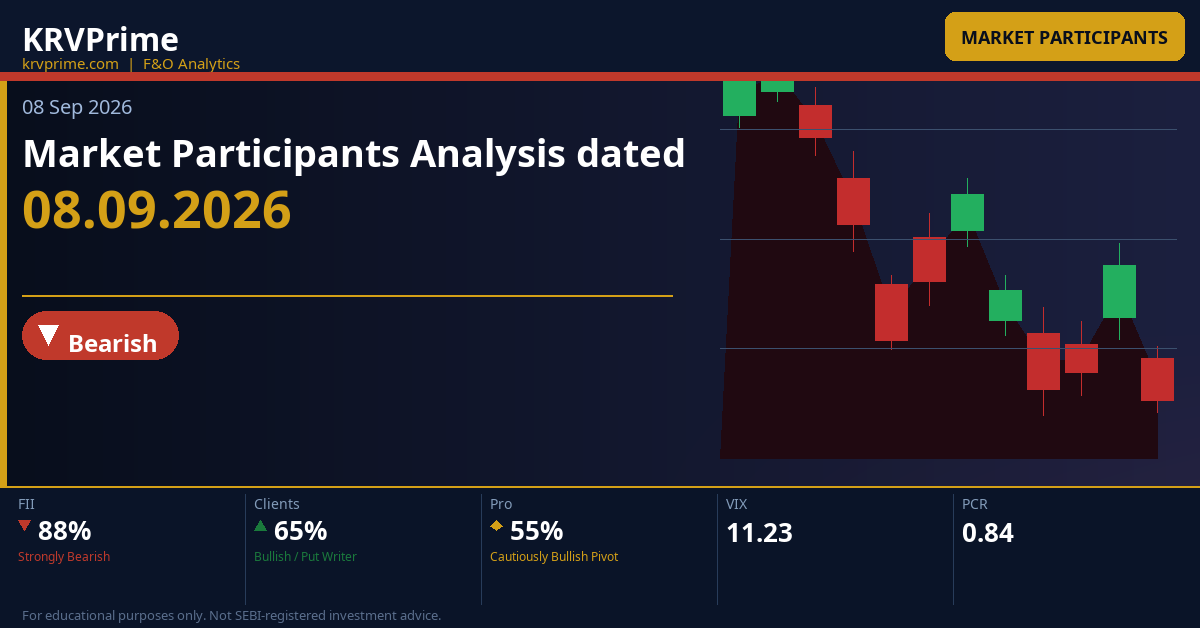
KRVPrime — Daily Market Outlook
Key Market Signals — Data: 08 Sep 2026
NIFTY 50 23,635.10 ▼ -144.05 (-0.61%) | BANK NIFTY 56,777.55 ▼ -310.75 (-0.54%) | SENSEX 75,577.58 ▼ -555.23 (-0.73%) |
OVERALL PCR 0.84 ▲ +0.12 (+18.03%) PCR jumped sharply from 0.72 to 0.84 — a put-heavy mass expiry unwind still leaves put writers marginally in control; approaching neutral zone. | INDIA VIX 11.23 ▲ +0.07 (+0.65%) VIX at 11.23 remains in the low-fear zone; marginal uptick alongside market decline signals early caution, not panic. | TOTAL OI CHANGE 42,957,954 ▼ -9,053,570 (-17.41%) Massive OI contraction of 17.41% signals large-scale option expiry unwind — market shedding positions aggressively. |
FUTURES OI 822,686 ▲ +27,486 (+3.46%) Futures OI rising on a declining market day = fresh short buildup or long unwinding — structurally bearish signal. | CALL OI CHANGE 8,060,346 ▼ -6,103,966 (-43.09%) Call OI collapsed 43.09% — primarily expiry-driven unwind of written and purchased calls across all participants. | PUT OI CHANGE 6,803,258 ▼ -3,325,744 (-32.83%) Put OI fell 32.83%, less than call OI, causing PCR to rise — relative put retention indicates lingering downside hedging. |
Participant-wise Key Points
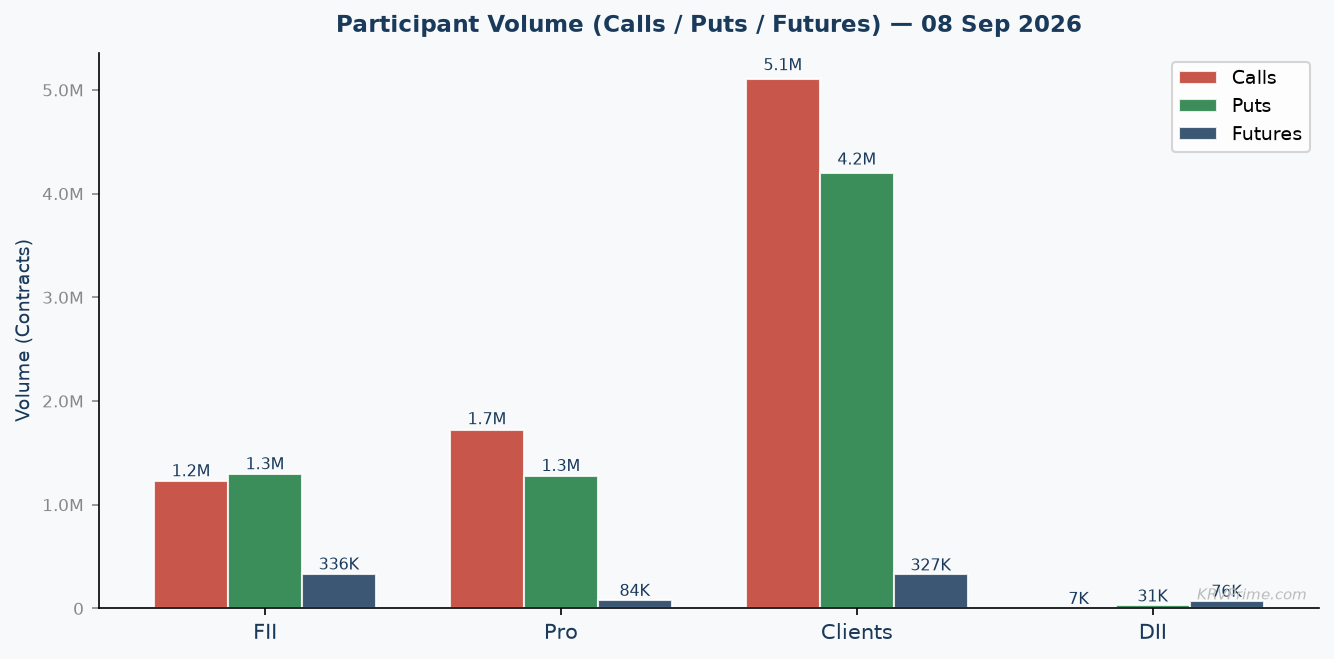
FII Strongly Bearish — Dual-Leg Short Conviction with Defensive Put Hedge
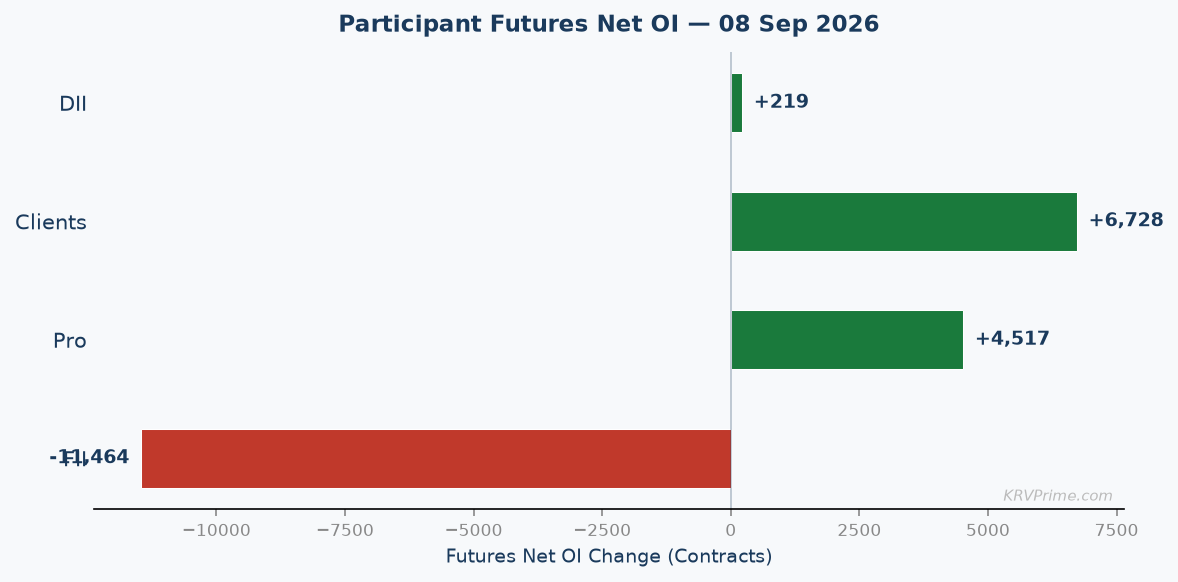
- Futures net deteriorated from -250,093 to -261,557 (net change -11,464, a further deepening of the short book). On the long side, FIIs added 2,196 contracts (prev 34,987 → today 37,183, +6.28%) tagged [Long Buildup - Low Vol], indicating a hesitant, low-conviction defensive hedge rather than a directional long. On the short side, they added a far more decisive 13,660 contracts (prev 285,080 → today 298,740, +4.79%) tagged [Short Buildup - Avg Vol], which at average volume shows routine yet deliberate short accumulation. The gross short-to-long ratio now stands at an extreme 8.04:1 (298,740 shorts vs 37,183 longs) — this is not a hedge; it is an outright dominant directional short position that FIIs have now held and extended through a declining session, confirming sustained macro-level bearish conviction. With NIFTY down 0.61% today and FIIs choosing to add shorts rather than cover, the thesis flip risk is very low in the near term.
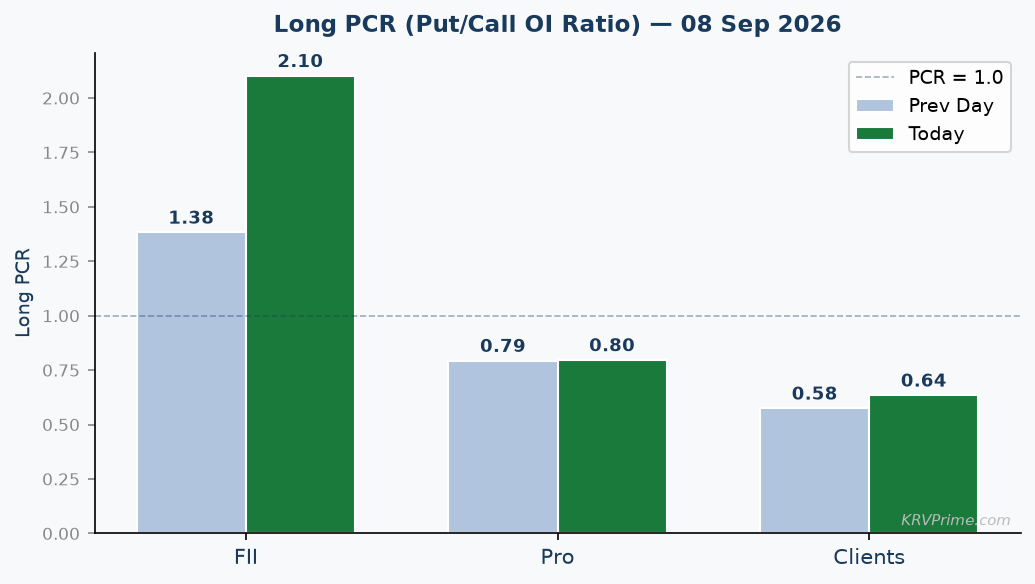
- FII Long PCR surged from 1.38 to 2.10 (+52.01%) and Short PCR edged from 0.43 to 0.42 (-2.62%). A Long PCR of 2.10 is extremely elevated — it means FIIs are holding 2.10 times as many put longs as call longs, which is a deeply defensive posture consistent with either protecting a large institutional equity book or expressing an outright directional bearish view through options. The spike of +52.01% in a single session is particularly significant: even as total option OI collapsed by 17–43%, FIIs retained and relatively increased their put-long proportion, meaning they selectively held on to downside protection while liquidating call longs at a far greater pace. The Short PCR holding near flat at 0.42 tells us FIIs are still writing significantly more calls than puts on the short side — a classic call-writing overlay that caps upside for others and generates carry income aligned with their bearish futures book. Together, the two PCRs reinforce rather than contradict each other: FIIs are simultaneously long downside (put longs) and short upside (call writes).
- Call OI net moved from -298,102 to -302,082 (chg -3,980): Long calls fell sharply from 798,438 to 462,231 (chg -336,207, -42.11%) tagged [Long Unwinding - High Vol], while short calls fell from 1,096,540 to 764,313 (chg -332,227, -30.30%) tagged [Short Covering - High Vol]. The High Vol tag on both legs confirms these were deliberate, high-conviction actions — not passive expiry roll-offs. The net remains negative at -302,082 (net short calls), meaning FIIs still hold more call writes than call purchases. Put OI net improved from +631,147 to +650,645 (chg +19,498): Long puts dropped from 1,104,502 to 971,982 (chg -132,520, -12.00%) tagged [Long Unwinding - High Vol], while short puts collapsed harder from 473,355 to 321,337 (chg -152,018, -32.12%) tagged [Short Covering - High Vol]. Despite the gross shrinkage in both legs (expiry-driven unwind), the net put position actually improved by +19,498 contracts, meaning FIIs net added to their protective put dominance today. The combined architecture of net short calls (-302,082) and net long puts (+650,645) is a textbook synthetic short collar — directionally aligned with the futures short book.
- Synthesis — FII Dual-Leg Bearish Architecture with Deepening Conviction: FIIs present the clearest and most internally consistent bearish narrative across all four participant groups on 08 Sep 2026. Every data point aligns: futures net deepened to -261,557 (from -250,093), gross short book expanded to 298,740 contracts at an 8.04:1 short-to-long ratio, Long PCR spiked to 2.10 signalling maximum put-long retention, Short PCR held at 0.42 confirming persistent call-write overlay, and the net options architecture remains a synthetic short collar (net short calls -302,082 + net long puts +650,645). Even during today's massive 17.41% OI contraction — which was primarily expiry-driven unwinding — FIIs chose to deepen futures shorts, retain put longs, and cover puts short faster than put longs, all of which widened their net put-long balance. There are no internal contradictions in the FII data today; the Low Vol tag on the long side actually reinforces the picture by confirming the long additions were defensive, not directional. Compared to the previous session where net futures stood at -250,093, today's -261,557 represents an acceleration of the bearish thesis rather than a hold-steady or reversal.
- Forward: The critical trigger to monitor is whether FII futures net approaches or breaches -270,000 contracts in tomorrow's session — any further deepening beyond that level would confirm that FIIs are systematically targeting a lower structural range for NIFTY and would likely accelerate the bearish momentum across the market. Conversely, if FII futures net improves materially toward -250,000 or better (short-covering of 11,000+ contracts), that would be the first credible signal of a thesis reversal and could trigger a sharp short-covering rally. Watch FII Long PCR: if it retreats below 1.80 tomorrow, it signals FIIs are beginning to monetise put longs — a tactical bearish exit that often precedes near-term stabilisation. The NIFTY 23,600 PE OI support is the line in the sand; a breach of this level on high FII futures net short deepening would open the door to the 23,000 monthly PE support.
DII Mildly Bullish — Small Net Long Futures, Cautious Options Posture
- Futures net improved marginally from +11,053 to +11,272 (net change +219). On the long side, DIIs added 954 contracts (prev 42,493 → today 43,447, +2.25%) tagged [Long Buildup - High Vol] — the High Vol tag here is significant and suggests this was a deliberate, conviction-backed addition even on a down day, not a passive carry. On the short side, they added 735 contracts (prev 31,440 → today 32,175, +2.34%) tagged [Short Buildup - Low Vol] — the Low Vol tag indicates the short additions were hesitant, likely hedges rather than directional bets. The gross long-to-short ratio stands at a modest 1.35:1 (43,447 longs vs 32,175 shorts), which is consistent with DIIs' traditional role as structural domestic liquidity providers who lean long on dips. The net improvement of +219 is small, but the High Vol long tag versus Low Vol short tag creates an asymmetry that favours the long side being more intentional. This is a direct contrast to FIIs who deepened shorts by 11,464 contracts on the same session — DIIs are leaning against the FII bearish flow, which is their typical countercyclical pattern.
- DII PCR data is not separately reported in the participant-level breakdown, so Long PCR and Short PCR specific values are not available for DII. However, we can infer posture from the options OI data: DII put longs at 30,873 significantly exceed put shorts at 40 (flat), while call longs at 5,201 are less than call shorts at 1,768 — the net call position is long (+3,433) and the net put position is strongly long (+30,833). This structure tells us DIIs are overwhelmingly net put-long relative to their tiny put-short book, implying a strong downside hedge-to-long ratio. Their call short buildup today (+41.33%, [Short Buildup - High Vol]) adds a marginal cap on upside. While DIIs are directionally long futures, their options posture is defensively oriented — suggesting they are hedging their equity book rather than expressing pure upside conviction.
- Call OI net moved from +3,650 to +3,433 (chg -217): Long calls grew from 4,901 to 5,201 (chg +300, +6.12%) tagged [Long Buildup - High Vol], while short calls grew faster from 1,251 to 1,768 (chg +517, +41.33%) tagged [Short Buildup - High Vol]. Both High Vol tags confirm these were deliberate, high-conviction additions — DIIs were actively writing calls today even on a declining market, which is an unusual but telling move (writing calls into a decline typically signals range-bound expectations or income harvesting with limited upside outlook). Put OI net moved from +31,094 to +30,833 (chg -261): Long puts fell marginally from 31,134 to 30,873 (chg -261, -0.84%) tagged [Long Unwinding - Low Vol], while short puts remained completely flat at 40 contracts (chg 0, [Short Flat - Low Vol]). The put-long book at 30,873 versus a negligible put-short book of 40 shows an extreme 771.8:1 long-to-short ratio on puts — DIIs are overwhelmingly long downside protection. The combined architecture is a covered hedge overlay: long futures + long puts (floor protection) + short calls (income cap), which is a classic institutional equity-book protection structure.
- Synthesis — DII Covered Hedge Overlay on Structural Long Bias: DIIs are the structural counterweight to FII bearishness today. Their futures net of +11,272 (marginally improved from +11,053), combined with a long puts book of 30,873 contracts versus a negligible put-short position of 40 contracts and a growing call-write book (short calls up +41.33% [High Vol]), defines a classic covered hedge or protective collar from the long side. The High Vol tag on the futures long additions (954 contracts) confirms institutional intent to stay net long despite the -0.61% NIFTY decline, while the Low Vol tag on short additions signals the hedges were secondary. The call-write buildup (+517, High Vol) is particularly interesting: in a declining session, writing calls aggressively suggests DIIs expect the market to stay range-bound or lower in the near term, even while maintaining structural long futures exposure. This creates a nuanced picture — DIIs are not outright bullish; they are long with a capped upside view, preferring to earn premium from calls while protecting the downside via the massive put-long book. Compared to the previous session (net +11,053), the marginal improvement of +219 contracts indicates they are holding steady rather than aggressively adding longs, implying conviction is present but not accelerating.
- Forward: The key trigger for DIIs is whether their call-write book continues to expand in tomorrow's session — if short calls rise above 2,500 contracts (from today's 1,768), it would signal DIIs are explicitly capping market upside and expect NIFTY to struggle at or below the 23,650 CE resistance level. If instead DIIs begin unwinding their put-long book materially (long puts falling below 28,000), it would indicate reduced fear of downside, which could be a mild bullish signal for market stabilisation. Watch the futures net: if DII net long improves above +13,000 in tomorrow's data, it would confirm domestic institutions are stepping up as buyers into the FII-driven weakness — a classic DII-vs-FII divergence trade that historically supports index stabilisation at key OI support levels.
Pro Cautiously Bullish Reversal — Net Long Futures with Mass Options Unwind
- Futures net improved sharply from +20,130 to +24,647 (net change +4,517, a decisive swing toward the long side). On the long side, Pros added 3,895 contracts (prev 50,324 → today 54,219, +7.74%) tagged [Long Buildup - Avg Vol] — average volume indicates routine but consistent buying rather than panic accumulation. On the short side, Pros actually reduced shorts by 622 contracts (prev 30,194 → today 29,572, -2.06%) tagged [Short Covering - Low Vol], indicating mild short-covering on today's decline. The gross long-to-short ratio stands at 1.83:1 (54,219 longs vs 29,572 shorts), which is a moderate long lean. The combination of fresh long addition at average volume and simultaneous short reduction at low volume suggests Pros are incrementally repositioning for a potential bounce or stabilisation — though the low-vol short covering tag tempers the conviction of that view. This is notably divergent from FIIs, who deepened shorts by 13,660 contracts today, indicating a direct disagreement between the two sophisticated participant groups on near-term direction.
- Pro Long PCR moved from 0.79 to 0.80 (+0.42%) and Short PCR moved from 0.61 to 0.69 (+13.15%). A Long PCR of 0.80 means Pros hold slightly fewer put longs than call longs — a near-neutral, mildly bullish options posture on the long side (they are not heavily hedging downside). The fractional rise of +0.42% shows virtually no change in their long-side hedge preference, suggesting they are comfortable with their existing balance. The more telling signal is the Short PCR rising sharply from 0.61 to 0.69 (+13.15%) — this means Pros are now writing proportionally more puts relative to calls on the short side, which is a net bullish options-writing posture (writing puts = being paid to be long the market at lower levels, or expressing a view that the market will not fall below put strike). Rising Short PCR in the context of a declining market day is a contrarian signal — Pros are selling puts into weakness, betting the downside is limited. This partially contradicts the low conviction in futures and suggests Pros see the current decline as a selling opportunity for put writers, not a trend-following moment.
- Call OI net improved from -73,068 to -44,990 (chg +28,078): Long calls collapsed from 1,448,678 to 839,189 (chg -609,489, -42.07%) tagged [Long Unwinding - High Vol], while short calls also fell sharply from 1,521,746 to 884,179 (chg -637,567, -41.90%) tagged [Short Covering - High Vol]. Both legs shrunk by roughly equal magnitude but short calls fell slightly more, which is why the net improved (became less negative) by +28,078. Put OI net deteriorated from +227,067 to +62,142 (chg -164,925): Long puts collapsed from 1,150,500 to 669,242 (chg -481,258, -41.83%) tagged [Long Unwinding - High Vol], while short puts fell less severely from 923,433 to 607,100 (chg -316,333, -34.26%) tagged [Short Covering - High Vol]. This is the critical signal — Pros unwound put longs at a far faster pace (-41.83%) than they covered put shorts (-34.26%), causing the net put position to collapse from +227,067 to just +62,142. The High Vol tags across all four legs confirm every one of these moves was deliberate. The shrinking net put long from +227,067 to +62,142 means Pros shed 164,925 units of their net downside hedge — a massive reduction in defensive positioning that, combined with the rising Short PCR (more put writing), tells a story of Pros transitioning from a hedged posture to a more naked or range-bound posture.
- Synthesis — Pro Cautious Long Pivot Amid Mass Expiry Cleanup: Pros present the most internally complex positioning today. Their futures net improved by +4,517 (from +20,130 to +24,647) while simultaneously executing a massive options cleanup — both call and put books shrunk by approximately 41-42% in gross terms. The net result is a participant group that is becoming cleaner and more directional: futures lean long (+24,647), put-write bias rising (Short PCR +13.15%), and net put-long position collapsing from +227,067 to +62,142 (a removal of excess downside hedging). The net call position also improved from -73,068 to -44,990, suggesting some short-call covering as well. The combined architecture is shifting from a complex hedged straddle toward a lean-long with limited downside hedge — a posture consistent with Pros expecting the market to stabilise or bounce rather than continue declining. The critical internal contradiction is the High Vol tags on all options unwinds — these were not mechanical expiry rolls; they were deliberate decisions to exit positions, which could also signal that Pros are simply cleaning the slate post-expiry and will re-enter fresh positions in the next session. The comparison with FIIs is stark: while FIIs deepened the bearish trade, Pros unwound hedges and added futures longs — two informed participant groups are currently on opposite sides of the directional argument.
- Forward trigger: Watch Pro futures net in tomorrow's session — if it crosses above +28,000 contracts (from today's +24,647), it would confirm Pros are systematically adding to their long lean and represents a meaningful signal of a potential intraday bounce. Equally important is whether Pro Short PCR continues rising — a move above 0.75 would indicate Pros are writing puts aggressively into the dip, a strong contrarian signal that the 23,600 PE support is expected to hold. If instead Pro futures net reverses below +20,000 and their put-write activity fades, it would confirm the session's options cleanup was a blank-slate reset rather than a directional call, and the bias would revert to neutral.
Client Net Long Futures but Reducing Options Exposure — Cautious Dip Buyers
- Futures net improved from +218,910 to +225,638 (net change +6,728). On the long side, Clients added 6,698 contracts (prev 269,796 → today 276,494, +2.48%) tagged [Long Buildup - Avg Vol] — consistent with retail/HNI dip-buying behaviour at average volume. On the short side, Clients reduced by a negligible 30 contracts (prev 50,886 → today 50,856, -0.06%) tagged [Short Covering - Avg Vol] — effectively flat. The gross long-to-short ratio is a commanding 5.44:1 (276,494 longs vs 50,856 shorts), confirming Clients are the most dominantly long futures participant group in absolute terms. With a net long of +225,638, Clients represent the largest futures long position of all four participant categories — they are the primary counterweight to FII's massive gross short of 298,740 contracts. The average-volume tag on longs suggests this is routine dip-buying rather than high-conviction accumulation, but the consistency of Client long buildup across multiple sessions signals a persistent structural retail bull bias.
- Client Long PCR moved from 0.58 to 0.64 (+10.40%) and Short PCR moved from 0.82 to 1.04 (+26.44%). A Long PCR of 0.64 means Clients hold fewer put longs than call longs (still more call longs than put longs) — a modestly bullish options posture on the long side, with the rising trend from 0.58 to 0.64 suggesting they are incrementally adding downside hedges even while maintaining a bullish directional view in futures. The Short PCR surging from 0.82 to 1.04 (+26.44%) is the most striking signal: crossing above 1.00 means Clients are now writing more puts than calls on the short side for the first time — this is a classically bullish options-writing posture (selling puts = being paid to be long at lower levels, betting the market will not fall further). A Short PCR of 1.04 after today's -0.61% NIFTY decline signals that retail/HNI participants are actively selling puts into the dip — a contrarian bullish signal that they expect the 23,600 support to hold. The Long PCR rising simultaneously suggests they are also hedging the long futures book with put longs — a cautious but bullish-leaning dual posture.
- Call OI net moved from +367,520 to +343,639 (chg -23,881): Long calls fell from 4,830,139 to 2,723,552 (chg -2,106,587, -43.61%) tagged [Long Unwinding - High Vol], while short calls fell from 4,462,619 to 2,379,913 (chg -2,082,706, -46.67%) tagged [Short Covering - High Vol]. The net call position remains positive at +343,639 — Clients are net long calls, suggesting they hold more upside exposure than they write. The short calls fell slightly faster (-46.67%) than long calls (-43.61%), which caused the net to narrow from +367,520 to +343,639 — Clients are covering call shorts slightly faster than unwinding call longs. Put OI net moved from -889,308 to -743,620 (chg +145,688): Long puts fell from 2,778,365 to 1,729,532 (chg -1,048,833, -37.75%) tagged [Long Unwinding - High Vol], while short puts fell faster from 3,667,673 to 2,473,152 (chg -1,194,521, -32.57%) tagged [Short Covering - High Vol]. The net put position improved from -889,308 to -743,620 (+145,688) — Clients remain net short puts (writing more puts than holding), which perfectly aligns with the rising Short PCR of 1.04. High Vol tags across all four legs confirm every adjustment was deliberate. The overall options architecture — net long calls (+343,639) combined with net short puts (-743,620) — creates a synthetic long structure, fully consistent with and reinforcing the massive +225,638 futures net long position.
- Synthesis — Client Synthetic Long Pyramid with Put-Writing Overlay: Clients present the most unambiguously directional long structure across all participants today. The combination of +225,638 futures net long, net long calls (+343,639), and net short puts (-743,620) forms a three-legged synthetic long pyramid — every leg is positioned for upside or against downside. The Short PCR crossing above 1.00 (to 1.04) is the session's defining retail signal — Clients are selling puts into the decline, doubling down on their view that the market will stabilise or bounce from current levels near the 23,600 PE support. Simultaneously, the Long PCR rising to 0.64 shows they are also adding put longs as a hedge on the book, which creates a nuanced internal picture: Clients are bullish on direction but cautious enough to hedge, unlike prior sessions where they carried unhedged long exposure. The High Vol tags across all options adjustments confirm these are not passive residual positions — they are active, deliberate repositioning events. Compared to the previous session (futures net +218,910), today's +225,638 shows consistent long accumulation, reinforcing the pattern of retail dip-buying into FII-driven selling. The direct contrast with FIIs (futures net -261,557) creates the classic institutional-vs-retail standoff — FIIs are short at 8.04:1, Clients are long at 5.44:1, and the market close determines who is right.
- Forward: The critical trigger for the Client thesis is whether the NIFTY 23,600 weekly PE support holds tomorrow — if NIFTY holds above 23,600, Client put-writing income will be preserved and the net short puts position (-743,620) will remain profitable, reinforcing a buy-the-dip feedback loop. If NIFTY breaks below 23,600 with expanding volume, Client put writers will face mark-to-market losses and forced covering of short puts at higher premiums — a scenario that could accelerate the decline as put short-covering adds delta pressure. Watch the Client Short PCR in tomorrow's data: if it rises above 1.15 (from today's 1.04), it signals aggressive retail put-writing into further weakness — a historically reliable contrarian buy signal at key support zones. A decline in Client Short PCR back below 0.90 would warn that retail confidence in the support is cracking.
Bull vs Bear Strength by Participant
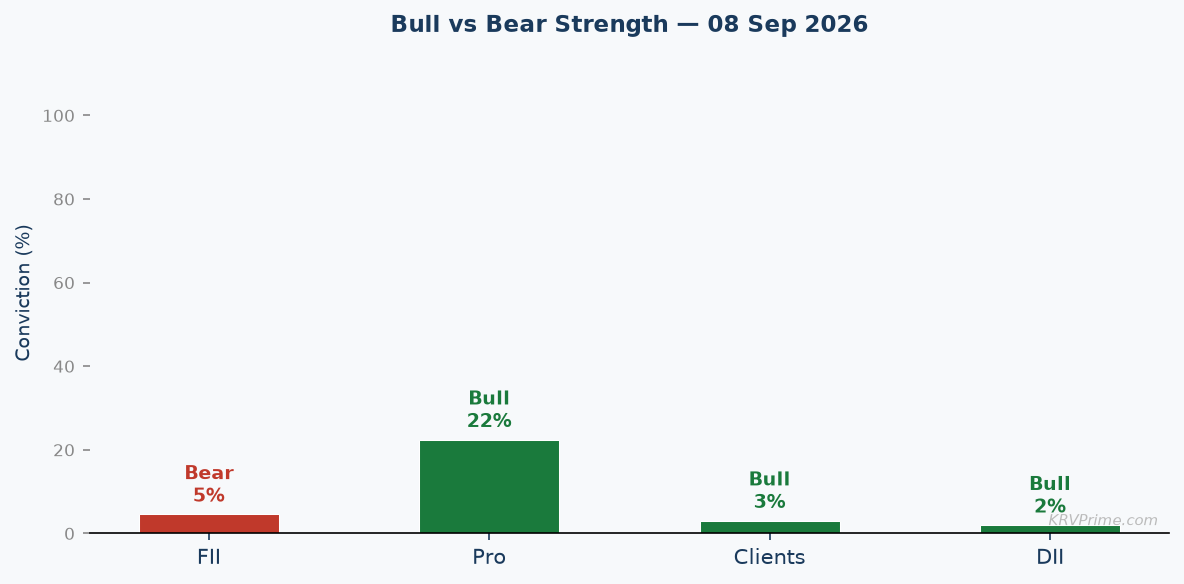
FII Strongly Bearish 88% ▼▼ | Clients Bullish / Put Writer 65% ▲ | Pro Cautiously Bullish Pivot 55% ▲ | DII Mildly Bullish / Hedged 55% ▶ |
Conclusion — Market Outlook for Tomorrow (09 Sep 2026)
The collective participant positioning on 08 Sep 2026 presents a structurally bifurcated market. FIIs, the most sophisticated and largest institutional player, have deepened their futures short book to a net of -261,557 contracts at an extreme 8.04:1 gross short-to-long ratio — this is the dominant structural force in the market. Against this, Clients hold the largest absolute long position at +225,638 futures net with a synthetic long architecture (net long calls +343,639, net short puts -743,620), while Pros have incrementally improved their futures net to +24,647 and are writing puts into the decline (Short PCR +13.15% to 0.69). DIIs maintain a modest net long of +11,272 with a covered hedge overlay. The FII bearish architecture — a synthetic short collar of net short calls (-302,082) plus net long puts (+650,645) combined with deep futures shorts — is the most internally consistent and high-conviction position in the market and must be respected as the primary directional signal.
The Overall PCR surged from 0.72 to 0.84 (+18.03%) — a sharp move toward neutral that on the surface appears bullish, but is primarily a product of the 17.41% total OI contraction driven by expiry-cycle unwind. Call OI fell -43.09% while Put OI fell a lesser -32.83%, causing the ratio to improve mechanically. The persistence of put OI relative to call OI tells us that downside hedges are being retained even as upside bets are cleared — this is not a clean bullish signal. India VIX at 11.23 remains in the low-fear zone, but the marginal rise of +0.65% alongside a market decline is an early warning signal — historically, VIX rising with price falling indicates the market is beginning to price in tail risk, even if modestly. If VIX crosses above 12.00 in coming sessions, it would confirm a shift in options pricing that could accelerate the decline through gamma effects. The 23,600 weekly PE support and 23,000 monthly PE support are the structural floors identified by OI positioning; a close below 23,600 would structurally validate the FII short thesis.
The bullish scenario requires FII futures net to improve materially (short-covering), the Overall PCR to sustain above 0.85 through organic put retention (not just expiry mechanics), and VIX to remain below 11.50. The bearish scenario — which has higher structural support from the data — requires FII to continue deepening their net short beyond -270,000 contracts, VIX to begin a sustained climb above 12.00, and the 23,600 OI support to break on a closing basis, which would expose the 23,000 monthly support. The retail put-writing (Client Short PCR 1.04) and Pro put-writing (Short PCR 0.69) represent the primary contrarian risk to the bearish case — if this cohort is correct and the market stabilises, it would create a significant short-squeeze opportunity. However, against FII's 8.04:1 gross short ratio, that contrarian bet carries substantial risk.
Scenario 1 — Bull case:
If FII futures net improves toward -250,000 (short-covering of 11,000+ contracts), the Overall PCR sustains above 0.90 organically, and VIX retreats below 11.00, the Client put-writing (Short PCR 1.04) and Pro long buildup (net +24,647) would be validated. The 23,600 weekly PE OI support would act as a hard floor, and a relief bounce toward the 23,650 CE resistance and then 24,000 monthly CE resistance becomes the primary upside scenario. The key confirming signal would be Clients increasing put-write exposure further (Short PCR above 1.15) alongside FII covering.
Scenario 2 — Bear case:
If FII futures net deepens beyond -270,000 contracts, VIX rises above 12.00, and the Overall PCR retreats below 0.75 on fresh put-buying, the 23,600 weekly PE support would be tested on a closing basis. A breach of 23,600 on expanding Futures OI would signal the FII synthetic short collar is monetising — the Long PCR of 2.10 (put longs) would begin generating profit, triggering further institutional short additions. The structural target would then shift toward the 23,000 monthly PE OI support, which is the next major floor in the OI architecture. Client put short-covering losses would compound the move lower.
Key Resistance — NIFTY 23,650 (weekly CE OI resistance): FIIs are net short calls (-302,082) and DIIs are actively writing calls ([Short Buildup - High Vol], short calls at 1,768 contracts), creating layered supply at this strike. Any close above 23,650 on declining FII futures shorts would be the first meaningful bullish breakout signal. | Key Support — NIFTY 23,600 (weekly PE OI support): Clients hold 1,729,532 long puts and FIIs hold 971,982 long puts — both groups are monetising at or near this level. Pros are writing puts (Short PCR 0.69) and Clients are writing puts (Short PCR 1.04) at this zone, indicating broad market consensus that 23,600 is the line to defend. A closing breach opens the 23,000 monthly PE support. | Trigger to Watch FII futures net crossing -270,000 (from today's -261,557): This threshold, if breached, confirms systematic short addition and removes any doubt about FII directional intent. Simultaneously, watch the Overall PCR: a drop back below 0.72 (today's prior session value) would signal put longs are being added fresh — not just retained from expiry — confirming a renewed bearish wave rather than post-expiry noise. |