
Market Participants Analysis dated 09.09.2026
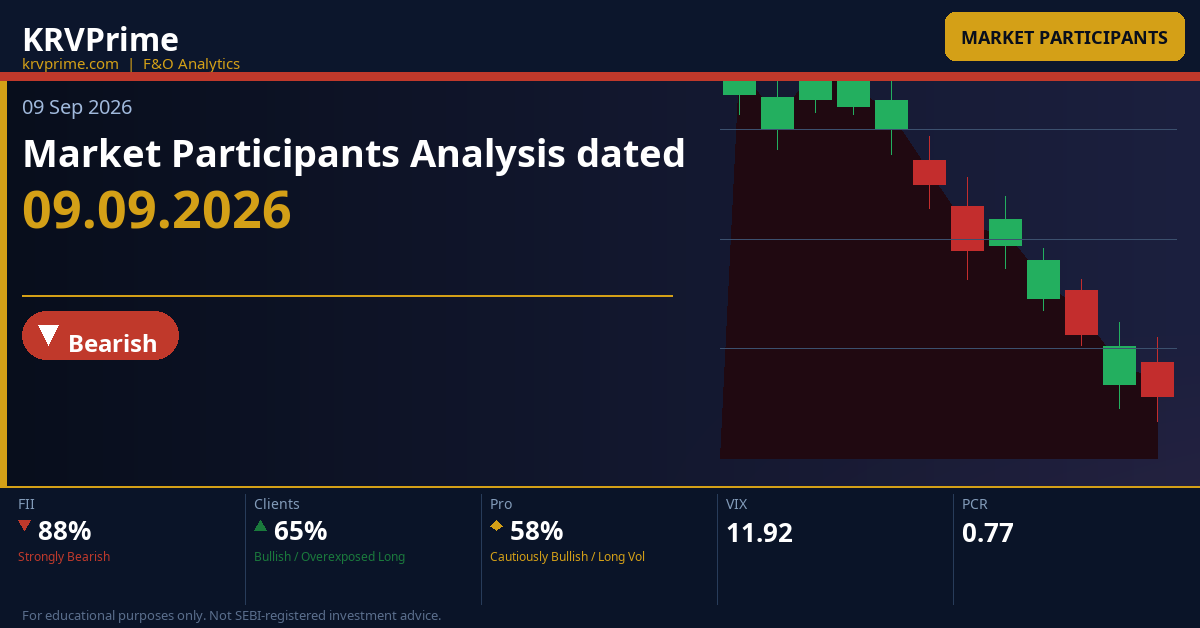
KRVPrime — Daily Market Outlook
Key Market Signals — Data: 09 Sep 2026
NIFTY 50 23,431.50 ▼ -203.60 (-0.86%) | BANK NIFTY 56,295.55 ▼ -482.00 (-0.85%) | SENSEX 74,764.23 ▼ -813.35 (-1.08%) |
OVERALL PCR 0.77 ▼ -0.07 (-9.06%) PCR below 0.80 with a sharp 9.06% drop signals call writers dominating — bearish sentiment building. | INDIA VIX 11.92 ▲ +0.69 (+6.12%) VIX spiking 6.12% on a down-day signals rising fear premium — hedging demand accelerating. | TOTAL OI CHANGE 46,849,550 ▲ +3,891,596 (+9.06%) Massive 9.06% OI surge on a falling market confirms fresh short buildup, not short-covering. |
FUTURES OI 859,030 ▲ +36,344 (+4.42%) Futures OI rising with price falling — textbook short buildup reinforcing bearish conviction. | CALL OI CHANGE 10,246,849 ▲ +2,186,503 (+27.13%) Call OI exploding +27.13% — massive supply of calls being written at resistance, capping upside. | PUT OI CHANGE 7,864,150 ▲ +1,060,892 (+15.59%) Put OI rising +15.59% but lagging call OI growth — PCR compression confirms bearish tilt. |
Participant-wise Key Points
FII Strongly Bearish — Dual-Leg Conviction Short with Defensive Put Hedge
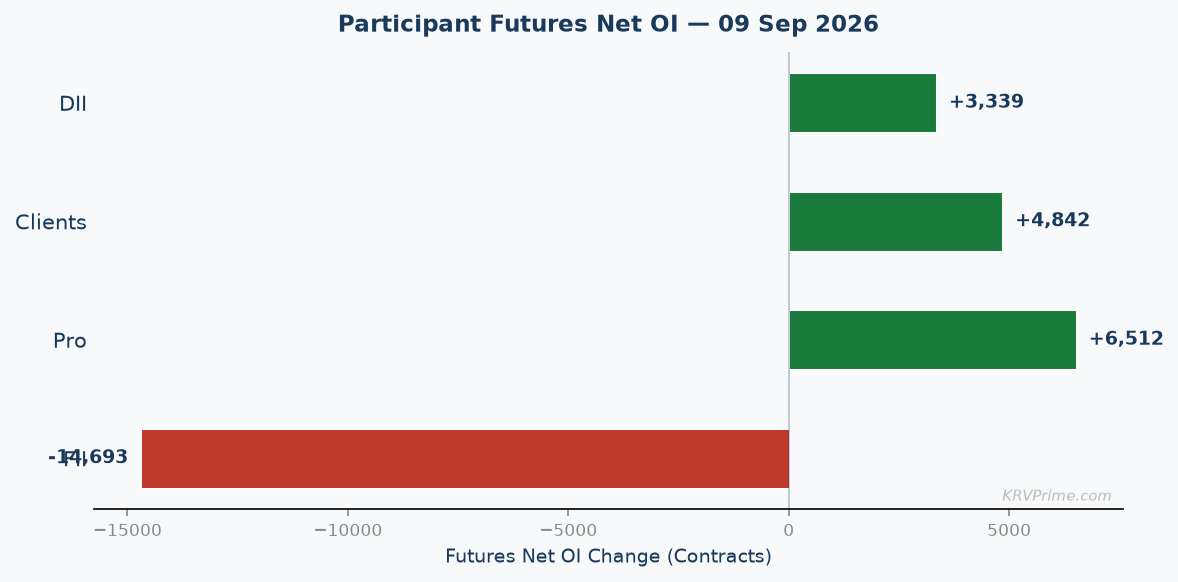
- Futures net deteriorated from -261,557 to -276,250 (net change -14,693, a further deepening of their already dominant short position). The Long side added 1,844 contracts moving from 37,183 to 39,027 [Long Buildup - High Vol], while the Short side added a far larger 16,537 contracts moving from 298,740 to 315,277 [Short Buildup - High Vol]. The High Vol confirmation tag on BOTH legs is critical — it confirms that neither side of this move is accidental or routine; both long additions and short additions today were high-conviction, deliberate positioning. The gross short-to-long ratio now stands at an extreme 8.08:1 (315,277 shorts vs 39,027 longs), which is not a hedge ratio — a true hedge would look like 1:1 or 2:1; at 8.08:1, FIIs are running an outright directional short position with a cosmetic long leg that does nothing to neutralise downside exposure. This deepening of net shorts by -14,693 contracts on a day when Nifty fell -0.86% tells us FIIs are not satisfied with existing short profits — they are actively adding to a winning trade and pressing the directional bet lower, suggesting strong institutional conviction that this decline has further to run.
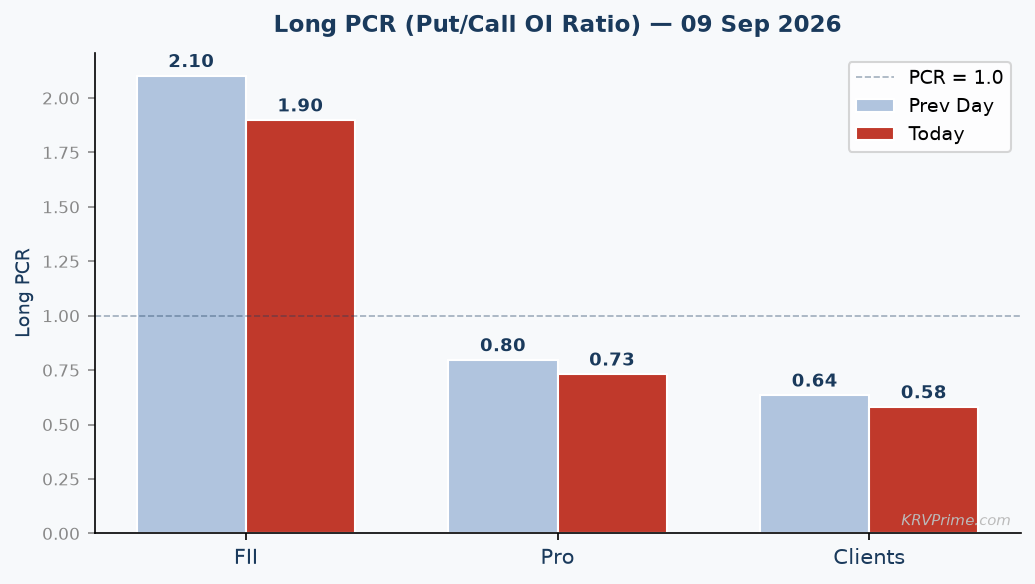
- FII Long PCR fell from 2.10 to 1.90 (change -0.20, -9.69%), and Short PCR rose from 0.42 to 0.45 (change +0.03, +7.68%). A Long PCR of 1.90 means FIIs hold 1.90 put longs for every call long — they are nearly doubling up on put protection relative to their call exposure, which is a deeply defensive or outright directional bearish posture in options; this is not a neutral hedged book. The falling Long PCR from 2.10 to 1.90 is not bullish — it reflects that FIIs added call longs at a faster pace than put longs today (call longs +101,528 vs put longs +98,581), suggesting they may be buying calls as cheap delta hedges against their futures short book or as tail-risk insurance against a squeeze. The Short PCR rising from 0.42 to 0.45 means FIIs are now writing more puts than before on their short options book — a Short PCR of 0.45 still means they write far more calls than puts (i.e. for every put sold, they sell 2.22 calls), which is a ceiling-capping strategy consistent with their net futures short: writing calls at resistance to collect premium while their futures short does directional work. The dominant signal today is unambiguous — the Long PCR of 1.90 and rising Short PCR together with the futures short deepening reinforce a bearish structural conviction.
- Call OI net moved from -302,082 to -342,643 (net change -40,561): Long calls rose from 462,231 to 563,759 [Long Buildup - Low Vol], while Short calls rose from 764,313 to 906,402 [Short Buildup - Low Vol]. Put OI net improved slightly from +650,645 to +660,252 (net change +9,607): Long puts rose from 971,982 to 1,070,563 [Long Buildup - Low Vol], while Short puts rose from 321,337 to 410,311 [Short Buildup - Low Vol]. The Low Vol tags on all four options legs are notable — they suggest that while the gross contract additions are large in absolute terms, the volumes relative to average are moderate, implying this is a systematic, spread-out positioning rather than panic or urgency. The architecture is classic net short calls (-342,643) combined with net long puts (+660,252) — this is a synthetic short plus protective put construction, meaning FIIs are expressing a directional bearish view through options while simultaneously hedging their own futures short book against a sharp snap-back rally. The net short calls at the 24,000 CE resistance level act as a ceiling, and the net long puts at 23,000 PE support represent both downside monetisation vehicles and a floor for their equity book hedge.
- Synthesis — FII Dual-Leg Conviction Bearish Architecture: FIIs today present the most internally consistent and high-conviction directional story across all four participants. Their futures net has deepened to -276,250 (from -261,557), their options architecture combines net short calls at -342,643 with net long puts at +660,252, their Long PCR stands at a defensive 1.90, and all futures confirmation tags are High Vol — every single data point aligns directionally bearish without a single internal contradiction. The gross futures short-to-long ratio of 8.08:1 is not a hedge; it is an outright directional position that would require a sustained and violent rally to inflict meaningful pain. The fact that FIIs added 16,537 new short futures contracts on a day when the market was already falling -0.86% tells us this is not momentum-chasing into a thin tape — this is a deliberate press of an existing thesis, with the High Vol tag confirming institutional-scale execution. Their options book adds a second layer: writing 142,089 new short calls while simultaneously buying 98,581 new put longs creates a dual monetisation structure — they collect premium from call writing while their put longs appreciate as the market falls, effectively running a synthetic short with a funded put wing. Compared to the prior session where the net stood at -261,557, today's -276,250 represents an acceleration of the bearish thesis rather than a hold or reversal — FIIs are moving faster into their short, not waiting for confirmation.
- Forward: The key watch level for tomorrow is 23,000 Nifty (OI PE Support) — this is where the largest put OI is concentrated, and FIIs hold significant long put positions that would be in substantial profit if this level is tested. If Nifty breaks decisively below 23,000 on volume tomorrow, expect FII put longs to be partially monetised (put OI net may start declining as they book profits), which could create a counterintuitive bounce signal. Conversely, if Nifty recovers above 23,600 tomorrow and FII futures net begins improving from -276,250 toward -265,000 or better, that would be the first signal of short-covering and a potential thesis reversal — watch the futures net change as the single most important number in tomorrow's data release. Until FII futures net shows a meaningful reduction in gross shorts (specifically the 315,277 short leg declining), the structural bias remains firmly bearish.
DII Defensively Bullish — Aggressively Loading Put Protection While Reducing Futures Shorts
- Futures net improved from +11,272 to +14,611 (net change +3,339, a continued strengthening of their net long futures position). The Long side added a modest 291 contracts moving from 43,447 to 43,738 [Long Buildup - High Vol], while the Short side reduced by 3,048 contracts moving from 32,175 to 29,127 [Short Covering - Low Vol]. The combination of High Vol on long buildup and Low Vol on short covering is telling — the long additions are deliberate and conviction-backed, while the short reduction is quiet and measured rather than panicked, suggesting DIIs are systematically reducing their short hedge rather than responding to a squeeze. The gross long-to-short ratio now stands at 1.50:1 (43,738 longs vs 29,127 shorts), a mild long bias that is consistent with DIIs' traditional role as net buyers of domestic equities — they are not aggressively directional but are slowly improving their net futures exposure even as the market fell today. This is sharply divergent from FII behaviour: where FIIs added 16,537 new shorts, DIIs reduced shorts by 3,048 — a clear inter-participant divergence that reflects the structural difference between foreign institutions pressing a macro bearish thesis and domestic institutions continuing to deploy long-term capital.
- DII options PCR data is not available in today's dataset for a meaningful Long PCR / Short PCR calculation in the traditional sense. However, we can observe the directional implications from their options OI changes directly. The call side is unchanged (Long calls flat at 5,201, no change) while the short call side surged by 1,999 contracts moving from 1,768 to 3,767 [Short Buildup - High Vol] — the High Vol tag here is significant, meaning this call writing is a deliberate, high-conviction move, not routine. On the put side, long puts exploded by 18,800 contracts from 30,873 to 49,673 [Long Buildup - High Vol] while short puts were completely closed out from 40 to 0 [Short Covering - High Vol]. The combined directional read from the options side is that DIIs are aggressively buying put protection (High Vol) while simultaneously writing calls (High Vol) and eliminating all short put exposure — this translates to an implied Short PCR on the options short side of essentially infinity (no short puts at all), meaning all their option writing activity today is in calls, which is a ceiling-capping or income-harvesting strategy consistent with a cautious long equity book that expects limited upside in the near term.
- Call OI net moved from +3,433 to +1,434 (net change -1,999): Long calls held flat at 5,201 [Long Flat - Low Vol], while Short calls jumped from 1,768 to 3,767 [Short Buildup - High Vol]. Put OI net surged from +30,833 to +49,673 (net change +18,840): Long puts rose massively from 30,873 to 49,673 [Long Buildup - High Vol], while Short puts dropped from 40 to 0 [Short Covering - High Vol]. The architecture that emerges is a net long puts (+49,673) combined with net short calls (+1,434 net long calls, but only because longs exceed shorts by a thin margin) — effectively a protective collar structure: long futures + long puts + short calls. The short call writing at 24,000 CE resistance collects premium to fund the cost of put protection, while the put longs at 23,000 PE provide downside insurance for their substantial long equity book. This architecture is highly consistent with DIIs' role as custodians of large long equity positions — they are not expressing a directional short view but are actively hedging against a deeper market correction while maintaining long futures exposure. The High Vol tags on both the put long buildup (+18,800) and short put covering (-40) confirm this is a decisive, same-day decision to dramatically increase downside protection.
- Synthesis — DII Defensive Collar with Accelerating Put Protection: DIIs today are executing a textbook protective collar strategy — net long futures (+14,611), net short calls (capping upside), and a dramatically expanded net long put position (+49,673, up from +30,833) that provides substantial downside cushion. The most striking move today is the +18,800 long put addition tagged as High Vol — this is one of the largest single-day put protection increases we have seen from DIIs, suggesting that domestic institutions are genuinely concerned about downside risk despite their structural long equity book. The complete elimination of their 40 short puts (Short Covering - High Vol) reinforces this — they have left zero downside exposure on the options short side, choosing instead to be purely long puts and short calls. Compared to FIIs who are running an outright short with 8.08:1 gross short-to-long ratio, DIIs are essentially saying: 'we remain net long the market, but we are paying up for insurance' — this is a fundamentally different thesis. The divergence is important: FIIs believe the market will fall and are positioned to profit from it; DIIs believe there is downside risk but are not abandoning their long equity mandate, instead hedging it systematically. The quiet short covering in futures (Low Vol, -3,048 contracts) suggests confidence that the market does not need a futures short hedge when you own put protection costing far less than the futures short opportunity cost.
- Forward: The critical watch for DIIs tomorrow is whether their long put position at 23,000 PE begins monetising — if Nifty approaches 23,000, expect DII put OI to start declining as profits are booked, which would be a contrarian buy signal for the broader market (smart domestic money taking profits on downside bets). If the market stabilises above 23,200 tomorrow and DII put OI holds or increases further beyond 49,673, it signals domestic institutions expect a second leg down and are not yet satisfied with their hedge. The key threshold to watch in tomorrow's participant data is whether DII futures net improves further above 14,611 (long bias strengthening) while put OI holds — that combination would confirm they are buying dips while hedging, not capitulating to the FII bearish thesis.
Pro Cautiously Bullish — Net Long Futures with Expanding Options Long Book on Both Sides
- Futures net improved from +24,647 to +31,159 (net change +6,512, a meaningful strengthening of their net long position). The Long side added 9,087 contracts moving from 54,219 to 63,306 [Long Buildup - High Vol], while the Short side added a smaller 2,575 contracts moving from 29,572 to 32,147 [Short Buildup - High Vol]. Both confirmation tags are High Vol, which tells us that Pros are executing with high conviction on both sides — this is not passive or routine roll activity. The gross long-to-short ratio stands at 1.97:1 (63,306 longs vs 32,147 shorts), meaning Pros are running almost a 2:1 long-to-short ratio in futures, which is a meaningfully bullish lean despite the market falling today. The net improvement of +6,512 on a day when FIIs deepened their short by -14,693 creates a direct inter-participant divergence: Pros are specifically adding to futures longs while FIIs add to shorts, suggesting Pros either see the current decline as an overreaction or are running a structural long position that benefits from mean-reversion. Proprietary desks typically operate with shorter time horizons and greater sensitivity to intraday mispricing, so their willingness to add longs at lower prices on a down-day carries genuine informational weight.
- Pro Long PCR fell from 0.80 to 0.73 (change -0.07, -8.25%), and Short PCR fell from 0.69 to 0.63 (change -0.06, -8.49%). A Long PCR of 0.73 means Pros hold 0.73 put longs for every call long — unlike FIIs who are deeply defensive at 1.90, Pros are actually overweight call longs relative to put longs, suggesting a net bullish options bias or at minimum a non-defensive posture. The falling Long PCR (from 0.80 to 0.73) tells us Pros added call longs at a significantly faster pace than put longs today, which on a market down-day suggests they are buying call optionality cheaply as a contrarian bet on a bounce. The Short PCR falling from 0.69 to 0.63 means Pros are now writing relatively more calls than puts on their short options book — while this could cap upside in the near term, combined with their net long futures and long call bias, it is more likely a covered call or ratio spread structure where the short calls are written above their long call strikes to reduce premium cost. The dominant signal is that Pros are in a net bullish options posture (more call longs than put longs) even as the market is falling — a contrarian long setup.
- Call OI net turned positive from -44,990 to +14,552 (net change +59,542): Long calls surged from 839,189 to 1,088,947 [Long Buildup - Low Vol], while Short calls rose from 884,179 to 1,074,395 [Short Buildup - Low Vol]. Put OI net improved from +62,142 to +121,753 (net change +59,611): Long puts rose from 669,242 to 796,832 [Long Buildup - Low Vol], while Short puts rose from 607,100 to 675,079 [Short Buildup - Low Vol]. The Low Vol tags on all four options legs indicate this is a broad, spread-out positioning rather than concentrated high-urgency buying — consistent with systematic/quant-driven Prop desk behaviour. Crucially, the Call OI net flipped from -44,990 to +14,552 — Pros are now net long calls for the first time, meaning they own more calls than they write, which is a structurally bullish options posture. Combined with the net long puts (+121,753), this creates a long strangle / long volatility architecture — long both calls and puts — which profits if the market makes a large move in either direction but particularly if volatility continues to expand (VIX already up +6.12% today). This long-vega architecture is internally consistent: Pros may be saying 'we expect a big move, we just don't know which direction, but our futures long suggests we lean bullish on the resolution'.
- Synthesis — Pro Long Volatility with Bullish Futures Lean: Pros today are running a sophisticated long-gamma, bullish-directional hybrid strategy: net long futures (+31,159), net long calls (+14,552), and net long puts (+121,753) simultaneously. This is a long strangle / long straddle options architecture that profits from volatility expansion in either direction, combined with a directional futures long that gives them a bullish tilt if the move is upward. The timing is notable — they are loading up on long volatility on a day when VIX has already spiked +6.12% to 11.92, suggesting they believe the current VIX reading understates actual near-term volatility risk or that the spike has further to run. The simultaneous futures long improvement from +24,647 to +31,159 tells us the directional lean within their vega-long book is bullish — they want the market to bounce but are protected if it falls further. Compared to FIIs who are running a clean directional short at 8.08:1 and writing calls as a ceiling, Pros are positioned exactly on the other side of the volatility trade: buying optionality rather than selling it. The Low Vol tags on their options additions suggest this is a systematic spread of positions rather than a panicked reaction — disciplined long-vega accumulation on a high-fear day. One internal note worth flagging: the falling Short PCR (from 0.69 to 0.63) means their option writing is tilting toward calls, which could suggest they are writing calls above market as part of a spread structure rather than as a directional ceiling bet.
- Forward: The key trigger for Pros tomorrow is India VIX direction — since their strategy is long volatility (long both calls and puts), a further VIX spike above 13.00 would substantially increase the mark-to-market value of their long options book, potentially triggering profit-taking on the options side that shows up as declining net long calls and net long puts in tomorrow's data. Conversely, if VIX reverses sharply below 11.00 tomorrow (suggesting the fear spike was one-day noise), Pros may begin monetising their long options positions and increasing their futures long more aggressively as the directional bet takes over. Watch whether Pro futures net crosses 35,000 tomorrow — an improvement beyond that level would confirm they are converting from a volatility-neutral to a directional bullish stance, and that signal from smart money proprietary desks would be a meaningful buy signal for the broader market.
Client Structurally Long but Increasingly Hedged — Net Futures Long with Growing Put Protection
- Futures net improved slightly from +225,638 to +230,480 (net change +4,842, a marginal strengthening of their massive net long position). The Long side added 6,950 contracts moving from 276,494 to 283,444 [Long Buildup - High Vol], while the Short side added 2,108 contracts moving from 50,856 to 52,964 [Short Buildup - High Vol]. Both sides carry High Vol tags, confirming this is deliberate and not accidental roll activity — retail and HNI clients are actively pressing both their long futures and (to a lesser extent) short futures positions on a down day. The gross long-to-short ratio stands at 5.35:1 (283,444 longs vs 52,964 shorts), which reflects the dominant retail market posture of being structurally long index futures while maintaining a smaller hedge short book. The net +4,842 improvement on a down day is notable — clients are not panicking out of longs despite the -0.86% Nifty decline and VIX spike of +6.12%, suggesting either a 'buy the dip' mentality or that many client longs were entered at lower levels and are not yet under material stress. This contrasts sharply with FIIs deepening shorts by -14,693 on the same day — the retail-institutional divergence is a classic crowded trade setup where clients are long and FIIs are short at the same price point.
- Client Long PCR fell from 0.64 to 0.58 (change -0.06, -8.44%), and Short PCR fell sharply from 1.04 to 0.91 (change -0.13, -12.73%). A Long PCR of 0.58 means clients hold only 0.58 put longs for every call long — this is the most call-overweight posture of any participant today, meaning the retail/HNI community is predominantly buying calls rather than puts for directional exposure, which is a bullish sentiment indicator. The falling Long PCR (from 0.64 to 0.58) reveals that clients added call longs at a dramatically faster rate than put longs today — on a day when the market fell -0.86%, retail traders are still buying calls, a classic 'dip is temporary' retail psychology. The Short PCR falling from 1.04 to 0.91 is the most significant PCR signal for clients — previously they were writing more puts than calls on their short options book (Short PCR > 1.00 = bullish range bet), but now they have shifted below 1.00, meaning they are writing proportionally more calls than puts for the first time today, which is a subtle shift toward a more defensive income posture. The overall message is that while clients remain bullish (call-overweight long book), there is a marginal shift toward more caution in their writing activity, with the Short PCR drop of -12.73% being the sharpest PCR directional change across all participants today.
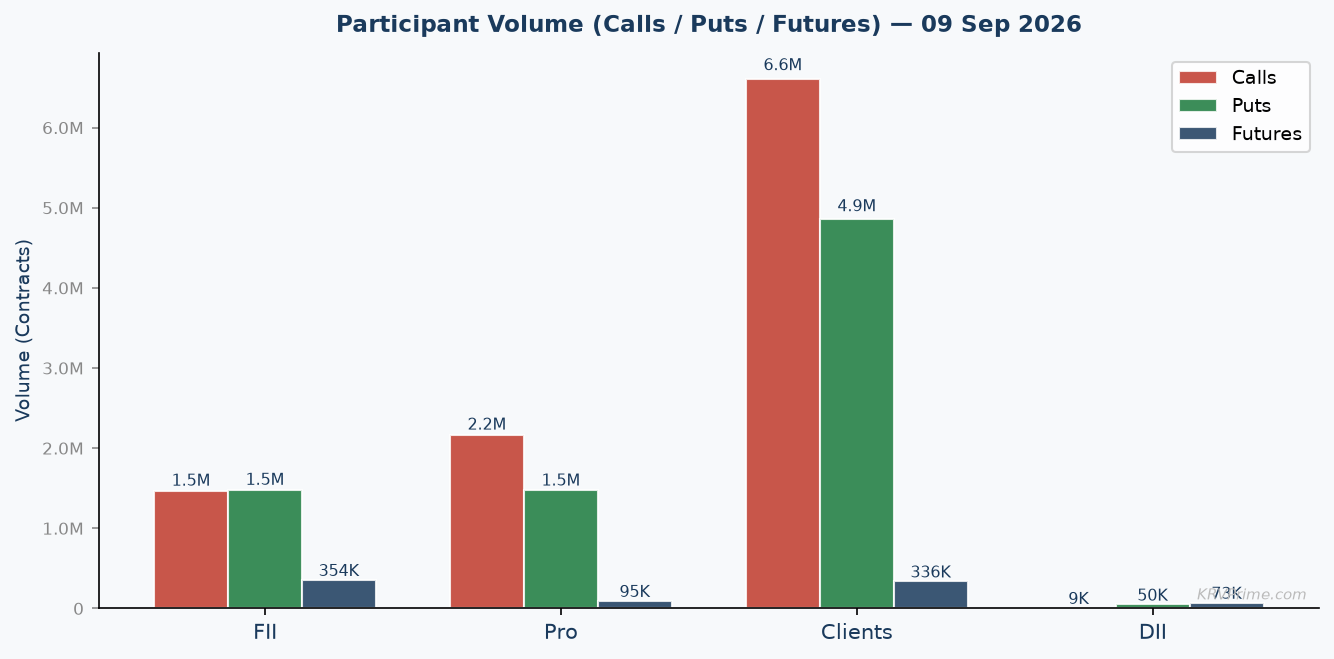
- Call OI net fell from +343,639 to +326,656 (net change -16,983): Long calls surged from 2,723,552 to 3,465,517 [Long Buildup - Low Vol], while Short calls surged from 2,379,913 to 3,138,861 [Short Buildup - Low Vol]. Put OI net worsened from -743,620 to -831,678 (net change -88,058): Long puts rose from 1,729,532 to 2,015,007 [Long Buildup - Low Vol], while Short puts rose from 2,473,152 to 2,846,685 [Short Buildup - Low Vol]. Clients are the largest single options participant in gross contract terms, with over 3.4 million call longs and 2.8 million call shorts — dwarfing every other participant in raw size. The architecture is net long calls (+326,656) but net short puts (-831,678), which creates a synthetic long / bullish risk reversal structure — long calls give upside participation while net short puts create an obligation to buy the market lower, effectively doubling their bullish exposure by profiting if the market stays flat or rises AND collecting premium while obligating themselves to buy dips. The Low Vol tags on all four options legs suggest this is a widespread, distributed retail/HNI positioning rather than a single concentrated institutional trade — consistent with the heterogeneous nature of the client category. The worsening put OI net from -743,620 to -831,678 (-88,058) tells us clients wrote 373,533 new puts while only buying 285,475 — they are aggressively writing downside protection, collecting premium and expressing confidence that 23,000 PE support will hold.
- Synthesis — Client Bullish Risk Reversal with Structural Dip-Buying: Clients today are running the most aggressively bullish options architecture of any participant group: net long calls (+326,656), net short puts (-831,678), and net long futures (+230,480) — all three legs point in the same direction. This is a triple-layered synthetic long structure: futures long + call long + short put = maximum directional exposure to an upside move, with the short put leg generating premium income but creating unlimited downside obligation if support breaks. The scale is staggering — with 3,465,517 long calls, 3,138,861 short calls, 2,015,007 long puts, and 2,846,685 short puts, clients represent the dominant force in gross options OI by a wide margin and their positioning sets the market's structural tone. Compared to FIIs who are running an 8.08:1 short futures ratio and net short calls, clients are positioned exactly opposite — the battle between FII shorts and Client longs is the central structural tension in this market. The falling Short PCR from 1.04 to 0.91 (-12.73%) is the one internal shift worth watching: it suggests the previously dominant 'write puts to collect premium' behaviour is moderating, and clients are beginning to reduce their net put-writing activity at the margin, which could be an early sign of sentiment caution creeping in at the edges. However, the enormous absolute size of the short put book (-831,678 net) means any meaningful put covering rally would generate a violent short-covering squeeze in the options market.
- Forward: The most important watch level for the Client category tomorrow is the 23,000 Nifty PE OI support level — clients are net short puts with -831,678 contracts, and if Nifty breaks decisively below 23,000, their short put book will move sharply into-the-money, generating mark-to-market losses and forcing a wave of put-buying to close positions. This put-covering dynamic below 23,000 would represent a capitulation event and could paradoxically create a sharp bounce as the mechanical buying overwhelms sellers. Watch tomorrow's client put OI net — if it improves meaningfully from -831,678 toward -750,000 or better (i.e., clients are buying puts back), that is the signal that their bullish thesis is being unwound under duress. Conversely, if Nifty holds above 23,200 tomorrow and client call OI net remains above +300,000, it confirms the retail/HNI dip-buying thesis is intact and the FII short position faces increasing pressure from the sheer weight of client long demand at these levels.
Bull vs Bear Strength by Participant
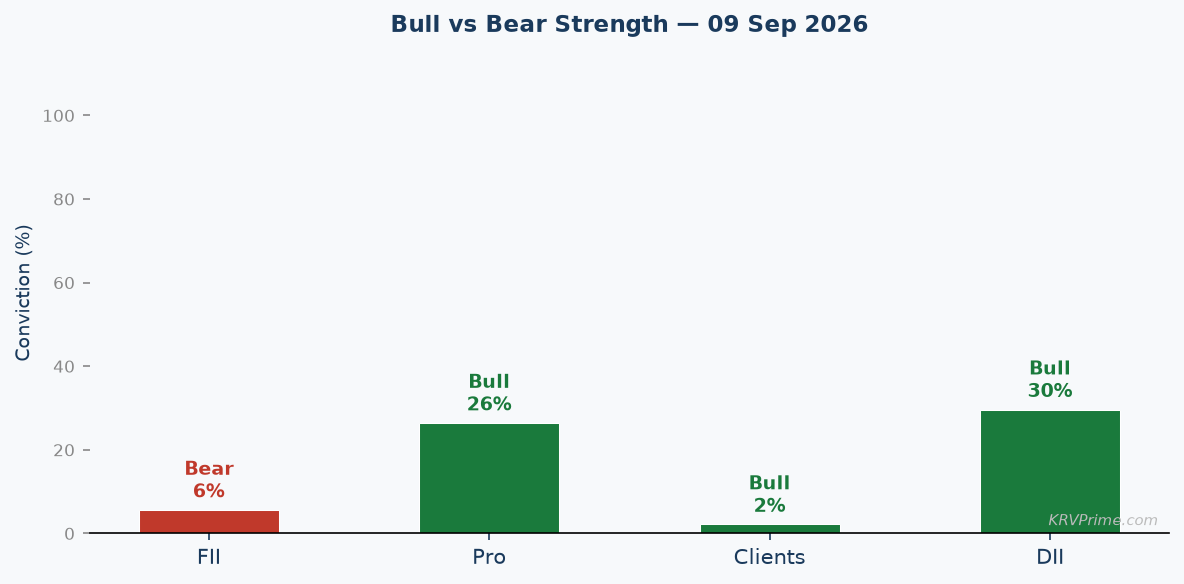
FII Strongly Bearish 88% ▼▼ | DII Defensively Bullish 62% ▲ | Pro Cautiously Bullish / Long Vol 58% ▲ | Clients Bullish / Overexposed Long 65% ▲▲ |
Conclusion — Market Outlook for Tomorrow (10 Sep 2026)
The collective participant positioning on 09 Sep 2026 paints a structurally bearish picture dominated by FII conviction. FIIs deepened their net futures short to -276,250 (from -261,557), running an extreme 8.08:1 gross short-to-long ratio of 315,277 shorts vs 39,027 longs — all tagged High Vol, confirming deliberate institutional execution. Their options architecture compounds this: net short calls (-342,643) at the 24,000 CE resistance and net long puts (+660,252) near the 23,000 PE support form a dual-leg synthetic short that monetises from both premium collection and directional movement. DIIs responded defensively, loading 18,800 new put longs (High Vol) and eliminating all short puts, expanding their protective put net to +49,673 — they are not bearish by conviction but are clearly hedging a long equity book against further downside. Pros are running a long-volatility futures-bullish hybrid (net futures +31,159, net long calls +14,552, net long puts +121,753) that profits if the VIX spike sustains. Clients remain the most aggressively long participant with a +230,480 futures net, +326,656 net call OI, and -831,678 net short put position — but this very overexposure makes them the most vulnerable if FII pressure intensifies below key support.
The overall PCR collapsing from 0.84 to 0.77 (-9.06%) on the same day that total OI expanded by +3,891,596 contracts (+9.06%) is a deeply bearish combination — fresh supply is overwhelming demand in the options market, and call writers (led by FIIs) are setting the structural ceiling at 24,000 CE. India VIX surging +6.12% from 11.23 to 11.92 on a down day confirms that the market is not merely drifting lower on light volume — there is genuine fear-premium being bid up, which historically precedes sustained directional moves rather than one-day corrections. The OI-based PE support at 23,000 (Nifty weekly and monthly) represents the last meaningful buyer base where FII put longs, DII put longs, and client short puts all converge — a clean break below this level would trigger cascading client put-covering and FII put monetisation simultaneously, creating the conditions for an accelerated decline. On the upside, the 24,000 CE resistance carries the weight of FII net short calls (-342,643) and significant client short call exposure — any rally attempt will face relentless call-writing supply at this ceiling unless FII shorts are covered.
The bearish thesis breaks down if tomorrow's session sees FII futures net improve meaningfully from -276,250 toward -265,000 or better (short-covering signal), overall PCR recovers above 0.85 (put buying exceeding call writing), and VIX reverses below 11.00 (fear premium collapsing). In that scenario, the enormous client short put book (-831,678 net) and Pro long futures position (+31,159) would trigger a sharp mechanical squeeze rally. However, until those specific thresholds are hit, the weight of evidence — FII's 8.08:1 short ratio, PCR at 0.77, VIX at 11.92, and total OI expanding +9.06% on a falling market — firmly supports a continued bearish bias with the 23,000 PE support as the critical line in the sand.
Scenario 1 — Bull case:
If FII futures net improves from -276,250 toward -265,000 or better tomorrow (indicating short-covering of at least 11,000 contracts), AND the overall PCR recovers above 0.85 (put buying reaccelerating relative to call writing), AND India VIX reverses below 11.00, the structural bearish thesis weakens materially. In this scenario, the Client short put book (-831,678 net) and Pro long futures position (+31,159) would act as mechanical accelerants — put-covering by clients and futures long additions by Pros would drive a sharp squeeze rally targeting 24,000 CE resistance. DII's protective put longs would also begin to be monetised as the market rises, and that put OI net reduction from +49,673 would confirm smart domestic money is booking hedge profits into the rally.
Scenario 2 — Bear case:
If FII futures net deepens further below -285,000 tomorrow (adding another 9,000+ short contracts), PCR continues falling below 0.72, and VIX breaks above 13.50 (sustained fear expansion), the market faces a high-probability test of the 23,000 Nifty PE support level where the largest OI concentration resides. A clean daily close below 23,000 would be the most dangerous development — it would force mechanical put-covering by clients (whose -831,678 net short put position would move sharply into-the-money), simultaneously monetising FII long puts at peak profitability. This dual dynamic — forced client buying of puts + FII selling of puts — could create a violent gap-down scenario. DII's +49,673 long put position would also reach maximum profitability below 23,000, and partial monetisation by DIIs could remove a key buyer from that level, further destabilising support.
Key Resistance 24,000 (Nifty CE OI Resistance) — FIIs have written 906,402 short calls (net short calls -342,643) concentrated at this strike, acting as a structural ceiling. Client short call OI of 3,138,861 adds further supply at and above this level. Any rally into 24,000 faces compounded call-writing pressure from the two largest participants in gross OI terms. | Key Support 23,000 (Nifty PE OI Support, weekly and monthly) — FIIs hold 1,070,563 long puts (net long puts +660,252) and DIIs hold 49,673 long puts at this level, making it a critical institutional defence zone. Simultaneously, Client net short puts of -831,678 mean a break below 23,000 would force massive mechanical put-covering, creating a double-edge: smart-money put longs are monetised while client short puts are covered, both adding buying pressure but confirming bearish sentiment. | Trigger to Watch Overall PCR crossing back above 0.85 — the single most important threshold for tomorrow's session. Today's PCR collapse from 0.84 to 0.77 (-9.06%) drove the bearish structure; a recovery above 0.85 would signal put buying is reaccelerating relative to call writing, which historically precedes short-covering in futures. Simultaneously watch India VIX — a reversal below 11.00 would signal the fear premium is being withdrawn, which combined with PCR recovery would be the clearest dual-confirmation of a trend reversal signal. |