
Market Participants Analysis dated 11.09.2026
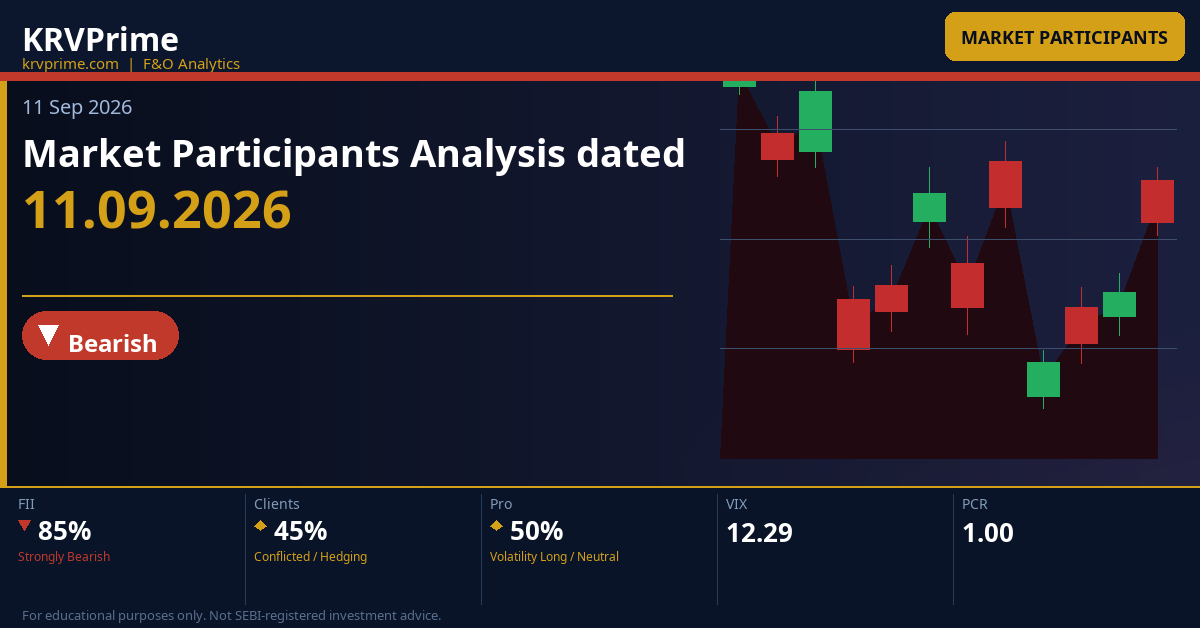
KRVPrime — Daily Market Outlook
Key Market Signals — Data: 11 Sep 2026
NIFTY 50 23,398.10 ▼ -79.70 (-0.34%) | BANK NIFTY 56,606.55 ▲ +134.60 (+0.24%) | SENSEX 74,781.76 ▼ -120.83 (-0.16%) |
OVERALL PCR 1.00 ▲ +0.22 (+28.04%) PCR surged from 0.78 to 1.00 — massive put OI build signals elevated hedging demand, not pure bullishness | INDIA VIX 12.29 ▲ +0.50 (+4.15%) VIX rising despite low absolute level — fear creeping in, options premium expanding, watch for acceleration | TOTAL OI CHANGE 52,340,506 ▲ +2,921,268 (+5.91%) Large OI expansion driven almost entirely by put buildup — hedging-led OI, not directional conviction |
FUTURES OI 875,922 ▲ +2,826 (+0.32%) Futures OI nearly flat — participants expressing views through options, not outright futures | CALL OI CHANGE 11,408,551 ▼ -346 (-0.00%) Call OI virtually unchanged — upside supply wall stable, no fresh call writing or aggressive call buying | PUT OI CHANGE 11,389,555 ▲ +2,493,633 (+28.03%) Explosive put OI surge of +28% — dominant theme of the session; all participants adding puts aggressively |
Participant-wise Key Points
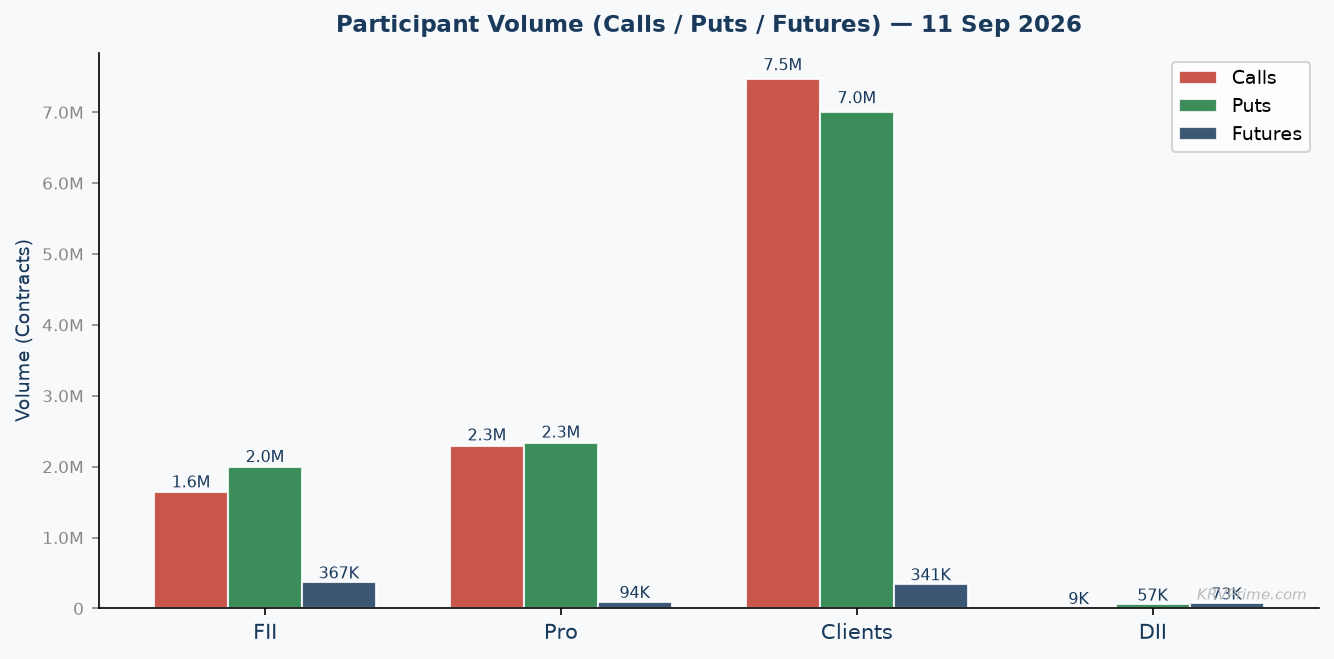
FII Bearish — Deepening Dual-Leg Short with Massive Put Accumulation
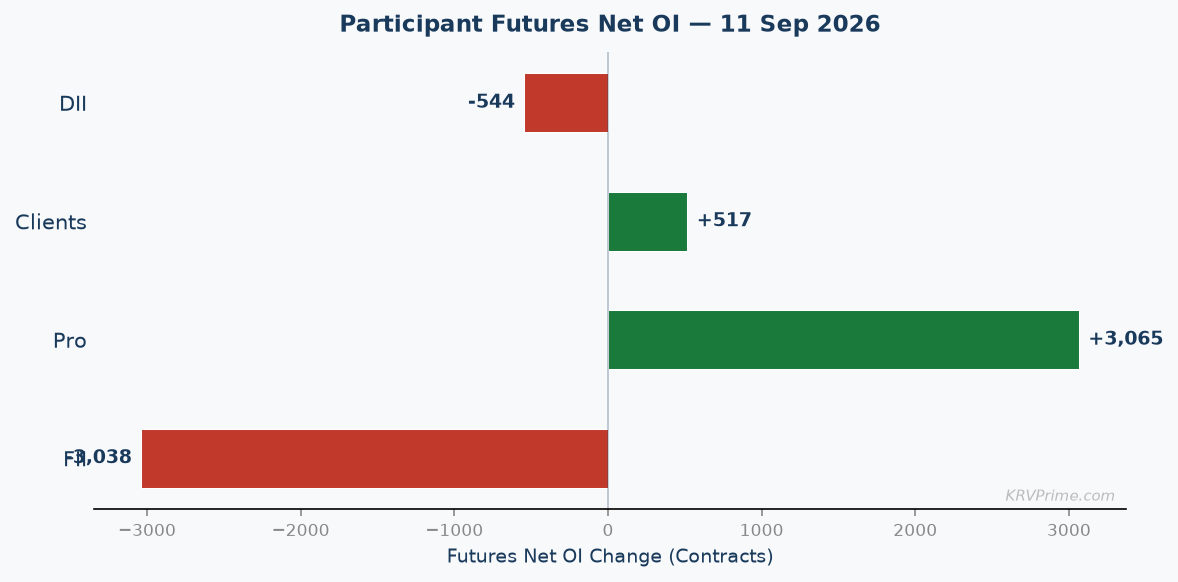
- Futures net deteriorated from -281,844 to -284,882 (net change -3,038). On the long side, FIIs added 1,558 contracts (prev 39,694 → today 41,252) tagged [Long Buildup - High Vol], while on the short side they added 4,596 contracts (prev 321,538 → today 326,134) tagged [Short Buildup - Avg Vol]. The gross short-to-long ratio now stands at a striking 7.90:1 (326,134 shorts vs 41,252 longs) — this is not a hedged position, this is an outright directional short of the highest order. The High Vol tag on the long buildup is noteworthy: it suggests FIIs are adding longs selectively and with conviction, but the Avg Vol short buildup confirms they are steadily layering into shorts without urgency, implying a systematic short-building campaign rather than panic-driven selling. The net deterioration of -3,038 contracts on a day when NIFTY closed down only -0.34% tells us FIIs are not covering despite moderate market softness — they want more downside.
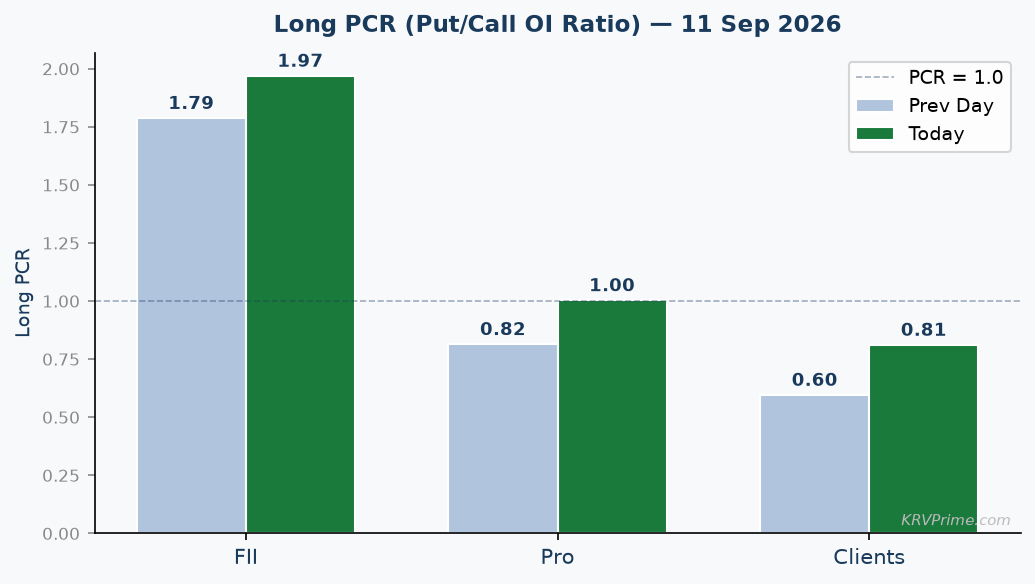
- Long PCR rose from 1.79 to 1.97 (+10.16%) and Short PCR rose from 0.49 to 0.69 (+41.01%). A Long PCR of 1.97 means FIIs now hold nearly twice as many put longs as call longs — this is a deeply defensive and directionally bearish options posture. The jump of +10.16% in a single session signals that FIIs are aggressively accelerating their downside hedge or directional put exposure. The Short PCR rising from 0.49 to 0.69 (+41.01%) is a dramatic shift — previously FIIs were writing far more calls than puts on the short side, but now they are writing significantly more puts (though still net call-heavy on shorts), which could indicate they are selling puts at lower strikes to collect premium while staying net bearish — a classic bear-spread or put-selling income layer within a larger bearish architecture. Together, the surging Long PCR and the rapidly rising Short PCR confirm that FII options positioning is tilting decisively toward the bearish side, and the velocity of change in the Short PCR (+41.01%) is the single most telling number: it shows a structural shift in their options short book composition, not a routine rebalance.
- Call OI net improved marginally from -318,871 to -287,098 (Long 675,792 [Long Buildup - High Vol], Short 962,890 [Short Buildup - High Vol]; net change +31,773). The High Vol tags on both legs confirm these are deliberate, high-conviction positions — FIIs added 46,982 call longs and 15,209 call shorts, meaning they are buying more calls than writing, which is the only mildly constructive signal in FII data today. Put OI net grew marginally from +662,764 to +669,711 (Long 1,331,606 [Long Buildup - High Vol], Short 661,895 [Short Buildup - High Vol]; net change +6,947). The explosive put long addition of +206,875 contracts (+18.39%) dwarfs the put short addition of +199,928 contracts (+43.28%), keeping the net put position firmly bullish at +669,711 — but the near-equal size of both adds creates an interesting dynamic: FIIs are simultaneously mass-buying puts AND mass-selling puts, suggesting they are constructing layered put spreads across multiple strikes, capturing both protection and premium income. The net options architecture — net short calls (-287,098) combined with net long puts (+669,711) — remains a textbook synthetic short / protective collar, perfectly aligned with their dominant futures short book.
- Synthesis — FII Accelerating Bearish Collar with Put Spread Overlay: FIIs present the most internally consistent and structurally bearish positioning across all four participants today. Their futures net of -284,882 (7.90:1 short-to-long gross ratio), combined with a Long PCR of 1.97, net short calls of -287,098, and net long puts of +669,711, creates a comprehensive multi-leg bearish architecture. The session's key development is the massive simultaneous addition of 206,875 put longs and 199,928 put shorts — the near-symmetry of these additions at High Vol on both legs strongly suggests FII desks are executing put spreads (buying higher-strike puts, selling lower-strike puts) as a cost-efficient way to maintain downside exposure without paying full premium. This strategy is consistent with a medium-term bearish view where FIIs expect a defined downside range rather than a catastrophic crash. The fact that they continued building both futures shorts and put longs on a day when NIFTY only fell -0.34% — and did not cover despite modest weakness — confirms they are not yet satisfied with the market's downside move and are positioning for further deterioration. Compared to the previous session, FIIs have accelerated their short book in options (Long PCR +10.16%, Short PCR +41.01%) while holding the futures short steady, signalling a transition from pure futures shorts toward a more sophisticated options-led bearish strategy.
- Forward trigger: Watch FII futures net — if it crosses below -290,000 contracts in tomorrow's data, it signals a fresh leg of deliberate short addition and confirms FIIs are targeting a move toward the 23,300 weekly PE support (OI max pain floor). Conversely, if FII futures net improves above -280,000 (i.e. shorts are being covered), that would be the first signal of a thesis reversal and could trigger a sharp short-covering rally in NIFTY. The critical options watch is whether FII Long PCR holds above 2.00 tomorrow — a breach above 2.00 would mark the most bearish put-to-call long ratio in recent sessions and would confirm their conviction in further downside.
DII Cautiously Bearish — Reducing Net Long Futures, Aggressively Hedging via Puts
- Futures net fell from +14,892 to +14,348 (net change -544). On the long side, DIIs added a modest 459 contracts (prev 43,284 → today 43,743) tagged [Long Buildup - Low Vol], while on the short side they added 1,003 contracts (prev 28,392 → today 29,395) tagged [Short Buildup - Avg Vol]. The Low Vol tag on the long buildup is significant — it signals hesitant or thin long addition, lacking institutional conviction, while the Avg Vol short buildup confirms that the short addition is a routine but deliberate incremental hedge. The gross long-to-short ratio is 1.49:1 (43,743 longs vs 29,395 shorts), which shows DIIs remain net long futures but are gradually compressing this advantage. The net change of -544 contracts, while small in absolute terms, is directionally important: DIIs are not adding to their net long — they are trimming it, suggesting reduced near-term bullish conviction even as they maintain structural equity exposure through long futures.
- DII PCR data is not reported in the dataset — unlike FII and other participants, DII Long PCR and Short PCR values are not available for this session. However, we can infer their options sentiment directionally from their Put OI changes: DIIs added 6,286 put longs with a [Long Buildup - High Vol] tag, while their put short book remains at 0 contracts — meaning DIIs have zero put short exposure. This is an unambiguously defensive posture: every single options contract DII holds on the put side is a long, providing pure downside protection. On the call side, their long call book is entirely unchanged at 5,401 contracts [Long Flat - High Vol] while their short call book reduced by -551 contracts (from 3,901 to 3,350) tagged [Short Covering - Low Vol], meaning they are gently unwinding call shorts — a mild upside acknowledgement. The combined picture of put long accumulation with zero put shorts and gentle call short covering tells us DIIs are in a classic protective hedge mode: long equity (via futures), buying puts for downside insurance, and cautiously reducing their call writing commitments.
- Call OI net improved from +1,500 to +2,051 (Long 5,401 [Long Flat - High Vol], Short 3,350 [Short Covering - Low Vol]; net change +551). The Long Flat - High Vol tag confirms that DII call longs at 5,401 are deliberate and intentionally maintained positions — they are not stale. The Short Covering - Low Vol on the call short side indicates a thin, low-conviction unwind of written calls — perhaps expiry management or a modest bullish tilt. Put OI net grew from +50,538 to +56,824 (Long 56,824 [Long Buildup - High Vol], Short 0 [Short Flat - Low Vol]; net change +6,286). The High Vol tag on put long buildup at 56,824 total contracts is the dominant DII options signal: these are actively managed, high-conviction put longs — not passive or stale. With zero put shorts and a growing put long book, DII options architecture is a pure protective put position, representing the clearest expression of downside insurance among all four participants. This is not a speculative bearish bet; it is institutional risk management.
- Synthesis — DII Structural Hedge Build with Declining Net Long Conviction: DIIs are navigating a conflicted environment today — they remain structurally net long in futures at +14,348 (consistent with their mandate as domestic institutional long-term buyers) but are simultaneously accelerating put protection at High Vol conviction (56,824 put longs, zero put shorts). The net futures deterioration of -544 contracts, though small, combined with the aggressive put long addition of +6,286 contracts at High Vol, tells a coherent story: DIIs are not abandoning their equity exposure, but they are pricing in a meaningful probability of near-term downside. The call short covering of -551 contracts at Low Vol (Short Covering - Low Vol) adds a nuanced twist — they are marginally reducing their call writing, which could mean they see some upside risk or are simply managing expiry positions. Compared to FIIs, DIIs are structurally less bearish (they are net long futures, not net short) but their options behaviour is identically defensive — both are buying puts aggressively. The key divergence from FIIs is that DIIs have zero put shorts, meaning they are paying full premium for protection rather than spreading costs via put spreads — this suggests a shorter-term, more urgent hedge rather than FII's more calculated spread strategy.
- Forward trigger: If DII put longs cross above 65,000 contracts in tomorrow's session, it would signal an escalation in institutional domestic hedging that historically precedes sharper market corrections — watch this threshold as a leading indicator of DII risk-off acceleration. Conversely, if DII futures net improves back above +15,000 contracts (recovering the lost ground), it would signal that domestic institutions are re-committing to their bullish structural thesis and the put build was purely defensive. The key level for DII context is the 23,300 weekly PE support — DII put longs clustered near this strike would confirm they see it as the floor and are protecting against a breach.
Pro Neutral to Cautiously Bearish — Aggressively Restructuring Options Book
- Futures net improved from +35,981 to +39,046 (net change +3,065). On the long side, Pros reduced by -128 contracts (prev 66,741 → today 66,613) tagged [Long Unwinding - High Vol], while on the short side they reduced by -3,193 contracts (prev 30,760 → today 27,567) tagged [Short Covering - High Vol]. Both High Vol tags on both legs — one for long unwinding and one for short covering — indicate these are deliberate, high-conviction actions by professional desks, not mechanical rollovers. The net effect of covering more shorts (-3,193) than unwinding longs (-128) is a net improvement of +3,065 in the long direction, making Pros incrementally more net long in futures. The gross long-to-short ratio stands at 2.42:1 (66,613 longs vs 27,567 shorts), and the High Vol short covering signals that Pros believe there is limited near-term downside in futures — they are reducing their downside bets even as FIIs add to theirs. This creates a notable inter-participant divergence: FIIs are adding futures shorts while Pros are covering them, suggesting disagreement at the institutional level about the immediacy of further downside.
- Long PCR rose from 0.82 to 1.00 (+23.16%) and Short PCR rose from 0.69 to 1.03 (+49.93%). The Long PCR crossing the psychologically important 1.00 level means Pros now hold equal put longs and call longs — a perfect pivot point that indicates they have shifted from a net call-long (bullish options) posture to a perfectly balanced long options book in a single session, a dramatic repositioning. The +23.16% single-session jump in Long PCR confirms this was not gradual — Pros made a deliberate, large put addition to their long book. The Short PCR surging from 0.69 to 1.03 (+49.93%) is even more dramatic: crossing above 1.00 means Pros are now writing more puts than calls on the short side, which is a classic bullish income / range trade signal — they are selling puts believing the downside is limited (collecting premium at strikes they think will expire worthless). The combination of rising Long PCR (adding put longs for protection) and rising Short PCR above 1.00 (writing puts for income) creates an ambiguous signal: Pros appear to be constructing a complex spread book — long puts at one strike, short puts at a lower strike — consistent with a bull put spread or put ratio spread strategy, expressing a cautiously range-bound view.
- Call OI net swung dramatically from -62,790 to +55,386 (Long 1,175,140 [Long Buildup - Avg Vol], Short 1,119,754 [Short Covering - Avg Vol]; net change +118,176). This is the single largest positional flip in today's data — Pros went from net short calls by 62,790 to net long calls by 55,386 in a single session, driven by adding 50,474 call longs and simultaneously covering 67,702 call shorts. The Avg Vol tags on both sides indicate this was a systematic, planned restructuring rather than a panic-driven trade. Put OI net fell sharply from +101,200 to +26,585 (Long 1,180,310 [Long Buildup - Avg Vol], Short 1,153,725 [Short Buildup - Avg Vol]; net change -74,615). Both the put long addition of +263,134 (+28.69%) and put short addition of +337,749 (+41.39%) are enormous in absolute terms, but the short addition outpaced the long addition by 74,615 contracts, compressing the net from +101,200 to +26,585. The options architecture has fundamentally shifted for Pros: they moved from net short calls + net long puts (bearish synthetic) to net long calls + net long puts (long strangle/straddle territory) — this is a volatility-long positioning, consistent with Pros expecting a significant move in either direction without a clear directional bias.
- Synthesis — Pro Desk Volatility Long Repositioning via Strangle Architecture: Today's Pro data tells the story of a major, deliberate options book restructuring. They entered the session as net short calls (-62,790) and net long puts (+101,200) — a moderately bearish configuration — and exited as net long calls (+55,386) and net long puts (+26,585) — a long strangle configuration that profits from volatility expansion in either direction. The High Vol short covering in futures (+3,065 net improvement) further supports the idea that Pros are not committed to a bearish directional view and are instead positioning for a vol event. The India VIX rising from 11.79 to 12.29 (+4.15%) in today's session is consistent with this thesis: Pros may be anticipating further VIX expansion and are buying options on both sides to profit from it. The Avg Vol tags on both call and put restructuring legs confirm this was a planned, systematic portfolio shift — not reactive. The key internal contradiction is the Short PCR surging to 1.03 (writing more puts than calls), which sits uncomfortably with a pure volatility-long thesis — this suggests Pros are not simply buying strangles but are selling puts at lower strikes to fund the long strangle, creating a ratio-adjusted long strangle or jade lizard variant. Compared to the previous session, Pros have made the most radical single-session repositioning of all four participants.
- Forward trigger: The critical watch for Pro positioning tomorrow is whether their Call OI net (currently +55,386) holds positive — if Pros begin covering call longs (net falling back toward zero), it would signal the long strangle thesis is being abandoned and could coincide with a directional market move resolving. Watch also whether their Short PCR remains above 1.03 — if it rises further, Pros are adding more put shorts (bullish on the put side) and the market may find floor support near the 23,300 weekly PE strike. If VIX accelerates above 13.00 tomorrow, Pros' long volatility book would be profitable and we could see them adding further — a VIX cross above 13.00 is the single clearest confirmation trigger for the Pro long-volatility thesis.
Client Conflicted — Unwinding Call Longs, Aggressively Adding Put Longs and Put Shorts
- Futures net marginally improved from +230,971 to +231,488 (net change +517). On the long side, Clients reduced by -476 contracts (prev 286,829 → today 286,353) tagged [Long Unwinding - High Vol], while on the short side they also reduced by -993 contracts (prev 55,858 → today 54,865) tagged [Short Covering - High Vol]. Both High Vol tags on both legs confirm these are deliberate unwinding decisions — Clients reduced both longs and shorts simultaneously, which is consistent with position squaring or expiry-driven cleanup. The gross long-to-short ratio remains massively dominant at 5.22:1 (286,353 longs vs 54,865 shorts), confirming that retail and institutional client participants remain overwhelmingly net long futures by a wide structural margin. However, the High Vol Long Unwinding tag is a caution flag — when retail clients reduce longs at high volume, it often signals profit-taking or stop-loss triggering on the long side, which can become self-reinforcing if the market dips further. The modest net improvement of +517 (more shorts covered than longs unwound) keeps the structural bias long, but the direction of travel in both legs is toward position reduction.
- Long PCR rose from 0.60 to 0.81 (+36.08%) and Short PCR rose from 0.89 to 1.07 (+20.58%). The Long PCR jumping from 0.60 to 0.81 in a single session (+36.08%) signals an enormous addition to put longs relative to call longs — Clients are rapidly hedging their dominant futures long book. A Long PCR of 0.81 means Clients hold 81 put longs for every 100 call longs — they are not yet in a defensive majority, but they are rapidly approaching parity, driven by the session's massive put acquisition. The Short PCR rising from 0.89 to 1.07 (+20.58%) and crossing above 1.00 mirrors what we saw in Pros: Clients are now writing more puts than calls on the short side, which in the retail context typically indicates aggressive put selling for premium income — a behaviour consistent with retail participants believing the market will not fall significantly below current levels and trying to profit from elevated put premiums. The combined signal of rapidly rising Long PCR (fearful, hedging) and Short PCR crossing 1.00 (greedy, premium-collecting) reveals the classic retail contradiction: simultaneously buying puts for protection AND selling puts for income, creating a self-hedging but also self-limiting options book.
- Call OI net fell sharply from +380,160 to +229,662 (Long 3,847,943 [Long Unwinding - Avg Vol], Short 3,618,281 [Short Buildup - Avg Vol]; net change -150,498). Clients reduced call longs by -97,628 contracts (-2.47%) while simultaneously adding call shorts of +52,870 contracts (+1.48%) — both with Avg Vol tags — confirming a systematic shift away from call buying toward call writing. This is a clear capitulation on the bullish call-buying thesis that retail clients typically carry. Put OI net improved from -814,502 to -753,121 (Long 3,126,037 [Long Buildup - Avg Vol], Short 3,879,158 [Short Buildup - Avg Vol]; net change +61,381). The addition of +770,521 put longs (+32.71%) and +709,140 put shorts (+22.37%) is the largest absolute options addition of any participant today — Clients drove the bulk of the day's explosive +28.03% put OI expansion. The net put position remains negative at -753,121 (more put shorts than put longs), meaning Clients are structurally net short puts — they are the primary put sellers of the market. This creates the dominant market dynamic: FIIs and DIIs buy puts, Clients sell them — a classic institutional-vs-retail options transfer.
- Synthesis — Client Retail Capitulation on Calls with Defensive Put Buying vs Premium-Seeking Put Selling: The Client data today captures two simultaneous and contradictory retail behaviours at unprecedented scale. First, a call long unwinding (-97,628) combined with call short addition (+52,870) signals that retail participants who were bullish via call buying are abandoning that thesis — a bearish capitulation on the upside. Second, the addition of 770,521 put longs indicates widespread fear and hedging among a different segment of retail. Third, the addition of 709,140 put shorts shows another retail cohort aggressively selling puts for premium income, betting that the drop is overdone. The net result is a net short put book of -753,121 — Clients are collectively the biggest underwriters of downside protection in today's market. Comparing to FII: FIIs are the primary buyers of puts (1,331,606 put longs) and Clients are their primary counterparties (3,879,158 put shorts) — this is the defining trade of the session: institutional put buying funded by retail put selling. If the market falls sharply toward 23,300, FII put longs profit massively while Client put sellers face mounting mark-to-market losses, potentially triggering forced covering and accelerating the downside move.
- Forward trigger: The critical watch for Client positioning is their net short put book — currently -753,121 contracts. If tomorrow's put OI data shows Clients reducing put shorts (net improving toward -700,000 or better), it signals retail put sellers are getting nervous and covering — which historically coincides with sharp downside moves as the natural buyer support disappears. Conversely, if Client put shorts continue expanding (net falling below -800,000), it signals retail complacency and continued premium income seeking, which would provide a put-writing floor and limit downside. The key price reference for Client positioning is the 23,300 weekly PE support — a close below this level would trigger mass pain for retail put sellers and could cascade into a volatility spike well above the current 12.29 VIX.
Bull vs Bear Strength by Participant
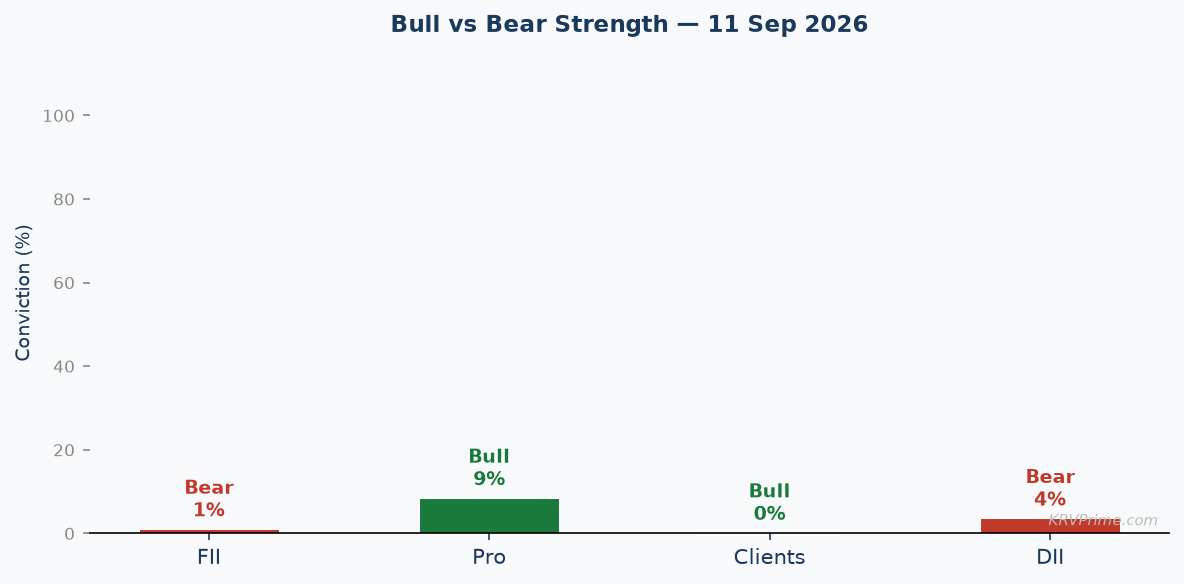
FII Strongly Bearish 85% ▼▼ | DII Cautiously Bearish 65% ▼ | Pro Volatility Long / Neutral 50% ▶ | Clients Conflicted / Hedging 45% ▶▼ |
Conclusion — Market Outlook for Tomorrow (12 Sep 2026)
The structural picture emerging from today's participant data is one of coordinated institutional hedging against a dominant retail put-selling counterparty. FIIs deepened their futures short position to a net of -284,882 contracts (7.90:1 short-to-long gross ratio) while simultaneously executing what appears to be a large-scale put spread — adding 206,875 put longs and 199,928 put shorts at High Vol on both legs. DIIs reinforced this defensive theme by adding 6,286 put longs with zero put shorts and a High Vol conviction tag, while marginally reducing their futures net long from +14,892 to +14,348. Pros made the most dramatic single-session repositioning — flipping from net short calls to net long calls (+55,386) and compressing their net put long from +101,200 to +26,585, creating a long strangle / volatility-long architecture that bets on a significant directional move. The critical counter-force is Client positioning: retail participants added a staggering 709,140 put shorts, keeping the net Client put book at -753,121 — they are the market's primary put sellers and their pain threshold near 23,300 is the most important near-term risk event.
The Overall PCR surging from 0.78 to 1.00 (+28.04%) in a single session is a landmark shift. A PCR of 1.00 means put OI now exactly equals call OI — this is a market at equilibrium between fear and greed, but the velocity of the move (28% in one day) tells us the shift was fear-driven, not greed-driven. India VIX rising from 11.79 to 12.29 (+4.15%) confirms options premium is expanding, which benefits long-volatility players (Pros) and long-put holders (FIIs, DIIs) while hurting put sellers (Clients) through mark-to-market. Total OI expanded by +5.91% (+2,921,268 contracts), overwhelmingly driven by the put OI surge of +28.03% — this is hedging-led OI expansion, not trend-following. Futures OI grew only +0.32% (+2,826 contracts), confirming participants chose options over futures to express today's views. The combination of PCR surge, VIX rise, put OI explosion, and FII deepening shorts creates a bearish bias for tomorrow, with the 23,300 weekly PE support and 23,000 monthly PE support as the critical downside OI-defined floors.
The bearish thesis would be invalidated if FII futures net improves above -280,000 (covering of shorts) combined with the Overall PCR retreating below 0.90 — either of these signals would suggest the put build was a one-session event rather than the start of a sustained hedging trend. On the upside, the 24,000 CE resistance (both weekly and monthly) represents a massive wall of call OI that would require significant FII short-covering and retail call-buying momentum to breach. Until FIIs show evidence of reducing their 7.90:1 short book, the risk-reward favors maintaining a defensive bias, with any intraday bounce toward 24,000 likely to be met with fresh call writing from both FIIs and Clients.
Scenario 1 — Bull case:
If FII futures net improves above -280,000 (net short covering of ~4,882+ contracts), Overall PCR retreats below 0.90 as put longs are monetised, and India VIX pulls back below 11.79 (today's open level), it would signal that the day's hedging surge was a one-off event rather than the start of sustained institutional bearishness. A PCR retreat from 1.00 to below 0.90 would confirm put sellers (Clients) are winning the options tug-of-war. In this scenario, NIFTY could stabilise above the 23,300 weekly PE support and build toward 24,000 CE resistance, with short-covering providing the rally fuel.
Scenario 2 — Bear case:
If FII futures net deteriorates below -290,000 (further short addition), Overall PCR surges above 1.10 as fresh put buying outpaces call writing, and India VIX accelerates above 13.00, the institutional bearish thesis gains full confirmation. In this scenario, Client put short holders (-753,121 net) would face mounting losses near the 23,300 weekly PE support, triggering forced put-short covering that paradoxically adds buying pressure at lower strikes but also signals market stress. A VIX above 13.00 would mark the beginning of a premium re-rating event, and the 23,000 monthly PE support would become the next OI-defined floor to defend.
Key Resistance 24,000 (NIFTY — Weekly & Monthly CE max OI strike): Both the weekly and monthly CE resistance coincide at 24,000, making this a double-layer supply wall. FIIs are net short calls (-287,098 net), Clients are adding call shorts (+52,870 today), and Pros were net short calls entering today — all three major participants have vested interest in keeping NIFTY below 24,000 through options expiry. For BANKNIFTY, the key CE resistance is 57,500 (monthly), with SENSEX monthly CE resistance at 77,000 and weekly at 75,000. | Key Support 23,300 (NIFTY — Weekly PE max OI strike): FII put longs total 1,331,606 contracts, DII put longs total 56,824 contracts, and Client put longs total 3,126,037 contracts — all representing significant downside protection clustered around the 23,300 weekly floor. A breach of this level would trigger FII and DII put profits while devastating Client put sellers (3,879,158 put shorts), potentially cascading into a volatility spike. NIFTY monthly PE support sits at 23,000, BANKNIFTY monthly PE support at 56,000, and SENSEX weekly PE support at 70,000 (monthly: 74,500). | Trigger to Watch Overall PCR holding above or breaking below 1.00: Today's surge to exactly 1.00 from 0.78 is a tipping-point level. If PCR holds above 1.00 tomorrow, it confirms sustained institutional put accumulation and the bearish bias deepens. If PCR retreats below 0.90, it signals put monetisation and a potential stabilisation. The secondary trigger is India VIX crossing 13.00 — above that level, the options premium expansion would confirm a vol-event is underway and validate Pros' long strangle strategy. |