
Market Participants Analysis dated 16.09.2026
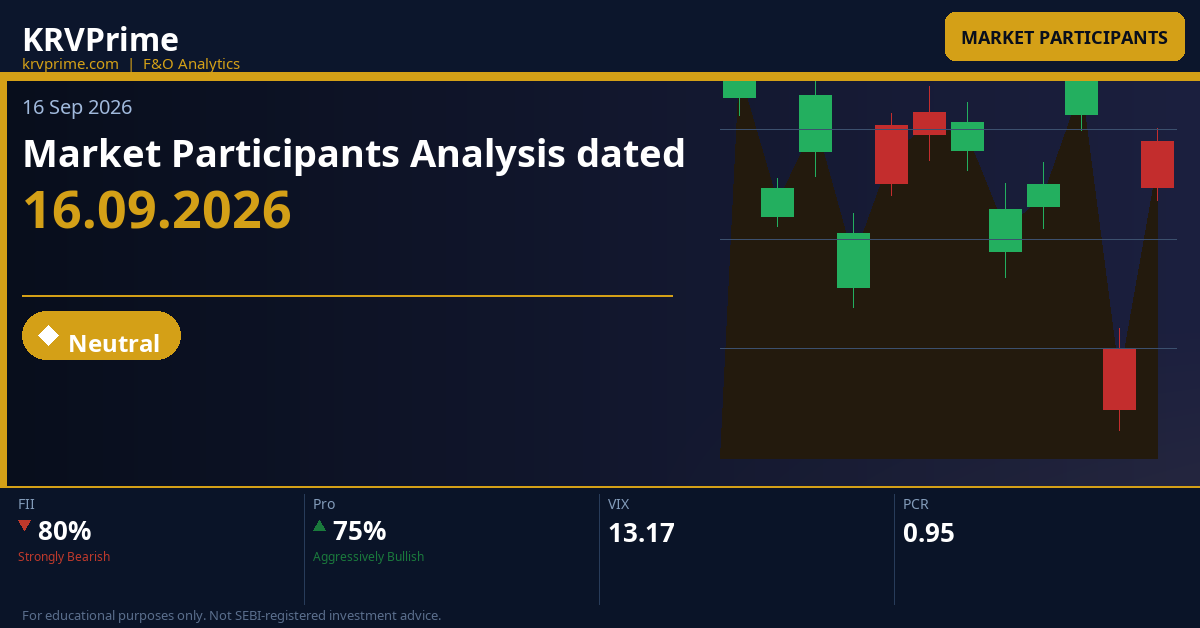
KRVPrime — Daily Market Outlook
Key Market Signals — Data: 16 Sep 2026
NIFTY 50 23,217.60 ▲ +99.00 (+0.43%) | BANK NIFTY 56,292.45 ▲ +497.70 (+0.89%) | SENSEX 74,336.45 ▲ +332.63 (+0.45%) |
OVERALL PCR 0.95 ▲ +0.12 (+14.20%) PCR surged from 0.83 to 0.95 — put OI building sharply, approaching neutral zone; sentiment improving but not yet bullish. | INDIA VIX 13.17 ▼ -0.26 (-1.97%) VIX declining into low-fear zone — market pricing in stability; complacency risk if VIX drops below 13. | TOTAL OI CHANGE 47,823,750 ▲ +2,572,486 (+5.68%) Massive OI expansion driven by options buildup — new positions dominate, not rollover or unwinding. |
FUTURES OI 900,282 ▼ -1,488 (-0.17%) Futures OI marginally lower — futures market is near steady while all action is in options. | CALL OI CHANGE 9,080,415 ▲ +681,709 (+8.12%) Heavy call OI buildup — supply being written aggressively at higher strikes, capping upside. | PUT OI CHANGE 8,610,491 ▲ +1,636,821 (+23.47%) Exceptional put OI surge of +23.47% — put buying and writing both accelerating, driving PCR recovery. |
Participant-wise Key Points
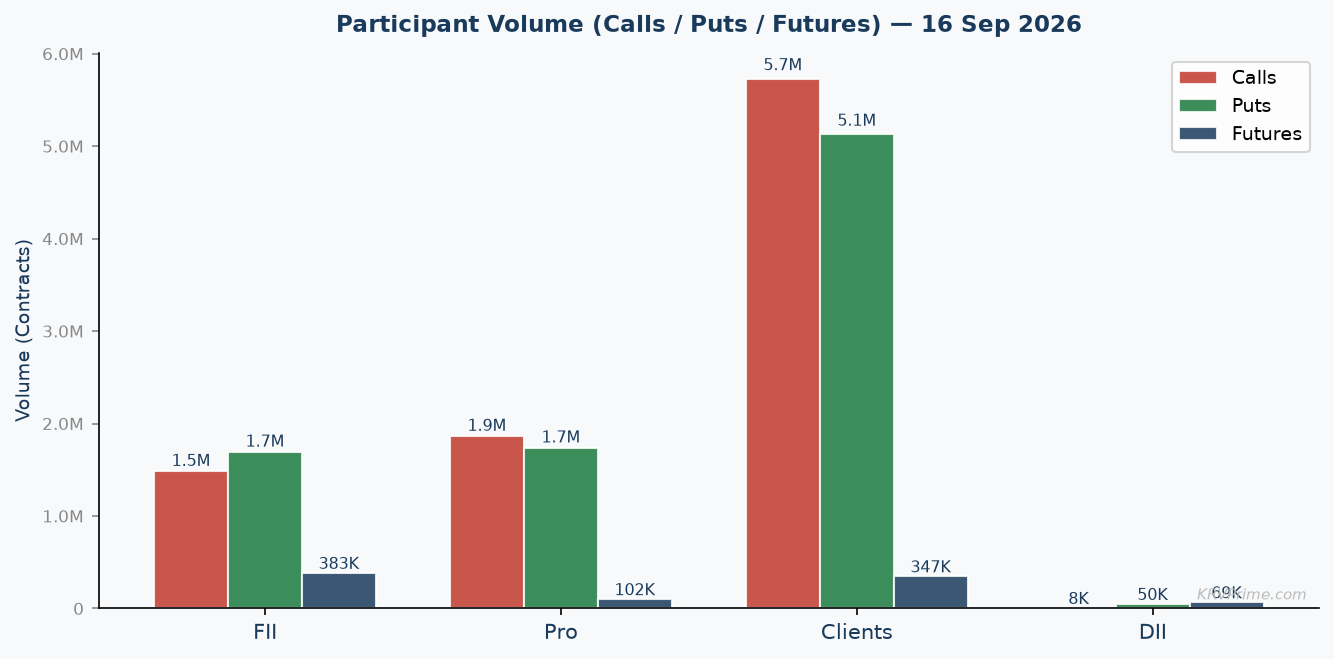
FII Structurally Bearish — Dual-Leg Hedged with Rising Put Short Book
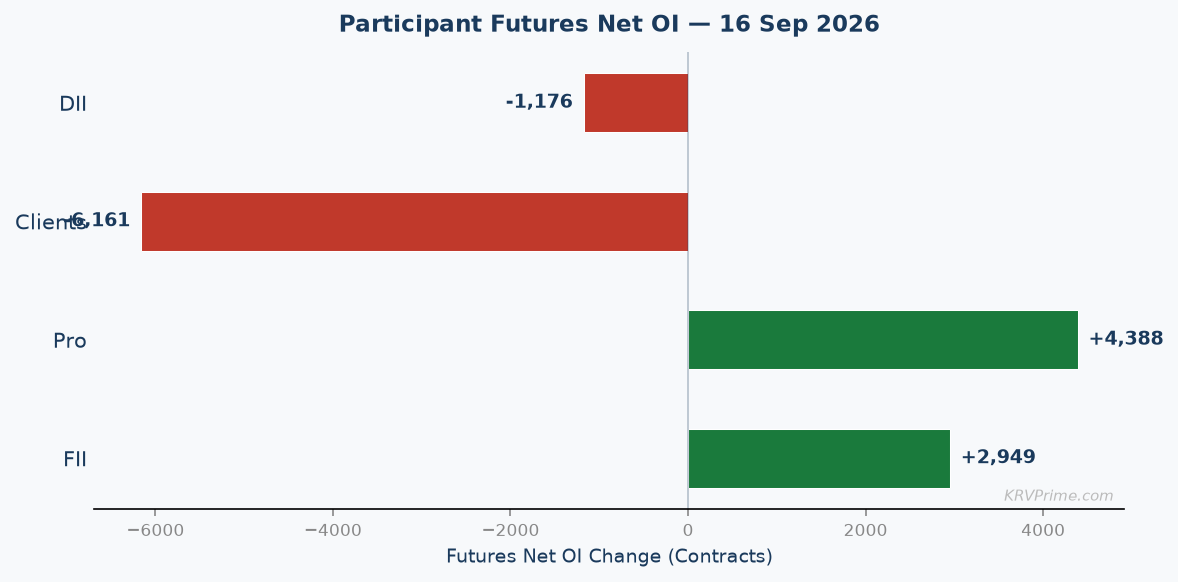
- Futures net improved modestly from -291,052 to -288,103 (net change +2,949 contracts). The long side added 1,188 contracts (prev 46,258 → today 47,446, +2.57%) tagged [Long Buildup - Avg Vol], indicating routine accumulation without strong conviction, while the short side shed -1,761 contracts (prev 337,310 → today 335,549, -0.52%) tagged [Short Covering - Low Vol], meaning the short-covering is hesitant and low-intensity. The gross short-to-long ratio remains a towering 7.08:1 (335,549 shorts versus 47,446 longs), which is unambiguously an outright directional short posture, not a hedge. Despite Nifty closing up +0.43% at 23,217.60, FIIs made virtually no meaningful reduction to their dominant short book — the low-volume short-covering tag confirms this is not conviction-driven repositioning, and the slight long buildup via avg-vol simply reflects marginal rebalancing rather than a bullish thesis switch.
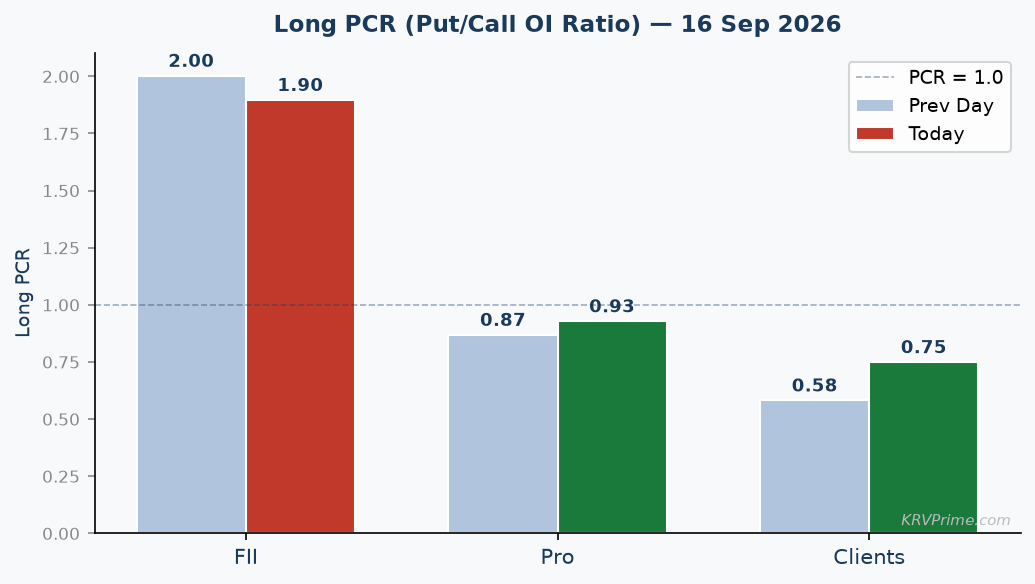
- Long PCR declined from 2.00 to 1.90 (-5.28%) and Short PCR surged from 0.45 to 0.63 (+38.89%). A Long PCR of 1.90 means FIIs still hold 1.90 put longs for every call long — an emphatically defensive posture that signals either deep hedging of an equity book or a directional bearish expression through options. The decline from 2.00 to 1.90 is modest and suggests a partial reduction in put-long dominance, but the absolute level remains extreme. The Short PCR jumping from 0.45 to 0.63 (+38.89%) is the more aggressive signal today — FIIs have dramatically accelerated put writing on the short side, shifting from writing far more calls than puts to a more balanced but rapidly converging stance. A rising Short PCR alongside a still-elevated Long PCR creates an internal tension: FIIs are simultaneously holding large put longs (bearish hedge) while aggressively writing new puts (income or range play), suggesting they may be monetising part of their put book by selling lower strikes as premium income — a classic put spread construction.
- Call OI net stands at -288,206 (Long 598,953 [Long Buildup - Low Vol] vs Short 887,159 [Short Buildup - Low Vol]). FIIs added 70,614 call longs and 45,779 call shorts — net call position improved by 24,835 contracts toward less negative, but they remain net short calls by a wide margin. Put OI net deteriorated from +678,520 to +580,162 (net change -98,358), driven by Long 1,136,529 [Long Buildup - Low Vol] vs Short 556,367 [Short Buildup - Low Vol] — critically, the short side exploded by +176,520 contracts (+46.47%) while put longs added +78,162. The net position is still meaningfully long puts, but the aggressive put short buildup is compressing that net fast. The architecture remains net short calls + net long puts, which is a classic synthetic short or protective collar, though the dramatic put-short addition is beginning to transform this toward a put spread — where FIIs own puts at higher strikes and sell puts at lower strikes to finance premium costs. Both Low Vol tags on all legs indicate these are spread-type, structured entries rather than high-conviction naked directional bets today.
- Synthesis — FII Structured Bearish with Put Spread Overlay: FIIs present a picture of a participant maintaining a large directional short thesis while actively restructuring their options book for cost efficiency. The -288,103 futures net with a 7.08:1 short-to-long gross ratio leaves no ambiguity about their macro directional view — they remain bearish on Indian equities. However, the collapse in put short additions (+46.47% surge in short puts) alongside a declining Long PCR (2.00 → 1.90) strongly suggests FIIs are converting a portion of their naked put-long book into a put spread — buying protection at higher put strikes while selling lower put strikes to recover premium. This is a cost-management move, not a bullish capitulation. The Low Vol tags across all four options legs reinforce that today's activity is methodical, spread-construction positioning rather than panic or momentum-driven. Compared to the prior session, FIIs are holding steady on futures bias, accelerating their options restructuring, and showing no sign of thesis reversal despite today's +0.43% Nifty gain.
- Forward: Watch FII futures net — if it deteriorates back below -291,052 (previous day's level) in tomorrow's data, it confirms the short-covering was temporary noise and FIIs are re-pressing shorts, which would be a strong bearish signal for Nifty. Conversely, if the futures net improves decisively above -280,000, it would signal the beginning of meaningful short-covering that could fuel an upside squeeze. Additionally, monitor the Short PCR — if it crosses 0.70 (meaning FIIs are writing puts nearly as aggressively as calls on the short side), the put-spread restructuring is accelerating and their net options architecture could flip from net-long-puts to closer to neutral, removing a key bearish anchor.
DII Mildly Bearish — Reducing Futures and Options Exposure Simultaneously
- Futures net declined from +13,722 to +12,546 (net change -1,176 contracts). The long side shed -2,683 contracts (prev 43,240 → today 40,557, -6.20%) tagged [Long Unwinding - Low Vol], indicating passive, low-conviction reduction of long futures rather than an aggressive exit. The short side simultaneously shed -1,507 contracts (prev 29,518 → today 28,011, -5.11%) tagged [Short Covering - High Vol], and this is the more telling signal — DIIs are covering shorts with High Vol conviction while unwinding longs at Low Vol. The gross long-to-short ratio remains solidly net-long at 1.45:1 (40,557 longs versus 28,011 shorts), maintaining a structural long bias in futures. However, the directional message is one of de-risking on both sides — shrinking the book rather than adding to directional exposure — which is consistent with DIIs moving to a more conservative stance heading into a potential volatility event or expiry-related uncertainty.
- DII options PCR data is not reported in today's dataset — no Long PCR or Short PCR values are available for DII. Accordingly, the PCR analysis for DII is derived entirely from the options OI changes and confirmation tags. The Put OI Long Unwinding tagged [High Vol] is the dominant signal — DIIs are actively and deliberately reducing their put long book, which has historically been their primary hedging instrument. The absence of PCR data does not obscure the conclusion: the High Vol tag on put long unwinding paired with a zero short put position means DIIs are reducing directional hedge rather than replacing it with a new structure.
- Call OI net stands at +3,576 (Long 5,539 [Long Buildup - Low Vol] vs Short 1,963 [Short Buildup - Low Vol]). DII added +438 call longs and +253 call shorts — trivially small changes indicating no meaningful options activity on the call side. Put OI net fell from +53,470 to +50,325 (net change -3,145 contracts), driven by Long 50,325 [Long Unwinding - High Vol] vs Short 0 (unchanged, still zero). The High Vol confirmation on put long unwinding is critical — this is a deliberate, high-conviction reduction of their hedge book, not passive decay. With zero put shorts, the entire put OI structure for DIIs is a naked long put portfolio, meaning they are purely buying protection. The reduction of 3,145 put longs at high volume suggests DIIs are either taking profits on existing put hedges (with Nifty near support levels) or deliberately reducing insurance costs as VIX at 13.17 makes puts relatively cheap. This architecture — small net long calls, large net long puts — is a net long equity with put protection posture.
- Synthesis — DII Measured De-Risking, Structural Long Intact: DIIs are executing a controlled de-risking across all segments today — futures longs reduced by -2,683, put longs unwound by -3,145, and the overall futures net slipped from +13,722 to +12,546. Crucially, the High Vol tag on short-covering in futures alongside the High Vol tag on put-long unwinding tells a coherent story: DIIs are reducing hedge costs and selectively trimming long futures, but they are NOT reversing their structural long equity bias. The net futures position of +12,546 remains comfortably long, and with zero put shorts and still-large put longs at 50,325, the protection is still meaningfully in place. Compared to FIIs who are aggressively maintaining short futures, DIIs stand as the institutional counterweight — long futures, long puts, gradually reducing both as the market grinds higher and puts appreciate. The Low Vol tag on the long futures unwind suggests the reduction is routine portfolio rebalancing rather than a fear-driven exit.
- Forward: The key threshold to monitor for DIIs is whether their put long book falls below 48,000 contracts in tomorrow's session — a further reduction of ~2,300 contracts would signal that DIIs are systematically stripping out downside protection, which would be a secondary bullish signal (if the smart institutional money is removing hedges, it implies lower perceived downside risk). Conversely, if DII futures net falls below +10,000 contracts with High Vol confirmation on long unwinding, it would signal a more aggressive de-risking that could foreshadow larger institutional equity sales.
Pro Aggressively Bullish — Large Options Repositioning with Futures Long Buildup
- Futures net improved from +37,867 to +42,255 (net change +4,388 contracts). The long side added +3,464 contracts (prev 68,738 → today 72,202, +5.04%) tagged [Long Buildup - Avg Vol], signalling routine but sustained directional accumulation. The short side shed -924 contracts (prev 30,871 → today 29,947, -2.99%) tagged [Short Covering - Avg Vol], further reinforcing the bullish tilt. The gross long-to-short ratio stands at a healthy 2.41:1 (72,202 longs versus 29,947 shorts), and this ratio has expanded from approximately 2.23:1 in the prior session — meaning Pros are widening their long bias, not just holding steady. Avg Vol tags on both legs indicate this is a consistent, disciplined build rather than a reactive one-day swing, which adds credibility to the directional conviction. Among all participants, Pros are the clearest futures bulls today, diverging sharply from FII's dominant short book.
- Long PCR rose from 0.87 to 0.93 (+6.87%) and Short PCR surged from 0.70 to 0.94 (+34.17%). A Long PCR of 0.93 means Pros hold nearly equal put longs to call longs — this is a relatively balanced defensive posture on the long side but notable for a participant also running a large futures long. The rise from 0.87 to 0.93 indicates they are adding put longs faster than call longs — a protective hedge layer on top of the futures long, constructing a long futures + long put = synthetic call structure. The Short PCR exploding from 0.70 to 0.94 (+34.17%) is the most dramatic signal — Pros are aggressively writing put shorts to fund the call longs and futures longs, crossing toward near-parity with call shorts. A Short PCR approaching 1.0 means they are writing roughly equal puts and calls on the short side, which combined with their net long options and futures is consistent with a bullish income-generating strangle sell on the short side while maintaining directional long bias on the futures and long-put side.
- Call OI net improved dramatically from -125,118 to -13,701 (net change +111,417 contracts). Long calls surged by +90,302 contracts (prev 833,958 → today 924,260, +10.83%) tagged [Long Buildup - Low Vol], while short calls fell by -21,115 (prev 959,076 → today 937,961, -2.20%) tagged [Short Covering - Low Vol]. The combination of adding call longs and covering call shorts nearly eliminates the net short call position in one session — an extraordinary 111,417 contract swing in the call net. Put OI net turned negative from +55,491 to -19,854 (net change -75,345). Long puts added +133,723 (prev 725,089 → today 858,812, +18.44%) tagged [Long Buildup - Low Vol], while put shorts surged by +209,068 (prev 669,598 → today 878,666, +31.22%) tagged [Short Buildup - Low Vol]. The net options architecture for Pros has shifted from mildly net-short-calls + net-long-puts to nearly-neutral-calls + net-short-puts — a bullish options repositioning where the dominant new income trade is put selling and the dominant new directional trade is call buying. This combination — long futures, long calls, short puts — is a levered bullish structure.
- Synthesis — Pro Aggressive Bullish Repositioning with Levered Options Structure: Pros are executing the most significant single-session repositioning of any participant today. Their futures long buildup (+4,388 net, expanding to +42,255), combined with a near-elimination of their net short call position (from -125,118 to -13,701) and a flip to net short puts (-19,854), forms a coherent and aggressive bullish architecture: long futures + long calls + short puts = maximum bullish exposure. The Short PCR surge to 0.94 confirms they are funding this structure partly through put premium collection, consistent with the view that Pros expect Nifty to hold above 23,000 OI support (the key put OI level) and potentially test 24,000 CE resistance. Low Vol tags across all four options legs indicate this is spread-type, structured positioning rather than reactive buying — suggesting a pre-planned directional trade rather than panic chasing. Compared to FIIs who remain stubbornly short with a 7.08:1 short-to-long futures ratio, Pros are positioned directly opposite at 2.41:1 long-to-short — one of these two participants will face significant mark-to-market pressure if a directional move accelerates.
- Forward trigger: The critical threshold to watch is whether Pros' call OI net turns net long (above 0) in tomorrow's data — today they are at -13,701, a near-zero reading. If call OI net crosses into positive territory alongside continued futures long buildup (net above 44,000), it signals Pros are fully committed to the bull case and could act as a momentum catalyst. Conversely, if Pros begin unwinding put shorts (Short PCR falling back below 0.85) or covering futures longs, it would indicate the repositioning was tactical rather than strategic and the bullish thesis is being abandoned.
Client Cautiously Bullish — Hedging via Massive Put Buying While Adding Short Calls
- Futures net declined from +239,463 to +233,302 (net change -6,161 contracts). The long side shed -2,713 contracts (prev 292,649 → today 289,936, -0.93%) tagged [Long Unwinding - Low Vol], indicating passive, low-intensity reduction of long futures. The short side added +3,448 contracts (prev 53,186 → today 56,634, +6.48%) tagged [Short Buildup - Avg Vol] — and this is the more concerning development. Avg Vol on the short buildup means retail clients are adding shorts with moderate but deliberate conviction, not just noise. The gross long-to-short ratio is 5.12:1 (289,936 longs versus 56,634 shorts), which remains overwhelmingly net long, but the direction of change — longs falling, shorts rising — suggests at the margin clients are becoming more cautious on futures directional exposure. The net of +233,302 is still the largest net long futures position among all participants, making clients the dominant structural bull in futures, even as they trim at the edges.
- Long PCR surged from 0.58 to 0.75 (+28.78%) and Short PCR rose from 1.02 to 1.06 (+4.04%). The Long PCR rising from 0.58 to 0.75 is the standout development — clients are rapidly building put longs relative to call longs, a significant shift from a call-dominant long book toward a more balanced or hedged posture. An absolute Long PCR of 0.75 still means clients hold more call longs than put longs, but the direction of change (+28.78% in a single day) is emphatic and signals growing concern about downside risk. The Short PCR at 1.06 means clients are writing marginally more puts than calls on the short side — a mild income/bullish-range bet on the short side. Combined, the picture is: clients are long calls (bullish), adding put hedges (nervous), and writing puts (income/range) — a messy but ultimately cautiously bullish posture that is hedging its primary bullish view.
- Call OI net declined from +434,768 to +298,330 (net change -136,438 contracts). Long calls added +179,500 (prev 2,831,955 → today 3,011,455, +6.34%) tagged [Long Buildup - Low Vol], but short calls surged by +315,938 (prev 2,397,187 → today 2,713,125, +13.18%) tagged [Short Buildup - Low Vol]. Clients added far more call shorts than call longs — this is an aggressive call-writing session for the retail segment, potentially monetising premium at resistance levels near 24,000 CE (the OI resistance strike). Put OI net improved from -787,481 to -610,634 (net change +176,847). Long puts surged by +609,670 (prev 1,649,909 → today 2,259,579, +36.95%) tagged [Long Buildup - Low Vol], while put shorts added +432,823 (prev 2,437,390 → today 2,870,213, +17.76%) tagged [Short Buildup - Low Vol]. The massive put long addition of +609,670 contracts dwarfs even the large put short addition — clients are bulk-buying protective puts while simultaneously writing lower-strike puts for income, consistent with a put spread structure. The overall options architecture — net long calls but shrinking, large net short puts — is typical of retail participants who are long the market but concerned enough to buy insurance at scale.
- Synthesis — Client Cautiously Bullish with Massive Hedge Overlay: Clients are the largest structural long participant across futures and options by a significant margin, with a futures net of +233,302 and put long additions of +609,670 contracts in a single session — the largest absolute options flow of any participant today. The dual action of aggressively buying puts (+36.95%) while simultaneously adding call shorts (+13.18%) tells us clients are long the market but deeply uncertain about near-term direction — they are hedging their long futures with puts (fear trade) while selling calls at resistance to generate income (range trade). This is a covered call + protective put = collar architecture on a massive scale. The Long PCR surge from 0.58 to 0.75 in one session is a significant sentiment shift — clients were previously call-dominant bulls; today they are moving toward balanced or defensive positioning. The Low Vol tags on all options legs suggest this is widespread, distributed retail activity rather than a single large operator, which is consistent with the Client segment's typical composition. Compared to FIIs who are dominant shorts and Pros who are aggressive bulls, clients sit in the middle — structurally long but increasingly nervous, expressing that nervousness through the options market rather than unwinding futures.
- Forward: Monitor the Client put long total — if it exceeds 2,500,000 contracts in tomorrow's data (from today's 2,259,579), it signals retail participants are panic-hedging at an accelerating rate, which historically precedes a mean-reversion bounce as put premiums become expensive and sellers step in. Conversely, if client call long additions outpace put long additions in the next session (returning Long PCR below 0.65), it signals the hedging wave has peaked and clients are returning to a pure bullish posture, which would support Nifty holding above 23,000 OI support. The critical watch is also the client short call book — if it grows further above 2,800,000, it confirms clients are writing calls aggressively at 24,000 CE resistance, creating a structural ceiling for the near term.
Bull vs Bear Strength by Participant
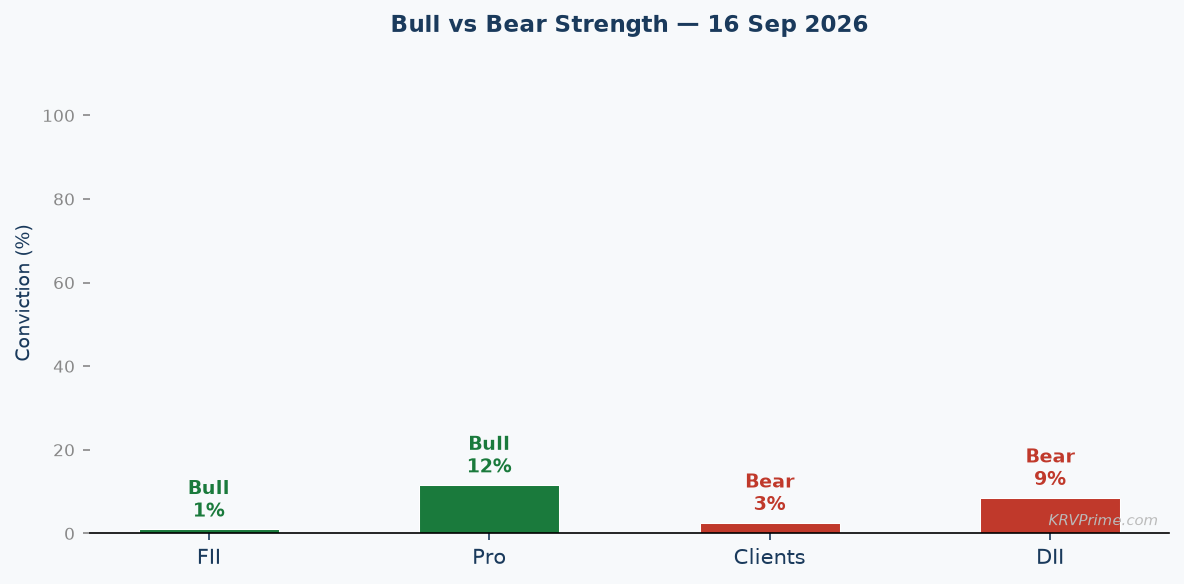
FII Strongly Bearish 80% ▼▼ | Pro Aggressively Bullish 75% ▲▲ | Client Cautiously Bullish / Hedged 55% ▲ | DII Mildly Bearish / De-risking 55% ▼ |
Conclusion — Market Outlook for Tomorrow (17 Sep 2026)
The collective participant positioning on 16 Sep 2026 paints a market in active but unresolved tug-of-war. FIIs maintain a 7.08:1 short-to-long gross futures ratio at a net of -288,103 — one of the most dominant institutional short books in recent sessions — while Pros have simultaneously executed a dramatic bullish repositioning, nearly eliminating their -125,118 net short call position and flipping to net short puts at -19,854, all while adding futures longs to +42,255. Clients hold the largest structural long in futures at +233,302 but are layering on 2,259,579 put longs as a hedge — a classic collar trade at scale. DIIs are the most passive participant, gradually de-risking from +13,722 to +12,546 net long futures while high-volume unwinding of put longs confirms they see near-term downside risk as receding. The market is structurally underpinned by Client and Pro futures longs, but capped by FII's enormous short book — neither side has yet delivered a decisive blow.
The Overall PCR surging from 0.83 to 0.95 (+14.20%) in a single session is a materially bullish development for near-term sentiment — PCR approaching and above 1.00 historically signals put-heavy positioning that can fuel short-covering rallies as sellers exhaust. However, the driver of this PCR surge is critically nuanced: put OI expanded by +1,636,821 contracts (+23.47%), and a meaningful portion of this is put buying (clients adding +609,670 put longs) rather than pure put selling — meaning the PCR recovery is partly a fear hedge, not simply bullish put writing. India VIX declining from 13.43 to 13.17 (-1.97%) confirms the market is not pricing in a volatility event imminently, and low VIX supports option sellers (including FII put writers at the lower end of the range). The OI support at 23,000 PE and resistance at 24,000 CE define the near-term range — Nifty at 23,217.60 is above the support floor but well below the CE resistance wall, leaving nearly 800 points of upside range before the supply zone.
The bull case hinges on FII short-covering accelerating — if their futures net improves decisively above -280,000 alongside Pro call longs continuing to build, a squeeze toward 24,000 CE resistance is plausible. The bear case materialises if PCR fails to sustain above 0.90 tomorrow, VIX reverses back above 13.50, and Client put longs are monetised aggressively on a down move — that combination would signal the PCR recovery was a false dawn and the 23,000 PE support is at risk of being tested.
Scenario 1 — Bull case:
If FII futures net improves above -280,000 (from today's -288,103) signalling short-covering, and the Overall PCR sustains above 1.00 tomorrow, and VIX continues declining below 13.00, the conditions for a squeeze toward 24,000 CE OI resistance are in place. Pro's near-zero net call position (-13,701) turning net long would further confirm bullish momentum is building from the smart-money side. Client put-long monetisation (a drop in Client put OI) would add fuel to any upside move.
Scenario 2 — Bear case:
If FII futures net deteriorates back below -291,052 (pressing new shorts), Overall PCR falls back below 0.90, and VIX spikes above 13.50, the bear case takes control. Client put longs of 2,259,579 contracts provide the ammunition for a sharp down move if monetised — a break below 23,000 PE OI support would trigger systematic put-long liquidation that could accelerate selling. DII high-volume put-long unwinding continuing for a second session would remove the institutional floor and expose the market to further downside pressure.
Key Resistance 24,000 CE (Nifty OI resistance) — Clients are aggressively writing calls here (2,713,125 short calls, +315,938 today), and FIIs maintain a large net short call position of -288,206. Combined call-writing pressure from both participants creates a structural supply wall at 24,000 that will require significant FII short-covering or a macro catalyst to break. | Key Support 23,000 PE (Nifty OI support) — Clients hold 2,259,579 put longs (added +609,670 today) and FIIs hold 1,136,529 put longs, creating massive demand for protection at and below this level. Pros are simultaneously short puts at lower strikes, suggesting they expect 23,000 to hold. A breach of 23,000 would trigger large-scale put-long monetisation and accelerated selling. | Trigger to Watch Overall PCR crossing and sustaining above 1.00 in tomorrow's session would be the single most important confirming trigger for a bullish resolution — it would signal put OI has overtaken call OI, historically associated with market bottoms and short-covering rallies. Alternatively, a reversal of PCR back below 0.88 would confirm today's recovery was not durable and the bearish FII short book retains the upper hand. |