
Index Analysis
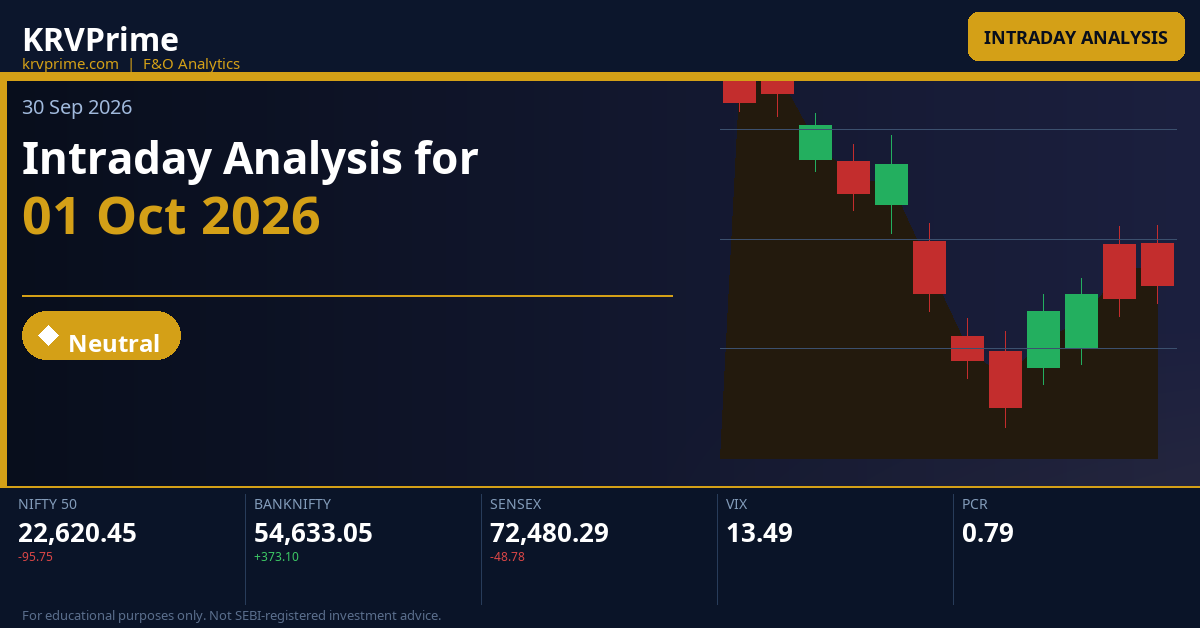
Intraday Analysis for 01 Oct 2026
KRV Prime02 October 202649 min
Educational/Derived AnalysisSource: KRV Prime Market Insights (End-of-Day)As of 02 Oct 2026, 06:08 AM IST
Intraday Analysis for 01 Oct 2026
Markets enter October 2026 on a mixed note — NIFTY closing at **22,620.45** (-0.42%) and SENSEX at **72,480.29** (-0.07%) reflect mild selling pressure, while BANKNIFTY outperformed with a **+0.69%** gain to **54,633.05**, signalling selective banking sector strength. India VIX data is unavailable for this session, which warrants caution — traders should assume moderate implied volatility given the NIFTY weekly straddle pricing **278.3 points** of expected movement (±1.23% from ATM 22,600), and position size accordingly. The divergence between NIFTY's mild weakness and BANKNIFTY's strength suggests a rotation dynamic rather than broad market conviction, making CPR-level reactions and OI wall tests the key intraday decision points for 01 Oct 2026.
Key Market Signals — Intraday Setup
All three indices are trading decisively **below their respective Weekly CPR bands** (NIFTY Weekly P=23,216.82, BANKNIFTY Weekly P=55,864.23, SENSEX Weekly P=74,137.48), and also well below their Monthly CPR midpoints — this multi-timeframe CPR alignment is structurally bearish and implies that any intraday rally should be treated as a selling opportunity unless accompanied by sustained volume and a reclaim of the Daily CPR band. BANKNIFTY's Ascending Narrow CPR for 01 Oct is the standout anomaly — its trending structure conflicts with the broader index weakness, making **54,640–54,655** the most critical intraday battleground across all three indices.
Deep Technical Analysis & Levels
NIFTY
Outside — Wide (0.24%)
◆ Neutral
Market Structure Sideways or range-bound | Straddle ATM 22,600 weekly straddle = **278.3 points** (Call 159.8 + Put 118.5), implying an expected intraday move of approximately ±**278 points** from ATM, giving a range of roughly **22,322 to 22,878** — this range sits neatly between OI-S at 22,000 and OI-R at 23,000, confirming the market expects a contained session within established OI walls. | Max Pain NIFTY Weekly Max Pain = **22,700** (expiry 06-Oct-2026) — price is currently **79.55 points below** Max Pain at 22,620.45, which creates a gravitational pull upward toward 22,700 as option sellers (typically large institutions) will defend this level through the week; however, Monthly Max Pain at **23,400** remains a distant target and is not relevant for tomorrow's intraday session. |
Tomorrow's Complete Level Map
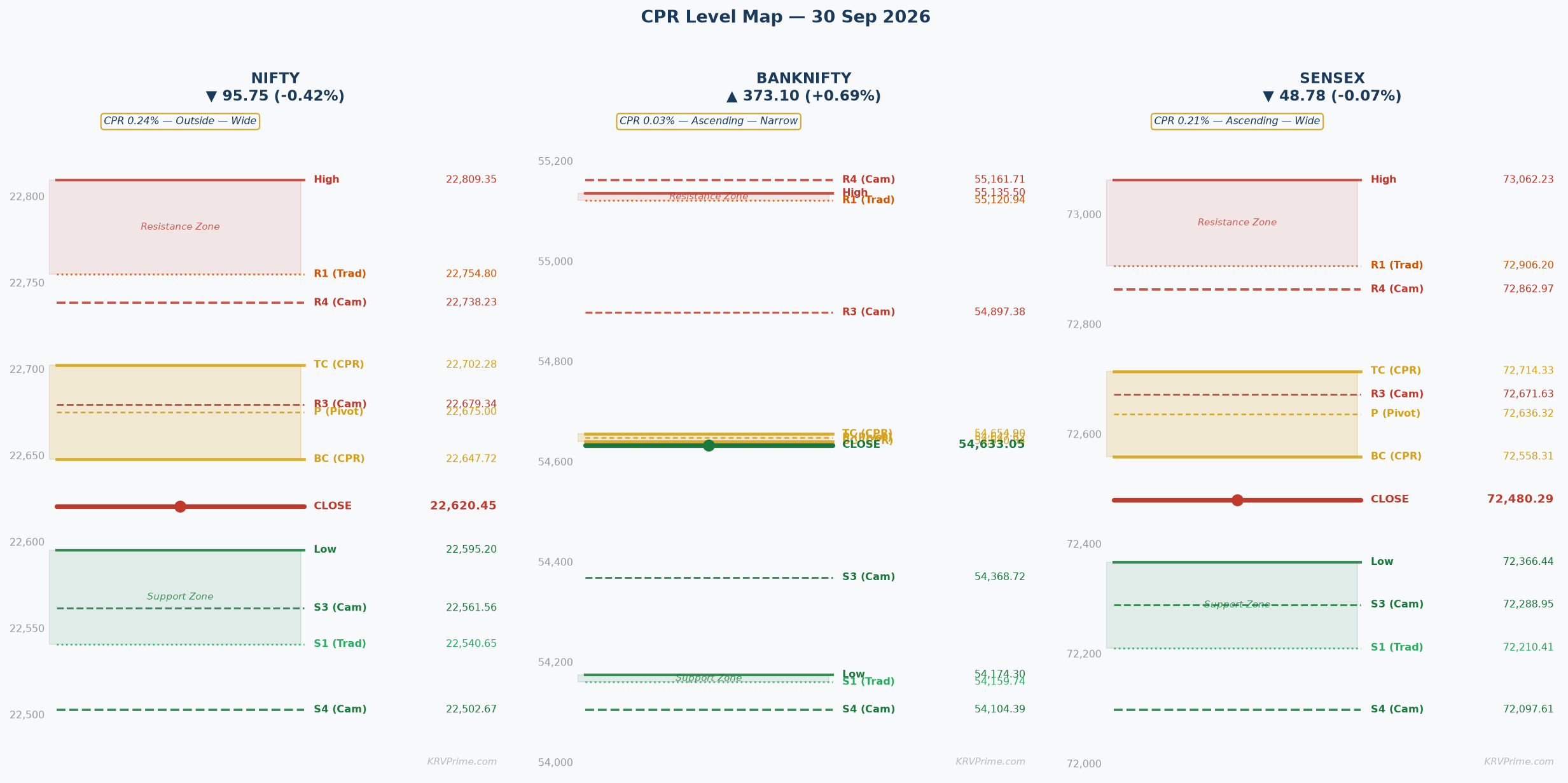
OI-R: 23,000 R3: 22,968.95 H6: 22,834.84 H5: 22,807.01 R2: 22,889.15 H4 ▶: 22,738.23 R1: 22,754.80 PDH: 22,809.35 H3 ↩: 22,679.34
TC: 22,702.28 P: 22,675 BC: 22,647.72
L3 ↩: 22,561.56 PDL: 22,595.20 S1: 22,540.65 L4 ▶: 22,502.67 S2: 22,460.85 L5: 22,433.89 L6: 22,406.06 S3: 22,326.50 OI-S: 22,000
↩ = Camarilla reversal point | ▶ = Camarilla breakout/breakdown trigger | OI-R/OI-S = Options wall (CE/PE max OI)
▲ Higher Open (Gap Up) — Open > Prev Close
◆ Neutral
Open lands: Outside Wide CPR engulfs yesterday's range — prev close at 22,620.45 sits inside the wide CPR band (BC=22,647.72 to TC=22,702.28). A gap-up open will push price into the interior of the CPR band (above BC=22,647.72 and potentially testing TC=22,702.28) or marginally above TC if the gap is significant. Since the CPR is Outside-Wide and prev_close is just below BC, even a minor gap up lifts price into the CPR interior — the band acts as an immediate decision zone rather than a clean launch pad.
CPR role: Decision zone and overhead resistance — the wide CPR band (22,647.72 to 22,702.28) absorbs gap-up energy and forces a directional decision; price must close two consecutive 30-min candles above TC=22,702.28 to confirm bullish momentum given the Wide width rule.
Minor Gap (0.05–0.25%) — Structure Dominant
A minor gap up of 0.05–0.25% from 22,620.45 would place the open approximately in the range of **22,631 to 22,676** — squarely inside the Wide CPR band between BC=22,647.72 and P=22,675, or at most touching P. The Outside-Wide CPR structure means the entire band functions as a compression zone absorbing this small gap, and the structural bias remains sideways with no decisive directional lean from the gap alone — the Wide confirmation rule demands two 30-min closes above TC=22,702.28 before any bullish bias is trusted. First resistance above is the Camarilla H3 at **22,679.34** (nearly coincident with P=22,675), followed by H4=22,738.23 and R1=22,754.80 — these cluster between 22,675 and 22,755 and represent the first meaningful supply zone where scalpers should take partial profits on any long initiated at the open.
Significant Gap (0.25–0.5%) — Balanced
A significant gap up of 0.25–0.5% from 22,620.45 would place the open in the range of **22,677 to 22,734** — above P=22,675 and potentially above H3=22,679.34, testing TC=22,702.28 or breaching it toward H4=22,738.23. This opens directly into the most critical resistance cluster of the day: TC at **22,702.28**, Camarilla H3 at **22,679.34**, and H4 at **22,738.23** — a gap into this zone without prior acceptance creates immediate gap-fill risk as sellers positioned at these levels defend. Delta-hedging flow from options market makers would also create selling pressure near TC=22,702.28 as the move approaches the upper bound of the wide CPR band, making a two-30-min-close confirmation rule above TC absolutely mandatory before initiating fresh longs targeting R1=22,754.80.
Large Gap (>0.5%) — Gap Direction Dominant
A large gap up of greater than 0.5% from 22,620.45 would push the open above **22,733**, potentially approaching PDH=22,809.35, H5=22,807.01, or even H6=22,834.84 — these levels form a powerful triple-resistance zone at the top of the daily Camarilla range. Opening above PDH=22,809.35 with a large gap would be a high-risk scenario for fresh longs as price would be stretching toward OI-R=23,000 while the weekly straddle only prices **278.3 points** of movement — a large gap itself would consume much of that expected range, leaving little reward-to-risk for upside continuation. Abort/fade level is a candle rejection below PDH=22,809.35 within the first 30 minutes, with a gap-fill target back toward TC=22,702.28 and then P=22,675; genuine breakout above PDH=22,809.35 with two 30-min closes targets R2=22,889.15 and then the OI-R wall at **23,000**, but this scenario requires exceptional global cues given NIFTY's sideways market structure.
|
▲ Upside Path → OI-R Confirmed break above TC=**22,702.28** (two 30-min closes) targets Camarilla H3=**22,679.34** (which is actually below TC — note this is a mean-reversion reference; the true upside sequence is TC→H4→R1→H5→OI-R): H4=**22,738.23** is the first meaningful breakout confirmation level, followed by R1=**22,754.80** where partial profits should be booked (Wide rule: first partial at first Traditional target). Continuation above R1=22,754.80 targets H5=**22,807.01** and PDH=**22,809.35** as the next cluster, and any sustained trade above PDH would open the path toward R2=**22,889.15** and ultimately the OI-R wall at **23,000** — though the weekly straddle range of 278.3 points makes 23,000 an end-of-week target rather than a single-session expectation. |
▼ Downside Path → OI-S Failure to sustain above TC=**22,702.28** after a gap-up open shifts price back toward P=**22,675** and then BC=**22,647.72** — a close below BC on a 30-min basis confirms the Wide CPR is acting as overhead resistance and invalidates the gap-up bullish thesis. From BC=22,647.72, the path turns bearish toward L3=**22,561.56** (Camarilla mean-reversion support, first downside stall), then L4=**22,502.67** (breakdown trigger below which stops accelerate), and finally S1=**22,540.65** (Traditional first support); OI-S at **22,000** is the ultimate floor but requires sustained bear pressure over multiple sessions to test. |
| 🔴 OI-R: OI-R at **23,000** is the dominant CE writing wall for the NIFTY Weekly series (expiry 06-Oct-2026) — large call writers have accumulated maximum open interest here, meaning every 1-point rise above 23,000 forces market makers to buy futures for delta hedging, but below 23,000 their negative delta creates structural selling pressure that keeps the ceiling intact in the near term. In a gap-up scenario, 23,000 should be treated as an absolute upside ceiling for intraday traders — the straddle pricing of only 278.3 points from ATM 22,600 means the market is only pricing a move to approximately 22,878 on the upside, well short of 23,000, making OI-R a fade-not-chase zone for the session. | 🟢 OI-S: OI-S at **22,000** represents the dominant PE writing base for the NIFTY Weekly series — in a gap-up scenario, this level is highly unlikely to be tested and is effectively irrelevant for intraday risk management on the upside. However, if a gap-up turns into a dramatic reversal (which is low probability given straddle pricing), a sustained break below L4=22,502.67 and S2=22,460.85 would begin to make OI-S at 22,000 a medium-term target; for tomorrow's session, use OI-S only as the absolute stop-loss reference for overnight positions and not as an active intraday target. |
⚡ Key Trigger: The primary trigger for the gap-up scenario is **two consecutive 30-min candles closing above TC=22,702.28** — as mandated by the Wide CPR confirmation rule — because TC represents the upper boundary of the Outside-Wide CPR band and acts as the structural fulcrum separating CPR interior noise from genuine bullish momentum. A sustained close above TC=22,702.28 shifts the band's role from decision zone to support, opening the path to H4=22,738.23 and R1=22,754.80; conversely, rejection at TC=22,702.28 and a return below P=22,675 confirms the band is capping price and triggers a fade setup targeting L3=22,561.56.
▼ Lower Open (Gap Down) — Open < Prev Close
▼ Bearish
Open lands: An Outside-Wide CPR with prev_close=22,620.45 sitting just below BC=22,647.72 means a gap-down open pushes price further below BC — into territory below the entire CPR band. The open would land below BC=22,647.72, potentially testing L3=22,561.56 directly if the gap is significant, or hovering between PDL=22,595.20 and L3=22,561.56 for a minor gap. The CPR band (22,647.72 to 22,702.28) immediately becomes overhead resistance above the open.
CPR role: Overhead resistance — the entire Wide CPR band (BC=22,647.72 to TC=22,702.28) sits above the gap-down open and acts as a lid; price must reclaim BC=22,647.72 and then TC=22,702.28 with two 30-min closes to neutralise the bearish opening structure.
Minor Gap (0.05–0.25%) — Structure Dominant
A minor gap down of 0.05–0.25% from 22,620.45 places the open in the range of **22,564 to 22,609** — below PDL=22,595.20 and dangerously close to Camarilla L3=**22,561.56**, which is the first mean-reversion support level for the day. Minor gaps in a Wide Outside CPR often fill within 30–60 minutes as the wide band creates magnetic price attraction toward its centre, making BC=**22,647.72** the immediate gap-fill magnet that bulls need to defend. However, if price opens below PDL=22,595.20 and fails to recover above it within the first 30-min candle, the PDL becomes a ceiling, and L3=22,561.56 becomes the primary downside target for the morning session.
Significant Gap (0.25–0.5%) — Balanced
A significant gap down of 0.25–0.5% from 22,620.45 places the open in the range of **22,507 to 22,564** — at or below Camarilla L3=**22,561.56** and within striking distance of L4=**22,502.67**, which is the critical breakdown trigger level. Opening at or below L3=22,561.56 in a significant gap is a high-conviction bearish signal under the Outside-Wide CPR framework — the 30-min reclaim rule applies, meaning price must close back above L3=22,561.56 within 30 minutes to suggest a gap-fill recovery attempt toward BC=22,647.72; failure to do so confirms resumption of the downtrend targeting L4=22,502.67 and then S2=22,460.85. PUT writing activity at OI-S=22,000 will begin to compress delta hedging flows, and L4=22,502.67 becomes a critical support where institutional PE buyers may step in — a 30-min close below L4 accelerates the move toward L5=**22,433.89** and S2=**22,460.85**.
Large Gap (>0.5%) — Gap Direction Dominant
A large gap down of greater than 0.5% from 22,620.45 places the open below **22,507**, potentially testing L4=**22,502.67** or even L5=**22,433.89** at the open — this is a panic/capitulation scenario where major support levels are breached instantly. In such a scenario, the weekly straddle pricing of 278.3 points would be rapidly consumed on the downside (target zone 22,322 from ATM 22,600 minus straddle), aligning with S3=**22,326.50** as the ultimate intraday target; VIX would likely spike sharply and PUT buyers would monetise aggressively, making any recovery attempt highly volatile and tradeable only via defined-risk long setups. Recovery target on a bounce would be L4=22,502.67 as immediate resistance, then L3=22,561.56, and then BC=22,647.72 as the wider recovery milestone; abort level for any recovery long is a 15-min close below L5=**22,433.89** which opens the path to L6=**22,406.06** and S3=22,326.50.
|
▲ Upside Path → OI-R Recovery path: BC=**22,647.72** → P=**22,675** → TC=**22,702.28** → H3=**22,679.34** (note H3 is below TC, so upside sequence is TC→H4=**22,738.23**→R1=**22,754.80**→PDH=**22,809.35**→OI-R=**23,000**); two consecutive 30-min closes above each level confirm genuine recovery momentum rather than a dead-cat bounce within the Wide CPR band. Volume must be above average on the reclaim of BC=22,647.72 to confirm institutional buying rather than low-conviction retail short-covering. |
▼ Downside Path → OI-S Primary bear path: L3=**22,561.56** (first stall and mean-reversion support) → L4=**22,502.67** (breakdown trigger, retail stop-losses cluster below here and accelerate the move) → S1=**22,540.65** (Traditional support, partial cover for bears) → L5=**22,433.89** → S2=**22,460.85** → L6=**22,406.06** → S3=**22,326.50** → OI-S=**22,000**; the sequence from L4 downward typically accelerates as retail stops hit and delta-hedging futures selling kicks in from PUT writers covering their positions. |
| 🔴 OI-R: OI-R at **23,000** in a gap-down scenario is a distant and irrelevant upside ceiling — shorts defending this level have no pressure in a bear session, and the CE writing wall only becomes relevant if price stages a massive recovery of more than 380 points from near 22,620 base. The practical implication for gap-down traders is that CE writers at 23,000 are not adding gamma pressure to tomorrow's session, and the bear move will not encounter meaningful options-driven resistance until the Traditional levels at R1=22,754.80 and R2=22,889.15 on any recovery attempt. | 🟢 OI-S: OI-S at **22,000** is the primary downside target and PUT monetisation zone — in a significant or large gap-down scenario, institutional PUT holders who accumulated positions at this strike will begin delta-hedging by selling futures as NIFTY approaches the 22,000 zone, creating a self-reinforcing bear pressure. However, OI-S also represents maximum PE writing accumulation, meaning a large number of option sellers (who collected premium by selling 22,000 PUTs) have a strong incentive to defend this level aggressively — making the 22,000 zone a high-volatility battleground where sharp reversals can occur if NIFTY approaches it intraday. |
⚡ Key Trigger: The key trigger in the gap-down scenario is **failure to reclaim BC=22,647.72 within two 30-minute candles from the open** — this confirms the Wide Outside CPR band has flipped to overhead resistance and the bearish structure dominates the session. The bull trigger is a 30-min close above BC=22,647.72 followed by a second 30-min close, which opens a recovery path toward P=22,675 and then TC=22,702.28; the bear trigger is confirmed when price cannot sustain above PDL=22,595.20 and breaks below L3=22,561.56 on a 30-min close, signalling fresh short positions targeting L4=22,502.67.
◆ Near Flat Open — Open ≈ Prev Close (±0.05%)
◆ Neutral
Open lands: A ±0.05% flat open from 22,620.45 places the open in the narrow range of **22,609 to 22,631** — below BC=22,647.72, meaning price opens below the entire Outside-Wide CPR band. This is a critical structural position: the wide CPR (22,647.72 to 22,702.28) is entirely above the open, functioning as overhead resistance, while the close below BC reflects the continuation of yesterday's closing weakness.
CPR role: Overhead resistance and decision zone — the Wide CPR band (BC=22,647.72 to TC=22,702.28) acts as a ceiling above the flat open; a reclaim of BC initiates a potential recovery, while continued rejection below BC reinforces the bearish structure from yesterday's close.
Near Flat (±0.05%)
A flat open near 22,620.45 inside an Outside-Wide CPR framework creates one of the most information-rich setups of all — the first 15-minute candle (and certainly the first two 30-minute candles under the Wide rule) IS the trade, because the level at which price stalls or accelerates within the CPR band reveals institutional intent. The specific CPR values of BC=**22,647.72** and TC=**22,702.28** define the daily battleground: a sustained two-30-min-close above BC=22,647.72 signals that buyers are absorbing yesterday's weakness and targeting the Max Pain gravitational pull toward **22,700** (essentially TC), while a rejection at BC and a 30-min close below PDL=**22,595.20** confirms bears are in control targeting L3=**22,561.56**. Although this CPR is Wide (0.24%) rather than Narrow, the fact that prev_close=22,620.45 is only 27 points below BC means the CPR band is acting like a compression lid — a break in either direction will be decisive, and the Outside-Wide structure suggests that once price exits the wide band with two 30-min confirms, it tends to reach the first Traditional target (R1=22,754.80 on the upside or S1=22,540.65 on the downside) before encountering meaningful friction. Both bull trigger (two 30-min closes above TC=**22,702.28**, then target H4=22,738.23 and R1=22,754.80) and bear trigger (two 30-min closes below PDL=**22,595.20** OR L3=**22,561.56**, then target L4=22,502.67 and S2=22,460.85) must be waited for with discipline — premature entries inside the wide band between 22,561.56 and 22,702.28 are low-probability choppy trades unsuitable for intraday F&O.
|
▲ Upside Path → OI-R BC=**22,647.72** (first reclaim target) → P=**22,675** (midpoint, partial profit for scalpers) → TC=**22,702.28** (full CPR reclaim, max pain magnet at **22,700**) → H4=**22,738.23** (Camarilla breakout trigger, first momentum confirmation) → R1=**22,754.80** (Traditional first target, Wide rule: book partial here) → H5=**22,807.01** and PDH=**22,809.35** (second target cluster) → OI-R=**23,000** (absolute ceiling, not a single-session target given straddle pricing of 278.3 points). |
▼ Downside Path → OI-S Below PDL=**22,595.20** (yesterday's low, first bear confirmation) → L3=**22,561.56** (Camarilla mean-reversion support, first stall) → S1=**22,540.65** (Traditional first support, partial cover for bears here) → L4=**22,502.67** (Camarilla breakdown trigger, stop-loss cascade zone) → S2=**22,460.85** → L5=**22,433.89** → L6=**22,406.06** → S3=**22,326.50** → OI-S=**22,000** (ultimate floor, PE wall). |
| 🔴 OI-R: OI-R at **23,000** in the flat-open scenario acts as the weekly ceiling that option sellers are defending with maximum conviction — CE writers at this strike have no pressure to close below 23,000 and will continue to cap any intraday rally by supplying futures delta; the practical result is that even if NIFTY surges through R1=22,754.80 and PDH=22,809.35, the speed of the rally will slow dramatically as gamma pressure from 23,000 CE writers increases. For flat-open traders, 23,000 should be noted as the final profit target on any multi-day swing, not as a same-day objective, given the straddle implies a maximum upside of approximately 22,878. | 🟢 OI-S: OI-S at **22,000** in the flat-open scenario represents the PE base that PUT writers are defending — this level is approximately 620 points below the current close, making it an intermediate-term support anchor rather than an active intraday target. The existence of massive PE open interest at 22,000 provides a psychological and gamma-driven floor, meaning any sustained approach toward 22,000 over multiple sessions would trigger aggressive PE writing (premium collection), which in turn cushions the downside — for tomorrow's flat open, OI-S=22,000 is relevant only as the backstop reference level for sizing intraday shorts (do not hold naked shorts overnight if NIFTY is near L4=22,502.67, as OI-S support could trigger sharp recoveries). |
⚡ Key Trigger: The dual trigger structure for the flat open is: **Bull — two consecutive 30-min candles closing above TC=22,702.28** (confirming the CPR band has been reclaimed as support, lifting price toward the Max Pain magnet at 22,700 and then H4=22,738.23 and R1=22,754.80); **Bear — two consecutive 30-min candles closing below BC=22,647.72 AND below PDL=22,595.20** (confirming the CPR band remains overhead resistance and price is resuming yesterday's selling, targeting L3=22,561.56 and L4=22,502.67). TC=22,702.28 is the structural fulcrum because it represents the upper boundary of the Outside-Wide band — above it, sellers who were comfortable inside the band are forced to cover, creating a squeeze; below BC=22,647.72, buyers who hoped for a recovery are stopped out, accelerating the downside.
BANKNIFTY
Ascending — Narrow (0.03%)
▲ Bullish
Market Structure Trending (up or down trend) | Straddle ATM 54,600 monthly straddle = **1,773.5 points** (Call 1,073.5 + Put 700.0), implying a monthly expected move of approximately ±**1,773.5 points** from ATM — for intraday purposes, the daily expected move is roughly ±**177–250 points**, making the intraday range approximately **54,350 to 54,850** as the base case, well-supported by PDL=54,174.30 and PDH=55,135.50 as the outer daily range. | Max Pain BANKNIFTY Monthly Max Pain = **56,000** (expiry 27-Oct-2026) — price is currently **1,366.95 points below** Max Pain at 54,633.05, creating a powerful multi-week gravitational pull toward 56,000 and strongly supporting the bullish Ascending Narrow CPR structure; this Max Pain gap of 2.5% is significant and implies institutional PUT writers will defend lower levels aggressively to protect premium collected at 56,000 Max Pain. |
Tomorrow's Complete Level Map
OI-R: 58,000 R3: 56,082.14 H6: 55,602.39 H5: 55,470.45 R2: 55,608.82 H4 ▶: 55,161.71 R1: 55,120.94 PDH: 55,135.50 H3 ↩: 54,897.38
TC: 54,654.90 P: 54,647.62 BC: 54,640.34
L3 ↩: 54,368.72 PDL: 54,174.30 S1: 54,159.74 L4 ▶: 54,104.39 S2: 53,686.42 L5: 53,795.65 L6: 53,663.71 S3: 53,198.54 OI-S: 54,000
↩ = Camarilla reversal point | ▶ = Camarilla breakout/breakdown trigger | OI-R/OI-S = Options wall (CE/PE max OI)
▲ Higher Open (Gap Up) — Open > Prev Close
▲ Bullish
Open lands: Ascending Narrow CPR with BC=54,640.34 above prev_TC (the previous session's TC was below today's BC, confirming the ascending structure) — a gap-up open from 54,633.05 places price directly inside or above the ultra-narrow CPR band (BC=54,640.34 to TC=54,654.90, width only 14.56 points). Even the smallest gap up places the open inside or above TC=54,654.90, meaning price opens in bullish territory with the entire Narrow Ascending CPR acting as a support base below.
CPR role: Launch pad and immediate support — the Narrow Ascending CPR band (54,640.34 to 54,654.90) acts as a high-probability launch pad in a gap-up scenario; the Narrow confirmation rule requires only the first 15-min candle direction to confirm, making this the most actionable CPR setup of all three indices today.
Minor Gap (0.05–0.25%) — Structure Dominant
A minor gap up of 0.05–0.25% from 54,633.05 places the open in the range of **54,660 to 54,769** — above TC=**54,654.90**, confirming the Ascending Narrow CPR is fully acting as support beneath the open. The Ascending Narrow CPR structure is the most bullish CPR configuration — narrow width means energy compression with a high probability of a trending day, and ascending structure confirms the multi-session uptrend; the 15-min confirmation rule applies, meaning the first 15-min candle direction is the trade signal, and a close above TC=54,654.90 on the first 15-min candle (which is already the case if we open above TC) confirms an immediate long setup. First target is Camarilla H3=**54,897.38** (the mean-reversion upper reference), followed by PDH=**55,135.50** and R1=**55,120.94** as a tightly-clustered resistance zone — partial profits at H3=54,897.38 with trail to H4=**55,161.71**.
Significant Gap (0.25–0.5%) — Balanced
A significant gap up of 0.25–0.5% from 54,633.05 places the open in the range of **54,769 to 54,906** — approaching or breaching Camarilla H3=**54,897.38** at the open, which is an aggressive gap into the first Camarilla resistance zone. This opens a gap-fill risk scenario where shorts at H3=54,897.38 could push price back toward TC=54,654.90 in the first 30 minutes — the 15-min rule means if the first 15-min candle closes below H3=54,897.38 (after opening above it), wait for a retest of TC=54,654.90 as support before entering long. If price sustains above H3=54,897.38 on the first 15-min candle, the path opens directly to PDH=**55,135.50** and R1=**55,120.94**, where delta-hedging pressure from CALL writers will increase significantly — book partial profits at R1=55,120.94.
Large Gap (>0.5%) — Gap Direction Dominant
A large gap up of greater than 0.5% from 54,633.05 places the open above **54,906**, potentially above PDH=**55,135.50** or testing H4=**55,161.71** at the open — this is a momentum breakout scenario where the Ascending Narrow CPR's trending energy is being fully expressed. Opening above PDH=55,135.50 with a large gap shifts the session's risk to mean-reversion sellers at H4=**55,161.71** and R1=**55,120.94** (the two levels are separated by only 40.77 points, creating a powerful confluence resistance zone) — the first 15-min candle must close above H4=55,161.71 to confirm continuation toward H5=**55,470.45** and H6=**55,602.39**. If the large gap fails and price retreats below PDH=55,135.50 on the first 15-min candle, the abort is a fade back to H3=**54,897.38** and then TC=**54,654.90** — straddle pricing of 1,773.5 monthly points supports a larger intraday range for BANKNIFTY versus NIFTY, making these extended targets achievable.
|
▲ Upside Path → OI-R TC=**54,654.90** (support base, confirmed hold) → H3=**54,897.38** (Camarilla upper mean-reversion zone, first partial profit per Narrow rule) → R1=**55,120.94** and PDH=**55,135.50** (tightly clustered, second partial profit) → H4=**55,161.71** (Camarilla breakout trigger above PDH) → H5=**55,470.45** (Camarilla upside target zone) → H6=**55,602.39** → R2=**55,608.82** (Traditional second target) → OI-R=**58,000** (absolute ceiling, not a single-day target but the directional magnet for the month given Max Pain at 56,000). |
▼ Downside Path → OI-S Rejection at TC=**54,654.90** (gap fill completed, CPR support broken) → P=**54,647.62** → BC=**54,640.34** (Narrow CPR base, last bull defence) → L3=**54,368.72** (Camarilla downside mean-reversion reference, significant support given OI-S=54,000 proximity) → PDL=**54,174.30** and S1=**54,159.74** (tightly clustered daily low support, critical bear/bull decision zone) → L4=**54,104.39** (Camarilla breakdown trigger) → OI-S=**54,000** (PE writing wall, primary downside floor). |
| 🔴 OI-R: OI-R at **58,000** is the dominant CE writing wall for BANKNIFTY Monthly (expiry 27-Oct-2026) — this is 3,366.95 points above yesterday's close, making it a multi-week directional target rather than an intraday concern; however, its existence confirms that CE writers are comfortable selling calls above 58,000 and will not generate downward gamma pressure until price approaches that zone. For tomorrow's gap-up session, OI-R=58,000 is the BULLISH directional anchor that supports intraday long trades — it means the broader options market expects BANKNIFTY to stay below 58,000, providing room for intraday upside without CE writer panic buying. | 🟢 OI-S: OI-S at **54,000** is critically close to current price (only 633 points below close at 54,633.05) and represents the highest PE open interest strike for BANKNIFTY Monthly — this is an active and powerful intraday support level that PUT writers are defending aggressively. In a gap-up scenario, OI-S=54,000 acts as the ultimate downside abort level: any intraday dip that approaches 54,000 should be viewed as a high-conviction buying opportunity aligned with PE writer hedging flows (as they sell futures to delta-hedge, then buy them back at OI-S), making 54,000 to 54,104.39 (L4) a strong institutional demand zone. |
⚡ Key Trigger: The primary trigger for gap-up in BANKNIFTY's Ascending Narrow CPR is the **first 15-min candle close above TC=54,654.90** (Narrow rule) — but since a gap-up already opens above TC, the refined trigger is whether the first 15-min candle HOLDS above TC=54,654.90 without filling the gap down to BC=54,640.34, which confirms the CPR is acting as support and momentum is genuine. A 15-min close above H3=**54,897.38** is the secondary trigger for aggressive positions targeting PDH=55,135.50 and R1=55,120.94; any 15-min close below TC=54,654.90 negates the gap-up bullish thesis and forces re-evaluation at P=54,647.62 and BC=54,640.34.
▼ Lower Open (Gap Down) — Open < Prev Close
↕ Conflicted
Open lands: Ascending Narrow CPR — BC=54,640.34 is above prev_close=54,633.05 (the ascending structure places entire CPR above yesterday's close). A gap-down open from 54,633.05 pushes price further below BC=54,640.34 and below the entire Ascending Narrow CPR band, placing the open below BC in bearish territory relative to the CPR — this is an Ascending CPR Gap Down scenario where the CPR acts as overhead resistance despite being structurally bullish.
CPR role: Overhead resistance and recovery gate — in a gap-down open, the Ascending Narrow CPR (54,640.34 to 54,654.90) becomes immediate overhead resistance; reclaiming BC=54,640.34 within the first 15 minutes is the critical bull trigger, failing which the CPR confirms intraday bearish momentum despite the multi-day ascending trend.
Minor Gap (0.05–0.25%) — Structure Dominant
A minor gap down of 0.05–0.25% from 54,633.05 places the open in the range of **54,506 to 54,606** — below BC=**54,640.34** but above L3=**54,368.72**, with the open potentially near PDL=**54,174.30** area or in the mid-range. Since the Ascending Narrow CPR signals a trending day and the gap is minor, the probability of a fast gap-fill recovery is HIGH — the first 15-min candle closing back above BC=54,640.34 is the bull trigger that confirms the ascending trend is intact and the gap was a false break. If the first 15-min candle closes below the open without recovering BC=54,640.34, bears gain control for the session, targeting L3=**54,368.72** first and then S1=**54,159.74** and PDL=**54,174.30** as the next cluster support.
Significant Gap (0.25–0.5%) — Balanced
A significant gap down of 0.25–0.5% from 54,633.05 places the open in the range of **54,360 to 54,497** — at or approaching Camarilla L3=**54,368.72**, which is the mean-reversion downside support zone. This is a critical opening level — L3=54,368.72 represents the first meaningful Camarilla support, and given the OI-S wall at **54,000** only 368 points below L3, the downside is cushioned; the 15-min rule for Narrow CPR means a 15-min close back above L3=54,368.72 followed by reclaim of BC=**54,640.34** defines the bull recovery path, while a 15-min close below L3=54,368.72 signals a trend-day down targeting L4=**54,104.39** and OI-S=**54,000**. PUT writing flows at OI-S=54,000 create a strong gravitational support that makes the bear trade high-risk below L3 — risk-reward favours recovery longs at L3 with a stop below L4=54,104.39.
Large Gap (>0.5%) — Gap Direction Dominant
A large gap down of greater than 0.5% from 54,633.05 places the open below **54,361**, potentially testing L3=**54,368.72**, L4=**54,104.39**, or even approaching S1=**54,159.74** and PDL=**54,174.30** at the open — this is a severe gap that directly challenges the OI-S=**54,000** PE writing wall. A large gap down in an Ascending Narrow CPR context is a high-volatility conflict scenario — the CPR structure signals a trending day, but the direction becomes ambiguous; if price opens near PDL=54,174.30 and holds above OI-S=54,000, the PUT writer defence creates a massive compression and reversal signal, with the first 15-min candle close above PDL=54,174.30 signalling a V-shaped recovery targeting L4=54,104.39 reclaim → L3=54,368.72 → BC=54,640.34. Abort for recovery: any 15-min close below OI-S=**54,000** confirms systemic selling and targets S2=**53,686.42** and L5=**53,795.65**.
|
▲ Upside Path → OI-R BC=**54,640.34** (first recovery target, Narrow rule: 15-min close confirms) → TC=**54,654.90** (full CPR reclaim, trend day bullish confirmation) → H3=**54,897.38** (first Camarilla upside target, partial profit) → R1=**55,120.94** and PDH=**55,135.50** (clustered second target, trail stops) → H4=**55,161.71** → H5=**55,470.45** → OI-R=**58,000** (monthly ceiling). |
▼ Downside Path → OI-S L3=**54,368.72** (mean-reversion support, first stall) → PDL=**54,174.30** and S1=**54,159.74** (critical support cluster, retail stops accumulate here) → L4=**54,104.39** (Camarilla breakdown trigger, below which momentum accelerates sharply) → OI-S=**54,000** (PE writing wall, primary target and potential reversal zone) → L5=**53,795.65** (if OI-S breaks, rare bear extension target) → S2=**53,686.42** → L6=**53,663.71**. |
| 🔴 OI-R: OI-R at **58,000** in a gap-down scenario provides no immediate gamma pressure and is not an active intraday resistance — however, its existence as the Monthly CE writing wall means that the broader market structure remains range-bound below 58,000 and above 54,000, which is relevant context for understanding that today's gap-down is occurring within a well-defined monthly OI corridor. Bears should not expect sustained follow-through below OI-S=54,000 given the CE writing structure at 58,000 implies institutional positioning for a range-trade, not a directional breakdown. | 🟢 OI-S: OI-S at **54,000** is the most critical level in the entire gap-down scenario — it is the dominant PE writing base for BANKNIFTY Monthly and is only 633 points below yesterday's close, making it an imminent intraday test if the gap is significant or large. PUT writers at 54,000 have sold premium expecting BANKNIFTY to stay above 54,000 through October expiry — they will delta-hedge aggressively by buying futures near 54,000, creating a powerful institutional demand zone; for intraday traders, **54,000–54,104.39 (L4)** is the primary support box where long entries with tight stops offer the best risk-reward on a gap-down day. |
⚡ Key Trigger: The gap-down key trigger for BANKNIFTY's Ascending Narrow CPR is **first 15-min candle close back above BC=54,640.34** — this is the bull trigger confirming the ascending trend has reasserted itself and the gap was absorbed by institutional buyers; from here, the day likely becomes a trending up session given the Narrow CPR's trend-day probability. The bear confirmation trigger is **first 15-min candle close below L3=54,368.72** — this negates the ascending structure for the session and signals a rare but powerful trend-day DOWN targeting L4=54,104.39, S1=54,159.74 (clustered with PDL=54,174.30), and ultimately the OI-S wall at **54,000**.
◆ Near Flat Open — Open ≈ Prev Close (±0.05%)
◆ Neutral
Open lands: A ±0.05% flat open from 54,633.05 places the open in the range of **54,606 to 54,660** — straddling the Ascending Narrow CPR band (BC=54,640.34 to TC=54,654.90). The ultra-narrow CPR width of only 14.56 points means the flat open is essentially AT the CPR band's midpoint (P=54,647.62), creating the maximum information scenario for a Narrow CPR trending day — above TC or below BC, even by a few points, determines the entire day's directional bias.
CPR role: Compression launch pad — the Ascending Narrow CPR (BC=54,640.34 to TC=54,654.90) in a flat open creates maximum compression energy; the Narrow CPR with Trending market structure signals that one direction will dominate with high probability, and the 15-min rule determines which direction that is.
Near Flat (±0.05%)
A flat open in BANKNIFTY's Ascending Narrow CPR is the highest-probability trending day setup across all three indices today — the Narrow CPR width of only **0.03%** (14.56 points) creates extreme compression energy that must resolve in one direction, and the Trending market structure classification confirms this is not a range-bound day. The specific CPR values of BC=**54,640.34** and TC=**54,654.90** are separated by only 14.56 points — meaning a flat open near 54,633 places price just below this ultra-narrow band, and the first 15-min candle's close relative to TC=54,654.90 determines the ENTIRE day's direction with high confidence: a close above TC=54,654.90 signals a bullish trending day targeting H3=**54,897.38** and then R1=**55,120.94**, while a close below BC=54,640.34 signals a bearish trending day targeting L3=**54,368.72** and OI-S=**54,000**. The Ascending CPR structure adds a bullish tilt — the ascending nature of the CPR confirms multi-session upward momentum, meaning the bull trigger (above TC) aligns with the multi-day trend, making it the higher-probability outcome; the bear scenario (below BC) would be a trend reversal signal requiring additional confirmation from volume and OI flow. Both triggers must be respected with discipline: bull entry at a 15-min close above TC=**54,654.90** (stop below BC=54,640.34, target H3=54,897.38 partial and R1=55,120.94 final); bear entry at a 15-min close below BC=**54,640.34** (stop above TC=54,654.90, target L3=54,368.72 partial and OI-S=54,000 final).
|
▲ Upside Path → OI-R TC=**54,654.90** (15-min close confirms, launch pad activated) → H3=**54,897.38** (Camarilla upper mean-reversion zone, trail stop to CPR after this; Narrow rule: partial profit here) → R1=**55,120.94** and PDH=**55,135.50** (clustered resistance, second partial profit per Narrow rule) → H4=**55,161.71** (above PDH, Camarilla breakout trigger for genuine momentum continuation) → H5=**55,470.45** (Camarilla upside target zone if H4 breaks) → H6=**55,602.39** and R2=**55,608.82** (final intraday target cluster) → OI-R=**58,000** (monthly Max Pain convergence at 56,000 is the gravitational multi-week target). |
▼ Downside Path → OI-S BC=**54,640.34** (15-min close below confirms bearish trend reversal) → L3=**54,368.72** (Camarilla downside mean-reversion reference, first partial cover for shorts per Narrow rule) → PDL=**54,174.30** and S1=**54,159.74** (tightly clustered critical support, second partial cover) → L4=**54,104.39** (Camarilla breakdown trigger, retail stop-cascade zone) → OI-S=**54,000** (primary downside floor, PE writing wall, high-conviction reversal zone) → L5=**53,795.65** (rare extension if OI-S fails, bears should reduce size below OI-S). |
| 🔴 OI-R: OI-R at **58,000** in the flat-open scenario is the monthly bullish ceiling that paradoxically supports the bull thesis — because CE writers at 58,000 have not yet accumulated stress, the path from current levels (54,633) to 58,000 is open from an options-market perspective, with Max Pain at **56,000** acting as a powerful intermediate magnet. For flat-open intraday traders, OI-R=58,000 is not an active ceiling for tomorrow but rather the directional north star that makes every intraday dip to BC=54,640.34 a potential long entry aligned with the monthly CE writing structure. | 🟢 OI-S: OI-S at **54,000** in the flat-open scenario is the most immediately relevant support level of any index today — it is only 633 points below the open and represents the PE writing wall where institutional sellers of puts will aggressively defend their positions. For flat-open traders, OI-S=54,000 defines the maximum intraday downside for bears: short positions initiated on a 15-min close below BC=54,640.34 should target **L4=54,104.39** and OI-S=**54,000** as final exits, with no expectation of follow-through below 54,000 unless accompanied by extraordinary news flow that forces PE writer capitulation. |
⚡ Key Trigger: The precise dual trigger is: **Bull — first 15-min candle close above TC=54,654.90** (Narrow CPR rule: 15-min confirmation only) with confirmation from above-average volume, signalling the ascending trend is resuming and targeting H3=54,897.38 immediately; **Bear — first 15-min candle close below BC=54,640.34** with sustained sell volume, signalling trend reversal and targeting L3=**54,368.72** and OI-S=**54,000**. TC=54,654.90 is the structural fulcrum because the Narrow Ascending CPR's entire bullish thesis rests on price accepting the band as support — a break below BC=54,640.34 within 15 minutes of the open, in an ascending structure, is a powerful reversal signal that triggers institutional selling as the ascending trend assumption is invalidated.
SENSEX
Ascending — Wide (0.21%)
◆ Neutral
Market Structure Sideways or range-bound | Straddle ATM 72,500 weekly straddle = **515.55 points** (Call 222.4 + Put 293.15), implying an expected weekly move of approximately ±**515.55 points** from ATM — for tomorrow's intraday session, this translates to a probable range of roughly **71,984 to 73,016**, which aligns closely with OI-S=70,000 (distant floor) and OI-R=73,000 (immediately relevant ceiling), confirming that the options market sees **73,000** as the weekly resistance cap for SENSEX. | Max Pain SENSEX Weekly Max Pain = **72,600** (expiry 01-Oct-2026, same-day expiry) — this is a critical detail as today IS the SENSEX weekly expiry; price at 72,480.29 is **119.71 points below** Max Pain=72,600, creating a strong same-day gravitational pull toward 72,600 as option sellers will pin price near Max Pain on expiry day, making 72,600 the primary magnetic target for the opening 30–60 minutes of 01 Oct 2026. |
Tomorrow's Complete Level Map
OI-R: 73,000 R3: 73,601.99 H6: 73,177.17 H5: 73,086.46 R2: 73,332.11 H4 ▶: 72,862.97 R1: 72,906.20 PDH: 73,062.23 H3 ↩: 72,671.63
TC: 72,714.33 P: 72,636.32 BC: 72,558.31
L3 ↩: 72,288.95 PDL: 72,366.44 S1: 72,210.41 L4 ▶: 72,097.61 S2: 71,940.53 L5: 71,874.12 L6: 71,783.41 S3: 71,514.62 OI-S: 70,000
↩ = Camarilla reversal point | ▶ = Camarilla breakout/breakdown trigger | OI-R/OI-S = Options wall (CE/PE max OI)
▲ Higher Open (Gap Up) — Open > Prev Close
▲ Bullish
Open lands: Ascending Wide CPR — BC=72,558.31 is above prev_close=72,480.29 (ascending structure confirmed). A gap-up open from 72,480.29 pushes price toward BC=72,558.31, P=72,636.32, or TC=72,714.33 depending on gap magnitude. For a minor gap-up, the open lands inside the Wide CPR band; for a significant or large gap, the open approaches H3=72,671.63 or TC=72,714.33. The ascending nature means the CPR structure supports the gap direction, but the Wide width (0.21%) requires two 30-min confirms before trusting any directional move.
CPR role: Support and launch pad — the Ascending Wide CPR (72,558.31 to 72,714.33) acts as support in a gap-up scenario, but the Wide width means price must work through the CPR band with two 30-min confirms before H3 and TC can be confirmed as support rather than resistance.
Minor Gap (0.05–0.25%) — Structure Dominant
A minor gap up of 0.05–0.25% from 72,480.29 places the open in the range of **72,516 to 72,661** — inside the Ascending Wide CPR band, between BC=**72,558.31** and H3=**72,671.63**, potentially near P=**72,636.32** or the Max Pain magnet at **72,600**. The SENSEX weekly expiry today (01-Oct-2026) adds a critical overlay: option market makers will actively pin SENSEX near Max Pain=**72,600** through the expiry session, meaning a minor gap-up opening near 72,600 is the HIGHEST probability scenario for expiry-day dynamics, with both CE and PE writers having maximum incentive to keep price in the 72,500–72,700 range through noon. The first upside target from BC=72,558.31 is P=**72,636.32** (Max Pain alignment), then TC=**72,714.33** — two 30-min closes above TC=72,714.33 open the path to H4=**72,862.97** and R1=**72,906.20**, but given expiry-day pinning, this breakout is unlikely unless a macro trigger forces it.
Significant Gap (0.25–0.5%) — Balanced
A significant gap up of 0.25–0.5% from 72,480.29 places the open in the range of **72,661 to 72,842** — above P=**72,636.32** and H3=**72,671.63**, potentially approaching TC=**72,714.33** or even H4=**72,862.97**. Opening above H3=72,671.63 in an Ascending Wide CPR on SENSEX expiry day creates immediate tension between the Max Pain pin at **72,600** (below the open) and the upside momentum from the gap — CE writers at OI-R=**73,000** will begin to create selling pressure as price approaches their strike. Two 30-min closes above TC=**72,714.33** are required before trusting continuation toward H4=**72,862.97** and R1=**72,906.20**; gap-fill risk back to P=72,636.32 and Max Pain=72,600 is real and should be used as the intraday support reference.
Large Gap (>0.5%) — Gap Direction Dominant
A large gap up of greater than 0.5% from 72,480.29 places the open above **72,842**, potentially approaching PDH=**73,062.23**, OI-R=**73,000**, or H5=**73,086.46** — this is an aggressive gap that opens directly into the most critical resistance cluster of the day on SENSEX expiry. OI-R at **73,000** is a massive CE writing wall for SENSEX Weekly (same-day expiry), and opening near or above 73,000 on expiry day creates maximum gamma pressure as CE writers scramble to hedge — this will cause intense selling pressure that caps the gap, making a fade from OI-R=73,000 the highest-probability trade. Two 30-min closes above PDH=**73,062.23** are needed to confirm a genuine breakout (very low probability on expiry day); abort level for any long is a 30-min close below TC=**72,714.33**, targeting gap-fill to Max Pain=**72,600** and P=**72,636.32**.
|
▲ Upside Path → OI-R BC=**72,558.31** (ascending CPR base support) → P=**72,636.32** and Max Pain=**72,600** (expiry pin zone) → TC=**72,714.33** (two 30-min closes required, Wide rule) → H3=**72,671.63** (note: H3 is between BC and TC, so CPR interior; upside sequence above TC is TC→H4→R1) → H4=**72,862.97** (Camarilla breakout trigger, first partial profit) → R1=**72,906.20** (Traditional first target, Wide rule: book partial here) → PDH=**73,062.23** and H5=**73,086.46** (clustered near OI-R=**73,000**) → OI-R=**73,000** (absolute intraday ceiling). |
▼ Downside Path → OI-S Rejection at TC=**72,714.33** (Wide rule: two 30-min closes failure) → P=**72,636.32** → BC=**72,558.31** (ascending support, last bull defence) → L3=**72,288.95** (Camarilla downside mean-reversion reference, first bear target) → PDL=**72,366.44** (between BC and L3, yesterday's low as interim support) → S1=**72,210.41** (Traditional first support) → L4=**72,097.61** (Camarilla breakdown trigger) → S2=**71,940.53** → L5=**71,874.12** → OI-S=**70,000** (distant PUT writing floor). |
| 🔴 OI-R: OI-R at **73,000** is the dominant CE writing wall for SENSEX Weekly (expiry TODAY, 01-Oct-2026) — this is an extreme and critically important resistance level on expiry day, as CE writers at 73,000 have maximum gamma exposure and will sell futures aggressively as SENSEX approaches 73,000 to delta-hedge their short call positions, creating a near-impenetrable ceiling for the session. A gap-up that pushes SENSEX toward 73,000 is the ideal fade setup for experienced traders: sell at/near 73,000 with a tight stop above 73,062 (PDH), targeting Max Pain=72,600 and then P=72,636.32 as the gravity pull closes the gap. | 🟢 OI-S: OI-S at **70,000** is the PE writing base for SENSEX Weekly — in a gap-up scenario, this level is approximately 2,480 points below the open and completely irrelevant for intraday risk management. The straddle pricing of 515.55 points implies a maximum downside to approximately 71,984 from ATM 72,500, well above OI-S=70,000, confirming that PUT writers at 70,000 face no pressure tomorrow and the true functional downside floor is the straddle range bottom near 71,984, not 70,000. |
⚡ Key Trigger: The gap-up key trigger for SENSEX Ascending Wide CPR on expiry day is **two consecutive 30-min candles closing above TC=72,714.33** combined with rejection of the OI-R=73,000 selling pressure — this is the Wide confirmation rule, and on expiry day it is even more critical because Max Pain pinning dynamics can cause false breakouts that reverse within 30 minutes. The secondary trigger is **Max Pain magnetic pull**: if price opens above 72,600 (Max Pain), the first 30 minutes will test whether buyers can maintain above Max Pain or whether expiry pinning drags price back toward 72,600 — a 30-min close above Max Pain=72,600 and above P=**72,636.32** with volume confirms the gap is holding.
▼ Lower Open (Gap Down) — Open < Prev Close
▼ Bearish
Open lands: Ascending Wide CPR — BC=72,558.31 is above prev_close=72,480.29. A gap-down open from 72,480.29 pushes price further below BC=72,558.31, placing the open below the entire Ascending Wide CPR band. The CPR band (72,558.31 to 72,714.33) immediately becomes overhead resistance above the gap-down open. On SENSEX weekly expiry day (01-Oct-2026), a gap-down creates an additional Max Pain dynamic — if price gaps below Max Pain=72,600, the pin toward 72,600 may initially cushion the fall but expiry-day volatility can amplify moves in both directions.
CPR role: Overhead resistance and recovery gate — the Ascending Wide CPR band (BC=72,558.31 to TC=72,714.33) acts as dual resistance above the gap-down open; reclaiming BC=72,558.31 with two 30-min closes is the minimum requirement for the bull recovery thesis, while rejection at BC confirms the bearish continuation.
Minor Gap (0.05–0.25%) — Structure Dominant
A minor gap down of 0.05–0.25% from 72,480.29 places the open in the range of **72,300 to 72,444** — below BC=**72,558.31** and approaching L3=**72,288.95** (the Camarilla downside mean-reversion support) or bracketing PDL=**72,366.44** (yesterday's low). On SENSEX expiry day, a minor gap down below Max Pain=**72,600** triggers put seller hedging — PUT writers who sold 72,500 and 72,000 PUTs will buy futures near the open to delta-hedge, providing a natural cushion and increasing gap-fill probability toward BC=**72,558.31**. If the first 30-min candle reclaims BC=72,558.31, the recovery path to Max Pain=72,600 and P=72,636.32 is high-probability given expiry pinning; failure to reclaim BC on two 30-min candles confirms bears hold control, targeting L3=**72,288.95** and S1=**72,210.41**.
Significant Gap (0.25–0.5%) — Balanced
A significant gap down of 0.25–0.5% from 72,480.29 places the open in the range of **72,118 to 72,299** — approaching or below L3=**72,288.95** and potentially testing L4=**72,097.61** territory. Opening at or below L3=72,288.95 on SENSEX expiry day is a severe gap that immediately tests the Camarilla mean-reversion support and risks triggering retail stop-losses between PDL=**72,366.44** and S1=**72,210.41**. The 30-min reclaim rule applies — a 30-min close above L3=**72,288.95** after the initial dip suggests a recovery attempt toward PDL=72,366.44 and BC=**72,558.31**; sustained trade below L3=72,288.95 for two 30-min candles activates the bearish path with L4=**72,097.61** and S1=**72,210.41** as the next targets.
Large Gap (>0.5%) — Gap Direction Dominant
A large gap down of greater than 0.5% from 72,480.29 places the open below **72,117**, potentially testing L4=**72,097.61** or S2=**71,940.53** at the open — this is a capitulation gap on SENSEX expiry day that would immediately raise volatility and trigger aggressive PUT buying. The SENSEX monthly straddle prices a ±2,126.05 point move, meaning a large gap down of 500+ points would consume a significant portion of monthly implied volatility and trigger straddle seller panic; recovery plays from L4=**72,097.61** with a stop below L5=**71,874.12** targeting L3=**72,288.95** and BC=**72,558.31** are the highest-reward trades in this scenario, leveraging the expiry-day mean-reversion dynamic. Continuation bears should target S2=**71,940.53**, L5=**71,874.12**, L6=**71,783.41**, and S3=**71,514.62** — the OI-S at **70,000** is the theoretical extreme that the straddle (515.55 weekly points from 72,500) mathematically cannot reach this week.
|
▲ Upside Path → OI-R L3=**72,288.95** (first recovery stall / bounce zone) → PDL=**72,366.44** (yesterday's low, interim resistance flipped to support on reclaim) → BC=**72,558.31** (two 30-min close reclaim, Wide rule) → P=**72,636.32** and Max Pain=**72,600** (expiry magnet, key recovery target) → TC=**72,714.33** (full CPR reclaim) → H4=**72,862.97** → R1=**72,906.20** (Wide rule: first Traditional target, partial profit) → OI-R=**73,000** (expiry ceiling). |
▼ Downside Path → OI-S PDL=**72,366.44** (yesterday's low, first bear confirmation below BC) → L3=**72,288.95** (Camarilla mean-reversion support, first stall — retail buying attempts here) → S1=**72,210.41** (Traditional first support, partial cover for bears) → L4=**72,097.61** (Camarilla breakdown trigger, stop-cascade zone — below here momentum accelerates sharply) → S2=**71,940.53** and L5=**71,874.12** (second target cluster) → L6=**71,783.41** → S3=**71,514.62** → OI-S=**70,000** (distant monthly PUT writing floor, not a realistic single-day target). |
| 🔴 OI-R: OI-R at **73,000** on SENSEX expiry day (01-Oct-2026) is the most powerful overhead resistance of any level for this session — CE writers who sold 73,000 calls are near expiry with maximum short gamma, meaning they will furiously sell futures to delta-hedge any approach toward 73,000, making it an impenetrable ceiling in the gap-down scenario (since price is moving away from 73,000, not toward it). In the gap-down context, OI-R=73,000 is only relevant as an abort level for overnight short positions — intraday, it is the ceiling that bears are safe below, and the natural range for the session in a gap-down is 72,000–72,700 based on straddle pricing. | 🟢 OI-S: OI-S at **70,000** is the PE writing base for SENSEX Weekly (expiry today) — in a gap-down scenario, this level represents the strike at which PUT buyers would maximally profit and PUT writers (sellers) face maximum loss; however, it is approximately 2,480 points below the current close and completely unreachable in a single session under normal market conditions. The practical relevance of OI-S=70,000 for the gap-down session is as a psychological reference: PUT writers who sold 70,000 puts are safe regardless of today's move, meaning their delta-hedging flows will NOT support price near current levels — instead, support comes from PUT writers at 72,000, 72,500, and 73,000 strikes who are closer to the money and will actively defend their positions. |
⚡ Key Trigger: The gap-down key trigger for SENSEX Ascending Wide CPR on expiry day is: **Bull recovery — two consecutive 30-min candles closing above BC=72,558.31** (Wide rule), which resets the Max Pain gravity and opens the path to P=72,636.32 and TC=72,714.33; **Bear confirmation — two consecutive 30-min candles closing below L3=72,288.95**, which breaks Camarilla mean-reversion support and confirms a trend-down session targeting S1=72,210.41 and L4=72,097.61. The expiry-day dynamic adds a third trigger: sustained trade at Max Pain=**72,600** level — if price is hovering near 72,600 by 11:00 AM, expiry pinning forces are strong and the bias becomes range-bound 72,500–72,700 for the afternoon.
◆ Near Flat Open — Open ≈ Prev Close (±0.05%)
◆ Neutral
Open lands: A ±0.05% flat open from 72,480.29 places the open in the range of **72,444 to 72,516** — below BC=72,558.31, meaning price opens below the entire Ascending Wide CPR band. On SENSEX expiry day (01-Oct-2026), a flat open below BC=72,558.31 but above Max Pain=72,600 (which is above the open, so Max Pain is also above the flat open) creates a double gravitational pull: the Ascending Wide CPR pulling price toward BC=72,558.31 from below, and the Max Pain at 72,600 exerting an even stronger upward pull given same-day expiry dynamics.
CPR role: Overhead magnetic zone — both the Ascending Wide CPR band (BC=72,558.31 to TC=72,714.33) and the Max Pain=72,600 act as magnets above the flat open, creating a strong upward bias for the first 60 minutes of trading as expiry mechanics pull price toward 72,600; however, the Wide CPR requires two 30-min confirms before genuine breakout can be trusted.
Near Flat (±0.05%)
A flat open on SENSEX expiry day in an Ascending Wide CPR is dominated by a unique and powerful dynamic: **same-day expiry pinning toward Max Pain=72,600** combined with the ascending CPR structure creates an extremely high probability of the first 30–60 minutes seeing price drift upward from the flat open near 72,480 toward BC=**72,558.31** and then Max Pain=**72,600** — this is the most predictable morning movement of the three indices on this setup. The specific CPR values of BC=**72,558.31** and TC=**72,714.33** (Width=0.21%, Wide) mean the band covers 156 points and will require two 30-min candle closes above TC=72,714.33 to confirm genuine bullish momentum beyond the expiry pin — within the band (72,558.31 to 72,714.33), price action is largely driven by expiry mechanics, not technical momentum. The ascending nature of the CPR (BC=72,558.31 above prev_close=72,480.29) confirms the multi-session upward structure and makes BC=72,558.31 the first critical trigger: a two-30-min-close above BC=72,558.31 opens the Max Pain drift to **72,600** and then P=**72,636.32**, while a 30-min close below PDL=**72,366.44** (yesterday's low) after a failed BC reclaim signals genuine selling pressure overcoming both the ascending CPR and the Max Pain pin. Both scenarios have high-quality triggers: Bull trigger — two 30-min closes above BC=**72,558.31** then continuation to Max Pain=72,600 and TC=**72,714.33**, with Wide rule requiring two 30-min closes above TC before targeting H4=**72,862.97** and R1=**72,906.20**; Bear trigger — two 30-min closes below PDL=**72,366.44** signals expiry selling and targets L3=**72,288.95** and S1=**72,210.41**.
|
▲ Upside Path → OI-R BC=**72,558.31** (first reclaim target, two 30-min closes confirm, Wide rule) → Max Pain=**72,600** (expiry gravitational target, high probability on same-day expiry) → P=**72,636.32** (CPR midpoint, scalp partial) → TC=**72,714.33** (full CPR reclaim, two 30-min confirm for extension) → H3=**72,671.63** (note: H3 is inside CPR, between BC and TC; actual upside above TC: H4=**72,862.97**) → H4=**72,862.97** → R1=**72,906.20** (Wide rule: first Traditional target, partial profit) → PDH=**73,062.23** and OI-R=**73,000** (expiry ceiling cluster, do not hold longs into this zone on same-day expiry). |
▼ Downside Path → OI-S PDL=**72,366.44** (two 30-min closes below, bear confirmation above L3) → L3=**72,288.95** (Camarilla mean-reversion support, first partial bear cover) → S1=**72,210.41** (Traditional first support) → L4=**72,097.61** (Camarilla breakdown trigger, Wide rule: trail stops here on extended bear day) → S2=**71,940.53** and L5=**71,874.12** (final intraday target cluster within straddle range of 515.55 points from ATM 72,500) → L6=**71,783.41** → S3=**71,514.62** → OI-S=**70,000** (monthly floor, not a single-day target). |
| 🔴 OI-R: OI-R at **73,000** on SENSEX same-day expiry (01-Oct-2026) is the most powerful and immediately relevant resistance level for the flat-open scenario — CE writers at 73,000 who sold same-day expiry options are at maximum short-gamma and will sell futures aggressively as price approaches 73,000, making it an absolute expiry-day ceiling that will not be breached without extraordinary macro catalyst. For flat-open traders, OI-R=73,000 defines the maximum profit target on any long initiated from the flat open: buy near PDL=72,366.44 or BC=72,558.31, target 73,000 minus a 50-100 point buffer (**72,900–72,950**), and close all longs before OI-R=73,000 on expiry day to avoid being trapped in the CE writer reversal. | 🟢 OI-S: OI-S at **70,000** for SENSEX Weekly (expiry today) is the PUT writing floor that is completely safe from a directional standpoint — no realistic scenario moves SENSEX 2,480 points lower in a single expiry session, making this level irrelevant for intraday risk management but deeply relevant for understanding that PUT writers at 70,000 will collect their entire premium today, confirming that the SENSEX options market perceives 70,000 as an unbreachable weekly floor. For intraday traders in the flat-open scenario, OI-S=70,000 provides the psychological backdrop that no systemic crash is priced for today, which reduces tail-risk fear and supports intraday long setups targeting the Max Pain=72,600 and OI-R=73,000 zones with appropriate position sizing. |
⚡ Key Trigger: The dual expiry-day trigger: **Bull (expiry pin) — two consecutive 30-min candles closing above BC=72,558.31** confirms Max Pain drift is active and targets **72,600** (Max Pain) → P=**72,636.32** → TC=**72,714.33** (after which Wide rule requires two more 30-min closes for extension to H4=72,862.97 and R1=72,906.20); **Bear — two consecutive 30-min candles closing below PDL=72,366.44** (note: the flat open is between 72,444 and 72,516, and PDL=72,366.44 is below that range) signals that selling is overcoming both the ascending CPR and expiry pinning, targeting L3=**72,288.95** first. The structural fulcrum is BC=**72,558.31** because above it, the ascending CPR provides support and Max Pain gravity takes price to 72,600; below it, price is below the entire CPR band and the ascending structure is invalidated for the session, removing the pin protection.
📊 VIX Insight: India VIX data is unavailable for this session — this absence of VIX information requires traders to exercise heightened caution in position sizing and not assume low volatility conditions. Proxy indicators suggest moderate volatility: the NIFTY weekly straddle prices **278.3 points** (±1.23% from ATM 22,600) and SENSEX weekly straddle prices **515.55 points** (±0.71% from ATM 72,500), both of which are consistent with a moderate-VIX environment of approximately 14–16; BANKNIFTY monthly straddle at **1,773.5 points** implies higher daily banking index volatility. Traders should use the straddle midpoints as de-facto VIX proxies for stop-loss calibration — specifically, stops wider than half the straddle value (±139 points for NIFTY, ±258 points for SENSEX, ±887 points for BANKNIFTY) are outside the day's implied range and should trigger position exits.
Overall View:
The cross-index picture for 01 Oct 2026 is one of **structural weakness masked by selective strength** — NIFTY and SENSEX are trading well below their Weekly and Monthly CPR bands (NIFTY below Weekly P=23,216.82, SENSEX below Weekly P=74,137.48), while BANKNIFTY's Ascending Narrow CPR for tomorrow signals a potential trend day that could extend yesterday's +0.69% outperformance toward Max Pain=56,000. The most critical session-defining dynamic is the **SENSEX same-day expiry** (01-Oct-2026 weekly), which will dominate SENSEX price action through expiry pinning toward Max Pain=72,600 and the OI-R ceiling at 73,000 — SENSEX traders should focus exclusively on the 72,558.31 (BC) to 73,000 (OI-R) range as their intraday trading corridor. For NIFTY and BANKNIFTY, the primary watch remains the respective CPR band tests: NIFTY needs two 30-min closes above TC=22,702.28 to neutralise yesterday's selling, while BANKNIFTY's 15-min trigger at TC=54,654.90 will set the tone for a potentially high-momentum trending session — BANKNIFTY's OI-S at 54,000 (only 633 points away) is the single most important level to monitor across all three indices on 01 Oct 2026.
The cross-index picture for 01 Oct 2026 is one of **structural weakness masked by selective strength** — NIFTY and SENSEX are trading well below their Weekly and Monthly CPR bands (NIFTY below Weekly P=23,216.82, SENSEX below Weekly P=74,137.48), while BANKNIFTY's Ascending Narrow CPR for tomorrow signals a potential trend day that could extend yesterday's +0.69% outperformance toward Max Pain=56,000. The most critical session-defining dynamic is the **SENSEX same-day expiry** (01-Oct-2026 weekly), which will dominate SENSEX price action through expiry pinning toward Max Pain=72,600 and the OI-R ceiling at 73,000 — SENSEX traders should focus exclusively on the 72,558.31 (BC) to 73,000 (OI-R) range as their intraday trading corridor. For NIFTY and BANKNIFTY, the primary watch remains the respective CPR band tests: NIFTY needs two 30-min closes above TC=22,702.28 to neutralise yesterday's selling, while BANKNIFTY's 15-min trigger at TC=54,654.90 will set the tone for a potentially high-momentum trending session — BANKNIFTY's OI-S at 54,000 (only 633 points away) is the single most important level to monitor across all three indices on 01 Oct 2026.
Disclaimer: KRV Prime provides educational and informational content relating to financial markets. Articles, research, examples, charts, strategies and tools are provided for educational purposes and should not be interpreted as personalised investment advice or a guarantee of financial performance. Markets involve risk, including possible loss of capital. Past performance does not guarantee future results. KRV Prime is not a SEBI Registered Investment Adviser or Research Analyst.