
Index Analysis
Intraday Analysis for 07 Oct 2026
KRV Prime06 October 202647 min
Educational/Derived AnalysisSource: KRV Prime Market Insights (End-of-Day)As of 06 Oct 2026, 03:29 PM IST
Intraday Analysis for 07 Oct 2026
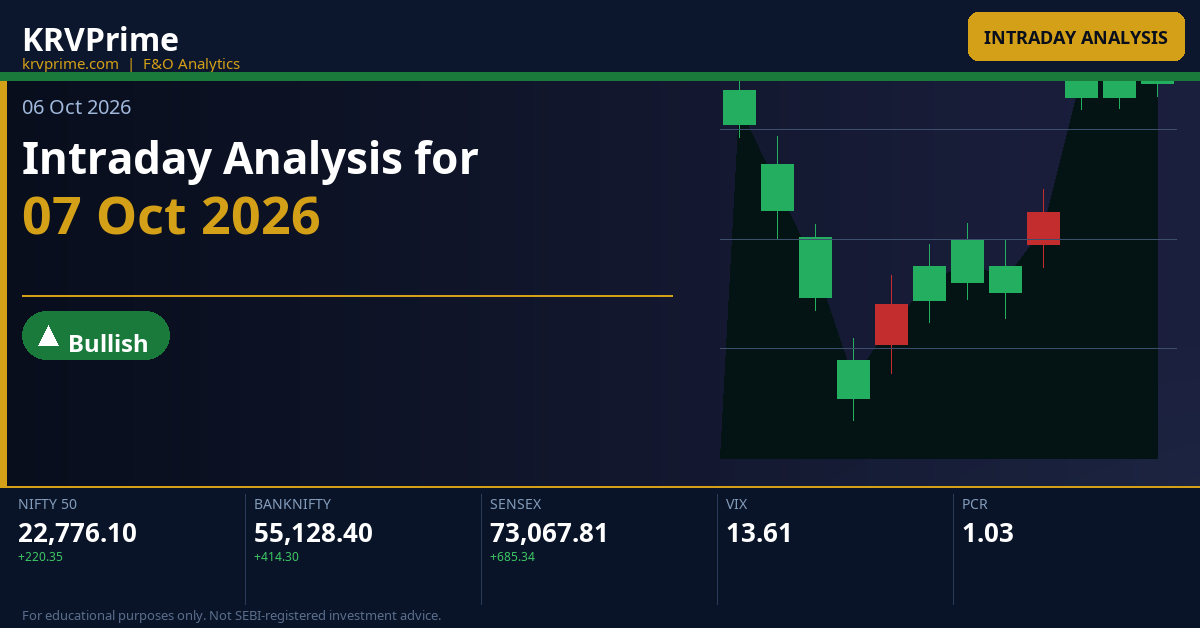
Markets closed on a strong note on 06 Oct 2026, with NIFTY gaining +0.98% to 22,776.10, BANKNIFTY up +0.76% to 55,128.40, and SENSEX advancing +0.95% to 73,067.81, all three indices closing at or near their session highs — a sign of broad-based buying into the close. India VIX data is unavailable for this session, making directional conviction assessment harder; traders should lean on OI positioning, CPR structure, and straddle pricing as the primary volatility proxies. The weekly NIFTY straddle at 22,800 ATM prices only 23.9 points of expected move, signalling near-expiry time decay compression, while the monthly straddle at 544.95 points suggests the real swing territory for the medium term remains significant.
Key Market Signals — Intraday Setup
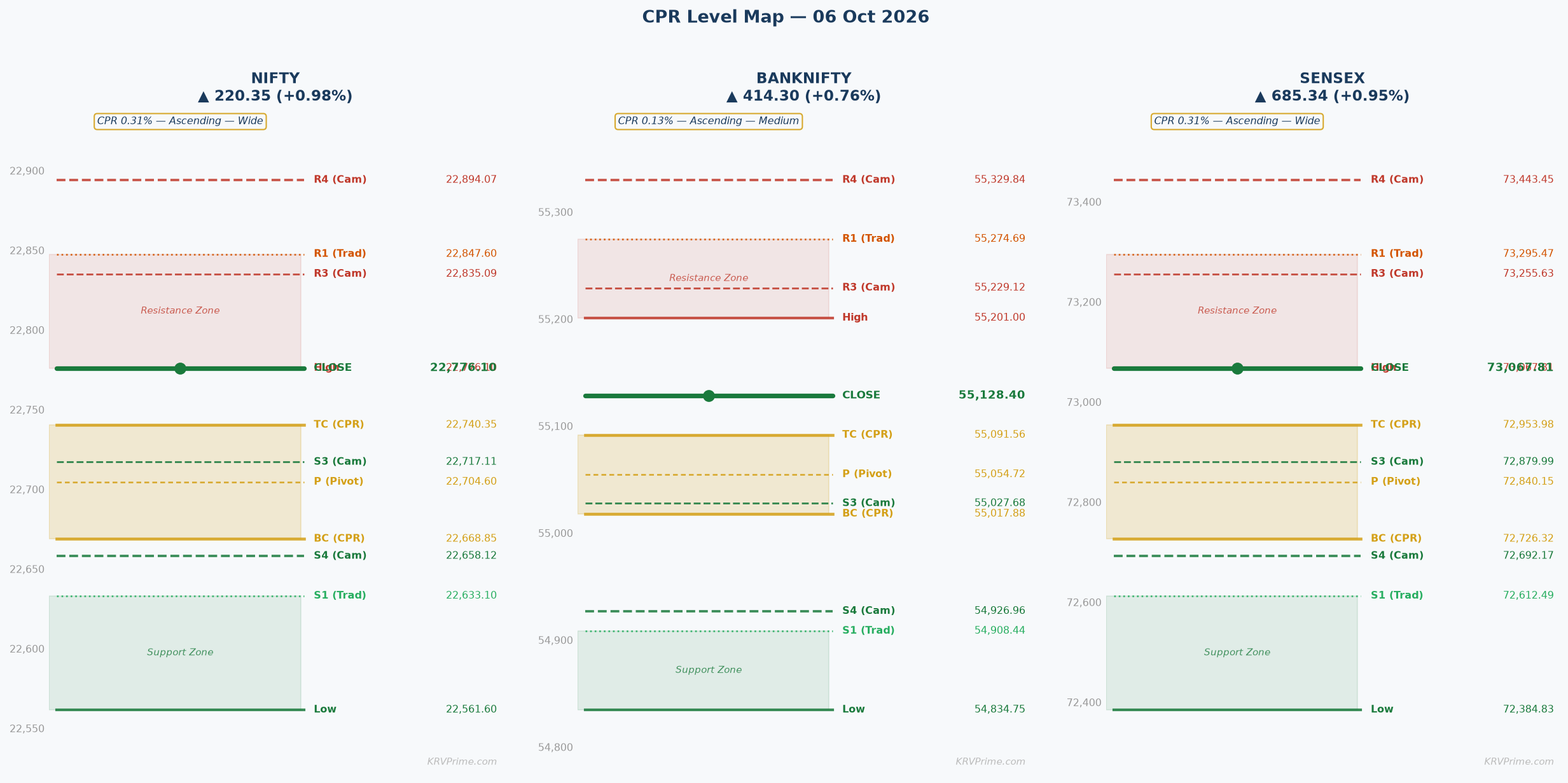
All three indices are trading above their respective weekly CPR bands, with day CPRs shifting Ascending — Wide for NIFTY and SENSEX and Ascending — Medium for BANKNIFTY, confirming a multi-session bullish bias; however, the wide CPR bands on NIFTY and SENSEX caution against chasing breakouts without two confirmed 30-minute closes, as range-bound fading remains the dominant structural playbook.
Deep Technical Analysis & Levels
NIFTY
Ascending — Wide (0.31%)
▲ Bullish
Market Structure Sideways or range-bound | Straddle NIFTY Week ATM 22,800: Call LTP 0.05 + Put LTP 23.85 = Straddle 23.9 points — this near-zero expected move signals the weekly expiry is pricing virtually no premium, meaning price is essentially pinned at 22,800 heading into Thursday. NIFTY Month ATM 22,800: Straddle 544.95 points implies a monthly swing range of roughly ±545 points from 22,800, defining the medium-term risk corridor between approximately 22,255 and 23,345. | Max Pain NIFTY Week max pain is 22,750 — just 26 points below Friday's close of 22,776.10, suggesting option sellers prefer a mild pullback or consolidation near 22,750 into Thursday's expiry. NIFTY Month max pain is 23,300 — significantly above current price, implying a structural upside pull over the coming three weeks if theta decay dynamics dominate. |
Tomorrow's Complete Level Map
OI-R: 22,800 R3: 23,062.10 H6: 22,992.64 H5: 22,962.96 R2: 22,919.10 H4 ▶: 22,894.07 R1: 22,847.60 PDH: 22,776.10 H3 ↩: 22,835.09
TC: 22,740.35 P: 22,704.60 BC: 22,668.85
L3 ↩: 22,717.11 PDL: 22,561.60 S1: 22,633.10 L4 ▶: 22,658.12 S2: 22,490.10 L5: 22,589.22 L6: 22,559.56 S3: 22,418.60 OI-S: 22,700
↩ = Camarilla reversal point | ▶ = Camarilla breakout/breakdown trigger | OI-R/OI-S = Options wall (CE/PE max OI)
▲ Higher Open (Gap Up) — Open > Prev Close
▲ Bullish
Open lands: For an Ascending CPR, a gap-up open places price above the prev close of 22,776.10, which is already above TC 22,740.35. Price therefore opens above the entire CPR band — BC 22,668.85, P 22,704.60, and TC 22,740.35 — and into the resistance cluster formed by OI-R 22,800, PDH 22,776.10, and Camarilla H3 22,835.09.
CPR role: Support — the entire CPR band (BC 22,668.85 to TC 22,740.35) transforms into a multi-layered support shelf below the opening price; as long as NIFTY holds above TC 22,740.35, the CPR acts as a launch pad for further gains.
Minor Gap (0.05–0.25%) — Structure Dominant
A minor gap-up of 0.05–0.25% places NIFTY opening between approximately 22,787 and 22,833, which is directly into the OI resistance wall at 22,800 and below Camarilla H3 22,835.09. The Ascending Wide CPR adds structural bullish lean, but the wide band (0.31%) mandates that traders wait for two confirmed 30-minute closes above 22,800 before committing to a long — premature entries here risk being caught in the CE-selling decay that compresses price back toward TC 22,740.35. First target on confirmation is H3 22,835.09, and the straddle pricing of only 23.9 points for the weekly contract means any move beyond 23 points from 22,800 is outside the options market's expected range, adding momentum energy to such a breakout.
Significant Gap (0.25–0.5%) — Balanced
A significant gap-up of 0.25–0.5% places NIFTY opening between approximately 22,833 and 22,890, which is above Camarilla H3 22,835.09 and pressing directly toward H4 22,894.07. At this open, the gap-fill risk is real — price is opening into the Camarilla mean-reversion sell zone (H3), and the Ascending Wide CPR structure, while bullish, requires two 30-minute closes above H3 22,835.09 to confirm that this is a genuine breakout rather than a fade opportunity. If the two 30-min close rule is satisfied, the next target sequence is H4 22,894.07 then R2 22,919.10; a failure at H3 without confirmation immediately exposes the pullback path toward TC 22,740.35 and then OI-S 22,700.
Large Gap (>0.5%) — Gap Direction Dominant
A large gap-up of greater than 0.5% places NIFTY opening above 22,890, potentially at or above H4 22,894.07 and R2 22,919.10, well clear of the OI-R ceiling at 22,800 — in this case, the options wall at 22,800 becomes support rather than resistance as short-call delta hedging creates a floor. The probability of an immediate gap-fill back to 22,776 or lower is meaningful in this case, given the weekly straddle prices only 23.9 points of movement, meaning a large gap represents a significant overshoot of realized implied volatility, inviting professional fade-sellers. Traders should watch for a two 30-min close failure below H4 22,894.07 as the abort signal and treat any sustained hold above R2 22,919.10 as a momentum continuation setup targeting H5 22,962.96 and then H6 22,992.64.
|
▲ Upside Path → OI-R On confirmed breakout above H3 22,835.09, the first partial profit target is R1 22,847.60 — traditional resistance where initial supply typically emerges; on sustained momentum, H4 22,894.07 is the Camarilla breakout extension trigger and R2 22,919.10 forms the second target. The OI-R at 22,800 transforms into dynamic support on a gap-up breakout, meaning each retest of 22,800 from above should be treated as a buy-the-dip opportunity rather than a short signal, and the ultimate session ceiling in an extreme bull scenario is H5 22,962.96 or H6 22,992.64. |
▼ Downside Path → OI-S Failure of the gap-up to hold above TC 22,740.35 following the initial spike is the first red flag — a 30-minute close back below TC 22,740.35 signals that the gap was a false breakout and shifts the session to a bearish bias with P 22,704.60 as the next pivot and BC 22,668.85 as the critical CPR floor. If BC 22,668.85 breaks on two 30-min closes, the downside path accelerates to L4 22,658.12, then S1 22,633.10, and ultimately toward OI-S 22,700 where PE writers provide a structural floor — loss of 22,700 on a closing basis is a material bearish signal for the week. |
| 🔴 OI-R: OI-R at 22,800 (highest CE open interest strike) acts as the primary upside ceiling for the gap-up session — a massive concentration of call writers have effectively 'sold the wall' here, and their delta-hedging creates natural selling pressure every time NIFTY approaches 22,800 from below. In a gap-up open that places NIFTY above 22,800 from the start, this OI-R flips to a support-confirmation level — if sustained above 22,800, CE writers are forced to buy futures to hedge their short delta, amplifying the upward move. | 🟢 OI-S: OI-S at 22,700 (highest PE open interest strike) is not an immediate concern in a gap-up scenario but remains the critical abort level — a session close below 22,700 would represent a complete reversal of the bullish gap and trigger PE writer panic covering, accelerating the downside. In the gap-up context, OI-S 22,700 serves as the maximum pain anchor below the session, and the 50-point gap between OI-S 22,700 and OI-R 22,800 defines the options market's preferred range for the weekly expiry. |
⚡ Key Trigger: The primary bull trigger is two consecutive 30-minute candle closes above OI-R 22,800 and Camarilla H3 22,835.09 on above-average volume — this dual confirmation is mandatory for the Wide CPR (0.31%) rule and validates that CE sellers at 22,800 have been overwhelmed. Failure to achieve two such closes returns the session to a range-bound fade setup where TC 22,740.35 and P 22,704.60 become the gravitational anchors and the trade flips to selling strength near H3 22,835.09.
▼ Lower Open (Gap Down) — Open < Prev Close
▼ Bearish
Open lands: For an Ascending CPR, a gap-down open on NIFTY places price below the prev close of 22,776.10; since BC 22,668.85 is already above the theoretical 'prev TC' level in the Ascending framework, a gap-down opens below the entire CPR band — price is below BC 22,668.85, P 22,704.60, and TC 22,740.35, and the CPR band now acts as overhead resistance.
CPR role: Overhead resistance — in a gap-down on an Ascending CPR, the entire CPR band (BC 22,668.85 to TC 22,740.35) inverts from support to a resistance ceiling; bulls must reclaim BC 22,668.85 to stabilise and TC 22,740.35 to regain control.
Minor Gap (0.05–0.25%) — Structure Dominant
A minor gap-down of 0.05–0.25% places NIFTY opening between approximately 22,719 and 22,765, which is within or just below TC 22,740.35 and above BC 22,668.85, effectively inside the CPR band — this is a 'decision zone' opening where neither bulls nor bears have full control. The Ascending Wide CPR (0.31%) maintains a structural bullish tilt, and minor gaps in Ascending setups frequently fill within the first 30–60 minutes; however, the Wide confirmation rule requires two 30-min closes above TC 22,740.35 before treating the fill as a bull signal. Traders should treat OI-S 22,700 as the near-term floor and watch for a 30-min hold above P 22,704.60 as the first sign of stabilisation, with BC 22,668.85 as the critical make-or-break line below.
Significant Gap (0.25–0.5%) — Balanced
A significant gap-down of 0.25–0.5% places NIFTY opening between approximately 22,663 and 22,719, which lands at or just below BC 22,668.85 — precisely at the bottom of the Ascending CPR band and dangerously close to OI-S 22,700. At this level, the failure-and-resume dynamic is active: if NIFTY cannot reclaim BC 22,668.85 within the first 30 minutes, the bearish structure firms up and L3 22,717.11 (already above open) and L4 22,658.12 become the immediate downside targets. The Wide CPR band requires two 30-min closes above TC 22,740.35 for full bull recovery, but a faster bull signal is any 30-min close above OI-S 22,700 that also holds P 22,704.60 — PE writers will defend 22,700 aggressively, making this the most critical intraday battleground.
Large Gap (>0.5%) — Gap Direction Dominant
A large gap-down of greater than 0.5% places NIFTY opening below 22,663, below BC 22,668.85, below OI-S 22,700, and approaching L4 22,658.12 and S1 22,633.10 — multiple structural supports are simultaneously breached on the open, triggering stop-losses and panic selling. In this scenario, the VIX (currently unavailable) is likely spiking and PE premiums will be elevated; the weekly straddle at only 23.9 points is completely overwhelmed, meaning weekly options are effectively worthless and the session will be driven by monthly option dynamics where the 544.95-point straddle sets the corridor. Recovery watch is above L4 22,658.12 and a two 30-min close above BC 22,668.85 for a mean-reversion long, while the bear continuation target is L5 22,589.22, L6 22,559.56, and ultimately PDL 22,561.60.
|
▲ Upside Path → OI-R The gap-down recovery path is BC 22,668.85 → P 22,704.60 → TC 22,740.35 → OI-R 22,800, with each level acting as a confirmation gate — a two 30-min close above TC 22,740.35 fully neutralises the gap-down bear thesis and sets up a retest of OI-R 22,800 and PDH 22,776.10. Genuine recovery above TC 22,740.35 supported by improving breadth and above-average volume should be treated as a bullish momentum reentry, targeting H3 22,835.09 and R1 22,847.60 into the afternoon session. |
▼ Downside Path → OI-S On bear continuation, the path is L3 22,717.11 (initial stall) → L4 22,658.12 (breakdown trigger) → L5 22,589.22 → L6 22,559.56 → S2 22,490.10, with retail stop-losses concentrated below L3 22,717.11 and L4 22,658.12 accelerating the move. OI-S 22,700 is the most important downside level — a session close below 22,700 would be highly significant, triggering PE unwinds and potentially extending the decline toward S2 22,490.10 and S3 22,418.60 if weekly expiry dynamics amplify the selling. |
| 🔴 OI-R: In a gap-down scenario, OI-R 22,800 becomes a distant ceiling that shorts are actively defending — the heavy CE open interest at 22,800 means any intraday recovery rally is unlikely to reach this level without exceptional buying volume, and CE sellers will use any bounce toward TC 22,740.35 or PDH 22,776.10 to add short calls, capping the rebound. The gamma pressure from CE writers at 22,800 creates a natural ceiling effect throughout the session, meaning traders should fade strength approaching 22,776 to 22,800 in a gap-down day. | 🟢 OI-S: OI-S 22,700 is the primary bear target and PUT monetisation zone in the gap-down scenario — the massive PE open interest here means that reaching 22,700 triggers an inflection: some PE writers will take profits (covering their shorts in futures), creating a temporary bounce, while others add to positions anticipating further downside. A sustained break below 22,700 on a closing basis is a material bearish event, potentially dragging NIFTY toward S1 22,633.10 and L4 22,658.12 as the options market shifts its gravity lower. |
⚡ Key Trigger: The key trigger for the gap-down scenario is a 30-minute candle close back above BC 22,668.85 — this is the bull reclaim level that signals the gap is being filled and the Ascending CPR structure is reasserting itself; failure to reclaim BC 22,668.85 within 45 minutes confirms bearish session structure. For the bear side, a confirmed 30-min close below L4 22,658.12 triggers the downside cascade toward S1 22,633.10 and then OI-S 22,700 from above as a now-resistance zone, with stop placement above BC 22,668.85.
◆ Near Flat Open — Open ≈ Prev Close (±0.05%)
◆ Neutral
Open lands: A flat open on NIFTY places price at approximately 22,776.10 (±0.05% = ±11 points, so 22,765 to 22,787), which is above the entire Ascending CPR band (TC 22,740.35, P 22,704.60, BC 22,668.85) — the CPR band is entirely below the opening price, acting as tiered support beneath the market.
CPR role: Support shelf — in a flat open above an Ascending Wide CPR, the CPR band (BC 22,668.85 to TC 22,740.35) forms a 71.5-point wide support zone directly below the opening level; the key question is whether NIFTY can hold above TC 22,740.35 and attack OI-R 22,800, or gravitates back toward the CPR band.
Near Flat (±0.05%)
A flat open near 22,776.10 on an Ascending Wide CPR (0.31%) is a high-information setup because price opens above the entire CPR band, and the first 15-minute candle will determine whether the prior session's strength is sustained or fades — the CPR is not acting as a trading zone today but as a distant anchor below. TC 22,740.35 is the critical intraday bull-bear pivot: a 30-minute hold above TC 22,740.35 confirms that bulls remain in control of the CPR structure and the day is targeting OI-R 22,800 and H3 22,835.09, while a 30-minute close below TC 22,740.35 signals that the overnight strength was ephemeral and the CPR band is now acting as overhead resistance for a bearish intraday push. The Wide CPR (0.31%) rules require two 30-minute closes above OI-R 22,800 for an upside breakout confirmation, and price should not be chased above 22,800 without this confirmation — professional option sellers have heavily written CE at 22,800 and will resist any move above it. Both the bull trigger (two 30-min closes above 22,800 targeting H3 22,835.09 then R1 22,847.60) and the bear trigger (30-min close below TC 22,740.35 targeting BC 22,668.85 then OI-S 22,700) must be monitored simultaneously, as the flat open provides no directional pre-commitment and the first decisive 30-minute move IS the trade.
|
▲ Upside Path → OI-R On bull trigger confirmation above 22,800, the upside path is OI-R 22,800 (now support) → H3 22,835.09 (first partial profit) → R1 22,847.60 (traditional first target) → H4 22,894.07 (Camarilla breakout extension) → R2 22,919.10, with each level presenting a natural profit-booking zone. Above H4 22,894.07, momentum shifts to H5 22,962.96 and H6 22,992.96, and the monthly max pain at 23,300 acts as a structural magnet if the session turns into a trending bull day. |
▼ Downside Path → OI-S On bear trigger below TC 22,740.35, the downside path follows BC 22,668.85 (CPR floor) → L3 22,717.11 (Camarilla mean-reversion) → L4 22,658.12 (breakdown trigger) → OI-S 22,700 (PE base defense zone) → S1 22,633.10. Loss of OI-S 22,700 on a closing basis is the most significant intraday bear development, as it invalidates the weekly max pain gravity of 22,750 and could force a structural reassessment toward S2 22,490.10. |
| 🔴 OI-R: In a flat-open scenario, OI-R 22,800 is the primary ceiling that CE writers are actively defending — with the weekly ATM call priced at only 0.05, expiry-day dynamics mean that any move above 22,800 triggers rapid delta hedging by call sellers (buying futures to neutralise short delta), creating a self-reinforcing upside spike if 22,800 breaks decisively. This dynamic makes 22,800 the single most important level of the day: a confirmed break turns the options market from headwind to tailwind. | 🟢 OI-S: OI-S 22,700 in the flat-open scenario acts as the deep support anchor — PE writers who have sold puts at 22,700 will defend this level aggressively by buying futures near 22,700 to maintain their delta neutrality, creating a natural bid below the market. If NIFTY drifts toward 22,700 without a significant catalyst, this PE-writer support should create a bounce; a break of 22,700 on volume, however, triggers PE unwinding and accelerates the move toward S1 22,633.10. |
⚡ Key Trigger: Bull trigger: two consecutive 30-minute candle closes above OI-R 22,800 on above-average volume confirms CE writer capitulation and opens the path to H3 22,835.09 and R1 22,847.60. Bear trigger: a single 30-minute close below TC 22,740.35 shifts intraday structure bearish, with BC 22,668.85 as the first destination and OI-S 22,700 as the session's downside anchor — this level is the structural fulcrum because it separates the 'above CPR = bull' from 'inside CPR = range' market regimes.
BANKNIFTY
Ascending — Medium (0.13%)
▲ Bullish
Market Structure Balanced or transitional | Straddle BANKNIFTY Month ATM 55,100: Call LTP 852.0 + Put LTP 709.0 = Straddle 1,561.0 points — this implies a monthly expected move of approximately ±1,561 points from 55,100, defining the monthly range corridor between roughly 53,539 and 56,661, which aligns closely with the month's Camarilla L3 53,538.40 on the downside and H3 55,727.70 on the upside. | Max Pain BANKNIFTY Month max pain is 56,000 — approximately 872 points above Tuesday's close of 55,128.40, suggesting meaningful upside pull from theta decay dynamics over the remaining three weeks of the monthly expiry cycle. This 56,000 max pain level is just above the weekly Camarilla H4 55,333.17 and traditional R1 55,274.69, implying that a sustained move above these levels could trigger a self-reinforcing max pain chase. |
Tomorrow's Complete Level Map
OI-R: 58,000 R3: 55,640.94 H6: 55,496.61 H5: 55,447.48 R2: 55,420.97 H4 ▶: 55,329.84 R1: 55,274.69 PDH: 55,201.00 H3 ↩: 55,229.12
TC: 55,091.56 P: 55,054.72 BC: 55,017.88
L3 ↩: 55,027.68 PDL: 54,834.75 S1: 54,908.44 L4 ▶: 54,926.96 S2: 54,688.47 L5: 54,809.32 L6: 54,760.19 S3: 54,542.19 OI-S: 55,000
↩ = Camarilla reversal point | ▶ = Camarilla breakout/breakdown trigger | OI-R/OI-S = Options wall (CE/PE max OI)
▲ Higher Open (Gap Up) — Open > Prev Close
▲ Bullish
Open lands: For an Ascending Medium CPR, a gap-up open places BANKNIFTY above prev close of 55,128.40, which is already above TC 55,091.56. Price therefore opens above the entire CPR band (BC 55,017.88, P 55,054.72, TC 55,091.56) and into the zone between PDH 55,201 and Camarilla H3 55,229.12.
CPR role: Support — in a gap-up above an Ascending Medium CPR, the CPR band (BC 55,017.88 to TC 55,091.56) becomes a 73.68-point wide support shelf; the Medium CPR (0.13%) implies a balanced session where the CPR acts as a reliable pivot, and opening above it adds clear bullish lean.
Minor Gap (0.05–0.25%) — Structure Dominant
A minor gap-up of 0.05–0.25% places BANKNIFTY opening between approximately 55,156 and 55,266, landing above the CPR band and approaching PDH 55,201 and Camarilla H3 55,229.12 — the CPR structure (Ascending Medium) adds bullish confirmation since the entire band is below the open. The Medium CPR (0.13%) confirmation rule requires a first 30-minute candle close above TC 55,091.56 to confirm directional bias, but given the open is already above TC, the immediate focus shifts to whether BANKNIFTY can clear PDH 55,201 and H3 55,229.12 on volume. A confirmed 30-minute hold above H3 55,229.12 sets up the path to R1 55,274.69 as the first partial profit target, with H4 55,329.84 as the Camarilla breakout extension — OI-R at 58,000 is far enough away to be irrelevant as a near-term ceiling, leaving the day's trading range defined by the Camarilla levels.
Significant Gap (0.25–0.5%) — Balanced
A significant gap-up of 0.25–0.5% places BANKNIFTY opening between approximately 55,266 and 55,404, above Camarilla H3 55,229.12 and pressing toward H4 55,329.84 and R2 55,420.97. At this opening, the Camarilla mean-reversion sell zone (H3) is breached on the open, which in the Medium CPR framework requires a confirmed 30-minute close above H4 55,329.84 before committing to a long — H4 is the Camarilla breakout trigger and the most important confirmation level. Failure to sustain above H3 55,229.12 after a significant gap inverts the trade to a fade-short targeting TC 55,091.56 and then OI-S 55,000, where the heavy PE open interest provides the ultimate support floor.
Large Gap (>0.5%) — Gap Direction Dominant
A large gap-up of greater than 0.5% places BANKNIFTY opening above 55,404, potentially at or above H4 55,329.84, R2 55,420.97, and H5 55,447.48 — in this extreme scenario, the session opens directly into the Camarilla target extension zone where mean-reversion sellers are most aggressive. The gap-fill risk is high: the monthly straddle of 1,561 points prices meaningful volatility, but a single-day gap of more than 275 points (0.5%) into H5 territory (55,447.48) likely represents an overdone move unless a significant macro catalyst is present. Traders should wait for a two 30-min close confirmation above H5 55,447.48 before pressing longs, treat H4 55,329.84 as the session pivot, and target H6 55,496.61 and R3 55,640.94 on a momentum continuation while keeping OI-S 55,000 as the maximum tolerable loss anchor.
|
▲ Upside Path → OI-R On bull confirmation above H3 55,229.12, the upside path is PDH 55,201 (now support) → H3 55,229.12 (base) → R1 55,274.69 (first partial) → H4 55,329.84 (Camarilla breakout extension, second partial) → R2 55,420.97 → H5 55,447.48, with OI-R at 58,000 being far enough away that it does not cap the intraday session. Each Camarilla level should be treated as a partial profit zone in line with the Medium CPR confirmation rule (30-min closes, retests expected), and above-average volume on each breakout confirms genuine institutional participation rather than thin gap-extension. |
▼ Downside Path → OI-S If the gap-up fails and BANKNIFTY retreats below TC 55,091.56 on a 30-minute closing basis, the downside path is TC 55,091.56 → P 55,054.72 → BC 55,017.88 → OI-S 55,000 → L4 54,926.96 → S1 54,908.44. OI-S 55,000 is only 17.88 points below BC 55,017.88, making it the most critical line — the clustering of BC, OI-S 55,000, and the Camarilla L3 55,027.68 creates an ultra-dense support zone between 55,000 and 55,027.68 that should produce a significant bounce or a clean breakdown signal. |
| 🔴 OI-R: OI-R at 58,000 (highest CE open interest for BANKNIFTY month) is an extremely distant ceiling — approximately 2,872 points above Tuesday's close — and is effectively irrelevant as an intraday resistance for a gap-up session on 07 Oct. Instead, the near-term CE supply is concentrated at lower strikes (R1 55,274.69 and H4 55,329.84 region), and traders should treat 58,000 as the monthly upside target for swing positions rather than an intraday obstacle. | 🟢 OI-S: OI-S at 55,000 (highest PE open interest for BANKNIFTY month) is the critical downside anchor — only 128.40 points below Tuesday's close and extremely close to BC 55,017.88, making it the most important support cluster for any gap-up day. A break below 55,000 on volume would be an extraordinarily bearish development, causing PE writers to unwind their short puts by selling futures, creating a waterfall effect toward L4 54,926.96 and S1 54,908.44. |
⚡ Key Trigger: The primary bull trigger for a gap-up session is a first 30-minute candle close above PDH 55,201 (yesterday's high) confirming the gap is holding — this is the key structural level because it marks the boundary of the prior day's range and represents where sellers were most active. A confirmed 30-minute close above H3 55,229.12 adds Camarilla breakout confirmation, setting up the sequence to R1 55,274.69 and H4 55,329.84; failure to hold above PDH 55,201 within 30 minutes flags a false gap and reverses the trade to a short targeting TC 55,091.56.
▼ Lower Open (Gap Down) — Open < Prev Close
▼ Bearish
Open lands: For an Ascending Medium CPR, a gap-down open places BANKNIFTY below prev close of 55,128.40; a minor gap-down opens inside the CPR band (TC 55,091.56 to BC 55,017.88), while a significant or large gap-down opens below BC 55,017.88 and potentially below OI-S 55,000.
CPR role: Overhead resistance — in a gap-down on an Ascending CPR, the CPR band (BC 55,017.88 to TC 55,091.56) acts as resistance above the gap-down open; reclaiming BC 55,017.88 is the minimum bull requirement to stabilise, while TC 55,091.56 reclaim is full bull recovery.
Minor Gap (0.05–0.25%) — Structure Dominant
A minor gap-down of 0.05–0.25% places BANKNIFTY opening between approximately 55,046 and 55,100, inside the CPR band between BC 55,017.88 and TC 55,091.56 — this is a classic 'inside CPR' decision zone opening where the first 30-minute candle direction determines the session bias. The Ascending Medium CPR (0.13%) maintains its structural bullish tilt, and minor gaps in Ascending setups frequently fill within 30–60 minutes, meaning a 30-minute hold above P 55,054.72 and TC 55,091.56 quickly restores the bull setup targeting PDH 55,201 and H3 55,229.12. Conversely, a 30-minute close below BC 55,017.88 and OI-S 55,000 (which are only 17.88 points apart) confirms the bear case and targets L4 54,926.96 and S1 54,908.44.
Significant Gap (0.25–0.5%) — Balanced
A significant gap-down of 0.25–0.5% places BANKNIFTY opening between approximately 54,990 and 55,046, which is below BC 55,017.88 and at or through OI-S 55,000 — this is a high-tension opening because the most important PE support level is being tested immediately at the open. The failure-and-resume dynamic here is acute: if BANKNIFTY cannot reclaim BC 55,017.88 within 30 minutes, the bearish structure firms as PE writers (who had sold puts at 55,000) begin unwinding, selling futures and amplifying the downside toward L4 54,926.96, S1 54,908.44, and L5 54,809.32. The Medium CPR confirmation rule requires a 30-minute close above BC 55,017.88 to signal recovery, and traders should watch for a volume spike near OI-S 55,000 as a potential reversal tell before entering any recovery long.
Large Gap (>0.5%) — Gap Direction Dominant
A large gap-down of greater than 0.5% places BANKNIFTY opening below 54,853, below PDL 54,834.75 and into L5 54,809.32 and L6 54,760.19 territory — major structural supports are simultaneously breached and the session enters panic-driven territory. In this scenario, the monthly straddle of 1,561 points is being rapidly priced in on the downside, and PUT holders are in profit; the key watch is whether price stabilises at L6 54,760.19 or accelerates toward S3 54,542.19 and S2 54,688.47, with recovery attempted only after a two 30-min close above BC 55,017.88 to confirm the panic is over. The maximum pain magnet at 56,000 is deeply out of play in this scenario, and traders should respect the bear momentum, using L4 54,926.96 as the first short target on any bounces and S3 54,542.19 as the session's extreme downside.
|
▲ Upside Path → OI-R Recovery path from a gap-down is BC 55,017.88 → P 55,054.72 → TC 55,091.56 → PDH 55,201 → H3 55,229.12 → R1 55,274.69, with the Medium CPR rule requiring a 30-minute close above each level before extending further and expecting retests at each station. A full recovery to TC 55,091.56 and above would shift the day from bearish to neutral-to-bullish, setting up a retest of PDH 55,201 in the afternoon session if global cues remain supportive. |
▼ Downside Path → OI-S On bear confirmation below OI-S 55,000, the downside path accelerates to L4 54,926.96 (Camarilla breakdown level, first major target) → S1 54,908.44 (traditional first support) → L5 54,809.32 → PDL 54,834.75 → L6 54,760.19 → S2 54,688.47. Retail stop-losses are concentrated below OI-S 55,000 and L3 55,027.68, and their triggering creates a cascading sell effect that typically moves 100–150 points rapidly, making L4 54,926.96 the first stabilisation point to monitor. |
| 🔴 OI-R: OI-R at 58,000 is entirely irrelevant as a near-term resistance in a gap-down scenario — the real CE supply acting as an overhead cap in a gap-down day is found at PDH 55,201, TC 55,091.56, and the CPR band, not at the 58,000 strike which is more than 2,800 points away. Traders should not reference 58,000 for intraday gap-down strategy; instead, the CPR band resistance (BC 55,017.88 to TC 55,091.56) is the functional equivalent of a near-term OI resistance ceiling. | 🟢 OI-S: OI-S at 55,000 is the single most important level in a gap-down scenario — a massive concentration of PE sellers have their maximum profit-protection zone at 55,000, and they will defend this level by buying futures aggressively if price approaches or breaks below. A sustained break below 55,000 triggers PE writer capitulation (they sell futures to cut losses on short puts), creating a self-reinforcing downward spiral toward L4 54,926.96 and S1 54,908.44 — this is the primary PUT monetisation zone and the first downside target if the session confirms bearish structure. |
⚡ Key Trigger: The bear continuation trigger is a 30-minute candle close below BC 55,017.88 AND below OI-S 55,000 — both must break to confirm that PE writers have abandoned their defense, signalling acceleration toward L4 54,926.96 and S1 54,908.44. The bull recovery trigger is a 30-minute close back above P 55,054.72 followed by a hold above TC 55,091.56, confirming that the gap was a false break and the Ascending CPR's structural support has reasserted; these two levels are the exact structural fulcrum because BC-P-TC form the CPR hierarchy and each reclaim adds a layer of bull confidence.
◆ Near Flat Open — Open ≈ Prev Close (±0.05%)
◆ Neutral
Open lands: A flat open on BANKNIFTY places price at approximately 55,128.40 (±0.05% = ±27.5 points, so 55,100 to 55,156), which is above TC 55,091.56 — the entire Ascending Medium CPR band is below the flat open, with TC 55,091.56, P 55,054.72, and BC 55,017.88 acting as layered support below.
CPR role: Support shelf and launch pad — a flat open above an Ascending Medium CPR places the CPR band directly below as a support zone; the Medium CPR (0.13%) makes this session balanced, with the CPR acting as the primary pivot that separates the bull regime (above TC 55,091.56) from the bear regime (below BC 55,017.88).
Near Flat (±0.05%)
A flat open near 55,128.40 on an Ascending Medium CPR (0.13%) is an extremely high-probability information setup — price is above the entire CPR band and the Medium width implies a balanced session where the CPR acts as a reliable two-way pivot. The key bull-bear line is TC 55,091.56: any 30-minute candle that closes above TC 55,091.56 on volume confirms bull continuation toward PDH 55,201 and H3 55,229.12, while a 30-minute close below TC 55,091.56 signals that the session is slipping back into the CPR decision zone and the next support test is P 55,054.72 and BC 55,017.88. The Medium CPR width (0.13%) sits just above the Narrow threshold (0.10%), meaning trending day probability is elevated — historically, Ascending Medium CPRs with price opening above TC produce directional trending sessions more than 60% of the time, and the first 30-minute candle direction is the dominant signal. The bull setup requires a 30-minute close above PDH 55,201 targeting H3 55,229.12 and R1 55,274.69 on the upside, while the bear setup requires a 30-minute close below TC 55,091.56 followed by a retest failure, targeting BC 55,017.88, OI-S 55,000, and L4 54,926.96 — the 55,000 OI-S level is only 91.56 points below TC, making it a highly relevant downside anchor even in a flat open.
|
▲ Upside Path → OI-R On bull trigger above PDH 55,201, the upside path follows H3 55,229.12 (first partial profit — Camarilla mean-reversion zone) → R1 55,274.69 (traditional first target, second partial) → H4 55,329.84 (Camarilla breakout extension, trail stop here) → R2 55,420.97 → H5 55,447.48, with the monthly max pain at 56,000 acting as the medium-term magnetic target and OI-R 58,000 as the absolute monthly ceiling. Above-average volume at each breakout level confirms institutional participation and distinguishes a genuine trend day from a thin-air rally. |
▼ Downside Path → OI-S On bear trigger below TC 55,091.56, the downside path is TC 55,091.56 → P 55,054.72 → BC 55,017.88 → OI-S 55,000 (primary downside target and PE support zone) → L4 54,926.96 → S1 54,908.44. The clustering of BC 55,017.88 and OI-S 55,000 (only 17.88 points apart) creates an extraordinarily important support cluster — any sustained break below 55,000 on a closing basis would be a session-defining bearish event that accelerates the decline toward L5 54,809.32. |
| 🔴 OI-R: OI-R at 58,000 is the monthly CE writing ceiling and acts as a long-term resistance target in the flat-open scenario, not an intraday obstacle — CE writers at 58,000 are comfortably out-of-the-money and their delta is minimal, meaning they create no meaningful gamma pressure at current levels. In a flat-open trending day scenario, the actionable near-term CE resistance is found at H4 55,329.84 and R2 55,420.97, which are where intraday CE supply is most concentrated based on the Camarilla and traditional level analysis. | 🟢 OI-S: OI-S at 55,000 in a flat-open scenario is an extraordinarily close and critical support level — only 128.40 points below the Tuesday close of 55,128.40 — and PE writers have a vested interest in keeping BANKNIFTY above 55,000 throughout the session. This proximity makes OI-S 55,000 the most actionable intraday level: any test of this zone (within 30 points) should be watched for PE-writer defense buying in futures, and a failure of this defense is the strongest possible bear signal of the session, overriding all other technical inputs. |
⚡ Key Trigger: Bull trigger: first 30-minute candle close above PDH 55,201 on above-average volume, confirming that buyers are in control and the session is a continuation of the prior day's rally — this level is the structural fulcrum because it marks the boundary between 'prior range' and 'new territory', and a close above it forces short-sellers to cover. Bear trigger: 30-minute close below TC 55,091.56 initiates re-entry into the CPR band, and a subsequent close below BC 55,017.88 confirms the bear session, as the market psychology shifts from 'buying above support' to 'selling resistance below previous highs'.
SENSEX
Ascending — Wide (0.31%)
▲ Bullish
Market Structure Sideways or range-bound | Straddle SENSEX Week ATM 73,100: Call LTP 277.65 + Put LTP 382.20 = Straddle 659.85 points — implies an expected weekly move of approximately ±659.85 points from 73,100, defining a range of roughly 72,440 to 73,760 for the expiry on 08 Oct 2026. SENSEX Month ATM 73,100: Straddle 1,862.40 points implies a monthly corridor of approximately 71,238 to 74,962, spanning from near monthly Camarilla L3 71,059.13 to near H4 75,322.62. | Max Pain SENSEX Week max pain is 72,900 — approximately 167.81 points below Tuesday's close of 73,067.81, aligning almost exactly with the Camarilla L3 72,879.99, suggesting option sellers want a mild pullback toward 72,900 into Thursday's expiry. SENSEX Month max pain is 73,500 — 432 points above Tuesday's close, implying upside pull from option seller dynamics over the coming weeks and broadly consistent with the monthly Camarilla H3 73,901.45 region as the structural target. |
Tomorrow's Complete Level Map
OI-R: 74,000 R3: 73,978.45 H6: 73,757.23 H5: 73,662.82 R2: 73,523.13 H4 ▶: 73,443.45 R1: 73,295.47 PDH: 73,067.81 H3 ↩: 73,255.63
TC: 72,953.98 P: 72,840.15 BC: 72,726.32
L3 ↩: 72,879.99 PDL: 72,384.83 S1: 72,612.49 L4 ▶: 72,692.17 S2: 72,157.17 L5: 72,472.80 L6: 72,378.39 S3: 71,929.51 OI-S: 70,000
↩ = Camarilla reversal point | ▶ = Camarilla breakout/breakdown trigger | OI-R/OI-S = Options wall (CE/PE max OI)
▲ Higher Open (Gap Up) — Open > Prev Close
▲ Bullish
Open lands: For an Ascending Wide CPR, a gap-up open places SENSEX above the prev close of 73,067.81, which is already above TC 72,953.98. Price therefore opens above the entire CPR band (BC 72,726.32, P 72,840.15, TC 72,953.98) and into the cluster formed by PDH 73,067.81 (previous high) and approaching Camarilla H3 73,255.63.
CPR role: Support — in a gap-up above an Ascending Wide CPR, the CPR band (BC 72,726.32 to TC 72,953.98) forms a 227.66-point wide support shelf below the opening price; given the Wide band (0.31%), this support zone is thick and reliable as a floor but requires two 30-minute closes above the key resistance to confirm upside continuation.
Minor Gap (0.05–0.25%) — Structure Dominant
A minor gap-up of 0.05–0.25% places SENSEX opening between approximately 73,104 and 73,250, which is above PDH 73,067.81 and approaching Camarilla H3 73,255.63 — the Ascending Wide CPR structure adds bullish confirmation but the Wide rule (0.31%) mandates two 30-minute closes above the H3 zone before pressing longs. The weekly straddle of 659.85 points at ATM 73,100 prices a significant expected range, meaning a gap of 0.05–0.25% (approximately 37–183 points) is well within the normal volatility band and does not trigger unusual options flow — the session is expected to be CPR-structure dominated. First target on two 30-min close confirmation above H3 73,255.63 is R1 73,295.47; second target is H4 73,443.45, and OI-R 74,000 remains the ultimate ceiling approximately 930 points above Tuesday's close.
Significant Gap (0.25–0.5%) — Balanced
A significant gap-up of 0.25–0.5% places SENSEX opening between approximately 73,250 and 73,432, directly into or through Camarilla H3 73,255.63 and approaching H4 73,443.45 — this is the Camarilla mean-reversion sell zone and a significant gap into this area invites immediate fade pressure from professional sellers. The Wide CPR (0.31%) confirmation rule requires two 30-minute candle closes above H3 73,255.63 before treating the gap as a genuine breakout; a single close below H3 73,255.63 after the gap reverses the trade to a fade setup targeting TC 72,953.98 and P 72,840.15. On successful two 30-min close confirmation above H3 73,255.63, the target sequence is R1 73,295.47 (first partial), H4 73,443.45 (second partial), R2 73,523.13 (trail), and OI-R 74,000 as the session's extreme upside ceiling.
Large Gap (>0.5%) — Gap Direction Dominant
A large gap-up of greater than 0.5% places SENSEX opening above 73,432, at or above H4 73,443.45 and potentially into R2 73,523.13 or H5 73,662.82 — extreme territory where mean-reversion sellers and CE writers at OI-R 74,000 create coordinated downward pressure. The weekly straddle of 659.85 points suggests that such a move (>365 points in one gap) accounts for more than half the week's expected volatility in one overnight move, making gap-fill probability high and fade-trading the primary strategy. Two 30-min closes above H5 73,662.82 are required for a genuine breakout continuation targeting H6 73,757.23 and OI-R 74,000, while any failure of these closes signals a fade trade back to TC 72,953.98 and then OI-S 70,000 (far below) as the session extreme.
|
▲ Upside Path → OI-R On bull confirmation above H3 73,255.63, the upside path is PDH 73,067.81 (now support) → H3 73,255.63 (base for extension) → R1 73,295.47 (first partial profit) → H4 73,443.45 (Camarilla breakout extension, second partial) → R2 73,523.13 → H5 73,662.82 → H6 73,757.23 → OI-R 74,000 (ultimate session ceiling). Each Camarilla level represents genuine supply from professional sellers, and above-average volume at each breakout confirms that institutional buyers are absorbing this supply — without volume confirmation, each level should be treated as a partial profit zone rather than a pass-through. |
▼ Downside Path → OI-S Failure of the gap-up triggers a retreat path of H3 73,255.63 (fail) → TC 72,953.98 → P 72,840.15 → BC 72,726.32 → L4 72,692.17 → S1 72,612.49 → OI-S 70,000 (distant but ultimate bear anchor). The Wide CPR (0.31%) means the TC-to-BC range is 227.66 points of potential retracement, and a two 30-min close below BC 72,726.32 is the strongest bear signal, opening the path to L5 72,472.80 and L6 72,378.39 — both near PDL 72,384.83, which acts as the prior session's floor and a critical bull-bear line for multi-day structure. |
| 🔴 OI-R: OI-R at 74,000 (highest CE open interest for SENSEX week) acts as the primary CE writing ceiling — approximately 932 points above Tuesday's close, it is the dominant options wall for the weekly expiry on 08 Oct and represents where the maximum concentration of call sellers have positioned. In a gap-up scenario, 74,000 is a distant but important ceiling: as SENSEX approaches this level, delta-hedging from short call writers (buying futures) creates accelerating upside momentum, but once 74,000 is reached, the wall becomes an impenetrable ceiling where every point higher requires massive incremental buying to sustain. | 🟢 OI-S: OI-S at 70,000 (highest PE open interest for SENSEX week) is approximately 3,068 points below Tuesday's close — it is irrelevant as a near-term concern in a gap-up session and serves primarily as the extreme downside anchor confirming that the options market expects SENSEX to remain far above 70,000 through the weekly expiry. The deep OI-S 70,000 provides a structural confidence floor for bulls: with PE writers heavily defending 70,000, there is substantial options-market support for SENSEX remaining in the 72,000–74,000 range through Thursday's expiry. |
⚡ Key Trigger: The primary bull trigger in a gap-up SENSEX session is two consecutive 30-minute candle closes above H3 73,255.63 on above-average volume — this dual Wide-CPR confirmation validates that the gap is a genuine momentum breakout and not a fade trap from Camarilla mean-reversion sellers. Failure to achieve two such closes within the first 60 minutes of trading shifts the session to a range-bound fade playbook where TC 72,953.98 and H3 73,255.63 form the daily range boundaries and the trade is to sell near H3 and buy near TC.
▼ Lower Open (Gap Down) — Open < Prev Close
▼ Bearish
Open lands: For an Ascending Wide CPR, a gap-down open places SENSEX below prev close of 73,067.81; a minor gap-down opens inside the CPR band (TC 72,953.98 to BC 72,726.32), while a significant or large gap-down places price below BC 72,726.32, below the entire CPR band, converting the entire band to overhead resistance.
CPR role: Overhead resistance — a gap-down on Ascending Wide CPR converts the band (BC 72,726.32 to TC 72,953.98) into a 227.66-point wide resistance ceiling; bulls must reclaim BC 72,726.32 as the minimum stability requirement and TC 72,953.98 for full bull control recovery.
Minor Gap (0.05–0.25%) — Structure Dominant
A minor gap-down of 0.05–0.25% places SENSEX opening between approximately 72,885 and 73,030, which is inside the CPR band between L3 72,879.99 and TC 72,953.98 — this is within the CPR decision zone and the minor gap does not establish a clear directional bias. The Ascending Wide CPR (0.31%) maintains a structural bullish tilt, and given the weekly straddle prices 659.85 points of expected movement, a 37–183 point gap is minor and likely to see a fill attempt within the first 30 minutes. Key watch: a 30-minute close above TC 72,953.98 restores the bull structure and targets PDH 73,067.81, while a 30-minute close below L3 72,879.99 and then BC 72,726.32 confirms the bear setup and targets L4 72,692.17 and S1 72,612.49.
Significant Gap (0.25–0.5%) — Balanced
A significant gap-down of 0.25–0.5% places SENSEX opening between approximately 72,702 and 72,885, which is at or just below BC 72,726.32 — the bottom of the Ascending Wide CPR band is being tested on the open, creating an immediately critical decision point. A 30-minute close above BC 72,726.32 is the minimum bull requirement — the Wide CPR rules require two subsequent 30-min closes above TC 72,953.98 for full recovery, but even partial reclaim of BC 72,726.32 halts the bear momentum. Failure to reclaim BC 72,726.32 within 30 minutes confirms the bear structure, with L4 72,692.17 (only 34 points below BC) as the immediate target and S1 72,612.49 as the session's first significant downside level — the weekly straddle's 659.85-point range suggests this would represent approximately 55% of the week's expected downside in a single day.
Large Gap (>0.5%) — Gap Direction Dominant
A large gap-down of greater than 0.5% places SENSEX opening below 72,702, through BC 72,726.32, and into L4 72,692.17 and S1 72,612.49 territory — the entire CPR band is breached and multiple structural supports are simultaneously broken. The weekly max pain at 72,900 is above the opening price in this scenario, meaning option sellers face increasing losses and may aggressively sell futures to delta-hedge their short puts, amplifying the downside move toward L5 72,472.80, L6 72,378.39, and PDL 72,384.83. Recovery requires two 30-min closes above BC 72,726.32 for the Ascending Wide CPR rules to restore bull control, and any bounce toward the CPR band without two confirms should be treated as a dead-cat rally and faded toward S2 72,157.17 and S3 71,929.51.
|
▲ Upside Path → OI-R Recovery path from a gap-down is BC 72,726.32 → P 72,840.15 → TC 72,953.98 → PDH 73,067.81 → H3 73,255.63, with each level requiring a 30-minute close confirmation per the Wide CPR rule before extending further. A full recovery to TC 72,953.98 and above neutralises the bear thesis and positions SENSEX for a retest of PDH 73,067.81 in the afternoon, while a hold above H3 73,255.63 would confirm that the gap-down was an orchestrated shakeout rather than genuine distribution. |
▼ Downside Path → OI-S On bear confirmation below BC 72,726.32, the downside path is L4 72,692.17 (Camarilla breakdown trigger, immediate target) → S1 72,612.49 (traditional first support, first partial profit on shorts) → L5 72,472.80 → L6 72,378.39 → PDL 72,384.83 → S2 72,157.17. Retail stop-losses accumulated below BC 72,726.32 and S1 72,612.49 create cascading sell pressure, and weekly max pain at 72,900 being above the session's lows means option sellers are experiencing increasing mark-to-market pain, potentially triggering additional futures selling through delta hedging. |
| 🔴 OI-R: OI-R at 74,000 is a distant ceiling approximately 3,068 points above the gap-down open in this scenario — CE writers at 74,000 have deeply out-of-the-money positions and exert minimal gamma pressure on a gap-down day. The relevant near-term 'CE resistance' in a gap-down session is the CPR band (BC 72,726.32 to TC 72,953.98) and PDH 73,067.81, not the 74,000 strike, and traders should use the CPR band levels as the functional overhead resistance for all intraday short setups. | 🟢 OI-S: OI-S at 70,000 is extremely distant (approximately 3,068 points below Tuesday's close) and is irrelevant as an intraday target even in a large gap-down scenario — however, its existence as the highest PE OI strike confirms that the options market's base-case scenario does not contemplate SENSEX falling anywhere near 70,000 this week. The practical intraday downside support levels to watch are S1 72,612.49, L5 72,472.80, and PDL 72,384.83, not OI-S 70,000, and any rally attempt should be measured against BC 72,726.32 as the gatekeeping level for recovery. |
⚡ Key Trigger: The bull recovery trigger is a 30-minute candle close above BC 72,726.32 followed by a hold above P 72,840.15, signalling that the gap-down is being absorbed and CPR support is reasserting — traders can initiate recovery longs above BC 72,726.32 with stop below L4 72,692.17. The bear continuation trigger is a 30-minute close below L3 72,879.99 and a failure to reclaim BC 72,726.32 within 45 minutes, which confirms that the CPR band has flipped to overhead resistance and accelerates the move toward S1 72,612.49 and L5 72,472.80.
◆ Near Flat Open — Open ≈ Prev Close (±0.05%)
◆ Neutral
Open lands: A flat open on SENSEX places price at approximately 73,067.81 (±0.05% = ±36.5 points, so 73,031 to 73,104), which is above TC 72,953.98 — the entire Ascending Wide CPR band (BC 72,726.32 to TC 72,953.98) lies below the flat open, acting as a layered support shelf beneath the opening level.
CPR role: Support shelf and decision zone — a flat open above an Ascending Wide CPR leaves the entire CPR band as a 227.66-point wide support zone below price; however, the Wide band (0.31%) means the session is more likely range-bound than trending, and the first decisive move above PDH 73,067.81 or below TC 72,953.98 determines the day's character.
Near Flat (±0.05%)
A flat open near 73,067.81 on an Ascending Wide CPR (0.31%) creates a high-tension decision point because price is above the entire CPR band, yet the Wide structure signals that range-bound behavior and fade trading are more likely than a clean trending day — the 'launch pad' quality of the ascending CPR is tempered by the wide band's fade-extreme mandate. TC 72,953.98 is the critical intraday bull-bear pivot: a hold above TC 72,953.98 on the first 30-minute candle confirms that the Ascending CPR structure is supporting price and the session targets PDH 73,067.81 and then H3 73,255.63, while a 30-minute close below TC 72,953.98 signals that the gap between yesterday's close and today's CPR top is being closed and the market is reverting into the CPR band. The Wide CPR (0.31%) rules are particularly important in a flat-open — two 30-minute closes above OI-R 74,000 (impossible in a single session) effectively mean that the session upside is capped at H3 73,255.63 and R1 73,295.47 as practical profit-taking zones, and fade traders should be active near these levels. Both directional setups must be pre-planned: bull trigger is a two 30-min close above PDH 73,067.81 and H3 73,255.63 targeting R1 73,295.47 and H4 73,443.45, while bear trigger is a single 30-min close below TC 72,953.98 and two closes below BC 72,726.32 targeting L4 72,692.17, S1 72,612.49, and then OI-S 70,000 as the distant but ultimate support anchor.
|
▲ Upside Path → OI-R On bull trigger confirmation above H3 73,255.63, the upside path is PDH 73,067.81 (now support) → H3 73,255.63 (breakout confirmation) → R1 73,295.47 (first partial profit, traditional resistance) → H4 73,443.45 (Camarilla breakout extension, second partial) → R2 73,523.13 → H5 73,662.82 → H6 73,757.23 → OI-R 74,000. The monthly max pain at 73,500 acts as a gravitational mid-session target and is situated between H4 73,443.45 and R2 73,523.13, making this cluster the most important zone for afternoon profit-taking in a bull session. |
▼ Downside Path → OI-S On bear trigger below TC 72,953.98, the path follows TC 72,953.98 → P 72,840.15 → BC 72,726.32 → L3 72,879.99 (note: L3 is above BC in this data, so L3 72,879.99 acts as first Camarilla mean-reversion support inside the CPR band) → L4 72,692.17 (below BC, Camarilla breakdown trigger) → S1 72,612.49 → L5 72,472.80. The weekly max pain at 72,900 creates a magnetic pull for the session's intraday low — if SENSEX tests this level and the weekly short-put writers defend it with futures buying, a bounce from 72,900 is likely, making this a tactical long entry with stop below L4 72,692.17. |
| 🔴 OI-R: OI-R at 74,000 in the flat-open scenario is the ultimate weekly CE writing ceiling, approximately 932 points above the flat open — CE sellers at this strike have significant out-of-the-money premium working in their favor and will defend 74,000 aggressively with future short positions if approached. In the flat-open context, 74,000 is more relevant as a psychological ceiling for swing traders than an intraday obstacle for scalpers, and the practical CE resistance for intraday purposes is H3 73,255.63 and R1 73,295.47 where near-term CE writing is most concentrated. | 🟢 OI-S: OI-S at 70,000 in the flat-open scenario is the ultimate weekly PE writing floor, approximately 3,068 points below the flat open — with the weekly straddle pricing only 659.85 points of expected movement, OI-S 70,000 is far outside the tradeable range for Wednesday's session and confirms the options market's view that SENSEX will remain comfortably above 70,000 through Thursday's expiry. The practical PE support for intraday purposes in a flat-open scenario is the CPR band (BC 72,726.32 to TC 72,953.98) and the weekly max pain zone at 72,900, not OI-S 70,000, and this distinction is critical for setting rational stop-loss levels. |
⚡ Key Trigger: Bull trigger: two consecutive 30-minute candle closes above H3 73,255.63 confirm that SENSEX has broken out of its prior-session ceiling and CE sellers are being overwhelmed — this is the structural fulcrum because H3 73,255.63 is the Camarilla mean-reversion resistance that defines the boundary between 'range trading' and 'genuine trending day', and a confirmed break signals institutional conviction buying. Bear trigger: a 30-minute close below TC 72,953.98 initiates the CPR reversion trade, and a subsequent close below BC 72,726.32 confirms the bear session structure, targeting L4 72,692.17 and S1 72,612.49 — the 341-point gap between the flat open (73,067.81) and BC (72,726.32) defines the maximum reversion risk for flat-open bears entering at the open.
📊 VIX Insight: India VIX data is unavailable for 06 Oct 2026, which limits precise volatility assessment for the 07 Oct session. In the absence of VIX data, traders should use straddle pricing as the primary implied volatility proxy: the NIFTY weekly straddle at only 23.9 points signals extreme low volatility expectations into Thursday's expiry, while the BANKNIFTY monthly straddle at 1,561 points and the SENSEX monthly straddle at 1,862.40 points confirm that medium-term volatility expectations remain elevated. A low-VIX environment (implied by the compressed weekly straddle) typically favors range-bound, mean-reverting strategies — fade moves toward Camarilla extremes and avoid chasing breakouts without the Wide CPR two 30-min close confirmation.
Overall View:
All three indices closed near their session highs on 06 Oct 2026, with Ascending CPR structures on each for 07 Oct signalling a multi-session bullish bias — however, the Wide CPR bands on NIFTY (0.31%) and SENSEX (0.31%) and the clustering of OI-R walls (22,800 for NIFTY, 74,000 for SENSEX) immediately above current prices are likely to cap short-term upside and force a consolidation or range-bound session before any meaningful breakout. BANKNIFTY's Ascending Medium CPR (0.13%) is the most bullish structure among the three, and the OI-S at 55,000 being only 128 points below Tuesday's close makes it the index with the most defined risk-reward setup — a hold above 55,000 is the single most important signal for overall market health on 07 Oct. Traders should favor selling option premiums near Camarilla H3 zones for NIFTY and SENSEX, look for BANKNIFTY to trend if PDH 55,201 is reclaimed on volume, and use the weekly max pain levels (NIFTY 22,750, SENSEX 72,900) as gravitational midpoints for Thursday's expiry positioning.
All three indices closed near their session highs on 06 Oct 2026, with Ascending CPR structures on each for 07 Oct signalling a multi-session bullish bias — however, the Wide CPR bands on NIFTY (0.31%) and SENSEX (0.31%) and the clustering of OI-R walls (22,800 for NIFTY, 74,000 for SENSEX) immediately above current prices are likely to cap short-term upside and force a consolidation or range-bound session before any meaningful breakout. BANKNIFTY's Ascending Medium CPR (0.13%) is the most bullish structure among the three, and the OI-S at 55,000 being only 128 points below Tuesday's close makes it the index with the most defined risk-reward setup — a hold above 55,000 is the single most important signal for overall market health on 07 Oct. Traders should favor selling option premiums near Camarilla H3 zones for NIFTY and SENSEX, look for BANKNIFTY to trend if PDH 55,201 is reclaimed on volume, and use the weekly max pain levels (NIFTY 22,750, SENSEX 72,900) as gravitational midpoints for Thursday's expiry positioning.
Disclaimer: KRV Prime provides educational and informational content relating to financial markets. Articles, research, examples, charts, strategies and tools are provided for educational purposes and should not be interpreted as personalised investment advice or a guarantee of financial performance. Markets involve risk, including possible loss of capital. Past performance does not guarantee future results. KRV Prime is not a SEBI Registered Investment Adviser or Research Analyst.