
Index Research
Intraday Analysis for 14 Aug 2026
KRVFinMart13 August 202654 min
Educational/Derived AnalysisSource: KRVFinMart Research Desk (End-of-Day)As of 13 Aug 2026, 03:37 PM IST
Intraday Analysis for 14 Aug 2026
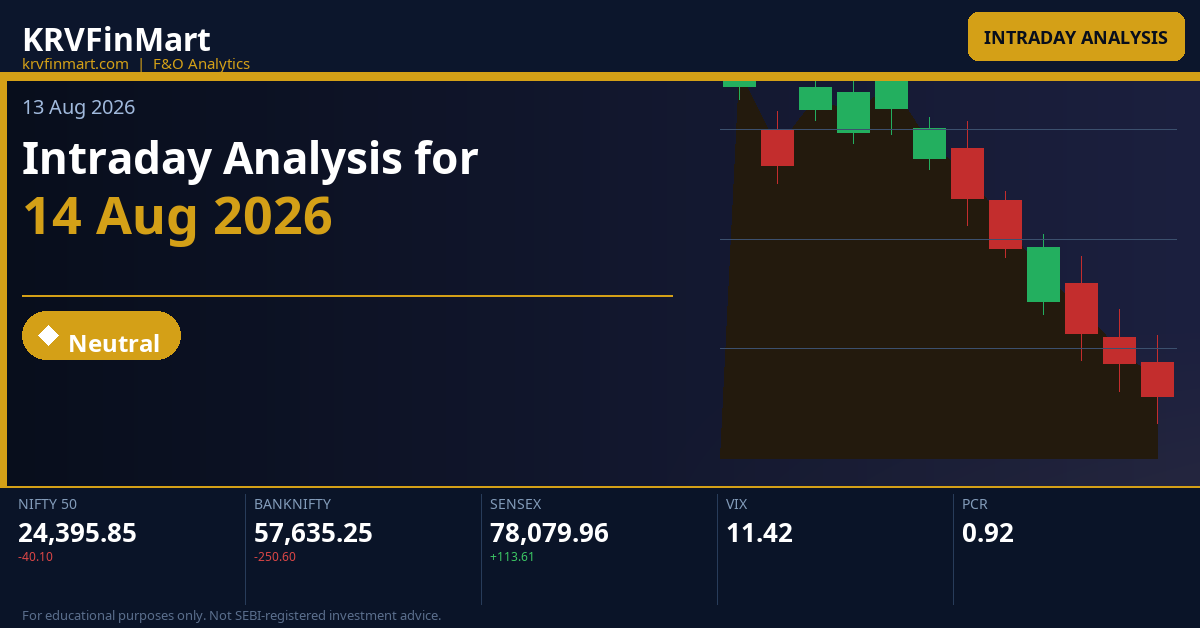
Markets closed on a mixed note on 13 Aug 2026, with NIFTY edging lower by 0.16% to 24,395.85, BANKNIFTY declining 0.43% to 57,635.25, while SENSEX bucked the trend with a marginal 0.15% gain to 78,079.96 — reflecting a divergent undercurrent between broader market sentiment and banking sector pressure. India VIX data is unavailable for this session, which makes it critical to rely heavily on straddle pricing and OI structure for gauging implied volatility expectations; the NIFTY weekly straddle at 205.40 points implies a move of roughly ±0.84% from the ATM of 24,400, suggesting the options market is pricing a contained but directional day ahead. Traders should approach 14 Aug 2026 with CPR compression as the dominant theme — both NIFTY and BANKNIFTY carry Inside Narrow CPRs, historically the strongest precursor to trend days, making the first 15-minute candle's direction absolutely decisive for the session's trajectory.
Key Market Signals — Intraday Setup
All three indices are trading below their respective Weekly CPR Pivot levels (NIFTY Weekly P at 24,590.97, BANKNIFTY Weekly P at 57,782.35, SENSEX Weekly P at 78,618.06), signalling that weekly bias remains tilted bearish-to-neutral and any intraday recovery attempt must first reclaim these weekly pivot anchors to shift structural momentum. The Inside Narrow CPR configuration on both NIFTY and BANKNIFTY alongside the SENSEX Overlapping Medium CPR creates a session where compression energy on NIFTY and BANKNIFTY could set the tone, while SENSEX with its broader OI walls at 77,800 PE and 78,100 CE acts as the range-defining barometer for the entire market.
Deep Technical Analysis & Levels

NIFTY
Inside — Narrow (Width: 0.07%)
◆ Neutral
Market Structure Trending (up or down trend) | Straddle NIFTY Weekly ATM 24,400 straddle is priced at **205.40 points** (Call 122.05 + Put 83.35), implying an expected intraday move of approximately **±205 points** from 24,400 — covering a range of roughly 24,195 to 24,605. The Call premium at 122.05 exceeds the Put at 83.35, suggesting a slight bullish skew in absolute premium terms, but the proximity of the current close at 24,395.85 to the ATM strike of 24,400 means the market is essentially pricing an at-the-money straddle with maximum time-value exposure — any sharp directional move in either direction will begin rapid decay on the losing leg. | Max Pain NIFTY Weekly Max Pain is at **24,400** (expiry 18-Aug-2026), which coincides almost perfectly with the current closing price of 24,395.85 and the ATM strike. This means option sellers are maximally hedged at 24,400 and will actively defend this level by selling CE on rallies and PE on dips — the market structure strongly favours magnetic price action toward 24,400 as the session progresses, making aggressive directional trades above 24,447.84 (R1) or below 24,327.64 (S1) necessary to escape the Max Pain gravity zone. |
Tomorrow's Complete Level Map
OI-R: 25,000 R3: 24,568.04 H6: 24,516.47 H5: 24,500.57 R2: 24,499.82 H4 ▶: 24,461.96 R1: 24,447.84 PDH: 24,431.60 H3 ↩: 24,428.90
TC: 24,387.74 P: 24,379.62 BC: 24,371.50
L3 ↩: 24,362.79 PDL: 24,311.40 S1: 24,327.64 L4 ▶: 24,329.74 S2: 24,259.42 L5: 24,291.14 L6: 24,275.23 S3: 24,207.44 OI-S: 24,000
↩ = Camarilla reversal point | ▶ = Camarilla breakout/breakdown trigger | OI-R/OI-S = Options wall (CE/PE max OI)
▲ Higher Open (Gap Up) — Open > Prev Close
▲ Bullish
Open lands: Any gap up above the previous close of 24,395.85 immediately places the open ABOVE the TC of 24,387.74, since TC itself is below yesterday's close. For a Minor Gap (0.05–0.25%), the open lands in the H3 zone of 24,428.90, well above TC but below PDH of 24,431.60. For a Significant Gap (0.25–0.5%), open approaches R1 at 24,447.84 and H4 at 24,461.96. For a Large Gap (>0.5%), open breaches H4 at 24,461.96 and potentially reaches R2 at 24,499.82 or H5 at 24,500.57. This is a DOUBLE compression release scenario — the Inside CPR energy combines with the gap to create a high-probability trend day to the upside.
CPR role: In a gap-up scenario on an Inside Narrow CPR, the entire CPR band (BC 24,371.50 to TC 24,387.74) acts as a LAUNCH PAD and immediate support below. The CPR is no longer a decision zone but a springboard — price has already vaulted above TC on the open, confirming the bulls control the compression release. Any pullback to the TC at 24,387.74 or pivot at 24,379.62 is a buy-the-dip opportunity rather than a structural failure signal.
Minor Gap (0.05–0.25%) — Structure Dominant
A minor gap of 0.05–0.25% opens NIFTY at approximately 24,408 to 24,457, placing the index just above TC at 24,387.74 and within or approaching the H3 Camarilla level at 24,428.90 and PDH at 24,431.60. This gap size activates the Inside CPR compression release but keeps structure as the dominant force — the first 15-minute candle direction becomes critical, and a close above H3 at 24,428.90 and PDH at 24,431.60 within the first candle confirms the double compression release is live. The immediate first target on a confirmed minor gap-up is R1 at 24,447.84, followed by H4 at 24,461.96, with the confluence of R2 at 24,499.82 and H5 at 24,500.57 as the intraday swing target — traders should initiate longs above H3 at 24,428.90 with a stop below TC at 24,387.74.
Significant Gap (0.25–0.5%) — Balanced
A significant gap of 0.25–0.5% opens NIFTY around 24,457 to 24,518, directly into the H4 Camarilla breakout zone at 24,461.96 or potentially reaching R2 at 24,499.82 and H5 at 24,500.57 — creating immediate gap-fill risk as these are major resistance confluences. Traders must assess whether the open is above or below H4 at 24,461.96; an open directly AT this level creates a battle between gap momentum and Camarilla mean-reversion pressure, and any failure to hold H4 in the first 15 minutes signals a gap-fill trade back toward H3 at 24,428.90 and then CPR TC at 24,387.74. Delta-hedging by CE writers at H4 and R2 will create selling pressure at the open, so the high-probability trade is to wait for a 15-minute consolidation above H3 at 24,428.90 before adding longs — confirmed holds target R3 at 24,568.04 while failures signal a return to the CPR band.
Large Gap (>0.5%) — Gap Direction Dominant
A large gap exceeding 0.5% opens NIFTY above 24,518, potentially above H5 at 24,500.57 and H6 at 24,516.47, which represents extreme compression release territory and overrides most structural caution. At this level, the open sits above the straddle implied move upper band (24,400 + 205 = 24,605 approximate ceiling), which means the options market is being stress-tested — CE writers will aggressively sell into the gap, creating a powerful ceiling dynamic. The Inside CPR compression energy, however, provides genuine momentum even against CE writing pressure, so the key abort level is a break back below H4 at 24,461.96 on a 15-minute close, while sustained trade above H5 at 24,500.57 targets the next OI wall at 25,000 — but given Max Pain at 24,400, large gaps are statistically prone to partial gap-fills by midday.
|
▲ Upside Path → OI-R Confirmed gap-up bull path: **H3 24,428.90 → PDH 24,431.60 → R1 24,447.84 → H4 24,461.96 → R2 24,499.82 / H5 24,500.57 → R3 24,568.04 → OI-R 25,000**. Each level must show price acceptance with back-to-back buying candles — H4 at 24,461.96 is the critical Camarilla breakout trigger that, once cleared on a 15-minute close, accelerates momentum toward the R2/H5 confluence at 24,499–24,500, where partial profits should be booked; continuation above R2 with volume targets R3 at 24,568.04 as the day's maximum bull extension before the OI wall at 25,000 becomes relevant. |
▼ Downside Path → OI-S Failure path from a gap-up: **TC 24,387.74 → P 24,379.62 → BC 24,371.50 → L3 24,362.79 → PDL 24,311.40 → L4 24,329.74 → OI-S 24,000**. Loss of TC at 24,387.74 within 30 minutes of open after a gap-up is a major structural signal — it means the double compression release has failed, bulls are trapped, and the session could become a reverse trend day; L3 at 24,362.79 is the first bear target, and breach of PDL at 24,311.40 opens a sharp move toward L4 at 24,329.74 and ultimately the OI support wall at 24,000. |
| 🔴 OI-R: The OI resistance at **25,000 CE** is a distant but powerful ceiling — massive CE writing at this strike means any attempt to breach 25,000 will face enormous gamma-driven selling from option writers who will aggressively hedge their delta exposure by selling NIFTY futures. In a gap-up day, 25,000 CE OI acts as the ultimate circuit breaker for the session, and price is unlikely to reach there without a cascading short-squeeze that forces CE writers to cover — the more relevant intraday ceiling remains R3 at 24,568.04 and the straddle upper bound near 24,605. | 🟢 OI-S: The OI support at **24,000 PE** is the primary downside anchor for the day — PE writers at 24,000 have the strongest incentive to defend this level, and in a gap-up scenario it acts as a distant safety net that is largely irrelevant for intraday direction unless a catastrophic reversal occurs. Its role in a gap-up session is to define the 'worst-case' downside floor and reassure bulls that the structural base remains intact well below current price levels, providing psychological support for adding to long positions on dips. |
⚡ Key Trigger: The primary bullish trigger is a **first 15-minute candle close above H3 at 24,428.90 AND PDH at 24,431.60** on above-average volume — this dual confirmation signals that compression energy is directionally committed upward and the prior day's high is no longer an obstacle. If the first 15-minute candle fails to close above PDH at 24,431.60 and instead reverses below H3 at 24,428.90, this signals a trap-door scenario where gap buyers are caught, and the trade flips to a short toward the CPR TC at 24,387.74 and then BC at 24,371.50.
▼ Lower Open (Gap Down) — Open < Prev Close
▼ Bearish
Open lands: A gap down below the previous close of 24,395.85 places the open below TC at 24,387.74 — but the critical differentiation is where relative to BC at 24,371.50. For a Minor Gap (0.05–0.25%), the open lands between TC at 24,387.74 and BC at 24,371.50, i.e., INSIDE the CPR band — a compression indecision zone. For a Significant Gap (0.25–0.5%), open lands below BC at 24,371.50, triggering a double compression release to the downside. For a Large Gap (>0.5%), open plunges below L3 at 24,362.79, approaching PDL at 24,311.40 or S1 at 24,327.64 — a full bearish compression release with immediate momentum.
CPR role: In a gap-down on an Inside Narrow CPR, the CPR band (BC 24,371.50 to TC 24,387.74) immediately flips to OVERHEAD RESISTANCE. Sellers who were trapped above the CPR on the previous day will use any bounce into the CPR band as an opportunity to exit or add short positions, making TC at 24,387.74 and BC at 24,371.50 formidable barriers to recovery.
Minor Gap (0.05–0.25%) — Structure Dominant
A minor gap down of 0.05–0.25% opens NIFTY around 24,384 to 24,332, placing price INSIDE the CPR band between BC at 24,371.50 and TC at 24,387.74 — this is an ambiguous zone where the compression energy has not yet committed directionally. The gap-fill probability within the first 30–60 minutes is moderate-to-high for minor gaps, as price tends to test TC at 24,387.74 first before deciding direction — a reclaim of TC on the first 15-minute close is bullish, while rejection from TC and close below BC at 24,371.50 triggers the bear scenario. If price fails to reclaim BC at 24,371.50 within the first 15 minutes and closes below it, the next target is L3 at 24,362.79, followed by PDL at 24,311.40 and then S1 at 24,327.64 as the bear continuation path.
Significant Gap (0.25–0.5%) — Balanced
A significant gap down of 0.25–0.5% opens NIFTY around 24,335 to 24,274, placing price below BC at 24,371.50 and potentially near L3 at 24,362.79 or L4 at 24,329.74 — this is a double compression release to the downside and the opening itself serves as directional confirmation. The 30-minute reclaim rule applies: if NIFTY can reclaim BC at 24,371.50 within the first 30 minutes on a candle close, the gap-fill trade back to TC at 24,387.74 and P at 24,379.62 is valid, but failure to reclaim BC confirms bears are in control. PUT writing flows at 24,000 and 24,200 will provide a psychological floor, but the immediate bear targets on a failed recovery are L3 at 24,362.79, then L4 at 24,329.74 and PDL at 24,311.40, with extension to L5 at 24,291.14 and the OI support wall at 24,000.
Large Gap (>0.5%) — Gap Direction Dominant
A large gap down exceeding 0.5% opens NIFTY below 24,276, directly into L5 at 24,291.14 or L6 at 24,275.23 — breaching PDL at 24,311.40, S1 at 24,327.64, and L4 at 24,329.74 in a single opening move, which represents a panic opening that forces all intraday stop-losses to trigger simultaneously. In this scenario, VIX (unavailable but implied by straddle at 205 pts) would be spiking, making straddle buying at the open highly expensive, but those who hold puts from the prior day will begin booking profits near L5 at 24,291.14 — creating a temporary bounce. The recovery level to watch is L4 at 24,329.74; any two consecutive 30-minute closes above this level signal a recovery trade toward BC at 24,371.50, while sustained trade below L5 at 24,291.14 targets S2 at 24,259.42 and then OI support at 24,000 as the ultimate destination.
|
▲ Upside Path → OI-R Recovery bull path from gap-down: **BC 24,371.50 → P 24,379.62 → TC 24,387.74 → H3 24,428.90 → R1 24,447.84 → OI-R 25,000**. Each step requires a confirmed 15-minute candle close above the level with back-to-back green candles — the most critical reclaim is BC at 24,371.50 because it transforms the CPR from overhead resistance back to support and signals that gap-down sellers have been absorbed. |
▼ Downside Path → OI-S Bear continuation from gap-down: **L3 24,362.79 → PDL 24,311.40 → L4 24,329.74 → S1 24,327.64 → L5 24,291.14 → L6 24,275.23 → S2 24,259.42 → OI-S 24,000**. Retail stop-losses cluster just below L3 at 24,362.79 and PDL at 24,311.40 — once these levels breach on volume, algorithmic selling accelerates the move toward L4 at 24,329.74 and L5 at 24,291.14, with the OI support at 24,000 acting as the session's maximum bearish target where PE monetisation creates a strong reversal bounce. |
| 🔴 OI-R: In a gap-down scenario, the OI resistance at **25,000 CE** becomes a distant and irrelevant ceiling — it represents a level so far above current price that CE delta-hedging at that strike adds negligible selling pressure to the intraday session. However, it sets the psychological ceiling for any 'escape to bull' narrative, and CE writers at nearer strikes like R1 at 24,447.84 and H3 at 24,428.90 will be the more impactful sellers capping any recovery bounce. | 🟢 OI-S: The OI support at **24,000 PE** is the PRIMARY bear target and PUT monetisation zone in a gap-down session — massive PE OI at 24,000 means PUT holders begin booking profits aggressively if NIFTY approaches this level, creating a powerful reversal bounce that makes 24,000 the most important intraday support to watch. Whether this level triggers covering (bounce) or further selling depends on the velocity of the decline — a slow, grinding fall typically sees strong PE-driven reversal at 24,000, while a panic decline may briefly breach it before recovering. |
⚡ Key Trigger: The bear confirmation trigger is **failure to reclaim BC at 24,371.50 within the first 30 minutes** — if price opens below BC and cannot close a 15-minute candle above it within the opening two candles, the double compression release is confirmed bearish and longs should be exited immediately. Conversely, the bull recovery trigger is a **first 15-minute candle close above TC at 24,387.74** with volume — this signals that the gap-down was a false break and the compression energy is actually releasing to the upside, targeting R1 at 24,447.84.
◆ Near Flat Open — Open ≈ Prev Close (±0.05%)
◆ Neutral
Open lands: A flat open within ±0.05% of the previous close at 24,395.85 places NIFTY at approximately 24,384 to 24,408 — this means the open lands ABOVE TC at 24,387.74 but BELOW H3 at 24,428.90, inside the CPR compression zone. The Inside Narrow CPR with its tight width of 0.07% (BC 24,371.50 to TC 24,387.74) creates maximum ambiguity at the open, and the flat open directly in this zone is the highest-information setup of the day — every participant is watching the first candle direction.
CPR role: The CPR band in a flat-open Inside Narrow scenario acts as a pure DECISION ZONE and COMPRESSION BAND — there is no directional lean from either the gap or the CPR structure, making the first 15-minute candle the sole arbiter of the day's trend. The TC at 24,387.74 is the bullish trigger and BC at 24,371.50 is the bearish trigger, with the pivot at 24,379.62 as the neutral midpoint.
Near Flat (±0.05%)
A flat open on an Inside Narrow CPR (width 0.07%) is statistically the highest-probability setup for a trend day — research on narrow CPRs consistently shows that price compression of this magnitude releases in a single, sustained directional move once the first 15-minute candle closes, and NIFTY traders must treat this as a 'wait and act' scenario rather than an anticipatory trade. The CPR band from BC at 24,371.50 to TC at 24,387.74 spans only 16.24 points — in a market where the weekly straddle implies a ±205-point move, this compression is extreme and the energy release will be violent and fast once direction is confirmed. The CPR width of 0.07% is well below the 0.10% Narrow threshold that signals trend day probability exceeding 70%, meaning traders should size up on the first confirmed directional close — a 15-minute close ABOVE TC at 24,387.74 targets H3 at 24,428.90 immediately and then R1 at 24,447.84, while a 15-minute close BELOW BC at 24,371.50 targets L3 at 24,362.79 and then PDL at 24,311.40. Both triggers require volume confirmation — a weak first candle close on below-average volume at either TC or BC is a false signal and the trade should be skipped, waiting for the second candle to confirm.
|
▲ Upside Path → OI-R Bull flat-open path: **TC 24,387.74 → H3 24,428.90 → PDH 24,431.60 → R1 24,447.84 → H4 24,461.96 → R2 24,499.82 / H5 24,500.57 → R3 24,568.04 → OI-R 25,000**. H3 at 24,428.90 is the first Camarilla mean-reversion stall zone — if price blows through it on the first candle with high volume, it signals genuine compression release rather than a weak probe; book partial profits at R1 at 24,447.84 and trail the remainder to H4 at 24,461.96, with final targets at R2 at 24,499.82 and the OI resistance at 25,000. |
▼ Downside Path → OI-S Bear flat-open path: **BC 24,371.50 → L3 24,362.79 → PDL 24,311.40 → L4 24,329.74 → S1 24,327.64 → L5 24,291.14 → S2 24,259.42 → OI-S 24,000**. L3 at 24,362.79 is the first Camarilla mean-reversion target — a close below it signals bearish momentum is accelerating; PDL at 24,311.40 is the critical prior-day low that, if breached, triggers stop-losses from yesterday's longs and accelerates the drop toward L4 at 24,329.74 and L5 at 24,291.14, with the OI support at 24,000 as the ultimate destination. |
| 🔴 OI-R: In a flat-open scenario, the OI resistance at **25,000 CE** represents the ceiling for the entire week's range expectation — CE writers at 25,000 are comfortable that price will not reach there this week given the straddle pricing of 205 points, and their gamma exposure means they will not add significant directional pressure until NIFTY approaches 24,700+. The more immediate OI-driven ceiling in today's flat-open context is the cluster of CE OI at intermediate strikes between 24,500 and 24,600, making R2 at 24,499.82 the practical OI-R ceiling for today's session. | 🟢 OI-S: In a flat-open scenario, the OI support at **24,000 PE** represents the absolute floor for the week — PUT writers at 24,000 have maximum incentive to defend this level, and their delta-hedging means any drop toward 24,100–24,200 will attract aggressive PE-driven support through futures buying. For a flat-open day where NIFTY starts near 24,396, the 24,000 PE OI level is 395 points below — beyond the straddle's implied move — and functions as a psychological anchor that keeps intraday bears from becoming too aggressive on short positions. |
⚡ Key Trigger: **First 15-minute candle close above TC at 24,387.74 = Bull trigger** targeting H3 at 24,428.90, PDH at 24,431.60, and R1 at 24,447.84; **First 15-minute candle close below BC at 24,371.50 = Bear trigger** targeting L3 at 24,362.79, then PDL at 24,311.40 and L4 at 24,329.74. These levels are the structural fulcrum of the Inside CPR compression because they represent the absolute boundary of yesterday's compressed energy band — any directional close outside this boundary signals that the balance of power has shifted decisively, and market psychology dictates that traders positioned on the wrong side of the compression release will be forced to cover simultaneously, amplifying the directional move.
BANKNIFTY
Inside — Narrow (Width: 0.04%)
◆ Neutral
Market Structure Trending (up or down trend) | Straddle BANKNIFTY Monthly ATM 57,600 straddle is priced at **1,014.10 points** (Call 640.10 + Put 374.00), implying an expected move of approximately **±1,014 points** from 57,600 — covering a range of roughly 56,586 to 58,614 for the monthly expiry cycle. The significantly higher Call premium at 640.10 versus Put at 374.00 reveals a pronounced bullish skew, suggesting institutional participants are pricing in more upside risk than downside risk for BANKNIFTY over the coming weeks. For intraday purposes on 14 Aug, the straddle implies the options market is anticipating large amplitude moves — BANKNIFTY's Inside Narrow CPR of 0.04% width combined with a 1,014-point straddle creates an explosive setup where the compression release could cover 500–700 points intraday. | Max Pain BANKNIFTY Monthly Max Pain is at **57,800** (expiry 25-Aug-2026), which is 164.75 points above the current close of 57,635.25. This implies a mild upward pull from option seller positioning — MAX Pain at 57,800 means option writers will nudge prices higher through the week, creating a slight upside bias that aligns with the Call-heavy straddle skew. Intraday, Max Pain gravity at 57,800 makes the PDH at 57,799.15 an extraordinarily important level — a close above PDH on 14 Aug would directly align with Max Pain and create powerful option-seller-driven momentum. |
Tomorrow's Complete Level Map
OI-R: 58,000 R3: 58,023.95 H6: 57,886.18 H5: 57,853.53 R2: 57,911.55 H4 ▶: 57,773.05 R1: 57,773.40 PDH: 57,799.15 H3 ↩: 57,704.15
TC: 57,673.88 P: 57,661.00 BC: 57,648.12
L3 ↩: 57,566.35 PDL: 57,548.60 S1: 57,522.85 L4 ▶: 57,497.45 S2: 57,410.45 L5: 57,416.97 L6: 57,384.32 S3: 57,272.30 OI-S: 57,000
↩ = Camarilla reversal point | ▶ = Camarilla breakout/breakdown trigger | OI-R/OI-S = Options wall (CE/PE max OI)
▲ Higher Open (Gap Up) — Open > Prev Close
▲ Bullish
Open lands: A gap up above the previous close of 57,635.25 places the open above TC at 57,673.88 — the entire CPR band (BC 57,648.12 to TC 57,673.88) is left below the opening price, creating a DOUBLE compression release to the upside. For a Minor Gap, the open lands between TC at 57,673.88 and H3 at 57,704.15. For a Significant Gap, open reaches H3 at 57,704.15 to H4 at 57,773.05, approaching the extraordinary convergence of H4 at 57,773.05, R1 at 57,773.40, PDH at 57,799.15, and Max Pain at 57,800. For a Large Gap, open exceeds H4 at 57,773.05 and potentially challenges OI resistance at 58,000.
CPR role: The CPR band (BC 57,648.12 to TC 57,673.88) instantly becomes a LAUNCH PAD and strong support zone below the opening price in a gap-up scenario. The extremely narrow width of 0.04% (only 25.76 points) means the support band is tight and clear — any pullback into this zone should be bought, as the Inside CPR compression release logic requires price to stay above TC at 57,673.88 to maintain the bullish thesis.
Minor Gap (0.05–0.25%) — Structure Dominant
A minor gap of 0.05–0.25% opens BANKNIFTY at approximately 57,664 to 57,779, placing it between TC at 57,673.88 and the extraordinary confluence of H4 at 57,773.05, R1 at 57,773.40, PDH at 57,799.15, and Max Pain at 57,800 — this is the most important cluster of resistance levels in today's session for BANKNIFTY. The Inside CPR compression structure at 0.04% width adds maximum bullish confirmation to the minor gap, as CPR structure is dominant for sub-0.25% gaps — the first 15-minute candle must close above H3 at 57,704.15 to confirm compression release is active. The initial targets are H3 at 57,704.15 and then the critical quad-confluence zone at H4/R1/PDH/Max Pain around 57,773–57,799, where partial profits must be booked as this zone will generate heavy CE writer resistance; a clean 15-minute close above PDH at 57,799.15 targets R2 at 57,911.55, H5 at 57,853.53, and OI resistance at 58,000.
Significant Gap (0.25–0.5%) — Balanced
A significant gap of 0.25–0.5% opens BANKNIFTY at approximately 57,779 to 57,924, directly into or above the massive quad-confluence resistance zone (H4 57,773.05 / R1 57,773.40 / PDH 57,799.15 / Max Pain 57,800) — this opening creates immediate gamma-hedging pressure from CE writers at 58,000 who will sell BANKNIFTY futures aggressively. Gap-fill risk is extremely high at this level because the convergence of four major resistance levels acts as a ceiling of maximum selling pressure, and a significant gap opening above PDH at 57,799.15 without sustained volume is a prime fade setup back toward H3 at 57,704.15. However, if the first 15-minute candle closes above R1 at 57,773.40 AND PDH at 57,799.15 simultaneously on above-average volume, the double compression release overrides mean-reversion, and the next targets are R2 at 57,911.55, H5 at 57,853.53, H6 at 57,886.18, and OI resistance at 58,000.
Large Gap (>0.5%) — Gap Direction Dominant
A large gap exceeding 0.5% opens BANKNIFTY above 57,924, potentially directly at or above R2 at 57,911.55 and challenging OI resistance at 58,000 — this is the extreme compression release scenario where the 0.04% CPR width generates maximum momentum but also maximum mean-reversion risk. At an opening above 57,924, BANKNIFTY is trading above both the monthly Max Pain at 57,800 and approaching the massive CE OI wall at 58,000, where call writers will sell futures with full delta, making upside extension very difficult. The Inside CPR exception applies — the compression energy can sustain the gap for 30–45 minutes before mean-reversion kicks in; the abort level for bulls is a 15-minute close below H4 at 57,773.05, which signals the gap is filling, and the bear target becomes TC at 57,673.88 and BC at 57,648.12.
|
▲ Upside Path → OI-R Confirmed bull gap-up path: **H3 57,704.15 → H4 57,773.05 / R1 57,773.40 → PDH 57,799.15 → Max Pain 57,800 → R2 57,911.55 / H5 57,853.53 → H6 57,886.18 → R3 58,023.95 → OI-R 58,000**. The quad-confluence zone at 57,773–57,800 is the most critical intraday checkpoint — book 50% of position here and let the remainder run only if a 15-minute close ABOVE PDH at 57,799.15 occurs on volume; above PDH, the Max Pain magnet at 57,800 becomes a launch pad rather than a ceiling, accelerating the move toward R2 at 57,911.55 and the OI resistance at 58,000. |
▼ Downside Path → OI-S Failure path from gap-up: **TC 57,673.88 → P 57,661.00 → BC 57,648.12 → L3 57,566.35 → PDL 57,548.60 → L4 57,497.45 → OI-S 57,000**. Loss of TC at 57,673.88 within 30 minutes of a gap-up open on BANKNIFTY is a severe structural failure signal — it means the double compression release has inverted to bearish, and the violent whipsaw will trap both gap-up buyers and late shorts; the L3 at 57,566.35 and PDL at 57,548.60 represent the next critical support cluster, and breach of PDL accelerates selling toward L4 at 57,497.45 and OI support at 57,000. |
| 🔴 OI-R: The OI resistance at **58,000 CE** is today's most critical upside ceiling — it is only 364.75 points above the previous close of 57,635.25 and sits within the straddle's implied monthly move range, making it a realistic intraday target in a strong gap-up scenario. CE writers at 58,000 will sell BANKNIFTY futures with maximum aggression as price approaches this level — any intraday push above 58,000 will face enormous gamma-driven selling pressure, and traders should exit long positions at or below 58,000 rather than holding for extension. | 🟢 OI-S: The OI support at **57,000 PE** is the primary downside anchor — PE writers at 57,000 have positioned with the expectation that BANKNIFTY will not fall below this level, and their delta-hedging creates a 635-point buffer below current price. In a gap-up scenario, this level is irrelevant unless a catastrophic reversal occurs — its role is to define the maximum downside risk for the week and reassure bulls that the structural base is intact. |
⚡ Key Trigger: The primary bullish trigger is a **first 15-minute candle close above H3 at 57,704.15 with above-average volume**, confirming the Inside CPR double compression release is active and directionally committed upward — this level is the fulcrum because it represents the first Camarilla resistance above the CPR band, and a clear close above it signals that buyers have overcome the opening resistance and the next destination is the quad-confluence zone at H4/R1/PDH/Max Pain around 57,773–57,800. Failure to close above H3 at 57,704.15 on the first candle is a significant warning — it means CPR compression energy is not being converted to momentum and the gap may fill back to TC at 57,673.88 and BC at 57,648.12.
▼ Lower Open (Gap Down) — Open < Prev Close
▼ Bearish
Open lands: A gap down below the previous close of 57,635.25 places the open below TC at 57,673.88 and potentially below BC at 57,648.12. For a Minor Gap, the open lands between TC at 57,673.88 and BC at 57,648.12, inside the CPR band — creating ambiguity. For a Significant Gap, open drops below BC at 57,648.12, approaching PDL at 57,548.60 or L3 at 57,566.35 — a double compression release to the downside. For a Large Gap, open plunges below PDL at 57,548.60, challenging S1 at 57,522.85 and L4 at 57,497.45.
CPR role: In a gap-down scenario on BANKNIFTY's Inside Narrow CPR, the band from BC at 57,648.12 to TC at 57,673.88 immediately converts to OVERHEAD RESISTANCE. The 0.04% width of just 25.76 points makes this a very precise resistance ceiling — bears will add to shorts on any bounce into this band, while bulls must reclaim TC at 57,673.88 with conviction to neutralise the bear thesis.
Minor Gap (0.05–0.25%) — Structure Dominant
A minor gap down of 0.05–0.25% opens BANKNIFTY at approximately 57,607 to 57,491, placing price between TC at 57,673.88 and BC at 57,648.12 (for the smallest gaps) or just below BC heading toward PDL at 57,548.60 (for larger minor gaps). Minor gap-fills on BANKNIFTY are common within the first 30–60 minutes due to the banking sector's high liquidity and active institutional participation — if the open is inside the CPR band, the gap-fill trade toward TC at 57,673.88 is valid with a stop below BC at 57,648.12. However, if the open is below BC at 57,648.12 and the first 15-minute candle closes below it, the double compression release bearish scenario is confirmed — targets become L3 at 57,566.35, then PDL at 57,548.60, then L4 at 57,497.45 and S1 at 57,522.85.
Significant Gap (0.25–0.5%) — Balanced
A significant gap down of 0.25–0.5% opens BANKNIFTY around 57,491 to 57,347, below BC at 57,648.12 and potentially at or below PDL at 57,548.60 — a clear double compression release to the downside with immediate structural bear confirmation. The 30-minute reclaim rule is critical: if BANKNIFTY can recover BC at 57,648.12 within the first 30 minutes on a candle close, it signals aggressive institutional PUT selling (shorting options) and futures buying that can reverse the gap; failure to reclaim BC confirms structural weakness and targets L4 at 57,497.45, then L5 at 57,416.97 and OI support at 57,000. PUT writing activity at 57,000 will begin providing buying support as price approaches 57,200–57,300, creating a technical bounce zone before the OI wall is reached.
Large Gap (>0.5%) — Gap Direction Dominant
A large gap down exceeding 0.5% opens BANKNIFTY below 57,347, potentially at or below L4 at 57,497.45 or S1 at 57,522.85 — a panic opening that breaches multiple key supports simultaneously and triggers algorithmic selling cascades. VIX would be spiking sharply in this scenario, straddle buyers would be well in profit, and the first instinct of institutional PUT holders would be to book profits near L5 at 57,416.97 and L6 at 57,384.32, creating a temporary bounce. Recovery above L4 at 57,497.45 on two consecutive 30-minute closes is the minimum requirement for any bull rescue trade — sustained failure below L4 targets S2 at 57,410.45, then L5 at 57,416.97, and ultimately OI support at 57,000 where maximum PUT holder profit-taking occurs.
|
▲ Upside Path → OI-R Recovery bull path: **BC 57,648.12 → P 57,661.00 → TC 57,673.88 → H3 57,704.15 → H4 57,773.05 / R1 57,773.40 → PDH 57,799.15 → OI-R 58,000**. The CPR pivot at 57,661.00 is the first checkpoint — a close above it signals partial recovery; TC at 57,673.88 is the full recovery signal; and H3 at 57,704.15 confirms the gap-down was a false break with genuine bull momentum, opening the path to the quad-confluence resistance at 57,773–57,800. |
▼ Downside Path → OI-S Bear continuation: **L3 57,566.35 → PDL 57,548.60 → S1 57,522.85 → L4 57,497.45 → L5 57,416.97 → L6 57,384.32 → S2 57,410.45 → OI-S 57,000**. The cluster of PDL at 57,548.60 and L3 at 57,566.35 is the first major support zone — if both breach on volume, retail stop-losses cascade and algo selling pushes price rapidly toward L4 at 57,497.45 and L5 at 57,416.97; the OI support at 57,000 represents the maximum bearish destination for the week where PUT monetisation creates a powerful reversal. |
| 🔴 OI-R: In a gap-down scenario, the OI resistance at **58,000 CE** is an extremely distant and irrelevant ceiling — CE writers at 58,000 are comfortable and not adding delta hedging pressure at current price levels. The more proximate overhead resistance comes from the quad-confluence of H4/R1/PDH/Max Pain at 57,773–57,800, which will cap any recovery rally well before the 58,000 CE OI wall becomes relevant. | 🟢 OI-S: The OI support at **57,000 PE** is the session's most critical bear target — it represents the strike at which BANKNIFTY PE OI is maximum, meaning PUT buyers have the largest notional profit at this level and will book aggressively, creating a powerful reversal bounce. Whether the bounce sustains depends on the velocity of the decline — a slow grind toward 57,000 typically generates a strong 200–300 point reversal, while a panic collapse may breach 57,000 briefly before the PE covering rally pushes the index back above S3 at 57,272.30. |
⚡ Key Trigger: **Failure to reclaim BC at 57,648.12 within 30 minutes** of a gap-down open is the primary bear confirmation — this means institutional buyers are absent and the compression release is fully bearish, targeting L3 at 57,566.35 and PDL at 57,548.60 in the first hour. The bull recovery trigger is a **first 15-minute candle close above TC at 57,673.88** with above-average volume — this signals that the gap was a false bear trap and the compression energy is actually releasing bullish, targeting H3 at 57,704.15 and the quad-confluence zone at H4/R1/PDH/Max Pain around 57,773–57,800.
◆ Near Flat Open — Open ≈ Prev Close (±0.05%)
◆ Neutral
Open lands: A flat open within ±0.05% of the previous close at 57,635.25 places BANKNIFTY at approximately 57,606 to 57,664 — this zone straddles the CPR band (BC 57,648.12 to TC 57,673.88), meaning the open is INSIDE the CPR compression band. At the tightest end, price could open just below BC at 57,648.12, and at the wider end, it approaches TC at 57,673.88 — creating the highest-compression flat-open setup possible on BANKNIFTY.
CPR role: The CPR band in a flat-open on an Inside Narrow 0.04% CPR is the ultimate COMPRESSION BAND and DECISION ZONE — BANKNIFTY's 0.04% width (just 25.76 points from BC to TC) makes this the tightest CPR in the dataset, implying the maximum trend-day probability of any index today. Every institutional algorithm is watching BC at 57,648.12 and TC at 57,673.88 as the directional triggers.
Near Flat (±0.05%)
A flat open on BANKNIFTY's Inside Narrow CPR of 0.04% width is the single highest-probability trend-day setup in today's market — the compression is so extreme that the CPR band is only 25.76 points wide (BC 57,648.12 to TC 57,673.88), and the first 15-minute candle will almost certainly define the session's direction with a move that captures 70–80% of the daily range in the opening hour. The structural driver is the extraordinary quad-confluence resistance at H4 57,773.05 / R1 57,773.40 / PDH 57,799.15 / Max Pain 57,800 on the upside versus the PDL at 57,548.60 / L3 57,566.35 / L4 57,497.45 cluster on the downside — whichever side breaks first will attract institutional momentum with minimal resistance until these major level clusters are hit. With BANKNIFTY's monthly straddle at 1,014 points and the index closing -0.43% yesterday in a bearish session, the flat open creates a coin-flip directional scenario where the compression energy could release either way with equal fury — the bull case targets the Max Pain magnet at 57,800 and then OI resistance at 58,000, while the bear case targets L4 at 57,497.45 and OI support at 57,000. Traders must not anticipate direction — the ONLY valid trade is to wait for the first 15-minute candle CLOSE above TC at 57,673.88 (bull) or below BC at 57,648.12 (bear) on above-average volume before entering, as premature entries inside the CPR band in this compressed setup are the primary source of intraday stop-outs.
|
▲ Upside Path → OI-R Bull flat-open path: **TC 57,673.88 → H3 57,704.15 → H4 57,773.05 / R1 57,773.40 → PDH 57,799.15 → Max Pain 57,800 → H5 57,853.53 → H6 57,886.18 → R2 57,911.55 → R3 58,023.95 → OI-R 58,000**. Book 40% at H3 57,704.15 as it is the first Camarilla stall zone — if price blows through it in a single candle with high volume, hold the remainder to the quad-confluence at 57,773–57,800 where 40% more should be booked; let the final 20% run to OI-R at 58,000 only if a 15-minute close above PDH at 57,799.15 is confirmed. |
▼ Downside Path → OI-S Bear flat-open path: **BC 57,648.12 → L3 57,566.35 → PDL 57,548.60 → S1 57,522.85 → L4 57,497.45 → L5 57,416.97 → S2 57,410.45 → OI-S 57,000**. L3 at 57,566.35 and PDL at 57,548.60 form the first critical support cluster — if both are breached on consecutive bearish candles, it signals institutional selling is active and retail stop-losses are cascading; book partials at PDL at 57,548.60, hold remainder to L4 at 57,497.45 and trail stop to breakeven above L3. |
| 🔴 OI-R: In a flat-open scenario, the OI resistance at **58,000 CE** plays a dual role — it is the ultimate bullish target that validates the entire Inside CPR compression release thesis, AND it is the ceiling beyond which CE writing pressure becomes overwhelming. If BANKNIFTY reaches 58,000 on a trend day triggered by the flat open, traders should exit all long positions and reverse to short, as the gamma hedging from CE writers at 58,000 will be a powerful reversal catalyst. | 🟢 OI-S: In a flat-open scenario, the OI support at **57,000 PE** is the ultimate bearish target — it is 635 points below the previous close and represents the maximum downside for the week from the options market perspective. PE writers at 57,000 will provide strong buying support as BANKNIFTY approaches 57,100–57,200, creating a reversal zone; the flat-open bear scenario targets this level only if the compression release generates a sustained trend day with multiple confirming candles below L4 at 57,497.45. |
⚡ Key Trigger: **First 15-minute candle close above TC at 57,673.88 = Bull trigger** targeting H3 at 57,704.15 and the critical quad-confluence at H4/R1/PDH/Max Pain around 57,773–57,800; **First 15-minute candle close below BC at 57,648.12 = Bear trigger** targeting L3 at 57,566.35 and PDL at 57,548.60. These two levels are the absolute structural boundary of the Inside CPR compression — the market psychology driving the move after either trigger fires is fear-of-missing-out for those not positioned and stop-loss-driven covering for those caught on the wrong side, both of which amplify the trend day move significantly.
SENSEX
Overlapping — Medium (Width: 0.16%)
◆ Neutral
Market Structure Balanced or transitional | Straddle SENSEX Monthly ATM 78,100 straddle is priced at **1,265.85 points** (Call 739.65 + Put 526.20), implying an expected monthly move of approximately **±1,266 points** from 78,100. The weekly straddle at ATM 78,100 is an almost negligible **20.05 points** (Call 0.05 + Put 20.00), indicating the weekly expiry (13-Aug-2026) has essentially expired with maximum time decay — the Call at 0.05 is practically worthless, confirming 78,100 was the closing convergence point for weekly expiry. The key insight is that with the weekly series expiring, the monthly straddle at 1,265.85 becomes the primary volatility reference, implying SENSEX can move 1,266 points in either direction from 78,100 over the August series — today's intraday range should be bounded by the OI walls at 77,800 PE and 78,100 CE. | Max Pain SENSEX Weekly Max Pain is **78,000** and Monthly Max Pain is **78,100** — this extraordinary convergence of weekly and monthly Max Pain within 100 points of each other creates a powerful gravitational zone between 78,000 and 78,100. With the current closing price at 78,079.96, SENSEX is perfectly bracketed between these two Max Pain levels, signalling maximum option seller comfort at current levels and strong mean-reversion pressure if price deviates significantly from this 78,000–78,100 band. |
Tomorrow's Complete Level Map
OI-R: 78,100 R3: 78,697.77 H6: 78,535.88 H5: 78,475.06 R2: 78,408.58 H4 ▶: 78,329.39 R1: 78,244.27 PDH: 78,119.39 H3 ↩: 78,204.67
TC: 78,017.52 P: 77,955.08 BC: 77,892.64
L3 ↩: 77,955.25 PDL: 77,665.89 S1: 77,790.77 L4 ▶: 77,830.54 S2: 77,501.58 L5: 77,684.88 L6: 77,624.04 S3: 77,337.27 OI-S: 77,800
↩ = Camarilla reversal point | ▶ = Camarilla breakout/breakdown trigger | OI-R/OI-S = Options wall (CE/PE max OI)
▲ Higher Open (Gap Up) — Open > Prev Close
↕ Conflicted
Open lands: The previous close of 78,079.96 is ABOVE TC at 78,017.52 — SENSEX closed the previous session above the entire CPR band. For an Overlapping Medium CPR, this means the open will likely be near or above the previous close. A Minor Gap opens in the range 78,119 to 78,275, above TC at 78,017.52 and above PDH at 78,119.39 — directly into H3 at 78,204.67 and approaching the critical OI resistance at 78,100 CE. A Significant Gap opens 78,275 to 78,470, above H3 at 78,204.67 and approaching H4 at 78,329.39. A Large Gap opens above 78,470, at H5 at 78,475.06 or higher.
CPR role: In a gap-up on this Overlapping Medium CPR with the previous close already above TC at 78,017.52, the CPR band acts as a DISTANT SUPPORT and LAUNCH PAD well below the open. The CPR band from BC at 77,892.64 to TC at 78,017.52 (width 124.88 points) is over 62 points below the previous close — in a gap-up scenario, this entire CPR band is irrelevant as immediate support, and the OI resistance at 78,100 CE becomes the dominant ceiling immediately above the current price.
Minor Gap (0.05–0.25%) — Structure Dominant
A minor gap up of 0.05–0.25% opens SENSEX at approximately 78,119 to 78,275, placing it immediately above PDH at 78,119.39 — critically, this also means the open is at or above the OI resistance at 78,100 CE, which is the highest CE OI strike for both the weekly and monthly series. This creates an immediate conflict: the gap-up momentum is bullish, but the OI resistance at 78,100 CE is a maximum selling zone where CE writers will aggressively sell SENSEX derivatives to protect their positions. The Overlapping Medium CPR confirmation rule requires a 30-minute close above H3 at 78,204.67 to validate the gap-up as genuine — a 30-minute close above H3 targets R1 at 78,244.27 and then H4 at 78,329.39, while failure to hold PDH at 78,119.39 within the first 30 minutes signals the OI wall is acting as a ceiling and a fade trade back to TC at 78,017.52 is valid.
Significant Gap (0.25–0.5%) — Balanced
A significant gap of 0.25–0.5% opens SENSEX at approximately 78,275 to 78,469, above the OI resistance at 78,100 CE and into the H3 at 78,204.67 to H4 at 78,329.39 zone — this is an opening above the primary OI ceiling, which in SENSEX terms represents a gap through maximum CE writing territory. Gap-fill risk back toward 78,100 OI resistance and then TC at 78,017.52 is very high, as CE writers who are now in-the-money will delta-hedge by selling SENSEX futures aggressively. The Overlapping Medium CPR requires two 30-minute closes above H3 at 78,204.67 to confirm that the gap is sustainable — if two consecutive 30-minute candles close above H3, the next target is R1 at 78,244.27, H4 at 78,329.39, and R2 at 78,408.58.
Large Gap (>0.5%) — Gap Direction Dominant
A large gap exceeding 0.5% opens SENSEX above 78,470, at or above H5 at 78,475.06 — above both Max Pain levels (78,000 and 78,100), above OI resistance at 78,100 CE, and beyond the straddle's implied weekly move. This is an extreme opening that creates maximum CE writer stress — every CE series below the open becomes in-the-money, forcing delta-hedging selling across multiple strikes simultaneously. The Inside CPR exception does NOT apply here (this is Overlapping Medium, not Inside), so two 30-minute confirms are required before trusting the gap — the primary abort level is H3 at 78,204.67 (if the open is above H5, any pullback below H3 is a full gap-fill signal targeting the OI resistance at 78,100 and then TC at 78,017.52).
|
▲ Upside Path → OI-R Confirmed bull gap-up path: **PDH 78,119.39 → H3 78,204.67 → R1 78,244.27 → H4 78,329.39 → R2 78,408.58 → H5 78,475.06 → H6 78,535.88 → R3 78,697.77**. H3 at 78,204.67 is the first Camarilla mean-reversion stall — book 30% at H3; H4 at 78,329.39 is the Camarilla breakout trigger — book another 30% here and trail the remainder; R2 at 78,408.58 and H5 at 78,475.06 are the maximum intraday bull targets for the Overlapping Medium CPR — do NOT hold beyond H5 as the Wide-adjacent confirmation rules require profit-booking at Traditional targets. |
▼ Downside Path → OI-S Failure from gap-up: **OI-R 78,100 → TC 78,017.52 → P 77,955.08 → L3 77,955.25 → BC 77,892.64 → OI-S 77,800 → L4 77,830.54 → S1 77,790.77**. Loss of OI resistance at 78,100 as support (price falls back through it) is the primary failure signal — this means the CE OI wall has absorbed all buying and sellers are winning; TC at 78,017.52 is the next support, and the near-identical values of P at 77,955.08 and L3 at 77,955.25 create a tight double support at 77,955 which, if broken, opens the gap-fill to OI support at 77,800 and then L4 at 77,830.54. |
| 🔴 OI-R: The OI resistance at **78,100 CE** is uniquely positioned as the MOST PROXIMATE ceiling for SENSEX — at just 20 points above the previous close of 78,079.96, this CE OI wall is literally at the current price level and represents maximum CE writing concentration. In a gap-up scenario, this level acts as the first and most important resistance test — CE writers at 78,100 will sell SENSEX derivatives aggressively on any move toward or above this level, and only a sustained two-candle close above it validates genuine bullish momentum; a bounce and rejection here signals a mean-reversion short toward BC at 77,892.64. | 🟢 OI-S: The OI support at **77,800 PE** is the primary downside anchor at 279.96 points below the previous close — PUT writers at 77,800 have positioned with the expectation that SENSEX will not fall below this level this week, and their delta-hedging creates strong futures buying near 77,800. In a gap-up scenario, 77,800 PE OI is the safety net that defines maximum downside risk — if the gap reverses completely and price falls to 77,800, it signals a catastrophic session reversal, but strong PE writer defence should create a significant reversal bounce. |
⚡ Key Trigger: The bullish trigger for SENSEX in a gap-up scenario is a **30-minute candle close above H3 at 78,204.67 AND above PDH at 78,119.39**, confirming that the OI resistance wall at 78,100 CE has been genuinely absorbed rather than merely touched — this is critical because the OI resistance at 78,100 CE is the most proximate ceiling to the current price and must be decisively cleared before any upside extension is credible. Failure to sustain above OI resistance at 78,100 within the first 30 minutes confirms the CE wall is intact and the gap-fill trade toward TC at 78,017.52 and then BC at 77,892.64 becomes the high-probability scenario for the remainder of the session.
▼ Lower Open (Gap Down) — Open < Prev Close
▼ Bearish
Open lands: The previous close of 78,079.96 is above TC at 78,017.52. A gap down on this Overlapping Medium CPR means different things at different gap sizes: a Minor Gap opens 78,040 to 77,880, potentially inside the CPR band (between BC at 77,892.64 and TC at 78,017.52) or near BC. A Significant Gap opens 77,880 to 77,690, below BC at 77,892.64 and near PDL at 77,665.89 and L5 at 77,684.88 — directly at OI support at 77,800. A Large Gap opens below 77,690, below PDL at 77,665.89 and challenging L5 at 77,684.88 and L6 at 77,624.04.
CPR role: In a gap-down on SENSEX's Overlapping Medium CPR where the previous close was above TC, the CPR band (BC 77,892.64 to TC 78,017.52) flips to OVERHEAD RESISTANCE if the open is below it, or BATTLEGROUND if the open is inside the band. The 124.88-point width of the CPR means there is significant territory to navigate — a gap into the CPR band creates a wide decision zone where both bulls and bears can establish positions, and the 30-minute confirmation rule is essential.
Minor Gap (0.05–0.25%) — Structure Dominant
A minor gap down of 0.05–0.25% opens SENSEX at approximately 78,041 to 77,881, placing price either just below TC at 78,017.52 (inside the CPR band) or just below BC at 77,892.64. For opens inside the CPR band (between BC 77,892.64 and TC 78,017.52), the first 30-minute candle direction is crucial — a 30-minute close above TC at 78,017.52 re-establishes the bullish stance and targets OI resistance at 78,100, while failure to reach TC and a close below P at 77,955.08 signals CPR rejection and bears are in control. For opens near BC at 77,892.64, the OI support at 77,800 becomes the key reference — if SENSEX holds above 77,800 with the first 30-minute candle, the CPR band between BC and TC is the day's consolidation range; a breach of OI support at 77,800 targets L4 at 77,830.54 and then S1 at 77,790.77.
Significant Gap (0.25–0.5%) — Balanced
A significant gap down of 0.25–0.5% opens SENSEX at approximately 77,881 to 77,690, below the entire CPR band and directly at or near the critical OI support at 77,800 PE — this is the most important gap-down scenario as it tests the primary options-market floor on the open. The convergence of OI support at 77,800 and L4 at 77,830.54 creates a powerful dual-support zone within a 30-point range — if the first 30-minute candle closes above OI support at 77,800, a strong recovery toward BC at 77,892.64 and P at 77,955.08 is expected, as PE writers defend aggressively. Failure to hold OI support at 77,800 and a 30-minute close below it confirms that even PUT writers are covering and the session moves into panic territory — L5 at 77,684.88, PDL at 77,665.89, L6 at 77,624.04, and S2 at 77,501.58 become the sequential bear targets.
Large Gap (>0.5%) — Gap Direction Dominant
A large gap down exceeding 0.5% opens SENSEX below 77,690, breaching PDL at 77,665.89 and directly into L5 at 77,684.88 and L6 at 77,624.04 — a catastrophic opening that breaks all intraday support structures simultaneously and forces PUT holders into profit-booking mode. VIX would be spiking severely in this scenario, and the weekly Max Pain at 78,000 creates a 410-point recovery requirement that is statistically very difficult to achieve after a large gap-down. The first recovery target is L4 at 77,830.54 and OI support at 77,800, which requires two consecutive 30-minute closes above 77,800 — sustained trade below L5 at 77,684.88 targets S2 at 77,501.58 and then S3 at 77,337.27 as the maximum bear extension.
|
▲ Upside Path → OI-R Recovery path from gap-down: **BC 77,892.64 → P 77,955.08 → L3 77,955.25 → TC 78,017.52 → PDH 78,119.39 → OI-R 78,100 → H3 78,204.67**. The near-perfect confluence of P at 77,955.08 and L3 at 77,955.25 creates a major resistance cluster at 77,955 — a 30-minute close above this double level is the confirmation of genuine recovery momentum; TC at 78,017.52 must then be reclaimed for the bull thesis to be fully restored. |
▼ Downside Path → OI-S Bear continuation: **OI-S 77,800 → L4 77,830.54 → S1 77,790.77 → L5 77,684.88 → PDL 77,665.89 → L6 77,624.04 → S2 77,501.58 → S3 77,337.27**. The OI support at 77,800 is the pivotal level — a breach with a 30-minute close below it signals that PE writer delta-hedging has failed to stop the decline, and the next support cluster at L5 at 77,684.88 and PDL at 77,665.89 is only 115–135 points below, where the second major PUT buying wave should emerge. |
| 🔴 OI-R: In a gap-down scenario, the OI resistance at **78,100 CE** becomes the ultimate overhead ceiling for any recovery attempt — it is approximately 20 points above the previous close and 200+ points above the gap-down open, making it the session's maximum recovery target. CE writers at 78,100 who are now safely out-of-the-money will not add significant delta pressure at current lower levels, but as a psychological level, 78,100 defines the boundary between 'recovery' and 'full bull restoration' for the day. | 🟢 OI-S: The OI support at **77,800 PE** is the most critical level of the entire gap-down session — it represents the primary floor where SENSEX PUT writers have maximum exposure and maximum incentive to defend through futures buying. The strength of this defence determines whether the gap-down is a buying opportunity (strong hold above 77,800 = buy) or the beginning of a multi-day decline (sustained close below 77,800 = hold shorts) — PE writers at 77,800 are the market's de facto buyers of last resort in this scenario. |
⚡ Key Trigger: **Failure to reclaim TC at 78,017.52 with a 30-minute close** is the primary bear confirmation in a gap-down — this means the Overlapping Medium CPR has fully converted to overhead resistance and the session's directional bias is bearish, with BC at 77,892.64 as the next resistance and OI support at 77,800 as the day's first major target. The bull recovery trigger is a **30-minute candle close above TC at 78,017.52 with above-average volume**, which signals the CPR band has been reclaimed and the gap was a false break — this targets a return to OI resistance at 78,100 and PDH at 78,119.39.
◆ Near Flat Open — Open ≈ Prev Close (±0.05%)
◆ Neutral
Open lands: A flat open within ±0.05% of the previous close at 78,079.96 places SENSEX at approximately 78,041 to 78,119 — this range spans from slightly above TC at 78,017.52 to approximately at PDH at 78,119.39. Crucially, the flat open sits between TC at 78,017.52 (below) and the OI resistance at 78,100 CE (above, just 20 points away) — this is a uniquely compressed zone defined by the CPR TC as support below and the OI ceiling above.
CPR role: In a flat-open on this Overlapping Medium CPR, with the previous close above TC at 78,017.52, the CPR band acts as a DECISION ZONE where TC at 78,017.52 is the immediate downside reference and OI resistance at 78,100 CE is the upside ceiling. The Medium CPR width of 124.88 points is substantial — price is above the entire CPR band, making the TC at 78,017.52 a critical support level that must hold on any dip, while the 30-minute confirmation rule governs all directional trades.
Near Flat (±0.05%)
A flat open on SENSEX's Overlapping Medium CPR places price in a uniquely pressurised zone — above TC at 78,017.52 (bullish positioning) but directly at the OI resistance at 78,100 CE (supply zone), creating a natural equilibrium where neither bulls nor bears have a clear structural edge at the open. The Medium CPR width requires 30-minute candle confirmation rather than 15-minute, meaning the session will have a wider 'wait zone' before direction is committed — the first 30-minute candle open-to-close range relative to TC at 78,017.52 and H3 at 78,204.67 defines the day's bias. The convergence of Weekly Max Pain at 78,000 and Monthly Max Pain at 78,100 — spanning a range of only 100 points around the current close of 78,079.96 — means SENSEX is magnetically held between these two Max Pain anchors, and a flat open reinforces the gravitational pull of this zone; the high-probability trade is RANGE SELLING — selling above OI resistance at 78,100 and buying above OI support at 77,800. Both the bull trigger (30-minute close above H3 at 78,204.67 = escape above OI ceiling) and the bear trigger (30-minute close below TC at 78,017.52 then BC at 77,892.64 = fall toward OI support at 77,800) require confirmation before initiating directional trades, and the Balanced market structure reinforces patience over aggression in the flat-open scenario.
|
▲ Upside Path → OI-R Bull flat-open path: **H3 78,204.67 → R1 78,244.27 → H4 78,329.39 → R2 78,408.58 → H5 78,475.06 → H6 78,535.88 → R3 78,697.77**. Book 30% at H3 at 78,204.67 as this is the Camarilla mean-reversion first stall — if volume sustains above H3 on the second 30-minute candle, add to position targeting R1 at 78,244.27 and H4 at 78,329.39 as the primary Overlapping Medium CPR upside targets; R2 at 78,408.58 and H5 at 78,475.06 are extended targets for a genuine trend day only. |
▼ Downside Path → OI-S Bear flat-open path: **TC 78,017.52 → P 77,955.08 / L3 77,955.25 → BC 77,892.64 → OI-S 77,800 → L4 77,830.54 → S1 77,790.77 → L5 77,684.88 → PDL 77,665.89**. The near-identical P at 77,955.08 and L3 at 77,955.25 create a double-support cluster at 77,955 — a 30-minute close below this level is a strong bear confirmation that targets BC at 77,892.64 and then OI support at 77,800 where PUT writer defence should create a significant reversal; book shorts at increments between TC and BC, targeting OI support at 77,800 as the primary destination. |
| 🔴 OI-R: In a flat-open scenario, the OI resistance at **78,100 CE** is the session's primary ceiling and the first trade decision point — with SENSEX opening within 20 points of this level, CE writers are on maximum alert and will sell aggressively above 78,100 to protect their positions. The flat-open creates a CE-writer-vs-bull battle right at the market open, where every CE writer tick of delta-hedging selling is countered by bottom-up demand — the outcome of this battle in the first 30 minutes sets the session's tone. | 🟢 OI-S: In a flat-open scenario, the OI support at **77,800 PE** defines the session's maximum downside risk for PUT writers and serves as the primary target for any bearish CPR breakdown trade — PE writers at 77,800 are the natural buyers if price falls toward this level, creating a strong bid that prevents SENSEX from sustaining below 77,800 without a major macro catalyst. The flat-open bull-bear dynamic between OI resistance at 78,100 CE and OI support at 77,800 PE creates a 300-point trading range that is the highest-probability intraday range for SENSEX on 14 Aug 2026. |
⚡ Key Trigger: **First 30-minute candle close above H3 at 78,204.67 = Bull trigger** escaping OI resistance at 78,100, targeting R1 at 78,244.27 and H4 at 78,329.39; **First 30-minute candle close below TC at 78,017.52 = Bear trigger** initiating CPR breakdown, targeting P at 77,955.08 and BC at 77,892.64 and then OI support at 77,800. H3 at 78,204.67 is the structural fulcrum because it sits above both OI resistance at 78,100 and PDH at 78,119.39 — a close above H3 means both the options OI ceiling and the prior-day high have been cleared, validating genuine bullish momentum rather than a temporary spike; a close below TC at 78,017.52 means the CPR band has converted to overhead resistance and the path to OI support at 77,800 is open.
📊 VIX Insight: India VIX data is unavailable for the 13 Aug 2026 session, which creates a gap in the primary volatility gauge — in the absence of VIX, traders must rely on straddle pricing as the implied volatility proxy. The NIFTY weekly straddle at 205.40 points (±0.84% from 24,400) implies a controlled volatility environment consistent with a VIX in the 13–15 range historically, while the BANKNIFTY monthly straddle at 1,014.10 points implies higher relative volatility for the banking sector. Until VIX data is confirmed for 14 Aug, traders should treat any sudden widening in ATM straddle prices at the open as the functional equivalent of a VIX spike and de-risk positions accordingly — the absence of VIX data also means protective hedge sizing should be slightly increased for option sellers going into tomorrow's session.
Overall View:
All three indices enter 14 Aug 2026 in a state of compressed indecision — NIFTY and BANKNIFTY with the most extreme Inside Narrow CPRs (0.07% and 0.04% respectively) signal that trend days are highly probable, while SENSEX's Overlapping Medium CPR and balanced market structure suggest a more range-bound outcome for India's oldest index. The dominant theme is the dual OI wall dynamic: SENSEX is pinned between 77,800 PE and 78,100 CE (a 300-point range), NIFTY between 24,000 PE and 25,000 CE (a 1,000-point range), and BANKNIFTY between 57,000 PE and 58,000 CE (a 1,000-point range) — Max Pain gravity at NIFTY 24,400, BANKNIFTY 57,800, and SENSEX 78,000–78,100 will be the dominant magnetic force keeping prices anchored unless gap-driven compression releases override the gravitational pull. Traders should prioritise the first 15-minute candle direction on NIFTY and BANKNIFTY as the session's most critical data point — a synchronised gap-up and sustained close above their respective TC levels (24,387.74 and 57,673.88) would signal a bullish trend day across the board, while a gap-down and failure to reclaim BC levels (24,371.50 and 57,648.12) would confirm a coordinated bearish session with BANKNIFTY targeting Max Pain at 57,800 from below and NIFTY gravitating toward Max Pain at 24,400.
All three indices enter 14 Aug 2026 in a state of compressed indecision — NIFTY and BANKNIFTY with the most extreme Inside Narrow CPRs (0.07% and 0.04% respectively) signal that trend days are highly probable, while SENSEX's Overlapping Medium CPR and balanced market structure suggest a more range-bound outcome for India's oldest index. The dominant theme is the dual OI wall dynamic: SENSEX is pinned between 77,800 PE and 78,100 CE (a 300-point range), NIFTY between 24,000 PE and 25,000 CE (a 1,000-point range), and BANKNIFTY between 57,000 PE and 58,000 CE (a 1,000-point range) — Max Pain gravity at NIFTY 24,400, BANKNIFTY 57,800, and SENSEX 78,000–78,100 will be the dominant magnetic force keeping prices anchored unless gap-driven compression releases override the gravitational pull. Traders should prioritise the first 15-minute candle direction on NIFTY and BANKNIFTY as the session's most critical data point — a synchronised gap-up and sustained close above their respective TC levels (24,387.74 and 57,673.88) would signal a bullish trend day across the board, while a gap-down and failure to reclaim BC levels (24,371.50 and 57,648.12) would confirm a coordinated bearish session with BANKNIFTY targeting Max Pain at 57,800 from below and NIFTY gravitating toward Max Pain at 24,400.
Disclaimer: KRV Prime provides educational and informational content relating to financial markets. Articles, research, examples, charts, strategies and tools are provided for educational purposes and should not be interpreted as personalised investment advice or a guarantee of financial performance. Markets involve risk, including possible loss of capital. Past performance does not guarantee future results. KRV Prime is not a SEBI Registered Investment Adviser or Research Analyst.