
Index Analysis
Intraday Analysis for 17 Sep 2026
KRV Prime16 September 202653 min
Educational/Derived AnalysisSource: KRV Prime Market Insights (End-of-Day)As of 16 Sep 2026, 04:54 PM IST
Intraday Analysis for 17 Sep 2026
Markets closed on a positive note on 16 Sep 2026 with NIFTY gaining 0.43% to 23,217.60, BANKNIFTY up 0.89% to 56,292.45, and SENSEX rising 0.45% to 74,336.45, setting the stage for a technically loaded session on 17 Sep 2026. India VIX data is unavailable for this session, which introduces uncertainty around premium pricing and expected move validation — traders should treat straddle values as the primary volatility proxy for the day. All three indices are printing Inside CPR formations for the upcoming session — NIFTY and SENSEX with Narrow widths indicating high-probability trend days, while BANKNIFTY's Inside Wide configuration sets up a more complex range-or-breakout dynamic that requires two 30-minute confirmations before committing directionally.
Key Market Signals — Intraday Setup
All three indices are trading below their respective weekly CPR bands (NIFTY weekly P=23,506.50, BANKNIFTY weekly P=56,577.62, SENSEX weekly P=75,139.70), indicating persistent overhead pressure from the weekly timeframe and suggesting any intraday rally will face structural resistance well before weekly CPR reclaim. The Inside CPR compression across all three indices on the same session is a rare synchronised setup — the first 15–30 minutes of trade on 17 Sep 2026 will likely define the directional character of the entire week.
Deep Technical Analysis & Levels
NIFTY
Inside — Narrow
◆ Neutral
Market Structure Trending (up or down trend) | Straddle ATM 23,200 straddle = 181.95 (Call) + 126.60 (Put) = **308.55 points**, implying an expected intraday move of approximately ±308 points from ATM — an upside target zone around 23,508 and downside zone around 22,891, though the OI walls at 24,000 (CE) and 23,000 (PE) act as hard structural ceilings and floors well within this straddle range. | Max Pain Max Pain for the week expiry (22-Sep-2026) is **23,300** — sitting 82 points above yesterday's close of 23,217.60 and just above R1 at 23,296.20, implying that option sellers are positioned to benefit from NIFTY drifting slightly higher toward 23,300 by weekly expiry; intraday longs targeting 23,296–23,310 zone have expiry-day gravity on their side. |
Tomorrow's Complete Level Map
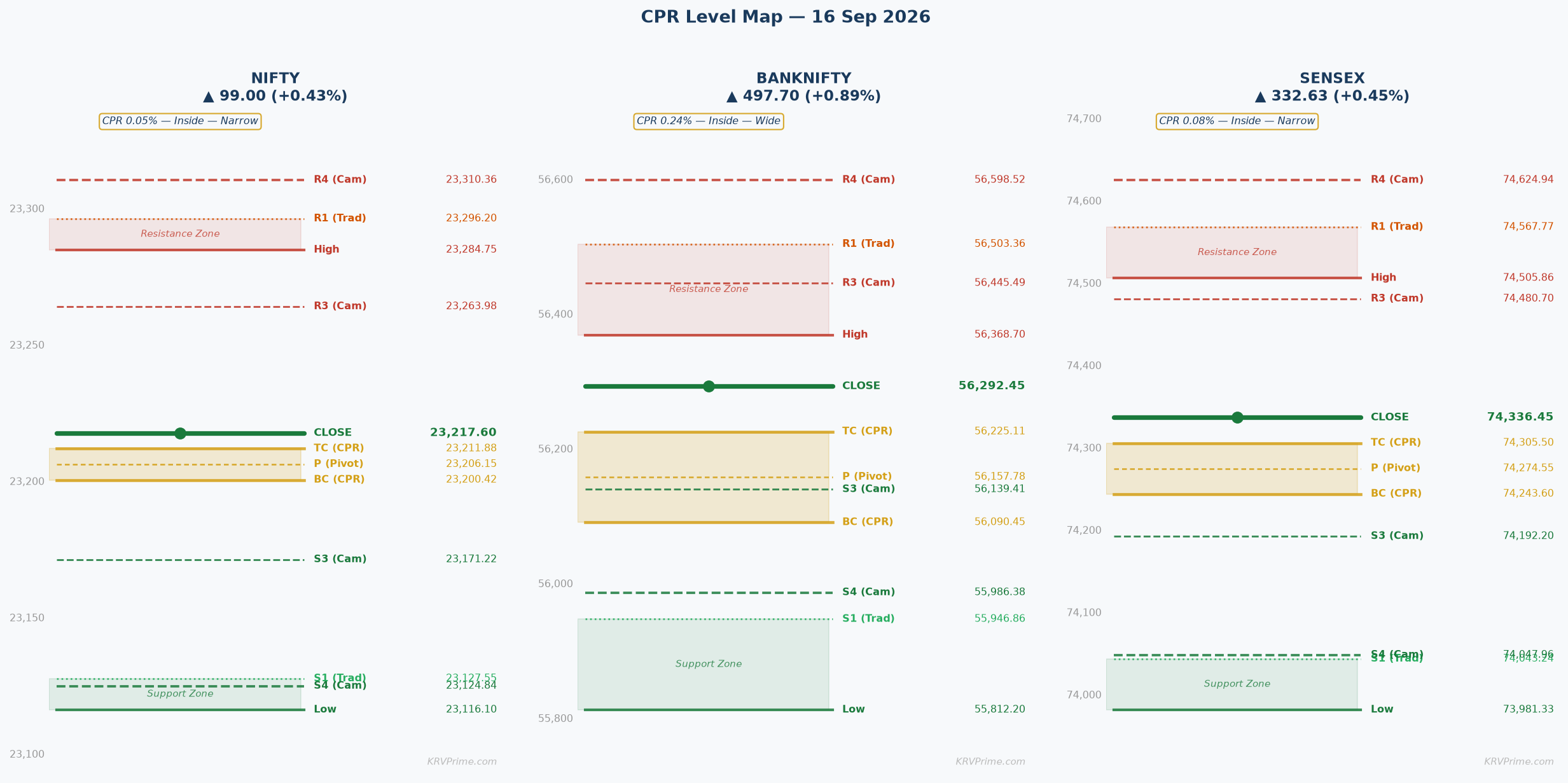
OI-R: 24,000 R3: 23,464.85 H6: 23,386.99 H5: 23,364.53 R2: 23,374.80 H4 ▶: 23,310.36 R1: 23,296.20 PDH: 23,284.75 H3 ↩: 23,263.98
TC: 23,211.88 P: 23,206.15 BC: 23,200.42
L3 ↩: 23,171.22 PDL: 23,116.10 S1: 23,127.55 L4 ▶: 23,124.84 S2: 23,037.50 L5: 23,070.67 L6: 23,048.21 S3: 22,958.90 OI-S: 23,000
↩ = Camarilla reversal point | ▶ = Camarilla breakout/breakdown trigger | OI-R/OI-S = Options wall (CE/PE max OI)
▲ Higher Open (Gap Up) — Open > Prev Close
▲ Bullish
Open lands: With an Inside Narrow CPR, a gap-up open above prev close (23,217.60) automatically places price above TC at 23,211.88 — this is the classic 'double compression release upward' scenario. The CPR band (BC=23,200.42 to TC=23,211.88) immediately transforms into a support base below the opening print, and the entire compressive energy of yesterday's Inside CPR is directed upward from the opening bell.
CPR role: Launch pad and trailing support — the CPR band (BC=23,200.42 to TC=23,211.88) acts as an immediate springboard from which bulls seek extension toward Camarilla and Traditional targets above.
Minor Gap (0.05–0.25%) — Structure Dominant
A minor gap up of 0.05%–0.25% opens NIFTY approximately in the 23,229–23,275 zone, placing it above TC at 23,211.88 but still below the first Camarilla resistance at H3=23,263.98 — a technically clean bullish compression release. The Inside Narrow CPR structure strongly reinforces this gap because the width of just 0.05% means the compressed energy is potent and needs very little catalyst to sustain directional momentum; the CPR band immediately flips to support below the open. The first target is H3 at 23,263.98 (Camarilla mean-reversion zone), followed by PDH at 23,284.75 and then R1 at 23,296.20, confirmed by a first 15-minute candle close above TC at 23,211.88 — any early dip toward TC that holds and bounces is a textbook long entry for the Narrow width confirmation rule.
Significant Gap (0.25–0.5%) — Balanced
A significant gap up of 0.25%–0.5% opens NIFTY in the 23,275–23,333 range, placing the open directly into the Camarilla H3=23,263.98 to H4=23,310.36 resistance cluster — a zone where mean-reversion selling is structurally expected from Camarilla methodology. Gap-fill risk is elevated here because a gap into H3–H4 without fresh volume typically triggers profit-booking by overnight longs and institutional delta-hedging; the open may stall or pull back toward TC at 23,211.88 before a clean directional move develops. If the first 15-minute candle holds above H3 at 23,263.98 with conviction, the target sequence accelerates to R1=23,296.20, H4=23,310.36, and R2=23,374.80, but a rejection at H3 and close back below TC converts the gap-up into a fakeout with PDL=23,116.10 and S1=23,127.55 as downside references.
Large Gap (>0.5%) — Gap Direction Dominant
A large gap up exceeding 0.5% opens NIFTY above 23,333 and potentially challenges the PDH at 23,284.75 and H4 at 23,310.36 zone from above — at this level, the gap is the dominant force and CPR structure plays a secondary role, though the Inside CPR compression energy is one of the few exceptions that retains its directional significance even through large gaps. Gap-fill probability increases sharply above 0.5% as the straddle of 308.55 points suggests the market has already priced a contained move, and an open that consumes more than 50% of the weekly straddle in gap space alone invites aggressive call-selling by institutions near R2=23,374.80 and R3=23,464.85. The abort level for any large gap-up long is a failure below TC at 23,211.88 within the first 30 minutes — if that occurs, straddle decay trades (selling CE) near H5=23,364.53 become more relevant than directional longs, with OI-R at 24,000 remaining a distant ceiling for the session.
|
▲ Upside Path → OI-R **H3 at 23,263.98** is the first Camarilla mean-reversion resistance — a clean breakout above this level with 15-minute close confirmation propels price to **PDH at 23,284.75** (yesterday's high, a natural stop cluster), then **R1 at 23,296.20** (Traditional first target, partial profit zone), and onward to **H4 at 23,310.36** (Camarilla breakout trigger) where a second 15-minute confirmation sets up for **R2 at 23,374.80**. The **OI-R at 24,000** is the ultimate CE wall for this week and month — it is not a realistic intraday target from current levels but acts as the gravitational limit that CE writers are defending, making any move toward R3=23,464.85 face exponentially increasing supply. |
▼ Downside Path → OI-S A failure to sustain above TC at 23,211.88 after a gap-up open converts the CPR band from launch pad to overhead resistance — price would then test **P at 23,206.15** and **BC at 23,200.42** as immediate support, and a 15-minute close below BC triggers a flush toward **L3 at 23,171.22** (first Camarilla mean-reversion support on the downside). Further weakness below L3 opens **PDL at 23,116.10** and the confluence of **S1=23,127.55 / L4=23,124.84** — a dense support cluster where PE writers at **OI-S=23,000** begin to provide meaningful intraday cushion. |
| 🔴 OI-R: **OI-R at 24,000** represents the heaviest CE open interest concentration for both the weekly and monthly NIFTY contracts — it is a remote but structurally dominant ceiling for the session, with call writers having positioned aggressively at this strike to collect premium as NIFTY remains trapped below it. In a gap-up scenario, the proximity of R3=23,464.85 (the highest Traditional target) is still 535 points below OI-R, confirming that the 24,000 CE wall is unlikely to be tested intraday but serves as the maximum directional aspiration and a psychological anchor for CE writers to keep selling into any rally. | 🟢 OI-S: **OI-S at 23,000** is the primary PE support floor for this session, sitting approximately 217 points below yesterday's close — it is outside the weekly straddle's bear range (which puts floor at ~22,891) and represents a strike where massive put writing has taken place, indicating institutional conviction that NIFTY will NOT close below 23,000 on the weekly or monthly basis. In a gap-up scenario, OI-S at 23,000 is largely irrelevant as an intraday target but serves as the deep abort reference — a breakdown through 23,000 on sustained volume would represent a catastrophic failure of the entire bull thesis and trigger forced delta-hedging by option dealers. |
⚡ Key Trigger: The primary trigger is a **first 15-minute candle close above TC at 23,211.88** — for a gap-up open this level should already be support, so the real directional confirmation comes from whether H3 at 23,263.98 is cleared on the next 15-minute candle, as that breakout signals that trapped overnight shorts are being squeezed and fresh momentum is entering. If price fails to hold TC at 23,211.88 at any point in the first 30 minutes, the gap-up turns structural fakeout and bulls must exit immediately, watching for a flush toward P=23,206.15 and BC=23,200.42 as the next assessment point.
▼ Lower Open (Gap Down) — Open < Prev Close
▼ Bearish
Open lands: With an Inside Narrow CPR, a gap-down open below prev close (23,217.60) automatically places price below BC at 23,200.42 — the classic 'double compression release downward' scenario. The CPR band (BC=23,200.42 to TC=23,211.88) immediately shifts to overhead resistance, and the compressive energy of the narrow Inside CPR is released in the downward direction from the first traded print.
CPR role: Overhead resistance and the key recovery battleground — the CPR band (BC=23,200.42 to TC=23,211.88) acts as a supply zone that bears will defend on any attempted bounce; a sustained reclaim above TC is the only bull recovery trigger.
Minor Gap (0.05–0.25%) — Structure Dominant
A minor gap down of 0.05%–0.25% opens NIFTY approximately in the 23,159–23,206 range, placing it below BC at 23,200.42 but above L3 at 23,171.22 — a technically important zone where the gap releases the Narrow Inside CPR's compression in the downward direction but the move is still modest enough for gap-fill recovery within the first 30 minutes. The CPR band immediately becomes overhead resistance (BC=23,200.42 to TC=23,211.88), and bulls need a 15-minute close back above BC to invalidate the bearish signal; failure to reclaim BC keeps L3 at 23,171.22 as the first downside target. The minor gap scenario is the most uncertain because the Inside CPR's trend day probability (from the Narrow width) can go either direction — watch the first 15-minute candle's high vs TC at 23,211.88 and low vs L3 at 23,171.22 for the day's directional declaration.
Significant Gap (0.25–0.5%) — Balanced
A significant gap down of 0.25%–0.5% opens NIFTY in the 23,101–23,159 range, placing the open below L3 at 23,171.22 and into the dense support cluster of S1=23,127.55 and L4=23,124.84 — this is a structurally more serious breakdown where the Inside Narrow CPR's double-release downward energy is meeting real support but momentum is clearly negative. The recovery trade requires a sustained 30-minute close back above L3 at 23,171.22 before targeting BC at 23,200.42; failure to do so within the first hour confirms that PUT writers at OI-S=23,000 are under pressure and L5=23,070.67 becomes the next downside reference. Institutional PUT writing at 23,000 will likely provide buying interest around the L4=23,124.84 to S1=23,127.55 zone, making this a natural mean-reversion entry point for scalps, but only with explicit 15-minute confirmation of base formation.
Large Gap (>0.5%) — Gap Direction Dominant
A large gap down exceeding 0.5% opens NIFTY below 23,101 and potentially through the PDL at 23,116.10, placing price in uncharted intraday territory below all major Camarilla levels — in this scenario, the Inside CPR compression release has been explosive to the downside and the straddle's implied floor of ~22,891 becomes a realistic target. The panic dynamic typical of large gaps below major support creates an initial capitulation flush toward L5=23,070.67 and L6=23,048.21, after which the OI-S at 23,000 (PE wall) tends to create a hard bounce as put writers delta-hedge and institutional buyers step in at the psychological 23,000 level. For traders, the strategy shifts from directional to straddle monetisation — buying the ATM 23,200 put that is now deeply in the money while watching for a bounce from 23,000 OI-S to scalp the recovery; the abort for any short is a recovery above S2=23,037.50 on a 30-minute close basis.
|
▲ Upside Path → OI-R The recovery path for bulls after a gap-down: **BC at 23,200.42** reclaim is the first gate (15-minute close needed), then **P at 23,206.15** (pivot confirmation), then **TC at 23,211.88** (full CPR reclaim = neutral-to-bullish shift), followed by **H3 at 23,263.98** and **PDH at 23,284.75** as the final intraday recovery targets. Each level must be confirmed with a 15-minute close in the Narrow CPR framework — a recovery that stalls at P or TC without follow-through is a dead-cat bounce and should be faded back toward L3 at 23,171.22. |
▼ Downside Path → OI-S The primary bear path after a gap-down confirmation: **L3 at 23,171.22** (first Camarilla mean-reversion target, where initial stall expected), then **PDL at 23,116.10** and the dense support cluster at **S1=23,127.55 / L4=23,124.84**, followed by **L5=23,070.67** and **L6=23,048.21** as extended bear targets. The **OI-S at 23,000** is the ultimate destination where retail stop losses below L6 trigger forced selling into the PE wall — this level historically generates sharp snap-back bounces as put writers aggressively buy futures to delta-hedge their short put exposure. |
| 🔴 OI-R: **OI-R at 24,000** acts as a remote but psychologically significant ceiling that keeps CE writers comfortable selling calls throughout any gap-down session — the massive call OI at 24,000 means that institutional shorts are not concerned about upside risk and will use any intraday bounce to add CE positions, creating a consistent supply overhang that limits recovery rallies to the CPR zone and H3 at 23,263.98 at best. | 🟢 OI-S: **OI-S at 23,000** is the PRIMARY bear target in a gap-down scenario — it is where the highest concentration of weekly and monthly PE open interest resides, meaning that if NIFTY breaks through L6=23,048.21 and approaches 23,000, a violent and sharp reversal is probable as PE writers are forced to buy futures rapidly to neutralise their delta exposure. Traders holding short positions from a confirmed gap-down breakdown should begin covering at L6=23,048.21 and take full profits near 23,050–23,000, as the OI-S at 23,000 is more likely to produce a bounce than a clean break in an environment without extreme VIX expansion. |
⚡ Key Trigger: The critical dual trigger is: **(1) Bear confirmation** — failure to reclaim BC at 23,200.42 within the first 30 minutes after a gap-down open confirms bearish momentum and activates L3=23,171.22 as the next target; **(2) Bull recovery trigger** — a first 15-minute candle close back above BC at 23,200.42 followed by TC at 23,211.88 signals gap-fill potential and initiates a recovery toward P=23,206.15 and then PDC=23,217.60. The CPR band from BC to TC (only 11.46 points wide due to Narrow configuration) is the entire battleground — every tick within this band is a decision point, and volume is the arbiter of whether bulls can reclaim the CPR or bears maintain the supply.
◆ Near Flat Open — Open ≈ Prev Close (±0.05%)
◆ Neutral
Open lands: A flat open within ±0.05% of prev close (23,217.60) places NIFTY's opening print in the 23,205.92–23,229.28 range — this means price is opening either marginally inside the CPR band (BC=23,200.42 to TC=23,211.88) or just fractionally above TC, both of which are the highest-information setup for the Narrow Inside CPR because the directional declaration will come entirely from the first 15-minute candle.
CPR role: Decision zone and compression nucleus — the CPR band (BC=23,200.42 to TC=23,211.88, width just 11.46 points = 0.05%) is the most condensed possible Inside Narrow configuration, meaning NIFTY is essentially coiled at the tightest possible tension spring; a flat open inside or at this band means the market is undecided but the first directional candle carries outsized importance.
Near Flat (±0.05%)
Flat opens inside an Inside Narrow CPR (width 0.05%) are among the highest-conviction setup days in technical analysis — the compressed energy of yesterday's range being absorbed into today's even tighter CPR band means the first 15-minute candle IS the trade signal, and false breaks are uncommon when width is this compressed. Specifically, **BC at 23,200.42** is the downside trigger — a first 15-minute candle that closes below BC initiates the double-compression release downward, targeting L3=23,171.22 first, while **TC at 23,211.88** is the upside trigger — a first 15-minute close above TC activates the double-compression release upward, targeting H3=23,263.98 and then R1=23,296.20. Given that the CPR width is only 0.05% (just 11.46 points), the market structure classification of 'Trending' is highly consistent — Inside Narrow CPRs on trending days statistically resolve into directional trend days more than 65% of the time, making this a 'wait-for-15-min-and-follow' setup rather than a fade-the-extreme approach. The bull trigger (first 15-min close above TC=23,211.88) targets H3=23,263.98 → PDH=23,284.75 → R1=23,296.20 → H4=23,310.36 sequentially, while the bear trigger (first 15-min close below BC=23,200.42) targets L3=23,171.22 → S1=23,127.55 / L4=23,124.84 → L5=23,070.67 → OI-S=23,000 as the maximum downside; traders must not pre-empt either direction and should use BC–TC as a no-trade zone until the 15-minute candle completes.
|
▲ Upside Path → OI-R Bull path: **TC at 23,211.88** → **H3 at 23,263.98** (first Camarilla mean-reversion resistance, take partial profits here as initial stall is expected) → **PDH at 23,284.75** (yesterday's high, a natural stop cluster for overnight shorts that become fuel for the upside) → **R1 at 23,296.20** (Traditional first target, trail stop to H3 after this) → **H4 at 23,310.36** (Camarilla breakout trigger, second partial) → **R2 at 23,374.80** and **H5 at 23,364.53** as extended targets if trend day momentum is confirmed. The **OI-R at 24,000** remains the distant but absolute ceiling — intraday longs should not target beyond R2=23,374.80 unless volume is exceptionally strong and VIX data confirms an expansion day. |
▼ Downside Path → OI-S Bear path: **BC at 23,200.42** → **L3 at 23,171.22** (first Camarilla mean-reversion support on downside, initial stall expected, take partial profits on shorts) → **PDL at 23,116.10** and the dense cluster of **S1=23,127.55 / L4=23,124.84** (high-probability bounce zone, cover partial shorts here) → **L5 at 23,070.67** and **L6 at 23,048.21** as extended bear targets on trend day follow-through. The **OI-S at 23,000** is the maximum downside for this session — put writers' heavy positioning here creates a mechanical backstop that limits the bear run, and shorts should be fully covered at or above 23,020 intraday. |
| 🔴 OI-R: **OI-R at 24,000** in the flat-open scenario plays a psychological role as the CE writing anchor — call writers at 24,000 are comfortable that a flat NIFTY open near 23,206–23,217 gives them nearly 800 points of buffer, and this comfort means they will aggressively sell CE on any intraday rally above H3=23,263.98, creating consistent supply that caps the session well below 24,000. The 24,000 CE wall effectively defines the maximum possible bull aspiration for the week and keeps any Inside CPR trend day rally contained within the R2–R3 zone of 23,374–23,464. | 🟢 OI-S: **OI-S at 23,000** in the flat-open scenario is the floor that gives medium-term bulls confidence to buy dips toward L4=23,124.84 and L5=23,070.67 — the massive put open interest at 23,000 means that PE writers will buy futures aggressively if NIFTY approaches this level, creating a self-reinforcing mechanical bounce. In a flat-open trend day scenario where the bear trigger fires, traders should monitor the speed of decline relative to the OI-S: a slow grind toward 23,000 invites orderly PE writing and a clean bounce, while a rapid spike below 23,050 triggers panic delta-hedging that produces a sharp but brief capitulation low before violent recovery. |
⚡ Key Trigger: **Bull trigger**: First 15-minute candle close **above TC at 23,211.88** on above-average volume — this confirms that the Inside Narrow CPR's double compression energy is releasing upward and initiates a trend day higher toward H3=23,263.98 and beyond; partial profits at R1=23,296.20 with trail to Camarilla H4=23,310.36 per the Narrow width confirmation rule. **Bear trigger**: First 15-minute candle close **below BC at 23,200.42** on above-average volume — this confirms the double compression release downward, initiating a trend day lower toward L3=23,171.22 and the S1/L4 cluster at 23,124–23,127; the CPR band from BC to TC then acts as overhead resistance for the remainder of the session.
BANKNIFTY
Inside — Wide
◆ Neutral
Market Structure Sideways or range-bound | Straddle ATM 56,300 straddle = 659.00 (Call) + 566.10 (Put) = **1,225.10 points**, implying an expected intraday move of approximately ±1,225 points from ATM — an upside target zone around 57,525 and downside zone around 55,075; notably, the OI-R at 57,500 nearly perfectly aligns with the upside straddle boundary, confirming that the market is pricing maximum expected move precisely to the CE wall. | Max Pain Max Pain for the monthly expiry (29-Sep-2026) is **57,300** — sitting approximately 1,008 points above yesterday's close of 56,292.45, indicating that option sellers are positioned for BANKNIFTY to drift significantly higher toward 57,300 by month-end; for intraday purposes, this creates a gravitational pull toward higher levels and suggests call sellers at 57,500 (OI-R) are managing the ceiling just above max pain. |
Tomorrow's Complete Level Map
OI-R: 57,500 R3: 57,059.86 H6: 56,853.74 H5: 56,777.26 R2: 56,714.28 H4 ▶: 56,598.52 R1: 56,503.36 PDH: 56,368.70 H3 ↩: 56,445.49
TC: 56,225.11 P: 56,157.78 BC: 56,090.45
L3 ↩: 56,139.41 PDL: 55,812.20 S1: 55,946.86 L4 ▶: 55,986.38 S2: 55,601.28 L5: 55,807.64 L6: 55,731.16 S3: 55,390.36 OI-S: 56,000
↩ = Camarilla reversal point | ▶ = Camarilla breakout/breakdown trigger | OI-R/OI-S = Options wall (CE/PE max OI)
▲ Higher Open (Gap Up) — Open > Prev Close
▲ Bullish
Open lands: With an Inside Wide CPR, a gap-up open above prev close (56,292.45) places price above TC at 56,225.11 — this is the double compression release upward scenario for the Inside configuration. However, the Wide width of 0.24% means the CPR band spans 134.66 points (BC=56,090.45 to TC=56,225.11), and a gap-up open above TC still leaves price well within the upper half of yesterday's range, requiring two 30-minute confirmations per the Wide width rule before directional commitment.
CPR role: Launch pad from below and support base — the Wide CPR band (BC=56,090.45 to TC=56,225.11) transitions to a support zone once price gaps above TC, but the Wide configuration demands extra caution as fades back into the CPR band are common and must be treated as range-continuation rather than reversal.
Minor Gap (0.05–0.25%) — Structure Dominant
A minor gap up of 0.05%–0.25% opens BANKNIFTY in the 56,320–56,433 range, placing it above TC at 56,225.11 but below the first Camarilla resistance at H3=56,445.49 — a clean Inside Wide double-compression release upward that is structurally bullish but requires the Wide CPR confirmation protocol of two 30-minute closes above TC at 56,225.11 before full directional commitment. The Inside Wide combination is notably more complex than Inside Narrow because the 0.24% width means the CPR band itself (134.66 points) is a meaningful range where false breakouts occur with higher frequency, and a minor gap that opens above TC may see a retest of the TC=56,225.11 level in the first 30 minutes before the uptrend resumes. First target after two 30-minute confirms above TC is H3 at 56,445.49, followed by PDH at 56,368.70 (already below H3 so this is cleared en route) — the actual sequence is PDH at 56,368.70 → H3 at 56,445.49 → R1 at 56,503.36, with partial profits at R1 and trailing stop moved to H3.
Significant Gap (0.25–0.5%) — Balanced
A significant gap up of 0.25%–0.5% opens BANKNIFTY in the 56,433–56,574 range, placing it in or above the H3=56,445.49 resistance zone and potentially approaching H4=56,598.52 — a Camarilla breakout trigger level where mean-reversion selling meets momentum buying in the Inside Wide context. Gap-fill risk is high at this opening level because a gap into H3–H4 without sustained volume forces delta-hedgers and Camarilla mean-reversion traders to sell aggressively, and the Wide CPR rule requiring two 30-minute closes means a premature entry above H3 can be caught in the fade. If two 30-minute candles close above H4 at 56,598.52, the target sequence extends to R2=56,714.28 and H5=56,777.26, with OI-R at 57,500 as the session ceiling; without two 30-minute confirms, scalp and partial profits at R1=56,503.36.
Large Gap (>0.5%) — Gap Direction Dominant
A large gap up exceeding 0.5% opens BANKNIFTY above 56,574 and potentially above H4=56,598.52, entering the Camarilla extended target zone (H5=56,777.26) and approaching the critical OI-R at 57,500 within straddle range — in this scenario, the Inside CPR compression energy may be overwhelmed by external gap catalysts and the market structure becomes gap-dominant. The Inside Wide exception (where compression energy survives large gaps) applies, but with the Wide confirmation rule intact — two 30-minute closes above H4=56,598.52 are still required, and a failure to maintain H4 on the second candle triggers a violent gap-fill trade targeting TC at 56,225.11 and the CPR band. Target levels for a large confirmed gap are R2=56,714.28, H5=56,777.26, R3=57,059.86, and ultimately OI-R at 57,500 — the straddle's exact upside boundary, where call writers will defend with maximal force.
|
▲ Upside Path → OI-R **H3 at 56,445.49** is the first Camarilla target after two 30-minute confirms — this is where mean-reversion sellers first appear and a partial profit of 30–40% of the position should be booked here. Continuation above H3 targets **R1 at 56,503.36** (Traditional first target, book another partial), then **H4 at 56,598.52** (Camarilla breakout trigger, if this breaks decisively the momentum run targets **R2 at 56,714.28** and **H5 at 56,777.26**), with the **OI-R at 57,500** acting as the hard ceiling where call writers defend maximally and all longs should exit by the time price reaches 57,400–57,500. |
▼ Downside Path → OI-S A failure below TC at 56,225.11 after a gap-up open converts the CPR band into a resistance zone — price targets **P at 56,157.78** and then **BC at 56,090.45**, and a 30-minute close below BC triggers a fade-the-gap short toward **L3 at 56,139.41** and then the OI-S zone at **56,000**. Below OI-S at 56,000, **PDL at 55,812.20** and **L5 at 55,807.64** form the next major support cluster, which also coincides with **S1 at 55,946.86** — these three levels form the bear case full target for the day if the gap-up entirely reverses. |
| 🔴 OI-R: **OI-R at 57,500** is the single most important level for BANKNIFTY this session — it is the exact upper boundary of the monthly straddle's implied range (56,300 + 1,225 = 57,525) and the strike with the heaviest call writing, meaning institutional shorts are maximally positioned to defend this level. In a gap-up scenario where momentum pushes toward R3=57,059.86, OI-R at 57,500 will trigger aggressive gamma hedging by call writers (buying puts, selling futures) that creates a ceiling-like force field — traders should exit all longs by 57,400 and consider short-strangle/call-fade strategies above 57,200. | 🟢 OI-S: **OI-S at 56,000** in a gap-up scenario serves as the deep abort reference and the level that confirms whether the gap-up has genuine backing — if BANKNIFTY, after gapping up, falls all the way back to 56,000 within the session, it signals a catastrophic bull failure and triggers PUT writer delta-hedging (buying futures) that produces a mechanical bounce; however, a break and 30-minute close below 56,000 would accelerate selling toward PDL=55,812.20 and the L4=55,986.38 to L5=55,807.64 range. |
⚡ Key Trigger: The primary trigger for gap-up confirmation is **two consecutive 30-minute candle closes above TC at 56,225.11** — the first close establishes initial direction, but the Wide CPR rule requires the second close as insurance against the common fakeout pattern in wide bands; once two closes are confirmed, a long entry with a stop below TC at 56,225.11 is valid with H3=56,445.49 as the first target. If the second 30-minute candle fails to close above TC or if price reverses back inside the CPR band (below TC toward P=56,157.78), the setup converts to a fade-the-gap short targeting BC=56,090.45 and L3=56,139.41, making the TC level the absolute decision boundary for the session.
▼ Lower Open (Gap Down) — Open < Prev Close
▼ Bearish
Open lands: With an Inside Wide CPR, a gap-down open below prev close (56,292.45) places price inside the CPR band (BC=56,090.45 to TC=56,225.11) or below BC depending on gap size — the Inside double-compression release downward is triggered once the open is below BC at 56,090.45. A minor gap down may still open inside the CPR band, creating a more ambiguous situation where the Wide CPR rules require careful observation of price relative to BC and P=56,157.78.
CPR role: Overhead resistance and decision zone — the Wide CPR band (BC=56,090.45 to TC=56,225.11) acts as a 134-point supply zone that price must fight through on any recovery attempt; the Wide width ensures that multiple tests of TC are common before a decisive directional move occurs.
Minor Gap (0.05–0.25%) — Structure Dominant
A minor gap down of 0.05%–0.25% opens BANKNIFTY in the 56,151–56,264 range, placing it potentially inside the CPR band (BC=56,090.45 to TC=56,225.11) — in this case the Inside Wide CPR creates genuine ambiguity because the open is within the band rather than below it, and the first 30-minute candle must be observed to determine whether price respects P=56,157.78 and BC=56,090.45 as support or fails through them. If the first 30-minute candle closes below BC at 56,090.45, the double-compression release downward is confirmed and L3=56,139.41 (which is slightly above BC in this data set — note L3=56,139.41 is between BC and P, so a close below BC is already below L3) and OI-S at 56,000 become the primary targets. A recovery through TC at 56,225.11 on a 30-minute close basis negates the gap-down signal and flips the bias back to neutral-bullish with H3=56,445.49 as the upside target — the Wide CPR creates this two-way ambiguity that makes minor gap-downs in Inside Wide setups the most challenging configuration to trade.
Significant Gap (0.25–0.5%) — Balanced
A significant gap down of 0.25%–0.5% opens BANKNIFTY in the 56,010–56,151 range, placing it at or just below BC at 56,090.45 and very close to the critical OI-S at 56,000 — this is a structurally bearish opening that triggers the Inside Wide double-compression release downward from below BC. The proximity to OI-S at 56,000 means the first test of the session is whether put writers defend 56,000 aggressively; if the opening print holds above 56,000 on the first 30-minute candle, a recovery trade toward BC=56,090.45 and P=56,157.78 is valid with tight stops at 56,000. Failure to hold 56,000 on two consecutive 30-minute closes confirms the bear thesis with L4=55,986.38 and S1=55,946.86 as primary targets, followed by PDL=55,812.20 and L5=55,807.64 as the extended bear target zone that represents the full day's downside potential.
Large Gap (>0.5%) — Gap Direction Dominant
A large gap down exceeding 0.5% opens BANKNIFTY below 56,010 and potentially below OI-S at 56,000, entering a zone of structural panic where the Wide Inside CPR's compression release has been dominated by a large external catalyst. A gap below 56,000 triggers immediate delta-hedging by put writers (buying futures) and creates a mechanical bounce that is sharp but may be short-lived — the initial bounce target is BC at 56,090.45, but two 30-minute closes above BC are required before treating it as genuine recovery. PDL at 55,812.20 and L5=55,807.64 are the maximum bear targets if 56,000 is convincingly broken with volume, while L6=55,731.16 and S2=55,601.28 represent catastrophic downside that would only materialise in an extreme macro event — traders should use the straddle's bear boundary (~55,075) as the absolute floor reference.
|
▲ Upside Path → OI-R Recovery path: **BC at 56,090.45** reclaim (first 30-minute close) → **P at 56,157.78** (pivot) → **TC at 56,225.11** (second 30-minute close required for full recovery confirmation) → **PDH at 56,368.70** (yesterday's high, natural resistance) → **H3 at 56,445.49** (Camarilla target, first partial) → **R1 at 56,503.36** (Traditional first target, trail stop to H3). Each level in the recovery path must be confirmed with individual 30-minute closes per the Wide CPR rule — a staircase of closes is the hallmark of a genuine recovery from a gap-down in Inside Wide setups. |
▼ Downside Path → OI-S Bear path: **L3 at 56,139.41** (between BC and P — note this level sits inside the CPR band in this dataset, so a break of BC=56,090.45 is the real trigger) → **OI-S at 56,000** (PE wall, primary bear target and initial partial cover zone) → **L4 at 55,986.38** and **S1 at 55,946.86** (dense support cluster, cover additional shorts here) → **PDL at 55,812.20** and **L5 at 55,807.64** (maximum bear target for the day, coincides with previous day's low — a two-sigma downside move that implies extreme bear pressure). Traders should cover 60–70% of short positions at OI-S=56,000 given the massive put writer positioning there. |
| 🔴 OI-R: **OI-R at 57,500** in a gap-down scenario is distant and largely irrelevant as an intraday target, but it serves a critical psychological role — call writers who are short the 57,500 CE are emboldened by BANKNIFTY gapping down, as their short calls are moving further out-of-the-money and their risk diminishes; this comfort reduces any institutional need to buy futures for hedging, which means the natural bid that would come from call writer delta-hedging is absent in a gap-down, amplifying the downside momentum. | 🟢 OI-S: **OI-S at 56,000** is the MOST important level for a gap-down BANKNIFTY session — it is the primary PE wall where put writers must defend their positions by buying futures, and historically, a touch of 56,000 in an Inside Wide CPR gap-down produces the sharpest intraday reversals. For options traders, reaching 56,000 is a PUT monetisation event — ATM puts bought at open will have appreciated significantly by this point, and traders should sell puts against their longs (creating spreads) as BANKNIFTY approaches 56,000–56,050 to lock in profits while maintaining residual bear exposure. |
⚡ Key Trigger: The critical dual trigger for gap-down BANKNIFTY: **(1) Bear confirmation** — two consecutive 30-minute closes below BC at 56,090.45 (Wide CPR rule requires two, not one) confirm the Inside Wide double-compression release downward and activate OI-S=56,000 → L4=55,986.38 → S1=55,946.86 as sequential targets. **(2) Bull recovery trigger** — two consecutive 30-minute closes above TC at 56,225.11 after a gap-down completely invalidate the bear scenario and restore the Inside Wide CPR's bullish compression potential, targeting H3=56,445.49 and R1=56,503.36 — the Wide CPR's requirement for two 30-minute closes is non-negotiable here because single closes inside the wide band are statistically unreliable as directional signals.
◆ Near Flat Open — Open ≈ Prev Close (±0.05%)
◆ Neutral
Open lands: A flat open within ±0.05% of prev close (56,292.45) places BANKNIFTY's opening print in the 56,264–56,320 range — above TC at 56,225.11 by approximately 39–95 points. This means a flat open in BANKNIFTY is technically a mild gap-up relative to the CPR band (TC=56,225.11), but the Inside Wide CPR's two 30-minute confirmation rule applies regardless, and the opening print above TC does not automatically confirm bullish momentum without sustained closes.
CPR role: Decision zone with bullish lean — the Wide CPR band (BC=56,090.45 to TC=56,225.11) sits below the opening print in a flat-open scenario, giving bulls a slight structural advantage, but the 'Sideways or range-bound' market structure classification and the Inside Wide CPR rules mean that two 30-minute closes above TC are needed before treating this as a confirmed trend day; before those closes, the session is best played as a range between L3=56,139.41 and H3=56,445.49.
Near Flat (±0.05%)
A flat open in BANKNIFTY above TC at 56,225.11 (by approximately 40–90 points) within the Inside Wide CPR configuration is a structurally neutral-to-bullish setup that demands the Wide confirmation protocol — unlike the Narrow CPR (where a single 15-minute candle decides), the Wide CPR requires two consecutive 30-minute closes above TC at 56,225.11 before initiating longs, because the 0.24% width (134.66 points) creates enough internal range for false signals to develop within the first 30 minutes. **BC at 56,090.45** is the key downside trigger — a flat open above TC that subsequently falls back through TC=56,225.11 and then BC=56,090.45 on two 30-minute closes is the double-compression release downward signal, targeting L3=56,139.41 (inside CPR band, actually between BC and L3 in this setup) and OI-S=56,000 as the primary bear destination. The market structure of 'Sideways or range-bound' combined with Inside Wide CPR creates a high-probability range day: BC=56,090.45 to H3=56,445.49 is the likely intraday range, with TC=56,225.11 as the central battleground — traders should fade extremes within this range rather than chase breakouts unless two 30-minute confirmations above H3=56,445.49 (upside breakout) or two closes below BC=56,090.45 (downside breakdown) occur. **Bull trigger**: Two 30-minute closes above TC at 56,225.11 → target H3=56,445.49 and R1=56,503.36; **Bear trigger**: Two 30-minute closes below BC at 56,090.45 → target OI-S=56,000 and L4=55,986.38; between these triggers, scalp long at BC and short at H3 within the defined range.
|
▲ Upside Path → OI-R Bull path from flat open: **TC at 56,225.11** hold and two 30-minute confirms → **H3 at 56,445.49** (first Camarilla target, book 40% of longs here per Wide CPR rule; do not trail beyond this level without OI-R context) → **PDH at 56,368.70** (already cleared en route to H3, so milestone noted) → **R1 at 56,503.36** (Traditional first target, second partial 30%) → **H4 at 56,598.52** (Camarilla breakout trigger, remaining 30% with trail stop to R1) → exit all by **OI-R at 57,500** which is the absolute ceiling for the session and the expiry cycle. |
▼ Downside Path → OI-S Bear path from flat open: **BC at 56,090.45** two 30-minute breaks → **L3 at 56,139.41** (slightly above BC in this dataset — the real structural break is BC itself, with L3 acting as initial friction) → **OI-S at 56,000** (primary PE wall, book 50% of shorts here — put writers' buying is fierce at this level) → **L4 at 55,986.38** and **S1 at 55,946.86** (dense support cluster, book remaining shorts) → **PDL at 55,812.20** and **L5 at 55,807.64** (maximum bear target, only reached if OI-S at 56,000 is convincingly broken with panic volume). |
| 🔴 OI-R: **OI-R at 57,500** in a flat-open Inside Wide scenario is the invisible ceiling that keeps CE sellers comfortable and prevents institutional buyers from chasing prices aggressively above H3=56,445.49 — with 57,500 as the max call OI strike, there is structural supply being added on every 200–300 point intraday rally above H3, creating a progressively steeper resistance gradient that makes reaching R3=57,059.86 on a flat-open day a high-effort, low-probability scenario without a major catalyst. Traders should use 57,200–57,500 as a CE selling zone if they are into options strategies, while futures longs should not hold above H5=56,777.26 intraday. | 🟢 OI-S: **OI-S at 56,000** in the flat-open Inside Wide scenario acts as the floor that allows bulls to buy dips within the range with confidence — the put writer positioning at 56,000 creates a meaningful demand zone that prevents BANKNIFTY from sustaining below 56,000 without a macro shock, and this mechanical support gives intraday traders a definitive bear-abort level. If BANKNIFTY reaches 56,050–56,000 in a flat-open range day, PE writers' buying typically produces a bounce of 200–400 points back toward TC=56,225.11 and P=56,157.78, making this zone an attractive risk-reward long scalp with a stop at 55,950. |
⚡ Key Trigger: **Bull trigger**: **Two consecutive 30-minute candle closes above TC at 56,225.11** with expanding volume — the first close tests conviction, the second close confirms momentum; a failed second close (reversal below TC) is a bearish signal stronger than the initial close was bullish. **Bear trigger**: **Two consecutive 30-minute candle closes below BC at 56,090.45** with expanding volume — this activates the Inside Wide double-compression release downward and confirms that the range-bound market structure has broken to the downside, making OI-S=56,000 the session's primary bear objective and all recoveries below TC=56,225.11 trap opportunities.
SENSEX
Inside — Narrow
◆ Neutral
Market Structure Trending (up or down trend) | Straddle ATM 74,300 straddle = 311.95 (Call) + 279.10 (Put) = **591.05 points** for the weekly expiry (17-Sep-2026), implying an expected intraday move of approximately ±591 points from ATM — an upside target zone around 74,891 and downside zone around 73,709; the monthly straddle of 1,222.45 points gives a wider range of 73,078–75,522, and the OI-S at 71,000 is well outside both ranges, confirming the PE floor is deeply defensive. | Max Pain SENSEX weekly max pain (17-Sep-2026) is **74,400** — just 63.55 points above yesterday's close of 74,336.45 and squarely within the weekly straddle range, suggesting that option sellers on the weekly expiry need SENSEX to drift slightly higher to around 74,400 by today's close; this creates an expiry-day gravity pull toward 74,400 that coincides with H3=74,480.70 as the first Camarilla resistance zone. |
Tomorrow's Complete Level Map
OI-R: 76,000 R3: 75,092.30 H6: 74,863.50 H5: 74,793.41 R2: 74,799.08 H4 ▶: 74,624.94 R1: 74,567.77 PDH: 74,505.86 H3 ↩: 74,480.70
TC: 74,305.50 P: 74,274.55 BC: 74,243.60
L3 ↩: 74,192.20 PDL: 73,981.33 S1: 74,043.24 L4 ▶: 74,047.96 S2: 73,750.02 L5: 73,879.49 L6: 73,809.40 S3: 73,518.71 OI-S: 71,000
↩ = Camarilla reversal point | ▶ = Camarilla breakout/breakdown trigger | OI-R/OI-S = Options wall (CE/PE max OI)
▲ Higher Open (Gap Up) — Open > Prev Close
▲ Bullish
Open lands: With an Inside Narrow CPR (width 0.08%, band only 61.90 points from BC=74,243.60 to TC=74,305.50), a gap-up open above prev close (74,336.45) automatically places price above TC at 74,305.50 — the classic Inside Narrow double-compression release upward. The CPR band immediately becomes support below the opening print, and since today is also a weekly SENSEX expiry day (17-Sep-2026), the directional move in the first 15–30 minutes is amplified by expiry-related delta unwinding.
CPR role: Launch pad and expiry-day support base — the CPR band (BC=74,243.60 to TC=74,305.50) transforms into immediate support in a gap-up scenario, and with weekly max pain at 74,400 (just 94 points above TC), expiry-day hedging flows will reinforce this CPR as a strong intraday support on any dip.
Minor Gap (0.05–0.25%) — Structure Dominant
A minor gap up of 0.05%–0.25% opens SENSEX in approximately 74,373–74,522 range, placing it above TC at 74,305.50 but with the weekly expiry max pain of 74,400 already within the gap range — this is an exceptionally well-aligned opening where the Narrow Inside CPR's double-compression release upward is reinforced by expiry-day gravity toward 74,400. The Narrow width (0.08%) means the first 15-minute candle is the only confirmation required, and a close above TC=74,305.50 (already achieved at open in this scenario) means the first target is H3=74,480.70, followed by PDH=74,505.86 (yesterday's high that creates a natural stop cluster just above H3). The weekly straddle's upside boundary of ~74,891 aligns closely with R2=74,799.08 and H5=74,793.41, making the 74,793–74,891 zone the maximum practical upside target for this expiry day session — book 70% of longs by this zone as expiry-day reversals can be sharp.
Significant Gap (0.25–0.5%) — Balanced
A significant gap up of 0.25%–0.5% opens SENSEX in the 74,522–74,709 range, placing it above PDH at 74,505.86 and into the H3=74,480.70 to H4=74,624.94 resistance cluster — the gap-up on expiry day into PDH/H3 creates a complex dynamic where overnight longs take profits (supply at PDH), while expiry-related gamma squeeze pushes CE sellers to hedge by buying futures (demand above 74,400 max pain zone). Gap-fill risk is elevated because PDH=74,505.86 and H3=74,480.70 are both resistance levels that have not been surpassed today, and a significant gap opening above these levels without immediate volume confirmation typically leads to a 15–30 minute fade back toward TC=74,305.50. If the first 15-minute candle (Narrow rule) holds above H3=74,480.70 on a close basis, the momentum path extends to R1=74,567.77 and H4=74,624.94, with the weekly straddle boundary at ~74,891 aligning with H5=74,793.41 as the session ceiling.
Large Gap (>0.5%) — Gap Direction Dominant
A large gap up exceeding 0.5% opens SENSEX above 74,709 and potentially above H4=74,624.94, entering Camarilla extended target territory near H5=74,793.41 and H6=74,863.50 — on a weekly expiry day this is an extreme opening that immediately monetises the weekly straddle's upside while creating acute gap-fill risk as delta-hedging flows reverse. The Inside Narrow CPR's compression energy survives even large gaps (exception rule), but on a weekly expiry day a large gap up often triggers aggressive put unwinding and call writing at higher strikes, creating a ceiling effect near H6=74,863.50 and R2=74,799.08. Traders should treat any large gap-up on SENSEX weekly expiry day as a premium-collection opportunity — fade the open with call ratio spreads or outright CE selling at H5=74,793.41 to H6=74,863.50, while maintaining a hard stop above R2=74,799.08; the abort level for any long is TC=74,305.50 on a 15-minute close basis.
|
▲ Upside Path → OI-R **H3 at 74,480.70** is the first Camarilla target and coincides closely with PDH at 74,505.86 — together these form the first major resistance cluster where partial profits (30–40% of position) should be taken, per the Narrow CPR rule of trailing to Camarilla zone after first Traditional target. Above PDH/H3, the path extends to **R1 at 74,567.77** (Traditional first target, another partial), then **H4 at 74,624.94** (Camarilla breakout trigger), and finally **R2=74,799.08 / H5=74,793.41** (the weekly straddle's upside boundary and maximum practical expiry-day target). The **OI-R at 76,000** is remote but confirms that CE writers have no reason to defend below 76,000, allowing the 74,500–74,800 zone to be a clean directional long without macro-level resistance. |
▼ Downside Path → OI-S A failure to sustain above TC at 74,305.50 after a gap-up on expiry day triggers an aggressive fade — price targets **P at 74,274.55** and **BC at 74,243.60** within the first 30 minutes, and a 15-minute close below BC confirms a gap-fill attempt toward **L3 at 74,192.20** and then **PDL at 73,981.33** and **S1/L4 at 74,043–74,047** (note S1=74,043.24 and L4=74,047.96 form a near-identical support cluster). Below this dense support, **L5=73,879.49** and **S2=73,750.02** represent the extended downside that would only materialise if expiry-day selling becomes extreme. |
| 🔴 OI-R: **OI-R at 76,000** is the monthly SENSEX CE wall — sitting approximately 1,664 points above yesterday's close, it is a remote ceiling that poses no intraday threat but provides critical strategic context: the sheer distance of OI-R from current prices means that call writers are not under any delta-hedging pressure, and the absence of gamma squeeze dynamics above the current price means upside momentum is limited to technical levels (H3, H4, R1) rather than OI-driven squeezes. This is a key distinction from NIFTY where OI-R at 24,000 plays a similar role — SENSEX longs can chase moves to R2=74,799.08 without worrying about OI-R overhead pressure. | 🟢 OI-S: **OI-S at 71,000** for SENSEX is extraordinarily distant from current price (approximately 3,336 points below yesterday's close) — it is the weekly PE max OI strike and represents the deepest defensive floor for put writers, who are extremely comfortable at this level. In a gap-up scenario, OI-S at 71,000 is irrelevant as an intraday target and serves only as the absolute catastrophe level; its existence suggests that PE writers see no risk of SENSEX approaching 71,000 in the near term, which ironically gives bulls psychological confidence to maintain long positions without deep-downside hedging concerns. |
⚡ Key Trigger: On this weekly expiry day, the **first 15-minute candle close above TC at 74,305.50** is the bull confirmation trigger — since a gap-up places the open above TC, the test is whether the first candle's low holds TC as support, confirming the Inside Narrow double-compression release upward; a first candle that dips below TC at 74,305.50 and closes there or below signals a gap-fill in progress. The expiry-day context adds a second trigger: **max pain at 74,400 acting as a magnetic gravity level** — if SENSEX opens and holds above 74,400 for the first 15 minutes, expiry-related CE writer hedging (buying futures) will reinforce the bull move toward H3=74,480.70 and PDH=74,505.86.
▼ Lower Open (Gap Down) — Open < Prev Close
▼ Bearish
Open lands: With an Inside Narrow CPR (width 0.08%), a gap-down open below prev close (74,336.45) on a weekly expiry day creates the Inside Narrow double-compression release downward — the open landing below BC at 74,243.60 (for any meaningful gap) immediately converts the entire CPR band to overhead resistance. On SENSEX weekly expiry day, the max pain at 74,400 being well above a gap-down open adds bearish complexity as option sellers must delta-hedge their net exposure by selling futures, amplifying the initial downside.
CPR role: Overhead resistance and expiry-day supply zone — the CPR band (BC=74,243.60 to TC=74,305.50) becomes a 61.90-point supply cluster that bears defend aggressively on any attempt to recover; on expiry day, max pain at 74,400 further extends this resistance to a ~160-point supply zone from BC to max pain level.
Minor Gap (0.05–0.25%) — Structure Dominant
A minor gap down of 0.05%–0.25% opens SENSEX approximately in the 74,150–74,299 range, placing it either marginally inside the CPR band (above BC=74,243.60) or just below BC — on expiry day, even a minor gap below the CPR band can have outsized effects because gamma exposure from weekly options forces rapid delta-hedging from all participants. If the open is inside the CPR band (above BC=74,243.60), the first 15-minute candle is critical: a close above TC=74,305.50 recovers the Inside Narrow release upward, while a close below BC=74,243.60 confirms the downside release toward L3=74,192.20 and then the dense S1/L4 cluster at 74,043–74,047. Minor gap-downs on SENSEX weekly expiry days statistically see higher gap-fill rates than non-expiry days because the max pain gravity toward 74,400 attracts buying on weakness — traders should not aggressively short a minor gap until BC=74,243.60 is confirmed as resistance on the first 15-minute close.
Significant Gap (0.25–0.5%) — Balanced
A significant gap down of 0.25%–0.5% opens SENSEX in the 73,895–74,150 range, placing it below BC=74,243.60 and into the territory between L3=74,192.20 and PDL=73,981.33 — a structurally bearish opening that confirms the Inside Narrow double-compression release downward and simultaneously breaches the prior day's range. On weekly expiry day, a significant gap down here creates urgent delta-hedging by CE sellers (who are now more in-the-money) and PE writers (who face losses and must hedge by selling futures), creating a dual-selling pressure that accelerates the initial downside toward PDL=73,981.33 and the S1/L4 cluster at 74,043–74,047. Recovery from this level requires two things: first, a 15-minute close back above L3=74,192.20, and second, a subsequent close above BC=74,243.60 — without both, the bear path targets L5=73,879.49 and S2=73,750.02 as the extended downside on an expiry-day sell-off.
Large Gap (>0.5%) — Gap Direction Dominant
A large gap down exceeding 0.5% opens SENSEX below 74,000 and potentially through the S1/L4 cluster at 74,043–74,047, entering a zone of acute expiry-day panic where the weekly straddle's downside boundary of ~73,709 becomes a realistic intraday target. On SENSEX weekly expiry day, a large gap below 74,000 will trigger forced put exercise by traders and aggressive delta-hedging that creates a cascading effect toward L5=73,879.49 and S2=73,750.02 — the weekly straddle floor of ~73,709 and S2=73,750.02 form a critical support confluence that provides the first meaningful bounce level. Traders should not short below L5=73,879.49 without a 30-minute confirm and should prepare for violent intraday reversals driven by expiry-related buy programs near 73,750–73,709; the straddle monetisation trade (existing put longs sold near S2=73,750) is the primary strategy from this opening level.
|
▲ Upside Path → OI-R Recovery path from gap-down on expiry day: **L3 at 74,192.20** stabilisation → **BC at 74,243.60** reclaim (15-minute close) → **P at 74,274.55** → **TC at 74,305.50** (full CPR reclaim = neutral shift) → **max pain gravity zone at 74,400** (expiry-specific target where CE/PE writers converge in interest) → **H3 at 74,480.70** (maximum recovery target on expiry day, book all recovery longs here as expiry-day sessions rarely sustain beyond H3 after a gap-down open). Each step requires 15-minute confirmation per the Narrow CPR rule. |
▼ Downside Path → OI-S Bear path from gap-down: **L3 at 74,192.20** (first Camarilla support, book 30% of shorts here; expiry-day bounces at L3 can be fierce) → **S1 at 74,043.24 / L4 at 74,047.96** (dense confluence support, book another 40% of shorts — this is the primary bear target on a significant gap-down expiry day) → **PDL at 73,981.33** (prior day's low, book remaining shorts) → **L5 at 73,879.49** and **S2 at 73,750.02** (extended targets only on large gap-down with sustained volume; weekly straddle floor at ~73,709 acts as ultimate expiry-day floor). The **OI-S at 71,000** is not a realistic intraday target but confirms that PE writers are not at risk near current levels, meaning any bounce from L4–S1 cluster may be short-lived rather than sustained. |
| 🔴 OI-R: **OI-R at 76,000** is even more distant in a gap-down SENSEX scenario — approximately 1,664+ points above a lower open, the CE wall at 76,000 is irrelevant as an intraday reference but its distance confirms that there is no gamma squeeze risk to the upside, and call writers who are comfortable short will ADD to CE positions on any intraday recovery toward H3=74,480.70, creating consistent supply on bounces and keeping recoveries capped well below 75,000. | 🟢 OI-S: **OI-S at 71,000** on SENSEX weekly expiry day is a remote but structurally important PE floor — the distance of approximately 3,336+ points below a gap-down open means that put writers at 71,000 are massively profitable and their delta-hedging needs are minimal, which paradoxically removes a natural buying force that would otherwise support SENSEX in a gap-down. For practical intraday purposes, OI-S at 71,000 should be ignored as a trading reference and instead the S2=73,750.02 and the weekly straddle floor at ~73,709 should be used as the real PE-influenced support levels for today's expiry session. |
⚡ Key Trigger: The expiry-day dual trigger: **(1) Bear confirmation** — first 15-minute candle close below BC at 74,243.60 after a gap-down open (Narrow rule: single 15-minute candle suffices) confirms the Inside Narrow double-compression release downward and activates L3=74,192.20 → S1/L4 at 74,043–74,047 → L5=73,879.49 as the sequential bear targets; expiry-day selling pressure from put delta-hedgers will likely accelerate this path. **(2) Bull recovery trigger** — first 15-minute close above TC at 74,305.50 on a gap-down day signals a max-pain recovery trade where the expiry gravity toward 74,400 kicks in and SENSEX could recover to H3=74,480.70 before expiry — this is the higher-risk recovery trade that requires confirmation above TC.
◆ Near Flat Open — Open ≈ Prev Close (±0.05%)
◆ Neutral
Open lands: A flat open within ±0.05% of prev close (74,336.45) places SENSEX's opening print in the 74,299–74,373 range — either fractionally below TC=74,305.50 or just above it, both of which sit within the tightest possible Inside Narrow CPR configuration (width 0.08%, band just 61.90 points). On a weekly expiry day (17-Sep-2026), a flat open places SENSEX squarely between TC=74,305.50 and the max pain level of 74,400 — a 94.50-point expiry gravity zone that becomes the primary directional driver for the morning session.
CPR role: Expiry-day decision zone and compression nucleus — the CPR band (BC=74,243.60 to TC=74,305.50) is the tightest possible band for SENSEX, and a flat open either inside or just above this band means the first 15-minute candle will generate the day's trend; max pain at 74,400 adds an expiry-specific gravity force that biases the flat-open toward an upside drift unless a catalyst pushes below BC.
Near Flat (±0.05%)
A flat open in SENSEX on a weekly expiry day within an Inside Narrow CPR (width 0.08%) is one of the most powerful convergence setups in intraday F&O analysis — the compressed energy of the Inside Narrow CPR combines with expiry-day gamma decay to create a high-probability directional move within the first 15–30 minutes. **TC at 74,305.50** is the bull trigger — a first 15-minute candle close above TC on this expiry day activates the double-compression release upward and aligns with max pain gravity toward 74,400, making H3=74,480.70 the primary session target and PDH=74,505.86 the secondary target before the expiry close. **BC at 74,243.60** is the bear trigger — a first 15-minute close below BC activates the double-compression release downward and, because this is expiry day, put writers' delta-hedging amplifies the move toward L3=74,192.20 and the S1/L4 cluster at 74,043–74,047 — the speed of a bear move on expiry day is typically 30–40% faster than non-expiry days. The 'Trending (up or down trend)' market structure classification for SENSEX on an Inside Narrow CPR flat-open expiry day is extremely significant — trending market structure + narrow CPR + expiry day = the entire day's range is likely to be established within the first 60 minutes, and the direction set in the first 15 minutes is sustained through the rest of the session with minimal reversals. For options traders, the ideal strategy is: wait for the first 15-minute close, then buy ATM calls (if above TC=74,305.50) or ATM puts (if below BC=74,243.60) with a tight delta hedge, using the straddle value of 591.05 points as the maximum expected move boundary.
|
▲ Upside Path → OI-R Bull path from flat open: **TC at 74,305.50** (15-minute close above = entry) → **max pain gravity at 74,400** (expiry-day magnetic level, partial profits on 20% of position here) → **H3 at 74,480.70** (first Camarilla target, partial profits 30–40% per Narrow rule, trail stop to TC) → **PDH at 74,505.86** (yesterday's high, resistance that becomes fuel if broken) → **R1 at 74,567.77** (Traditional first target, trail stop to H3) → **H4 at 74,624.94** (Camarilla breakout trigger, trail remaining to R1) → **R2 at 74,799.08 / H5 at 74,793.41** (weekly straddle upside boundary, FULL EXIT here on expiry day — do not hold above this zone into the last hour of expiry). The **OI-R at 76,000** is remote and does not influence today's expiry-day session. |
▼ Downside Path → OI-S Bear path from flat open: **BC at 74,243.60** (15-minute close below = entry) → **L3 at 74,192.20** (first Camarilla support, partial profits 30–40% on shorts, per Narrow rule; expiry-day bounces at L3 can be sharp so take profits here) → **S1 at 74,043.24 / L4 at 74,047.96** (dense support confluence — these two levels are less than 5 points apart and form the primary bear target for this expiry session; book 50% of remaining shorts here) → **PDL at 73,981.33** (prior day's low, cover all remaining shorts here) → **L5 at 73,879.49** and **S2 at 73,750.02** (extended targets only on extreme expiry-day selling with VIX expansion; weekly straddle floor at ~73,709 is the absolute expiry-day downside reference). |
| 🔴 OI-R: **OI-R at 76,000** in the flat-open expiry-day scenario is a distant structural ceiling that provides no gamma pressure to today's session — SENSEX is approximately 1,664 points below this CE wall, meaning call writers at 76,000 are deeply out-of-the-money and their delta-hedging is minimal. The practical implication is that there is no structural force lifting SENSEX toward 76,000 from options mechanics alone, and the real directional drivers are the Inside Narrow CPR release and expiry-day max pain gravity — the OI-R at 76,000 simply confirms that the upside for today's session is not limited by options mechanics but by the CPR and Camarilla levels at H3=74,480.70 through R2=74,799.08. | 🟢 OI-S: **OI-S at 71,000** in the flat-open expiry-day scenario for SENSEX is so distant (approximately 3,336 points below) that it plays no role in today's intraday mechanics — but its existence provides critical context for option strategy: PE writers at 71,000 are massively profitable and will not be forced to buy futures at today's levels, meaning the natural bid from put-writer delta-hedging is absent near current price levels. For practical purposes, traders should substitute the monthly straddle's downside boundary (approximately 74,300 - 1,222 = 73,078) and the weekly straddle's floor (~73,709) as the real operational PE floors for the session, treating S2=73,750.02 as the proxy OI-S for this expiry day. |
⚡ Key Trigger: **Bull trigger**: First 15-minute candle close **above TC at 74,305.50** — on this weekly expiry day, this single close (Narrow rule: one candle, not two) is sufficient to confirm the Inside Narrow double-compression release upward; the expiry max pain gravity toward 74,400 then becomes a self-reinforcing mechanism as CE writers buy futures to hedge their short gamma exposure above 74,400. **Bear trigger**: First 15-minute candle close **below BC at 74,243.60** — this single close confirms the Inside Narrow double-compression release downward; on expiry day, PE writers who are short puts below 74,400 must sell futures rapidly to delta-hedge, accelerating the downside toward L3=74,192.20 and creating a 15-minute candle with above-average volume that should be used as the entry signal for the bear trade.
📊 VIX Insight: India VIX data is unavailable for this session — this is a significant analytical limitation because VIX is the primary measure of options premium richness and expected move velocity. In the absence of VIX data, traders should use the NIFTY weekly straddle of 308.55 points and the SENSEX weekly straddle of 591.05 points as the de facto volatility proxies for the day; if actual market premiums on open are significantly higher than these straddle values, it implies a VIX spike and traders should reduce position size and favour premium-selling strategies (straddle fading) rather than directional longs. For 17 Sep 2026 specifically, the confluence of Inside Narrow CPR on NIFTY and SENSEX (both trending market structures) with a weekly expiry for SENSEX suggests that actual VIX on open will be an important signal — a rising VIX above the implied straddle would indicate that the Inside CPR's compression energy is releasing explosively, while a declining VIX would confirm a range-bound expiry drift toward max pain levels.
Overall View:
All three indices enter 17 Sep 2026 in Inside CPR formations — NIFTY and SENSEX in ultra-compressed Narrow configurations (0.05% and 0.08% widths respectively) with Trending market structures, and BANKNIFTY in an Inside Wide (0.24%) with Sideways structure — creating a session where the first 15 minutes will establish the directional character of the entire day for NIFTY and SENSEX, while BANKNIFTY requires two 30-minute confirmations before directional commitment. The critical strategic overlay for 17 Sep 2026 is the SENSEX weekly expiry, which adds gamma-driven acceleration to any directional move and makes the max pain level at 74,400 a magnetic gravity point — traders should watch whether SENSEX opens above or below max pain as the primary expiry-day signal. Across all three indices, the OI-S levels (NIFTY=23,000, BANKNIFTY=56,000, SENSEX=71,000) confirm that institutional put writers are providing strong multi-timeframe floors, while OI-R levels (NIFTY=24,000, BANKNIFTY=57,500, SENSEX=76,000) remain distant ceilings that give intraday bulls room to work — the day's highest-probability setup is a bullish gap-up or flat-open CPR breakout on NIFTY targeting R1=23,296.20 and SENSEX targeting H3=74,480.70, with BANKNIFTY needing two 30-minute closes above TC=56,225.11 before any long entry is validated.
All three indices enter 17 Sep 2026 in Inside CPR formations — NIFTY and SENSEX in ultra-compressed Narrow configurations (0.05% and 0.08% widths respectively) with Trending market structures, and BANKNIFTY in an Inside Wide (0.24%) with Sideways structure — creating a session where the first 15 minutes will establish the directional character of the entire day for NIFTY and SENSEX, while BANKNIFTY requires two 30-minute confirmations before directional commitment. The critical strategic overlay for 17 Sep 2026 is the SENSEX weekly expiry, which adds gamma-driven acceleration to any directional move and makes the max pain level at 74,400 a magnetic gravity point — traders should watch whether SENSEX opens above or below max pain as the primary expiry-day signal. Across all three indices, the OI-S levels (NIFTY=23,000, BANKNIFTY=56,000, SENSEX=71,000) confirm that institutional put writers are providing strong multi-timeframe floors, while OI-R levels (NIFTY=24,000, BANKNIFTY=57,500, SENSEX=76,000) remain distant ceilings that give intraday bulls room to work — the day's highest-probability setup is a bullish gap-up or flat-open CPR breakout on NIFTY targeting R1=23,296.20 and SENSEX targeting H3=74,480.70, with BANKNIFTY needing two 30-minute closes above TC=56,225.11 before any long entry is validated.
Disclaimer: KRV Prime provides educational and informational content relating to financial markets. Articles, research, examples, charts, strategies and tools are provided for educational purposes and should not be interpreted as personalised investment advice or a guarantee of financial performance. Markets involve risk, including possible loss of capital. Past performance does not guarantee future results. KRV Prime is not a SEBI Registered Investment Adviser or Research Analyst.