
Index Research
Intraday Analysis for 20 Aug 2026
KRVFinMart19 August 202651 min
Educational/Derived AnalysisSource: KRVFinMart Research Desk (End-of-Day)As of 19 Aug 2026, 03:55 PM IST
Intraday Analysis for 20 Aug 2026
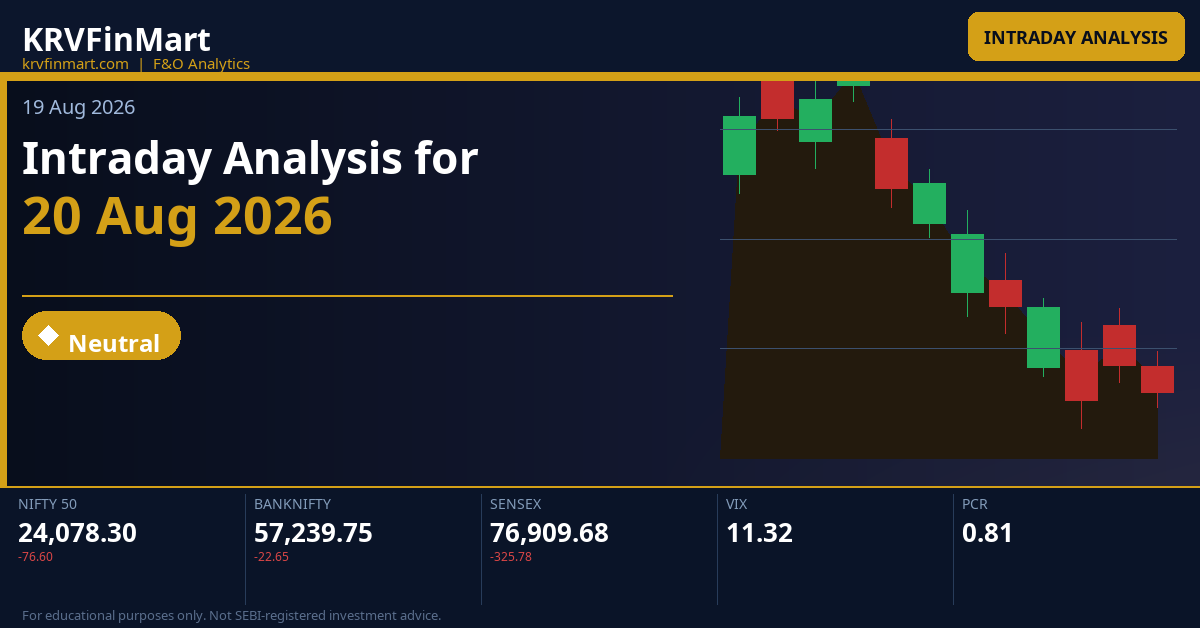
Markets closed on a soft note on 19 Aug 2026 with NIFTY shedding 0.32% to 24,078.30, BANKNIFTY barely slipping 0.04% to 57,239.75, and SENSEX declining 0.42% to 76,909.68, painting a picture of broad but shallow selling pressure. India VIX data is unavailable for this session, making it essential to rely on OI structure, CPR dynamics, and straddle pricing to gauge implied volatility — the NIFTY ATM straddle at 234.2 points (~0.97% of spot) and SENSEX straddle at 365.35 points (~0.47% of spot) suggest moderate intraday expectations. All three indices carry Descending CPR configurations into 20 Aug, meaning the CPR band for each sits below yesterday's closing price, creating a structural overhead resistance dynamic that biases the early session toward weakness unless bulls reclaim the CPR decisively.
Key Market Signals — Intraday Setup
All three indices — NIFTY, BANKNIFTY, and SENSEX — are printing Descending CPR formations for 20 Aug 2026, meaning the entire CPR band lies below yesterday's close, structurally favouring sellers unless price breaks above TC and sustains. Max Pain for NIFTY and BANKNIFTY sits well above current levels (24,200 and 57,500 respectively), implying option sellers will attempt to pin price higher into expiry, but the descending CPR and OI walls at 24,500 (NIFTY) and 58,000 (BANKNIFTY) create a ceiling that limits upside without fresh buying conviction.
Deep Technical Analysis & Levels

NIFTY
Descending — Narrow (Width 0.06%)
▼ Bearish
Market Structure Trending (up or down trend) | Straddle ATM 24100 straddle = 234.2 pts (Call 123.10 + Put 111.10), implying an expected intraday move of approximately ±234 points from ATM, putting the day's range roughly between 23,866 and 24,334 — note that the OI support at 24,000 sits well within this expected band, making it a high-probability touch point. | Max Pain Max Pain for the week expiry (25 Aug 2026) is at 24,200 — this is 121.70 points above the 19 Aug close of 24,078.30, meaning option sellers are positioned to benefit if price gravitates toward 24,200 by expiry; in the near term this acts as a magnetic pull upward, but for 20 Aug intraday, the descending CPR and proximity to OI-S at 24,000 mean the session could test lower before any mean-reversion toward max pain. |
Tomorrow's Complete Level Map
OI-R: 24,500 R3: 24,306.09 H6: 24,225.82 H5: 24,206.54 R2: 24,239.47 H4 ▶: 24,159.26 R1: 24,158.89 PDH: 24,172.85 H3 ↩: 24,118.78
TC: 24,099.25 P: 24,092.27 BC: 24,085.29
L3 ↩: 24,037.82 PDL: 24,025.65 S1: 24,011.69 L4 ▶: 23,997.34 S2: 23,945.07 L5: 23,950.06 L6: 23,930.78 S3: 23,864.49 OI-S: 24,000
↩ = Camarilla reversal point | ▶ = Camarilla breakout/breakdown trigger | OI-R/OI-S = Options wall (CE/PE max OI)
▲ Higher Open (Gap Up) — Open > Prev Close
▲ Bullish
Open lands: For a Descending CPR where TC=24,099.25 is below yesterday's close of 24,078.30 — wait, the CPR (BC=24,085.29, TC=24,099.25) is actually clustered tightly around yesterday's close of 24,078.30. A gap up above 24,078.30 would place the open above BC (24,085.29) and potentially at or above TC (24,099.25). For a Descending CPR configuration, a gap up places the open above the entire descending CPR band, which per the Descending rule = above TC, meaning price opens above the CPR and the CPR flips to become support below.
CPR role: Launch pad — with a gap up placing the open above TC (24,099.25), the CPR band (BC=24,085.29 to TC=24,099.25) transitions from potential overhead resistance to an immediate support base. Price opening above the descending CPR in a trending structure is a bullish signal, and the narrow 0.06% width of the CPR means this support base is tight and well-defined — any retest of TC or BC would be a low-risk long opportunity.
Minor Gap (0.05–0.25%) — Structure Dominant
A minor gap up of 0.05–0.25% from 24,078.30 places NIFTY's open between approximately 24,090 and 24,138, which lands it inside or just above the CPR band (BC=24,085.29, TC=24,099.25) or at the Camarilla H3 level of 24,118.78. In a Descending Narrow CPR configuration within a trending market structure, even a minor gap up above TC is structurally significant — the narrow 0.06% width means price has already cleared the compression band and the CPR now acts as a springboard below. The first target on the upside is the Camarilla H3 at 24,118.78, and a first 15-min candle close above H3 (the Narrow CPR confirmation rule) opens the door toward the clustered resistance zone of R1=24,158.89 and H4=24,159.26, with PDH=24,172.85 as the natural extension cap before the session.
Significant Gap (0.25–0.5%) — Balanced
A significant gap up of 0.25–0.5% from 24,078.30 places the open between approximately 24,138 and 24,198, which immediately brackets the dense resistance cluster at H3=24,118.78, R1=24,158.89, H4=24,159.26, and H5=24,206.54 — price would be opening directly into or beyond this zone, creating immediate gap-fill risk back toward TC=24,099.25. The CPR band (BC=24,085.29 to TC=24,099.25) now sits well below, acting as strong structural support, but the risk is that delta-hedging flows from CE writers at the 24,200-24,500 zone will cap any extension, especially with OI-R parked at 24,500. If the opening candle sustains above PDH=24,172.85 in the first 15 minutes per the Narrow confirmation rule, the next target becomes H5=24,206.54 and H6=24,225.82, but failure to hold above R1=24,158.89 within the first 15-min candle invites a retest of TC=24,099.25 and the possibility of a fade trade for bears.
Large Gap (>0.5%) — Gap Direction Dominant
A large gap up exceeding 0.5% from 24,078.30 places NIFTY's open above 24,198, potentially at or above H5=24,206.54 and H6=24,225.82, which is well into the extreme upper Camarilla zone and approaching R2=24,239.47. Opening this far above the CPR in a Descending-Narrow trending structure triggers gap-fill probability dynamics — historically, large gaps into resistance without underlying catalyst sustenance see 60–70% gap fill toward the CPR within the first hour, and the ATM straddle of 234.2 points would begin deteriorating rapidly as IV collapses. The abort level for longs on a large gap would be a first 15-min candle close below H3=24,118.78, and the extension targets if momentum sustains would be R2=24,239.47 and R3=24,306.09, with the real ceiling being the OI-R wall at 24,500 where CE writers are firmly entrenched — reaching that level intraday would require exceptional catalyst-driven buying.
|
▲ Upside Path → OI-R Confirmed bull scenario targets: **TC=24,099.25 → H3=24,118.78 → R1=24,158.89 / H4=24,159.26 → PDH=24,172.85 → H5=24,206.54 → H6=24,225.82 → R2=24,239.47 → OI-R=24,500**. H3=24,118.78 is the first Camarilla mean-reversion resistance and also the first partial profit level (Narrow CPR rule = partial at first Traditional target, trail to Camarilla zone); R1=24,158.89 and H4=24,159.26 form a dense dual-level cluster that requires strong volume to break — a close above PDH=24,172.85 on the second 15-min candle would confirm genuine momentum toward H5=24,206.54 and ultimately the OI-R ceiling at 24,500 which represents the real CE-writing supply wall for the weekly expiry. |
▼ Downside Path → OI-S If the gap up fails and price reverses below TC=24,099.25, the session structure shifts to a gap-and-trap: **TC=24,099.25 → P=24,092.27 → BC=24,085.29 → L3=24,037.82 → PDL=24,025.65 → S1=24,011.69 → L4=23,997.34 → OI-S=24,000**. Loss of the CPR band (below BC=24,085.29) in a Descending Narrow trending structure is a high-conviction bear signal — retail stop-losses cluster just below PDL=24,025.65 and S1=24,011.69, and their triggering can accelerate the move into L4=23,997.34 which is essentially at the OI-S=24,000 PE support wall, making that zone the primary target and also the level where PE writers will defend aggressively. |
| 🔴 OI-R: The OI-R at **24,500** represents the weekly CE max OI strike where the highest concentration of call writers are positioned — this is a hard ceiling for intraday moves unless a very large institutional catalyst emerges, as CE writers at this strike will sell additional calls on any approach, increasing gamma resistance and creating a delta-hedging headwind that mechanically suppresses spot price. In a gap-up scenario, OI-R=24,500 is the ultimate bull target but realistically only relevant if price clears both H5=24,206.54 and R2=24,239.47 with volume confirmation, making it a second-session target rather than an immediate intraday focus. | 🟢 OI-S: The OI-S at **24,000** is the weekly PE max OI strike and acts as the primary downside floor — in a gap-up scenario it is largely irrelevant as an immediate target unless the gap completely reverses, but it defines the abort level for any bullish thesis: if price reaches 24,000 intraday on a day that opened higher, it signals a complete reversal and PE writers will begin unwinding their positions aggressively, potentially accelerating any fall below 24,000 toward L4=23,997.34 and L5=23,950.06. |
⚡ Key Trigger: The primary trigger for the Higher Open scenario is a **first 15-min candle close above TC=24,099.25** with above-average volume — this narrow CPR (0.06%) means any sustained close above TC confirms bulls have absorbed the Descending CPR overhead and flipped the band to support, validating the gap as genuine rather than a noise-driven morning pop. If the first 15-min candle fails to close above TC=24,099.25 or reverses below BC=24,085.29, the descending structure reasserts itself and the session risks becoming a gap-and-trap scenario where latecomers on the long side are caught, with the day's direction then turning to the downside toward L3=24,037.82 and OI-S=24,000.
▼ Lower Open (Gap Down) — Open < Prev Close
▼ Bearish
Open lands: For a Descending CPR (BC=24,085.29, TC=24,099.25), a gap down from yesterday's close of 24,078.30 places the open below BC=24,085.29 — which per the Descending CPR framework means the open lands inside the CPR or below BC, and the CPR band transitions to act as overhead resistance. Since the CPR is already descending and narrow, a gap down confirms the bearish structural thesis and the CPR band becomes a ceiling that price must reclaim to neutralise the bear pressure.
CPR role: Overhead resistance — with a gap down placing the open below BC=24,085.29, the entire CPR band (BC=24,085.29 to TC=24,099.25) sits above market and acts as a resistance ceiling. The Descending Narrow structure in a trending market confirms that sellers are in control below the CPR, and any attempt to reclaim the CPR requires a sustained close above BC=24,085.29 followed by TC=24,099.25 to shift the intraday bias back to neutral or bullish.
Minor Gap (0.05–0.25%) — Structure Dominant
A minor gap down of 0.05–0.25% from 24,078.30 places the open between approximately 24,018 and 24,066, which is below BC=24,085.29 but still above L3=24,037.82 and PDL=24,025.65 in many cases — this is a structurally weak opening where the CPR band (BC=24,085.29 to TC=24,099.25) acts as immediate overhead resistance. The gap-fill probability for minor gaps is moderate (~50–60%) within the first 30–60 minutes, so the first watch point is whether price can reclaim BC=24,085.29 on the first 15-min candle — if it does, a gap-fill trade toward P=24,092.27 and TC=24,099.25 is viable, but if BC repels price, the bear path to L3=24,037.82 and PDL=24,025.65 becomes the primary scenario with S1=24,011.69 as the next key level below.
Significant Gap (0.25–0.5%) — Balanced
A significant gap down of 0.25–0.5% from 24,078.30 places the open between approximately 23,958 and 24,018, which drops price toward or below PDL=24,025.65 and S1=24,011.69 — this is a structurally serious opening that breaches multiple intraday support levels simultaneously and places the session immediately into bearish trending mode. The CPR band (BC=24,085.29 to TC=24,099.25) sits well above and acts as a strong resistance ceiling — any recovery attempt that fails at BC=24,085.29 within the first 30 minutes (Narrow rule: first 15-min confirmation) confirms the failure-and-resume bear pattern, with L3=24,037.82 then L4=23,997.34 as downside targets. PUT writers at OI-S=24,000 will be under pressure and the PE OI there may provide temporary support, but a sustained trade below 24,000 signals PE writer capitulation and an acceleration toward L5=23,950.06 and S2=23,945.07.
Large Gap (>0.5%) — Gap Direction Dominant
A large gap down exceeding 0.5% from 24,078.30 places the open below 23,958, which is below L5=23,950.06 and approaching S2=23,945.07 and L6=23,930.78 — this would represent a panic-opening that breaches the OI-S=24,000 PE wall before the session even begins, creating immediate straddle monetisation opportunities as the ATM 234.2-point straddle would rapidly gain in put premium value. The CPR band (BC=24,085.29 to TC=24,099.25) would be 120–150 points above the opening price, making any recovery to the CPR a day-long endeavour — the realistic intraday scenario in this case is a bounce off the extreme levels (L5=23,950.06, L6=23,930.78, S2=23,945.07) followed by a range-bound recovery, with the key recovery trigger being a first 15-min close above OI-S=24,000 signalling that the panic flush is complete and mean-reversion toward S1=24,011.69 and PDL=24,025.65 can begin.
|
▲ Upside Path → OI-R Recovery path: **OI-S=24,000 → S1=24,011.69 → PDL=24,025.65 → L3=24,037.82 → BC=24,085.29 → P=24,092.27 → TC=24,099.25 → H3=24,118.78**. Each level is a step in the recovery confirmation — BC=24,085.29 reclaim is the key milestone that converts the session from bearish to neutral, and TC=24,099.25 reclaim is the bull trigger; volume must be expanding on each bounce and the first 15-min candle above BC must close cleanly to avoid a bull-trap scenario. |
▼ Downside Path → OI-S Bear continuation path: **BC=24,085.29 rejection → L3=24,037.82 → PDL=24,025.65 → S1=24,011.69 → L4=23,997.34 / OI-S=24,000 → L5=23,950.06 → S2=23,945.07 → L6=23,930.78 → S3=23,864.49**. Retail stop-losses cluster heavily just below PDL=24,025.65 and at the round number 24,000 (OI-S), and once these trigger, algorithmic selling accelerates the move — L4=23,997.34 and OI-S=24,000 are the primary bear targets, and if PE writers at 24,000 capitulate, L5=23,950.06 becomes the next meaningful support. |
| 🔴 OI-R: The OI-R at **24,500** is effectively irrelevant as an intraday target in a gap-down scenario — it sits approximately 420+ points above the likely opening price and represents the ultimate overhead ceiling that only becomes meaningful if the market stages a full reversal. More practically, CE writers at 24,500 are defending shorts and have no motivation to cover on a gap-down day, meaning their delta-hedging will add further selling pressure on any intraday recovery attempt above the CPR band. | 🟢 OI-S: The OI-S at **24,000** is the primary bear destination and PE monetisation zone in a gap-down scenario — the highest concentration of put writers are at this strike, and as price approaches 24,000, long PE holders will be in profit while put writers face mounting losses, creating a dynamic where some short-covering of PEs may occur near 24,000 (providing temporary bounce) but a sustained breach below 24,000 would trigger PE writer panic-unwinding and accelerate the drop toward L4=23,997.34, L5=23,950.06, and S2=23,945.07. |
⚡ Key Trigger: The critical trigger for the Lower Open bear scenario is **failure to reclaim BC=24,085.29 within the first 15 minutes** (Narrow CPR confirmation rule) — if the opening 15-min candle closes below BC=24,085.29, bears have confirmed control and the session is structurally bearish with L3=24,037.82 as the first downside target. Conversely, the bull trigger (recovery scenario) requires a first 15-min close above BC=24,085.29 followed by a hold above P=24,092.27, which would suggest the gap down was an overreaction and open the gap-fill trade toward TC=24,099.25 and H3=24,118.78.
◆ Near Flat Open — Open ≈ Prev Close (±0.05%)
◆ Neutral
Open lands: A flat open of ±0.05% from 24,078.30 places NIFTY's open between approximately 24,066 and 24,090 — this range straddles BC=24,085.29, meaning the open could land just below BC or just above it. In a Descending Narrow CPR framework, a flat open per the rules places price near TC=24,099.25 as the reference (CPR acts as resistance below), but given the actual close of 24,078.30 is below BC=24,085.29, a flat open of ±0.05% places price right at or just below the CPR base, making this the most nuanced and information-rich opening scenario for 20 Aug.
CPR role: Decision zone and compression band — the CPR band (BC=24,085.29 to TC=24,099.25, width 0.06%) is a tight 13.96-point band that the market must immediately resolve. The flat open inside or at the base of this band creates a classic narrow-CPR compression trigger: the first 15-min candle direction IS the trade of the day, as a trending market structure combined with a narrow CPR almost guarantees a directional breakout rather than a choppy range session.
Near Flat (±0.05%)
A flat open in a Descending Narrow CPR (0.06%) configuration is one of the highest-probability setups in intraday F&O trading — the narrow width means the CPR cannot contain price for long, and since market structure is Trending (not sideways), the first directional break from the BC=24,085.29 to TC=24,099.25 band will likely define the entire session. The CPR pivot P=24,092.27 is the exact center of gravity — price above P=24,092.27 in the first 15 minutes leans bullish, below P=24,092.27 leans bearish, but the definitive signal is a first 15-min candle CLOSE above TC=24,099.25 (bull trigger) or CLOSE below BC=24,085.29 (bear trigger). A Narrow CPR (≤0.10%) in a trending structure has historically produced trend days 65–70% of the time — this is because the compression energy stored in the tight CPR band releases explosively once the market decides direction, and the trending market structure means the day is unlikely to reverse after the initial 15-min breakout candle. The bull trigger of a first 15-min close above TC=24,099.25 targets H3=24,118.78 first, then the dense cluster of R1=24,158.89 and H4=24,159.26, with PDH=24,172.85 as the intraday swing target; the bear trigger of a first 15-min close below BC=24,085.29 targets L3=24,037.82, then PDL=24,025.65 and OI-S=24,000 — and the proximity of OI-S at 24,000 (only 85 points from the CPR base) makes the bear scenario particularly high-conviction if triggered.
|
▲ Upside Path → OI-R Bull path: **TC=24,099.25 (trigger) → H3=24,118.78 (first partial, Camarilla mean-reversion) → R1=24,158.89 / H4=24,159.26 (dense cluster, second partial) → PDH=24,172.85 (prior day high, swing target) → H5=24,206.54 → H6=24,225.82 → R2=24,239.47 → OI-R=24,500 (weekly CE wall)**. Volume confirmation is essential at H3=24,118.78 — a stall here on declining volume is a cue to partial profit; a continuation candle above H3 with expanding volume confirms the session is trending and the R1/H4 cluster at 24,158–24,159 becomes the next destination. |
▼ Downside Path → OI-S Bear path: **BC=24,085.29 (trigger) → L3=24,037.82 (Camarilla mean-reversion, first partial short) → PDL=24,025.65 → S1=24,011.69 → L4=23,997.34 / OI-S=24,000 (primary bear target, PE wall)**. L3=24,037.82 is only 47.47 points below BC, making it a rapid first target — retail stop-losses below PDL=24,025.65 and the OI-S at 24,000 combine to create a magnetic pull for bearish momentum once the CPR base breaks, and the 85-point distance from CPR to OI-S means the primary target can be reached within the first 45–60 minutes of a confirmed bearish trending session. |
| 🔴 OI-R: The OI-R at **24,500** acts as the weekly CE writing ceiling — in a flat-open scenario it is a distant but important reference that caps the upside ambition for any bull position entered off TC=24,099.25. CE writers at 24,500 are not under immediate pressure in a flat-open session, but their presence means that as price rallies toward R2=24,239.47 and R3=24,306.09, the delta-hedging headwind intensifies, and traders should not chase longs above H5=24,206.54 without fresh catalyst confirmation. | 🟢 OI-S: The OI-S at **24,000** is the PE writer's base camp and acts as the primary magnet for any bear scenario triggered off BC=24,085.29 — the PE max OI at 24,000 means a large number of put writers need 24,000 to hold by expiry (25 Aug), but intraday, if price trades through 24,000, these writers will begin delta-hedging by selling futures, creating a self-reinforcing bear spiral that accelerates toward L4=23,997.34 and L5=23,950.06; conversely, strong PE support at 24,000 can produce a sharp intraday bounce that disciplined shorts should respect. |
⚡ Key Trigger: **Bull trigger: First 15-min candle close above TC=24,099.25** initiates a long position targeting H3=24,118.78 with a stop below BC=24,085.29; **Bear trigger: First 15-min candle close below BC=24,085.29** initiates a short targeting L3=24,037.82 and OI-S=24,000 with a stop above TC=24,099.25. The 13.96-point gap between BC and TC is the structural fulcrum of the entire session — in a Descending Narrow trending CPR, price cannot stay inside this band for more than the first 15–30 minutes without explosive resolution, and whichever side wins the first candle close sets up a high-probability momentum trade for the full session.
BANKNIFTY
Descending — Narrow (Width 0.07%)
▼ Bearish
Market Structure Trending (up or down trend) | Straddle ATM 57200 straddle = 690.25 pts (Call 418.20 + Put 272.05), implying an expected intraday move of approximately ±690 points from ATM, putting the day's range broadly between 56,510 and 57,890 — the asymmetry between call premium (418.20) and put premium (272.05) reveals a modest bullish skew in options pricing despite the bearish CPR configuration, suggesting markets are pricing in higher probability of upside than downside at current levels. | Max Pain Max Pain for the month expiry (25 Aug 2026) is at 57,500 — this is 260.25 points above the 19 Aug close of 57,239.75, meaning option sellers on the monthly are positioned to benefit from a mild drift higher toward 57,500; intraday, this max pain gravitational pull adds a slight bullish undercurrent that partially offsets the Descending CPR bearish signal, creating a conflicted tape where any downside toward OI-S=57,000 will be contested by max pain mechanics attempting to keep price above 57,000. |
Tomorrow's Complete Level Map
OI-R: 58,000 R3: 57,752.25 H6: 57,596.33 H5: 57,549.13 R2: 57,554.55 H4 ▶: 57,435.06 R1: 57,397.15 PDH: 57,356.85 H3 ↩: 57,337.40
TC: 57,219.60 P: 57,199.45 BC: 57,179.30
L3 ↩: 57,142.10 PDL: 57,001.75 L4 ▶: 57,044.44 L5: 56,930.37 L6: 56,883.17 OI-S: 57,000
↩ = Camarilla reversal point | ▶ = Camarilla breakout/breakdown trigger | OI-R/OI-S = Options wall (CE/PE max OI)
▲ Higher Open (Gap Up) — Open > Prev Close
▲ Bullish
Open lands: For a Descending CPR where BC=57,179.30 and TC=57,219.60, yesterday's close was 57,239.75 — interestingly, the close is already above TC=57,219.60. A gap up opening above 57,239.75 places the open further above TC=57,219.60, which per the Descending rule (gap up = above TC = above entire descending CPR) confirms bulls are in control above the CPR band, and the CPR (BC=57,179.30 to TC=57,219.60) acts as a strong support zone below market.
CPR role: Launch pad and support base — with the open above TC=57,219.60, the CPR band (BC=57,179.30 to TC=57,219.60) acts as immediate structural support approximately 20–60 points below the opening price. The narrow 0.07% width (a 40.30-point band) creates a well-defined floor — any dip back to TC=57,219.60 is a low-risk long entry in a gap-up Descending Narrow trending configuration.
Minor Gap (0.05–0.25%) — Structure Dominant
A minor gap up of 0.05–0.25% from 57,239.75 places BANKNIFTY's open between approximately 57,268 and 57,383, which lands it above TC=57,219.60 but within the zone between TC and H3=57,337.40 or approaching PDH=57,356.85. In a Descending Narrow trending structure, a minor gap above the descending CPR is a high-quality bull setup — the CPR (BC=57,179.30 to TC=57,219.60) is now support and H3=57,337.40 becomes the first resistance target with the Narrow CPR rule requiring a first 15-min candle confirmation above TC=57,219.60. If the first 15-min candle holds above TC=57,219.60, the immediate target is H3=57,337.40, followed by PDH=57,356.85 — note that R1=57,397.15 and H4=57,435.06 form the next cluster resistance, and volume expansion at H3 is required to confirm a push toward R1.
Significant Gap (0.25–0.5%) — Balanced
A significant gap up of 0.25–0.5% from 57,239.75 places the open between approximately 57,383 and 57,526, which catapults price above PDH=57,356.85 and into the R1=57,397.15 / H4=57,435.06 resistance cluster or toward H5=57,549.13 — this is a major resistance zone where delta-hedging from CE writers at 58,000 (OI-R) begins to intensify. The CPR band (BC=57,179.30 to TC=57,219.60) sits 160–300 points below the opening price, making a gap-fill scenario low probability in the short term but the immediate risk is opening into dense resistance. A first 15-min candle close above H4=57,435.06 confirms momentum extension toward H5=57,549.13 and R2=57,554.55, while failure at R1=57,397.15 invites a retest of PDH=57,356.85 and H3=57,337.40 as the first consolidation level.
Large Gap (>0.5%) — Gap Direction Dominant
A large gap up exceeding 0.5% from 57,239.75 places the open above 57,526, potentially at H5=57,549.13 or H6=57,596.33 — this would be opening directly into the extreme Camarilla upper zone and within range of the OI-R wall at 58,000 (only ~400 points away). Large gaps into Camarilla H5-H6 zones carry high reversal risk as these levels are specifically designed as mean-reversion targets, and CE writers at 58,000 will aggressively add call supply on any approach to their strike. The abort level for longs in a large gap is a first 15-min close below H3=57,337.40, and if that triggers, a gap-fill trade toward TC=57,219.60 and BC=57,179.30 becomes the primary setup — the ATM straddle at 690.25 points would see rapid IV compression on a large gap, benefiting straddle sellers who faded the open.
|
▲ Upside Path → OI-R Confirmed bull path: **TC=57,219.60 (support base) → H3=57,337.40 (first partial) → PDH=57,356.85 → R1=57,397.15 / H4=57,435.06 (dense cluster, second partial) → H5=57,549.13 → R2=57,554.55 → H6=57,596.33 → R3=57,752.25 → OI-R=58,000**. The R1/H4 cluster at 57,397–57,435 is the critical momentum checkpoint — a volume-confirmed close above H4=57,435.06 in a trending structure signals the session is running toward H5=57,549.13 and potentially the OI-R at 58,000, which represents the monthly CE wall and the ultimate ceiling for intraday longs. |
▼ Downside Path → OI-S Failure path from a gap-up: **H3=57,337.40 rejection → TC=57,219.60 → P=57,199.45 → BC=57,179.30 → L3=57,142.10 → PDL=57,001.75 → OI-S=57,000 → L4=57,044.44**. Loss of TC=57,219.60 after a gap-up is the key danger signal — in a Descending Narrow structure, once price falls back into the CPR band (between BC and TC), bulls lose initiative and bears can press toward L3=57,142.10; the PDL=57,001.75 and OI-S=57,000 coincide to form a strong support confluence that is the primary downside target if the gap reverses completely. |
| 🔴 OI-R: The OI-R at **58,000** is the monthly CE max OI strike and represents an enormous CE writing supply wall — in a gap-up scenario, this level acts as the absolute intraday ceiling where call writers will defend aggressively, and any rally toward 58,000 will face mechanical headwinds from delta-neutral CE writers who sell additional calls to maintain their short gamma posture, creating a self-limiting price cap that is difficult to breach without a major directional catalyst or short-covering event. Traders should target H5=57,549.13 and H6=57,596.33 as realistic upside targets and treat 58,000 as a 'sell rip' level rather than a breakout target. | 🟢 OI-S: The OI-S at **57,000** is the monthly PE max OI strike and acts as a powerful downside floor — even in a gap-up scenario, this level defines the worst-case support that PE writers will defend with futures buying and put roll activity. In a higher open context, OI-S=57,000 is approximately 240 points below yesterday's close and would only come into play if the entire gap-up reverses catastrophically; its proximity to PDL=57,001.75 creates an exceptionally strong dual support confluence that makes any trade below 57,000 a low-probability intraday outcome on a gap-up day. |
⚡ Key Trigger: The primary trigger for BANKNIFTY's Higher Open scenario is a **first 15-min candle close above H3=57,337.40** which is the first meaningful resistance above TC in the Narrow CPR configuration — this confirms that the gap is not a fake-out and that buying momentum is genuine enough to absorb the first Camarilla resistance layer. Failure to hold H3=57,337.40 in the first 15-min candle with the close reverting toward TC=57,219.60 signals bull exhaustion and switches the session to a gap-fill scenario where BC=57,179.30 and L3=57,142.10 become the downside targets.
▼ Lower Open (Gap Down) — Open < Prev Close
▼ Bearish
Open lands: A gap down from 57,239.75 places BANKNIFTY's open below 57,239.75 — for the Descending CPR with TC=57,219.60, a minor gap down lands the open between TC=57,219.60 and BC=57,179.30 (inside the CPR band), while a more significant gap down places the open below BC=57,179.30, below the entire CPR band. Per the Descending CPR rule, a gap down places the open inside or below the CPR, and the CPR band becomes overhead resistance.
CPR role: Overhead resistance — with a gap down placing price below TC=57,219.60 or BC=57,179.30, the CPR band acts as a resistance ceiling that bears will defend and bulls must reclaim to reverse the session's bias. The Descending Narrow trending structure heavily favours the bear case in a gap-down scenario, and the proximity of OI-S=57,000 to PDL=57,001.75 (a mere 1.75-point difference) creates a powerful downside magnet only 240 points from yesterday's close.
Minor Gap (0.05–0.25%) — Structure Dominant
A minor gap down of 0.05–0.25% from 57,239.75 places the open between approximately 57,096 and 57,211, which lands inside the CPR band (BC=57,179.30 to TC=57,219.60) or just below BC=57,179.30 — this is a structurally weak open where the CPR band (40.30-point wide band) sits as an immediate overhead resistance layer. Gap-fill probability for minor gaps is moderate (~50%), but in a Descending Narrow trending structure, the bias favours failure at BC=57,179.30 with the first bear target being L3=57,142.10 and then the critical PDL=57,001.75 / OI-S=57,000 confluence; the bull recovery trade requires a first 15-min candle close above BC=57,179.30 followed by TC=57,219.60 to neutralise the gap-down bearish bias.
Significant Gap (0.25–0.5%) — Balanced
A significant gap down of 0.25–0.5% from 57,239.75 places the open between approximately 56,954 and 57,096, which breaches PDL=57,001.75 and OI-S=57,000 on the open — this is a high-impact opening that immediately activates PE writer stress at the 57,000 strike. The CPR band (BC=57,179.30 to TC=57,219.60) sits 80–230 points above the opening price and represents a distant recovery target — per the Narrow CPR rule, failure to reclaim BC=57,179.30 within the first 15 minutes confirms resumption of downside pressure toward L3=57,142.10 (above open), L4=57,044.44, and then L5=56,930.37 as the next meaningful support cluster. A significant gap below OI-S=57,000 is a critical signal — PUT writers at 57,000 will begin delta-hedging by selling futures, amplifying the downside move toward L5=56,930.37 and L6=56,883.17.
Large Gap (>0.5%) — Gap Direction Dominant
A large gap down exceeding 0.5% from 57,239.75 places BANKNIFTY's open below 56,953, which is at or below L5=56,930.37 and L6=56,883.17 — extreme Camarilla downside targets that are normally the end-of-day destination for strong bear sessions. Opening at this level triggers panic-selling dynamics and the 690.25-point ATM straddle would see put premium surge while call premium collapses, creating immediate straddle monetisation pressure; the realistic scenario at these levels is a swift bounce (dead-cat or genuine recovery) back toward OI-S=57,000 and PDL=57,001.75 as the first recovery target, with the first 15-min candle close above 57,000 being the key trigger for a recovery trade. If price cannot reclaim 57,000 within the first 30 minutes, S2=56,844.35 and S3=56,686.95 become the extended bear targets for the session.
|
▲ Upside Path → OI-R Recovery path: **OI-S=57,000 / PDL=57,001.75 → L4=57,044.44 → L3=57,142.10 → BC=57,179.30 → P=57,199.45 → TC=57,219.60 → H3=57,337.40**. The OI-S=57,000 / PDL=57,001.75 confluence is the strongest support in the BANKNIFTY structure for 20 Aug — a bounce from this level with expanding volume and a 15-min candle close above L4=57,044.44 initiates a recovery sequence, and reclaiming BC=57,179.30 shifts the session from bearish to neutral; TC=57,219.60 reclaim is required for a full bull reversal. |
▼ Downside Path → OI-S Bear cascade path: **BC=57,179.30 rejection → L3=57,142.10 → PDL=57,001.75 / OI-S=57,000 → L4=57,044.44 → L5=56,930.37 → L6=56,883.17 → S2=56,844.35 → S3=56,686.95**. L3=57,142.10 is only 37.20 points below BC=57,179.30 and will be reached rapidly after a bear confirmation; the critical pivot is OI-S=57,000 — if PE writers capitulate and price breaks below 57,000 with a candle close, L5=56,930.37 and L6=56,883.17 become the session's primary bear targets, consistent with the straddle-implied 690-point downside move from ATM. |
| 🔴 OI-R: The OI-R at **58,000** is completely irrelevant as an upside target in a gap-down scenario — it sits 760+ points above yesterday's close and represents a wall that only long-term directional flows can challenge. More relevantly, CE writers at 58,000 are in maximum comfort on a gap-down day and will be net sellers of any intraday rally, meaning their delta-hedging adds a headwind to any recovery attempt that gets above TC=57,219.60 and the H3=57,337.40 level. | 🟢 OI-S: The OI-S at **57,000** is the single most important level for BANKNIFTY on a gap-down day — the confluence of PE max OI at 57,000 and PDL=57,001.75 creates the most powerful support structure in the entire session, and a breach of 57,000 with a close below would trigger PE writer delta-hedging sell flows that could accelerate BANKNIFTY toward L5=56,930.37 within minutes; conversely, a bounce and hold above 57,000 with strong buying volume is the clearest signal for a recovery trade targeting L3=57,142.10 and BC=57,179.30. |
⚡ Key Trigger: **Failure to reclaim BC=57,179.30 within the first 15 minutes** is the bear confirmation trigger — in a Descending Narrow trending CPR, any gap-down opening that cannot recover BC=57,179.30 on the first candle confirms institutional selling and activates the L3=57,142.10 → PDL=57,001.75 → OI-S=57,000 bear cascade. The bull recovery trigger requires a first 15-min candle close above BC=57,179.30 (for minor gaps) or above OI-S=57,000 (for significant/large gaps), with volume expansion confirming genuine buying rather than short-covering relief.
◆ Near Flat Open — Open ≈ Prev Close (±0.05%)
◆ Neutral
Open lands: A flat open of ±0.05% from 57,239.75 places BANKNIFTY's open between approximately 57,211 and 57,268 — this zone sits between TC=57,219.60 and the area just above it. Given yesterday's close of 57,239.75 is already above TC=57,219.60, a flat open maintains the open above the entire descending CPR band. Per the Descending CPR flat-open rule, price opens near TC and the CPR acts as resistance below (TC=57,219.60 is the floor of the gap between close and CPR).
CPR role: Decision zone — with the open hovering above TC=57,219.60 but within 20–28 points of it, the CPR band (BC=57,179.30 to TC=57,219.60) is an immediate decision zone. The 0.07% narrow width in a trending market structure creates a high-probability trending day scenario — the first 15-min candle direction above or below TC=57,219.60 will define the session, and any breach below BC=57,179.30 activates a strong bear cascade given the proximity of OI-S=57,000 (only ~179 points below BC).
Near Flat (±0.05%)
A flat open in BANKNIFTY's Descending Narrow CPR (0.07%, 40.30-point band) is a classic trending-day setup — the narrow CPR width in a trending market structure means the session is predisposed to a strong directional move once the 15-min trigger resolves, and the fact that yesterday's close (57,239.75) is already marginally above TC=57,219.60 means the open is perched at the most sensitive decision point in the entire session. Bulls need to hold above TC=57,219.60 and push toward H3=57,337.40 within the first 15 minutes to activate the upside trending sequence, while bears need a first 15-min candle close below BC=57,179.30 to initiate the bearish cascade toward L3=57,142.10 and OI-S=57,000. The CPR pivot P=57,199.45 acts as the intrabar reference — if the first 5-minute candles are oscillating around P=57,199.45, the session is in compression mode and the 15-min candle close is the decisive signal. Adding further complexity, the monthly max pain at 57,500 creates upward gravitational pull while OI-S=57,000 creates downward pressure — in a flat open, this tug-of-war is most pronounced, and the 690.25-point ATM straddle implies a substantial move in whichever direction wins the first 15-min candle battle, making this a high-reward setup for directional traders who wait for CPR confirmation rather than anticipating.
|
▲ Upside Path → OI-R Bull path: **TC=57,219.60 (trigger and support) → H3=57,337.40 (first partial, Camarilla first resistance) → PDH=57,356.85 (prior day high breakout) → R1=57,397.15 / H4=57,435.06 (dense dual cluster, second partial) → H5=57,549.13 → R2=57,554.55 → H6=57,596.33 → OI-R=58,000 (monthly CE wall, ultimate ceiling)**. The PDH=57,356.85 breakout is the momentum confirmation level — a volume-driven close above PDH in the second or third 15-min candle signals a genuine upside trend day and activates the R1/H4 cluster as the next destination. |
▼ Downside Path → OI-S Bear path: **BC=57,179.30 (trigger) → L3=57,142.10 (Camarilla first bear target, first partial) → L4=57,044.44 → PDL=57,001.75 / OI-S=57,000 (primary bear target, PE wall, second partial)**. L3=57,142.10 is only 37.20 points below BC — it will be reached in the first 10–15 minutes of a confirmed bear session, and the critical decision is whether L4=57,044.44 holds or breaks; a close below L4=57,044.44 targets PDL=57,001.75 and OI-S=57,000, where PE writer defense will be fiercest and the session may find its low. |
| 🔴 OI-R: The OI-R at **58,000** (monthly CE max OI) is the ultimate upside ceiling in any flat-open bull scenario — CE writers at this strike are the dominant option positioning force for the monthly expiry, and their supply wall at 58,000 means BANKNIFTY cannot sustain above this level without short-covering. In a flat-open scenario, 58,000 is approximately 760 points above the likely opening price, making it a session-defining target only if the bull case plays out with full momentum through all intermediate resistance levels including H5=57,549.13 and R2=57,554.55. | 🟢 OI-S: The OI-S at **57,000** (monthly PE max OI) is the bear scenario's primary destination and the strongest support level in the entire session — PE writers at 57,000 will defend this strike aggressively with futures buying and put roll activity, creating a natural bounce zone approximately 239.75 points below yesterday's close. In a flat-open Narrow CPR setup, the proximity of OI-S=57,000 to PDL=57,001.75 means that any intraday break below BC=57,179.30 could reach the OI-S within a single trading hour, making the risk-reward for bear triggers (short below BC=57,179.30, target OI-S=57,000, stop above TC=57,219.60) particularly favorable at approximately 1:4.5 risk-reward ratio. |
⚡ Key Trigger: **Bull trigger: First 15-min candle close above TC=57,219.60** with volume confirmation initiates a long targeting H3=57,337.40 (first partial) and PDH=57,356.85 (swing target), stop below BC=57,179.30; **Bear trigger: First 15-min candle close below BC=57,179.30** initiates a short targeting L3=57,142.10 and OI-S=57,000, stop above TC=57,219.60. The 40.30-point distance between BC and TC is the structural fulcrum — in a Descending Narrow trending BANKNIFTY configuration, this band is the entire battleground for the opening 15 minutes, and the winner of the first candle close owns the session direction with high statistical confidence.
SENSEX
Descending — Medium (Width 0.15%)
▼ Bearish
Market Structure Balanced or transitional | Straddle SENSEX Week ATM 76900 straddle = 365.35 pts (Call 212.80 + Put 152.55), implying a weekly expected move of ±365 points from ATM — for intraday purposes this suggests a meaningful but not extreme range, and the call-heavy premium (212.80 vs 152.55 puts) implies markets are pricing more upside risk than downside, creating a mild bullish skew despite the Descending CPR configuration. The monthly straddle at 982.35 points reflects longer-term uncertainty and is not the primary intraday reference. | Max Pain SENSEX Week Max Pain (20 Aug 2026, today's expiry) is at 77,000 — this is critically important because 20 Aug IS the SENSEX weekly expiry date, meaning max pain at 77,000 will exert very strong gravitational pull throughout the session. The current close of 76,909.68 is 90.32 points below max pain at 77,000, making a drift toward 77,000 the highest-probability intraday scenario for option sellers — this max pain dynamics are expected to dominate the afternoon session, creating a natural target and resistance zone around 77,000. |
Tomorrow's Complete Level Map
OI-R: 78,000 R3: 77,755.61 H6: 77,435.19 H5: 77,367.00 R2: 77,551.71 H4 ▶: 77,198.39 R1: 77,230.69 PDH: 77,347.81 H3 ↩: 77,054.03
TC: 77,085.35 P: 77,026.79 BC: 76,968.23
L3 ↩: 76,765.33 PDL: 76,822.89 L4 ▶: 76,620.97 L5: 76,452.36 L6: 76,384.17 OI-S: 76,000
↩ = Camarilla reversal point | ▶ = Camarilla breakout/breakdown trigger | OI-R/OI-S = Options wall (CE/PE max OI)
▲ Higher Open (Gap Up) — Open > Prev Close
▲ Bullish
Open lands: For a Descending Medium CPR (BC=76,968.23, TC=77,085.35), yesterday's close was 76,909.68 — which is below BC=76,968.23. A gap up from 76,909.68 placing the open at or above BC=76,968.23 and potentially toward P=77,026.79 or TC=77,085.35 puts price inside the CPR band. Per the Descending CPR gap-up rule, a gap up places the open above TC, but given the close is 58.55 points below BC, a minor gap up would land inside the CPR band (between BC=76,968.23 and TC=77,085.35), while a significant or large gap up would place the open above TC=77,085.35.
CPR role: Battleground and decision zone (for minor gap) or launch pad (for significant/large gap) — in a Medium-width Descending CPR (0.15%, 117.12-point band), the CPR is wide enough to act as a trading range itself. The Balanced or transitional market structure adds nuance: SENSEX is not in a clean trend, meaning CPR tests and retests are more likely than a clean directional breakout, and the weekly max pain at 77,000 (inside the CPR band between BC=76,968.23 and TC=77,085.35) creates a powerful gravitational anchor for the session.
Minor Gap (0.05–0.25%) — Structure Dominant
A minor gap up of 0.05–0.25% from 76,909.68 places SENSEX's open between approximately 76,948 and 77,102, landing inside the Medium CPR band (BC=76,968.23 to TC=77,085.35) or just above TC=77,085.35 — critically, this open zone overlaps exactly with the weekly max pain at 77,000, creating a powerful pinning environment. In a Descending Medium CPR with a Balanced market structure, the Medium width confirmation rule requires a first 30-min candle close (not 15-min) to confirm direction — a 30-min close above TC=77,085.35 is the bull trigger targeting H3=77,054.03 wait, H3=77,054.03 is inside the CPR band, so the sequence is BC → P=77,026.79 → H3=77,054.03 → TC=77,085.35 → H4=77,198.39. The max pain pinning at 77,000 means the first 30-min session is likely choppy within the CPR band (76,968–77,085), and a decisive 30-min candle close above TC=77,085.35 would unlock the upside toward H4=77,198.39 and R1=77,230.69.
Significant Gap (0.25–0.5%) — Balanced
A significant gap up of 0.25–0.5% from 76,909.68 places the open between approximately 77,102 and 77,294, which clears TC=77,085.35 and approaches H4=77,198.39 and R1=77,230.69 — this is a meaningful gap that places SENSEX above the entire Descending CPR band and within the H4/R1 resistance cluster. The Medium CPR rule requires a first 30-min candle close confirmation and retests of TC=77,085.35 are expected — the session's first 30 minutes may involve a pullback to test TC=77,085.35 (now support), and a hold above TC on this retest is the bull confirmation. If TC=77,085.35 holds on the first retest, the target sequence is H4=77,198.39 → R1=77,230.69 → PDH=77,347.81 → H5=77,367.00 with the first partial at R1=77,230.69 per Medium CPR rules (partial at first Traditional target), second partial at Camarilla zone (H4=77,198.39 region already passed, so H5=77,367.00).
Large Gap (>0.5%) — Gap Direction Dominant
A large gap up exceeding 0.5% from 76,909.68 places SENSEX's open above 77,294, which is above H4=77,198.39 and R1=77,230.69, potentially approaching PDH=77,347.81 or H5=77,367.00 — opening this far above the CPR in a Balanced/transitional Descending Medium structure is an overshoot that should be treated cautiously. The Medium CPR confirmation requires 30-min closes and the Wide-leaning nature of the band (0.15%) means retests are highly probable; a large gap to PDH=77,347.81 or above would create an immediate gap-fill risk back toward TC=77,085.35 and the max pain magnet at 77,000. The abort level for longs is a 30-min close below TC=77,085.35, and if that triggers, the session reverts to the weekly max pain gravitational range of 76,909–77,000 with no clear directional trend.
|
▲ Upside Path → OI-R Confirmed bull path: **TC=77,085.35 (trigger) → H4=77,198.39 (first partial — Camarilla breakout trigger) → R1=77,230.69 (Traditional first target, second partial) → PDH=77,347.81 → H5=77,367.00 (Camarilla target zone, third partial) → H6=77,435.19 → R2=77,551.71 → OI-R=78,000 (weekly CE max OI wall)**. The Medium CPR rule specifies partial at first Traditional target (R1=77,230.69) and second partial at Camarilla zone (H4/H5 area); exit near OI-R=78,000 and do NOT trail beyond, as it is the absolute ceiling for the session. |
▼ Downside Path → OI-S Failure path from a gap-up: **TC=77,085.35 rejection → H3=77,054.03 → P=77,026.79 → max pain zone 77,000 → BC=76,968.23 → L3=76,765.33 → PDL=76,822.89 → L4=76,620.97 → OI-S=76,000**. Loss of the CPR band after a gap-up is a gap-and-trap signal — the max pain at 77,000 may provide temporary support before BC=76,968.23, but a 30-min close below BC=76,968.23 activates the bear cascade toward L3=76,765.33 and eventually the OI-S at 76,000, which is the PE max OI weekly wall and the ultimate downside destination if buying fails entirely. |
| 🔴 OI-R: The OI-R at **78,000** is the weekly CE max OI strike (highest CE writing concentration for the 20 Aug SENSEX weekly expiry) — on this expiry day, the gravitational pull of 78,000 as a ceiling is at maximum potency since CE writers are defending this strike with full force to avoid the calls going in-the-money on expiry. In a gap-up scenario, any rally above R2=77,551.71 toward R3=77,755.61 would face aggressive CE writing resistance as participants add new short calls to the 78,000 strike, making OI-R=78,000 an extremely hard ceiling that realistically requires a major positive event to breach on expiry day. | 🟢 OI-S: The OI-S at **76,000** is the weekly PE max OI strike — in a gap-up scenario it is approximately 910 points below the open and acts as the worst-case support level. On SENSEX weekly expiry day (20 Aug), PE writers at 76,000 are in maximum comfort on a gap-up day and their positions will only be stressed if a catastrophic reversal occurs — practically, OI-S=76,000 is the 'nuclear support' level that defines the maximum downside insurance for the session, and any mention of price testing 76,000 on an expiry day gap-up would represent an extraordinary reversal not expected under normal market conditions. |
⚡ Key Trigger: The primary trigger for SENSEX's Higher Open is **a first 30-min candle close above TC=77,085.35** (Medium CPR confirmation rule) with above-average volume, which would confirm that the gap-up has genuine follow-through and that the Descending CPR band has been cleared — this is the directional fulcrum because TC=77,085.35 is also very close to H3=77,054.03 (Camarilla mean-reversion level) and the weekly max pain at 77,000, creating a triple confluence that makes this exact zone the most important battleground for 20 Aug. A 30-min candle failure to close above TC=77,085.35 or a reversal below P=77,026.79 indicates the CPR band is acting as resistance and the max pain pinning scenario is dominant, with price likely to consolidate between BC=76,968.23 and TC=77,085.35 for the remainder of the session.
▼ Lower Open (Gap Down) — Open < Prev Close
▼ Bearish
Open lands: A gap down from 76,909.68 places SENSEX's open below 76,909.68, which is already below BC=76,968.23. Further gap-down action moves the open toward PDL=76,822.89, L3=76,765.33, or even lower. Per the Descending CPR rule, a gap down in a descending structure places the open inside or below the CPR — since yesterday's close is already below BC=76,968.23, a gap down confirms that price is falling away from the CPR band, with BC=76,968.23 and TC=77,085.35 both acting as overhead resistance above the opening price.
CPR role: Overhead resistance — the entire CPR band (BC=76,968.23 to TC=77,085.35, 117.12 points wide) sits above yesterday's close and further above any gap-down opening, acting as a strong overhead resistance ceiling for the session. The Medium width (0.15%) means this is not a razor-thin resistance but a wide defensive zone — recovery through the CPR band requires multiple 30-min candle closes, and the Balanced/transitional market structure means recovery attempts are possible but conviction is needed.
Minor Gap (0.05–0.25%) — Structure Dominant
A minor gap down of 0.05–0.25% from 76,909.68 places the open between approximately 76,718 and 76,871, which lands below PDL=76,822.89 (in some cases) or between PDL and yesterday's close — this is a meaningfully weak opening that immediately activates L3=76,765.33 and PDL=76,822.89 as intraday reference levels. The weekly expiry max pain at 77,000 creates an upward gravitational pull of approximately 250–280 points from the open, making a slow drift higher throughout the session a viable intraday scenario — the Medium CPR rule requires a first 30-min close above BC=76,968.23 for a gap-fill/recovery trade, but the first target on the downside for bears is L3=76,765.33, followed by L4=76,620.97 if selling continues. Traders should watch the 30-min structure carefully: if the first 30-min candle closes above PDL=76,822.89 and drives toward BC=76,968.23, the max pain expiry dynamics are taking over; if the first 30-min candle closes below L3=76,765.33, the bear case toward L4=76,620.97 and the OI-S=76,000 zone is active.
Significant Gap (0.25–0.5%) — Balanced
A significant gap down of 0.25–0.5% from 76,909.68 places the open between approximately 76,718 and 76,718, more precisely between 76,527 and 76,718 — this breaches L4=76,620.97 and approaches the OI-S=76,000 zone, creating an extreme stress scenario on SENSEX weekly expiry day. PE writers at the 76,000 OI-S strike will be severely stressed with a significant gap below 76,718, and their delta-hedging will add further selling pressure; the Medium CPR confirmation rule (30-min candle) means traders must wait for the first 30-min candle close to determine if this is a genuine crisis or an overreaction. The recovery scenario requires a 30-min close above L3=76,765.33 (which sits above the opening price in this scenario), and recovery toward BC=76,968.23 becomes the bull target — but failure to hold L4=76,620.97 activates L5=76,452.36, L6=76,384.17, and ultimately OI-S=76,000 as the expiry-day panic destinations.
Large Gap (>0.5%) — Gap Direction Dominant
A large gap down exceeding 0.5% from 76,909.68 places SENSEX's open below 76,527, which is below L4=76,620.97 and approaching L5=76,452.36 — opening at extreme Camarilla downside levels on an expiry day creates acute pain for PE writers at OI-S=76,000 and triggers panic-related selling from leveraged longs. The 365.35-point weekly straddle would see put premium surge dramatically on a large gap down, and IV expansion would create straddle buyer opportunities even on the open; the key recovery level is a 30-min candle close above L4=76,620.97 (Camarilla breakdown reversal level) which would initiate a mean-reversion trade toward L3=76,765.33 and PDL=76,822.89. If L4=76,620.97 cannot be reclaimed, L5=76,452.36 and L6=76,384.17 are the next downside targets, with OI-S=76,000 as the ultimate expiry-day support where PE writer collective defense will be maximum.
|
▲ Upside Path → OI-R Recovery path on expiry day: **PDL=76,822.89 (gap bounce base) → L3=76,765.33 → BC=76,968.23 (30-min reclaim, key milestone) → P=77,026.79 → max pain 77,000 → TC=77,085.35 (full CPR recovery) → H3=77,054.03 → H4=77,198.39**. The expiry day max pain at 77,000 acts as a powerful magnet — once BC=76,968.23 is reclaimed on a 30-min close, the expiry mechanics take over and price is likely to drift toward 77,000 throughout the afternoon session as market makers delta-hedge their books to the max pain strike. |
▼ Downside Path → OI-S Bear continuation: **BC=76,968.23 rejection → PDL=76,822.89 → L3=76,765.33 → L4=76,620.97 → L5=76,452.36 → L6=76,384.17 → S2=76,501.87 → OI-S=76,000**. L3=76,765.33 is the Camarilla mean-reversion zone where a significant short-covering or PE writer defense bounce is expected — if this level fails (30-min close below L3), L4=76,620.97 becomes the next support and the session moves into Camarilla breakdown mode; the OI-S=76,000 on expiry day is the extreme support where PE writer premium collapse and physical stop-losses converge to create the session's maximum volatility zone. |
| 🔴 OI-R: The OI-R at **78,000** (weekly CE max OI) is completely irrelevant as an intraday target in a gap-down scenario — the CE writers at 78,000 are in deep comfort and have no delta-hedging pressure whatsoever. Their comfortable positions may even lead to some CE covering (buying back), which would release mild upward pressure on spot, but this is a secondary effect that only matters if price is already recovering past R1=77,230.69 — in a gap-down, OI-R=78,000 is a spectator level. | 🟢 OI-S: The OI-S at **76,000** (weekly PE max OI) is the most critical level on SENSEX's 20 Aug expiry day in a gap-down scenario — it represents the strike where the maximum PE writing concentration sits, meaning PE writers have maximum economic motivation to prevent price from closing below 76,000 at expiry. If price approaches 76,000 intraday, expect aggressive futures buying from PE writers attempting to defend their positions, creating a sharp bounce; however, if expiry-day selling overwhelms this defense and price closes below 76,000 on an intraday basis near the close, the PE options at 76,000 would become deeply ITM, triggering one of the largest single-session losses for option writers and potentially creating a closing panic sell. |
⚡ Key Trigger: **Failure to reclaim BC=76,968.23 within the first 30 minutes** (Medium CPR rule) is the primary bear confirmation signal — in a Descending Medium CPR on expiry day, if the 30-min candle closes below BC=76,968.23, it overrides the max pain upward pull and confirms institutional selling is dominant, with L3=76,765.33 as the first target and OI-S=76,000 as the session's destination. The bull recovery trigger on expiry day is more nuanced: a 30-min close above BC=76,968.23 followed by a retest-hold of BC activates the max pain drift toward 77,000 and TC=77,085.35, making the recovery trade a high-reward setup on expiry day where theta decay accelerates in-the-money options.
◆ Near Flat Open — Open ≈ Prev Close (±0.05%)
◆ Neutral
Open lands: A flat open of ±0.05% from 76,909.68 places SENSEX's open between approximately 76,871 and 76,948 — this zone sits between PDL=76,822.89 and BC=76,968.23, meaning the open would be below BC in a flat-open scenario. Per the Descending CPR flat-open rule, price opens near TC but since yesterday's close is already 58.55 points below BC, a flat open places the open at or just below BC=76,968.23, with the CPR band acting as overhead resistance directly above the opening price.
CPR role: Overhead resistance and weekly max pain decision zone — the CPR band (BC=76,968.23 to TC=77,085.35) sits 20–175 points above a flat open, acting as the first major resistance ceiling. Critically, on SENSEX weekly expiry day (20 Aug), the max pain at 77,000 lies inside the CPR band — this creates a unique dynamics where the gravitational pull of max pain (77,000) and the resistance of the CPR band are overlapping, making a drift toward 77,000 during the session the dominant probabilistic scenario even in a flat-open setup.
Near Flat (±0.05%)
A flat open in SENSEX's Descending Medium CPR (0.15%, 117.12-point band) on the weekly expiry day is an extremely high-information setup — the combination of medium CPR width, Balanced/transitional market structure, and weekly max pain at 77,000 creates a session where neither pure bull nor pure bear thesis is dominant in the opening moments, but the max pain gravitational pull toward 77,000 biases the session toward a slow drift higher from the flat open. The first 30-min candle (Medium CPR rule) close above BC=76,968.23 is the bull trigger that activates the max pain drift — BC=76,968.23 is only 20–97 points above the flat-open range (76,871–76,948), making it a very achievable near-term target. If the first 30-min candle closes above BC=76,968.23, the session is likely to grind toward P=77,026.79 and the max pain level of 77,000, with TC=77,085.35 as the ultimate intraday bull target for expiry-day positioning; conversely, a 30-min candle close below PDL=76,822.89 (bear trigger) activates L3=76,765.33 as the immediate bear target, and the expiry-day max pain dynamics flip to bear as market makers are forced to delta-hedge PEs that are moving toward the money. The expiry day context adds specific urgency: by 2:30–3:00 PM, option gamma becomes enormous near the max pain strike, and directional moves that begin in the morning can accelerate dramatically in the final hour — traders should plan to reduce exposure significantly in the last 30 minutes of trading and avoid overnight risk on the weekly expiry.
|
▲ Upside Path → OI-R Bull drift path (max pain scenario): **Open (76,871–76,948) → BC=76,968.23 (30-min reclaim, first trigger) → P=77,026.79 → max pain 77,000 → H3=77,054.03 → TC=77,085.35 (second trigger and Medium CPR partial profit zone) → H4=77,198.39 → R1=77,230.69 (first Traditional target, partial exit) → PDH=77,347.81 → H5=77,367.00 → OI-R=78,000**. The expiry-day max pain drift scenario is the highest-probability bull setup for a flat open — option market makers will delta-hedge toward 77,000 throughout the day, creating a slow but consistent upward bias that makes the BC reclaim trade a reliable long setup with defined risk. |
▼ Downside Path → OI-S Bear path: **Open → PDL=76,822.89 (bear trigger) → L3=76,765.33 (Camarilla mean-reversion, first partial) → L4=76,620.97 (Camarilla breakdown, second partial) → L5=76,452.36 → L6=76,384.17 → S2=76,501.87 → OI-S=76,000 (weekly PE wall, expiry-day floor)**. L3=76,765.33 is approximately 58–183 points below the flat-open range and represents the first meaningful bear target — a 30-min candle close below L3 confirms a genuine bear session and activates L4=76,620.97; on expiry day, any move below 76,620.97 creates acute stress for PE writers at 76,000 and the self-reinforcing selling dynamic can compress the session rapidly toward OI-S=76,000. |
| 🔴 OI-R: The OI-R at **78,000** (weekly CE max OI, expiry day) is the extreme upside ceiling that CE writers are defending with full force — on expiry day, the probability of SENSEX reaching 78,000 from a flat open near 76,909 is extremely low given the 1,090-point gap and the time constraint of a single trading session. More practically, the fact that CE writers at 78,000 are fully comfortable means there is zero short-covering pressure from their side to create upside momentum — the drift toward 77,000 (max pain) is the realistic upside target, and OI-R=78,000 is a reference level only for risk management purposes (if price somehow approaches, it is an automatic short for the expiry close). | 🟢 OI-S: The OI-S at **76,000** (weekly PE max OI, expiry day) is the most strategically important level for SENSEX on 20 Aug — being the weekly expiry day, PE writers at 76,000 will do everything to prevent price from closing below 76,000 by 3:30 PM. This creates a structural floor approximately 910 points below yesterday's close that makes the downside risk highly asymmetric: any approach to 76,000 intraday will be met with aggressive PE writer defense (futures buying, PE roll-forward), creating sharp bounce potential; but if 76,000 is breached on an intraday basis near the close, the magnitude of PE writer losses would be extraordinary and the expiry settlement at any price below 76,000 would create significant post-market volatility in the next session. |
⚡ Key Trigger: **Bull trigger: First 30-min candle close above BC=76,968.23** activates the max pain drift toward P=77,026.79 and TC=77,085.35, stop below PDL=76,822.89; **Bear trigger: First 30-min candle close below PDL=76,822.89** activates L3=76,765.33 and L4=76,620.97 as targets, stop above BC=76,968.23. The choice of 30-min confirmation (Medium CPR rule) is critical on expiry day — 15-min candles on expiry day can be extremely noisy due to rapid theta decay and gamma spikes, and the 30-min close provides a more reliable directional signal while still giving sufficient time to capture the expiry-day momentum move from 9:45 AM onward.
📊 VIX Insight: India VIX data is unavailable for the 19 Aug 2026 session, making direct volatility assessment impossible from the VIX metric alone. In the absence of VIX data, the NIFTY ATM straddle of 234.2 points (~0.97% of spot) serves as the primary implied volatility proxy — this is a moderate straddle value suggesting markets are pricing a contained intraday range rather than an explosive move. Traders should use the straddle-implied ranges (NIFTY ±234 pts, BANKNIFTY ±690 pts, SENSEX ±365 pts weekly) as their reference for position sizing and stop-loss calibration; significantly, the SENSEX weekly straddle of 365.35 pts on an expiry day is particularly important as gamma acceleration in the final two hours can easily consume the full straddle premium in either direction.
Overall View:
All three indices enter 20 Aug 2026 with Descending CPR configurations — NIFTY (Narrow 0.06%), BANKNIFTY (Narrow 0.07%), and SENSEX (Medium 0.15%) — creating a structurally bearish opening framework where the CPR band for each index acts as overhead resistance unless bulls decisively reclaim it in the opening session. The session is further complicated by SENSEX weekly expiry on 20 Aug with max pain at 77,000 (only 90 points above the close), creating a gravitational pull toward 77,000 that may slow SENSEX's downside momentum even as NIFTY and BANKNIFTY face cleaner bear setups from their narrow CPRs. Key levels to watch across all three indices: NIFTY must reclaim TC=24,099.25 for any bull hope (OI-S=24,000 is the bear magnet), BANKNIFTY's critical battleground is the PDL=57,001.75 / OI-S=57,000 confluence (BC=57,179.30 is the bull recovery trigger), and SENSEX's session will be dominated by the max pain mechanics between BC=76,968.23 and TC=77,085.35 throughout the weekly expiry day.
All three indices enter 20 Aug 2026 with Descending CPR configurations — NIFTY (Narrow 0.06%), BANKNIFTY (Narrow 0.07%), and SENSEX (Medium 0.15%) — creating a structurally bearish opening framework where the CPR band for each index acts as overhead resistance unless bulls decisively reclaim it in the opening session. The session is further complicated by SENSEX weekly expiry on 20 Aug with max pain at 77,000 (only 90 points above the close), creating a gravitational pull toward 77,000 that may slow SENSEX's downside momentum even as NIFTY and BANKNIFTY face cleaner bear setups from their narrow CPRs. Key levels to watch across all three indices: NIFTY must reclaim TC=24,099.25 for any bull hope (OI-S=24,000 is the bear magnet), BANKNIFTY's critical battleground is the PDL=57,001.75 / OI-S=57,000 confluence (BC=57,179.30 is the bull recovery trigger), and SENSEX's session will be dominated by the max pain mechanics between BC=76,968.23 and TC=77,085.35 throughout the weekly expiry day.
Disclaimer: KRV Prime provides educational and informational content relating to financial markets. Articles, research, examples, charts, strategies and tools are provided for educational purposes and should not be interpreted as personalised investment advice or a guarantee of financial performance. Markets involve risk, including possible loss of capital. Past performance does not guarantee future results. KRV Prime is not a SEBI Registered Investment Adviser or Research Analyst.