
Index Analysis
Intraday Analysis for 22 Oct 2026
KRV Prime21 October 202651 min
Educational/Derived AnalysisSource: KRV Prime Market Insights (End-of-Day)As of 21 Oct 2026, 02:37 PM IST
Intraday Analysis for 22 Oct 2026
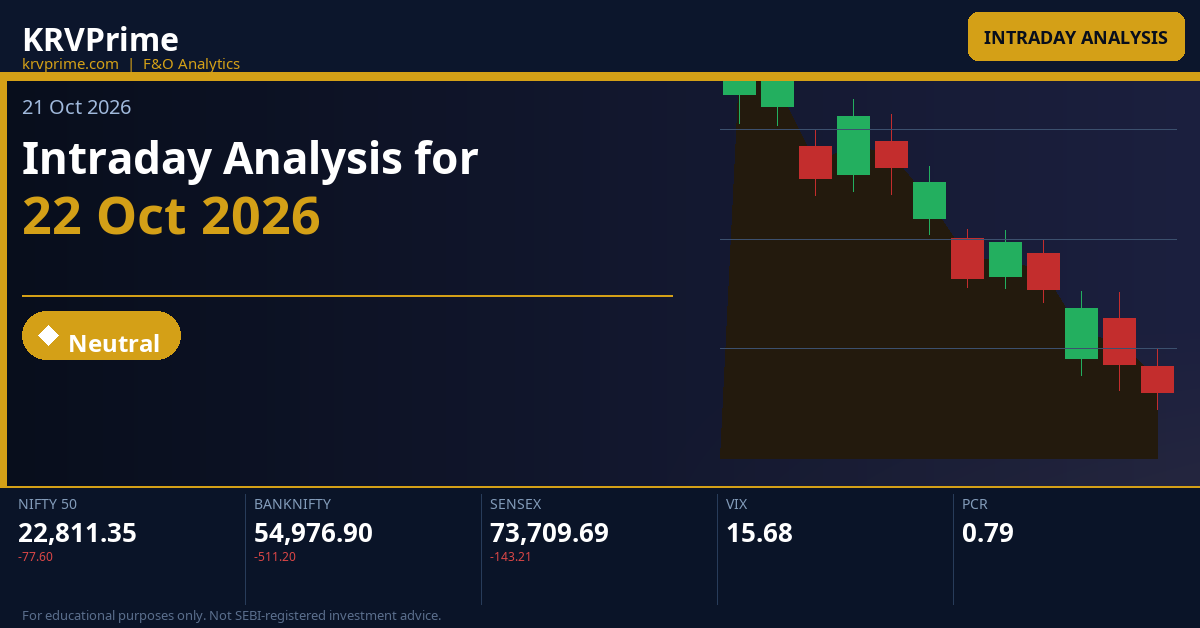
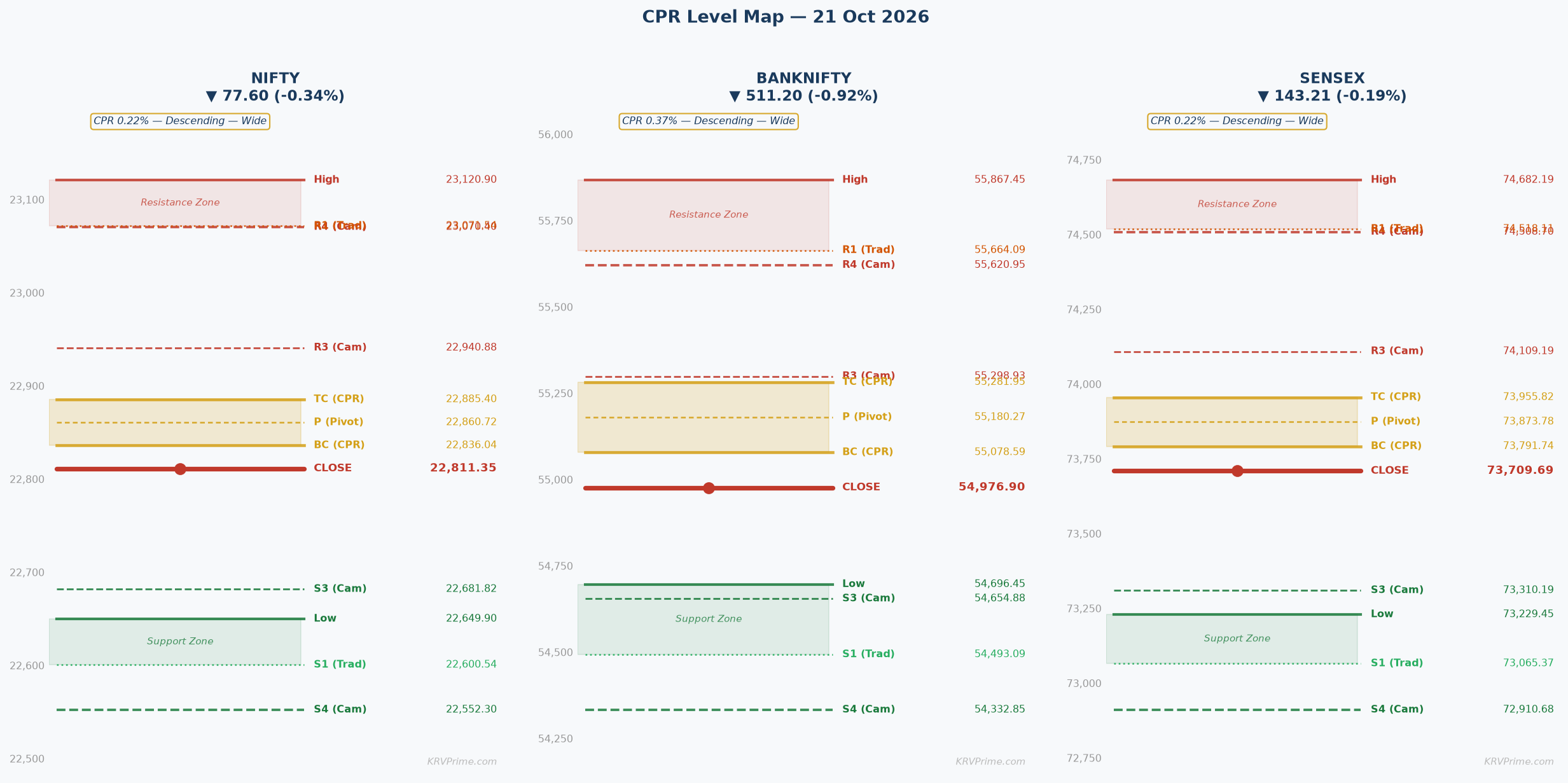
Markets closed on a weak note on 21 Oct 2026, with NIFTY shedding 0.34% to 22,811.35, BANKNIFTY dropping 0.92% to 54,976.90, and SENSEX easing 0.19% to 73,709.69, reflecting broad-based selling pressure across large-caps and banking names. All three indices carry a Descending — Wide CPR into 22 Oct 2026, meaning the entire CPR band sits below yesterday's close for each index, structurally framing the session as one where the CPR acts as overhead resistance on any recovery attempt. India VIX data is unavailable for today's close, which warrants caution — traders should watch the first 30-minute price action closely and avoid aggressive directional bets until the opening range establishes a clear directional bias confirmed by two 30-minute closes given the Wide CPR rule.
Key Market Signals — Intraday Setup
All three indices — NIFTY, BANKNIFTY, and SENSEX — are printing Descending Wide CPRs simultaneously into 22 Oct 2026, signalling a structurally bearish tilt where the CPR band in every index is positioned as overhead resistance below yesterday's close, creating a unified message of cautious, range-bound trade with downside vulnerability if the CPR band fails to attract buyers on the open.
Deep Technical Analysis & Levels
NIFTY
Descending — Wide (0.22%)
▼ Bearish
Market Structure Sideways or range-bound | Straddle ATM 22800 straddle = 135.95 (Call) + 200.35 (Put) = **336.30 points** expected move; this implies a session range of roughly 22,464 on the downside and 23,136 on the upside from the ATM strike, capturing both the PDL zone near 22,649.90 and the OI resistance wall at 23,000 within the straddle boundary, suggesting options markets are pricing in elevated directional uncertainty but within a defined corridor. | Max Pain Max Pain at **22,900** for the 27-Oct-2026 weekly expiry; price is currently 88.65 points below max pain at 22,811.35, meaning option sellers would benefit from a gravitational drift back toward 22,900, which also aligns closely with the CPR Pivot at 22,860.72 and TC at 22,885.40 — creating a strong magnetic zone between 22,860 and 22,900 for the remainder of the week. |
Tomorrow's Complete Level Map
OI-R: 23,000 R3: 23,542.54 H6: 23,285.71 H5: 23,221.68 R2: 23,331.72 H4 ▶: 23,070.40 R1: 23,071.54 PDH: 23,120.90 H3 ↩: 22,940.88
TC: 22,885.40 P: 22,860.72 BC: 22,836.04
L3 ↩: 22,681.82 PDL: 22,649.90 S1: 22,600.54 L4 ▶: 22,552.30 S2: 22,389.72 L5: 22,401.02 L6: 22,336.99 S3: 22,129.54 OI-S: 22,000
↩ = Camarilla reversal point | ▶ = Camarilla breakout/breakdown trigger | OI-R/OI-S = Options wall (CE/PE max OI)
▲ Higher Open (Gap Up) — Open > Prev Close
▲ Bullish
Open lands: For a Descending CPR, a gap-up open places price above TC (22,885.40), meaning the market opens above the entire CPR band which is structurally positioned below yesterday's close. A minor gap-up (0.05–0.25%) lands price in the 22,822–22,868 zone, likely inside or just above BC (22,836.04) but below TC (22,885.40). A significant gap-up (0.25–0.5%) opens price in the 22,868–22,925 zone, above TC (22,885.40) and testing the CPR band from above. A large gap-up (>0.5%) lifts price above 22,925, potentially directly into H3 (22,940.88) or beyond.
CPR role: In this Descending Wide CPR setup, the CPR band (BC 22,836.04 to TC 22,885.40) transitions from overhead resistance to a potential launch pad IF price can sustain above TC on two 30-minute closes — a confirmation threshold mandated by the Wide CPR rule. Until that dual confirmation is achieved, the CPR band acts as a trap door zone where early longs initiated on the gap are vulnerable to fading back toward BC and L3.
Minor Gap (0.05–0.25%) — Structure Dominant
A minor gap-up of 0.05–0.25% would open NIFTY approximately in the 22,822–22,868 range, placing it inside the CPR band between BC (22,836.04) and TC (22,885.40), or just at the base of BC. The Descending Wide CPR structure creates a conflict here — the gap adds an upward lean but the CPR band is set below yesterday's close, meaning price is opening into the resistance belly of the band rather than cleanly above it. The immediate first target on sustaining above TC (22,885.40) with two 30-minute closes is H3 (22,940.88), followed by the critical OI resistance wall at 23,000, while failure to hold BC (22,836.04) invalidates the gap-up thesis and exposes L3 (22,681.82) as the next meaningful reference.
Significant Gap (0.25–0.5%) — Balanced
A significant gap-up of 0.25–0.5% would open NIFTY in the 22,868–22,925 zone, placing it above TC (22,885.40) and into the H3 zone (22,940.88), directly confronting the first Camarilla mean-reversion resistance. This gap size creates a balanced scenario where gap-fill risk is real — price opened above the entire Descending CPR band, and without immediate volume confirmation via two 30-minute closes above TC (22,885.40), the CPR band transforms into a magnetic pullback target as delta-hedging flows compress the move. On the upside, sustaining above H3 (22,940.88) with two 30-minute closes targets H4 (23,070.40) and R1 (23,071.54) which form a confluent cluster, but the dominant OI ceiling at 23,000 is a primary fade zone where CE writers actively defend with gamma selling pressure that caps the move.
Large Gap (>0.5%) — Gap Direction Dominant
A large gap-up of more than 0.5% would open NIFTY above 22,925, potentially at or above H3 (22,940.88), and in extreme cases approaching the H4/R1 confluence at 23,070–23,071. At this opening level, the primary psychological dynamic shifts toward gap-fill risk, as participants who missed the move sell into strength and institutional desks fade the opening print using the OI wall at 23,000 as the hard ceiling. The straddle of 336.30 points from 22,800 ATM suggests the maximum upside priced by options is near 23,136, meaning a large gap-up into 23,070–23,121 is already consuming the full upside straddle premium — making further extension unlikely without fresh positive triggers. The abort level for any long initiated on a large gap-up is a two 30-minute close below TC (22,885.40), which would signal the gap has been faded and downside toward L3 (22,681.82) and PDL (22,649.90) becomes the operative path.
|
▲ Upside Path → OI-R On confirmed bullish momentum above TC (22,885.40), the first target is H3 (22,940.88) — the Camarilla mean-reversion zone where initial profit-taking is expected — followed by the confluent H4/R1 cluster at 23,070.40/23,071.54, which represents the Camarilla breakout trigger and traditional first resistance in tight alignment. The hard ceiling is the OI resistance wall at **23,000** where CE writers at this strike have positioned maximum open interest, creating an options-driven gamma squeeze zone where call sellers aggressively defend; only a daily close above 23,000 with high volume would justify targeting H5 (23,221.68) or R2 (23,331.72). |
▼ Downside Path → OI-S If the gap-up fails to hold TC (22,885.40) on two 30-minute closes, price reverts toward the CPR Pivot at 22,860.72 and then BC (22,836.04), with a breach of BC accelerating selling toward L3 (22,681.82) — the Camarilla mean-reversion support zone that coincides closely with PDL (22,649.90) forming a double support cluster. Below L3 (22,681.82), the failure of PDL (22,649.90) triggers momentum stops and the path extends to L4 (22,552.30) and S1 (22,600.54), with the ultimate downside anchor at the **OI-S wall at 22,000** where PE writers have the highest open interest concentration, providing a structural floor for the weekly expiry cycle. |
| 🔴 OI-R: The **OI resistance at 23,000** is the dominant options wall for both weekly and monthly NIFTY expiries, where CE writers have positioned maximum open interest, creating a gamma-driven ceiling that caps bullish momentum — every 10-point rally above 22,950 triggers incremental delta hedging by call sellers who sell futures to stay delta-neutral, creating mechanical selling pressure that suppresses the move. In a gap-up scenario, this 23,000 CE wall acts as the primary fade zone rather than a momentum target, meaning traders should book partial profits at H3 (22,940.88) and not chase toward 23,000 unless confirmed by extraordinary volume. | 🟢 OI-S: The **OI support at 22,000** is the bedrock PE writing zone for both weekly and monthly expiries, sitting 811 points below current close — in a gap-up session this level is operationally irrelevant as an intraday target, but it establishes the structural floor that keeps put writers comfortable and prevents panic selling unless a macro shock dramatically accelerates downside beyond the straddle range. The 22,000 PE wall means the downside in a gap-up day is most likely contained well above this level, with L3 (22,681.82) and PDL (22,649.90) acting as the practical bear abort levels for the session. |
⚡ Key Trigger: The directional fulcrum for a gap-up open is **two consecutive 30-minute candle closes above TC (22,885.40)** on above-average volume — this is the Wide CPR confirmation rule and must not be shortcut to a single candle close. If price achieves this, the CPR band has successfully converted from overhead resistance to a confirmed launch pad, validating bullish control and opening the path toward H3 (22,940.88) first, then the OI wall at 23,000; conversely, failure to achieve two 30-minute closes above TC (22,885.40) confirms the gap is being faded and the CPR band has acted as a trap door, with BC (22,836.04) as the first bearish checkpoint and L3 (22,681.82) as the subsequent target.
▼ Lower Open (Gap Down) — Open < Prev Close
▼ Bearish
Open lands: For a Descending CPR, a gap-down open places price below BC (22,836.04), meaning the market opens below the entire CPR band which itself is already positioned below yesterday's close — a compounding bearish structure. A minor gap-down opens price in the 22,754–22,800 zone, below BC (22,836.04) but above L3 (22,681.82). A significant gap-down opens in the 22,697–22,754 zone, approaching L3 (22,681.82) and the PDL cluster at 22,649.90. A large gap-down breaches PDL (22,649.90) and opens in the L4 (22,552.30) and S1 (22,600.54) zone.
CPR role: In a gap-down, the entire CPR band (BC 22,836.04 to TC 22,885.40) sits as overhead resistance above the opening price, meaning any recovery rally must fight through BC first, then the Pivot at 22,860.72, then TC (22,885.40) — a layered wall of resistance. The Wide CPR confirmation rule mandates two 30-minute closes above BC (22,836.04) to signal genuine recovery; anything short of that confirms the CPR band is acting as an overhead ceiling and the downside path remains operative.
Minor Gap (0.05–0.25%) — Structure Dominant
A minor gap-down of 0.05–0.25% opens NIFTY in the 22,754–22,800 zone, below BC (22,836.04) but still comfortably above L3 (22,681.82), providing room for a gap-fill rally back toward BC within the first 30 minutes given that minor gaps in wide CPR sessions frequently attract early dip buyers. However, the Descending Wide CPR structure means that even on a gap-fill attempt, BC (22,836.04) immediately becomes resistance rather than support, and the two 30-minute close rule above BC must be satisfied before any long bias is confirmed — failure to reclaim BC within 60 minutes shifts the session to a slow bleed toward L3 (22,681.82). The primary bear target on sustained weakness below the open is L3 (22,681.82) — the Camarilla mean-reversion support zone — which coincides near PDL (22,649.90) and S1 (22,600.54), making this a dense cluster for initial put profit-booking.
Significant Gap (0.25–0.5%) — Balanced
A significant gap-down of 0.25–0.5% opens NIFTY in the 22,697–22,754 range, placing price directly above or at the L3 (22,681.82) and PDL (22,649.90) support cluster, which is the most critical technical confluence for intraday bears — a break below here with sustained selling marks a structural breakdown day. The recovery analysis is straightforward: if price stabilises above L3 (22,681.82) and reclaims BC (22,836.04) within two 30-minute closes, the gap-fill is valid and a recovery toward CPR Pivot (22,860.72) and TC (22,885.40) becomes the bull case; if price fails at L3, PUT writers begin covering and momentum shorts accelerate toward L4 (22,552.30) and S1 (22,600.54). Weekly OI support at 22,000 is distant but the PE writing at this strike provides a gravitational anchor that limits catastrophic downside in the absence of a macro trigger.
Large Gap (>0.5%) — Gap Direction Dominant
A large gap-down of more than 0.5% opens NIFTY below PDL (22,649.90), likely in the L4 (22,552.30) to S1 (22,600.54) zone, breaching the prior day's low and triggering systematic stop-losses placed below PDL by overnight long holders. The panic-vs-recovery dynamic in such a scenario depends entirely on VIX behaviour in the first 15 minutes — given VIX data is unavailable, traders must watch the straddle premium expansion; if the 22,800 straddle swells significantly above 336.30 points, it confirms elevated fear and the downside path toward L5 (22,401.02) and S2 (22,389.72) becomes operative. Recovery above L4 (22,552.30) on high volume with two 30-minute closes signals a potential short-squeeze, but the CPR band at BC (22,836.04) to TC (22,885.40) remains a formidable overhead structure that caps any meaningful intraday recovery.
|
▲ Upside Path → OI-R The recovery path in a gap-down session runs BC (22,836.04) → Pivot (22,860.72) → TC (22,885.40) → H3 (22,940.88), where each level acts as a progressive hurdle requiring genuine volume-backed buying to breach — a thin-volume recovery that stalls at BC (22,836.04) signals a dead-cat bounce rather than genuine strength. Only a two 30-minute close above TC (22,885.40) reframes the day as bullish and targets H3 (22,940.88) then the OI wall at **23,000**, but the probability of reaching 23,000 in a gap-down session with Descending Wide CPR is low without a strong exogenous catalyst. |
▼ Downside Path → OI-S The primary bear path in a gap-down flows L3 (22,681.82) → L4 (22,552.30) → L5 (22,401.02), with L3 (22,681.82) acting as the mean-reversion zone where initial put profit-taking slows the decline momentarily before retail stop-losses cascade below PDL (22,649.90) and S1 (22,600.54), accelerating into L4 (22,552.30). The ultimate downside anchor for the intraday session is the **OI-S wall at 22,000**, which is 811 points below yesterday's close — reaching this level intraday is an extreme scenario but the PE writing at 22,000 provides a gravitational endpoint for a panic-driven session. |
| 🔴 OI-R: In a gap-down scenario, the **OI resistance at 23,000** is operationally distant at 189 points above yesterday's close, functioning as a hard ceiling that short-sellers use to benchmark their recovery abort level — any intraday bounce that approaches 23,000 faces aggressive CE writing pressure that maintains delta-neutral short hedges and mechanically caps the recovery. The 23,000 wall means recovery trades above the CPR band are low-probability intraday trades unless a significant positive macro catalyst emerges. | 🟢 OI-S: The **OI support at 22,000** is the PE writer's anchor for the weekly and monthly expiry, concentrating maximum put open interest at this strike — reaching this level intraday would force a wave of put covering as theta decay and gamma acceleration at 22,000 make holding shorts expensive. The 22,000 PE wall serves as the intraday bear's ultimate target and the structural floor below which the broader market's risk framework changes, making it the key level for options traders to monitor for straddle and strangle monetisation timing. |
⚡ Key Trigger: **Failure to reclaim BC (22,836.04) within two 30-minute candle closes** confirms that the CPR band is acting as an overhead ceiling and the bearish structure remains intact, making every minor recovery a selling opportunity for positional traders. Conversely, the bull recovery trigger is two 30-minute closes above BC (22,836.04) on above-average volume, which signals that the gap-down was a false breakdown and price has reestablished itself inside the CPR decision zone, opening a path toward Pivot (22,860.72) and TC (22,885.40).
◆ Near Flat Open — Open ≈ Prev Close (±0.05%)
◆ Neutral
Open lands: A ±0.05% flat open places NIFTY in the 22,799–22,823 range, which is below BC (22,836.04) and therefore below the entire Descending CPR band (BC 22,836.04 to TC 22,885.40). This is the classic Descending CPR flat-open setup: price opens near yesterday's close which is already below the new CPR band, confirming two consecutive sessions with price below the CPR structure — a structurally bearish tilt where the CPR acts as layered overhead resistance from the very first candle.
CPR role: The CPR band functions as a **decision zone / overhead resistance band** in a flat open — BC (22,836.04) is the first ceiling, Pivot (22,860.72) the second, and TC (22,885.40) the third layer. Price opening below the entire band means the bulls must fight uphill against this three-layer structure, while bears have an immediate structural advantage as long as price stays below BC (22,836.04).
Near Flat (±0.05%)
A flat open in a Descending Wide CPR is one of the highest-information setups of the trading calendar — price opens near yesterday's close (22,811.35), which is below the entire CPR band, and the first 30-minute candle IS the trade because it determines whether the CPR band acts as a launchpad for a surprise bull reversal or a confirmed resistance wall for the bear case. BC (22,836.04) is the critical first ceiling — a 30-minute close above BC shifts the day toward potential CPR recovery with Pivot (22,860.72) and TC (22,885.40) as successive targets, while a 30-minute close below the open's 22,799–22,823 zone confirms sustained pressure and targets L3 (22,681.82). The Wide CPR width of 0.22% mandates the two 30-minute close rule — no single candle close is sufficient for directional confirmation, preventing premature entry on false breakouts or breakdowns within this 49-point band. The bull trigger is two consecutive 30-minute closes above TC (22,885.40), targeting H3 (22,940.88) then OI-R at 23,000; the bear trigger is two 30-minute closes below the opening print near 22,811 (confirming CPR as ceiling), targeting L3 (22,681.82) then L4 (22,552.30) and S1 (22,600.54) with the weekly OI-S wall at 22,000 as the structural floor.
|
▲ Upside Path → OI-R A confirmed break above TC (22,885.40) targets H3 (22,940.88) — the Camarilla mean-reversion zone — as the first profit-taking level, followed by the confluent H4/R1 cluster at 23,070.40/23,071.54 which represents the Camarilla breakout trigger and first traditional resistance. The max pain at 22,900 also sits within the CPR-to-H3 corridor, meaning option sellers mechanically benefit from any drift toward 22,900 — enhancing the probability of a test of this zone early in the session before a more decisive directional move. |
▼ Downside Path → OI-S A confirmed break below BC (22,836.04) on two 30-minute closes triggers the downside path toward L3 (22,681.82) — the Camarilla mean-reversion support — followed by L4 (22,552.30) as the Camarilla breakdown trigger where momentum shorts accelerate. Below L4 (22,552.30), S1 (22,600.54) and PDL (22,649.90) form a demand cluster that may slow the decline, but sustained selling drives toward L5 (22,401.02) and S2 (22,389.72) with the ultimate weekly anchor at the **OI-S wall at 22,000**. |
| 🔴 OI-R: In a flat-open session, the **OI resistance at 23,000** serves as the options market's ceiling for CE writers who have sold maximum calls at this strike for both weekly and monthly expiries — any intraday rally toward 23,000 triggers incremental delta-hedging selling from these CE writers, creating a self-reinforcing cap that contains bullish moves within the H3 (22,940.88) to H4 (23,070.40) zone. Traders should use the 23,000 wall as the primary upside profit target rather than a breakout level unless extraordinary volume and a macro catalyst force a short-squeeze above this concentration. | 🟢 OI-S: The **OI support at 22,000** anchors the PE writer community's downside hedging for both weekly and monthly expiries, providing a structural floor 811 points below the current close — in a flat-open scenario this level acts as the intraday bear's maximum ambition rather than a realistic target, but its presence ensures that put writers aggressively defend any move toward 22,500–22,000 by selling additional puts, creating a gravitational support effect in the lower Camarilla zones (L4 22,552.30, L5 22,401.02). |
⚡ Key Trigger: **Two consecutive 30-minute candle closes above TC (22,885.40)** = bull confirmation, activating the path toward H3 (22,940.88) and the OI wall at 23,000; **two consecutive 30-minute closes below BC (22,836.04)** = bear confirmation, targeting L3 (22,681.82) and L4 (22,552.30). The 49-point CPR band between BC and TC is the structural fulcrum for the entire session — it concentrates all the competing order flows from max pain at 22,900, CPR Pivot at 22,860.72, and the straddle midpoint near 22,800, making a break out of this band on volume the day's most actionable signal.
BANKNIFTY
Descending — Wide (0.37%)
▼ Bearish
Market Structure Sideways or range-bound | Straddle ATM 55000 straddle = 417.50 (Call) + 435.00 (Put) = **852.50 points** expected move; this implies a session range of roughly 54,147 on the downside and 55,852 on the upside from the ATM strike, nearly encompassing the entire PDH (55,867.45) on the upside and testing the PDL (54,696.45) zone on the downside — reflecting elevated premium and wide expected range for BANKNIFTY given its inherently higher beta versus NIFTY. | Max Pain Max Pain at **55,500** for the 27-Oct-2026 monthly expiry; price is currently 523.10 points below max pain at 54,976.90, creating a meaningful gravitational pull toward 55,500 which aligns closely with the CPR Pivot (55,180.27) and TC (55,281.95) zone — the convergence of max pain, CPR resistance, and H3 (55,298.93) in the 55,281–55,500 band makes this the most magnetically attractive zone for option sellers to engineer price toward as expiry approaches. |
Tomorrow's Complete Level Map
OI-R: 56,000 R3: 56,835.09 H6: 56,153.90 H5: 55,997.07 R2: 56,351.27 H4 ▶: 55,620.95 R1: 55,664.09 PDH: 55,867.45 H3 ↩: 55,298.93
TC: 55,281.95 P: 55,180.27 BC: 55,078.59
L3 ↩: 54,654.88 PDL: 54,696.45 S1: 54,493.09 L4 ▶: 54,332.85 S2: 54,009.27 L5: 53,956.72 L6: 53,799.90 S3: 53,322.09 OI-S: 52,000
↩ = Camarilla reversal point | ▶ = Camarilla breakout/breakdown trigger | OI-R/OI-S = Options wall (CE/PE max OI)
▲ Higher Open (Gap Up) — Open > Prev Close
▲ Bullish
Open lands: For BANKNIFTY's Descending CPR, a gap-up open places price above TC (55,281.95), above the entire CPR band. A minor gap-up (0.05–0.25%) of 27–137 points opens price in the 55,004–55,114 zone, inside the CPR band between BC (55,078.59) and TC (55,281.95). A significant gap-up (0.25–0.5%) of 137–275 points opens in the 55,114–55,252 zone, approaching TC (55,281.95). A large gap-up (>0.5%) of more than 275 points opens above TC (55,281.95), likely testing H3 (55,298.93) and the PDH area at 55,867.45.
CPR role: In a gap-up scenario, the CPR band (BC 55,078.59 to TC 55,281.95) acts as a potential launch pad IF two 30-minute closes above TC (55,281.95) are achieved — without this confirmation, the 203-point wide CPR band functions as a trap door where premature longs face a swift reversal back toward BC and L3 (54,654.88). The Wide CPR at 0.37% is the widest of the three indices, meaning the range between BC and TC is substantial and intraband whipsaws are common.
Minor Gap (0.05–0.25%) — Structure Dominant
A minor gap-up of 0.05–0.25% opens BANKNIFTY in the 55,004–55,114 zone, placing price inside the CPR band above BC (55,078.59) but well below TC (55,281.95), giving early buyers a 167–277-point hill to climb before achieving any structural bullish confirmation. The Descending Wide CPR structure creates friction here — the gap provides an upward lean but being inside the 203-point wide band means price must navigate both BC and TC as resistance before any trend signal emerges, making this a scalp environment rather than a directional day. The first meaningful target on two 30-minute closes above TC (55,281.95) is H3 (55,298.93) — barely 17 points above TC — creating an immediate Camarilla mean-reversion stall zone before any extension toward H4 (55,620.95) and the OI resistance wall at 56,000 which caps the upside.
Significant Gap (0.25–0.5%) — Balanced
A significant gap-up of 0.25–0.5% opens BANKNIFTY in the 55,114–55,252 zone, placing price near the upper half of the CPR band, approaching TC (55,281.95) with only 30–167 points of gap-fill buffer before the CPR top is reached. This gap size creates a balanced scenario where delta-hedging flows from H3's proximity (55,298.93 is only 46–184 points above open) mean that CE writers at the OI resistance wall at 56,000 are not yet threatened but are monitoring closely, and the primary risk is a gap-fill reversal back toward BC (55,078.59) if two 30-minute closes above TC (55,281.95) fail. On sustained momentum above H3 (55,298.93), the next targets are H4 (55,620.95) and R1 (55,664.09) — a confluent Camarilla breakout trigger and traditional resistance cluster — before the dominant OI ceiling at 56,000 halts the rally with aggressive CE writing activity.
Large Gap (>0.5%) — Gap Direction Dominant
A large gap-up of more than 0.5% (275+ points) opens BANKNIFTY above TC (55,281.95), directly at or above H3 (55,298.93) and potentially challenging PDH (55,867.45) — a structurally significant gap that consumes a large portion of the 852.50-point straddle range in the opening print itself. The probability of a gap-fill back toward TC (55,281.95) and BC (55,078.59) is elevated in this scenario, as BANKNIFTY's higher beta amplifies mean-reversion dynamics and institutional desks use gap-up opens near PDH to re-establish short positions at premium levels near the OI resistance wall at 56,000. Two 30-minute closes above H3 (55,298.93) are needed to confirm the gap is being absorbed and extension toward H4 (55,620.95), R1 (55,664.09), and ultimately the OI wall at 56,000 is the operative bull path; failure below TC (55,281.95) signals a bull trap and opens downside toward BC (55,078.59) then L3 (54,654.88).
|
▲ Upside Path → OI-R Confirmed bullish momentum above TC (55,281.95) first tests H3 (55,298.93) — the Camarilla mean-reversion zone, just 17 points above TC, which is an immediate stall point requiring volume to break through convincingly — before targeting the confluent H4/R1 cluster at 55,620.95/55,664.09 representing the Camarilla breakout trigger and traditional first resistance. The primary upside ceiling is the **OI resistance wall at 56,000** where maximum CE open interest for the monthly expiry concentrates, meaning call writers at 56,000 apply systematic delta-hedging selling pressure on every 50-point rally above 55,800, mechanically containing the move unless a major positive banking sector catalyst forces a short squeeze. |
▼ Downside Path → OI-S Failure at TC (55,281.95) in a gap-up reversal drives price back through Pivot (55,180.27) and BC (55,078.59), with a breach of BC accelerating toward L3 (54,654.88) — the Camarilla mean-reversion support zone near PDL (54,696.45) — creating a high-density support cluster in the 54,655–54,696 range. Below L3 (54,654.88), retail stop-losses cascade and momentum sellers target L4 (54,332.85) and S1 (54,493.09) as the next pair of confluent levels, with the structural bear anchor at the **OI-S wall at 52,000** providing the monthly expiry's downside boundary for PE writers. |
| 🔴 OI-R: The **OI resistance at 56,000** is the BANKNIFTY monthly expiry's dominant CE writing zone, creating a gamma-driven ceiling where call sellers maintain delta-neutral shorts by selling BANKNIFTY futures on every 50–100-point approach, mechanically capping the bullish move. In a gap-up scenario, the 56,000 wall is 1,023 points above yesterday's close — it acts as the session's ultimate upside aspiration rather than an immediate intraday target, meaning partial profits at H3 (55,298.93) and H4 (55,620.95) are the realistic booking zones. | 🟢 OI-S: The **OI support at 52,000** is the monthly PE writing anchor, sitting 2,977 points below yesterday's close — in a gap-up session this level is operationally irrelevant as an intraday downside target but serves as the structural floor that anchors PE writer confidence and prevents panic-driven selling on minor bearish reversals. The distance of 52,000 from current levels (nearly 5.4% below) provides psychological comfort to bulls that the downside floor is firm within the options framework. |
⚡ Key Trigger: **Two consecutive 30-minute candle closes above TC (55,281.95)** on above-average volume is the Wide CPR confirmation rule for BANKNIFTY — achieving this transforms the CPR band from an overhead resistance structure into a confirmed launch pad and opens the path toward H3 (55,298.93), H4 (55,620.95), and the OI ceiling at 56,000. Failure to achieve two 30-minute closes above TC (55,281.95) signals the gap is being faded, with BC (55,078.59) as the first bear checkpoint and L3 (54,654.88) as the next meaningful support where put buyers begin accumulating positions.
▼ Lower Open (Gap Down) — Open < Prev Close
▼ Bearish
Open lands: For BANKNIFTY's Descending CPR, a gap-down open places price below BC (55,078.59) and below the entire CPR band. A minor gap-down (0.05–0.25%) of 27–137 points opens in the 54,840–54,950 zone, below BC (55,078.59) but above L3 (54,654.88). A significant gap-down (0.25–0.5%) of 137–275 points opens in the 54,702–54,840 range, approaching PDL (54,696.45) and L3 (54,654.88). A large gap-down (>0.5%) of more than 275 points opens below PDL (54,696.45), potentially at or below L3 (54,654.88) and approaching L4 (54,332.85).
CPR role: In a gap-down, the entire 203-point CPR band (BC 55,078.59 to TC 55,281.95) sits as a three-layer overhead resistance wall above the opening price, making any recovery attempt face BC first, then Pivot (55,180.27), then TC (55,281.95) — a formidable sequence of hurdles requiring two 30-minute closes above each layer. The Wide CPR at 0.37% makes intraday recovery through the full band extremely difficult without a major positive catalyst.
Minor Gap (0.05–0.25%) — Structure Dominant
A minor gap-down of 0.05–0.25% opens BANKNIFTY in the 54,840–54,950 zone, below BC (55,078.59) but with 185–295 points of cushion above L3 (54,654.88) and PDL (54,696.45) — providing room for a quick gap-fill attempt toward BC within the first 30 minutes. The Descending Wide CPR means BC (55,078.59) immediately becomes a resistance ceiling rather than a support, and two 30-minute closes above BC are required to confirm recovery — in the absence of this confirmation, the session drifts toward L3 (54,654.88) where the PDL (54,696.45) cluster creates a dual support reference. The bear continuation target below L3 (54,654.88) is L4 (54,332.85) and S1 (54,493.09), with PUT writers at the OI-S wall of 52,000 providing the structural expiry-cycle floor.
Significant Gap (0.25–0.5%) — Balanced
A significant gap-down of 0.25–0.5% opens BANKNIFTY in the 54,702–54,840 zone, placing price dangerously close to PDL (54,696.45) and L3 (54,654.88) — the dual Camarilla mean-reversion support and prior day's low cluster that represents the most important technical battleground for intraday positioning. A failure to hold L3 (54,654.88) with two 30-minute closes below this level is the bear confirmation that unlocks L4 (54,332.85) as the next target and S1 (54,493.09) as a partial profit zone for put longs; recovery above BC (55,078.59) on two 30-minute closes re-establishes the bull case and targets Pivot (55,180.27) then TC (55,281.95). The PE writing concentration at OI-S (52,000) provides a 2,977-point cushion below yesterday's close, making a full breach of L4 the maximum realistic intraday bear scenario without a systemic banking sector shock.
Large Gap (>0.5%) — Gap Direction Dominant
A large gap-down of more than 0.5% (275+ points) opens BANKNIFTY below PDL (54,696.45) at or near L3 (54,654.88) to L4 (54,332.85), triggering systematic stop-losses from overnight long holders in Nifty Bank futures and ETFs who had placed stops at PDL. The panic-vs-recovery dynamic is amplified by BANKNIFTY's higher beta — VIX data being unavailable means traders must watch the 55,000 straddle premium expansion against the base 852.50 points; a premium above 1,000 points signals panic and confirms the downside path toward L4 (54,332.85), L5 (53,956.72), and potentially S2 (54,009.27). Recovery above L3 (54,654.88) on two 30-minute high-volume closes signals a potential hammer-and-reverse day, but the CPR band overhead (BC 55,078.59 to TC 55,281.95) remains a formidable resistance wall that contains any recovery.
|
▲ Upside Path → OI-R The recovery path in a gap-down flows BC (55,078.59) → Pivot (55,180.27) → TC (55,281.95) → H3 (55,298.93), with each level requiring a separate two 30-minute close confirmation given the Wide CPR rule — a recovery that stalls at BC (55,078.59) on thin volume is classified as a dead-cat bounce. Max pain at 55,500 sits between TC (55,281.95) and H4 (55,620.95), making a recovery toward this zone the most option-seller-friendly outcome that could be engineered by market makers through delta-hedging flows. |
▼ Downside Path → OI-S The primary bear path flows L3 (54,654.88) → L4 (54,332.85) → L5 (53,956.72), with L3 (54,654.88) acting as the Camarilla mean-reversion zone where initial put profit-taking occurs but retail stop-losses below PDL (54,696.45) accelerate the cascade into L4 (54,332.85) which is the Camarilla breakdown trigger. Below L4 (54,332.85), the path toward S2 (54,009.27) and L5 (53,956.72) opens with momentum, though the **OI-S wall at 52,000** anchors the monthly expiry floor and prevents unlimited downside. |
| 🔴 OI-R: The **OI resistance at 56,000** is 1,023 points above yesterday's close — in a gap-down session this wall is operationally distant and functions as the benchmark ceiling that short-sellers reference to size their recovery abort levels. Any recovery trade that approaches 55,500–55,800 zone faces increasing CE writing pressure from the 56,000 call writers who sell futures to stay delta-neutral, capping intraday recovery well below the OI wall. | 🟢 OI-S: The **OI support at 52,000** is the monthly expiry's PE writing concentration zone, sitting 2,977 points below yesterday's close — reaching this level intraday would be a catastrophic event for BANKNIFTY, triggering massive put covering that could spark an explosive short-squeeze. In a significant or large gap-down session, the 52,000 PE wall ensures that put writers aggressively defend the L4 (54,332.85) and L5 (53,956.72) zones with fresh put selling, creating a gravitational floor effect and limiting intraday downside to the 53,800–54,000 zone in normal market conditions. |
⚡ Key Trigger: **Failure to reclaim BC (55,078.59) with two 30-minute candle closes** confirms the CPR band as overhead ceiling and validates the bear case, making recoveries toward BC shorting opportunities with L3 (54,654.88) and L4 (54,332.85) as downside targets. The bull recovery trigger is two 30-minute closes above BC (55,078.59) on above-average volume, which would signal that the gap-down was a false move and recovery toward Pivot (55,180.27), TC (55,281.95), and ultimately max pain at 55,500 is underway.
◆ Near Flat Open — Open ≈ Prev Close (±0.05%)
◆ Neutral
Open lands: A ±0.05% flat open places BANKNIFTY in the 54,949–55,004 zone, below BC (55,078.59) and therefore below the entire Descending CPR band. This is the textbook Descending CPR flat-open scenario where price opens at or near yesterday's close (54,976.90) and the new CPR band sits entirely above as a three-layer resistance structure — BC at 55,078.59 is 102 points above the open, Pivot at 55,180.27 is 204 points above, and TC at 55,281.95 is 305 points above.
CPR role: The CPR band functions as a **layered overhead resistance / decision zone** in a flat-open — the 203-point wide band from BC (55,078.59) to TC (55,281.95) is the widest of the three indices today, making it a substantial battleground. The Wide CPR confirmation rule (two 30-minute closes) strictly applies; any move inside the band must be treated as indecisive until a two-candle close above TC (55,281.95) is confirmed for bulls or a two-candle close below BC (55,078.59) confirms the bear case.
Near Flat (±0.05%)
A flat open in BANKNIFTY's Descending Wide CPR (0.37%) is a structurally loaded setup — price opens below the entire CPR band for the second consecutive session, meaning the structural message is bearish until bulls can prove the contrary by reclaiming TC (55,281.95) with two 30-minute closes. The first 30-minute candle is the highest-information candle of the session: if it closes above BC (55,078.59) on above-average volume, it signals aggressive dip-buying and a potential recovery toward Pivot (55,180.27) and TC (55,281.95); if it closes below the opening print (54,949–55,004) without reclaiming BC, the CPR band confirms as a ceiling and L3 (54,654.88) becomes the immediate bear target. The 203-point wide CPR band (0.37%) is classified as Wide and requires two 30-minute closes for directional confirmation — this prevents premature entries and protects against the intraband whipsaws that BANKNIFTY is notorious for generating in high-VIX sessions. Max pain at 55,500 is 523 points above the flat open zone, creating a gravitational pull that may slowly lift price toward BC (55,078.59) and Pivot (55,180.27) during the session as option sellers work their delta-hedging flows — bull trigger: two 30-minute closes above TC (55,281.95) targeting H3 (55,298.93), H4 (55,620.95), and max pain 55,500; bear trigger: two 30-minute closes below BC (55,078.59) targeting L3 (54,654.88), L4 (54,332.85), and S1 (54,493.09).
|
▲ Upside Path → OI-R A confirmed break above TC (55,281.95) first tests H3 (55,298.93) — just 17 points above TC, a hair-trigger Camarilla stall zone that requires volume conviction to break cleanly — before targeting the H4/R1 confluence at 55,620.95/55,664.09 and the gravitational max pain anchor at 55,500. The **OI resistance at 56,000** is the ultimate ceiling where monthly CE writers apply systematic delta-hedging selling; a session close above 55,800 with high volume would be required to meaningfully threaten the 56,000 wall. |
▼ Downside Path → OI-S A confirmed break below BC (55,078.59) with two 30-minute closes triggers the bear path toward L3 (54,654.88) — the Camarilla mean-reversion support near PDL (54,696.45) — where initial PUT profit-taking slows the move before retail stop cascades below PDL accelerate into L4 (54,332.85) and S1 (54,493.09). Below L4 (54,332.85), the path extends toward L5 (53,956.72) and S2 (54,009.27), with the **OI-S wall at 52,000** as the monthly expiry's structural floor that anchors the downside range. |
| 🔴 OI-R: In a flat-open scenario, the **OI resistance at 56,000** is 1,023 points above the flat-open zone — it operates as the options market's hard ceiling that validates the bear bias of the session, since price opening 1,023 points below the CE wall implies that call writers are comfortably out-of-the-money and have little incentive to cover, maintaining their short-gamma positions that suppress upside volatility. Traders should use the 56,000 wall as their maximum bull aspiration for any long trade initiated from the flat-open zone, with partial profits at each Camarilla level (H3 55,298.93, H4 55,620.95) along the way. | 🟢 OI-S: The **OI support at 52,000** is the monthly expiry's PE writing concentration, providing a structural floor 2,977 points below the flat-open zone — in a flat-open session this level anchors the downside framework and gives PE writers the confidence to sell additional puts at L4 (54,332.85) and L5 (53,956.72) levels, creating gravitational support within the lower Camarilla zones. The 52,000 PE wall means the realistic intraday bear target is bounded by L4 (54,332.85) to L5 (53,956.72) in a normal session, with 52,000 becoming relevant only in a systemic banking sector shock. |
⚡ Key Trigger: **Two consecutive 30-minute candle closes above TC (55,281.95)** = bull confirmation, activating the path toward H3 (55,298.93), max pain 55,500, H4 (55,620.95), and ultimately the OI wall at 56,000; **two consecutive 30-minute closes below BC (55,078.59)** = bear confirmation, targeting L3 (54,654.88), L4 (54,332.85), and the OI-S anchor at 52,000. The 203-point wide CPR band is the structural fulcrum where two sessions of price-below-CPR activity amplifies bearish pressure — a failure by bulls to reclaim BC within the first 60 minutes is a strong signal that the session belongs to the bears.
SENSEX
Descending — Wide (0.22%)
▼ Bearish
Market Structure Sideways or range-bound | Straddle ATM 73700 weekly straddle = 208.00 (Call) + 396.20 (Put) = **604.20 points** expected move for the weekly expiry (22-Oct-2026 expiry, today); the monthly straddle at ATM 73700 = 602.60 (Call) + 716.50 (Put) = **1,319.10 points**, reflecting significantly wider implied range for the monthly. The weekly 604.20-point straddle implies an intraday range from approximately 73,096 on the downside to 74,304 on the upside from the ATM strike — this is a weekly expiry day for SENSEX which dramatically elevates gamma risk and pin risk around the ATM strike at 73,700. | Max Pain Max Pain at **73,600** for the 22-Oct-2026 weekly expiry (today's expiry) and **74,000** for the 29-Oct-2026 monthly expiry; with today being weekly expiry day, the 73,600 max pain level is the primary gravitational anchor pulling price throughout the session, sitting 109.69 points below yesterday's close of 73,709.69 — expect option sellers to defend the 73,600 area aggressively as time value collapses and pin risk intensifies around this strike. |
Tomorrow's Complete Level Map
OI-R: 75,000 R3: 75,970.85 H6: 75,171.96 H5: 74,975.33 R2: 75,326.52 H4 ▶: 74,508.70 R1: 74,518.11 PDH: 74,682.19 H3 ↩: 74,109.19
TC: 73,955.82 P: 73,873.78 BC: 73,791.74
L3 ↩: 73,310.19 PDL: 73,229.45 S1: 73,065.37 L4 ▶: 72,910.68 S2: 72,421.04 L5: 72,444.05 L6: 72,247.42 S3: 71,612.63 OI-S: 72,000
↩ = Camarilla reversal point | ▶ = Camarilla breakout/breakdown trigger | OI-R/OI-S = Options wall (CE/PE max OI)
▲ Higher Open (Gap Up) — Open > Prev Close
▲ Bullish
Open lands: For SENSEX's Descending CPR, a gap-up open places price above TC (73,955.82), above the entire CPR band. A minor gap-up (0.05–0.25%) of 37–184 points opens price in the 73,747–73,894 zone — inside the CPR band between BC (73,791.74) and TC (73,955.82). A significant gap-up (0.25–0.5%) of 184–368 points opens in the 73,894–74,078 zone, above TC (73,955.82) and into the H3 (74,109.19) zone. A large gap-up (>0.5%) of more than 368 points opens above 74,078, near H3 (74,109.19) or H4 (74,508.70).
CPR role: In a gap-up on SENSEX's weekly expiry day, the CPR band (BC 73,791.74 to TC 73,955.82) acts as a potential launch pad IF two 30-minute closes above TC (73,955.82) are confirmed — but given today is weekly expiry for SENSEX (22-Oct-2026), pin risk around max pain at 73,600 creates a gravitational pull that competes with any gap-up momentum. The Wide CPR rule applies strictly: without two 30-minute candle closes above TC (73,955.82), the band acts as a trap door, and pin dynamics accelerate the reversal back toward 73,600.
Minor Gap (0.05–0.25%) — Structure Dominant
A minor gap-up of 0.05–0.25% opens SENSEX in the 73,747–73,894 zone, placing price inside the CPR band between BC (73,791.74) and TC (73,955.82) — a position that creates immediate structural ambiguity on this weekly expiry day. The Descending Wide CPR means the gap adds only a minor upward lean against the structural overhead resistance of the band, and with max pain at 73,600 just 147–294 points below the opening range, gamma-driven pin pressure will actively pull price toward 73,600 as expiry approaches, creating a natural fade against the minor gap-up. Two 30-minute closes above TC (73,955.82) would confirm genuine bullish intent targeting H3 (74,109.19) as the first Camarilla mean-reversion target, but in the absence of this confirmation, BC (73,791.74) and then max pain at 73,600 are the gravitational targets for the expiry session.
Significant Gap (0.25–0.5%) — Balanced
A significant gap-up of 0.25–0.5% opens SENSEX in the 73,894–74,078 zone, above TC (73,955.82) and approaching the H3 zone (74,109.19) — on expiry day this creates an immediate CE writer defense dynamic as delta-hedging flows from the OI resistance wall at 75,000 become active even at current levels. The gap-fill risk is pronounced: SENSEX opening 184–368 points above yesterday's close on weekly expiry day faces 73,600 max pain gravity as option sellers defend their short-gamma positions, creating a natural fade toward the CPR Pivot (73,873.78) and BC (73,791.74) within 30–60 minutes of open. Sustained two 30-minute closes above H3 (74,109.19) would override the pin dynamic and target H4 (74,508.70) and R1 (74,518.11) as the next confluent resistance cluster, but this scenario requires exceptional buyer conviction given both the Descending CPR structure and expiry-day gamma dynamics.
Large Gap (>0.5%) — Gap Direction Dominant
A large gap-up of more than 0.5% (368+ points) opens SENSEX above 74,078, near H3 (74,109.19) or approaching H4 (74,508.70) — on weekly expiry day this is a high-impact scenario where the entire weekly straddle premium of 604.20 points is immediately compressed as the large gap violates the expected range on the upside. CE writers at 75,000 and put writers at 72,000 both face delta-adjustment pressure as gamma spikes near expiry, creating erratic intraday swings rather than a clean directional trend — the abort level for long trades initiated on this large gap is a two 30-minute close below TC (73,955.82). The maximum upside target on a large gap-up is H4 (74,508.70) and R1 (74,518.11) before the monthly OI resistance at 75,000 provides the hard ceiling, with partial profits recommended at each Camarilla level given expiry-day volatility compression risks.
|
▲ Upside Path → OI-R Confirmed bullish momentum above TC (73,955.82) targets H3 (74,109.19) first — the Camarilla mean-reversion zone where option sellers and technical traders are positioned to take first profits — followed by the highly confluent H4/R1 cluster at 74,508.70/74,518.11 representing the Camarilla breakout trigger and traditional first resistance in near-perfect alignment. The monthly **OI resistance at 75,000** and weekly OI resistance at 75,000 align perfectly, making this a dual-expiry options wall where CE writers from both weekly and monthly contracts defend with maximum gamma — a test of 75,000 would require extraordinary buying volume. |
▼ Downside Path → OI-S Failure of TC (73,955.82) in a gap-up reversal on expiry day triggers the max pain gravity pull toward 73,600 and then BC (73,791.74) — a reversal through BC opens L3 (73,310.19) as the next Camarilla mean-reversion support level near PDL (73,229.45). Below L3 (73,310.19), the bear path extends toward L4 (72,910.68) and S1 (73,065.37), with the **OI-S wall at 72,000** as the weekly and monthly PE writing anchor that provides the structural floor for the expiry cycle. |
| 🔴 OI-R: The **OI resistance at 75,000** is the dominant CE writing wall for both SENSEX weekly (22-Oct expiry today) and monthly (29-Oct expiry) contracts, creating a dual-expiry gamma defense zone where call sellers from both expirations apply concurrent delta-hedging selling pressure. On weekly expiry day specifically, the 75,000 CE writers are deep out-of-the-money at 1,290 points above the close, meaning they are not acutely threatened by intraday price action — but their positioning signals that the market's risk framework does not anticipate a move to 75,000 in this session. | 🟢 OI-S: The **OI support at 72,000** is the dual-expiry PE writing zone for both the weekly (expiring today) and monthly SENSEX contracts — on today's weekly expiry, the 72,000 PE writers have deep in-the-money puts approaching expiry, and the 1,709.69-point gap between current price and 72,000 means these puts are expiring near maximum intrinsic value if price stays above 72,000. The 72,000 PE wall provides the structural floor confidence that prevents catastrophic intraday downside, with L4 (72,910.68) acting as the practical intraday bear limit in a normal session. |
⚡ Key Trigger: **Two consecutive 30-minute candle closes above TC (73,955.82)** is the Wide CPR confirmation for SENSEX — on weekly expiry day this trigger is especially important because it must overcome both the structural CPR overhead resistance AND the max pain gravity of 73,600 that pulls price downward as option time value collapses. Failure at TC (73,955.82) with a reversal below Pivot (73,873.78) confirms the gap is fading and pin dynamics are taking over, making max pain at 73,600 and BC (73,791.74) the operative targets.
▼ Lower Open (Gap Down) — Open < Prev Close
▼ Bearish
Open lands: For SENSEX's Descending CPR, a gap-down open places price below BC (73,791.74) and below the entire CPR band. A minor gap-down (0.05–0.25%) of 37–184 points opens in the 73,526–73,673 zone, below BC (73,791.74) but above L3 (73,310.19). A significant gap-down (0.25–0.5%) of 184–368 points opens in the 73,342–73,526 zone, approaching L3 (73,310.19) and PDL (73,229.45). A large gap-down (>0.5%) of more than 368 points opens below PDL (73,229.45), in the L4 (72,910.68) to S1 (73,065.37) zone.
CPR role: In a gap-down on weekly expiry day, the CPR band (BC 73,791.74 to TC 73,955.82) sits as a three-layer overhead resistance wall — but the critical additional factor is max pain at 73,600 sitting BETWEEN the open zone and BC. This creates a unique expiry-day dynamic where price opening below 73,600 faces TWO gravitational forces simultaneously: max pain pulling upward toward 73,600, and the CPR band overhead at BC (73,791.74). The Wide CPR rule still requires two 30-minute closes above BC for bullish confirmation.
Minor Gap (0.05–0.25%) — Structure Dominant
A minor gap-down of 0.05–0.25% opens SENSEX in the 73,526–73,673 zone, below BC (73,791.74) but above L3 (73,310.19), with max pain at 73,600 creating an interesting expiry-day dynamic where the gap-down may quickly find a floor near 73,600 as put writers on the weekly expiry defend this strike. The Descending Wide CPR structure means any recovery from the 73,600 max pain zone must still overcome BC (73,791.74) then Pivot (73,873.78) then TC (73,955.82) to be classified as a genuine recovery — each requiring two 30-minute close confirmations under the Wide CPR rule. Primary bear target on failure to hold the open is L3 (73,310.19) near PDL (73,229.45) and S1 (73,065.37), which coincides with the upper boundary of the weekly OI-S zone at 72,000 — making S1 (73,065.37) the first serious downside target for put buyers.
Significant Gap (0.25–0.5%) — Balanced
A significant gap-down of 0.25–0.5% opens SENSEX in the 73,342–73,526 zone, placing price between L3 (73,310.19) and the 73,526 level — directly threatening the critical PDL (73,229.45) and L3 (73,310.19) support cluster on weekly expiry day. The failure-and-resume analysis is particularly sharp here: if price holds above L3 (73,310.19) and reclaims BC (73,791.74) with two 30-minute closes, the gap-fill toward max pain at 73,600 and then Pivot (73,873.78) is a high-probability expiry-day recovery driven by put unwinding at 73,600. A failure below L3 (73,310.19) on expiry day triggers accelerated put covering and short-selling simultaneously, driving price toward L4 (72,910.68) and OI-S wall at 72,000 where weekly PUT writers begin closing expiring contracts.
Large Gap (>0.5%) — Gap Direction Dominant
A large gap-down of more than 0.5% (368+ points) opens SENSEX below PDL (73,229.45), likely in the 73,065 (S1) to 72,910 (L4) zone — on weekly expiry day this is an extreme scenario where the 72,000 PE writers face accelerating intrinsic value decay and begin aggressive defensive selling. The panic-vs-recovery dynamic is intensified by the weekly expiry gamma: as SENSEX approaches 72,000, put delta approaches 1.0, meaning every 100-point decline below 73,000 generates nearly 100 points of mechanical put value — creating feedback loops that can spike volatility. Recovery above L3 (73,310.19) on two 30-minute high-volume closes would signal a short-squeeze reversal, but the CPR overhead (BC 73,791.74 to TC 73,955.82) remains a formidable resistance structure above any recovery.
|
▲ Upside Path → OI-R The recovery path flows max pain (73,600) → BC (73,791.74) → Pivot (73,873.78) → TC (73,955.82) → H3 (74,109.19), with each level requiring two 30-minute closes for confirmation under the Wide CPR rule — a recovery that stalls at max pain (73,600) without reclaiming BC (73,791.74) is classified as expiry-pin behaviour rather than genuine recovery. Two 30-minute closes above TC (73,955.82) confirms full CPR recapture and targets H3 (74,109.19) then the H4/R1 confluence at 74,508.70/74,518.11, with the **OI resistance at 75,000** as the hard monthly ceiling. |
▼ Downside Path → OI-S The bear path flows L3 (73,310.19) → L4 (72,910.68) → S1 (73,065.37) → OI-S (72,000), with L3 (73,310.19) coinciding near PDL (73,229.45) as the first critical breakdown zone where put buyers take initial profits. Below L4 (72,910.68), the **OI-S wall at 72,000** for both weekly (expiring today) and monthly expiries concentrates maximum PE open interest — reaching 72,000 on weekly expiry day would trigger explosive put-value-unlocking and potential short-covering bounces as put writers scramble to close expiring deep-in-the-money positions. |
| 🔴 OI-R: In a gap-down session on expiry day, the **OI resistance at 75,000** (1,709 points above yesterday's close) is operationally irrelevant as an intraday target — it serves as the ceiling that keeps CE writers comfortable and out-of-the-money, meaning they apply no gamma-pressure to cap recovery moves until price approaches 74,500–75,000. This distance provides theoretical recovery room above the CPR band before any options-driven ceiling applies. | 🟢 OI-S: The **OI support at 72,000** is critical on today's weekly expiry day — PE writers at 72,000 have sold puts that are 1,709 points out-of-the-money at yesterday's close, but a significant gap-down toward 72,000–73,000 on expiry day compresses time value rapidly and forces put writer delta-adjustment selling. Reaching 72,000 intraday on expiry day would trigger a violent put-covering rally as expiring puts hit full intrinsic value, making 72,000 both the bear's maximum target and a high-probability reversal zone on today's weekly expiry session. |
⚡ Key Trigger: **Failure to reclaim BC (73,791.74) with two 30-minute closes** on expiry day confirms the CPR band as overhead resistance and validates the bear case, with max pain at 73,600 potentially acting as a temporary support if price opens below it — the bear confirmation is a two 30-minute close below max pain (73,600) after a failed recovery attempt. The bull recovery trigger is two 30-minute closes above BC (73,791.74) on above-average volume, which would signal that the gap-down is being absorbed and recovery toward Pivot (73,873.78), TC (73,955.82), and H3 (74,109.19) is underway.
◆ Near Flat Open — Open ≈ Prev Close (±0.05%)
◆ Neutral
Open lands: A ±0.05% flat open places SENSEX in the 73,672–73,747 zone, below BC (73,791.74) and below the entire Descending CPR band. On weekly expiry day for SENSEX (22-Oct-2026), a flat open near yesterday's close of 73,709.69 is structurally significant because max pain at 73,600 is only 110 points below the flat-open zone, creating an immediate gravitational pull toward max pain from the very first candle.
CPR role: The CPR band (BC 73,791.74 to TC 73,955.82) functions as a **decision zone / overhead resistance band** in a flat open on expiry day — the 164-point wide band is the day's primary battleground where the market determines whether the entire CPR structure acts as a ceiling (bearish expiry session pinning near 73,600) or a launch pad (bullish recovery toward H3 74,109.19). The Wide CPR rule mandates two 30-minute closes above TC (73,955.82) for the bull case, while the simultaneous max pain gravity at 73,600 gives the bear case a natural expiry-day anchor just 110 points below the open.
Near Flat (±0.05%)
A flat open on SENSEX weekly expiry day (22-Oct-2026) in a Descending Wide CPR environment is the most complex setup of the session — price opens below the entire CPR band at 73,672–73,747, with max pain at 73,600 just 72–147 points below acting as a dual gravitational anchor that option sellers actively defend through time-value decay mechanics. The first 30-minute candle is the highest-information event: if it closes above BC (73,791.74), dip buyers are overriding the expiry-pin dynamic and targeting Pivot (73,873.78) and TC (73,955.82); if it closes below max pain (73,600), the expiry pin is fully activated and price is likely to oscillate in the 73,400–73,700 range for the remainder of the session. The Wide CPR at 0.22% requires two 30-minute closes for directional confirmation — but on expiry day, the time-value decay acceleration after 12:00 PM IST makes early confirmation more critical than in a non-expiry session, as gamma spikes near ATM strikes can cause erratic intraday swings that invalidate technical setups. Bull trigger: two 30-minute closes above TC (73,955.82) targeting H3 (74,109.19), H4 (74,508.70)/R1 (74,518.11), and ultimately the dual-expiry OI resistance at 75,000; bear trigger: two 30-minute closes below BC (73,791.74) confirming CPR overhead resistance with targets at L3 (73,310.19), L4 (72,910.68), and the **OI-S wall at 72,000**.
|
▲ Upside Path → OI-R A confirmed break above TC (73,955.82) on the weekly expiry day targets H3 (74,109.19) — the Camarilla mean-reversion resistance zone where first partial profits are booked — followed by the highly confluent H4/R1 cluster at 74,508.70/74,518.11, which aligns with the monthly OI resistance boundary. The **dual-expiry OI resistance at 75,000** — where both weekly (today) and monthly CE writers have concentrated open interest — acts as the hard ceiling, with the weekly 73,700 Call at 208 points suggesting the market has priced in only a 208-point upside from ATM on the weekly contract, making 73,908 the outer boundary of weekly call option value. |
▼ Downside Path → OI-S A confirmed break below BC (73,791.74) with two 30-minute closes activates the expiry-day bear path: max pain at 73,600 → L3 (73,310.19) → L4 (72,910.68) → S1 (73,065.37), with L3 (73,310.19) near PDL (73,229.45) forming the first major demand cluster where buyers historically step in. The **OI-S wall at 72,000** — carrying both weekly and monthly PE writing — is the structural floor 1,709 points below yesterday's close, with L6 (72,247.42) and S2 (72,421.04) serving as the intermediate downside checkpoints before the PE wall's gravitational support activates. |
| 🔴 OI-R: On weekly expiry day, the **OI resistance at 75,000** represents CE writing from both the expiring weekly contracts (deeply out-of-the-money, expiring today) and the active monthly contracts — the weekly 75,000 CE writers face zero delta risk today as the option is 1,290 points out of the money with hours to expiry, meaning their delta-hedging selling pressure is negligible on the CE side. The monthly 75,000 CE wall is the operative resistance ceiling, applying gamma pressure only if price approaches 74,500–75,000 intraday, making this level a distant but meaningful upside boundary that validates the flat-open's neutral bias. | 🟢 OI-S: The **OI support at 72,000** carries dual-expiry PE writing significance — the weekly 72,000 puts (expiring today) are deeply in-the-money with 1,709 points of intrinsic value if price stays where it is, meaning weekly PE holders are sitting on significant gains and may begin defensive selling into the market to lock profits if price dips toward 73,000. This creates a paradoxical gravitational dynamic where reaching 72,000 intraday would accelerate put covering (buy-side pressure) even as CE delta-hedging sellers maintain downside pressure — making 72,000 the most explosive gamma zone for today's expiry session. |
⚡ Key Trigger: **Two consecutive 30-minute candle closes above TC (73,955.82)** = bull confirmation, activating the expiry-day squeeze path toward H3 (74,109.19), max pain at 73,600 (already below), H4 (74,508.70), and the monthly OI wall at 75,000; **two consecutive 30-minute closes below BC (73,791.74)** = bear confirmation with expiry gravity pulling toward max pain 73,600 first, then L3 (73,310.19) and OI-S at 72,000 as the weekly expiry's ultimate downside anchor. The max pain level at 73,600 is a uniquely important reference for today's session — on weekly expiry day, a flat open means market makers have a strong incentive to keep SENSEX oscillating between 73,400 and 73,800 to maximize put and call time-value erosion simultaneously.
📊 VIX Insight: India VIX data is unavailable for 21 Oct 2026 closing, which introduces a meaningful uncertainty parameter for 22 Oct 2026 intraday positioning — traders cannot assess whether implied volatility is rising (fear-driven, widening straddle premiums) or contracting (complacency, tighter range). Given that all three indices closed in the red with BANKNIFTY leading losses at -0.92%, and all three are entering sessions with Descending Wide CPRs, the structural message is one of elevated caution; traders should default to the Wide CPR two 30-minute confirmation rule strictly and avoid sizing up positions until the opening range is established, particularly given that 22 Oct 2026 is SENSEX weekly expiry day where gamma dynamics can spike volatility sharply in the last 2 hours of trading.
Overall View:
All three indices — NIFTY, BANKNIFTY, and SENSEX — enter 22 Oct 2026 with identical CPR architecture: Descending Wide CPRs that position the entire band below yesterday's closing prices, creating a uniform structural message of bearish tilt where every index's CPR acts as overhead resistance in flat and gap-down scenarios. SENSEX faces the additional complexity of weekly expiry (22-Oct-2026) with max pain at 73,600 creating powerful gamma-pin dynamics that could dominate price action between 73,400 and 73,800 throughout the session, while NIFTY's max pain at 22,900 and BANKNIFTY's max pain at 55,500 create upward gravitational pulls of 88.65 and 523.10 points respectively from their current closes. The high-conviction trade setup for 22 Oct 2026 is a fade-on-gap-up strategy for all three indices using the Wide CPR two 30-minute confirmation rule — until price confirms sustained holds above TC levels (NIFTY 22,885.40, BANKNIFTY 55,281.95, SENSEX 73,955.82), the structural bias favors selling into strength with OI walls at NIFTY 23,000, BANKNIFTY 56,000, and SENSEX 75,000 as the hard ceilings and OI floors at 22,000, 52,000, and 72,000 respectively as the structural downside anchors.
All three indices — NIFTY, BANKNIFTY, and SENSEX — enter 22 Oct 2026 with identical CPR architecture: Descending Wide CPRs that position the entire band below yesterday's closing prices, creating a uniform structural message of bearish tilt where every index's CPR acts as overhead resistance in flat and gap-down scenarios. SENSEX faces the additional complexity of weekly expiry (22-Oct-2026) with max pain at 73,600 creating powerful gamma-pin dynamics that could dominate price action between 73,400 and 73,800 throughout the session, while NIFTY's max pain at 22,900 and BANKNIFTY's max pain at 55,500 create upward gravitational pulls of 88.65 and 523.10 points respectively from their current closes. The high-conviction trade setup for 22 Oct 2026 is a fade-on-gap-up strategy for all three indices using the Wide CPR two 30-minute confirmation rule — until price confirms sustained holds above TC levels (NIFTY 22,885.40, BANKNIFTY 55,281.95, SENSEX 73,955.82), the structural bias favors selling into strength with OI walls at NIFTY 23,000, BANKNIFTY 56,000, and SENSEX 75,000 as the hard ceilings and OI floors at 22,000, 52,000, and 72,000 respectively as the structural downside anchors.
Disclaimer: KRV Prime provides educational and informational content relating to financial markets. Articles, research, examples, charts, strategies and tools are provided for educational purposes and should not be interpreted as personalised investment advice or a guarantee of financial performance. Markets involve risk, including possible loss of capital. Past performance does not guarantee future results. KRV Prime is not a SEBI Registered Investment Adviser or Research Analyst.