
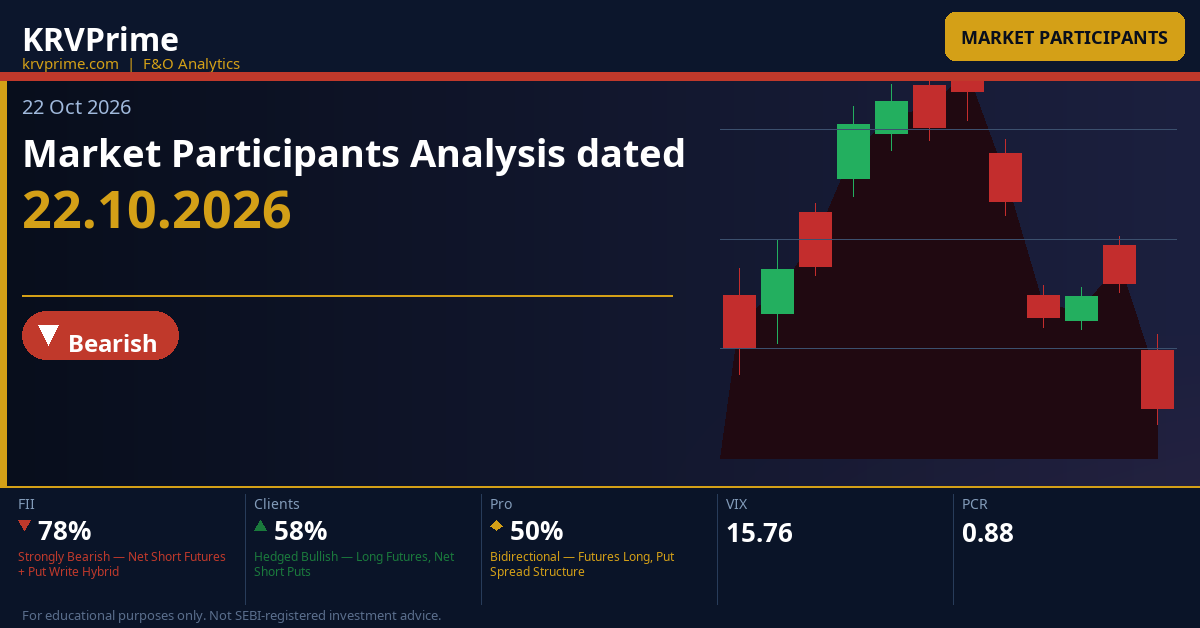
Market Participants Analysis dated 22.10.2026
KRVPrime — Daily Market Outlook
Key Market Signals — Data: 22 Oct 2026
NIFTY 50 22,687.65 ▼ -123.70 (-0.54%) | BANK NIFTY 54,925.70 ▼ -51.20 (-0.09%) | SENSEX 73,249.39 ▼ -460.30 (-0.62%) |
OVERALL PCR 0.88 ▲ +0.09 (+11.41%) PCR recovering toward neutrality from oversold 0.79 — put accumulation gaining pace but still below parity | INDIA VIX 15.76 ▲ +0.08 (+0.56%) VIX nudging higher — elevated fear zone; markets pricing modest premium for protection | TOTAL OI CHANGE 53,195,432 ▲ +1,508,918 (+2.92%) Broad OI expansion on a down-day signals fresh position building, not just short covering |
FUTURES OI 851,064 ▲ +38,936 (+4.79%) Futures OI rising with price falling — classic short buildup confirmation across participants | CALL OI CHANGE 11,807,060 ▲ +298,294 (+2.59%) Moderate call OI expansion — supply being added at resistance zones, capping upside | PUT OI CHANGE 10,408,999 ▲ +1,302,146 (+14.30%) Massive put OI surge (+14.30%) — dominant protective buying and speculative bearish bets accumulating |
Participant-wise Key Points
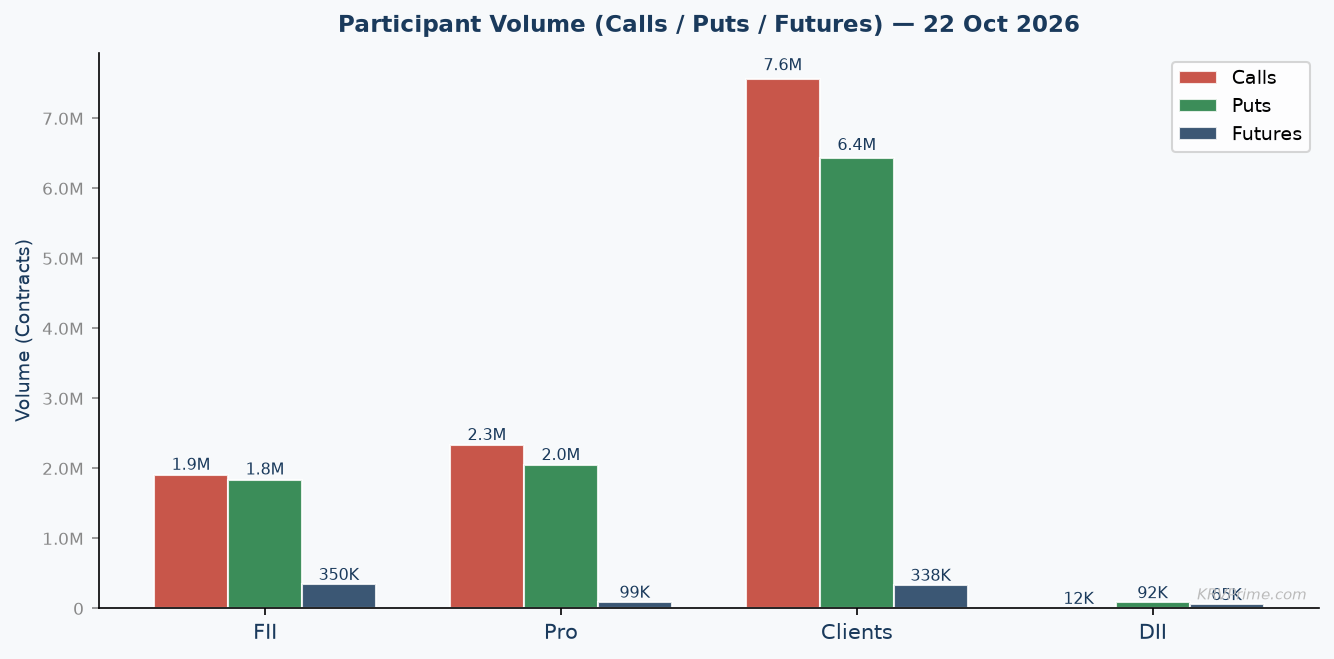
FII Cautiously Bearish — Expanding Both Sides, Net Short Futures with Put Writing Spike
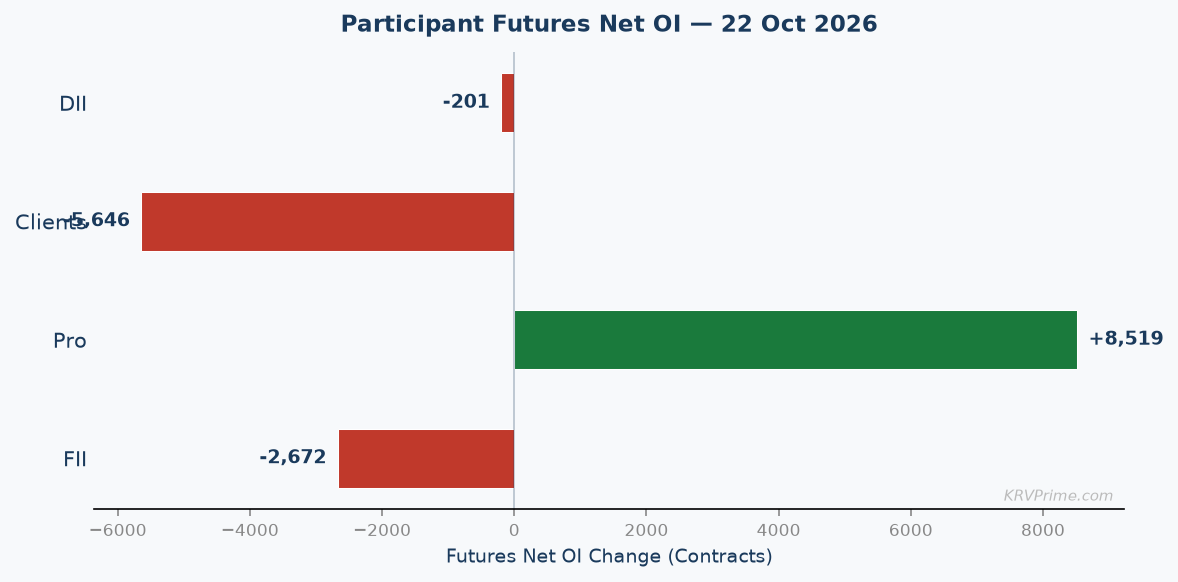
- Futures net deteriorated from -277,628 to -280,300 (net change -2,672 contracts). The long side added 2,105 contracts (prev 32,598 → today 34,703) tagged [Long Buildup - High Vol], while the short side added 4,777 contracts (prev 310,226 → today 315,003) tagged [Short Buildup - High Vol]. Both High Vol tags are critical — they confirm these are not routine roll-overs or incidental adjustments but deliberate, high-conviction directional additions on both legs. The gross short-to-long ratio now stands at approximately 9.07:1 (315,003 shorts vs 34,703 longs), which is an unambiguous outright directional short position — FIIs are not using futures for hedging here; they are expressing a primary bearish view on the index. The slight long addition alongside the larger short build may reflect minor delta-hedging of their options book rather than any genuine bullish reversal signal.
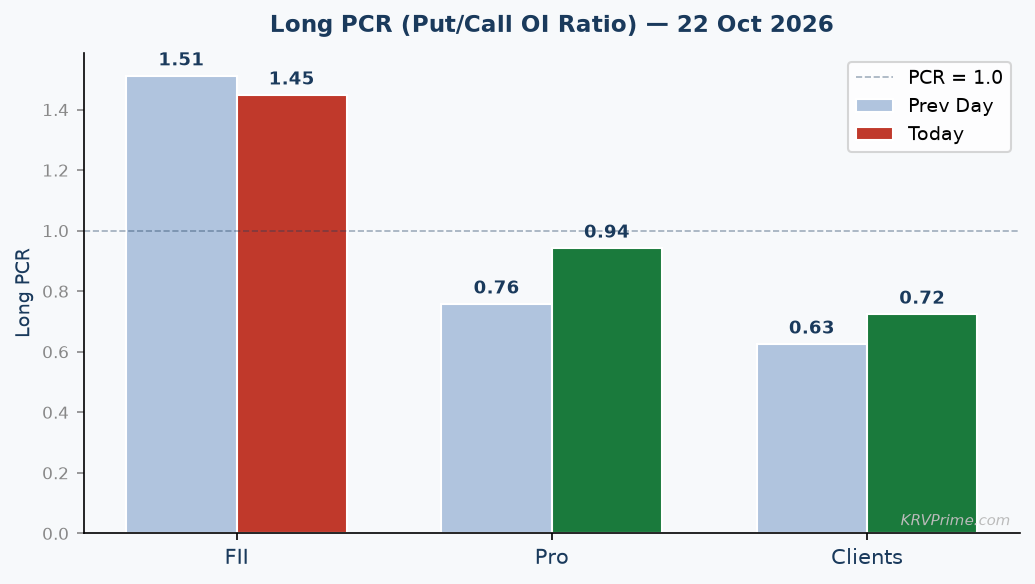
- Long PCR declined from 1.51 to 1.45 (-4.18%) and Short PCR surged from 0.51 to 0.61 (+20.04%). A Long PCR of 1.45 means FIIs continue to hold 45% more put longs than call longs on their options book — this is a deeply defensive or directionally bearish posture that confirms the futures short thesis. The decline in Long PCR from 1.51 to 1.45 is notable: it does not mean FIIs turned bullish — rather, they added call longs faster than put longs today (+41,685 call longs vs +11,980 put longs), which partially explains the ratio compression. More revealing is the Short PCR jump from 0.51 to 0.61 (+20.04%) — FIIs massively increased their put writing side (+107,040 put shorts) relative to call writing (-9,493 call shorts, short covering), meaning they are now writing far more puts than calls, a strategy consistent with collecting premium on the downside while retaining their futures short — this hybrid approach signals FIIs believe downside is limited to a defined range even as they stay net short.
- Call OI net moved from -341,527 to -290,349 (net change +51,178): Long side added 41,685 contracts to reach 808,596 [Long Buildup - Low Vol]; Short side reduced by 9,493 contracts to 1,098,945 [Short Covering - Low Vol]. The Low Vol tags on both call legs indicate these are thin-volume, non-conviction moves — the call short covering and call long buildup are likely mechanical adjustments rather than a strategic pivot. Put OI net dropped sharply from +597,220 to +502,160 (net change -95,060): Long side added 11,980 contracts to 1,171,687 [Long Buildup - Low Vol], while the Short side exploded by +107,040 contracts to 669,527 [Short Buildup - Low Vol]. The massive put short addition (+107,040) with a Low Vol tag is paradoxical — large additions on low relative volume suggest this was executed during low-liquidity windows or as a structured spread, not panic writing. Architecturally, FIIs now hold net short calls + net long puts but with a rising put-write book that is compressing the net put-long advantage — this resembles a ratio put spread or short strangle with put-heavy lean, rather than a pure synthetic short.
- Synthesis — FII Hybrid Bearish Spread Architecture: FIIs present a structurally bearish but tactically complex picture today. The futures net at -280,300 with a 9.07:1 gross short-to-long ratio leaves no ambiguity about their primary directional bet — they are short the index and added to that short today. However, the simultaneous explosion in put shorts (+107,040) while maintaining put longs (+11,980) tells us FIIs are not buying naked puts for directional downside; they are writing puts below the market to collect premium and fund their hedge — this is classic short-strangle with bearish futures tilt or a ratio spread where they own puts at one strike and write more puts at a lower strike, capping their downside profit potential in exchange for premium income. The call-side short covering (-9,493) combined with call long buildup (+41,685) slightly softens the synthetic-short signal on calls, suggesting FIIs are partially unwinding upside resistance plays. The net effect is a participant that remains firmly bearish on the index via futures but is monetising both tails through options — a strategy that works best in a ranged-down or slowly declining market rather than a sharp crash or sharp rally. Compared to the previous session, FIIs are accelerating the put-write leg while modestly loosening call resistance, which is internally consistent with a view that Nifty declines will be orderly and bounded near 22,000 PE support rather than disorderly.
- Forward trigger: Watch FII futures net — if it crosses below -285,000 contracts in tomorrow's data alongside a Short PCR continuing above 0.61, it confirms FIIs are layering into a structured range-short with premium income and the market faces sustained headwinds. Conversely, if FII futures net improves toward -270,000 (short covering of ~10,000 contracts) accompanied by put short unwinding, it would signal a thesis softening and could spark a sharp short-covering rally. The key OI level to monitor is the Nifty CE Resistance at 24,000 — as long as FIIs maintain gross call shorts above 1,098,000, upside remains structurally capped by their supply wall.
DII Defensively Neutral — Trimming Hedges, Marginal Long Reduction
- Futures net declined marginally from +37,971 to +37,770 (net change -201 contracts). The long side shed 211 contracts (prev 51,508 → today 51,297) tagged [Long Unwinding - Low Vol], and the short side trimmed 10 contracts (prev 13,537 → today 13,527) tagged [Short Covering - Low Vol]. Both Low Vol tags confirm these are minimal, non-conviction moves — this is essentially a flat session for DII futures positioning. The gross long-to-short ratio stands at 3.79:1 (51,297 longs vs 13,527 shorts), maintaining DII's characteristic role as a structural net-long participant in index futures, consistent with their institutional equity book hedging mandate. The marginal long unwind on low volume suggests DIIs are not alarmed by today's decline but are making minor portfolio adjustments — this is housekeeping, not a directional call.
- DII PCR data is not available in the provided dataset (no Call OI or Put OI PCR breakdown for DII on the short side for meaningful ratio construction). However, inferences can be drawn from the Put OI net: DII held a very large net-long put position of +113,261 in the prior session that has now collapsed to +92,090 (net change -21,171) — this massive reduction in net put longs is the most significant DII signal today. The direction of this reduction (unwinding long puts) suggests either profit-taking on existing hedges after recent market weakness, or a deliberate reduction in downside protection as DIIs become more comfortable with current index levels near 22,687. The call side net moved from +7,448 to +8,078 (marginal improvement) via a +630 call long addition, which combined with the put long unwind paints a picture of an institution cautiously reducing bearish hedges while maintaining a mildly constructive options bias.
- Call OI net improved from +7,448 to +8,078 (net change +630): Long side added 630 contracts to 9,948 [Long Buildup - Low Vol]; Short side was unchanged at 1,870 [Short Flat - Low Vol]. The Low Vol buildup and zero change on the short side confirms DII call activity was minimal and non-directional. Put OI net collapsed from +113,261 to +92,090 (net change -21,171): Long side shed 21,371 contracts to 92,170 [Long Unwinding - High Vol]; Short side reduced 200 contracts to 80 [Short Covering - High Vol]. The High Vol tag on the put long unwind is the standout signal — DIIs aggressively liquidated put longs today with above-average volume conviction, indicating this was a deliberate, planned exit of downside protection rather than a passive roll. Architecturally, DIIs hold a net long calls + net long puts posture (net long both), but the rapidly shrinking put-long leg is shifting the architecture toward a naked long calls structure — suggesting DIIs are moving from a protected-long to a more exposed-long stance as they reduce hedge cost.
- Synthesis — DII Hedge Liquidation, Cautious Long Retained: DII's story today is defined almost entirely by one number — the -21,371 High Vol put long unwind. This is not passive decay or routine roll-off; the High Vol confirmation tells us DIIs actively sold out of 21,371 put longs during the session, a meaningful reduction of their protective book from 113,541 to 92,170. Read alongside the near-flat futures position (net +37,770, barely changed), this signals DIIs are reducing insurance cost while keeping their structural equity-long exposure intact — they are not running for the exits, but they are saying 'we no longer need this level of protection at current prices.' This is a mildly constructive signal: if DIIs were genuinely worried about a sharp fall from 22,687, they would be adding puts, not liquidating them. The contradiction worth noting is that DIIs are trimming longs at the same time (-211 futures), which blunts the constructive put-unwind signal slightly. Compared to prior sessions, DIIs are in a de-risking mode — lighter on both long futures and long puts — which is consistent with a range-bound or modestly declining market view rather than a strong directional call in either direction.
- Forward trigger: The key level to watch for DII is whether their put long book stabilises or continues to shrink — if tomorrow's data shows DII put longs drop below 80,000 contracts, it would confirm a full hedge liquidation cycle and suggest DIIs are positioned for a floor near current levels (consistent with the 22,000 Nifty PE support from OI data). If DII put longs instead rebuild above 100,000, it would signal a reversal of today's de-hedging trade and renewed caution about downside risk. Watch the DII futures net — a sustained drop below 35,000 (net long contracts) would mark a material shift in their structural long stance.
Pro Aggressively Bidirectional — Dominant Put Buildup with Futures Long Bias
- Futures net improved sharply from +15,726 to +24,245 (net change +8,519 contracts). The long side surged by 16,105 contracts (prev 45,380 → today 61,485) tagged [Long Buildup - High Vol], while the short side added 7,586 contracts (prev 29,654 → today 37,240) tagged [Short Buildup - High Vol]. Both High Vol tags confirm these are high-conviction, deliberate additions on both legs — this is not passive activity. The gross long-to-short ratio stands at 1.65:1 (61,485 longs vs 37,240 shorts), a meaningful net-long futures tilt. The fact that Pro desks added 16,105 longs against 7,586 shorts on a day Nifty fell -0.54% is striking — they are buying the dip in futures with conviction while simultaneously hedging with proportionally smaller shorts, consistent with a view that the current pullback is a buying opportunity within a defined range rather than the start of a sustained breakdown.
- Long PCR jumped from 0.76 to 0.94 (+24.33%) and Short PCR surged from 0.64 to 0.81 (+28.04%). A Long PCR of 0.94 means Pro desks now hold nearly equal put longs and call longs — a near-parity reading suggesting they are building a straddle or strangle approach on the long side rather than leaning directionally through options. The +24.33% surge in Long PCR is the sharpest one-session jump across all participants today, driven by a massive +164,453 put long addition (discussed below) — this is a rapid and deliberate shift toward put-heavy options longs. The Short PCR rise from 0.64 to 0.81 (+28.04%) tells a similar story on the write side — Pros are writing more puts relative to calls on their short book, adding 129,771 put shorts vs the call short activity. The combination of a rapidly rising Long PCR and Short PCR together points to a long strangle hedged with short strangle architecture — Pros are simultaneously buying and selling the volatility envelope.
- Call OI net collapsed from -55,839 to near-zero at -32 (net change +55,807): Long side shed 66,485 contracts to 1,164,228 [Long Unwinding - Low Vol]; Short side shed 122,292 contracts to 1,164,260 [Short Covering - Low Vol]. The near-perfect neutralisation of the call book (net -32 contracts, virtually flat) with Low Vol tags on both sides tells us Pros systematically closed out their call positions today — both long calls and short calls — essentially exiting their entire net-short call position of -55,839 and moving to a flat call stance. Put OI net expanded from +115,949 to +150,631 (net change +34,682): Long side added a massive 164,453 contracts to 1,098,088 [Long Buildup - Low Vol]; Short side added 129,771 contracts to 947,457 [Short Buildup - Low Vol]. Despite the enormous gross additions on both put legs, the Low Vol tags suggest these were executed in structured, spread-like fashion rather than aggressive directional buying. Architecturally, Pros have shifted from a net short calls + net long puts (synthetic short) to a flat calls + net long puts position — a significant architecture change that removes the cap-writing element while retaining downside protection or directional put exposure.
- Synthesis — Pro Strangle Restructure with Bullish Futures Tilt: Pros present the most architecturally complex and rapidly evolving story today. They simultaneously bought the futures dip (+16,105 longs, High Vol), closed their entire net-short call book (from -55,839 to -32), and added the largest single-session gross put position across all participants (+164,453 put longs and +129,771 put shorts). The complete neutralisation of their call book combined with the massive put build signals a deliberate strangle-to-put-spread restructure — Pros appear to be repositioning from a directional synthetic short (which relied on short calls for premium income) to a net long put spread (long puts at a higher strike, short puts at a lower strike) financed by the call-book closure. The futures long addition (+8,519 net) is an apparent contradiction — if they are buying put spreads for downside protection, why add futures longs? The most coherent explanation is that Pros are running a delta-neutral or slightly bullish delta strategy: long futures to benefit from any bounce while owning put spreads to protect against a breakdown below 22,000 — a classic market-maker or prop-desk positioning for a volatile range rather than a clean directional bet. The High Vol tag on futures confirms this is a high-conviction structural trade, not opportunistic noise. Compared to previous sessions, Pros are accelerating complexity — this is a rapidly evolving book, not a static hold.
- Forward trigger: Watch whether Pros' call OI net moves back into negative territory (below -20,000 net) in tomorrow's data — a return to net-short calls would signal they are re-establishing the cap-writing leg and expect Nifty to stay below 24,000 CE resistance. If instead call longs begin to build (call OI net turning positive), it would confirm Pros are positioning for an upside breakout beyond resistance. The critical futures threshold is 24,245 net long — if Pro futures net expands above 30,000 on another down day, it confirms aggressive dip-buying conviction and could presage a sharp recovery. The 22,000 Nifty PE support level is the floor their put spread appears designed to protect.
Client Hedged Bullish — Aggressive Put Accumulation Masking Underlying Long Bias
- Futures net declined from +223,931 to +218,285 (net change -5,646 contracts). The long side added a modest 1,469 contracts (prev 276,578 → today 278,047) tagged [Long Buildup - High Vol], while the short side added a notable 7,115 contracts (prev 52,647 → today 59,762) tagged [Short Buildup - High Vol]. Both High Vol tags confirm deliberate activity on both sides — this is not incidental trading. The gross long-to-short ratio stands at 4.65:1 (278,047 longs vs 59,762 shorts), maintaining Clients' dominant structural long bias in futures. However, the net deterioration of -5,646 driven by disproportionate short additions (7,115 shorts vs 1,469 longs) tells us retail/HNI clients are beginning to hedge or bet against their own long book — a classic sign of uncertainty within a bullish framework: the primary position remains long but the conviction is softening as Nifty slides toward 22,687.
- Long PCR rose sharply from 0.63 to 0.72 (+15.78%) and Short PCR rose modestly from 0.94 to 0.99 (+4.34%). A Long PCR of 0.72 means Clients now hold puts equal to 72% of their call longs — a significant shift from 0.63, indicating rapid accumulation of put longs relative to call longs over this single session. The +15.78% surge in Long PCR is the second-largest jump across all participants today (after Pros) and is driven by the massive +496,011 put long addition — this is the largest single-leg options addition across any participant in today's dataset. The Short PCR of 0.99 (nearly at parity) means Clients are writing almost equal puts and calls on their short side — a move toward put-call write balance that has historically characterised a neutral-to-range market expectation from this segment. The +4.34% Short PCR increase suggests clients are modestly adding put writes alongside their massive put long accumulation — consistent with a bear spread structure (buy puts at market, sell puts below) rather than naked put buying.
- Call OI net declined from +389,918 to +282,303 (net change -107,615): Long side added 173,317 contracts to 3,920,758 [Long Buildup - Low Vol]; Short side added a much larger 280,932 contracts to 3,638,455 [Short Buildup - Low Vol]. The disproportionate short addition (+280,932) relative to long addition (+173,317) has compressed the net call-long position by -107,615 — Clients are writing calls faster than buying them, consistent with a range-cap or covered-call strategy where they own stocks/futures long but write calls at resistance to generate income. Put OI net improved from -826,431 to -744,882 (net change +81,549): Long side added a massive 496,011 contracts to 2,842,554 [Long Buildup - Low Vol]; Short side added 414,462 contracts to 3,587,436 [Short Buildup - Low Vol]. Despite the enormous put long addition, Clients remain in net short puts (-744,882) — meaning they continue to write more puts than they buy, a structurally bullish position on downside (put sellers profit if the market stays above the strike). The Low Vol tags across all four options legs are notable — the sheer size of these additions (hundreds of thousands of contracts) happening at low relative volume suggests this is systematic, spread-driven activity rather than reactive panic.
- Synthesis — Client Covered-Short Strangle with Bullish Net Bias: Clients are the most complex and paradoxical participant today. On the surface, they added 496,011 put longs — the single largest options addition of the day — which sounds deeply bearish. But examine the full architecture: they simultaneously wrote 414,462 puts (net put position remains -744,882 short), wrote 280,932 calls (net call position now +282,303 long), and retained 278,047 futures longs against only 59,762 shorts. The net picture is a participant that is structurally long futures, net short puts (bullish on downside), and net long calls — this is not a bear positioning; this is a short strangle with a long futures bias, where clients are collecting premium by writing options on both sides while holding the underlying long. The massive put long addition (+496,011) within this framework most likely represents the purchase of lower-strike puts as the long leg of a spread — clients are not buying protection at market; they are constructing bear put spreads to cap their maximum loss on the put-write book at minimal cost. The Long PCR surge from 0.63 to 0.72 is therefore not a bearish signal but a risk management upgrade within a bullish framework. Compared to prior sessions, the scale of today's options activity is extraordinary — clients are behaving as if they expect a volatile but ultimately ranged market anchored between 22,000 PE support and 24,000 CE resistance.
- Forward trigger: The critical threshold for Clients is whether their futures net long drops below 210,000 contracts — a move to that level would indicate a structural reduction in their primary long book and would be the first genuine signal of a bearish shift. On the options side, watch whether Clients' net put position (currently -744,882) improves (moves toward zero) in tomorrow's data — a narrowing of this short-put position (net put longs increasing toward parity) would signal Clients are genuinely frightened of downside and are buying back their put writes, which would confirm the 22,000 Nifty PE support is at risk. Conversely, if net put short remains stable or deepens, it confirms clients are comfortable at current levels and believe the 22,000 floor holds.
Bull vs Bear Strength by Participant
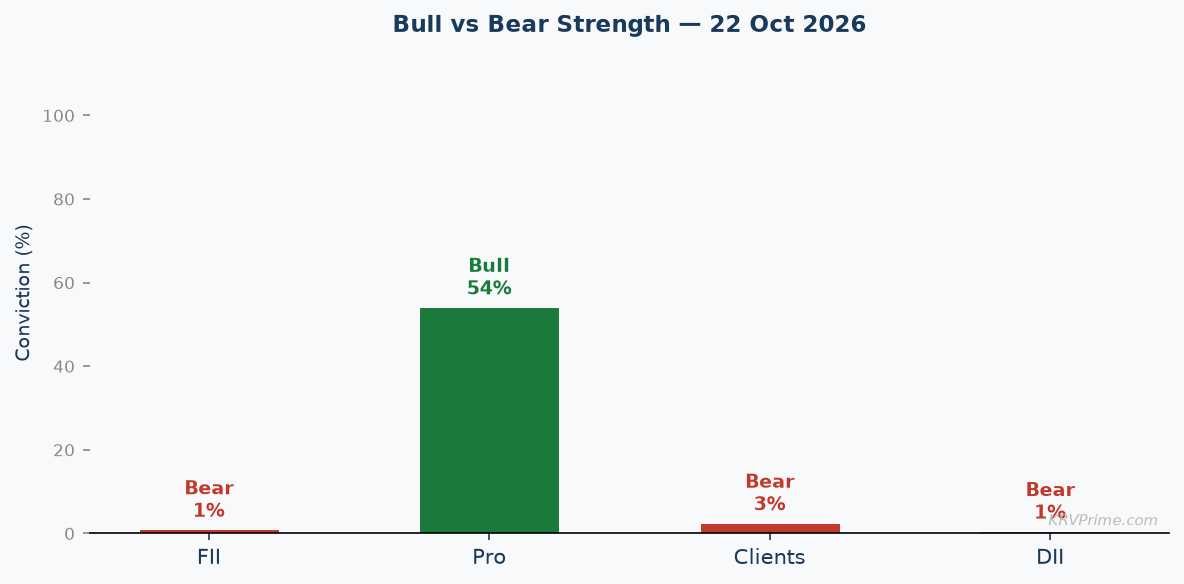
FII Strongly Bearish — Net Short Futures + Put Write Hybrid 78% ▼▼ | Clients Hedged Bullish — Long Futures, Net Short Puts 58% ▲ | Pro Bidirectional — Futures Long, Put Spread Structure 50% ▶ | DII Cautiously Neutral — Hedge Liquidation, Long Retained 55% ▼ |
Conclusion — Market Outlook for Tomorrow (23 Oct 2026)
The collective participant positioning on 22 Oct 2026 paints a picture of a market under structural bearish pressure but with a defined downside floor. FIIs remain the dominant force with a futures net of -280,300 (a 9.07:1 gross short-to-long ratio) and are accelerating a hybrid put-write strategy — writing 107,040 put contracts while retaining their massive futures short — a configuration that works best in a slow, orderly decline or tight range rather than a sharp crash. Clients, despite holding 278,047 futures longs, are simultaneously building the largest single-day options position of any participant (+496,011 put longs, +414,462 put shorts, +280,932 call shorts) — their net options architecture is a short strangle over a long futures base, consistent with an expectation of range-bound volatility rather than directional trending. Pro desks made the most dramatic intraday repositioning — closing out their entire net-short call book from -55,839 to -32 while adding a net +8,519 futures longs and +34,682 net put longs — suggesting institutional market-makers are shifting from a bearish synthetic-short posture to a bullish-futures-with-downside-protection stance. DIIs are essentially sitting on the sidelines, trimming minor positions and notably liquidating 21,371 put longs with High Vol conviction — a signal that the most conservative institutional players see the current Nifty level near 22,687 as one where heavy protection is no longer necessary.
The Overall PCR recovered sharply from 0.79 to 0.88 (+11.41%) — a significant one-day improvement driven almost entirely by the +14.30% surge in total Put OI (from 9,106,853 to 10,408,999 contracts). However, at 0.88 the PCR remains below parity (1.00), which historically indicates that call writers still have the structural edge and the market has not yet reached a put-heavy extreme that would suggest a contrarian bottom. India VIX ticked up from 15.68 to 15.76 (+0.56%) — a modest but directionally concerning move on a down-day, confirming that fear is being gradually repriced into the market rather than unwound. VIX at 15.76 is not in panic territory (which would be above 20), but the rising trend combined with rising Put OI suggests traders are buying protection at an increasing rate. The Futures OI expanding +4.79% (from 812,128 to 851,064) on a down-day is a textbook short buildup confirmation — new money is entering the short side, not just covering longs. The key OI anchors remain intact: Nifty PE support at 22,000 and CE resistance at 24,000 define the structural range, with BankNifty CE resistance at 56,000 and PE support at 52,000 providing the banking sector envelope.
The bear thesis breaks down if FII futures net improves meaningfully toward -270,000 (implying ~10,000 contract short-covering) alongside the Overall PCR crossing above 1.00 — both events together would signal genuine capitulation of the dominant short position and a potential for a sharp short-covering rally. The bull thesis gains further credibility only if India VIX retreats below 15.00 (reducing fear premium) AND Clients' futures net long holds above 220,000 contracts — confirming the largest participant by gross longs has not abandoned its structural position. Until either of these triggers materialises, the path of least resistance remains modestly lower or sideways, with the 22,000 Nifty PE support acting as the critical floor that both FIIs (via put writing at lower strikes) and Clients (via net short puts) appear to be defending.
Scenario 1 — Bull case:
If FII futures net improves from -280,300 toward -270,000 (short-covering of ~10,000 contracts) in tomorrow's data, accompanied by the Overall PCR rising above 0.95 and India VIX pulling back below 15.00, it would signal FIIs are unwinding their dominant short position. Additionally, if Clients' net put position (currently -744,882) narrows toward -700,000 (put short buyback), it would confirm participants are collectively pricing in a floor and the market could stage a short-covering recovery targeting the 24,000 CE resistance as the next structural ceiling.
Scenario 2 — Bear case:
If FII futures net deteriorates further below -285,000 (fresh short addition), India VIX breaks above 16.50 with acceleration, and the Overall PCR fails to sustain above 0.88 (reverting toward 0.80), it would confirm FIIs are doubling down on the bearish thesis. A concurrent breakdown in Clients' futures net below 210,000 (long unwinding) would remove the last major structural buyer from the futures market. In this scenario, put longs across FII and Pro books (1,171,687 and 1,098,088 contracts respectively) begin monetising aggressively, driving the market toward the 22,000 Nifty PE support — the maximum pain zone where put writers (FIIs and Clients) would face maximum losses and likely trigger forced covering.
Key Resistance Nifty 24,000 (CE max OI resistance) — FIIs hold 1,098,945 gross call shorts at this zone, representing the dominant supply wall. Pro desks neutralised their call short book today (now effectively flat) but retain 1,164,260 gross call shorts. The combined FII + Pro call short supply at and near 24,000 makes this an extremely high-friction resistance level that would require significant short-covering catalyst to breach. | Key Support Nifty 22,000 (PE max OI support) — FIIs hold 1,171,687 put longs providing structural demand, while Clients hold 2,842,554 put longs (the largest put long book in the market). Pro desks added 164,453 put longs today to reach 1,098,088. This is a fortress of put-long support: four participants collectively own put longs with anchors near 22,000, creating a powerful demand floor. Additionally, FIIs and Clients are writing puts below this zone, giving them financial incentive to defend the 22,000 level actively. | Trigger to Watch Overall PCR crossing 1.00 (from current 0.88) — this single threshold crossing would represent a shift from call-dominated to put-dominated open interest, signalling that the market has repriced sufficient fear to exhaust sellers. A PCR move to 1.00+ combined with FII futures net net improving (shorts reducing) would be the joint confirmation signal for a meaningful recovery. On the downside, India VIX breaking above 16.50 with FII futures net deepening below -285,000 would be the confirmation signal for accelerated bearish momentum toward 22,000 PE support. |