
Market Participants Analysis dated 21.10.2026
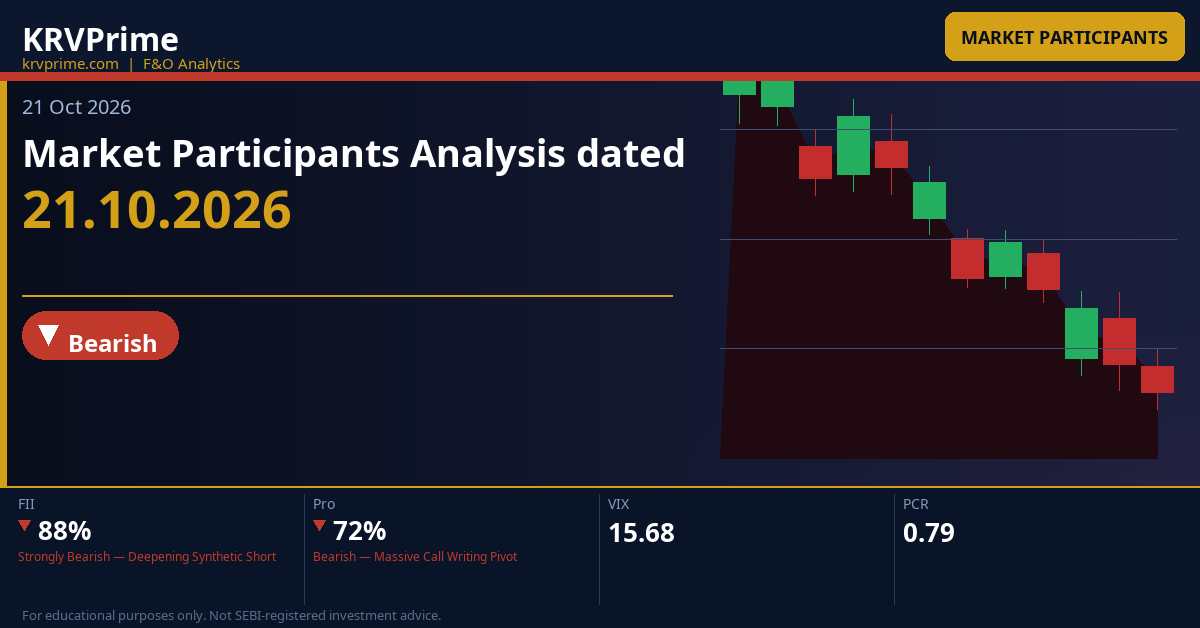
KRVPrime — Daily Market Outlook
Key Market Signals — Data: 21 Oct 2026
NIFTY 50 22,811.35 ▼ -77.60 (-0.34%) | BANK NIFTY 54,976.90 ▼ -511.20 (-0.92%) | SENSEX 73,709.69 ▼ -143.21 (-0.19%) |
OVERALL PCR 0.79 ▼ -0.40 (-33.37%) PCR at 0.79 — deep in bearish territory; put OI collapse vs call OI signals aggressive put unwinding and protective cover removal | INDIA VIX 15.68 ▲ +1.62 (+11.47%) VIX surged 11.47% to 15.68 from 14.06 — elevated fear zone; option premiums expanding, trend day risk rising sharply | TOTAL OI CHANGE 51,686,514 ▼ -3,881,718 (-6.99%) Heavy total OI unwind of 3.88M contracts — massive put unwinding driving systemic position liquidation |
FUTURES OI 812,128 ▼ -15,822 (-1.91%) Futures OI declining — net long reduction and short covering; market participants reducing directional futures exposure | CALL OI CHANGE 11,508,766 ▼ -21,452 (-0.19%) Call OI nearly flat — marginal contraction; call writers holding positions while new short buildup absorbs rollovers | PUT OI CHANGE 9,106,853 ▼ -4,586,358 (-33.49%) Catastrophic put OI collapse of 33.49% — largest single-day put unwind; hedges removed en masse, sentiment structurally shifted |
Participant-wise Key Points
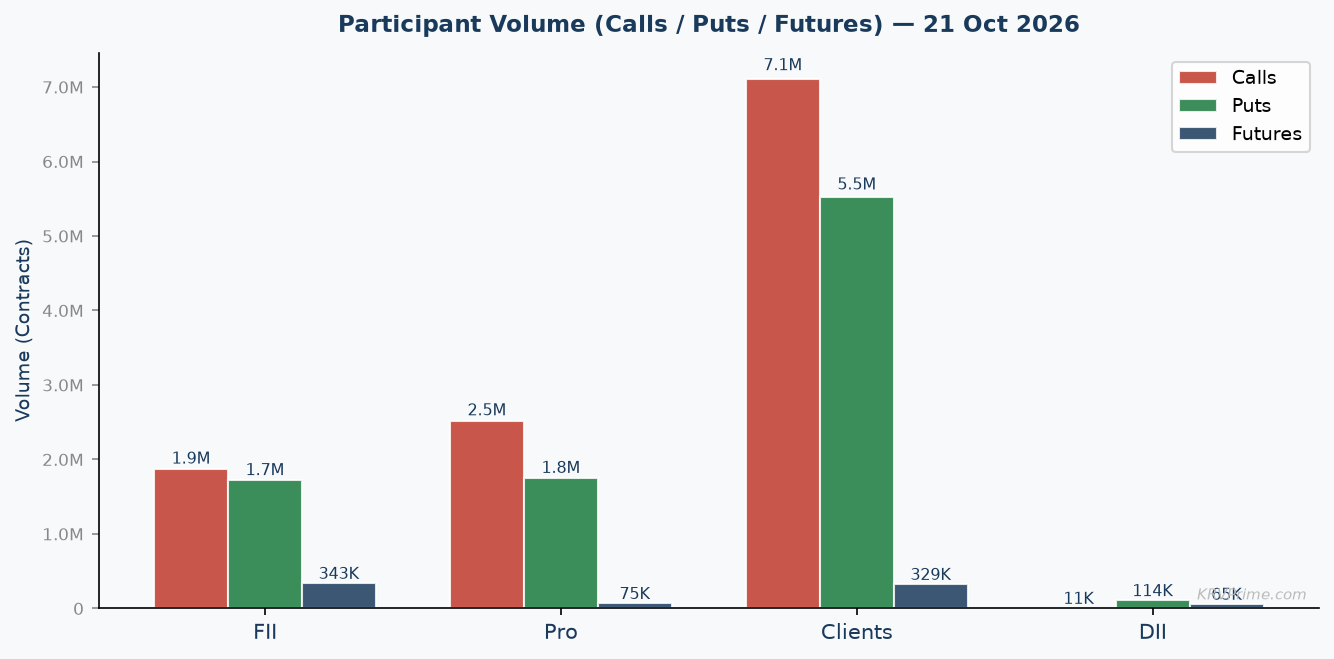
FII Bearish — Deepening Net Short Futures, Aggressive Call Writing with Put Book Restructuring
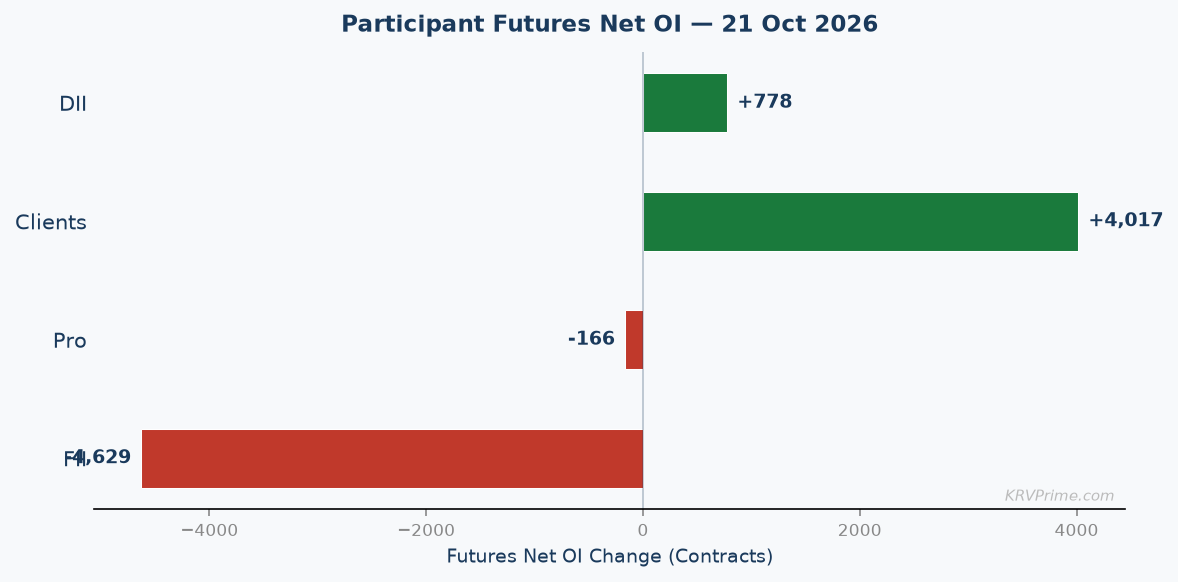
- Futures net deteriorated from -272,999 to -277,628 (net change -4,629 contracts). On the long side, FIIs reduced exposure aggressively from 39,966 to 32,598 (chg -7,368, -18.44%) tagged [Long Unwinding - High Vol], while shorts were only marginally trimmed from 312,965 to 310,226 (chg -2,739, -0.88%) tagged [Short Covering - High Vol]. The High Vol tag on the long unwinding confirms this was a deliberate, conviction-driven reduction of longs — not passive expiry noise. The resulting gross short-to-long ratio stands at a formidable 9.52:1 (310,226 shorts vs 32,598 longs), which is an unambiguous outright directional short position of high conviction — this is not a hedged book. FIIs are not merely defensive; they are actively leaning against the market, and the deepening of net futures short by 4,629 contracts in a single session confirms their bearish thesis is being maintained and selectively reinforced even as VIX surges to 15.68.
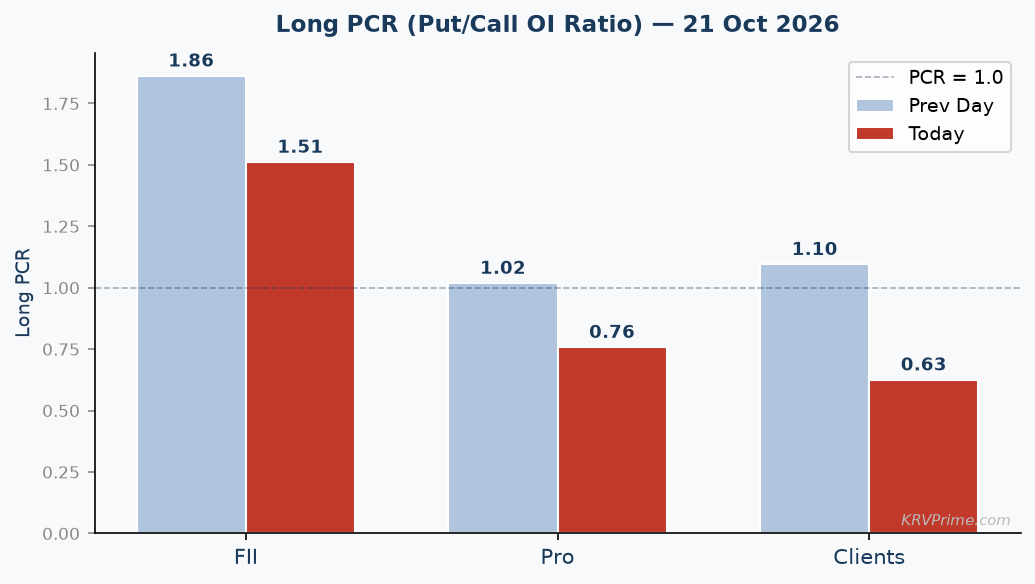
- Long PCR declined sharply from 1.86 to 1.51 (-18.84%) and Short PCR collapsed from 0.81 to 0.51 (-37.52%). A Long PCR of 1.51 means FIIs still hold 51% more put longs than call longs on their options book — this is a persistently defensive posture, though the decline from 1.86 signals they are actively reducing their put-long hedge load. The Short PCR collapsing from 0.81 to 0.51 is the more alarming data point: FIIs were already writing more calls than puts, and this ratio has now crashed further, meaning their short-call writing has dramatically increased relative to short-put writing. A Short PCR of 0.51 indicates they are writing nearly twice as many calls as puts — a strong cap-the-upside signal that reinforces their futures short book. Together, a falling Long PCR and a collapsing Short PCR present a consistent message: FIIs are reducing put hedges while simultaneously ramping up call selling — a structural shift from pure hedge to active premium collection on the short side.
- Call OI net deteriorated sharply to -341,527 (Long 766,911 [Long Buildup - Low Vol], Short 1,108,438 [Short Buildup - Low Vol]). FII call longs rose by 59,384 contracts while call shorts surged by 127,236 contracts — the net effect is that FIIs are building a larger short-call position, despite the Low Vol tag on both legs indicating this is systematic rather than panic-driven. Put OI net improved to +597,220 (Long 1,159,707 [Long Unwinding - Low Vol], Short 562,487 [Short Covering - Low Vol]) — both put legs reduced, with longs falling 158,589 and shorts falling 234,572. The net put position actually expanded to +597,220 because shorts were removed faster than longs, restructuring the put book into a cleaner long-put profile. The overall architecture — net short calls (-341,527) combined with net long puts (+597,220) — is a textbook synthetic short with put protection, an aggressive directional bearish structure layered on top of their already massive futures short book of -277,628.
- Synthesis — FII Dual-Leg Conviction Bearish Architecture: FIIs present the most internally consistent and structurally aggressive positioning of all participants today. Their futures net has deepened to -277,628, their call short book expanded to -341,527 net, their put long net stands at +597,220, and their Short PCR has collapsed to 0.51 — every single data point points in the same direction: a high-conviction multi-leg bearish structure. The 9.52:1 gross short-to-long futures ratio eliminates any possibility this is a hedged position — FIIs are expressing a directional view. The Low Vol tags on their call and put option legs indicate systematic, programmatic repositioning rather than reactive hedging, which suggests this is a pre-planned strategy being executed with discipline. The reduction in Long PCR from 1.86 to 1.51 tells us FIIs are not adding incremental protection — they believe the downside thesis is playing out and are now monetising hedges while maintaining the short framework. Compared to the previous session, FIIs are accelerating their bearish posture: futures short deepened, call short book grew, and put hedges were selectively trimmed to lock in gains — a classically bearish progression.
- Forward: The critical watch level for FII positioning is whether their futures net crosses below -285,000 in the next session — if gross shorts push toward 315,000+ with longs staying near 32,000, it would confirm FIIs are actively adding to the short thesis rather than managing existing positions. On the options side, if the FII Short PCR falls further below 0.50, it would signal accelerating call writing, placing a hard supply ceiling near the 23,000 CE OI resistance. Conversely, if FII Long PCR rebounds back above 1.65 with a futures net improvement toward -260,000, that would be the first signal of a potential thesis reversal — the trigger for a relief rally.
DII Defensively Bullish — Steady Futures Long, Aggressive Put Long Buildup
- Futures net improved marginally from +37,193 to +37,971 (net change +778 contracts). The long side was virtually unchanged at 51,508 (chg +5, +0.01%) tagged [Long Buildup - Low Vol], while shorts were trimmed from 14,310 to 13,537 (chg -773, -5.40%) tagged [Short Covering - Low Vol]. The Low Vol tags on both legs indicate this was a routine, low-conviction adjustment rather than a high-conviction directional bet — DIIs are maintaining their established net long futures position rather than aggressively adding to it. The gross long-to-short ratio stands at 3.81:1 (51,508 longs vs 13,537 shorts), which is a solidly bullish futures stance. The marginal net improvement of +778 contracts, combined with low-volume short covering, suggests DIIs are tidying their book rather than expressing a fresh view — their existing long futures position from prior sessions is being carried forward with quiet conviction.
- DII does not report Long PCR or Short PCR data in the provided dataset, so a direct PCR ratio analysis is not available for this participant. However, directional inference is possible from the put options data: DIIs executed a +23,660 contract (+26.32%) put long buildup tagged [Long Buildup - High Vol], which is their largest and most voluminous single-session options move. This High Vol tag is critical — it confirms the put long buildup was a deliberate, high-conviction decision, not a thin-market artifact. Additionally, a new short put position of 280 contracts was initiated (prev was 0), tagged [Short Buildup - High Vol], which is negligible in size but meaningful as it marks DII's first short-put entry — potentially the seed of a protective collar or a range income trade. The directional implication of the put buildup, combined with steady futures longs, is that DIIs are hedging their equity book defensively — they believe in the structural long but are buying protection against near-term downside risk, especially with VIX spiking to 15.68.
- Call OI net contracted to +7,448 (Long 9,318 [Long Unwinding - Low Vol], Short 1,870 [Short Covering - Low Vol]). Both call longs and call shorts reduced marginally — longs by 1,257 (-11.89%) and shorts by 30 (-1.58%) — with Low Vol tags on both, indicating routine management with no strong directional signal from the call side. Put OI net expanded significantly to +113,261 (Long 113,541 [Long Buildup - High Vol], Short 280 [Short Buildup - High Vol]). The put long buildup of +23,660 contracts with a High Vol tag is the dominant signal in DII's options architecture — they added substantial put protection in a single session. The resulting architecture of net long puts (+113,261) with a modest net long call (+7,448) suggests DIIs are running a long-equity futures with put protection structure — essentially a synthetic covered long with downside insurance, which is the classic institutional long-term fund positioning when VIX is rising and macro uncertainty is elevated.
- Synthesis — DII Hedged Long: Defensive Insurance Buy in Rising VIX Environment: DIIs present the simplest and most internally consistent positioning of all participants — they are long futures (+37,971 net), long puts aggressively (+113,261 net with a High Vol confirmation), and minimally exposed on the call side (+7,448 net via low-conviction longs). This is a textbook long equity with protective puts architecture, consistent with domestic institutional funds that hold large equity mandates and manage downside risk dynamically. The fact that the put long buildup of +23,660 contracts carried a High Vol tag on a day when total put OI collapsed by 33.49% makes this move particularly significant — DIIs were actively buying puts into a market-wide put unwind, suggesting they see near-term downside risk that the broader market is ignoring. Compared to the previous session, DIIs have materially increased their options protection while holding their futures book steady — this is an accelerating defensive posture, not a reversal. The contrast with FIIs is notable: while FIIs are reducing put longs, DIIs are building them — DIIs and FIIs are diverging on the near-term hedging thesis even as both remain net short-leaning or long-with-protection.
- Forward: The key watch trigger for DII positioning is whether their put long book expands further above 113,541 contracts in the next session with another High Vol tag — if it does, it would confirm DIIs are in active portfolio protection mode, reinforcing the bearish near-term bias. If instead their put longs decline toward 90,000 while futures net remains steady near +37,971, it would signal they view the current VIX spike as temporary and are unwinding the hedge. The 52,000 PE strike (BankNifty OI Support) and 22,000 PE strike (Nifty OI Support) are the structural anchors where DII put long accumulation likely concentrates — a break below these strikes closing basis would accelerate DII defensive put buying.
Pro Structurally Neutral to Bearish — Massive Call Short Buildup with Put Book Liquidation
- Futures net declined marginally from +15,892 to +15,726 (net change -166 contracts). Longs fell from 45,888 to 45,380 (chg -508, -1.11%) tagged [Long Unwinding - High Vol], and shorts fell from 29,996 to 29,654 (chg -342, -1.14%) tagged [Short Covering - High Vol]. Both High Vol tags on proportionally similar percentage moves on both sides indicate this was a simultaneous and symmetric reduction of gross futures exposure — a deliberate de-grossing rather than a directional call. The gross long-to-short ratio stands at 1.53:1 (45,380 longs vs 29,654 shorts), which is mildly bullish on futures alone but barely directional given the near-simultaneous reduction of both legs. The net futures change of -166 contracts is essentially negligible — Pro desks are not making a fresh directional bet in futures today; the action is concentrated overwhelmingly in their options book, which has undergone a dramatic structural transformation.
- Long PCR collapsed from 1.02 to 0.76 (-25.59%) and Short PCR cratered from 1.35 to 0.64 (-52.81%). A Long PCR of 0.76 means Pro desks now hold 24% more call longs than put longs — this has shifted from a mildly bearish/hedged stance (Long PCR of 1.02 is balanced) to a mildly bullish options-long posture in a single session. However, the more explosive signal is the Short PCR collapsing from 1.35 to 0.64 — previously Pro desks were writing significantly more puts than calls (Short PCR 1.35 = bullish income trade), but that ratio has inverted dramatically to 0.64, meaning they are now writing 36% more calls than puts on the short side. This is a structural reversal in their writing strategy — from put-writer (bullish) to call-writer (bearish cap), executed in one session. The combination of a falling Long PCR (reducing put longs) and a collapsing Short PCR (shifting from put writing to call writing) signals that Pro desks are repositioning from a range-bullish stance to a directionally bearish options framework — a significant and high-conviction pivot.
- Call OI net swung dramatically to -55,839 (Long 1,230,713 [Long Buildup - Low Vol], Short 1,286,552 [Short Buildup - Low Vol]). Call longs increased modestly by +7,287 (+0.60%) while call shorts surged by +271,601 (+26.76%) — this massive asymmetric buildup of 271,601 new call shorts at Low Vol tag indicates systematic, high-volume programmatic call writing rather than reactive positioning. The net swing from +208,475 (prev net call long) to -55,839 (today net call short) is a 264,314 contract reversal — the largest single-participant structural shift in today's data. Put OI net flipped to +115,949 (Long 933,635 [Long Unwinding - Low Vol], Short 817,686 [Short Covering - Low Vol]) — both put legs collapsed, with longs falling 313,643 and shorts falling 549,223, but shorts fell faster, leaving a net long put position. The architecture is now net short calls (-55,839) + net long puts (+115,949) — a classic synthetic short setup, though the Low Vol tags on all four legs indicate this was a programmatic roll or structural adjustment rather than a panic-driven repositioning.
- Synthesis — Pro Desk Structural Pivot to Synthetic Short via Massive Call Writing: Pro desks executed the most transformative single-session repositioning of all participants today. Their net call position flipped from +208,475 to -55,839 — a swing of -264,314 contracts — achieved entirely through adding 271,601 new call shorts while barely touching call longs. This, combined with put book liquidation that still leaves +115,949 net long puts, creates a synthetic short architecture that mirrors FII positioning, suggesting broad institutional alignment around a bearish near-term view. The Short PCR collapse from 1.35 to 0.64 is the clearest confirmation of this pivot: Pro desks have abandoned their put-writing income strategy and pivoted decisively to call writing — this is not a minor tactical tweak but a fundamental strategy rotation. The futures book remains mildly bullish at +15,726 net, which creates a slight internal contradiction — futures are mildly long while options suggest bearish — but this is a classic delta-neutral short setup where futures longs offset options deltas. Compared to the previous session where Pro desks were balanced-to-bullish, today's session marks a clear acceleration into bearish options territory, driven by the VIX spike to 15.68 and the collapse in put OI market-wide.
- Forward trigger: The critical watch level for Pro desks is whether their call short book expands further — specifically if their net call position deteriorates below -150,000 in the next session, which would confirm a sustained, multi-day call writing campaign targeting the 23,000 CE resistance level on Nifty. If instead the Short PCR bounces back above 1.00 (Pro desks returning to put writing), it would signal the synthetic short is being unwound and bullish range income trades are resuming. Watch the 23,000 CE strike closely — Pro call writing concentrated at or near that strike acts as a structural ceiling for any recovery attempt in tomorrow's session.
Client Conflicted — Net Long Futures Improving but Massive Options Hedge Removal Signals Uncertainty
- Futures net improved from +219,914 to +223,931 (net change +4,017 contracts). The long side was nearly unchanged at 276,578 (chg -40, -0.01%) tagged [Long Unwinding - High Vol], while shorts were reduced from 56,704 to 52,647 (chg -4,057, -7.15%) tagged [Short Covering - High Vol]. Both High Vol tags tell us the short covering of 4,057 contracts was a deliberate, high-conviction decision — Clients aggressively removed futures shorts in today's session. The gross long-to-short ratio stands at 5.25:1 (276,578 longs vs 52,647 shorts), which is the most lopsided long futures book of all participants — Clients hold the most structurally bullish futures position by gross ratio. The net improvement of +4,017 contracts driven entirely by short covering (rather than long addition) suggests Clients were defending or closing profitable short positions established at higher levels — this is reactive short covering into market weakness rather than fresh directional long conviction.
- Long PCR collapsed from 1.10 to 0.63 (-42.87%) and Short PCR declined from 1.24 to 0.94 (-23.97%). The Long PCR fall from 1.10 to 0.63 is the steepest absolute decline of all participants — Clients went from holding 10% more put longs than call longs to holding 37% more call longs than put longs in a single session, entirely driven by the massive put long liquidation of -1,844,608 contracts. This is the single largest OI event in today's data and represents a near-total collapse of the retail/HNI hedge book. The Short PCR declining from 1.24 to 0.94 means Clients also covered more put shorts than call shorts — they had been writing puts (bullish income trade), and that book has now been substantially reduced. The dominant signal is the Long PCR collapse: Clients stripped away their protective put longs at scale, which is either aggressive profit-taking on existing put hedges or forced liquidation — both are structurally bearish in outcome as they remove market-wide put OI support.
- Call OI net improved dramatically to +389,918 (Long 3,747,441 [Long Unwinding - Low Vol], Short 3,357,523 [Short Covering - Low Vol]). Call longs fell by 76,140 (-1.99%) and call shorts fell by 409,533 (-10.87%) — shorts fell at roughly 5x the rate of longs, meaning the net call position swung from +56,525 to +389,918, a +333,393 contract improvement. This confirms Clients were aggressively covering call shorts — removing the supply ceiling they had been maintaining on the market. Put OI net deteriorated to -826,431 (Long 2,346,543 [Long Unwinding - Low Vol], Short 3,172,974 [Short Covering - Low Vol]) — put longs collapsed by 1,844,608 and put shorts by 1,509,663. The net put position worsened to -826,431 as longs unwound faster than shorts. The resulting architecture — net long calls (+389,918) with net short puts (-826,431) — is a synthetic long structure, but built through destruction of hedges rather than fresh conviction longs. This is the opposite of FII and Pro architecture, and the contrast is stark.
- Synthesis — Client Hedge Destruction Creating Synthetic Long Without Fresh Conviction: Clients present the most structurally significant and potentially dangerous positioning of all participants today. The removal of 1,844,608 put long contracts — a 44.01% single-session collapse — combined with 409,533 call short covers has stripped the market of its largest retail/HNI hedge book in a single session, dramatically compressing overall PCR from 1.19 to 0.79. The resulting synthetic long architecture (+389,918 net call long, -826,431 net put short) was not built through fresh bullish conviction but through unwinding of protective positions — this is a structurally weaker bullish posture than one built on fresh longs. The contrast with FII positioning is acute: FIIs are deepening their synthetic short while Clients are constructing a synthetic long through hedge removal — this sets up a direct institutional vs retail confrontation with significant imbalance of conviction (FIIs at High Vol, Clients at Low Vol). The improvement in futures net (+4,017) via short covering rather than long addition further confirms this is a reactive, not a proactive, bullish stance. The danger in Client positioning is asymmetric: if VIX continues to rise and the put hedge book has been largely destroyed, Clients have limited downside protection — any sharp move lower would expose unhedged futures longs of 276,578 contracts.
- Forward: The most critical trigger to watch for Client positioning is whether the put long book stabilises above 2,000,000 contracts in tomorrow's session — if put longs continue to fall below 2,000,000, it would signal that retail/HNI participants are fully unhedged and the market is structurally vulnerable to a volatility shock. Conversely, if Clients begin rebuilding put longs from current 2,346,543 levels with a High Vol tag, it would signal re-hedging demand returning and PCR recovering toward 1.00. Watch the 22,000 PE strike (Nifty OI Support) — if Client put long concentration at this strike is maintained, it provides structural market support; its erosion would remove the key downside floor.
Bull vs Bear Strength by Participant
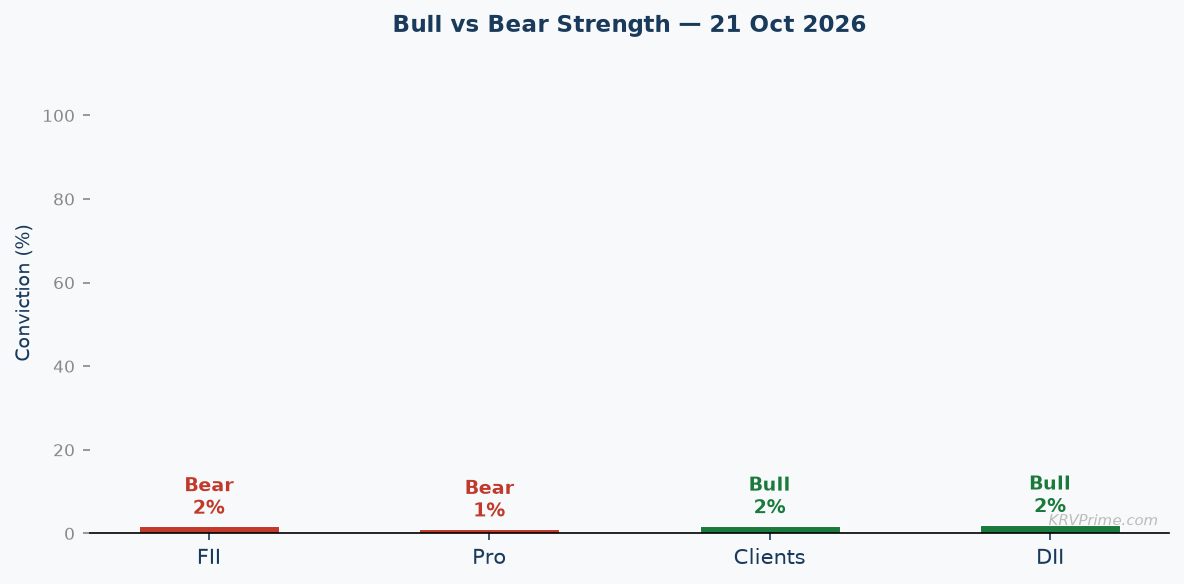
FII Strongly Bearish — Deepening Synthetic Short 88% ▼▼ | Pro Bearish — Massive Call Writing Pivot 72% ▼ | DII Defensively Bullish — Long with Put Protection 60% ▲ | Client Conflicted — Synthetic Long via Hedge Removal 45% ▶ |
Conclusion — Market Outlook for Tomorrow (21 Oct 2026)
The collective participant positioning on 21 Oct 2026 presents a structurally bearish picture driven by an unprecedented single-session put OI collapse of 33.49% and a VIX spike of +11.47% to 15.68. FIIs have deepened their futures net short to -277,628 at a 9.52:1 gross short-to-long ratio while simultaneously building a net short call position of -341,527 and maintaining a net long put book of +597,220 — a textbook dual-leg conviction bearish architecture. Pro desks have pivoted dramatically from a net long call position of +208,475 to a net short call position of -55,839 through the addition of 271,601 new call shorts, creating alignment with FII positioning and establishing heavy supply at the 23,000 CE resistance level. DIIs are the lone structural bulls, maintaining a net futures long of +37,971 while aggressively buying +23,660 put contracts with a High Vol tag — a defensive long stance that contradicts Clients who stripped 1,844,608 put longs in the same session. The combined FII and Pro call writing represents a formidable institutional supply ceiling, while the Client hedge destruction removes the cushion that would otherwise support the PCR.
The overall PCR's collapse from 1.19 to 0.79 — a -33.37% single-session decline — is the starkest data point in today's report. A PCR of 0.79 sits deep in bearish sentiment territory, and the mechanics behind this collapse are critical: it was not driven by aggressive call buying (which would be straightforwardly bearish) but by the near-total liquidation of Client put longs (-1,844,608 contracts) combined with Pro and FII put short covering (-549,223 and -234,572 respectively). This means the PCR collapse is a structural put hedge removal event rather than a fresh bearish options buildup — the distinction matters because it creates a vacuum of downside protection. With India VIX surging to 15.68 from 14.06 and both FII and Pro desks writing calls aggressively at the 23,000 CE level, the market faces a dual headwind: rising implied volatility expanding option premiums while institutional supply is concentrated at key resistance levels. The 22,000 PE support (Nifty OI Support) and 52,000 PE (BankNifty OI Support) are the remaining structural floors, anchored by DII put long accumulation and residual Client put positions.
The bearish thesis would be challenged and potentially reversed if two conditions are met simultaneously: first, if overall PCR recovers above 1.00 in the next session — indicating fresh put buying or call covering that would signal renewed hedging demand and potential institutional re-entry on the long side; and second, if FII futures net improves (reduces in short magnitude) toward -260,000 with gross shorts declining below 300,000 — this would be the first quantifiable signal of FII short covering and a potential thesis flip. On the bearish acceleration side, if VIX sustains above 16.50 into tomorrow's session with FII futures net deteriorating below -285,000 and Pro call shorts expanding further, the 22,000 PE Nifty support level would come into play as the next key structural test with limited put hedge buffer remaining after today's massive unwind.
Scenario 1 — Bull case:
If FII futures net improves from -277,628 toward -260,000 via gross short reduction (shorts falling below 295,000), AND overall PCR recovers above 1.00 driven by fresh put long buildup or aggressive call covering by Pro/Clients, AND India VIX retreats below 14.50, then the bearish FII + Pro call writing thesis weakens and a relief recovery toward 23,000 CE OI resistance becomes plausible. The trigger confirmation would be Client put long rebuilding above 2,500,000 contracts with a High Vol tag, signalling genuine re-hedging demand rather than mechanical positioning.
Scenario 2 — Bear case:
If FII futures net deteriorates further below -285,000 with gross shorts expanding above 315,000, AND Pro call shorts expand to push their net call position below -150,000, AND India VIX sustains above 16.50 into the next session, then the institutional bearish alignment becomes self-reinforcing. The critical breakdown trigger is overall PCR falling below 0.70 — which would confirm the remaining put support at 22,000 PE (Nifty) and 52,000 PE (BankNifty) is eroding, exposing Client unhedged futures longs of 276,578 contracts to accelerated downside without a protective put cushion.
Key Resistance 23,000 CE (Nifty Weekly & Monthly OI Resistance) — FIIs hold a net short call position of -341,527 and Pro desks added 271,601 new call shorts today, creating concentrated institutional supply at this strike. Combined call writing from both participants makes 23,000 a formidable ceiling; 56,000 CE (BankNifty Monthly OI Resistance) similarly concentrated. | Key Support 22,000 PE (Nifty Weekly & Monthly OI Support) — FII net long put book of +597,220 and DII net long put book of +113,261 (with High Vol confirmation) anchor this strike as the primary structural floor. 52,000 PE (BankNifty Monthly OI Support) provides the equivalent floor for BankNifty, backed by DII defensive put accumulation. Client residual put longs of 2,346,543 also concentrate near these support strikes after today's massive unwind. | Trigger to Watch Overall PCR threshold of 1.00 — a recovery above this level would confirm re-hedging demand returning and challenge the institutional bearish setup; a further decline below 0.70 would confirm structural put support erosion and validate accelerated downside. India VIX sustained above 16.50 acts as the secondary trigger, expanding premiums and forcing delta hedging that creates gap-risk conditions. |