
Index Analysis
Intraday Analysis for 29 Sep 2026
KRV Prime28 September 202649 min
Educational/Derived AnalysisSource: KRV Prime Market Insights (End-of-Day)As of 28 Sep 2026, 04:23 PM IST
Intraday Analysis for 29 Sep 2026
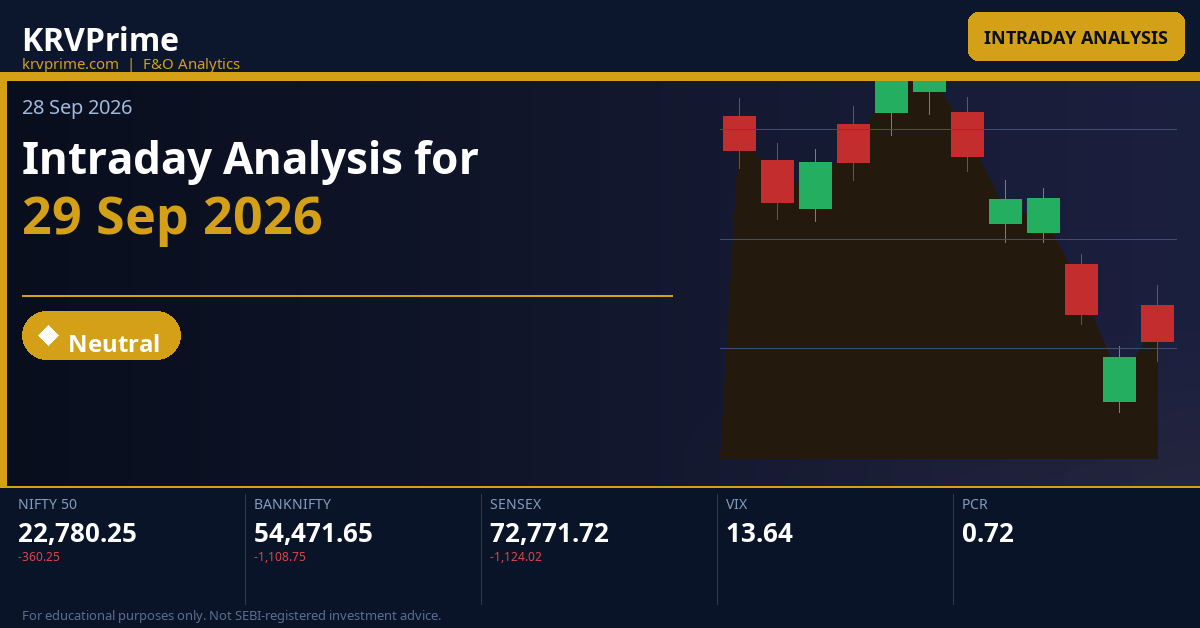
All three major indices closed sharply lower on 28 Sep 2026, with NIFTY shedding 1.56% to 22,780.25, BANKNIFTY dropping 1.99% to 54,471.65, and SENSEX falling 1.52% to 72,771.72, confirming broad-based selling pressure into the session close. India VIX data is unavailable for this session, making it critical to lean on options straddle pricing — NIFTY's ATM straddle of 153.55 points implies an expected intraday range of approximately ±153 points from 22,800, suggesting the market is pricing in continued volatility rather than a quiet consolidation day. With all three indices printing Descending Wide CPRs for 29 Sep 2026 and closing well below their respective day CPR bands, the structural bias entering tomorrow is decisively bearish unless price manages a sustained reclaim of key CPR boundaries within the first hour.
Key Market Signals — Intraday Setup
All three indices — NIFTY, BANKNIFTY, and SENSEX — are trading not only below their Day CPR bands but also significantly below their Weekly and Monthly CPR structures, confirming multi-timeframe bearish alignment. With Descending Wide CPRs across the board and no VIX reading available to soften the picture, option straddle premiums at 153.55 pts (NIFTY), 464.0 pts (BANKNIFTY), and 859.2 pts (SENSEX) confirm the market is pricing meaningful two-way risk for 29 Sep 2026.
Deep Technical Analysis & Levels
NIFTY
Descending — Wide (0.41%)
▼ Bearish
Market Structure Sideways or range-bound | Straddle ATM 22,800 straddle = Call 85.85 + Put 67.70 = **153.55 pts**. This implies an expected intraday move of approximately ±153 points from 22,800, giving a probable range of 22,647 to 22,954. The straddle premium is meaningful — at current pricing it rewards sellers only if NIFTY stays within this tight band, while buyers profit from any directional impulse beyond these boundaries. | Max Pain Max Pain = **22,950** for the 29-Sep-2026 weekly and monthly expiry. Since NIFTY closed at 22,780.25 — roughly 170 points below max pain — option sellers will exert gravitational pull to drag price back toward 22,950 through the session. This creates a natural upward magnetic bias intraday but will face structural resistance at the CPR band (BC 22,827.24 to TC 22,921.22) which sits squarely between current price and max pain. |
Tomorrow's Complete Level Map
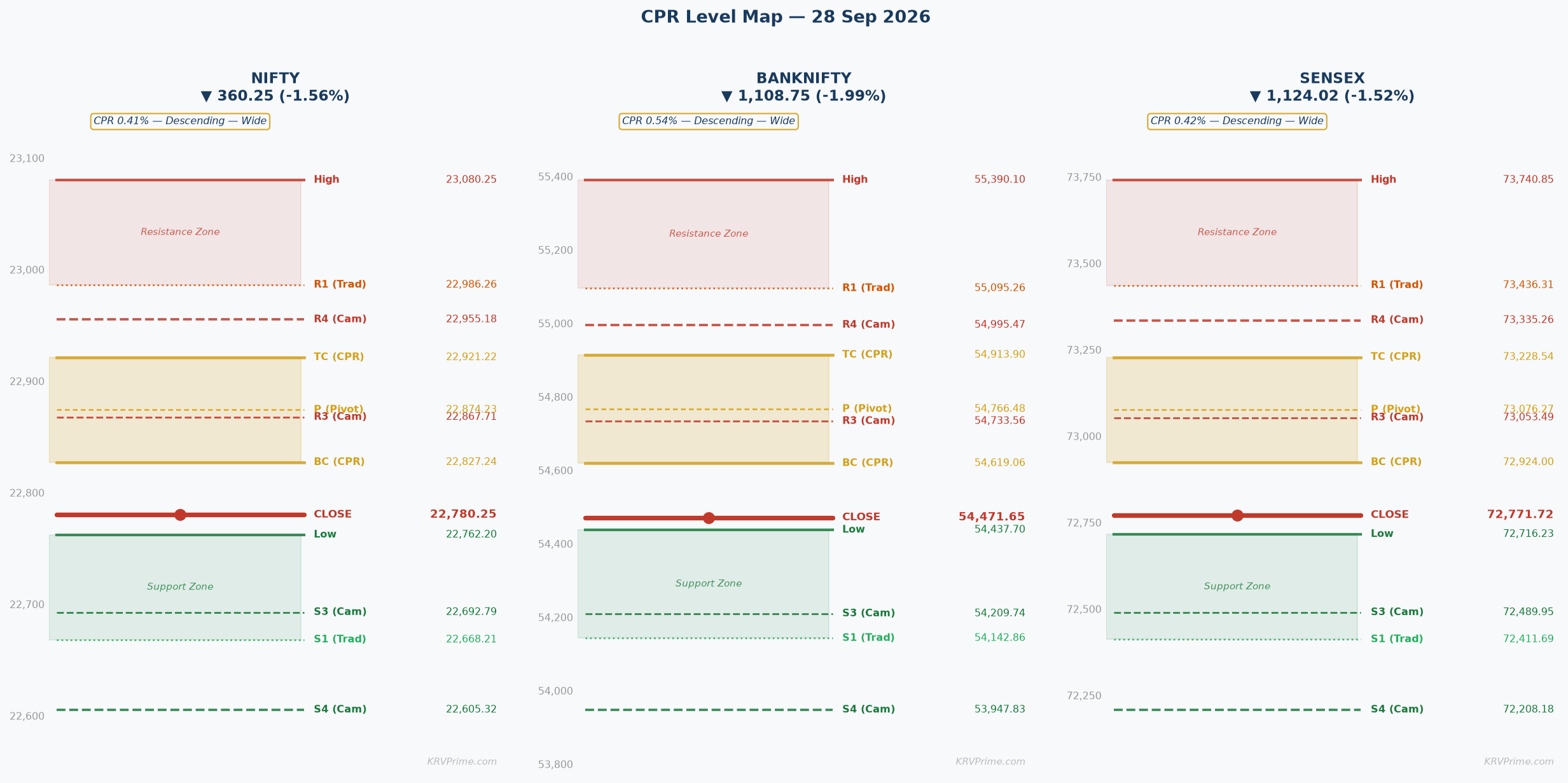
OI-R: 23,000 R3: 23,304.31 H6: 23,098.55 H5: 23,057.34 R2: 23,192.28 H4 ▶: 22,955.18 R1: 22,986.26 PDH: 23,080.25 H3 ↩: 22,867.71
TC: 22,921.22 P: 22,874.23 BC: 22,827.24
L3 ↩: 22,692.79 PDL: 22,762.20 S1: 22,668.21 L4 ▶: 22,605.32 S2: 22,556.18 L5: 22,503.16 L6: 22,461.95 S3: 22,350.16 OI-S: 22,000
↩ = Camarilla reversal point | ▶ = Camarilla breakout/breakdown trigger | OI-R/OI-S = Options wall (CE/PE max OI)
▲ Higher Open (Gap Up) — Open > Prev Close
↕ Conflicted
Open lands: With a Descending Wide CPR, any gap up on 29 Sep 2026 would push the open above the previous close of 22,780.25. A minor gap up (0.05–0.25%) would place the open in the 22,791–22,836 range, likely inside the CPR band between BC 22,827.24 and P 22,874.23. A significant gap up (0.25–0.5%) would open near P 22,874.23 or approaching TC 22,921.22. A large gap up (>0.5%) would open above TC 22,921.22 and potentially challenge the 23,000 OI-R wall — this is above the entire Descending CPR band, which per framework rules makes the open structurally bullish.
CPR role: Overhead resistance transforming into a potential launch pad — the CPR band (BC 22,827.24 to TC 22,921.22) will act as the first major overhead resistance zone. Given the Descending Wide structure, a gap up into or above the CPR band forces sellers to defend it aggressively; only a confirmed two 30-minute close above TC 22,921.22 would flip the band from resistance to support.
Minor Gap (0.05–0.25%) — Structure Dominant
A minor gap up of approximately 0.05–0.25% would place the open between 22,791 and 22,836, positioning price near or just below BC 22,827.24 — the bottom of the Descending Wide CPR band. The CPR structure is Descending, meaning the entire band sits below yesterday's price levels in a multi-session context and will act as strong overhead resistance; the minor gap adds a slight bullish lean but the structure has clear precedence given the Wide classification. Traders should wait for two consecutive 30-minute closes above BC 22,827.24 before initiating longs, with the first target at H3 22,867.71, then P 22,874.23, and a meaningful resistance cluster at TC 22,921.22 where profit-booking is warranted given Wide CPR rules.
Significant Gap (0.25–0.5%) — Balanced
A significant gap up of 0.25–0.5% would open NIFTY between 22,836 and 22,893, placing price inside the CPR band between BC 22,827.24 and TC 22,921.22 — the most complex opening scenario where neither bulls nor bears have clear control. In this zone, gap-fill risk to the downside (toward PDL 22,762.20 and L3 22,692.79) competes with breakout potential to R1 22,986.26; the gap-and-structure are balanced per framework, requiring two 30-minute closes above TC 22,921.22 to confirm upside intent and two 30-minute closes below BC 22,827.24 to confirm fade. Delta-hedging flows from MM desks will be particularly active inside this CPR band — expect choppy, two-way price action in the first 60 minutes before a directional bias emerges, and only trade the confirmed breakout side rather than anticipating direction.
Large Gap (>0.5%) — Gap Direction Dominant
A large gap up exceeding 0.5% would open NIFTY above TC 22,921.22, placing price above the entire Descending CPR band and immediately challenging the OI-R wall at 23,000 CE strikes where massive call writing creates an options ceiling. Per the Wide CPR rule, the gap dominates structure, but the CPR band below (BC 22,827.24 to TC 22,921.22) now becomes the support zone — a pullback to TC 22,921.22 should be bought on the first retest. The primary upside target in this scenario is OI-R 23,000 (where CE writers will aggressively defend), followed by H4 22,955.18 and R1 22,986.26 as intermediate checkpoints; however, traders must respect that the ATM straddle of 153.55 points caps the expected move at approximately 22,954 from 22,800 — meaning a large gap up could exhaust the straddle range quickly, making fading near 23,000 a high-probability intraday strategy.
|
▲ Upside Path → OI-R Upon confirmed two 30-minute closes above TC 22,921.22, the upside path unfolds as: TC 22,921.22 → H4 22,955.18 (Camarilla breakout trigger, first profit-booking zone) → R1 22,986.26 (Traditional first target, second partial exit) → OI-R 23,000 (primary CE writing wall — the session ceiling where option sellers will defend aggressively). The H4 22,955.18 to R1 22,986.26 cluster is a critical resistance confluence and should not be chased beyond; only a confirmed hold above R1 22,986.26 with volume justifies targeting H5 23,057.34 and H6 23,098.55 as extended targets. |
▼ Downside Path → OI-S If price opens gap-up but fails to sustain above TC 22,921.22 after two 30-minute candles, the failure path is: TC 22,921.22 → P 22,874.23 → BC 22,827.24 → PDL 22,762.20 → L3 22,692.79 (first Camarilla mean-reversion target, primary short entry). Loss of BC 22,827.24 on a 30-minute close completely negates the gap-up thesis and shifts the day's structure back to bearish, with L4 22,605.32 and S1 22,668.21 becoming the next logical targets for intraday bears. |
| 🔴 OI-R: OI-R at 23,000 is the primary CE writing wall for the 29-Sep-2026 expiry — this is where the largest call open interest is concentrated, meaning option sellers are positioned aggressively to cap upside at this strike. In a gap-up scenario, 23,000 acts as a hard ceiling: as NIFTY approaches this level, delta-hedging by MM desks and active short gamma positioning by CE writers will create selling pressure that is structural, not discretionary — fade near 23,000 is a high-probability intraday trade. | 🟢 OI-S: OI-S at 22,000 is the primary PE writing wall and is approximately 780 points below the previous close — making it largely irrelevant as an intraday target in a gap-up scenario. However, it provides context for the magnitude of downside protection that PE writers are comfortable absorbing; as long as NIFTY remains above 22,500 (L5 22,503.16), PE base support is intact and the long-side bias from max pain mechanics (pull toward 22,950) remains structurally valid. |
⚡ Key Trigger: The critical trigger for the higher-open scenario is two consecutive 30-minute candle closes above TC 22,921.22 on above-average volume — this is the mandatory Wide CPR confirmation rule and cannot be shortcut. If price opens above TC 22,921.22 but fails to hold it for two 30-minute closes, the Descending Wide CPR structure reasserts, making the gap a bull trap with a sharp reversal toward P 22,874.23 and then BC 22,827.24.
▼ Lower Open (Gap Down) — Open < Prev Close
▼ Bearish
Open lands: With a Descending Wide CPR, a gap down on 29 Sep 2026 would push the open below the previous close of 22,780.25, moving price further away from the already-overhead CPR band (BC 22,827.24 to TC 22,921.22). A minor gap down (0.05–0.25%) opens near 22,724–22,769, between PDL 22,762.20 and the previous close. A significant gap down (0.25–0.5%) opens near 22,666–22,724, approaching L3 22,692.79 and S1 22,668.21. A large gap down (>0.5%) opens below L3 22,692.79 and potentially tests L4 22,605.32, confirming a panic-driven continuation.
CPR role: Overhead resistance — the CPR band (BC 22,827.24 to TC 22,921.22) sits significantly above any gap-down open, making it a distant overhead ceiling. In a gap-down scenario, the band acts as a supply zone where any recovery attempt will face layered selling from CPR sellers, Camarilla H3 22,867.71 resistance, and the descending multi-session structure.
Minor Gap (0.05–0.25%) — Structure Dominant
A minor gap down of 0.05–0.25% opens NIFTY between 22,724 and 22,769, placing price below PDL 22,762.20 and the previous close but still above L3 22,692.79 — a zone where gap-fill attempts toward PDL 22,762.20 and even BC 22,827.24 are plausible within the first 30–60 minutes given that minor gaps inside a range often fill early in the session. However, BC 22,827.24 now acts as the critical resistance for any recovery attempt; two 30-minute closes above BC are required (Wide CPR rule) before initiating recovery longs, and failure to reclaim BC within 60 minutes confirms a bearish continuation toward L3 22,692.79. Bears should initiate shorts on a 30-minute close below PDL 22,762.20 with targets at L3 22,692.79, then S1 22,668.21, and L4 22,605.32 as extended downside objectives.
Significant Gap (0.25–0.5%) — Balanced
A significant gap down of 0.25–0.5% opens NIFTY between 22,666 and 22,724, placing price near the critical confluence of L3 22,692.79 (Camarilla mean-reversion) and S1 22,668.21 (Traditional first support) — a zone that immediately defines whether this is a bottom-fishing opportunity or a trend-continuation setup. Per the framework, gap and structure are balanced; the CPR band (BC 22,827.24 to TC 22,921.22) is now approximately 100–160 points overhead, acting as a formidable supply zone that makes recovery arduous without a major catalyst. PUT writers at OI-S 22,000 remain comfortable, but the significant gap signals that put buyers are gaining the upper hand — a 30-minute close below L3 22,692.79 confirms the bearish structure and unlocks L4 22,605.32, S2 22,556.18, and L5 22,503.16 as sequential intraday targets, with the session potentially driving toward max pain 22,950 only if a sharp, volume-backed reversal occurs from L3.
Large Gap (>0.5%) — Gap Direction Dominant
A large gap down exceeding 0.5% opens NIFTY below L3 22,692.79 and potentially near L4 22,605.32 or worse, breaking below PDL 22,762.20 decisively and triggering a cascade of retail stop-losses that were clustered near 22,760–22,780. In this scenario, the gap dominates per the Wide CPR rule — the structural bias is overwhelmingly bearish, and recovery attempts toward BC 22,827.24 should be treated as short opportunities unless sustained. The panic-exit dynamic in a large gap-down means L4 22,605.32 and S2 22,556.18 become immediate targets, with L5 22,503.16 and L6 22,461.95 as extended objectives; straddle buyers at 153.55 points from 22,800 (implying 22,646 downside) would already be in the money, and further momentum selling could see the session reach 22,500 or below.
|
▲ Upside Path → OI-R Recovery from a gap-down follows: breach low → L3 22,692.79 (Camarilla stabilisation) → BC 22,827.24 (CPR bottom — key reclaim level) → P 22,874.23 (pivot, halfway recovery) → TC 22,921.22 (full CPR reclaim — structural bull reversal) → OI-R 23,000 (max pain gravity zone). Genuine recovery is confirmed only when price holds above P 22,874.23 for at least one 30-minute candle, distinguishing a real reversal from a dead-cat bounce that fails at BC 22,827.24. |
▼ Downside Path → OI-S In confirmed breakdown, the path is: below PDL 22,762.20 → L3 22,692.79 (first Camarilla target, where retail stop-losses accelerate selling) → L4 22,605.32 (Camarilla breakdown trigger, institutional absorption zone) → S2 22,556.18 → L5 22,503.16 → OI-S 22,000 (PE writing wall and ultimate floor). The move from L3 22,692.79 to L4 22,605.32 is often fast and driven by stop-loss cascades — aggressive bears can trail stops at each broken level. |
| 🔴 OI-R: OI-R at 23,000 is a distant overhead ceiling in a gap-down scenario — approximately 220+ points above any realistic intraday recovery target — and primarily serves as a reminder that CE writers are committed to capping upside well above current price levels, which reinforces the bearish structural narrative. Gamma pressure from 23,000 CE writers will push hedging flows toward selling futures on any recovery attempt, creating supply that compounds the CPR resistance. | 🟢 OI-S: OI-S at 22,000 is the primary PE writing base and is approximately 780 points below the previous close; in a gap-down scenario, reaching 22,000 intraday would require a historic move exceeding the straddle range, making it a session-level floor rather than an intraday target. However, if NIFTY breaks below L5 22,503.16 and L6 22,461.95, it triggers urgent PE buyback by writers who are suddenly in-the-money, which can cause violent downside acceleration as delta-hedging forces sellers to cover shorts near 22,000. |
⚡ Key Trigger: Failure to reclaim BC 22,827.24 with two consecutive 30-minute closes above it within the first 60 minutes of trade confirms bearish continuation and makes the CPR band an active overhead supply zone for the entire session. Conversely, if NIFTY manages a sharp reversal and achieves two 30-minute closes above BC 22,827.24, the gap-down is treated as a failed breakdown and bulls target P 22,874.23 then TC 22,921.22 — but this bull trigger requires volume confirmation above average to be trusted given the Descending Wide structure.
◆ Near Flat Open — Open ≈ Prev Close (±0.05%)
◆ Neutral
Open lands: A flat open of ±0.05% from 22,780.25 places NIFTY in the 22,769–22,791 range — this is below BC 22,827.24 (the bottom of the Descending Wide CPR band) by approximately 36–58 points. Per the Descending CPR framework, a flat open near the previous close positions price at or near TC conceptually but here, given that the close is already BELOW the entire CPR band, the flat open confirms two sessions of price action below the CPR — a structurally bearish signal known as 'Descending Trend Confirmation.'
CPR role: Decision zone and overhead resistance — the CPR band (BC 22,827.24 to TC 22,921.22) is approximately 37–141 points above the flat open, acting as a layered resistance ceiling. The flat open below the entire Descending Wide CPR band means the band will repel any early recovery attempt; the pivot P 22,874.23 and BC 22,827.24 are the key resistance thresholds traders must monitor for directional confirmation.
Near Flat (±0.05%)
A flat open near 22,780 below the entire Descending Wide CPR band is an extremely high-information setup — this is the second consecutive session with price below CPR, and the first 30-minute candle (Wide CPR rule requires two 30-min closes for confirmation) IS the critical trade, as it will define whether bulls attempt a CPR reclaim or bears extend the breakdown. The CPR band spans BC 22,827.24 to TC 22,921.22, and price must overcome both of these levels sequentially to neutralise the bearish structure — a close above BC 22,827.24 on the first 30-minute candle is a tentative bull signal, but only TWO 30-minute closes above TC 22,921.22 constitute a full bullish reversal given the Wide (0.41%) classification. Since the CPR width is 0.41% (Wide), trend day probability is moderate-to-low on a flat open — Wide CPRs tend to favour range-bound sessions with fade opportunities at extremes, meaning the session is more likely to oscillate between L3 22,692.79 and BC 22,827.24 than to produce a clean directional trend. The bull trigger is two 30-minute closes above TC 22,921.22 targeting H4 22,955.18 and OI-R 23,000; the bear trigger is a 30-minute close below PDL 22,762.20 targeting L3 22,692.79 and L4 22,605.32, with the overall bias leaning bearish given the Descending multi-session structure and two sessions below CPR.
|
▲ Upside Path → OI-R From a flat open near 22,780, the bull path requires: reclaim of BC 22,827.24 (first hurdle) → P 22,874.23 (pivot resistance, partial profit zone) → TC 22,921.22 (confirmed bullish structure on two 30-min closes) → H4 22,955.18 (Camarilla breakout trigger) → R1 22,986.26 (Traditional first target) → OI-R 23,000 (max pain alignment and CE wall, primary upside ceiling where Wide CPR rules mandate profit-taking and no trailing beyond). Each level should be treated as a partial profit zone given the Wide CPR classification — do NOT run longs beyond OI-R 23,000 without fresh confirmation. |
▼ Downside Path → OI-S From a flat open near 22,780, the bear path unfolds: breach of PDL 22,762.20 (first confirmation) → L3 22,692.79 (Camarilla mean-reversion target, first bear profit zone where retail stops accelerate selling) → S1 22,668.21 (Traditional first bear target, second partial exit) → L4 22,605.32 (Camarilla breakdown trigger, institutional level) → S2 22,556.18 → L5 22,503.16 → OI-S 22,000 (ultimate PE base floor). Wide CPR rules mandate taking profit at S1 22,668.21 and not trailing shorts below OI-S 22,000 under normal conditions. |
| 🔴 OI-R: OI-R at 23,000 is the dominant CE writing wall for the 29-Sep-2026 expiry and sits approximately 220 points above the flat open — in a flat-open scenario, it functions as the session's hard upside ceiling where CE sellers will defend aggressively with delta-hedging selling pressure. Max pain at 22,950 creates a gravitational pull slightly below OI-R, meaning the 22,950–23,000 zone is a dual resistance cluster that is the profit-taking and fade target for any bullish recovery from a flat open. | 🟢 OI-S: OI-S at 22,000 is the primary PE writing base, approximately 780 points below the flat open, and functions as the session's structural floor — PE writers at 22,000 will absorb incremental selling pressure up to a point, but a catastrophic breakdown below L5 22,503.16 would begin threatening this base and trigger urgent put-buying that accelerates downside. In a flat-open scenario, OI-S at 22,000 provides comfort that the market is not in panic mode, and intraday traders should treat it as the ultimate stop-loss reference rather than a realistic intraday target. |
⚡ Key Trigger: Bull trigger: two consecutive 30-minute closes above TC 22,921.22 with above-average volume — this would confirm CPR reclaim and shift the day's structural bias from bearish to bullish, targeting H4 22,955.18, R1 22,986.26, and the max pain gravitational pull toward 22,950. Bear trigger: a single 30-minute close below PDL 22,762.20 (22,762.20) confirms sellers are pressing the breakdown and unlocks L3 22,692.79 as the first bear target — at a flat open, this level is only ~18 points below price, making it the most immediately accessible directional signal for session bears.
BANKNIFTY
Descending — Wide (0.54%)
▼ Bearish
Market Structure Sideways or range-bound | Straddle ATM 54,500 straddle = Call 256.20 + Put 207.80 = **464.0 pts**. This implies an expected intraday range of approximately ±464 points from 54,500, giving a probable session range of 54,036 to 54,964. The straddle magnitude reflects BANKNIFTY's inherently higher beta — at 464 points, the expected move is nearly three times NIFTY's implied range on a percentage basis, making directional accuracy and level selection even more critical for F&O traders. | Max Pain Max Pain = **55,500** for the 29-Sep-2026 monthly expiry. BANKNIFTY closed at 54,471.65 — approximately 1,028 points below max pain — creating a very strong upward gravitational pull from option sellers who need price closer to 55,500 to minimise their losses. However, the entire CPR band (BC 54,619.06 to TC 54,913.90) sits as an intermediate resistance zone between current price and max pain, meaning any max-pain-driven recovery must first navigate through the CPR before targeting 55,500. |
Tomorrow's Complete Level Map
OI-R: 57,500 H6: 55,424.64 H5: 55,301.38 R2: 55,718.88 H4 ▶: 54,995.47 R1: 55,095.26 PDH: 55,390.10 H3 ↩: 54,733.56
TC: 54,913.90 P: 54,766.48 BC: 54,619.06
L3 ↩: 54,209.74 PDL: 54,437.70 S1: 54,142.86 L4 ▶: 53,947.83 S2: 53,814.08 L5: 53,641.92 L6: 53,518.66 S3: 53,190.46 OI-S: 54,000
↩ = Camarilla reversal point | ▶ = Camarilla breakout/breakdown trigger | OI-R/OI-S = Options wall (CE/PE max OI)
▲ Higher Open (Gap Up) — Open > Prev Close
↕ Conflicted
Open lands: With a Descending Wide CPR, a gap up on 29 Sep 2026 pushes the open above BANKNIFTY's previous close of 54,471.65. A minor gap up (0.05–0.25%) opens price between 54,499 and 54,608 — below BC 54,619.06, still outside the CPR band. A significant gap up (0.25–0.5%) opens between 54,608 and 54,744, placing price inside the CPR band between BC 54,619.06 and P 54,766.48. A large gap up (>0.5%) opens above P 54,766.48 and approaches TC 54,913.90 or beyond, entering the upper CPR resistance zone.
CPR role: Overhead resistance and potential trap door — the Descending Wide CPR band (BC 54,619.06 to TC 54,913.90) spans 294.84 points and will act as a formidable supply zone in a gap-up scenario. CE writers and CPR sellers will defend this band aggressively, and the Wide classification (0.54%) mandates two 30-minute closes above TC 54,913.90 before any bullish breakout is considered valid.
Minor Gap (0.05–0.25%) — Structure Dominant
A minor gap up of 0.05–0.25% opens BANKNIFTY between 54,499 and 54,608 — still below BC 54,619.06 and therefore outside the CPR band, which means the opening bias from CPR structure is still technically bearish despite the positive gap. The Descending Wide CPR structure is dominant over this small gap, meaning the band above (BC 54,619.06 to TC 54,913.90) will immediately act as resistance; traders should look for two 30-minute closes above BC 54,619.06 before initiating recovery longs. First resistance targets on attempted recovery are BC 54,619.06, then H3 54,733.56 (which interestingly falls inside the CPR band near P 54,766.48), then P 54,766.48 — with the 30-minute rule applying at each level before conviction-based continuation.
Significant Gap (0.25–0.5%) — Balanced
A significant gap up of 0.25–0.5% opens BANKNIFTY between 54,608 and 54,744, placing price inside the CPR band and in the complex battleground between BC 54,619.06 and P 54,766.48. This inside-CPR opening on a Descending Wide band creates a balanced scenario where gap and structure are equal forces — the first 60 minutes will be contested, with H3 54,733.56 acting as an intraband pivot. Two 30-minute closes above TC 54,913.90 are required to flip the band bullish, targeting H4 54,995.47 and R1 55,095.26; failure at P 54,766.48 sends price back to BC 54,619.06 and then PDL 54,437.70 where bearish conviction resumes.
Large Gap (>0.5%) — Gap Direction Dominant
A large gap up exceeding 0.5% opens BANKNIFTY above P 54,766.48 and potentially near or above TC 54,913.90 — in this scenario, the gap dominates per the Wide CPR rule, and the CPR band flips from resistance to potential support on first retest. The immediate upside target becomes H4 54,995.47 (Camarilla breakout trigger) followed by R1 55,095.26 and H5 55,301.38; with max pain at 55,500, a large gap-up combined with max pain gravity could drive the session toward 55,301.38–55,424.64 (H5-H6 zone). However, OI-R at 57,500 is extremely distant (over 3,000 points away), meaning there is no near-term OI ceiling to worry about — the only structural caps are the Camarilla and Traditional levels, making BANKNIFTY the most explosive index in a large-gap-up scenario.
|
▲ Upside Path → OI-R Confirmed breakout above TC 54,913.90 unlocks: TC 54,913.90 → H4 54,995.47 (first partial profit, Camarilla breakout trigger) → R1 55,095.26 (Traditional first target, second profit zone per Wide CPR rule) → H5 55,301.38 → H6 55,424.64 → max pain gravity zone 55,500. OI-R at 57,500 is structurally irrelevant as an intraday target but confirms there is no major options wall capping the session between current price and max pain, giving bulls room to run if momentum sustains above R1 55,095.26. |
▼ Downside Path → OI-S Failed gap-up at CPR band triggers: TC 54,913.90 → P 54,766.48 → BC 54,619.06 → PDL 54,437.70 → L3 54,209.74 (Camarilla mean-reversion, first bear target) → OI-S 54,000 (PE writing wall — the critical support where PUT writers will defend). The proximity of OI-S 54,000 to L3 54,209.74 and L4 53,947.83 creates a powerful support cluster between 53,948 and 54,000 — this is the primary downside absorption zone for the session. |
| 🔴 OI-R: OI-R at 57,500 is extraordinarily distant from any intraday price action — approximately 3,000+ points above current price — and while it represents the dominant monthly CE writing wall, it is irrelevant as an intraday resistance target in a gap-up scenario. Its primary significance is that CE writers at 57,500 are unlikely to conduct any gamma-hedging selling near current price levels, meaning BANKNIFTY faces no near-term options market headwind from OI-R, which is structurally bullish for any recovery attempt. | 🟢 OI-S: OI-S at 54,000 is only approximately 472 points below the previous close and sits just below L3 54,209.74 and L4 53,947.83 — in a gap-up scenario where price opens above 54,471.65, OI-S 54,000 serves as the key downside abort level. PUT writers at 54,000 will aggressively defend this level, creating a meaningful support floor; a gap up that subsequently reverses and breaks below 54,000 would trigger panic PUT buying and delta-hedging selling that accelerates the move to L5 53,641.92. |
⚡ Key Trigger: The key trigger for BANKNIFTY higher-open scenario is two consecutive 30-minute candle closes above TC 54,913.90 — this is the mandatory Wide CPR confirmation level, and given the BANKNIFTY's high beta (±464 point straddle), a single false 30-minute close above TC can result in a 200+ point whipsaw, making patience essential. If TC 54,913.90 holds as support after two 30-minute closes above it, bulls target H4 54,995.47 → R1 55,095.26 → H5 55,301.38; failure at TC 54,913.90 sends price immediately back toward P 54,766.48 and then BC 54,619.06.
▼ Lower Open (Gap Down) — Open < Prev Close
▼ Bearish
Open lands: A gap down on 29 Sep 2026 for BANKNIFTY opens below the previous close of 54,471.65, moving further from the already-overhead CPR band. A minor gap down (0.05–0.25%) opens between 54,335 and 54,444 — near PDL 54,437.70 and approaching OI-S territory near 54,000. A significant gap down (0.25–0.5%) opens between 54,198 and 54,335, testing L3 54,209.74 immediately and the critical OI-S zone near 54,000. A large gap down (>0.5%) opens below L3 54,209.74 and directly challenges OI-S 54,000 and L4 53,947.83.
CPR role: Distant overhead resistance — the CPR band (BC 54,619.06 to TC 54,913.90) is 148–442 points above any gap-down open, making it a formidable ceiling that recovery attempts must overcome. In a gap-down scenario, the band functions as a layered supply zone where each component (BC, P, TC) acts as an independent resistance level, requiring significant volume and time to overcome.
Minor Gap (0.05–0.25%) — Structure Dominant
A minor gap down of 0.05–0.25% opens BANKNIFTY between 54,335 and 54,444 — within striking distance of both PDL 54,437.70 and the critical OI-S zone near 54,000, making this a high-stakes opening scenario despite the apparently small gap size. The Descending Wide CPR structure dominates over the minor gap, and the proximity to OI-S 54,000 (only 335–472 points below) means PUT writers will be actively defending their positions, creating a meaningful support cushion that may prevent immediate breakdown. Traders should watch for a 30-minute close below PDL 54,437.70 to confirm bearish continuation toward L3 54,209.74 and OI-S 54,000, while a recovery above BC 54,619.06 (requiring two 30-min closes per Wide rule) would signal a gap-fill attempt toward P 54,766.48.
Significant Gap (0.25–0.5%) — Balanced
A significant gap down of 0.25–0.5% opens BANKNIFTY between 54,198 and 54,335, immediately testing L3 54,209.74 — the Camarilla mean-reversion level and the first line of structural support. This is a critical juncture: if BANKNIFTY opens at or below L3 54,209.74, PUT writers at OI-S 54,000 immediately become nervous, and any early auction weakness that pushes below 54,100 could trigger a cascading move toward OI-S 54,000 and then L4 53,947.83. The balanced gap-structure scenario means traders should wait for the opening 30-minute candle to define direction — close above L3 54,209.74 sets up a recovery toward BC 54,619.06, while a close below L3 54,209.74 confirms breakdown toward S1 54,142.86, OI-S 54,000, and L4 53,947.83.
Large Gap (>0.5%) — Gap Direction Dominant
A large gap down exceeding 0.5% opens BANKNIFTY below L3 54,209.74 and potentially tests OI-S 54,000 or L4 53,947.83 at the open — this is a extreme scenario where the straddle at 464 points (implying 54,036 downside from 54,500) is already breached, meaning option buyers are in profit at the open. PUT writers at 54,000 will face immediate pressure to cover (buy back puts/sell futures), which can paradoxically create a sharp bounce near OI-S 54,000; this bounce should be treated as a short opportunity rather than a genuine recovery unless two 30-minute closes above L3 54,209.74 are achieved. Extended bear targets in this scenario include S1 54,142.86, L4 53,947.83, S2 53,814.08, L5 53,641.92, and L6 53,518.66 — a large gap down in BANKNIFTY can cover 500–800 points in a trending session.
|
▲ Upside Path → OI-R Recovery path from gap-down: L3 54,209.74 (stabilisation base) → S1 54,142.86 (if overshot, then back up) → BC 54,619.06 (CPR reclaim — key bull trigger requiring two 30-min closes) → P 54,766.48 (pivot, 50% recovery) → TC 54,913.90 (full CPR reclaim, structural reversal) → H4 54,995.47 → R1 55,095.26. Each level requires volume confirmation to be trusted; shallow, low-volume bounces that fail at BC 54,619.06 are the primary bear continuation signal. |
▼ Downside Path → OI-S Confirmed breakdown path: below PDL 54,437.70 → L3 54,209.74 (first bear target, stop-loss cascade zone) → S1 54,142.86 → OI-S 54,000 (PUT writing base, primary support floor) → L4 53,947.83 (below OI-S, panic zone) → S2 53,814.08 → L5 53,641.92 → L6 53,518.66. The L4 53,947.83 breach below OI-S 54,000 is particularly significant as it forces PUT writers to delta-hedge by selling futures, creating a self-reinforcing downside spiral. |
| 🔴 OI-R: OI-R at 57,500 is irrelevant as an intraday resistance target in a gap-down scenario — at over 3,000 points above any realistic session price level, CE writers at 57,500 will not be conducting any hedging flows that impact intraday price. Its broader significance is that it shows the market's bullish positioning from monthly expiry open remains deeply out of the money, confirming that CE writers are in full control of their positions without any gamma pressure. | 🟢 OI-S: OI-S at 54,000 is the most critical level in any BANKNIFTY gap-down scenario — it is the primary PE writing concentration zone and sits only approximately 472 points below the previous close, making it immediately relevant as an intraday target. If BANKNIFTY reaches 54,000, PUT writers face significant loss on their short put positions and will scramble to hedge by selling futures, potentially accelerating the decline to L4 53,947.83 in a swift and volatile manner; conversely, if 54,000 holds on high volume, it represents a genuine institutional support zone and contrarian long opportunity with a tight stop below L4 53,947.83. |
⚡ Key Trigger: Failure to reclaim BC 54,619.06 with two 30-minute closes above it within the first 60 minutes of trade confirms that the CPR band is acting as active overhead resistance and the Descending Wide bearish structure is dominant — this is the primary bear confirmation trigger. Bull recovery trigger: two 30-minute closes above BC 54,619.06 followed by a hold above P 54,766.48, at which point recovery toward TC 54,913.90 and max pain 55,500 becomes viable with reduced risk.
◆ Near Flat Open — Open ≈ Prev Close (±0.05%)
◆ Neutral
Open lands: A flat open of ±0.05% from 54,471.65 places BANKNIFTY between 54,444 and 54,499 — below BC 54,619.06 by approximately 120–175 points and well below the entire CPR band (BC 54,619.06 to TC 54,913.90). This is the second consecutive session of price action below the Descending CPR band, confirming the 'Descending Trend Continuation' framework scenario where flat open near previous close lands structurally below the CPR.
CPR role: Decision zone and overhead resistance — the CPR band spanning BC 54,619.06 to TC 54,913.90 is approximately 120–442 points above the flat open. Each level within the band (BC, H3 54,733.56, P 54,766.48, TC 54,913.90) acts as an independent resistance checkpoint, and the flat open below the band means bulls must overcome 4 distinct resistance levels before establishing bullish control — a high-effort recovery requiring sustained buying.
Near Flat (±0.05%)
A flat open near 54,472 below the entire Descending Wide CPR band (BC 54,619.06 to TC 54,913.90) is the most structurally informative BANKNIFTY setup — it confirms two consecutive sessions of price action failing to reach CPR support, signaling that the descending structure is intact and the probability of a mean-reversion attempt toward max pain 55,500 is tempered by layer-upon-layer of overhead supply. The CPR band is Wide at 0.54%, which means trend day probability is lower and range-bound behavior with fades at extremes is more likely; however, the two-session failure below CPR combined with max pain 1,028 points above current price creates significant event risk if a catalyst drives institutional buying. The bull trigger requires two 30-minute closes above TC 54,913.90 (Wide CPR rule), then targets H4 54,995.47 → R1 55,095.26 → H5 55,301.38 toward max pain 55,500; the bear trigger is a 30-minute close below PDL 54,437.70, which unlocks L3 54,209.74 and the critical OI-S 54,000 zone where PUT writers will face escalating pressure — given BANKNIFTY's ±464 point straddle, both scenarios are plausible within a single session and traders must be flexible.
|
▲ Upside Path → OI-R Bull recovery from flat open: PDL 54,437.70 as immediate support → BC 54,619.06 (first CPR hurdle, partial resistance) → H3 54,733.56 (intraband Camarilla level) → P 54,766.48 (pivot, 50% CPR) → TC 54,913.90 (full CPR reclaim trigger requiring two 30-min closes) → H4 54,995.47 (Camarilla breakout, first Wide CPR profit zone) → R1 55,095.26 (Traditional first target, mandatory partial exit per Wide rules) → H5 55,301.38 → max pain 55,500. Each level is a partial profit checkpoint — per Wide CPR rules, do NOT trail beyond R1 55,095.26 without fresh confirmation. |
▼ Downside Path → OI-S Bear continuation from flat open: breach of PDL 54,437.70 → L3 54,209.74 (Camarilla mean-reversion, first bear profit zone where retail stops accelerate selling) → S1 54,142.86 (Traditional support, second partial exit) → OI-S 54,000 (primary PUT base, institutional support floor) → L4 53,947.83 (critical breakdown below OI-S, forces PUT writer hedging) → S2 53,814.08 → L5 53,641.92 → L6 53,518.66. The OI-S 54,000 zone between L3 54,209.74 and L4 53,947.83 is the highest-conviction support cluster for intraday bears to target and partially exit. |
| 🔴 OI-R: OI-R at 57,500 is the monthly CE writing concentration zone and sits over 3,000 points above the flat open — while irrelevant as a direct intraday target, it is highly relevant as a directional context signal: the massive CE writing at 57,500 tells us that institutional option sellers are not worried about BANKNIFTY rallying anywhere near that level this month, confirming the broader bearish-to-sideways macro view. For intraday traders, OI-R at 57,500 means there is no near-term gamma squeeze risk and no delta-hedging buying from CE writers to assist any recovery attempt. | 🟢 OI-S: OI-S at 54,000 is the most critical level for the flat-open BANKNIFTY scenario — only approximately 472 points below the flat open, it is the primary PUT writing concentration zone and the session's real downside anchor. PUT writers at 54,000 will be monitoring price action closely from the open and will begin defensive buying if BANKNIFTY approaches 54,100; this creates a natural support buffer between 54,000 and 54,100 that makes the L3 54,209.74 to OI-S 54,000 zone the primary bear target range rather than a gap-through level. |
⚡ Key Trigger: Bull trigger: two consecutive 30-minute closes above TC 54,913.90 with volume above 20-day average — this confirms CPR band absorption and shifts structural bias to bullish, with max pain 55,500 as the session target. Bear trigger: a single 30-minute close below PDL 54,437.70 — given PDL sits at 54,437.70 and flat open is near 54,472, this is only 35 points below the open, making it an immediately actionable level for shorts; breach of PDL confirms sellers remain in control and opens L3 54,209.74 and OI-S 54,000 as bear targets for the session.
SENSEX
Descending — Wide (0.42%)
▼ Bearish
Market Structure Sideways or range-bound | Straddle ATM 72,800 straddle = Call 511.00 + Put 348.20 = **859.20 pts** (weekly). The monthly straddle at the same ATM is Call 1,485.05 + Put 826.05 = **2,311.10 pts**. For intraday purposes, the weekly straddle of 859.20 points implies an expected daily move of approximately ±859 points from 72,800, giving a probable session range of 71,941 to 73,659 — a wide range that reflects meaningful uncertainty heading into 29 Sep 2026. | Max Pain SENSEX Week Max Pain = **73,200** (expiry 01-Oct-2026); SENSEX Month Max Pain = **75,400** (expiry 29-Oct-2026). The weekly max pain at 73,200 is approximately 428 points above the close of 72,771.72, creating upward gravitational pull from weekly option sellers. However, the monthly max pain at 75,400 is 2,628 points above, which is not relevant for 29 Sep intraday trading but underscores how out-of-the-money the monthly options have become relative to current price. |
Tomorrow's Complete Level Map
OI-R: 75,000 H6: 73,797.12 H5: 73,664.37 R2: 74,100.89 H4 ▶: 73,335.26 R1: 73,436.31 PDH: 73,740.85 H3 ↩: 73,053.49
TC: 73,228.54 P: 73,076.27 BC: 72,924.00
L3 ↩: 72,489.95 PDL: 72,716.23 S1: 72,411.69 L4 ▶: 72,208.18 S2: 72,051.65 L5: 71,879.07 L6: 71,746.32 S3: 71,387.07 OI-S: 68,000
↩ = Camarilla reversal point | ▶ = Camarilla breakout/breakdown trigger | OI-R/OI-S = Options wall (CE/PE max OI)
▲ Higher Open (Gap Up) — Open > Prev Close
↕ Conflicted
Open lands: With a Descending Wide CPR, any gap up on 29 Sep 2026 opens SENSEX above the previous close of 72,771.72. A minor gap up (0.05–0.25%) opens between 72,808 and 72,953 — either approaching or just inside BC 72,924.00. A significant gap up (0.25–0.5%) opens between 72,953 and 73,135 — inside the CPR band between BC 72,924.00 and TC 73,228.54. A large gap up (>0.5%) opens above TC 73,228.54, above the entire Descending CPR band and near PDL 72,716.23's recovery zone, potentially challenging H3 73,053.49 or higher.
CPR role: Overhead resistance transitioning to potential support — the CPR band (BC 72,924.00 to TC 73,228.54) spans 304.54 points and will act as the key resistance-to-support conversion zone. Given the Descending Wide structure, only two 30-minute closes above TC 73,228.54 would convert the band from resistance to support, and any gap into the band will face active selling from CPR traders defending the descending structure.
Minor Gap (0.05–0.25%) — Structure Dominant
A minor gap up of 0.05–0.25% opens SENSEX between 72,808 and 72,953, placing price at or marginally inside the bottom of the CPR band near BC 72,924.00 — the CPR structure is dominant over the minor gap per framework rules, meaning BC 72,924.00 will immediately act as resistance. Note that H3 73,053.49 (Camarilla mean-reversion) sits inside the CPR band between P 73,076.27 and TC 73,228.54, creating an unusual confluence where traders waiting for Camarilla confirmation already face CPR resistance; the recommended approach is to wait for two 30-minute closes above BC 72,924.00 before initiating longs, targeting P 73,076.27 and then TC 73,228.54 as intermediate resistance zones. If BC 72,924.00 acts as intraday resistance and price fades below it, the structure shifts bearish toward PDL 72,716.23 and L3 72,489.95.
Significant Gap (0.25–0.5%) — Balanced
A significant gap up of 0.25–0.5% opens SENSEX between 72,953 and 73,135, placing price inside the CPR band — this is a classic balanced scenario where gap energy and descending CPR structure are equally matched. H3 73,053.49 is effectively inside the CPR band at this opening zone, making it an immediate intraband pivot: a hold above H3 73,053.49 for one 30-minute candle sets up a test of TC 73,228.54, while a failure below H3 73,053.49 sends price back toward BC 72,924.00 and PDL 72,716.23. Delta-hedging flows from weekly option expiry (01-Oct-2026) will be particularly active given the weekly straddle of 859 points — expect elevated volatility and possible whipsaws inside the CPR band before a clear directional bias emerges in the second hour.
Large Gap (>0.5%) — Gap Direction Dominant
A large gap up exceeding 0.5% opens SENSEX above TC 73,228.54, above the entire Descending CPR band, and immediately challenges H4 73,335.26 (Camarilla breakout trigger) and R1 73,436.31 (Traditional first target). Per Wide CPR rules, the gap dominates and the CPR band below becomes support on retest — a pullback to TC 73,228.54 should be bought on first touch. With weekly max pain at 73,200 sitting just below TC 73,228.54, a large gap up creates a powerful confluence of max pain gravity and CPR-as-support that makes the 73,200–73,229 zone a strong intraday support cluster; the primary upside targets are H4 73,335.26 → R1 73,436.31 → H5 73,664.37, with OI-R at 75,000 being too distant for single-session targeting.
|
▲ Upside Path → OI-R Confirmed breakout above TC 73,228.54: TC 73,228.54 → H4 73,335.26 (Camarilla breakout trigger, first partial profit — mandatory per Wide rules) → R1 73,436.31 (Traditional first target, second partial exit) → H5 73,664.37 → H6 73,797.12 → PDH 73,740.85 cluster → OI-R 75,000 (distant weekly CE wall). Per Wide CPR rules, primary profit-booking is at R1 73,436.31 and no trailing beyond without fresh 30-minute confirmation above R1. |
▼ Downside Path → OI-S Failed gap-up at CPR band: TC 73,228.54 → P 73,076.27 → BC 72,924.00 → PDL 72,716.23 → L3 72,489.95 (Camarilla mean-reversion, first bear profit) → S1 72,411.69 (Traditional first support) → L4 72,208.18 (Camarilla breakdown trigger) → S2 72,051.65. Loss of BC 72,924.00 on a 30-minute close completely negates the gap-up thesis and confirms the Descending Wide bearish structure is reasserting dominance. |
| 🔴 OI-R: OI-R at 75,000 for the SENSEX weekly expiry is approximately 2,228 points above the previous close — an enormous distance that makes it irrelevant as a direct intraday gap-up target on 29 Sep 2026. However, its significance lies in confirming that weekly CE writers at 75,000 face zero gamma pressure and are conducting no upside delta-hedging, meaning there is no structural buying support from option market mechanics at the upper end — the market must rely on genuine demand rather than options-driven flows for any recovery. | 🟢 OI-S: OI-S at 68,000 for the SENSEX weekly expiry is approximately 4,772 points below current price — completely irrelevant as an intraday target in a gap-up scenario. In broader context, the massive distance between current price (72,771.72) and OI-S (68,000) confirms that PE writers at 68,000 are deeply out of the money and face no immediate gamma pressure, meaning the structural PUT base provides no near-term support floor mechanics at any intraday-relevant level. |
⚡ Key Trigger: The primary trigger for SENSEX higher-open scenario is two consecutive 30-minute candle closes above TC 73,228.54 — this is the non-negotiable Wide CPR confirmation standard, and with SENSEX's ±859 point daily range, a false breakout above TC 73,228.54 without two confirmed closes can result in a 400–500 point whipsaw back through the band. Two confirmed closes above TC 73,228.54 targets H4 73,335.26 → R1 73,436.31 → H5 73,664.37 in sequence; failure at TC 73,228.54 returns the session to CPR-battleground mode with BC 72,924.00 as the key downside reference.
▼ Lower Open (Gap Down) — Open < Prev Close
▼ Bearish
Open lands: A gap down opens SENSEX below the previous close of 72,771.72, moving further from the overhead CPR band. A minor gap down (0.05–0.25%) opens between 72,590 and 72,735, between PDL 72,716.23 and the previous close, approaching L3 72,489.95. A significant gap down (0.25–0.5%) opens between 72,408 and 72,590, testing L3 72,489.95 and S1 72,411.69 immediately. A large gap down (>0.5%) opens below S1 72,411.69, potentially testing L4 72,208.18 and S2 72,051.65 from the opening bell.
CPR role: Distant overhead resistance — the CPR band (BC 72,924.00 to TC 73,228.54) sits 153–457 points above any gap-down open, making it a formidable multi-level supply zone. Any recovery attempt from a gap-down must sequentially overcome PDL 72,716.23, BC 72,924.00, P 73,076.27, and TC 73,228.54 before achieving structural bullish control — a daunting task that will require sustained institutional buying.
Minor Gap (0.05–0.25%) — Structure Dominant
A minor gap down of 0.05–0.25% opens SENSEX between 72,590 and 72,735 — below PDL 72,716.23 and approaching L3 72,489.95, which is only 100–226 points below the opening price; given SENSEX's ±859 point expected range, L3 72,489.95 is readily accessible within the first 30 minutes if selling pressure continues. The Descending Wide CPR structure dominates over the minor gap, meaning BC 72,924.00 (approximately 189–334 points above the open) will immediately cap any recovery attempt and two 30-minute closes above it are required before initiating longs. Bears should watch for a 30-minute close below PDL 72,716.23 as the primary confirmation to initiate shorts targeting L3 72,489.95 → S1 72,411.69 → L4 72,208.18 in sequence.
Significant Gap (0.25–0.5%) — Balanced
A significant gap down of 0.25–0.5% opens SENSEX between 72,408 and 72,590, placing price at or near S1 72,411.69 and testing L3 72,489.95 — a critical dual-support confluence from Camarilla and Traditional pivot levels simultaneously. This scenario is particularly dangerous for bears who chase the gap: S1 72,411.69 and L3 72,489.95 together represent a powerful absorption zone where mean-reversion buyers may emerge, creating a sharp 200–300 point bounce that traps premature shorts. The 30-minute rule applies: a close below L3 72,489.95 confirms continuation toward L4 72,208.18 and S2 72,051.65 and is the bear entry signal, while a recovery above BC 72,924.00 (requiring two 30-min closes per Wide rule) neutralises the gap.
Large Gap (>0.5%) — Gap Direction Dominant
A large gap down exceeding 0.5% opens SENSEX below S1 72,411.69, potentially near L4 72,208.18 or S2 72,051.65 — this represents a severe session where the straddle of 859 points from 72,800 (implying 71,941 downside) is immediately being tested. In this scenario, panic exits and stop-loss cascades from retail and HNI longs dominate price action in the first 30 minutes; while the magnitude suggests a potential mean-reversion bounce from L4 72,208.18 or L5 71,879.07, the gap dominance rule means shorts can hold until two 30-minute closes above L3 72,489.95 before any reversal is considered genuine. The session's extended bear targets in a large gap-down are L4 72,208.18 → S2 72,051.65 → L5 71,879.07 → L6 71,746.32, and straddle buyers from previous sessions will be aggressively monetising long put positions.
|
▲ Upside Path → OI-R Recovery from gap-down: L3 72,489.95 (bounce zone) → S1 72,411.69 (if overshot, then recovery) → PDL 72,716.23 (first recovery confirmation) → BC 72,924.00 (CPR bottom reclaim, two 30-min closes required) → P 73,076.27 → H3 73,053.49 → TC 73,228.54 (full CPR reclaim, structural reversal) → weekly max pain 73,200 (gravity zone). The weekly max pain at 73,200 and TC 73,228.54 are virtually the same level, creating a powerful magnet for recovery that can drive sharp 400–500 point bounces from deep gap-downs. |
▼ Downside Path → OI-S Confirmed breakdown: below PDL 72,716.23 → L3 72,489.95 (first Camarilla target, retail stop cascade zone) → S1 72,411.69 (Traditional first support, partial exit) → L4 72,208.18 (Camarilla breakdown trigger) → S2 72,051.65 → L5 71,879.07 → L6 71,746.32 → S3 71,387.07. The S3 71,387.07 level aligns approximately with the lower boundary of the straddle range from 72,800 minus 859 = 71,941 (L5 at 71,879.07 is very close) — bear traders should take significant partial profits at L4 72,208.18 and L5 71,879.07 rather than targeting OI-S 68,000 intraday. |
| 🔴 OI-R: OI-R at 75,000 is the weekly SENSEX CE concentration wall — approximately 2,228 points above current price and completely irrelevant as an intraday resistance in a gap-down scenario. The absence of any nearby OI resistance actually amplifies downside moves, as there are no gamma-hedging buying flows from CE writers between current price and 75,000 to cushion the fall — meaning SENSEX declines face purely supply-driven selling without options market buying support. | 🟢 OI-S: OI-S at 68,000 for the SENSEX weekly expiry is approximately 4,772 points below current price — far out of reach for intraday trading on 29 Sep 2026 even in a severe gap-down scenario. However, its conceptual significance is important: the PUT writers at 68,000 have been able to hold their positions comfortably through the recent decline from 79,143 monthly high to 72,771, meaning the broader market still has meaningful options-side support that prevents a macro panic narrative — this should temper extreme bearishness and keep intraday traders focused on Camarilla and Traditional levels rather than OI-S as targets. |
⚡ Key Trigger: Primary bear confirmation: a 30-minute close below PDL 72,716.23 confirms the gap-down is being extended rather than recovered, and targets L3 72,489.95 → S1 72,411.69 with high probability. Primary bull recovery trigger: two consecutive 30-minute closes above BC 72,924.00 — an arduous recovery that requires SENSEX to gain 153–334 points from a gap-down open, but if achieved, it signals that institutional buyers are absorbing the gap and targeting weekly max pain at 73,200 and TC 73,228.54.
◆ Near Flat Open — Open ≈ Prev Close (±0.05%)
◆ Neutral
Open lands: A flat open of ±0.05% from 72,771.72 places SENSEX between 72,735 and 72,808 — below BC 72,924.00 by approximately 116–189 points and well below TC 73,228.54. Per the Descending CPR framework, this confirms the second consecutive session with price failing to reach the CPR band from below — a structurally bearish 'Descending Trend Confirmation' setup where the flat open sits approximately at PDL 72,716.23 level, making the previous day's low an immediate reference point.
CPR role: Overhead resistance and session decision zone — the CPR band (BC 72,924.00 to TC 73,228.54) spanning 304.54 points sits above the flat open. The band's structure for 29 Sep 2026 makes each internal level (BC 72,924.00, H3 73,053.49, P 73,076.27, TC 73,228.54) an independent resistance threshold; the flat open below the entire band confirms that the structural onus is on bulls to overcome layered resistance while bears have gravity and structure working in their favor.
Near Flat (±0.05%)
A flat open near 72,772 places SENSEX below the entire Descending Wide CPR band for the second consecutive session, making this setup one of the highest-conviction structural bearish signals available in the CPR framework — the market has failed to reclaim its CPR band across two sessions, confirming that the path of least resistance is downward in the absence of a meaningful gap or catalyst. The CPR band spans BC 72,924.00 to TC 73,228.54 (Wide at 0.42%), and Wide CPR classification historically favours range-bound sessions with mean-reversion at extremes rather than clean trend days — however, the two-session CPR failure changes this probability distribution by adding directional weight to the bearish side, making a test of L3 72,489.95 and S1 72,411.69 the higher-probability intraday outcome from a flat open. The bull trigger requires two 30-minute closes above TC 73,228.54 — approximately 457 points above the flat open — which is a significant distance requiring strong institutional buying and is not expected from a flat open without a major catalyst; interim bull milestones are BC 72,924.00 (152 pts above) → P 73,076.27 → H3 73,053.49 → TC 73,228.54, each requiring 30-minute close confirmation. The bear trigger is a single 30-minute close below PDL 72,716.23 (approximately 55 points below the flat open) — an immediately accessible and actionable level that opens L3 72,489.95, S1 72,411.69, and L4 72,208.18 as sequential targets and is the primary setup for intraday bears on a flat-open session.
|
▲ Upside Path → OI-R Bull recovery from flat open: PDL 72,716.23 as immediate support → BC 72,924.00 (CPR bottom, first resistance requiring two 30-min closes) → H3 73,053.49 (Camarilla intraband level) → P 73,076.27 (pivot) → TC 73,228.54 (full CPR reclaim, structural bull trigger) → H4 73,335.26 (Camarilla breakout) → R1 73,436.31 (Traditional first target and primary profit zone per Wide CPR rules) → weekly max pain 73,200 (gravitational anchor). Per Wide CPR rules, do not trail longs beyond R1 73,436.31 without additional 30-minute confirmation. |
▼ Downside Path → OI-S Bear continuation from flat open: breach of PDL 72,716.23 → L3 72,489.95 (Camarilla mean-reversion, first profit zone where retail stop-losses accelerate the move) → S1 72,411.69 (Traditional support, mandatory partial exit per Wide rules) → L4 72,208.18 (Camarilla breakdown trigger — bears trail stops here) → S2 72,051.65 → L5 71,879.07 → L6 71,746.32 → S3 71,387.07. The L4 72,208.18 to S2 72,051.65 zone is the secondary bear target cluster and aligns with the lower bound of the weekly straddle range (72,800 minus 859 = 71,941), making L5 71,879.07 a high-conviction extended bear target that should be treated as the session's maximum downside objective. |
| 🔴 OI-R: OI-R at 75,000 for the SENSEX weekly expiry is the dominant CE concentration wall — sitting approximately 2,228 points above the flat open, it is completely irrelevant as a direct intraday target but provides critical structural context: CE writers at 75,000 are so deeply in-the-money profitable on their positions that they face zero gamma pressure, meaning there is no mechanical upside buying from option market dynamics to assist any SENSEX recovery on 29 Sep 2026. This absence of gamma-driven buying support reinforces the flat-open bearish bias, making the CPR reclaim path toward TC 73,228.54 a purely demand-driven endeavour. | 🟢 OI-S: OI-S at 68,000 for the SENSEX weekly expiry is approximately 4,772 points below the flat open — far beyond any realistic intraday target — and its primary significance in a flat-open scenario is the confirmation that PUT writers at 68,000 are deeply profitable and will not be forced into defensive hedging until SENSEX is dramatically lower. For practical intraday purposes, the effective support floor is defined by the Camarilla levels (L3 72,489.95 to L5 71,879.07) rather than OI-S, and traders should treat OI-S 68,000 as the monthly macro support anchor rather than a session-relevant reference. |
⚡ Key Trigger: Bear trigger: single 30-minute close below PDL 72,716.23 — with the flat open only approximately 55 points above PDL, this level is the most immediately tradeable trigger on 29 Sep 2026 and breach confirms continued bearish momentum targeting L3 72,489.95 → S1 72,411.69 → L4 72,208.18. Bull trigger: two consecutive 30-minute closes above BC 72,924.00, confirming initial CPR reclaim — this is 152+ points above flat open and requires material buying conviction, but if achieved sets up a test of P 73,076.27, H3 73,053.49, and then TC 73,228.54 (where Wide CPR rules mandate profit-booking).
📊 VIX Insight: India VIX data is unavailable for the 28 Sep 2026 close, which itself is a signal worth noting — in the absence of a direct fear gauge reading, traders must rely entirely on options straddle pricing to gauge implied volatility expectations. NIFTY's weekly straddle at 153.55 points (~0.67% of spot), BANKNIFTY's monthly straddle at 464 points (~0.85% of spot), and SENSEX's weekly straddle at 859.20 points (~1.18% of spot) collectively suggest that the options market is pricing elevated uncertainty but not extreme panic — a VIX reading in the 15–18 range would be consistent with these premiums if it were available. For 29 Sep 2026, traders should treat the straddle price as the de-facto volatility proxy: any move beyond the straddle range (NIFTY below 22,647 or above 22,953; BANKNIFTY below 54,036 or above 54,964; SENSEX below 71,941 or above 73,659) would confirm abnormally elevated volatility and momentum continuation rather than mean-reversion, requiring a trend-following approach rather than fade strategies.
Overall View:
All three indices — NIFTY (22,780.25), BANKNIFTY (54,471.65), and SENSEX (72,771.72) — closed sharply lower on 28 Sep 2026 and are entering 29 Sep with Descending Wide CPRs positioned as overhead resistance, confirming a multi-session bearish structure where the path of least resistance is downward in the absence of a decisive gap-up catalyst. The most critical near-term levels to watch are NIFTY's CPR band (BC 22,827.24 to TC 22,921.22) and OI-R 23,000, BANKNIFTY's CPR band (BC 54,619.06 to TC 54,913.90) and OI-S 54,000, and SENSEX's CPR band (BC 72,924.00 to TC 73,228.54) and PDL 72,716.23 — any session that opens flat and fails to reclaim these CPR bands within the first 60 minutes will confirm Descending Trend Continuation with high probability. Max pain mechanics (NIFTY 22,950, BANKNIFTY 55,500, SENSEX 73,200 weekly) create some upward gravitational pull that could support intraday bounces, but the structural weight of Descending Wide CPRs across all three indices and the absence of VIX data make risk management through strict stop-loss adherence at CPR levels the paramount discipline for 29 Sep 2026.
All three indices — NIFTY (22,780.25), BANKNIFTY (54,471.65), and SENSEX (72,771.72) — closed sharply lower on 28 Sep 2026 and are entering 29 Sep with Descending Wide CPRs positioned as overhead resistance, confirming a multi-session bearish structure where the path of least resistance is downward in the absence of a decisive gap-up catalyst. The most critical near-term levels to watch are NIFTY's CPR band (BC 22,827.24 to TC 22,921.22) and OI-R 23,000, BANKNIFTY's CPR band (BC 54,619.06 to TC 54,913.90) and OI-S 54,000, and SENSEX's CPR band (BC 72,924.00 to TC 73,228.54) and PDL 72,716.23 — any session that opens flat and fails to reclaim these CPR bands within the first 60 minutes will confirm Descending Trend Continuation with high probability. Max pain mechanics (NIFTY 22,950, BANKNIFTY 55,500, SENSEX 73,200 weekly) create some upward gravitational pull that could support intraday bounces, but the structural weight of Descending Wide CPRs across all three indices and the absence of VIX data make risk management through strict stop-loss adherence at CPR levels the paramount discipline for 29 Sep 2026.
Disclaimer: KRV Prime provides educational and informational content relating to financial markets. Articles, research, examples, charts, strategies and tools are provided for educational purposes and should not be interpreted as personalised investment advice or a guarantee of financial performance. Markets involve risk, including possible loss of capital. Past performance does not guarantee future results. KRV Prime is not a SEBI Registered Investment Adviser or Research Analyst.