
Index Analysis
Intraday Analysis for 30 Sep 2026
KRV Prime29 September 202644 min
Educational/Derived AnalysisSource: KRV Prime Market Insights (End-of-Day)As of 29 Sep 2026, 04:41 PM IST
Intraday Analysis for 30 Sep 2026
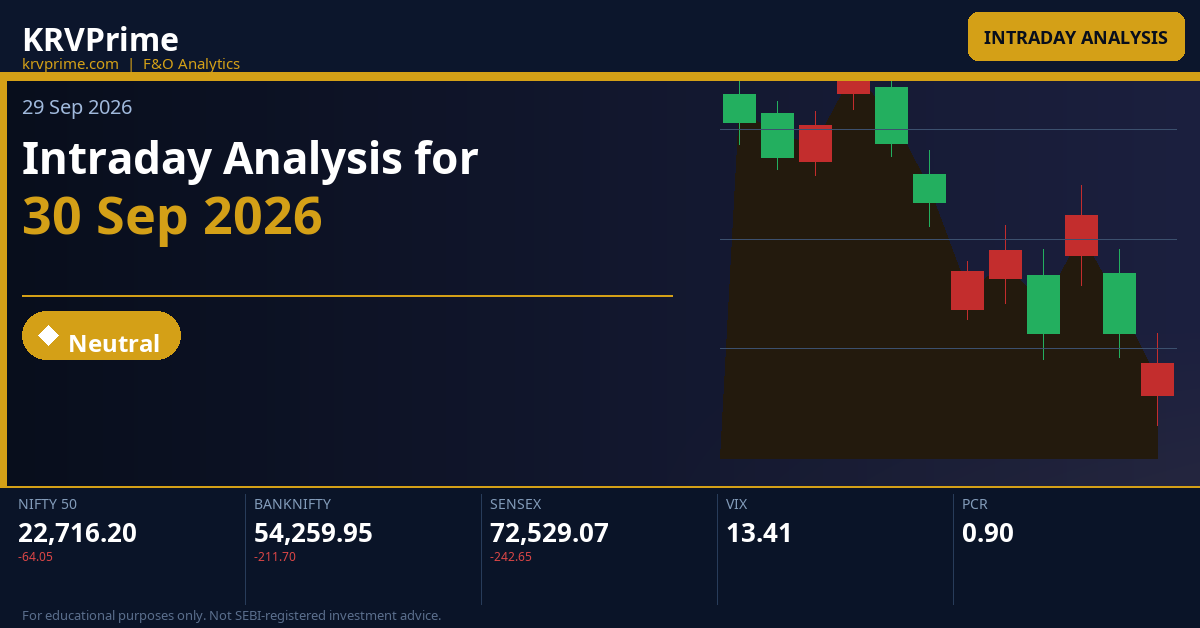
Markets closed in mild red on 29 Sep 2026 with NIFTY shedding 0.28% to 22,716.20, BANKNIFTY down 0.39% to 54,259.95, and SENSEX losing 0.33% to 72,529.07, reflecting a broadly cautious tone heading into 30 Sep — the last trading session of September. India VIX data is unavailable for this session, which limits precise volatility-premium sizing, but the extremely tight NIFTY weekly straddle of just 16.3 points signals near-zero implied move expected by options markets for the weekly expiry, suggesting institutional participants are pricing in a largely consolidative or expiry-pinning day. All three indices carry Descending CPR structures for tomorrow, confirming that the CPR band sits below yesterday's closing price, creating an overhead resistance dynamic from the outset of the session.
Key Market Signals — Intraday Setup
All three indices — NIFTY, BANKNIFTY, and SENSEX — enter 30 Sep with Descending CPR structures, meaning the entire CPR band is positioned below the previous close, which structurally tilts the opening bias bearish unless bulls reclaim their respective TC levels early in the session. The NIFTY weekly straddle of just 16.3 points and BANKNIFTY's pinned OI structure (CE resistance at 54,300 and PE support at 54,200 — a razor-thin 100-point band) signal extreme expiry-driven pin risk, making 30 Sep a classic last-day-of-month options-expiry session where directional breakouts are likely to be faded aggressively.
Deep Technical Analysis & Levels
NIFTY
Descending — Medium (Width 0.16%)
▼ Bearish
Market Structure Balanced or transitional | Straddle ATM 22,700 straddle: Call LTP 16.25 + Put LTP 0.05 = **16.3 points** total expected move. This near-zero straddle premium for the weekly expiry implies options markets expect essentially no directional movement on 30 Sep, strongly suggesting an expiry-pin scenario near 22,700-22,750. Traders should treat any move beyond 16 points from ATM with suspicion unless accompanied by a genuine breakout catalyst. | Max Pain Max Pain at **22,750** for both weekly and monthly expiry on 29-Sep-2026. Since current price (22,716.20) is 33.8 points below max pain, options sellers benefit from a mild drift upward toward 22,750 by expiry. This creates a gravitational pull upward intraday but is unlikely to override strong directional flows if a gap occurs. |
Tomorrow's Complete Level Map
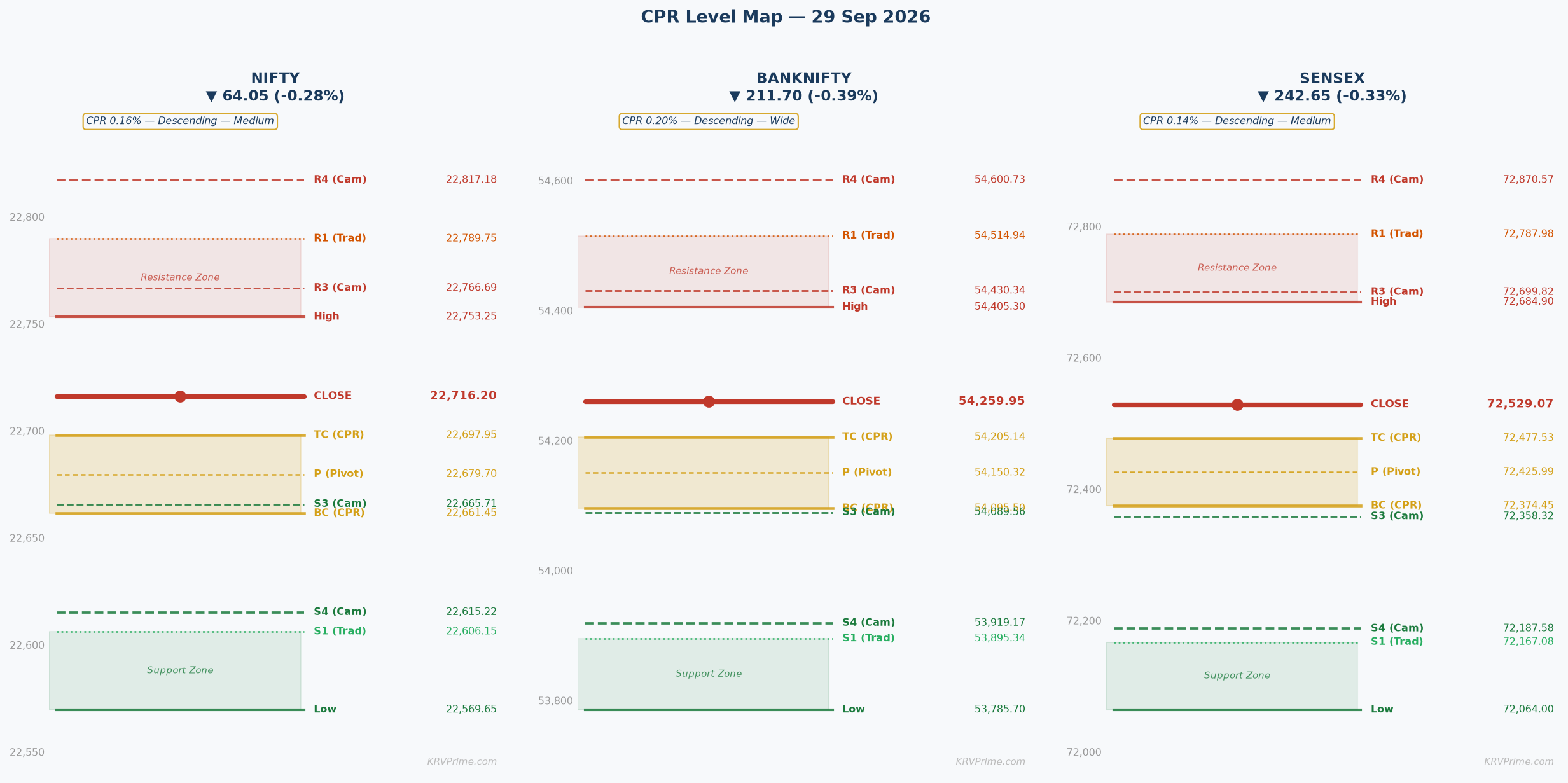
OI-R: 23,500 R3: 22,973.35 H6: 22,900.99 H5: 22,876.15 R2: 22,863.30 H4 ▶: 22,817.18 R1: 22,789.75 PDH: 22,753.25 H3 ↩: 22,766.69
TC: 22,697.95 P: 22,679.70 BC: 22,661.45
L3 ↩: 22,665.71 PDL: 22,569.65 S1: 22,606.15 L4 ▶: 22,615.22 S2: 22,496.10 L5: 22,556.25 L6: 22,531.41 S3: 22,422.55 OI-S: 22,700
↩ = Camarilla reversal point | ▶ = Camarilla breakout/breakdown trigger | OI-R/OI-S = Options wall (CE/PE max OI)
▲ Higher Open (Gap Up) — Open > Prev Close
▲ Bullish
Open lands: With a Descending CPR (TC=22,697.95 < prev_BC), any gap-up open above yesterday's close of 22,716.20 places price ABOVE the entire CPR band (above TC=22,697.95), which is actually constructive. The open would land above the TC at 22,697.95, positioning the CPR band as a support structure below the opening price rather than as overhead resistance.
CPR role: Launch pad / support floor below open — CPR band (BC=22,661.45 to TC=22,697.95) transitions to support on a gap-up, with TC=22,697.95 acting as the first intraday retest support level.
Minor Gap (0.05–0.25%) — Structure Dominant
A minor gap-up of 0.05–0.25% would open NIFTY in the range of approximately 22,727 to 22,773, placing price above TC=22,697.95 and near or just above Camarilla H3=22,766.69 and PDH=22,753.25. For a Descending Medium CPR, the structure is dominant and the gap adds a bullish lean, but the open is immediately confronting the PDH=22,753.25 and H3=22,766.69 as first resistance. Confirmation requires a first 30-minute candle close above H3=22,766.69 to validate genuine bullish momentum; if price stalls between TC=22,697.95 and PDH=22,753.25 in the first 30 minutes, that signals CPR-band magnet behavior rather than a breakout. The first upside target on confirmation is Traditional R1=22,789.75, followed by H4=22,817.18 as the breakout-retest zone.
Significant Gap (0.25–0.5%) — Balanced
A significant gap-up of 0.25–0.5% opens NIFTY in the range of approximately 22,773 to 22,830, pushing price above H3=22,766.69 and directly into the H4=22,817.18 breakout zone, with R1=22,789.75 as an intermediate reference. At this opening level, gap-fill risk is elevated because price opens above the PDH=22,753.25 and into a zone with no prior support structure, meaning a gap-fill back toward PDH and H3 is very possible within the first 30 minutes. The delta-hedging flow from short call writers at 22,800–22,850 will create natural selling pressure, and two 30-minute candle closes above H4=22,817.18 are needed to confirm this is not a fade opportunity. If confirmed above H4, the next target is R2=22,863.30 with H5=22,876.15 as the Camarilla upside extension.
Large Gap (>0.5%) — Gap Direction Dominant
A large gap-up exceeding 0.5% opens NIFTY above approximately 22,830, which is above H4=22,817.18 and into the R2=22,863.30 zone, overriding most CPR structure signals. However, given the weekly straddle of just 16.3 points, a large gap would be a shock event — options market makers would face severe gamma losses and would aggressively sell into the rally, creating a powerful mean-reversion force back toward 22,700–22,750. The high probability in this scenario is a gap-and-fade with a retracement back toward H3=22,766.69 and TC=22,697.95 within the first hour; traders should not chase the open and instead wait for the fade to stabilize above TC=22,697.95 before re-entering. The abort level for any long position is a 30-minute close below TC=22,697.95, which would confirm institutional selling into the gap.
|
▲ Upside Path → OI-R On confirmation above H3=22,766.69, the upside path follows H3→R1=22,789.75→H4=22,817.18→R2=22,863.30, with OI-R=23,500 as the ultimate ceiling — though reaching 23,500 in a single intraday session from 22,716 is extremely unlikely given the 16.3-point straddle. The real institutional target on a confirmed gap-up day is R1=22,789.75 as the first partial-profit level, with H4=22,817.18 as the scalp exit for aggressive momentum traders; volume acceleration through PDH=22,753.25 and H3=22,766.69 together is the confirmation of genuine momentum versus a fade setup. |
▼ Downside Path → OI-S Failure to hold above TC=22,697.95 after a gap-up immediately changes the day's structure from bullish-launch-pad to bearish-trap: price would fade from above TC toward P=22,679.70, then BC=22,661.45, and if BC fails on a 30-minute close, the downside path accelerates toward L3=22,665.71 and S1=22,606.15. A gap-up that fails below BC=22,661.45 is a particularly dangerous structure because it creates a bull trap for breakout buyers who entered on the gap, triggering stop-loss cascades toward L4=22,615.22 and OI-S=22,700 — note that OI-S at 22,700 is actually above current levels, meaning PE writers at 22,700 are already at risk. |
| 🔴 OI-R: OI resistance at the **23,500 CE strike** represents a massive call-writing wall that is approximately 784 points above the current close — this level is irrelevant as an intraday target on 30 Sep and functions purely as the macro ceiling for the weekly/monthly series. In a gap-up scenario, the effective intraday ceiling is the H4=22,817.18 and R2=22,863.30 cluster, where near-month call writers will defend aggressively through delta-hedging sales, making those levels the real OI-influenced intraday resistance. | 🟢 OI-S: OI support at the **22,700 PE strike** is critically positioned at almost exactly ATM (current close 22,716.20), meaning PE writers at this strike are under immediate pressure on any downward move. In a gap-up scenario, 22,700 acts as a floor that PE writers will defend — if price dips back toward 22,700 after a gap-up, put writers will buy futures to hedge, providing intraday support and creating a buy-the-dip opportunity at the OI-S=22,700 level. |
⚡ Key Trigger: The primary trigger for the higher-open bull case is a **first 30-minute candle close above H3=22,766.69** on above-average volume, which confirms that buyers have absorbed the PDH=22,753.25 resistance and the Camarilla mean-reversion zone, converting it to support. If the 30-minute close fails to sustain above H3=22,766.69, the structure reverts to CPR-band-magnet behavior where price gravitates back toward TC=22,697.95 and the pivotal P=22,679.70 — a failed breakout signal that opens short opportunities.
▼ Lower Open (Gap Down) — Open < Prev Close
▼ Bearish
Open lands: With a Descending CPR (TC=22,697.95 below prev close 22,716.20), a gap-down open places price inside the CPR band (between BC=22,661.45 and TC=22,697.95) or below BC=22,661.45. Even a minor gap-down of 0.1–0.15% opens inside the CPR band, making the CPR itself the immediate battleground zone.
CPR role: Overhead resistance battleground — the CPR band (BC=22,661.45 to TC=22,697.95) becomes a resistance ceiling on a gap-down; price needs to reclaim TC=22,697.95 decisively to neutralize the bearish gap signal.
Minor Gap (0.05–0.25%) — Structure Dominant
A minor gap-down of 0.05–0.25% opens NIFTY in the range of approximately 22,659 to 22,705, placing price right at or just inside the CPR band between BC=22,661.45 and TC=22,697.95. This is a high-significance zone because a minor gap-down into the CPR band for a Descending Medium CPR means price is opening directly at the structural battleground, where the 30-minute close becomes the critical decision point. If the first 30-minute candle closes above TC=22,697.95, the gap is treated as a non-event and bulls reclaim control toward PDH=22,753.25; if it closes below BC=22,661.45, the CPR band has capped the recovery and L3=22,665.71 becomes the first bear target. Given the OI-S at 22,700 and the straddle of just 16.3 points, a minor gap-down is the most likely scenario and the most nuanced — traders must respect the BC=22,661.45 as the structural line in the sand.
Significant Gap (0.25–0.5%) — Balanced
A significant gap-down of 0.25–0.5% opens NIFTY in the range of approximately 22,659 to 22,659, placing price below BC=22,661.45 and potentially near L3=22,665.71 or S1=22,606.15. At this level, the CPR band (BC=22,661.45 to TC=22,697.95) immediately becomes the overhead resistance zone, and bulls must stage a 30-minute reclaim of BC=22,661.45 and then TC=22,697.95 to neutralize the move; failure to reclaim BC within 30 minutes confirms bearish continuation. The downside path in this scenario follows L3=22,665.71 → L4=22,615.22 → S1=22,606.15, with PUT writers at OI-S=22,700 now in-the-money and likely to increase hedging pressure on futures, further amplifying the downward move. Traders should watch for two consecutive 30-minute closes below BC=22,661.45 to confirm the Wide confirmation rule is satisfied before initiating fresh shorts.
Large Gap (>0.5%) — Gap Direction Dominant
A large gap-down exceeding 0.5% opens NIFTY below approximately 22,603, breaching S1=22,606.15 on the opening tick and placing price near L4=22,615.22 and PDL=22,569.65. This scenario would trigger panic and margin calls, with OI-S=22,700 PE writers suffering significant mark-to-market losses and forced to buy back puts, creating a short-covering bounce around PDL=22,569.65 and L5=22,556.25. However, the 16.3-point straddle makes a large gap-down an extreme tail event — if it occurs, it signals a macro shock and the recovery could be sharp and fast; traders should wait for a stabilization candle (30-minute base-building) above L5=22,556.25 before considering any long-side scalp, targeting a recovery toward BC=22,661.45 as the first resistance on any bounce.
|
▲ Upside Path → OI-R The recovery path on a gap-down follows BC=22,661.45 → P=22,679.70 → TC=22,697.95 → H3=22,766.69, with the PDH=22,753.25 as the key intermediate resistance between TC and H3. Genuine recovery is confirmed only by volume acceleration through TC=22,697.95 — a low-volume reclaim of TC is a dead-cat bounce that will fail at PDH=22,753.25; high-volume reclaim of TC with a 30-minute close sets up a full recovery to H3=22,766.69 and R1=22,789.75. |
▼ Downside Path → OI-S The bear continuation path follows L3=22,665.71 → L4=22,615.22 → S1=22,606.15 → L5=22,556.25 → OI-S=22,700 (already breached in gap-down). Retail stop-losses clustered below L3=22,665.71 and PDL=22,569.65 will accelerate momentum toward L5=22,556.25 and L6=22,531.41 in a significant or large gap-down scenario, and PE writers at OI-S=22,700 will be forced to delta-hedge by selling futures, adding institutional selling pressure to the cascade. |
| 🔴 OI-R: In a gap-down scenario, OI-R=23,500 (CE max OI) is entirely irrelevant as an intraday target and functions only as a distant macro ceiling. The effective intraday overhead resistance is the CPR band itself (BC=22,661.45 to TC=22,697.95), with CE writers at 22,750 and 22,800 strikes providing additional resistance above, making the PDH=22,753.25 a powerful combined CPR+OI overhead level for any recovery attempt. | 🟢 OI-S: OI-S at **22,700** is the most critical level on any gap-down — PE writers at 22,700 are immediately in-the-money on a gap below 22,700, and they will buy futures to delta-hedge their short put positions, creating mechanical buying support around 22,660–22,680 (near BC=22,661.45). This PE-writer support makes the BC=22,661.45 zone a natural first bounce area in a minor gap-down; however, if selling overpowers this mechanical support and BC breaks on two 30-minute closes, it signals that PE writers have fully hedged and the support has collapsed, targeting L4=22,615.22 as the next floor. |
⚡ Key Trigger: The primary trigger for the gap-down scenario is: **failure to reclaim BC=22,661.45 within the first 30 minutes confirms bearish resumption targeting L3=22,665.71 and then S1=22,606.15**, while a 30-minute close above TC=22,697.95 signals a full gap-fill recovery and bull reclaim. The TC=22,697.95 level is the structural fulcrum because it is the TOP of the Descending CPR band — reclaiming it on a close basis means the entire CPR is now support, flipping the session bias from bearish to neutral-to-bullish.
◆ Near Flat Open — Open ≈ Prev Close (±0.05%)
◆ Neutral
Open lands: A ±0.05% flat open places NIFTY between approximately 22,705 and 22,727 — this is above TC=22,697.95, meaning a flat open for a Descending Medium CPR actually opens ABOVE the entire CPR band. The CPR band (BC=22,661.45 to TC=22,697.95) immediately assumes the role of a support zone below the open rather than a resistance ceiling.
CPR role: Decision zone / support floor — TC=22,697.95 is the key level to hold on any retest; the CPR band acts as a support cushion for bulls, but a breach of BC=22,661.45 flips it to a ceiling.
Near Flat (±0.05%)
A flat open near 22,716–22,727 for a Descending Medium CPR is a high-information, high-probability setup: price opens above the entire CPR band (above TC=22,697.95), making the first 30-minute candle the decisive directional signal for the entire session. The CPR band width is 0.16% (Medium), which means the 30-minute confirmation rule applies — a close above TC=22,697.95 is already satisfied by the flat open itself, so the real test becomes whether NIFTY can hold ABOVE TC=22,697.95 on any first-hour dip or retest; a dip that holds TC=22,697.95 as support is the highest-probability long setup of the day. Given the OI-S at 22,700 (virtually at TC=22,697.95) and the max pain at 22,750, a flat open creates a gravitational pull toward 22,750 as the expiry pin target — the OI pin force is the dominant intraday influence in this scenario, making a range between 22,700 and 22,753 (PDH) the most likely outcome. The bull trigger is a **30-minute candle close above H3=22,766.69** (above PDH=22,753.25) to confirm a breakout of the prior-day high; the bear trigger is a **30-minute close below BC=22,661.45**, which signals that the CPR band has been breached from above and the Descending structure is resuming its bearish dominance — targeting L3=22,665.71 and L4=22,615.22 as the next downside objectives.
|
▲ Upside Path → OI-R TC=22,697.95 (hold as support) → H3=22,766.69 (30-min confirmation) → PDH=22,753.25 (natural resistance and expiry pin zone) → R1=22,789.75 (first partial profit level) → H4=22,817.18 (Camarilla breakout trigger, secondary target). Volume confirmation through PDH=22,753.25 with a 30-minute close above H3=22,766.69 is essential — without volume, the PDH acts as a ceiling that fades price back toward TC=22,697.95 and the max-pain gravitational zone at 22,750. |
▼ Downside Path → OI-S BC=22,661.45 (30-min close breach triggers bear) → L3=22,665.71 (Camarilla mean-reversion zone, first stall point) → L4=22,615.22 (Camarilla breakdown trigger) → S1=22,606.15 (Traditional first target, partial profit for shorts) → OI-S=22,700 (already above — PE writers in danger). The L3=22,665.71 level is just 3.74 points below BC=22,661.45, meaning these two levels form a tight cluster that will either hold price in a consolidation (if PE writers defend) or collapse quickly toward L4=22,615.22 if institutional selling resumes. |
| 🔴 OI-R: OI-R at **23,500** (CE max OI strike) is 783+ points above the flat open zone and is completely irrelevant as a same-session target; its role in a flat-open scenario is as a distant macro structural ceiling confirming that the current price level (22,716) is well within the range where CE writers are comfortable, meaning there is no immediate gamma-squeeze pressure to the upside. The effective intraday CE writing resistance is at 22,750–22,800 (max pain vicinity and PDH cluster), where near-expiry call writers will provide mechanical overhead supply. | 🟢 OI-S: OI-S at **22,700** (PE max OI strike) is almost exactly at TC=22,697.95, creating a powerful dual confluence of CPR technical support and OI-structural support at this single level. In a flat-open scenario, this confluence means PE writers will mechanically buy futures to hedge if price dips toward 22,700, making the 22,697–22,700 zone a high-conviction support band; a breakdown below this zone on closing basis signals both CPR structure failure AND PE writer capitulation, making the move to L4=22,615.22 sharper and faster than normal. |
⚡ Key Trigger: **Bull trigger: first 30-minute close above H3=22,766.69** (above PDH=22,753.25) confirms breakout and targets R1=22,789.75; **bear trigger: first 30-minute close below BC=22,661.45** confirms CPR band has capped price and targets L3=22,665.71 and then S1=22,606.15. The TC=22,697.95 level is the structural fulcrum because it is the TOP of the Descending CPR — as long as price holds above it intraday, bulls control the session narrative and the max-pain pin at 22,750 remains the working hypothesis; loss of TC on a closing basis dismantles this narrative entirely.
BANKNIFTY
Descending — Wide (Width 0.20%)
▼ Bearish
Market Structure Sideways or range-bound | Straddle ATM 54,300 straddle: Call LTP 0.05 + Put LTP 40.10 = **40.15 points** total expected move. The near-zero call premium (0.05) versus 40.10 on the put side is an extraordinary asymmetry — it signals that the market expects BANKNIFTY to settle BELOW 54,300, and CE writers are treating 54,300 calls as worthless. This strongly implies an expiry-pin scenario at or below 54,200–54,300, with the OI band being a razor-thin 100-point range (OI-S=54,200, OI-R=54,300). | Max Pain Max Pain at **54,400** for monthly expiry (29-Sep-2026). Current price at 54,259.95 is 140 points below max pain, suggesting a drift upward toward 54,400 is favorable for option sellers. However, with CE at 54,300 essentially worthless, the real pin gravitational center is between 54,200 and 54,300, making max pain at 54,400 a secondary pull rather than the primary anchor. |
Tomorrow's Complete Level Map
OI-R: 54,300 R3: 55,134.54 H6: 54,885.01 H5: 54,799.75 R2: 54,769.92 H4 ▶: 54,600.73 R1: 54,514.94 PDH: 54,405.30 H3 ↩: 54,430.34
TC: 54,205.14 P: 54,150.32 BC: 54,095.50
L3 ↩: 54,089.56 PDL: 53,785.70 S1: 53,895.34 L4 ▶: 53,919.17 S2: 53,530.72 L5: 53,720.15 L6: 53,634.89 S3: 53,275.74 OI-S: 54,200
↩ = Camarilla reversal point | ▶ = Camarilla breakout/breakdown trigger | OI-R/OI-S = Options wall (CE/PE max OI)
▲ Higher Open (Gap Up) — Open > Prev Close
↕ Conflicted
Open lands: For a Descending Wide CPR (TC=54,205.14 below prev close 54,259.95), a gap-up open above 54,259.95 places price above TC=54,205.14 and above the entire CPR band. The open would land above TC and immediately into or above OI-R=54,300, which creates an extreme dynamic: price opens above the CE max OI wall.
CPR role: Launch pad below — but immediately negated by OI-R=54,300 as the dominant overhead ceiling; the CPR band (BC=54,095.50 to TC=54,205.14) transitions to support, but the OI wall at 54,300 is the more powerful structural force.
Minor Gap (0.05–0.25%) — Structure Dominant
A minor gap-up of 0.05–0.25% opens BANKNIFTY in the range of approximately 54,287 to 54,396, placing price directly AT or INTO the OI-R=54,300 CE max OI wall — this is an extraordinarily rare and significant opening scenario. The Descending Wide CPR structure is dominant but immediately conflicted: the CPR band is support below at TC=54,205.14, but the 0.05 CE LTP at 54,300 signals that option writers view any move above 54,300 as a fade opportunity with near-certainty. A minor gap-up here is a HIGH-CONVICTION FADE setup: two 30-minute candle closes above OI-R=54,300 are needed to even consider longs (per Wide CPR rule), and without that, the setup favors selling the gap-up into 54,300 targeting TC=54,205.14 and P=54,150.32. The first stall and reversal reference is H3=54,430.34, but reaching it requires sustained buying against the entire CE writing wall.
Significant Gap (0.25–0.5%) — Balanced
A significant gap-up of 0.25–0.5% opens BANKNIFTY in the range of approximately 54,395 to 54,531, placing price above OI-R=54,300 AND approaching PDH=54,405.30 and H3=54,430.34 simultaneously. At this opening level, BANKNIFTY has gapped above the CE OI wall at 54,300, triggering gamma-squeeze dynamics where CE writers must buy futures to hedge — this mechanical buying supports the gap briefly, but the structural conflict is extreme. Two 30-minute closes above H3=54,430.34 are required per the Wide CPR confirmation rule before initiating any long; failure to sustain above H3=54,430.34 signals a fade back toward OI-R=54,300 (now support), then TC=54,205.14. If confirmed above H3=54,430.34, targets are R1=54,514.94 and H4=54,600.73.
Large Gap (>0.5%) — Gap Direction Dominant
A large gap-up exceeding 0.5% opens BANKNIFTY above approximately 54,531, above H3=54,430.34 and potentially near H4=54,600.73 — this would be a shock event that obliterates the CE writing structure at 54,300. The CE writers at 54,300 with 0.05 LTP would face catastrophic losses, forcing massive delta-hedging futures purchases that could create a violent squeeze toward H4=54,600.73 and R1=54,514.94 in the first 30 minutes. However, the Wide CPR rule demands two 30-minute closes for confirmation, and the mean-reversion tendency of Wide CPRs means the best trade is to wait for the first 30-minute spike high and then fade toward H3=54,430.34 and OI-R=54,300 (converted to support from resistance on a large gap).
|
▲ Upside Path → OI-R If OI-R=54,300 is cleared on two 30-minute closes, the path is OI-R=54,300 → H3=54,430.34 → PDH=54,405.30 → R1=54,514.94 → H4=54,600.73, with volume acceleration through PDH=54,405.30 as the critical confirmation signal that institutional buyers have overwhelmed the CE writing wall. Each level — PDH at 54,405.30, H3 at 54,430.34, R1 at 54,514.94 — should be treated as a partial-profit target in a Wide CPR session where fading extremes is the base strategy. |
▼ Downside Path → OI-S Failure to hold above OI-R=54,300 after a gap-up triggers the fade: TC=54,205.14 → P=54,150.32 → BC=54,095.50 → L3=54,089.56 → OI-S=54,200 (between BC and TC, already above on a gap-up scenario). The BANKNIFTY OI band is so compressed (OI-S=54,200 to OI-R=54,300, just 100 points) that a gap-up failure retraces back to the center of this band at P=54,150.32 within the first hour in most cases. |
| 🔴 OI-R: OI-R at **54,300** (CE max OI) with a near-zero LTP of 0.05 is the most powerful structural level in BANKNIFTY for 30 Sep — it is simultaneously the ATM strike and the primary upside ceiling, meaning CE writers have written 54,300 calls as expiry-worthless bets. In a gap-up that opens AT or ABOVE 54,300, CE writers face immediate delta-hedging pressure and must buy futures (creating a mechanical squeeze), but any failure to sustain above 54,300 on closing basis triggers their delta to collapse back to near-zero, removing all CE-writer support and allowing a fast fade. | 🟢 OI-S: OI-S at **54,200** (PE max OI) is just 59.95 points below yesterday's close and forms the lower bound of the 100-point OI pin band; in a gap-up scenario, 54,200 becomes the distant floor that is unlikely to be tested intraday. PE writers at 54,200 are in-the-money protection mode on any gap-up, and they will reduce futures hedges (i.e., sell futures) as price rises above 54,200, adding a marginal headwind to strong gap-ups but not the dominant force in this scenario. |
⚡ Key Trigger: The primary trigger in any gap-up scenario for BANKNIFTY is whether price can achieve **two consecutive 30-minute closes above OI-R=54,300** — this is the only condition that neutralizes the CE writing wall and opens upside toward H3=54,430.34 and PDH=54,405.30. Failure to achieve two closes above 54,300 is a high-conviction signal to fade the gap, targeting TC=54,205.14, P=54,150.32, and BC=54,095.50 as the CPR band magnet on mean-reversion.
▼ Lower Open (Gap Down) — Open < Prev Close
▼ Bearish
Open lands: For a Descending Wide CPR, a gap-down below 54,259.95 opens price either inside the CPR band (between BC=54,095.50 and TC=54,205.14) or below BC=54,095.50. A minor gap-down of 0.1% opens near TC=54,205.14; a moderate gap-down opens inside the band near P=54,150.32; a significant gap-down below 0.3% opens near or below BC=54,095.50.
CPR role: Overhead resistance / battleground — the CPR band (BC=54,095.50 to TC=54,205.14) becomes a ceiling on a gap-down; price must reclaim TC=54,205.14 on two 30-minute closes to neutralize (Wide CPR rule). The OI-S=54,200 inside the CPR band creates a critical dual-level support zone.
Minor Gap (0.05–0.25%) — Structure Dominant
A minor gap-down of 0.05–0.25% opens BANKNIFTY in the range of approximately 54,124 to 54,233, placing price inside the CPR band between BC=54,095.50 and TC=54,205.14, and critically near OI-S=54,200. This is a highly contested zone: OI-S at 54,200 (PE max OI) means PE writers will defend this level by buying futures, creating mechanical support right inside the CPR band. However, the CPR band is overhead resistance in a Descending Wide setup, and per the Wide CPR rule, two 30-minute closes above TC=54,205.14 are needed to neutralize the structure — without that, the CPR band caps any recovery and the path of least resistance is toward BC=54,095.50 and L3=54,089.56. Traders should watch whether OI-S=54,200 holds as support on the first 30-minute candle — a hold with volume confirms PE writers are defending, while a break signals that PE writers have capitulated and L3=54,089.56 is the immediate target.
Significant Gap (0.25–0.5%) — Balanced
A significant gap-down of 0.25–0.5% opens BANKNIFTY in the range of approximately 54,124 to 53,935, placing price near or below BC=54,095.50 and approaching L3=54,089.56 on the lower end. At this level, OI-S=54,200 has been gapped below, meaning PE writers at 54,200 are immediately in-the-money and must buy futures to delta-hedge — this creates mechanical buying support that could drive a 30-minute bounce back toward BC=54,095.50 and then TC=54,205.14. However, per the Wide CPR two-30-minute-close rule, failure to reclaim BC=54,095.50 on two consecutive closes confirms the Descending structure dominance and targets L4=53,919.17 and S1=53,895.34 as the next downside stations. PUT writing recovery plays near L3=54,089.56 offer asymmetric reward if PE writer buying materializes.
Large Gap (>0.5%) — Gap Direction Dominant
A large gap-down exceeding 0.5% opens BANKNIFTY below approximately 53,989, breaching L3=54,089.56 and L4=53,919.17 on the opening tick and approaching S1=53,895.34. This scenario implies a macro shock — perhaps global market selloff or domestic news — and PE writers at OI-S=54,200 would suffer severe losses, triggering aggressive delta-hedging futures purchases that could cause a violent V-shape bounce from L4=53,919.17 or S1=53,895.34 zones. However, the Wide CPR rule demands patience: wait for a 30-minute stabilization candle above L4=53,919.17 before considering any long, using PDL=53,785.70 as the abort level for the recovery trade; the targets on recovery are L3=54,089.56, BC=54,095.50, and then TC=54,205.14.
|
▲ Upside Path → OI-R Recovery path: BC=54,095.50 (two 30-min closes needed) → TC=54,205.14 → OI-S=54,200 (confirmed support) → OI-R=54,300 → PDH=54,405.30 → H3=54,430.34. Each level on the recovery represents a partial-profit zone for recovery scalp traders; the OI pin band (54,200 to 54,300) makes any move inside this range a high-conviction mean-reversion target as it is where both PE and CE writers are most concentrated. |
▼ Downside Path → OI-S Bear continuation: L3=54,089.56 (first Camarilla mean-reversion stall) → L4=53,919.17 (Camarilla breakdown trigger) → S1=53,895.34 (Traditional first target, partial profit for shorts) → L5=53,720.15 → PDL=53,785.70. Stop-losses below L3=54,089.56 trigger retail cascade toward L4=53,919.17, and institutional PUT writers below OI-S=54,200 may accelerate the selling rather than absorb it if the breach is on high volume — making L4=53,919.17 to S1=53,895.34 the critical cluster to watch. |
| 🔴 OI-R: OI-R at **54,300** (CE max OI with 0.05 LTP) is completely irrelevant as a target in a gap-down scenario and functions only as a distant overhead ceiling that defines the upper boundary of the pin range. CE writers at 54,300 are increasingly profitable on a gap-down, and their delta approaches zero, meaning they add no directional futures activity — all the mechanical action comes from the PE writer side in this scenario. | 🟢 OI-S: OI-S at **54,200** (PE max OI) is the single most important level on any BANKNIFTY gap-down: PE writers at 54,200 are immediately in-the-money on any close below this level, and their delta-hedging futures purchases create significant mechanical buying pressure around 54,200 and BC=54,095.50. If PE writers successfully defend 54,200 (confirmed by price bouncing from BC=54,095.50 with volume), the OI-S acts as the primary intraday floor and the entire session becomes a range trade between OI-S=54,200 and OI-R=54,300 — a 100-point pin scenario that is the dominant structural outcome for monthly expiry day. |
⚡ Key Trigger: The primary bear trigger for BANKNIFTY gap-down is: **failure to reclaim BC=54,095.50 on two consecutive 30-minute closes confirms the Wide Descending CPR dominance**, targeting L3=54,089.56, L4=53,919.17, S1=53,895.34, and ultimately OI-S=54,200 floor test. The recovery (bull) trigger is two 30-minute closes above TC=54,205.14, which neutralizes the CPR overhead resistance and signals that OI-S=54,200 PE writers have successfully defended — targeting OI-R=54,300 and PDH=54,405.30.
◆ Near Flat Open — Open ≈ Prev Close (±0.05%)
◆ Neutral
Open lands: A ±0.05% flat open places BANKNIFTY between approximately 54,233 and 54,287 — this is above TC=54,205.14, meaning a flat open for a Descending Wide CPR opens above the entire CPR band. Price opens inside the 100-point OI pin band (OI-S=54,200 to OI-R=54,300), which is the most significant structural location possible.
CPR role: Decision zone within OI pin band — TC=54,205.14 is immediate support below, OI-R=54,300 is the ceiling above; the CPR band (BC=54,095.50 to TC=54,205.14) is support below the flat open. The OI pin band dominates the day's structure.
Near Flat (±0.05%)
A flat open near 54,233–54,287 for a Descending Wide CPR places BANKNIFTY in an extremely specific structural position: above TC=54,205.14 (CPR support) and inside the OI pin band (54,200 to 54,300), creating what is effectively the maximum expiry-pin setup possible. The Wide CPR rule demands two 30-minute closes for any directional confirmation, but with the 40.15-point straddle and OI pin band of just 100 points, the dominant scenario is a rangebound session where BANKNIFTY oscillates between OI-S=54,200 and OI-R=54,300 all day as CE and PE writers defend their respective strikes. The flat open ABOVE TC=54,205.14 means the CPR band is technically support (not resistance), but a breach of TC=54,205.14 on two 30-minute closes would drag price toward BC=54,095.50 and then L3=54,089.56 as the bear case activates. The bull trigger requires two 30-minute closes above OI-R=54,300, which would force CE writers to hedge and drive a squeeze toward H3=54,430.34 and PDH=54,405.30 — but this requires sustained institutional buying against what is effectively a CE writing fortress at 54,300.
|
▲ Upside Path → OI-R TC=54,205.14 (hold as support on retests) → OI-R=54,300 (two 30-min closes to clear) → H3=54,430.34 (Camarilla mean-reversion zone, first stall reference) → PDH=54,405.30 → R1=54,514.94 (Traditional first target, partial profit). Volume acceleration through OI-R=54,300 with a wide-range candle is the confirmation signal that CE writers are being squeezed rather than merely tested — absence of volume means the move will stall at OI-R=54,300 and revert. |
▼ Downside Path → OI-S TC=54,205.14 (two 30-min close breach triggers bear) → BC=54,095.50 → L3=54,089.56 (tight cluster, first stall) → L4=53,919.17 (Camarilla breakdown trigger, wide range move expected below here) → S1=53,895.34 → OI-S=54,200 (already above — PE writers in-the-money forcing futures buying). The proximity of L3=54,089.56 to BC=54,095.50 (just 5.94 points separation) means any two-close breach of TC creates a fast air-pocket move to L4=53,919.17. |
| 🔴 OI-R: OI-R at **54,300** with 0.05 CE LTP is the defining structural level for BANKNIFTY's flat-open session — it is simultaneously the ATM expiry ceiling, the OI resistance wall, and the upper bound of the 100-point pin band. CE writers at 54,300 treat their position as expiry-worthless, meaning any move above 54,300 triggers panic hedging and a potential CE-squeeze, which is why two 30-minute closes are the appropriate bar before trading the breakout — it must be a genuine forced hedge scenario, not a momentary spike. | 🟢 OI-S: OI-S at **54,200** with substantial PE OI is the lower bound of the 100-point pin band and is just 5.14 points below TC=54,205.14, creating an extraordinary confluence: TC and OI-S are virtually the same level. In a flat-open scenario, this means any retest of TC=54,205.14 is simultaneously a test of the PE max OI defense zone — PE writers will mechanically buy futures at this level, making it the highest-conviction support in the session and the key level to monitor for whether the pin structure holds or breaks. |
⚡ Key Trigger: **Bull trigger: two consecutive 30-minute closes above OI-R=54,300** (Wide CPR confirmation rule) forces CE writer delta-hedging and opens the path to H3=54,430.34 and PDH=54,405.30. **Bear trigger: two consecutive 30-minute closes below TC=54,205.14** converts the CPR band to overhead resistance and activates the Descending Wide CPR bearish structure, targeting BC=54,095.50, L3=54,089.56, and L4=53,919.17. The dominant scenario is a range between TC=54,205.14 and OI-R=54,300 — fade both extremes is the highest-probability play.
SENSEX
Descending — Medium (Width 0.14%)
▼ Bearish
Market Structure Balanced or transitional | Straddle ATM 72,500 weekly straddle: Call LTP 508.30 + Put LTP 224.15 = **732.45 points** expected weekly move; ATM 72,500 monthly straddle: Call LTP 1,564.05 + Put LTP 723.00 = **2,287.05 points** expected monthly move. The weekly 732.45-point straddle is substantial and implies the weekly expiry (01 Oct 2026) has significant time value remaining, giving SENSEX more room for directional movement compared to NIFTY's near-zero straddle — meaning SENSEX may exhibit larger intraday swings. | Max Pain Weekly Max Pain at **72,900** (01-Oct-2026 expiry) is 370.93 points above the current close of 72,529.07, suggesting a meaningful gravitational pull upward by Friday's close. Monthly Max Pain at **75,000** (29-Oct-2026) is 2,470.93 points above current price — a distant target relevant only for swing traders. For intraday 30 Sep, the weekly max pain at 72,900 is the operative pin target, creating upward magnetic force toward R1=72,787.98 and PDH=72,684.90. |
Tomorrow's Complete Level Map
OI-R: 74,000 R3: 73,408.88 H6: 73,153.98 H5: 73,070.01 R2: 73,046.89 H4 ▶: 72,870.57 R1: 72,787.98 PDH: 72,684.90 H3 ↩: 72,699.82
TC: 72,477.53 P: 72,425.99 BC: 72,374.45
PDL: 72,064 S1: 72,167.08 S2: 71,805.09 S3: 71,546.18 OI-S: 70,000
↩ = Camarilla reversal point | ▶ = Camarilla breakout/breakdown trigger | OI-R/OI-S = Options wall (CE/PE max OI)
▲ Higher Open (Gap Up) — Open > Prev Close
▲ Bullish
Open lands: For a Descending Medium CPR (TC=72,477.53 below prev close 72,529.07), a gap-up above 72,529.07 opens SENSEX above the entire CPR band (above TC=72,477.53). The gap-up open places price above the CPR, making the band a support floor below, and immediately approaches H3=72,699.82 and PDH=72,684.90 as the first key resistance cluster.
CPR role: Launch pad / support floor below open — TC=72,477.53 becomes the first support on any retest; the CPR band (BC=72,374.45 to TC=72,477.53) is the support cushion for bulls in this scenario.
Minor Gap (0.05–0.25%) — Structure Dominant
A minor gap-up of 0.05–0.25% opens SENSEX in the range of approximately 72,565 to 72,710, placing price above TC=72,477.53 and approaching PDH=72,684.90 and H3=72,699.82 as the first key resistance cluster — these two levels are just 14.92 points apart and form a highly confluent ceiling. The Descending Medium CPR structure is dominant and the gap adds a bullish lean, but the first 30-minute candle must close above H3=72,699.82 AND PDH=72,684.90 to confirm genuine breakout momentum per the Medium CPR confirmation rule. If price opens between TC=72,477.53 and PDH=72,684.90 and stalls in the first 30 minutes without closing above H3=72,699.82, the CPR-band magnetic pull toward TC=72,477.53 and P=72,425.99 dominates and the gap is faded back toward the CPR mid-point.
Significant Gap (0.25–0.5%) — Balanced
A significant gap-up of 0.25–0.5% opens SENSEX in the range of approximately 72,710 to 72,891, placing price above H3=72,699.82 and PDH=72,684.90, directly into or above R1=72,787.98 and approaching H4=72,870.57. At this opening level, the first 30-minute candle close confirmation is critical — price has already cleared H3 and PDH, but gap-fill risk is significant because the weekly straddle of 732.45 points and max pain at 72,900 both support a drift toward 72,900, not a sustained breakout. Delta-hedging from CE writers at 73,000–74,000 will create natural resistance around R1=72,787.98 to H4=72,870.57; a 30-minute close above H4=72,870.57 opens targets of R2=73,046.89 and H5=73,070.01. The significant gap-up aligns with the weekly max pain pull toward 72,900, making this one of the higher-conviction scenarios for SENSEX.
Large Gap (>0.5%) — Gap Direction Dominant
A large gap-up exceeding 0.5% opens SENSEX above approximately 72,891, above H4=72,870.57 and near R2=73,046.89, which would be a substantial move given the prior close of 72,529.07. A large gap to this zone creates extreme gap-fill risk — price would be approaching the weekly max pain level of 72,900 on the open, and the 732.45-point straddle suggests significant implied volatility that makes such a gap possible but unsustainable without follow-through. The Medium CPR confirmation rule requires a first 30-minute close above the opening zone to confirm; without volume, a large gap-up to 72,900+ will be faded back toward H3=72,699.82 and TC=72,477.53 within the first 90 minutes, making the gap a scalp-sell opportunity for experienced traders with a stop above H5=73,070.01.
|
▲ Upside Path → OI-R Confirmed above H3=72,699.82 and PDH=72,684.90: H3=72,699.82 → R1=72,787.98 (Traditional first target, partial profit) → H4=72,870.57 (Camarilla breakout trigger, maximum likely target for medium confirmation) → max pain=72,900 (weekly gravitational pull) → R2=73,046.89 (if sustained buying). Volume confirmation through PDH=72,684.90 and H3=72,699.82 simultaneously is the key signal — these two levels forming support is what separates a genuine trend day from a gap-fade day, and OI-R=74,000 is the distant macro ceiling confirming ample room for upside within the current range. |
▼ Downside Path → OI-S Failure to hold above TC=72,477.53 after a gap-up signals a bull trap: TC=72,477.53 → P=72,425.99 → BC=72,374.45 → L3=72,358.32 → S1=72,167.08 → OI-S=70,000 (distant floor). The failure at TC is significant because it signals that the Descending CPR structure has reasserted overhead dominance — buyers who chased the gap are now trapped above TC and will capitulate, creating a cascade toward L3=72,358.32 (which is just 16.13 points below BC=72,374.45, forming a tight cluster) and then S1=72,167.08. |
| 🔴 OI-R: OI-R at **74,000** (CE max OI) is approximately 1,470 points above the current close — this is a distant macro ceiling that is not reachable intraday but confirms the structural bearishness of CE writers who view 74,000 as an adequate ceiling for the current consolidation phase. In a gap-up scenario, the effective intraday CE writing resistance is at 73,000–73,500 based on the week straddle range, making R2=73,046.89 and H5=73,070.01 the realistic ceiling targets rather than OI-R=74,000. | 🟢 OI-S: OI-S at **70,000** (PE max OI) is approximately 2,529 points below the current close — an enormous distance that functions as a macro floor and catastrophic downside scenario reference rather than an intraday target. In a gap-up scenario, OI-S=70,000 is entirely irrelevant as a downside reference; the effective intraday PE support is at the weekly CPR S1=72,944.64 (from weekly data) and daily L4=72,187.58, confirming that the real intraday floor in a mild pullback is 72,000–72,187 rather than 70,000. |
⚡ Key Trigger: The primary trigger for the SENSEX higher-open bullish scenario is a **first 30-minute candle close above H3=72,699.82** (above PDH=72,684.90), which confirms that the resistance cluster at 72,684–72,699 has been converted to support — this is the structural fulcrum because PDH and Camarilla H3 coincide here. If the 30-minute close fails below H3=72,699.82, the gap is categorized as a failed breakout, and price gravitates back toward TC=72,477.53 and P=72,425.99 as the CPR band magnet reasserts itself.
▼ Lower Open (Gap Down) — Open < Prev Close
▼ Bearish
Open lands: For a Descending Medium CPR, a gap-down below 72,529.07 opens price either inside the CPR band (between BC=72,374.45 and TC=72,477.53) or below BC=72,374.45. A 0.07% gap-down opens near TC=72,477.53 at the top of the band; a 0.21% gap-down opens near BC=72,374.45 at the bottom of the band.
CPR role: Overhead resistance / recovery decision zone — the CPR band (BC=72,374.45 to TC=72,477.53) becomes the ceiling on a gap-down; price must reclaim TC=72,477.53 on the first 30-minute candle close to attempt recovery (Medium CPR rule).
Minor Gap (0.05–0.25%) — Structure Dominant
A minor gap-down of 0.05–0.25% opens SENSEX in the range of approximately 72,347 to 72,493, placing price inside or just below the CPR band (BC=72,374.45 to TC=72,477.53). This is a high-information zone: the CPR band is now overhead resistance, and the first 30-minute candle close determines whether price reclaims TC=72,477.53 (bull recovery) or confirms the Descending CPR structure below BC=72,374.45 (bear continuation). Minor gap-downs inside the CPR band often fill within 30–60 minutes when the 732.45-point weekly straddle implies significant remaining time value, giving buyers the theoretical room to recover; however, the Descending structure means recovery requires effort and is NOT the base case without the 30-minute confirmation close above TC=72,477.53. If BC=72,374.45 is not reclaimed within the first 30 minutes, L3=72,358.32 (just 16.13 points below BC) is the immediate bear target.
Significant Gap (0.25–0.5%) — Balanced
A significant gap-down of 0.25–0.5% opens SENSEX in the range of approximately 72,167 to 72,347, placing price near or below BC=72,374.45 and approaching L3=72,358.32 and S1=72,167.08. At this level, the entire CPR band (BC=72,374.45 to TC=72,477.53) is overhead resistance, and the two-level proximity of L3=72,358.32 to BC=72,374.45 means a significant gap-down creates an immediate test of the L3 Camarilla mean-reversion zone. Two 30-minute closes below BC=72,374.45 confirm the Medium CPR bearish dominance and target L4=72,187.58 and S1=72,167.08 as the next stations — these two levels are also tightly clustered (20.5 points apart), creating a powerful support confluence. PUT writers below the 72,000 level will provide mechanical buying support, and the weekly straddle of 732.45 points still prices in significant movement, so recovery scalps toward BC=72,374.45 remain viable on high-volume reversal candles.
Large Gap (>0.5%) — Gap Direction Dominant
A large gap-down exceeding 0.5% opens SENSEX below approximately 72,167, breaching S1=72,167.08 and L4=72,187.58 on the opening tick and approaching PDL=72,064 as the prior-day low floor. This scenario would be a significant shock, potentially driven by global overnight weakness or domestic negative news, and the 732.45-point weekly straddle suggests options were not pricing this in at yesterday's close. The recovery from a large gap-down requires stabilization above PDL=72,064 — failure to hold PDL triggers L5=71,988.16 and L6=71,904.16 as the next Camarilla downside targets; a bounce from PDL=72,064 targets BC=72,374.45 and TC=72,477.53 as the recovery ceiling. Straddle monetization begins near PDL=72,064 for experienced traders targeting a bounce of 300–400 points back toward the CPR band.
|
▲ Upside Path → OI-R Recovery path: BC=72,374.45 (first 30-min close above needed) → TC=72,477.53 (Medium CPR confirmation close above) → H3=72,699.82 (Camarilla mean-reversion zone, first stall point) → PDH=72,684.90 → R1=72,787.98 → weekly max pain=72,900. Genuine recovery is confirmed by a volume expansion candle through TC=72,477.53 — without volume, any bounce to TC will fail and create a lower-high pattern that accelerates the next leg down. |
▼ Downside Path → OI-S Bear continuation: L3=72,358.32 (Camarilla mean-reversion, first stall) → L4=72,187.58 (Camarilla breakdown trigger) → S1=72,167.08 (Traditional first target, tight cluster with L4) → PDL=72,064 (prior-day low, key structural support) → L5=71,988.16 → L6=71,904.16 → OI-S=70,000 (distant macro floor). The L4=72,187.58 and S1=72,167.08 cluster is the critical acceleration zone — breaks below here with volume signal a genuine directional day with momentum toward PDL=72,064 and below. |
| 🔴 OI-R: OI-R at **74,000** (CE max OI) is completely irrelevant in a gap-down scenario for SENSEX and serves only as a reminder of the macro ceiling distance. CE writers at 74,000 are deeply out-of-the-money and carry near-zero delta, meaning they add no directional mechanical activity to the session — all the OI-driven mechanics in a gap-down come from the PE side at lower strikes near 70,000–72,000. | 🟢 OI-S: OI-S at **70,000** (PE max OI) is 2,529 points below yesterday's close and is not an intraday target on a single gap-down day, but it defines the structural floor for the monthly series and gives a sense of the enormous cushion PE writers have built below current prices. However, in a significant gap-down scenario, PE writers at 72,000 strikes (not shown but inferred from the wide straddle structure) will be the active delta-hedgers buying futures near L4=72,187.58 and S1=72,167.08, making those levels the operative PE-writer support for the session rather than the distant 70,000 OI-S floor. |
⚡ Key Trigger: The primary trigger for the gap-down scenario: **first 30-minute candle close above TC=72,477.53 confirms bull recovery targeting H3=72,699.82 and PDH=72,684.90**; **two 30-minute closes below BC=72,374.45 confirm Descending CPR dominance targeting L4=72,187.58 and S1=72,167.08**. The TC=72,477.53 level is the structural fulcrum for SENSEX on 30 Sep — it is the top of the Descending CPR band, and reclaiming it on a 30-minute closing basis signals that the bearish CPR structure has been overcome, while failure to reclaim it within the first hour confirms that the overhead CPR is controlling the session.
◆ Near Flat Open — Open ≈ Prev Close (±0.05%)
◆ Neutral
Open lands: A ±0.05% flat open places SENSEX between approximately 72,493 and 72,565 — this is above TC=72,477.53, meaning a flat open for a Descending Medium CPR opens ABOVE the entire CPR band. The CPR band transitions to a support structure below the open, with TC=72,477.53 as the primary support and BC=72,374.45 as the secondary floor.
CPR role: Decision zone with CPR as support below — TC=72,477.53 acts as immediate support on any dip; the CPR band is the launch pad for bulls if TC holds, and a breakdown below BC=72,374.45 flips it to overhead resistance.
Near Flat (±0.05%)
A flat open near 72,493–72,565 for SENSEX's Descending Medium CPR is a constructive structural setup: price opens above the entire CPR band (above TC=72,477.53), making the CPR a technical support platform below, and the session opens with a bullish lean despite the Descending CPR type. The first 30-minute candle is decisive — the Medium CPR width of 0.14% means the structural signal is strong, and a 30-minute close above H3=72,699.82 (above PDH=72,684.90 simultaneously) triggers the bull case targeting R1=72,787.98 and the weekly max pain at 72,900. However, the weekly straddle of 732.45 points implies genuine two-way risk, and a dip to TC=72,477.53 on the first 30-minute candle followed by a close below TC converts the CPR to overhead resistance — the bear case then targets BC=72,374.45, L3=72,358.32, and ultimately S1=72,167.08. The dominant intraday gravity is toward the weekly max pain at 72,900 (370+ points above current), creating upward pull, but this must be validated by the first 30-minute close direction relative to H3=72,699.82 and TC=72,477.53.
|
▲ Upside Path → OI-R TC=72,477.53 (holds on first-hour retest as support) → H3=72,699.82 (30-min close confirmation zone, coincides with PDH=72,684.90 for powerful dual confluence) → R1=72,787.98 (Traditional first target, partial profit for longs) → H4=72,870.57 (Camarilla breakout trigger) → 72,900 (weekly max pain gravitational target) → R2=73,046.89. The dual confluence of H3=72,699.82 and PDH=72,684.90 within 14.92 points of each other makes this cluster the single most important upside resistance level in the session — clearing it on a 30-minute close with volume is the high-conviction long entry signal. |
▼ Downside Path → OI-S BC=72,374.45 (30-min close breach triggers bear) → L3=72,358.32 (just 16.13 points below BC, immediate next stop) → L4=72,187.58 (Camarilla breakdown trigger, wide range move expected below here) → S1=72,167.08 (Traditional first target for shorts, tight cluster with L4) → PDL=72,064 → L5=71,988.16 → OI-S=70,000. The extraordinary proximity of BC=72,374.45 and L3=72,358.32 means a bearish 30-minute close below BC immediately triggers the next Camarilla level, creating an air-pocket structure that accelerates moves — traders must set stops above TC=72,477.53 on short entries, not above BC. |
| 🔴 OI-R: OI-R at **74,000** (CE max OI) is 1,470+ points above the flat open zone — it is the macro structural ceiling but is irrelevant for intraday targeting. Its significance in a flat-open scenario is that it confirms CE writers are comfortable with price staying well below 74,000, meaning there is no gamma-squeeze pressure to the upside at current levels; the effective intraday CE resistance is at 73,000–73,500 (implied by the 732.45-point weekly straddle upper bound), making R2=73,046.89 and H5=73,070.01 the realistic ceiling for an aggressive bullish session. | 🟢 OI-S: OI-S at **70,000** (PE max OI) is 2,529+ points below the flat open, confirming an enormous downside buffer — PE writers at 70,000 are deeply out-of-the-money and provide no intraday mechanical support at current levels. The operative PE support for a flat-open day is at near-ATM strikes around 72,000–72,500, where PE writers will delta-hedge by buying futures if price dips toward their strikes, creating mechanical support near L4=72,187.58 and S1=72,167.08 rather than at the distant OI-S=70,000 floor. |
⚡ Key Trigger: **Bull trigger: first 30-minute close above H3=72,699.82** (above PDH=72,684.90 simultaneously) confirms the bullish session structure and targets R1=72,787.98, H4=72,870.57, and the weekly max pain at 72,900. **Bear trigger: first 30-minute close below BC=72,374.45** converts the CPR band from support to resistance and activates the Descending bearish structure, targeting L3=72,358.32, L4=72,187.58, S1=72,167.08 — these two tight clusters (BC+L3 and L4+S1) form the bear's sequential profit-taking zones in a Medium CPR session.
📊 VIX Insight: India VIX data is unavailable for this session, which is an unusual data gap that should itself be treated as a cautionary signal — VIX unavailability sometimes coincides with low-liquidity or data-processing delays on end-of-month settlement days. Given the NIFTY weekly straddle of just 16.3 points (near-zero implied move), the implied VIX for NIFTY's weekly options is extremely compressed, suggesting the options market is pricing in little volatility for the Thursday expiry despite the broader 732.45-point SENSEX weekly straddle indicating moderate volatility expectations for the BSE universe. Traders should use the straddle values as the operative volatility proxy: NIFTY implies +/-16 points, BANKNIFTY implies +/-40 points, and SENSEX weekly implies +/-732 points from their respective ATM strikes — size positions accordingly and treat any move beyond these ranges as a potential volatility event that warrants defensive action.
Overall View:
All three indices enter 30 Sep 2026 — the last trading day of September — with Descending CPR structures, meaning the CPR bands are technically below yesterday's closing prices, creating structural overhead resistance dynamics if prices gap down but functioning as support cushions if prices open flat-to-higher as they closed above their respective TC levels. The dominant theme for 30 Sep is expiry-pin behavior: NIFTY's 16.3-point weekly straddle and BANKNIFTY's razor-thin 100-point OI band (OI-S=54,200 to OI-R=54,300) strongly suggest a rangebound, expiry-settlement session where max pain gravitational forces (NIFTY 22,750, BANKNIFTY 54,400, SENSEX weekly 72,900) pull prices gently higher intraday, but institutional sellers cap any breakout attempts at Camarilla H3 levels and first Traditional resistance levels. Traders should prioritize fade-the-extreme strategies over breakout-chasing on 30 Sep — the structural confluence of Wide and Medium Descending CPRs, near-zero weekly straddle premiums, and end-of-month settlement dynamics all argue for tight ranges, quick reversals at resistance, and a session that ultimately gravitates toward options max pain levels by the close.
All three indices enter 30 Sep 2026 — the last trading day of September — with Descending CPR structures, meaning the CPR bands are technically below yesterday's closing prices, creating structural overhead resistance dynamics if prices gap down but functioning as support cushions if prices open flat-to-higher as they closed above their respective TC levels. The dominant theme for 30 Sep is expiry-pin behavior: NIFTY's 16.3-point weekly straddle and BANKNIFTY's razor-thin 100-point OI band (OI-S=54,200 to OI-R=54,300) strongly suggest a rangebound, expiry-settlement session where max pain gravitational forces (NIFTY 22,750, BANKNIFTY 54,400, SENSEX weekly 72,900) pull prices gently higher intraday, but institutional sellers cap any breakout attempts at Camarilla H3 levels and first Traditional resistance levels. Traders should prioritize fade-the-extreme strategies over breakout-chasing on 30 Sep — the structural confluence of Wide and Medium Descending CPRs, near-zero weekly straddle premiums, and end-of-month settlement dynamics all argue for tight ranges, quick reversals at resistance, and a session that ultimately gravitates toward options max pain levels by the close.
Disclaimer: KRV Prime provides educational and informational content relating to financial markets. Articles, research, examples, charts, strategies and tools are provided for educational purposes and should not be interpreted as personalised investment advice or a guarantee of financial performance. Markets involve risk, including possible loss of capital. Past performance does not guarantee future results. KRV Prime is not a SEBI Registered Investment Adviser or Research Analyst.