
Market Participants Analysis dated 07.09.2026
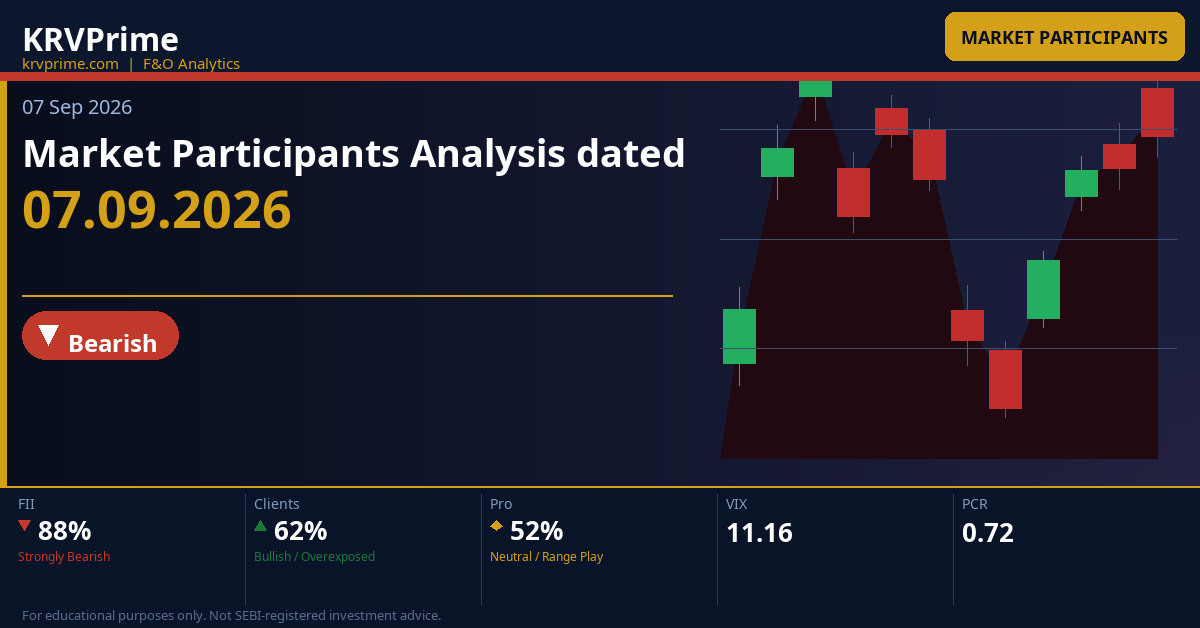
KRVPrime — Daily Market Outlook
Key Market Signals — Data: 07 Sep 2026
NIFTY 50 23,779.15 ▼ -118.55 (-0.50%) | BANK NIFTY 57,088.30 ▼ -281.35 (-0.49%) | SENSEX 76,132.81 ▼ -382.62 (-0.50%) |
OVERALL PCR 0.72 ▼ -0.21 (-22.58%) PCR at 0.72 — below 0.80 signals call OI dominance; put writers outnumbered by call writers, bearish tilt. | INDIA VIX 11.16 ▲ +0.48 (+4.49%) VIX spike of +4.49% on a down day signals hedging demand rising; fear creeping in at the margin. | TOTAL OI CHANGE 52,011,524 ▲ +4,111,506 (+8.58%) Massive OI addition on a declining market — classic short buildup or put writing into weakness. |
FUTURES OI 795,200 ▲ +26,984 (+3.51%) Futures OI expanding alongside price decline — fresh short positions being added, not covering. | CALL OI CHANGE 14,164,312 ▲ +3,473,646 (+32.49%) Explosive call OI surge of +32.49% — heavy call writing at resistance or speculative call buying as hedges. | PUT OI CHANGE 10,129,002 ▲ +150,044 (+1.50%) Put OI only mildly elevated (+1.50%) vs call OI surge — net bearish structure as call supply dominates. |
Participant-wise Key Points
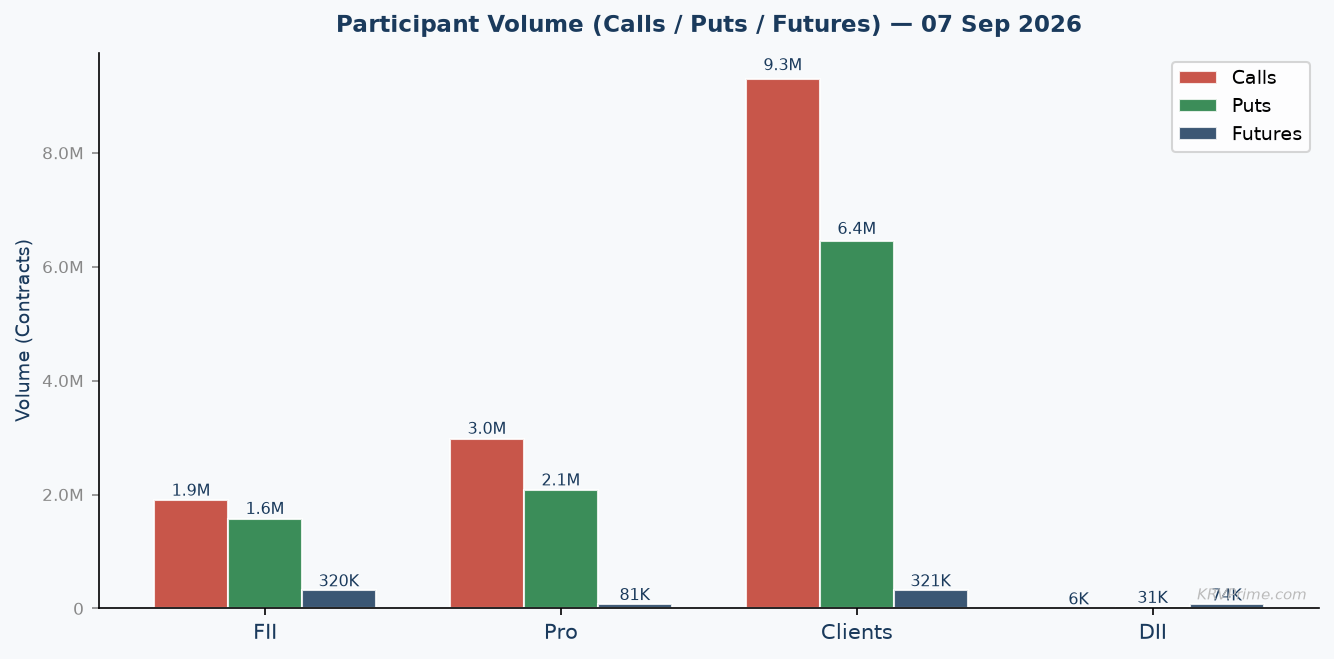
FII Strongly Bearish — Dual-Leg Short Conviction Deepening
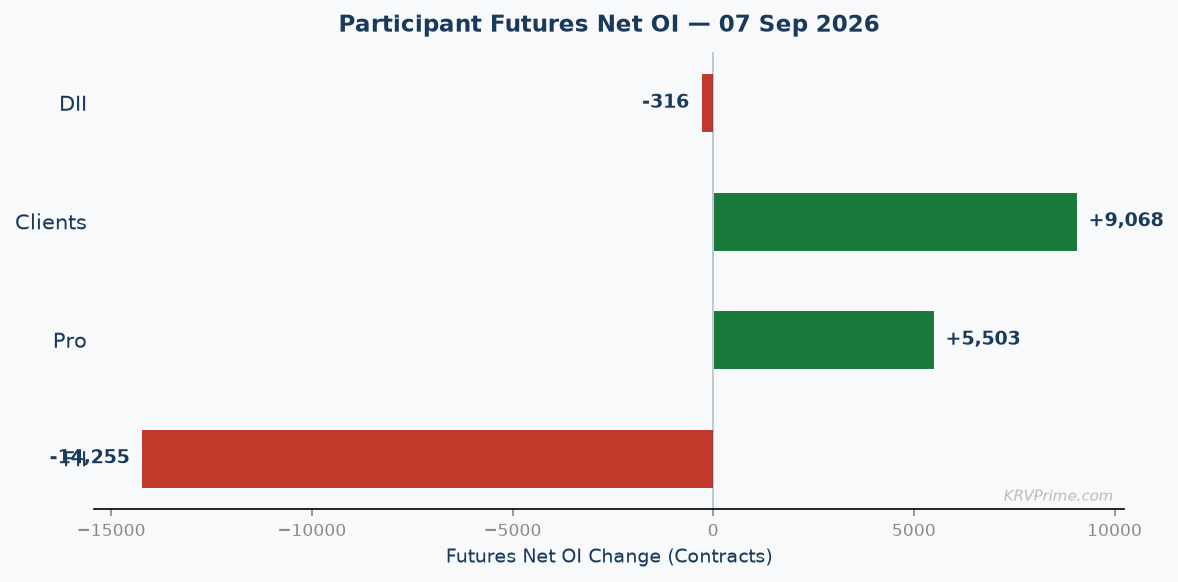
- Futures net deteriorated from -235,838 to -250,093 (net change -14,255 contracts), marking the deepest bearish futures position in recent sessions. The Long side added a modest 1,298 contracts (prev 33,689 → today 34,987, +3.85% [Long Buildup - Low Vol]) while the Short side added a far larger 15,553 contracts (prev 269,527 → today 285,080, +5.77% [Short Buildup - High Vol]). The Low Vol tag on the long addition tells us FIIs are not building a meaningful counter-position — this is token long coverage at best. The High Vol tag on the short buildup is the dominant signal: FIIs added shorts with deliberate, above-average conviction, pushing their gross short-to-long ratio to 8.15:1 (285,080 shorts vs 34,987 longs), which is an outright directional short position of extreme conviction, not a hedge. The sheer asymmetry of this gross ratio — more than 8 shorts for every 1 long — confirms FIIs view today's fall as the beginning of a continuation, not a dip to fade.
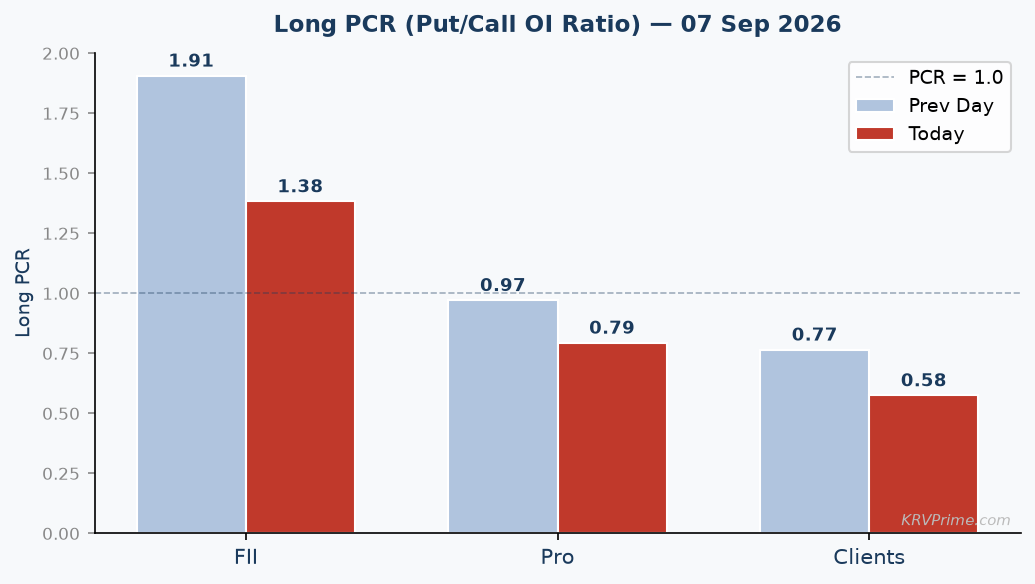
- Long PCR collapsed from 1.91 to 1.38 (prev → today, change -27.45%) and Short PCR fell from 0.57 to 0.43 (change -23.71%). A Long PCR of 1.38 means FIIs still hold 38% more put longs than call longs on the long-options side — this is a meaningful defensive hedge posture, but the sharp drop from 1.91 signals they have been net sellers of put longs or buyers of calls, subtly reducing their protective cover. The Short PCR of 0.43 means FIIs are writing nearly 2.3 calls for every put on their short-options book — this is an aggressive upside-cap strategy where they are selling calls to monetise the anticipated ceiling, consistent with their deep futures short. The decline in both PCR metrics simultaneously signals FIIs are not just short — they are actively restructuring their options book to shift from pure hedging toward a premium-collection strategy at higher strikes, which is a sophisticated bet that the market will stay suppressed or drift lower.
- Call OI net improved marginally from -303,454 to -298,102 (change +5,352): Long side surged +237,122 contracts (prev 561,316 → today 798,438, +42.24% [Long Buildup - Avg Vol]) while Short side added +231,770 contracts (prev 864,770 → today 1,096,540, +26.80% [Short Buildup - Avg Vol]). Put OI net expanded from +580,911 to +631,147 (change +50,236): Long side added +34,247 contracts (prev 1,070,255 → today 1,104,502, +3.20% [Long Buildup - Avg Vol]) while Short side reduced by -15,989 contracts (prev 489,344 → today 473,355, -3.27% [Short Covering - Avg Vol]). The architecture is clear: FIIs carry a net short call book of -298,102 and a net long put book of +631,147 — this is a classic synthetic short / protective collar structure maintained with Avg Vol conviction on both legs, confirming this is not a one-session reaction but a deliberate multi-session strategic position. The put short covering (unwinding written puts) is mildly supportive of downside protection maintenance, suggesting FIIs are keeping their put longs as the primary bearish instrument.
- Synthesis — FII Dual-Leg Bearish Architecture Deepening: FIIs today present the most internally consistent and conviction-heavy bearish structure among all participants. Every data point aligns: a futures net of -250,093 (the most negative on record in recent sessions), a gross short-to-long ratio of 8.15:1, a Long PCR of 1.38 (still defensive despite the drop from 1.91), a net short call book of -298,102, and a net long put book of +631,147. The combined strategy is a synthetic short collar — futures short plus net short calls (capping any rally) plus net long puts (monetising any decline). The High Vol tag on today's futures short addition confirms this is a deliberate escalation, not a passive roll. Compared to the previous session, FIIs have accelerated their bearish thesis rather than consolidating it — the -14,255 futures net deterioration and the +50,236 put long expansion both represent fresh capital deployed to the downside. The only mild internal contradiction is the falling Long PCR (from 1.91 to 1.38), which could signal modest call buying that partially offset put longs — but given the massive asymmetry in absolute contract counts, this is a rounding noise within an overwhelmingly bearish structure.
- Forward: The key trigger to watch is whether FII futures net breaks below -260,000 in tomorrow's data — a further deterioration beyond today's -250,093 would confirm FIIs are not merely holding but actively pressing their short thesis into the next session. If FII futures net instead improves toward -240,000 or better, it would signal short-covering and would be the first credible sign of a position flip that could catalyse a sharp short-covering rally. Also monitor FII Long PCR — a recovery above 1.60 would indicate renewed hedging demand, which paradoxically is bearish for the market as it would mean FIIs are buying puts again rather than reducing coverage.
DII Mildly Bearish — Reducing Options Exposure, Futures Marginally Net Long
- Futures net slipped from +11,369 to +11,053 (net change -316 contracts), remaining modestly net long but marginally deteriorating. The Long side added a negligible 48 contracts (prev 42,445 → today 42,493, +0.11% [Long Buildup - Low Vol]) while the Short side added 364 contracts (prev 31,076 → today 31,440, +1.17% [Short Buildup - Low Vol]). Both confirmation tags carry Low Vol, which is critical: neither the long addition nor the short buildup was executed with meaningful conviction — these are thin, almost statistical-noise moves around an existing position. The gross long-to-short ratio remains 1.35:1 (42,493 longs vs 31,440 shorts), which is a mild net long but far from a strong bullish directional stance. DIIs are effectively holding steady in futures, neither adding to their long book with conviction nor meaningfully shorting — this is a wait-and-see posture at a time when FIIs are aggressively pressing shorts.
- DII options PCR data is not available in the provided dataset — no Long PCR or Short PCR values are reported for this participant. Accordingly, sentiment on the options side is derived solely from the options OI direction and confirmation tags rather than PCR metrics. The absence of PCR data for DII is itself informative: DIIs are not a significant options book participant at the level that generates a meaningful PCR signal, and their primary market expression remains through the futures book.
- Call OI net moved from +3,895 to +3,650 (change -245): Long side shed -275 contracts (prev 5,176 → today 4,901, -5.31% [Long Unwinding - High Vol]) while Short side reduced by -30 contracts (prev 1,281 → today 1,251, -2.34% [Short Covering - High Vol]). Put OI net moved from +32,107 to +31,094 (change -1,013): Long side reduced by -1,013 contracts (prev 32,147 → today 31,134, -3.15% [Long Unwinding - High Vol]) while Short side remained completely flat at 40 contracts (chg 0, +0.00% [Short Flat - High Vol]). The High Vol tags on every single options leg are the most significant signal here: despite seemingly small contract changes, the High Vol classification means these reductions were deliberate and executed above-average volume — DIIs are actively trimming their options exposure on both calls and puts. The net result is a mild long unwind across the options book — shrinking both their long call position and their large long put position — which signals DII is reducing risk rather than increasing it. This is a de-risking architecture, not a new directional bet.
- Synthesis — DII Risk Reduction Under Uncertainty: DIIs today tell a story of disciplined risk reduction rather than directional conviction. Their futures net of +11,053 remains mildly long but is the smallest net gain in recent sessions and is essentially flat with Low Vol tags on both legs. More telling is the options book: the simultaneous High Vol unwinding of both call longs (-275 contracts) and put longs (-1,013 contracts) signals that DIIs are actively collapsing their options exposure — not rotating between calls and puts, but shrinking the entire book. This is the behaviour of an institution that is uncertain about near-term direction and prefers to reduce gamma exposure rather than take a fresh directional bet. Contrasted with FII's aggressive short escalation, DIIs are taking the opposite temperamental approach — they are not fighting the tape but they are also not joining the bears. The High Vol tags on the unwinds are the critical detail: these are not passive roll-offs but active portfolio decisions, suggesting DIIs have made a deliberate choice to reduce risk ahead of what they perceive as a volatile or uncertain period. Compared to the previous session, DIIs have moved from a slightly larger options long position to a meaningfully smaller one, confirming the de-risking trend is accelerating rather than pausing.
- Forward: The key signal to watch for DII in tomorrow's data is whether their futures net long position stays above +10,000 contracts. A sustained hold above +10,000 would confirm DIIs are maintaining their mild bullish bias in futures even as they de-risk options. If futures net drops below +9,000 — implying either short addition or long reduction with meaningful volume — it would signal DIIs are joining the bearish camp, which would be a meaningful confirmation of the downside thesis. Also watch whether DII call long unwind continues (below 4,500 contracts on the long call side) which would confirm continued de-risking rather than a stabilisation.
Pro Tactically Bullish Futures, Aggressively Range-Bound in Options — Sophisticated Strangle Writers
- Futures net improved dramatically from +14,627 to +20,130 (net change +5,503 contracts), the largest single-session futures net improvement among all participants today. The Long side added +4,051 contracts (prev 46,273 → today 50,324, +8.75% [Long Buildup - Avg Vol]) while the Short side reduced by -1,452 contracts (prev 31,646 → today 30,194, -4.59% [Short Covering - Low Vol]). The Avg Vol tag on long buildup confirms this is a routine but genuine directional addition — Pros are not making a headline-grabbing bet, but the +8.75% long increase is the largest single-side percentage move in their book today. The Short Covering at Low Vol is equally important: Pros are deliberately unwinding short futures positions even on a down day, which is contrarian to the FII positioning and signals Pros believe the market is approaching a near-term support zone. Their gross long-to-short ratio now stands at 1.67:1 (50,324 longs vs 30,194 shorts), the strongest net long reading in their futures book.
- Long PCR collapsed from 0.97 to 0.79 (change -18.27%) and Short PCR fell from 0.94 to 0.61 (change -35.52%). A Long PCR of 0.79 means Pro traders now hold 21% more call longs than put longs on the long-options side — a shift from a near-balanced 0.97 yesterday to a mildly call-heavy stance, suggesting Pros have been selectively adding call exposure or reducing put longs as the market falls. The Short PCR plunging from 0.94 to 0.61 is the dominant signal: Pros are now writing 1.64 calls for every put on the short side, meaning they are aggressively selling calls at current levels — this is an income strategy that monetises the sharp call OI expansion and the elevated premium environment created by the VIX spike. The -35.52% drop in Short PCR is the largest PCR change in the dataset today and signals Pros have dramatically repositioned their short-options book away from put-writing toward call-writing, which is a tactical bet that the market will be range-bound or that the call premium will decay as fears of a further rally subside.
- Call OI net flipped from +73,689 to -73,068 (change -146,757 contracts), a dramatic reversal: Long side added +339,165 contracts (prev 1,109,513 → today 1,448,678, +30.57% [Long Buildup - High Vol]) but Short side added a far larger +485,922 contracts (prev 1,035,824 → today 1,521,746, +46.91% [Short Buildup - High Vol]). Put OI net expanded from +103,240 to +227,067 (change +123,827): Long side added +72,419 contracts (prev 1,078,081 → today 1,150,500, +6.72% [Long Buildup - High Vol]) while Short side reduced by -51,408 contracts (prev 974,841 → today 923,433, -5.27% [Short Covering - High Vol]). All four options legs carry High Vol tags, confirming every move is deliberate and above average — this is an institutional-grade repositioning. The resulting architecture is net short calls (-73,068) and net long puts (+227,067): this is a bearish synthetic collar from the options side, but when combined with their futures net long of +20,130, the full structure reveals a sophisticated long futures + short calls + long puts = synthetic covered call with downside protection — a position that profits in a range or modest recovery but caps upside and protects against a sharp decline.
- Synthesis — Pro Sophisticated Range-Collar Architecture: Pros today are executing the most technically sophisticated multi-leg strategy in the market. In futures, they are net long +20,130 and adding with Avg Vol conviction, which is counter-trend to FII short addition. In options, they have simultaneously flipped their call book to net short -73,068 (selling calls aggressively at High Vol) while expanding their put long book to net +227,067 (buying puts at High Vol). The combined position — long futures, short calls, long puts — is a classic risk-reversal or synthetic covered call with tail protection: it profits maximally if the market stabilises or recovers modestly from current levels, generates premium income from the short calls (capitalising on the +4.49% VIX spike making calls expensive), and maintains downside insurance via the large put long book. The -35.52% collapse in Short PCR (from 0.94 to 0.61) confirms the sharp pivot toward call-writing dominance on the short side — Pros are essentially selling the fear premium into this decline. This is the behavior of sophisticated market-makers who believe the VIX spike is an overreaction and that current levels offer a premium-selling opportunity, but who are not reckless enough to take on unlimited downside risk without the put-long hedge. Compared to the previous session, Pros have dramatically escalated both sides of their options book with High Vol conviction, signalling this is a new strategic bet rather than a passive roll.
- Forward trigger: The critical watch for Pros tomorrow is whether their call short book expands further beyond 1,521,746 contracts — if it does, it confirms they are doubling down on the range-cap thesis and that the 24,000 CE resistance level is likely to hold as a ceiling. If instead call shorts are reduced (below 1,400,000) alongside a VIX pullback below 10.80, it would signal Pros are unwinding their premium-collection bet and potentially closing their range strategy, which would remove a key source of supply at resistance. Also critical: if their futures net long improves above +25,000, it would confirm Pros are taking a more directional bullish bet rather than a hedged range play.
Client Aggressively Long Futures, Structurally Bearish Options — Confused or Hedging
- Futures net improved from +209,842 to +218,910 (net change +9,068 contracts), the largest absolute futures net long position among all participants by a significant margin. The Long side added +8,095 contracts (prev 261,701 → today 269,796, +3.09% [Long Buildup - Avg Vol]) while the Short side reduced by -973 contracts (prev 51,859 → today 50,886, -1.88% [Short Covering - Avg Vol]). Both confirmation tags carry Avg Vol, indicating these are routine but genuine directional moves — retail and institutional clients are consistently adding to their futures long book even as the market falls -0.50%, a classic buy-the-dip behavioural pattern. Their gross long-to-short ratio stands at a commanding 5.30:1 (269,796 longs vs 50,886 shorts), which is unambiguously directional — Clients are the most aggressively net-long futures participant in the market, directly opposed to FII's 8.15:1 short-to-long ratio. This creates a direct FII vs Client confrontation in the futures market, with FIIs betting on further decline and Clients absorbing that selling.
- Long PCR fell from 0.77 to 0.58 (change -24.86%) and Short PCR fell from 1.02 to 0.82 (change -19.72%). A Long PCR of 0.58 means Clients now hold 72% more call longs than put longs on the long side — this is a decidedly bullish options posture, consistent with their aggressive futures long addition. The -24.86% drop in Long PCR signals that Clients have been adding call longs or reducing put longs significantly today, reinforcing their directional bullish bias. The Short PCR dropping from 1.02 to 0.82 is the more nuanced signal: Clients were previously writing slightly more puts than calls (PCR 1.02 > 1 = net put writers), but today at 0.82 they are now writing more calls than puts — a shift that is paradoxically bearish on the short side, suggesting Clients are selling calls against their long futures book as covered calls or short-term income trades. The tension between a long-biased futures book and a call-writing short-options book creates an internally complex picture for Clients — they are bullish on futures but capping their upside via call selling.
- Call OI net improved from +225,870 to +367,520 (change +141,650): Long side added +1,160,811 contracts (prev 3,669,328 → today 4,830,139, +31.64% [Long Buildup - High Vol]) and Short side added +1,019,161 contracts (prev 3,443,458 → today 4,462,619, +29.60% [Short Buildup - High Vol]). Put OI net deteriorated from -716,258 to -889,308 (change -173,050): Long side shed -30,631 contracts (prev 2,808,996 → today 2,778,365, -1.09% [Long Unwinding - High Vol]) while Short side added +142,419 contracts (prev 3,525,254 → today 3,667,673, +4.04% [Short Buildup - High Vol]). All four legs carry High Vol tags, confirming these are not passive or accidental positions. The resulting architecture — net long calls (+367,520) but net short puts (-889,308) — is a synthetic long / bull spread equivalent: Clients are long calls (directional upside bets) and short puts (income collection or forced-entry bets at lower strikes). However, the net short put book of -889,308 is enormous and represents significant downside risk if the market breaks below key put strikes — this is the classic retail over-confidence pattern of buying calls for upside while writing puts for premium income, creating an asymmetric risk profile.
- Synthesis — Client Bullish Overconfidence vs Structural Put Risk: Clients today present the starkest internal contradiction in the participant landscape. On the futures side, they are massively net long at +218,910 with a 5.30:1 long-to-short ratio, adding with Avg Vol conviction on a down day — classic buy-the-dip behavior. On the options side, they hold a net long call book of +367,520 (bullish) but a deeply net short put book of -889,308 (income collection that becomes catastrophic if the market falls sharply). The Long PCR of 0.58 confirms their call-long bias, but the Short PCR of 0.82 (writing more calls than puts on the short side) creates a call spread dynamic that caps their upside while the put short book amplifies their downside exposure. When compared to FII's position, the contrast is extreme: FIIs are short -250,093 futures and long +631,147 puts, while Clients are long +218,910 futures and short -889,308 puts — these two participants are on opposite sides of the most important trade in the market, and one of them will be proven decisively wrong. History and the High Vol confirmation on FII's positions suggest the informed money is with FIIs. The High Vol tags across all Client options legs confirm this is not an accident — Clients have made these bets with conviction today, and the magnitude of their put short book (+4.04% expansion to 3,667,673) is the most dangerous single number in today's dataset if the market breaks lower.
- Forward trigger: The critical level to watch for Client positioning is whether NIFTY sustains above the 23,500 PE support level (the weekly put max OI strike). If Nifty breaks and closes below 23,500, Clients' massive put short book of 3,667,673 contracts will begin to generate accelerating mark-to-market losses, likely forcing put short covering that paradoxically pushes put premiums higher and creates a gamma squeeze lower. Watch for Client futures net falling below +200,000 in tomorrow's data as an early warning that the buy-the-dip conviction is fading. Conversely, if Nifty holds above 23,500 and the market stabilises, Client's premium-collection strategy (short puts + short calls) will generate profit, temporarily validating their approach.
Bull vs Bear Strength by Participant
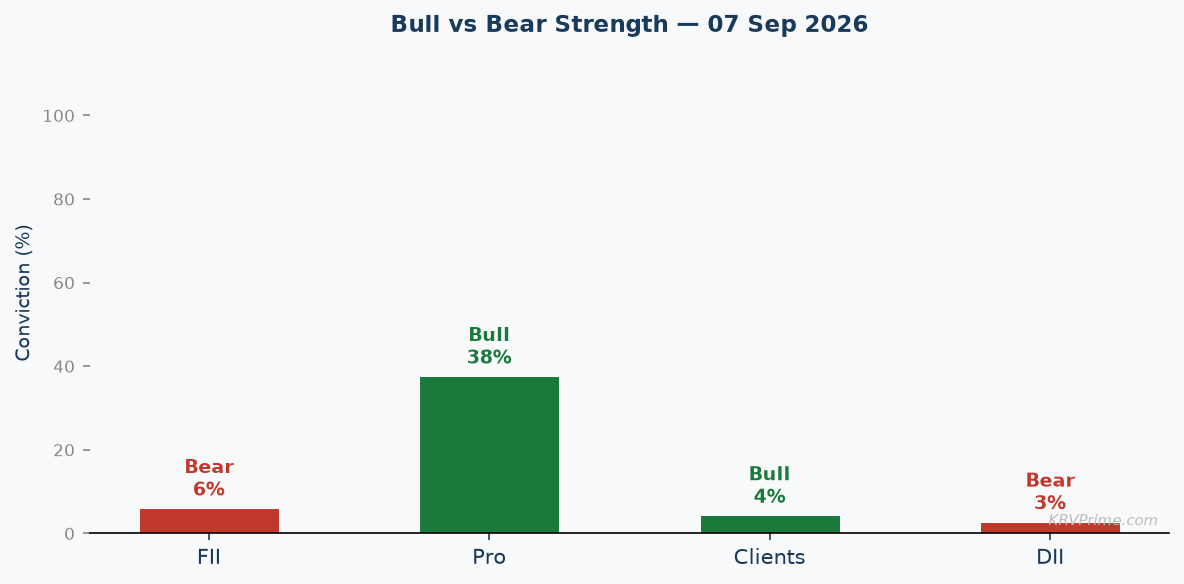
FII Strongly Bearish 88% ▼▼ | Clients Bullish / Overexposed 62% ▲ | Pro Neutral / Range Play 52% ▶ | DII Mildly Bearish / De-risking 58% ▼ |
Conclusion — Market Outlook for Tomorrow (08 Sep 2026)
The collective participant positioning for 07 Sep 2026 paints a structurally bearish picture dominated by FII conviction. FIIs have escalated their futures short book to -250,093 net contracts (gross short-to-long ratio of 8.15:1) and simultaneously hold a net long put book of +631,147 and a net short call book of -298,102 — a three-legged bearish architecture executed with High Vol conviction on the most critical leg (futures shorts). DIIs are effectively sidelined, with a marginal futures net long of +11,053 and High Vol unwinds across their entire options book, signalling de-risking rather than directional commitment. Pro traders have taken the most sophisticated counter-position: long futures at +20,130 while aggressively selling calls and buying puts, creating a covered-call-with-protection structure that profits only in a narrow range or modest recovery — not a strong bull signal. Clients, with a +218,910 futures net long and a dangerously large put short book of 3,667,673 contracts, represent the most exposed participant if the market breaks lower, and their buy-the-dip conviction is historically a contrarian bearish signal when FIIs are simultaneously pressing shorts at record levels.
The overall PCR at 0.72 — a collapse from 0.93 (change -23.39%) — is one of the most bearish single-session PCR moves in recent data, driven by the explosive +32.49% surge in call OI (to 14,164,312) against a comparatively muted +1.50% put OI increase. A PCR below 0.80 signals that call supply is vastly outpacing put demand, which in a declining market context means participants are writing calls at resistance levels (capping upside) rather than buying puts for protection — a bearish confirmation. India VIX spiking +4.49% to 11.16 on a day when Nifty fell only -0.50% is a disproportionate fear response that suggests the options market is pricing in the possibility of a sharper move to come, even if today's actual price action was contained. Total OI surging +8.58% to 52,011,524 on a negative price day is textbook short-side OI buildup — new money is entering on the short side, not unwinding from the long side.
The bullish thesis requires FII futures net to improve meaningfully toward -230,000 or better (short-covering) AND the overall PCR to recover above 0.85 (put demand re-emerging as a floor signal) AND VIX to pull back below 10.50 (fear dissipating). Until at least two of these three conditions are met simultaneously, any intraday recovery should be treated as a relief rally within a bearish trend structure rather than a directional reversal. The 23,500 PE support (weekly) and 23,000 PE support (monthly) from the OI data are the key downside levels where put writers will defend most aggressively — a break below 23,500 with FII shorts expanding further would be the clearest confirmation of a trend acceleration lower.
Scenario 1 — Bull case:
If FII futures net improves from -250,093 toward -230,000 (implying ~20,000 contracts of short-covering) AND the overall PCR recovers above 0.85 (put demand re-emerging relative to call supply) AND India VIX pulls back below 10.50 (options fear premium deflating), then the bearish thesis loses its primary pillar. In this scenario, Client futures longs (+218,910) and Pro futures longs (+20,130) become the price-driving force, and a short-covering rally could target the 24,000 CE resistance level (NIFTY weekly) where the largest call OI concentration sits. The bull case requires a genuine FII capitulation — not just a pause in short addition, but an actual reduction of their gross short book below 265,000 contracts.
Scenario 2 — Bear case:
If FII futures net deteriorates further below -260,000 (fresh short addition with High Vol) AND the overall PCR falls below 0.65 (call OI continues to dominate as put demand collapses) AND VIX rises above 12.50 (fear escalation), then Client put shorts (3,667,673 contracts) will come under severe gamma pressure below the 23,500 PE support, triggering forced covering that accelerates the decline. In this scenario, the absence of DII conviction (de-risking their options book) removes the typical institutional buy-side support, and NIFTY targets the 23,000 monthly PE support where the next significant put open interest concentration provides a floor. The bear case is validated if total OI continues to expand above 55,000,000 with price declining — confirming this is a short-building trend rather than a temporary volatility spike.
Key Resistance (NIFTY) 24,000 (CE weekly max OI) — FIIs are net short 1,096,540 call contracts and Pros have aggressively added call shorts to 1,521,746 with High Vol conviction; this strike is the primary supply zone where institutional call writers are capping upside. BANKNIFTY resistance at 57,500 (CE monthly max OI) where similar call-writing dynamics apply. | Key Support (NIFTY) 23,500 (PE weekly max OI) — FIIs hold 1,104,502 put long contracts concentrated near this level, and Pros have expanded their put long book to 1,150,500 with High Vol conviction; this is the institutional demand zone where put longs will be defended. Secondary monthly support at 23,000 (PE monthly max OI). BANKNIFTY support at 57,000 (PE monthly max OI). | Trigger to Watch Overall PCR crossing back above 0.80 (from today's 0.72) combined with FII futures net improving above -240,000 — if both occur simultaneously in tomorrow's data, it would signal the bearish structure is losing momentum and a short-covering bounce is underway. Failure to recover PCR above 0.80 and continued FII short expansion below -255,000 confirms the bearish trend is accelerating toward the 23,500 PE support test. |