
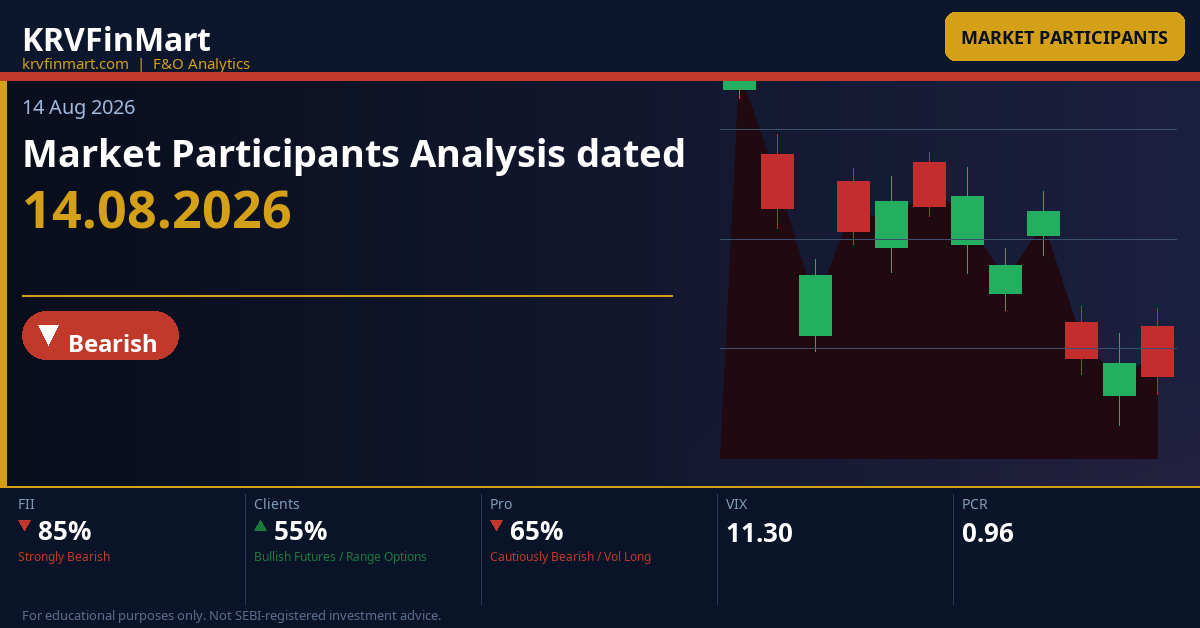
Market Participants Analysis dated 14.08.2026
KRVFinMart — Daily Market Outlook
Key Market Signals — Data: 14 Aug 2026
NIFTY 50 24,366.00 ▼ -29.85 (-0.12%) | BANK NIFTY 57,491.10 ▼ -144.15 (-0.25%) | SENSEX 78,009.25 ▼ -70.71 (-0.09%) |
OVERALL PCR 0.96 ▲ +0.04 (+4.83%) PCR rising toward 1.0 signals put-side accumulation; market moving from slightly call-heavy to near-neutral — marginally improving sentiment. | INDIA VIX 11.30 ▼ -0.12 (-0.99%) VIX at 11.30 — deeply low complacency zone; declining VIX confirms option sellers are confident; risk of a sharp spike remains latent. | TOTAL OI CHANGE 49,036,548 ▲ +1,775,502 (+3.76%) Broad OI expansion of +3.76% on a down day suggests fresh position building on both sides — not a clear directional signal alone. |
FUTURES OI 648,570 ▲ +7,492 (+1.17%) Futures OI edging up +1.17% — modest fresh futures interest; Clients and FII adding net divergent positions signals a tug-of-war. | CALL OI CHANGE 9,746,421 ▲ +527,624 (+5.72%) Call OI expanding +5.72% indicates aggressive call writing and/or call buying — supply building at higher strikes caps near-term upside. | PUT OI CHANGE 9,400,693 ▲ +918,111 (+10.82%) Put OI surging +10.82% — fastest-growing leg today; driven by Pro and Client put accumulation; signals aggressive downside hedging or bearish bets. |
Participant-wise Key Points


FII Strongly Bearish — Dual-Leg Short Buildup with Put Hedge Expansion
- Futures net deteriorated from -168,702 to -176,698 (net change -7,996 contracts). On the long side, FIIs unwound -1,950 contracts from 27,487 to 25,537 tagged [Long Unwinding - Low Vol] — the Low Vol label signals this was a hesitant, thin-volume retreat rather than a decisive exit from longs. On the short side, FIIs added +6,046 contracts from 196,189 to 202,235, tagged [Short Buildup - High Vol] — and the High Vol tag here is the key signal: this was a deliberate, high-conviction addition to their dominant short book. The resulting gross short-to-long ratio stands at 202,235 ÷ 25,537 = 7.92:1, meaning for every single long contract, FIIs hold nearly eight shorts — this is an unambiguous outright directional short position, not a hedge. With Nifty closing at 24,366 (down only -0.12%), the fact that FIIs chose to aggressively pile on 6,046 new short contracts on what was a relatively quiet down day demonstrates they are not waiting for a catalyst — they are positioning ahead of one.
- Long PCR declined from 1.88 to 1.81 (change -3.28%) and Short PCR rose from 0.55 to 0.59 (change +6.78%). The Long PCR of 1.81 means FIIs hold 81% more put longs than call longs in their long options book — this is a deeply defensive, bearish-leaning hedge posture maintained even as the ratio is slightly compressing; the decline from 1.88 to 1.81 suggests they added some call longs today (confirmed by the +60,106 call long buildup in options data) likely for tactical hedging or gamma capture. The Short PCR rising from 0.55 to 0.59 means FIIs are now writing modestly more puts relative to calls on the short side, but still writing far more calls (814,000 short calls) than puts (477,877 short puts) — a Short PCR below 1 consistently signals FIIs are using call-writing as a primary strategy to cap upside and generate carry income. The dominant signal today is the high-conviction futures short buildup at 7.92:1 gross ratio overriding the marginal Long PCR compression — the options book is a hedge layered on top of a structural short thesis, not a contradiction to it.
- Call OI net stands at -276,645 (Long 537,355 [Long Buildup - Avg Vol] vs Short 814,000 [Short Buildup - Avg Vol]). Both legs added with Avg Vol tags — routine, steady accumulation rather than panic or urgent repositioning. Put OI net stands at +497,176 (Long 975,053 [Long Buildup - Avg Vol] vs Short 477,877 [Short Buildup - Avg Vol]). FIIs added +79,748 put longs and +56,688 put shorts simultaneously — the net put long position expanded by +23,060 contracts to +497,176. The combined architecture of net short calls (-276,645) and net long puts (+497,176) is a textbook synthetic short / protective collar structure — net short calls cap upside payoff for a premium income, while net long puts provide direct downside payoff should Nifty break lower. This architecture powerfully confirms the futures short book: FIIs are building a three-legged bearish position (short futures + short calls + long puts) that generates maximum profit in a declining or stagnant market.
- Synthesis — FII Dual-Leg Conviction Bear Architecture: FIIs present the most internally consistent and high-conviction bearish setup among all participants today. Their futures net deepened to -176,698 (from -168,702) with the short side tagged High Vol, their gross short-to-long ratio expanded to 7.92:1, their Long PCR remains elevated at 1.81 despite a minor compression, their net call OI is -276,645 (net short), and their net put OI is +497,176 (net long) — every single data point aligns directionally. The strategy is a classic synthetic short collar with futures overlay: short futures provide direct delta exposure to the downside, short calls generate premium income while capping Nifty's upside participation, and long puts provide leveraged payoff if a sharper fall materialises. There is no meaningful internal contradiction in FII's book today — even the addition of 60,106 call longs is consistent with delta management of a large short book, likely buying OTM calls as tail-risk hedges against a short-squeeze scenario. Compared to the prior session where net was -168,702, FIIs have accelerated their bearish positioning by nearly 5% in one session, which — combined with High Vol confirmation on the short futures leg — signals a thesis in active execution rather than passive carry. In the context of Nifty at 24,366 and VIX at a complacent 11.30, FIIs appear to be betting that the low-volatility environment will not last and that the index will struggle above 25,000 (the CE maximum OI resistance strike).
- Forward trigger: The critical watch level for FII thesis validation is the futures net crossing beyond -185,000 contracts on the next session — if FIIs add another 8,000+ short contracts, it confirms full acceleration of the bearish campaign and would be a strong signal to avoid fresh longs. Conversely, if Nifty gaps up sharply and FII futures net improves toward -165,000 (i.e., short-covering of 10,000+ contracts), that would signal a short-squeeze in motion and FIIs capitulating — a potential momentum trigger for bulls. Also watch the Short PCR: if it drops back below 0.55, FIIs are adding call shorts again (bearish cap building), while a rise above 0.65 would indicate they are shifting to put-writing (bullish pivot signal).
DII Cautiously Bullish — Steady Long Futures, Minimal Options Activity
- Futures net improved marginally from +30,049 to +30,790 (net change +741 contracts). On the long side, DIIs added +741 contracts from 50,089 to 50,830, tagged [Long Buildup - High Vol] — and the High Vol confirmation is significant here: despite adding only 741 contracts in absolute terms, these were executed at above-average volume, implying deliberate and considered buying rather than passive drift. On the short side, DII short contracts remained completely unchanged at 20,040 with a [Short Flat - Low Vol] tag — zero movement on shorts in a Low Vol environment means there is absolutely no appetite to add downside protection or to bet against the market from this participant. The gross long-to-short ratio is 50,830 ÷ 20,040 = 2.54:1, a comfortable structural long bias that DIIs have maintained steadily. This steady, High Vol long buildup on a down day (-0.12%) is characteristic of DII behaviour — they are systematic buyers on dips, likely driven by domestic institutional inflows deployed into index futures as a quick-exposure mechanism.
- DII does not have a reported Long PCR or Short PCR in today's data for options, as their options book is negligible in scale. Their Index Call Options book shows Long at 7,380 and Short at 130, and their Index Put Options shows Long at 50,603 and Short at 0 — the sheer dominance of put longs (50,603) versus call activity confirms a clear protective hedging stance on their equity book rather than speculative options trading. The absence of reported PCR ratios for DIIs is consistent with the fact that their options activity is not a strategic directional play but a mechanical hedge — buying puts to protect a large equity long book is standard DII risk management. The near-zero call activity (Long 7,380, Short 130) further confirms DIIs are not attempting to generate premium income or cap upside — they are simply long the market with limited downside insurance in place.
- Call OI net stands at +7,250 (Long 7,380 [Long Unwinding - Low Vol] vs Short 130 [Short Buildup - High Vol]). The DII call book is minuscule — a -20 contract decline in call longs tagged Low Vol is essentially noise, while a +20 contract rise in call shorts tagged High Vol is proportionally meaningful (a +18.18% increase) but still tiny in absolute terms. Put OI net stands at +50,603 (Long 50,603 [Long Unwinding - Low Vol] vs Short 0 [Short Flat - Low Vol]). The put long book shrank by a modest -148 contracts — tagged [Long Unwinding - Low Vol] — suggesting DIIs are very gently rolling off put hedges that may have expired or been closed at a profit in the current low-VIX environment. The dominant architecture remains a long futures + long puts protective structure — essentially a synthetic call or collar, consistent with large domestic institutional equity portfolio management. This architecture does not contradict the futures long position; it reinforces it by showing DIIs are comfortable being long but are managing tail risk prudently.
- Synthesis — DII Steady Structural Long with Passive Hedge Decay: DIIs continue to represent the most stable and least volatile participant block in today's data. Their futures net advanced modestly to +30,790, the long addition was confirmed High Vol (deliberate), shorts are frozen at 20,040 (zero change, Low Vol), and the options book remains a straightforward protective put overlay on their equity long exposure. The strategy is best described as a systematic long equity with passive put hedge — the put book of 50,603 contracts has been slightly reduced (-148 contracts, Low Vol), which is consistent with DIIs allowing expiring hedges to lapse in a low-VIX environment rather than aggressively rolling them. There is no internal contradiction — DIIs are unambiguously long and have been adding to that long on a down day with High Vol conviction. Compared to FIIs (who are aggressively short at 7.92:1 short-to-long), DIIs represent the structural counterweight: they are the patient, systematic domestic buyers that have historically absorbed FII selling. The key observation is that DII options activity (particularly the put long book of 50,603) at the 24,000 PE support zone provides a natural floor for the market — if Nifty approaches 24,000, DII put longs will generate profits that could be rolled lower or monetised, providing both a demand cushion and a potential selling point.
- Forward trigger: Watch whether DII futures net crosses +32,000 contracts in the next session — a push above that level would indicate accelerating domestic institutional buying, likely in response to FII selling pressure creating value opportunities. If DII longs remain flat or decline below +29,000, it would signal domestic institutions are pausing their buying programme, removing the key counterbalance to FII shorts and increasing downside risk for Nifty. The secondary watch is the DII put long book — if it contracts below 48,000 contracts, it means DIIs are reducing downside hedges and growing more confident, which is a subtle bullish signal; if it expands above 55,000, they are growing more defensive.
Pro Cautiously Bearish — Aggressive Put Long Buildup with Modest Call Net Long
- Futures net improved marginally from -10,733 to -9,774 (net change +959 contracts). The improvement came from both sides simultaneously — Long contracts declined modestly from 36,385 to 36,280 (-105 contracts, tagged [Long Unwinding - Avg Vol]) while Short contracts fell from 47,118 to 46,054 (-1,064 contracts, tagged [Short Covering - Avg Vol]). Critically, the short side saw a larger reduction than the long side (-1,064 vs -105), which is why the net moved from -10,733 to -9,774 — both legs are being trimmed but shorts are being trimmed faster, which is a mild net-positive signal. The gross short-to-long ratio at 46,054 ÷ 36,280 = 1.27:1 reflects a relatively balanced book with a slight short lean — not a conviction short like FIIs, but not a clear directional long either. The Avg Vol tags on both legs suggest this is routine position management rather than a strong directional conviction trade; Pro desks appear to be cleaning up the futures book while concentrating their real directional bets in options.
- Long PCR rose from 0.81 to 0.91 (change +12.28%) and Short PCR rose from 0.93 to 0.98 (change +5.48%). The Long PCR moving from 0.81 to 0.91 — a +12.28% surge in a single session — is the most significant PCR change in today's data for Pro desks: it means they are now holding 91% as many put longs as call longs, a dramatic shift toward the downside from the prior session's 81%. This acceleration in the Long PCR is being driven by the massive +175,253 put long addition (discussed in bullet 3) and signals that Pro desks are aggressively repositioning toward a bearish or protective stance. The Short PCR rising from 0.93 to 0.98 means they are also writing more puts relative to calls on the short side — a Short PCR approaching 1.0 signals near-parity in put and call writing, consistent with a strangle-like income strategy that profits from range-bound or mildly declining conditions. The dominant signal is the Long PCR surge to 0.91 — Pro desks are taking out large directional put bets while simultaneously managing a balanced short-options book.
- Call OI net stands at +136,817 (Long 1,122,941 [Long Buildup - Low Vol] vs Short 986,124 [Short Buildup - Low Vol]). Both legs expanded with Low Vol tags — the call long book added +77,648 and the call short book added +28,011, with the net moving from +87,180 to +136,817 (+49,637 improvement). Put OI net stands at +59,914 (Long 1,024,818 [Long Buildup - Low Vol] vs Short 964,904 [Short Buildup - Low Vol]). This is a remarkable shift: the prior session's put net was -39,305 (net short puts) and today it swung to +59,914 (net long puts) — a +99,219 net contract swing driven by Pro desks aggressively adding +175,253 put longs (the single largest absolute put long addition across all participants today) against a smaller +76,034 put short addition. The Low Vol tags on all four options legs are notable — despite the massive absolute size of these additions, they were executed at below-average volume, suggesting these are structured, algorithmic, or off-market block trades rather than urgent market-order buying. The combined architecture has shifted from a net short put / long call (slightly bullish) structure to a net long call + net long put (long straddle/strangle) structure — Pro desks appear to be positioning for a volatility expansion event in either direction.
- Synthesis — Pro Volatility Long with Bearish Lean: Pro desks have executed the most dramatic intra-session repositioning of any participant today. Starting from a mildly net-short-puts position (-39,305) they have swung to net long puts (+59,914) via a +175,253 put long addition — the largest single-participant put long buildup of the session. Combined with a net long call book (+136,817), Pro desks are now running what appears to be a long strangle or long straddle — buying both downside (puts) and upside (calls) to profit from a volatility expansion. However, the bearish lean is visible: the Long PCR surge to 0.91 (puts almost matching calls) and the dominance of put long additions (+175,253) over call long additions (+77,648) suggests the directional bias within the volatility bet is tilted downward. The Low Vol confirmation across all options legs tells us these positions were likely built methodically through the day rather than in reactive panic — this is pre-positioning ahead of an anticipated event. Their futures book net improved marginally to -9,774 via short-covering, suggesting futures are not the primary vehicle — the real directional bet is in options. Contrasting with FIIs (pure synthetic short) and DIIs (structural long), Pro desks occupy a more sophisticated middle ground: they appear to be saying markets will move sharply, probably lower, and we want to own that move through options rather than through futures.
- Forward trigger: The key watch for Pro desks is whether their Put OI net long position further expands beyond +80,000 contracts in tomorrow's session — if it does, it will confirm they are fully committed to a downside volatility bet and signals the market is likely pricing in a specific event risk. If instead the put long position retreats toward +30,000 (partial profit-taking), it suggests the Pro bet was a one-day hedge that is being unwound. Separately, watch the Pro Long PCR: if it crosses 1.0 (more put longs than call longs), it flips from a straddle posture to an outright bearish options stance — that would be the strongest Pro signal of the cycle. Key Nifty OI level to monitor: 24,000 PE support — if Nifty cracks that, Pro put longs will generate significant delta exposure and accelerate the move.
Client Bullish in Futures, Structurally Hedged — Net Short via Options
- Futures net improved from +149,386 to +155,682 (net change +6,296 contracts). On the long side, Clients added +5,060 contracts from 206,578 to 211,638, tagged [Long Buildup - Avg Vol] — Avg Vol signals this is ordinary retail/HNI buying rather than a concentrated institutional move. On the short side, Clients covered -1,236 short contracts from 57,192 to 55,956, tagged [Short Covering - Avg Vol] — this simultaneous long addition and short covering is a dual bullish signal in futures, pushing the net from +149,386 to +155,682. The gross long-to-short ratio stands at 211,638 ÷ 55,956 = 3.78:1 — Clients are firmly long-biased in futures with nearly four longs for every short. This is the mirror image of FII behaviour (7.92:1 short-to-long) and represents the classic retail-vs-institutional divergence: Clients are buying the dip in futures, FIIs are shorting into strength — historically, in trending bear markets, FIIs tend to be correct; in range-bound markets, Client long accumulation drives the bounce.
- Long PCR rose from 0.79 to 0.83 (change +4.09%) and Short PCR rose from 1.02 to 1.06 (change +4.34%). The Long PCR of 0.83 means Clients hold 83% as many put longs as call longs — a near-parity posture suggesting retail/HNI investors are hedging their call longs with an almost equal number of put longs, consistent with a cautious bullish stance. The Short PCR rising from 1.02 to 1.06 is structurally important — a Short PCR above 1.0 means Clients are writing more puts than calls on the short side, which is a classically bearish-on-downside bet: writing puts signals they believe the market will not fall below key strikes (a bullish-on-range view) but could also reflect premium income generation. The divergence between the futures long bias (+155,682 net) and the options short put book is a classic Client contradiction — they are long in futures but also short puts (which profits only if market stays above the put strike). This could be a covered-write-style strategy or simply a bifurcated retail book where different participants are on opposite sides.
- Call OI net stands at +132,579 (Long 3,205,535 [Long Buildup - Avg Vol] vs Short 3,072,956 [Short Buildup - Avg Vol]). Both legs are the largest absolute call books of any participant — Clients dominate call OI on both sides. Long calls added +126,078 while short calls added +187,871, so the net declined from +194,372 to +132,579 (net change -61,793) — Clients added more call shorts than call longs today, which is a bearish signal within their call book (selling calls reduces upside payoff). Put OI net stands at -607,692 (Long 2,649,873 [Long Buildup - Avg Vol] vs Short 3,257,565 [Short Buildup - Avg Vol]). The put short book (3,257,565) is significantly larger than the put long book (2,649,873), and Clients added a massive +326,333 put shorts against only +204,203 put longs today — the net deteriorated from -485,562 to -607,692 (net change -122,130). The combined architecture of net short calls (-61,793 net direction today) + net short puts (-607,692) creates a short strangle on the options side — Clients are collecting premium on both call and put sides, betting the market stays range-bound between 24,000 and 25,000. This directly contradicts their futures long position, making Clients the most internally contradicted participant today.
- Synthesis — Client Bifurcated Book: Futures Long vs Options Short Strangle: Clients present the most internally contradicted positioning of any participant today. On the futures side, they are strongly bullish (+155,682 net, 3.78:1 long-to-short, both Avg Vol confirming steady accumulation). On the options side, they have built a short strangle — net short puts (-607,692) and a declining net on calls — which profits from a range-bound market between 24,000 PE support and 25,000 CE resistance. This bifurcation is likely not a single entity's strategy but rather the aggregate of different Client sub-groups: retail traders buying futures on the dip (expecting a bounce), while a different set of HNI/traders are writing puts and calls to harvest premium in the current low-VIX (11.30) environment. The massive put short addition of +326,333 contracts is the largest single-leg addition of any participant in any instrument today — it dominates the narrative and signals a large cohort of Clients are comfortable being short puts at current levels, implying they believe 24,000 will hold as support. However, if the market breaks 24,000, this massive put short book (3,257,565) becomes a liability — forced delta-hedging by put sellers would require buying futures, creating a technical floor but also a selling overhang from stop-losses. Compared to FIIs (pure structural short), DIIs (pure structural long), and Pros (volatility long), Clients are the market-makers of the range: they are the primary premium sellers, which is why PCR and VIX will be the critical daily gauges of their stress level.
- Forward trigger: The critical level for the Client put short book is 24,000 (PE maximum OI support) — if Nifty closes below 24,000, the 3,257,565 short put contracts face accelerating losses and forced hedging, creating a delta-driven liquidation cascade. Watch whether the Client put net deteriorates beyond -700,000 in the next session — if it does, it signals continued aggressive put writing and means Clients are doubling down on the range bet (a contrarian bullish signal for support holding). Conversely, if the Client put net improves toward -550,000 (partial short covering), it signals the put writers are getting nervous and the 24,000 floor may be tested. The Overall PCR at 0.96 edging toward 1.0 is the secondary gauge — if PCR crosses 1.0, put longs are outnumbering call longs market-wide, and Client put shorts will face increasing mark-to-market pressure.
Bull vs Bear Strength by Participant

FII Strongly Bearish 85% ▼▼ | Clients Bullish Futures / Range Options 55% ▲ | Pro Cautiously Bearish / Vol Long 65% ▼ | DII Steadily Bullish 70% ▲ |
Conclusion — Market Outlook for Tomorrow (15 Aug 2026)

The collective participant positioning on 14 Aug 2026 presents a market in structural tension. FIIs have deepened their futures short to -176,698 (gross short-to-long ratio 7.92:1, High Vol confirmed) while building a net short call (-276,645) and net long put (+497,176) architecture — a fully integrated three-legged bearish position that leaves no ambiguity about their directional thesis. Pro desks have executed the most dramatic pivot of the session, swinging from net short puts (-39,305) to net long puts (+59,914) via a +175,253 put long addition, and raising their Long PCR to 0.91 — aligning with FIIs on the downside options bet while adding a long strangle overlay for volatility. Against this bearish pressure, DIIs provide a steady structural counterweight at +30,790 net long with High Vol confirmation on the long addition, while Clients are aggressively long futures (+155,682 net) but simultaneously running a massive short strangle in options with 3,257,565 short puts — a range-bound premium income strategy that is exposed if 24,000 breaks. The net reading across all four participants is a market where informed money (FII + Pro) is positioning for a downside move while structural buyers (DII) and retail (Client futures longs) provide temporary support.
The Overall PCR rose from 0.92 to 0.96 (+4.83%), driven predominantly by the massive +10.82% surge in Put OI (+918,111 contracts added in a single session) against a more modest +5.72% Call OI expansion. A PCR approaching 1.0 from below historically signals that the market is shifting from call-heavy (bearish sentiment premium) to more balanced or put-heavy territory — marginally improving the technical picture for sentiment, but also indicating that professional players are buying downside protection at scale. India VIX at 11.30 (down -0.99%) remains in a deep complacency zone — this is a double-edged signal: low VIX makes option buying cheap (which is why Pro desks are building a volatility long position), but it also means any external shock could cause a sharp VIX spike that would simultaneously punish Client put writers and trigger FII put long monetisation. The OI Support at 24,000 (PE max OI) and OI Resistance at 25,000 (CE max OI) define the current battlefield — FIIs are writing calls at 25,000, Clients are writing puts at 24,000, and the market is currently sitting at 24,366, closer to the put-support floor than the call-resistance ceiling.
The bullish thesis reverses only if FII futures net improves toward -165,000 (net short-covering of 10,000+ contracts) accompanied by a PCR rise above 1.05 and VIX staying below 11.00 — a combination that would signal FII capitulation on shorts and a potential squeeze toward 25,000. The bearish thesis accelerates if Nifty OI data shows the 24,000 PE support being breached with sustained price action below that level — at that point, Client short put holders (3,257,565 contracts) face forced delta-hedging that would amplify downside momentum. The neutral outcome — most likely given the current configuration — is continued range-bound action between 24,000 and 25,000 as Client strangle sellers defend both sides, with day-to-day direction determined by whether FII short-covering or fresh selling is the dominant intraday flow.
Scenario 1 — Bull case:
FII futures net improves from -176,698 toward -165,000 (short-covering of 10,000+ contracts), Overall PCR rises above 1.05 signalling aggressive put accumulation outpacing call supply, and VIX drops below 11.00 confirming further complacency — these three combined would indicate FII shorts are being squeezed and DII/Client longs are gaining the upper hand. In this scenario, Client futures longs (211,638) become the driving force and Nifty could test the 25,000 CE resistance zone where FII and DII call writing creates a natural ceiling.
Scenario 2 — Bear case:
FII futures net deteriorates beyond -185,000 (adding another 8,000+ short contracts, High Vol confirmed), Pro put net long expands above +80,000, and VIX spikes above 13.00 — this combination signals informed money doubling down on the downside thesis and options market beginning to price in event risk. Client short puts (3,257,565) begin delta-hedging by selling futures, amplifying the move lower. PCR would likely decline toward 0.88 as call OI grows faster than put OI, and Nifty could test the 24,000 PE OI support — a break of which removes the primary client-written put floor and accelerates the move toward 23,500.
Key Resistance 25,000 (Nifty CE max OI) — FIIs hold 814,000 short call contracts near this strike, creating an institutional supply ceiling. Pro desks also have 986,124 short calls in their book. This is a double-layered resistance where two of the most sophisticated participant classes are writing calls, capping any rally attempt. | Key Support 24,000 (Nifty PE max OI) — Clients hold 2,649,873 put long contracts and have written 3,257,565 short puts near this strike, creating a self-reinforcing floor: put longs provide delta-hedging demand if Nifty falls here, while put writers are incentivised to defend this level. DII's 50,603 put longs add a secondary institutional bid. FII's 975,053 put longs will generate significant P&L acceleration below this level. | Trigger to Watch Overall PCR crossing above 1.00 in the next session — this would mean put OI has overtaken call OI market-wide, signalling a decisive shift in options sentiment from bearish (call-heavy) to bullish (put-heavy). Combined with FII futures net improving by 10,000+ contracts, a PCR above 1.00 would confirm the bullish scenario. Conversely, VIX rising above 13.00 while PCR falls below 0.90 would confirm the bearish acceleration scenario and signal Client put shorts are under maximum stress. |