
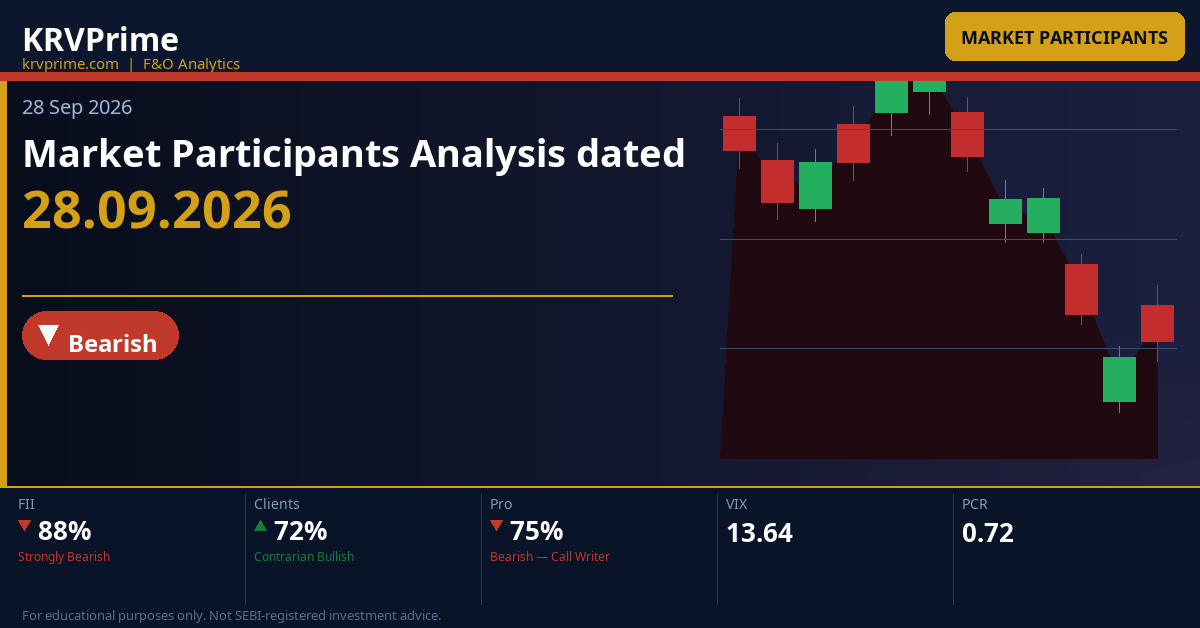
Market Participants Analysis dated 28.09.2026
KRVPrime — Daily Market Outlook
Key Market Signals — Data: 28 Sep 2026
NIFTY 50 22,780.25 ▼ -360.25 (-1.56%) | BANK NIFTY 54,471.65 ▼ -1108.75 (-1.99%) | SENSEX 72,771.72 ▼ -1124.02 (-1.52%) |
OVERALL PCR 0.72 ▼ -0.22 (-23.84%) PCR collapsed to 0.72 — deep bearish territory; put writers retreating, call supply surging | INDIA VIX 13.64 ▲ +1.48 (+12.15%) VIX spike of 12.15% on a down day signals fear re-entry; elevated uncertainty ahead | TOTAL OI CHANGE 58,117,928 ▲ +3,050,822 (+5.54%) OI expanding on price decline — classic short build-up confirming bearish trend continuation |
FUTURES OI 997,094 ▲ +21,032 (+2.15%) Futures OI rising on a down move — new short positions being added with conviction | CALL OI CHANGE 15,786,305 ▲ +3,646,918 (+30.04%) Massive 30% call OI surge — aggressive call writing and/or protective call buying on the fall | PUT OI CHANGE 11,301,850 ▼ -109,659 (-0.96%) Put OI marginally declined — put writers exiting as downside risk remains elevated |
Participant-wise Key Points
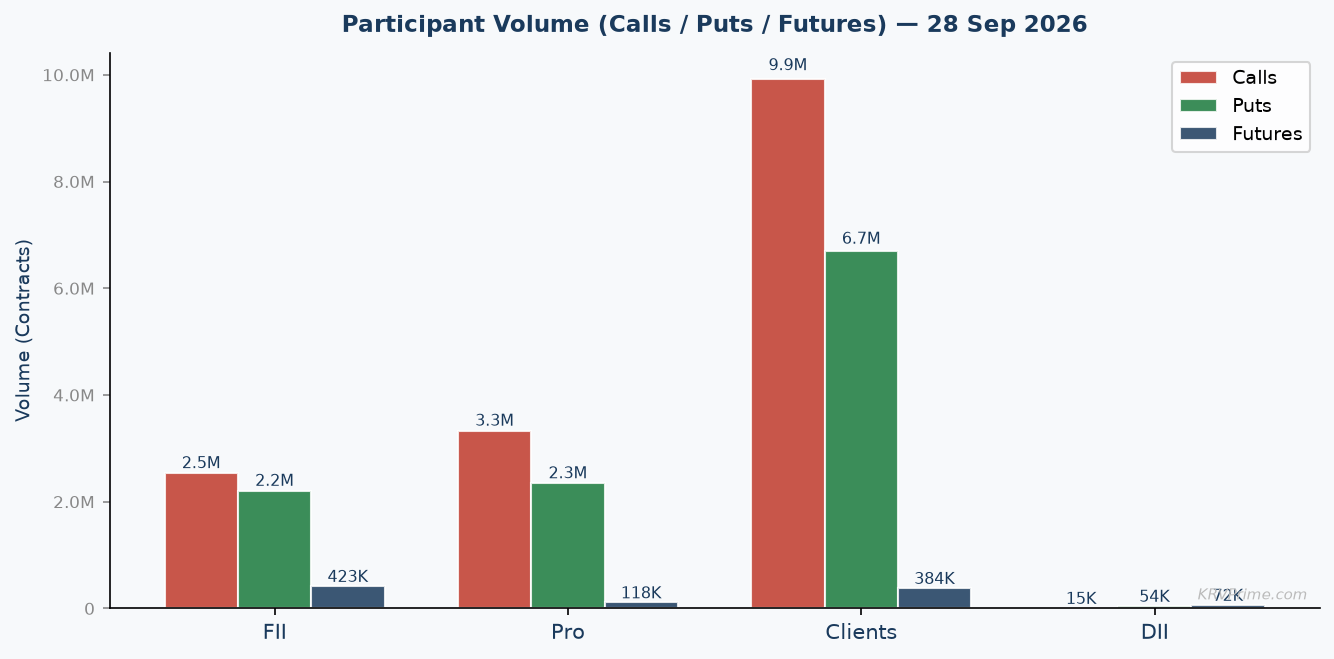
FII Strongly Bearish — Dual-Leg Conviction Short with Protective Put Book Intact
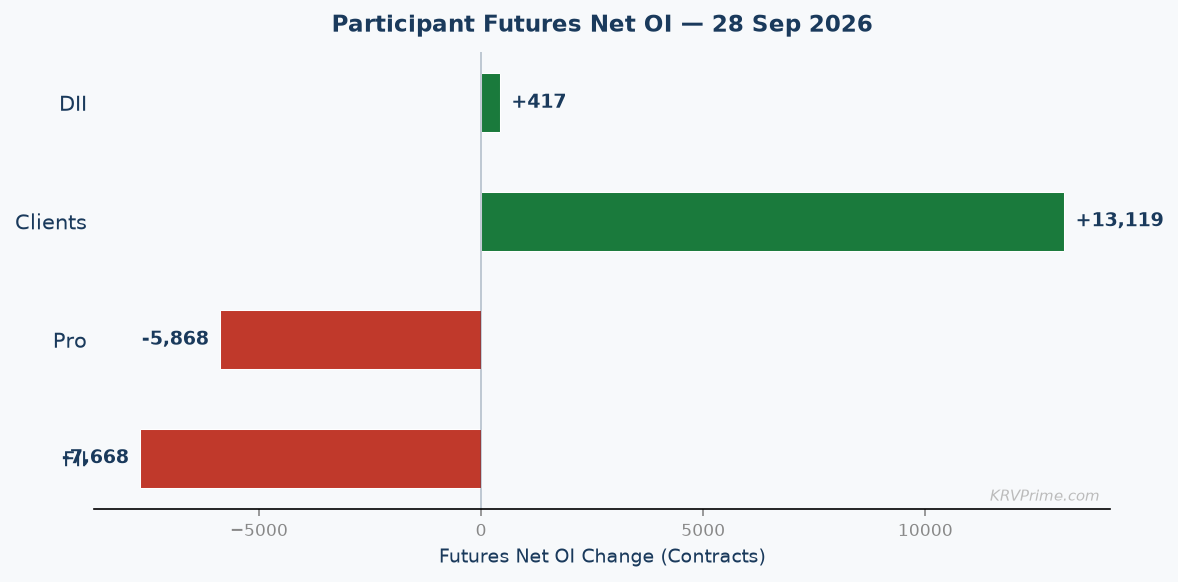
- Futures net deteriorated from -312,001 to -319,669 (net change -7,668). On the long side, FIIs added 5,262 contracts taking longs from 46,305 to 51,567 [Long Buildup - High Vol], while simultaneously adding 12,930 short contracts taking shorts from 358,306 to 371,236 [Short Buildup - High Vol]. The High Vol tag on both legs confirms these are deliberate, high-conviction additions — not passive rollovers or accidental accumulation. The gross short-to-long ratio now stands at 7.20:1 (371,236 shorts versus 51,567 longs), which is an unambiguous outright directional short of the highest order — this is not a hedge ratio, it is a structural bear position. The fact that FIIs added more shorts (+12,930) than longs (+5,262) today, even as price was already falling -1.56% on NIFTY, confirms they are pressing the bearish thesis rather than taking profits — they are short-sellers adding on weakness, anticipating further downside.
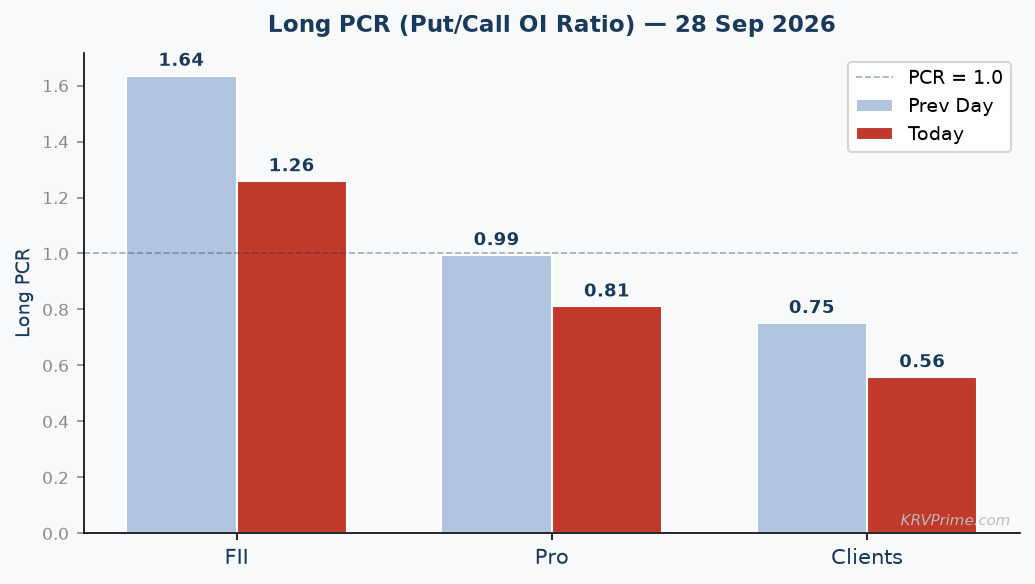
- FII Long PCR fell from 1.64 to 1.26 (-23.02%) and Short PCR fell from 0.65 to 0.55 (-15.74%). A Long PCR of 1.26 means FIIs still hold 26% more put longs than call longs — a materially defensive hedge posture that signals they are either protecting a large equity book or reinforcing a directional bearish view through the options market. The decline from 1.64 to 1.26 is significant — it means the put-long book grew more slowly than the call-long additions (call longs surged by +286,497 versus put longs up only +37,980), suggesting FIIs are also buying calls as tail-risk insurance on the upside, not just accumulating puts. The Short PCR falling from 0.65 to 0.55 means FIIs are now writing even more calls relative to puts on their short side, intensifying their call-supply pressure and keeping a ceiling on any potential rally. This combination — Long PCR still above 1.0 (defensive) AND Short PCR falling further below 1.0 (call-writing intensifying) — reinforces a fully coherent bearish architecture where FIIs protect their downside book while capping upside via short calls.
- Call OI net moved from -240,969 to -246,475 (net change -5,506). Call longs surged from 857,125 to 1,143,622 [Long Buildup - High Vol] while call shorts also expanded from 1,098,094 to 1,390,097 [Short Buildup - High Vol] — both sides saw massive additions, but the short side added +292,003 versus long side +286,497, keeping the net negative and pushing FIIs further into net-short-call territory at -246,475. Put OI net fell from +683,783 to +673,794 (net change -9,989). Put longs rose from 1,401,782 to 1,439,762 [Long Buildup - High Vol] while put shorts also rose from 717,999 to 765,968 [Short Buildup - High Vol], with the short side growing faster (+47,969) than the long side (+37,980), compressing the net long-put position. The resulting architecture remains a synthetic short / protective collar: net short calls (-246,475) combined with net long puts (+673,794) — this is the textbook institutional bearish structure, where the put longs monetise on downside moves while the short calls generate income and suppress any bounce.
- Synthesis — FII Dual-Leg Conviction Bearish Architecture: FIIs present the most internally consistent and deeply committed bearish profile of all participants today. Their futures net of -319,669 (7.20:1 short-to-long gross ratio), combined with a Long PCR of 1.26 (still holding 26% more put longs than call longs), a falling Short PCR of 0.55 (writing more calls), net short calls at -246,475, and net long puts at +673,794, together form a comprehensive, multi-instrument bearish strategy. Both legs — futures and options — are aligned, High Vol confirmed, and directionally coherent: FIIs are not hedging a long equity book in isolation; they are expressing a strong directional view that the market will continue lower. The slight compression in Long PCR (from 1.64 to 1.26) is not a bullish reversal — it simply reflects the proportional surge in call-long additions (likely tail-risk hedges against a short-squeeze), not a meaningful reduction in bearish conviction. Compared to the prior session, FIIs have accelerated their bearish positioning across all instruments simultaneously, confirming this is a deliberate escalation rather than passive drift. The VIX spike to 13.64 (+12.15%) today is entirely consistent with FII behaviour — they are the primary architects of this fear re-entry.
- Forward: The critical threshold to monitor tomorrow is whether FII futures net deteriorates further through -320,000 contracts — a breach of this level with continued High Vol confirmation would signal FIIs are accelerating the short campaign and targeting the 22,000 PE OI Support on NIFTY as the next structural floor. Conversely, if FII futures net improves (short-covering) back above -310,000 — a recovery of more than +9,000 net contracts — it would be the first sign of thesis exhaustion and could trigger a sharp short-covering bounce. Watch also for FII Long PCR: if it rebounds above 1.40 tomorrow, that would confirm renewed put-buying intensity and continued bearish positioning.
DII Cautiously Neutral — Reducing Gross Exposure with Selective Put Unwinding
- Futures net improved marginally from +6,571 to +6,988 (net change +417). However, this improvement is not from new long additions — both sides were reduced: longs fell from 40,198 to 39,355 (-843 contracts) [Long Unwinding - High Vol] and shorts fell from 33,627 to 32,367 (-1,260 contracts) [Short Covering - High Vol]. The High Vol tags on both the long unwinding and short covering confirm these reductions are deliberate risk-reduction moves, not thin-volume noise. The net improved slightly to +6,988 only because DII covered more shorts (-1,260) than they unwound longs (-843) — this is a de-grossing exercise, not a directional bet. The gross long-to-short ratio stands at 1.22:1 (39,355 longs versus 32,367 shorts), which is a near-neutral futures posture — DIIs are not expressing a strong directional view through futures today, and the de-grossing suggests risk management ahead of uncertainty.
- DII does not have separately disclosed Long PCR and Short PCR data in the participant breakdown. Instead, we analyse their options net OI changes directly. The absence of PCR data means we must infer DII's options sentiment from their absolute call and put OI movements. On the call side, DII added small long positions (+250 contracts) while reducing short positions (-198 contracts), resulting in a slightly more net-long-call stance — consistent with a mildly bullish or at least non-bearish options view. On the put side, DII dramatically reduced put longs by -25,600 contracts [Long Unwinding - Low Vol] while initiating fresh put shorts of +600 contracts [Short Buildup - High Vol]. The Low Vol tag on put long unwinding is a key signal — it suggests this is not a panic exit but rather a considered reduction, possibly profit-taking on previously held protective puts as the market fell today. The combination points to a DII that is selectively reducing downside protection rather than adding new hedges, which is a subtly less-bearish stance than what the headline market move might suggest.
- Call OI net improved from +10,398 to +10,846 (net change +448). DII call longs rose from 12,484 to 12,734 [Long Buildup - High Vol] while call shorts declined from 2,086 to 1,888 [Short Covering - High Vol] — both movements are small in absolute terms but directionally consistent: DII is a net call buyer at +10,846, which is an unusual and mildly bullish signal for an institutional participant. Put OI net collapsed from +78,667 to +52,467 (net change -26,200). DII put longs fell dramatically from 78,667 to 53,067 [Long Unwinding - Low Vol] — a reduction of -25,600 contracts — while put shorts appeared for the first time at +600 [Short Buildup - High Vol]. The Low Vol tag on the put long unwinding is critical: despite today being a sharp down day (NIFTY -1.56%), DII chose to reduce its put long book rather than ride it or add to it, which implies they were taking profits on existing protective put positions accumulated at higher levels. Net long calls (+10,846) combined with rapidly shrinking net long puts (+52,467 versus prior +78,667) represents a de-risking of the put hedge while retaining call longs — a transitional posture.
- Synthesis — DII De-Grossing and Hedge Reduction in a Down Market: DII's behaviour today is nuanced and somewhat counter-intuitive on the surface: on a day when NIFTY fell -1.56% and VIX spiked +12.15%, DIIs chose to reduce their protective put book by -25,600 contracts (Low Vol — measured, not panicked), cover futures shorts (-1,260 contracts), and add marginally to call longs. This is not the behaviour of a participant expecting further sharp declines — instead, it reads as a participant that had accumulated put protection at higher levels, is now monetising those puts on the day's decline, and is simultaneously reducing gross risk across both futures and options books ahead of potential month-end or event-related uncertainty. The small initiation of put shorts (+600 contracts, High Vol) is a new development — it suggests DII is beginning to write puts at current levels, implying they believe downside beyond current prices (near 22,780) is limited, or at least range-bound toward the 22,000 PE OI Support floor. Compared to FII's aggressive bearish escalation, DII's posture is distinctly more neutral and de-risking-oriented — they are not chasing the downside move.
- Forward: The key signal to monitor for DII tomorrow is whether their put long book — now at 53,067 contracts — stabilises or continues to decline. If DII put longs fall below 40,000 contracts in tomorrow's data, it would confirm outright profit-taking on the downside protection, implying they are now positioned closer to neutral and may even begin adding long futures exposure if the market shows signs of stabilising near the 22,000 OI Support level. Conversely, if DII reverses course and rebuilds put longs above 60,000 contracts with High Vol confirmation tomorrow, that would signal they see additional downside risk and are re-hedging — aligning their view more closely with FII's bearish stance.
Pro Bearish — Aggressive Call Supply with Futures De-Risking
- Futures net deteriorated from +61,031 to +55,163 (net change -5,868). Pro longs declined from 91,203 to 86,620 (-4,583 contracts) [Long Unwinding - High Vol] while shorts rose from 30,172 to 31,457 (+1,285 contracts) [Short Buildup - High Vol]. Both movements are High Vol confirmed — the long unwinding is a deliberate reduction of bullish futures exposure, while the short addition is a fresh directional bet on the downside. The gross long-to-short ratio has narrowed from approximately 3.02:1 to 2.75:1 (86,620 longs versus 31,457 shorts) — Pros remain net long futures but are systematically reducing that long exposure and adding shorts in a manner consistent with hedging or partial directional reversal. The combination of High Vol long unwinding plus High Vol short buildup in the same session is a classic transition signal — Pros are rotating from net-long confidence to a more cautious or mildly bearish futures stance.
- Pro Long PCR fell from 0.99 to 0.81 (-18.43%) and Short PCR fell dramatically from 0.90 to 0.61 (-31.52%). A Long PCR of 0.81 means Pros hold 19% more call longs than put longs — they are net call buyers on the long side, which appears mildly bullish, but the fall from 0.99 (near-equal) to 0.81 is important: it means call longs grew much faster than put longs today (call longs +263,259 versus put longs -24,098), suggesting Pros are buying calls perhaps as hedges on their short book or as speculative upside bets within an otherwise bearish framework. The Short PCR collapse from 0.90 to 0.61 (-31.52%) is the dominant signal: Pros are now writing 39% more calls than puts on their short side — this is an aggressive call-writing posture that creates massive upside resistance. A Short PCR of 0.61 means for every put they write short, they are writing 1.64 calls short — a highly directional call-supply strategy that will suppress any rally. This falling Short PCR combined with falling Long PCR creates a contradictory surface reading: Pros are simultaneously buying calls (long side) and writing calls at a much higher pace (short side), with the net being a strongly net-short-call position.
- Call OI net flipped sharply from +57,077 to -200,015 (net change -257,092 — a massive one-session reversal). Pro call longs rose from 1,296,952 to 1,560,211 (+263,259) [Long Buildup - High Vol] but call shorts exploded from 1,239,875 to 1,760,226 (+520,351) [Short Buildup - High Vol] — the short-side addition was nearly double the long-side addition, flipping the net from positive to deeply negative at -200,015. This is the single largest options positioning shift of any participant today. Put OI net improved slightly from +179,961 to +186,627 (net change +6,666). Put longs fell from 1,290,105 to 1,266,007 (-24,098) [Long Unwinding - Avg Vol] while put shorts also fell from 1,110,144 to 1,079,380 (-30,764) [Short Covering - Avg Vol], with put covers slightly outpacing put long exits, leaving Pro with a net long put position of +186,627. The resulting architecture — massive net short calls (-200,015) combined with modest net long puts (+186,627) — is a textbook bearish strangle / synthetic short skew where the dominant force is the enormous call supply Pros are injecting into the market.
- Synthesis — Pro Aggressive Call Supply Dominance Turning Bearish: The most significant development in today's entire dataset is Pro's single-session reversal in call OI net from +57,077 to -200,015 — a swing of -257,092 net contracts driven by +520,351 new short call contracts added in one session [Short Buildup - High Vol]. This is not routine hedging — this is a high-conviction directional call-writing campaign of institutional scale, designed to either harvest premium in a falling market or actively cap any recovery. Combined with futures long unwinding (-4,583) and fresh short additions (+1,285), the Pro participant is clearly shifting from a bullish-leaning stance (futures net was a healthy +61,031 yesterday) toward a bearish or at minimum range-capping posture. The Short PCR collapse to 0.61 confirms the primary expression of this view is through call writing — not futures shorts — which is a sophisticated strategy: they benefit from time decay, IV expansion (VIX now at 13.64), and the absence of any sharp rally. The slight net long put position (+186,627) provides asymmetric protection if the market accelerates lower. Pros and FIIs are today aligned on the bearish side through complementary instruments — FIIs via futures shorts and protective puts, Pros via aggressive call writing and futures long reduction.
- Forward trigger: The pivotal signal for Pro tomorrow is their call OI net — if it remains below -180,000 net contracts or deteriorates further, it confirms the call-writing campaign is sustained and the 23,000 CE OI Resistance on NIFTY will act as a near-impenetrable ceiling for any bounce. If instead Pro call shorts are covered and the net reverts toward -100,000 or better, that would signal short-covering on their call book and could unlock a sharper than expected upside squeeze. Watch Pro Short PCR specifically — a recovery above 0.75 would be the first early signal of the call-writing thesis being abandoned.
Client Contrarian Bullish — Aggressively Long Futures while Adding Call Longs
- Futures net improved from +244,399 to +257,518 (net change +13,119). Client longs surged from 310,325 to 321,005 (+10,680 contracts) [Long Buildup - High Vol] while shorts declined from 65,926 to 63,487 (-2,439 contracts) [Short Covering - High Vol]. Both sides are High Vol confirmed — the long buildup is deliberate and aggressive, and the short covering is equally intentional. The gross long-to-short ratio has expanded to 5.06:1 (321,005 longs versus 63,487 shorts) — Clients are overwhelming net long futures with a large majority of their book in directionally bullish futures positions. This is the most striking divergence in today's data: while NIFTY fell -1.56%, FIIs deepened their shorts, and Pros unwound longs — Clients added +10,680 long contracts and covered -2,439 short contracts simultaneously, a contrarian buy-the-dip response of high conviction. Compared to FII's 7.20:1 short-to-long ratio, Clients at 5.06:1 long-to-short represent the exact opposing institutional thesis — one of these camps will be proven decisively wrong.
- Client Long PCR fell from 0.75 to 0.56 (-25.70%) and Short PCR fell from 1.04 to 0.80 (-22.80%). A Long PCR of 0.56 means Clients hold 44% more call longs than put longs on their long book — they are significantly net call buyers, reflecting a bullish or at minimum recovery-expecting options bias. The sharp decline from 0.75 to 0.56 is driven by the massive +1,273,453 call long additions far outpacing the -43,112 put long reduction — Clients are piling into call longs on a down day, effectively buying calls as they fall, which is the behaviour of a participant expecting a reversal. The Short PCR fell from 1.04 to 0.80 (-22.80%) — moving from marginally more put-writing to now writing 25% more calls than puts on their short side. This Short PCR decline means Clients are also increasing call writing (on the short side), which is somewhat contradictory to their aggressive call buying on the long side — it suggests Clients are simultaneously speculating on a bounce (long calls) while also generating income through call writes, a net-bullish but hedged posture. The dominant signal remains the Long PCR at 0.56 and the +1,273,453 call long addition — this is unambiguously bullish bias from the retail and proprietary client segment.
- Call OI net improved dramatically from +173,495 to +435,645 (net change +262,150). Client call longs surged from 3,903,133 to 5,176,586 (+1,273,453) [Long Buildup - Avg Vol] while call shorts also expanded from 3,729,638 to 4,740,941 (+1,011,303) [Short Buildup - Avg Vol] — both sides saw enormous additions, but the long side outpaced by +262,150 contracts, pushing the net strongly positive to +435,645. The Avg Vol tags on both sides indicate this is broad-based retail/client participation rather than a concentrated institutional move — volume is at average levels despite the large absolute numbers, which reflects the sheer scale of the client participant base. Put OI net improved from -942,410 to -912,888 (net change +29,522). Put longs fell slightly from 2,935,201 to 2,892,089 (-43,112) [Long Unwinding - High Vol] while put shorts fell more significantly from 3,877,611 to 3,804,977 (-72,634) [Short Covering - High Vol] — both exits, but the short put side was covered more aggressively. The resulting architecture — massive net long calls (+435,645) combined with net short puts (-912,888) — is a synthetic long / bull spread architecture, where Clients are positioned for a market recovery through call longs AND are exposed on the downside via their net short put book. Contrast this directly with FII's synthetic short (-246,475 net short calls + +673,794 net long puts) — these two participants are structurally opposed.
- Synthesis — Client Contrarian Bullish Dip-Buying with Upside Options Exposure: Clients today executed the most unambiguously bullish positioning of all participants — adding +10,680 long futures, covering -2,439 short futures, buying +1,273,453 net call longs, and covering put shorts — all on a day when NIFTY fell -1.56% and VIX spiked +12.15%. This is classic retail/client-segment dip-buying behaviour: they are buying into weakness with the expectation that the 22,000 PE OI Support (NIFTY) acts as a floor and that the current decline is a buying opportunity rather than the beginning of a sustained downtrend. Their futures net of +257,518 (5.06:1 long-to-short ratio) and options net long call position of +435,645 create a fully aligned synthetic long — maximum benefit if NIFTY recovers toward 23,000 CE OI Resistance. The risk in this positioning is severe: if FII and Pro bearish pressure prevails and NIFTY breaks below 22,000, Client net short put exposure of -912,888 contracts will create accelerating losses, potentially forcing panic covering and adding downward momentum. Compared to the prior session, Clients have increased their bullish conviction across all instruments today, which is a concerning sign from a contrarian perspective — aggressive retail call buying on a down day historically precedes continued selling pressure before a bottom.
- Forward: The decisive trigger for the Client bullish thesis is whether NIFTY holds the 22,000 PE OI Support level — this is where the maximum put open interest is concentrated (both weekly and monthly) and where Client net short puts (-912,888) become increasingly dangerous if breached. If NIFTY sustains above 22,000 and Overall PCR recovers from today's reading of 0.72 back toward 0.85 or higher in tomorrow's session, the Client long call book (+1,273,453 new call longs) will begin generating profits and their bullish thesis will gain validation. Conversely, if NIFTY closes below 22,000 with continued PCR deterioration below 0.65, Client net short puts will face forced covering, amplifying any downside cascade — watch whether Client futures net contracts below +240,000 as an early signal of capitulation.
Bull vs Bear Strength by Participant
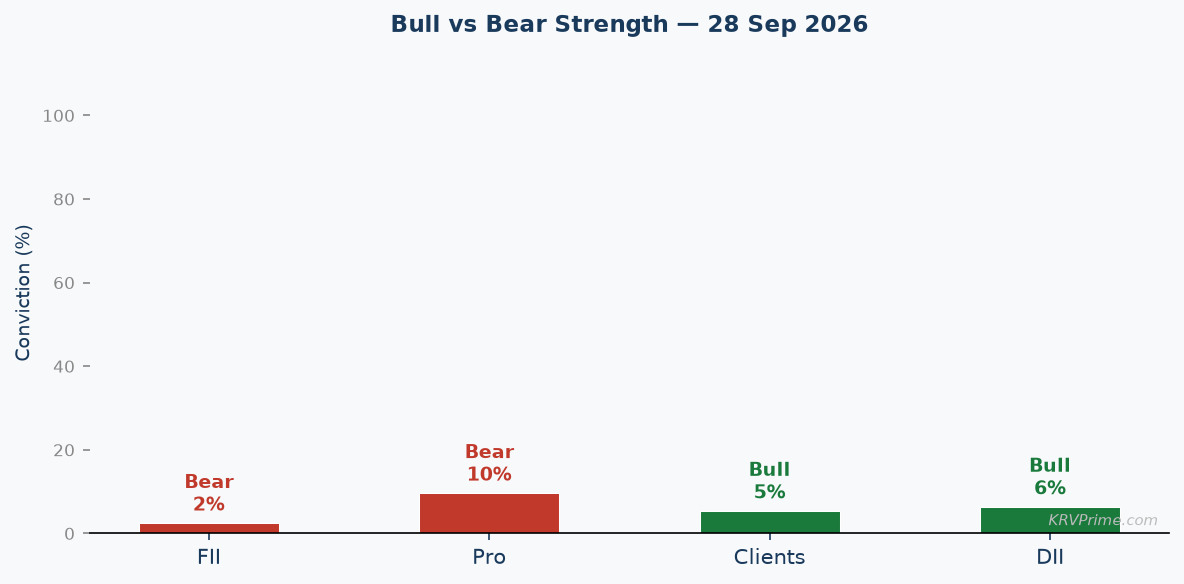
FII Strongly Bearish 88% ▼▼ | Clients Contrarian Bullish 72% ▲▲ | Pro Bearish — Call Writer 75% ▼ | DII Neutral — De-Grossing 52% ▶ |
Conclusion — Market Outlook for Tomorrow (29 Sep 2026)
The collective participant positioning on 28 Sep 2026 presents a structurally bearish picture, dominated by two of the four participants — FII and Pro — who are pressing directional short views through complementary instruments. FIIs deepened their futures net short to -319,669 (7.20:1 short-to-long gross ratio) while simultaneously sustaining a net short call position of -246,475 and a net long put position of +673,794 — a fully armed synthetic short that monetises on any further decline. Pros executed the largest single-session options positioning shift of the day, flipping their call OI net from +57,077 to -200,015 by adding +520,351 new short call contracts [High Vol], while also unwinding long futures by -4,583 contracts — effectively injecting massive supply at current and higher levels through the options market. The only participants taking the other side are Clients, who added +10,680 long futures and +1,273,453 net call longs in a contrarian dip-buying exercise — but their net short put book of -912,888 contracts makes them vulnerable to acceleration on the downside. DIIs are broadly neutral, reducing gross exposure on both sides and monetising put longs accumulated at higher levels, which itself is a signal that one sophisticated domestic participant believes the worst of the immediate decline may be priced in.
The Overall PCR's collapse from 0.94 to 0.72 (-23.84%) is the single most alarming sentiment indicator today — a reading of 0.72 places the market firmly in bearish sentiment territory, driven primarily by the enormous +30.04% explosion in Call OI (+3,646,918 contracts) against a marginal -0.96% decline in Put OI. This call OI surge is being driven by both aggressive call writing (FII and Pro on the short side) and speculative call buying (Clients on the long side) — but the net effect is a market where upside is being heavily supplied and downside protection is contracting. India VIX's spike to 13.64 from 12.16 (+12.15%) on an already-down day is a warning: VIX rising even as the market falls suggests fear is re-entering the market in a non-linear way, and that option buyers are willing to pay elevated premiums — which in turn supports the call writers (FII and Pro) who are benefiting from the higher IV. The OI support and resistance framework remains anchored at 22,000 PE OI Support (NIFTY weekly and monthly) and 23,000 CE OI Resistance — the market is currently at 22,780, which is less than 780 points above the primary put support floor, and the convergence of FII shorts, Pro call writing, and PCR deterioration creates a gravitational pull toward this support level.
The bearish thesis would be challenged and potentially reversed only if FII futures net shows meaningful short-covering — specifically, a recovery above -310,000 net contracts — combined with a PCR recovery above 0.85 and VIX retreating below 12.50. A sustained hold at or above 22,000 OI Support with Client put short covering (put OI net improving toward -850,000 or better) would confirm that floor is holding and could trigger a technical bounce toward 23,000 CE OI Resistance. However, until FII and Pro positioning reverses with High Vol confirmation, every bounce should be treated as a selling opportunity — the weight of smart money is firmly positioned for either continued decline or range-bound weakness.
Scenario 1 — Bull case:
If FII futures net improves from -319,669 toward -305,000 (short-covering of approximately +14,000 net contracts) with High Vol confirmation, AND Overall PCR recovers from 0.72 back above 0.85, AND VIX retreats below 12.50, then the bearish thesis faces a structural challenge. Pro short call covering (net call position recovering toward -100,000 from the current -200,015) would be an additional confirming signal. In this scenario, NIFTY could stage a relief rally back toward the 23,000 CE OI Resistance ceiling as trapped short-sellers cover and Client long call positions begin gaining value.
Scenario 2 — Bear case:
If FII futures net deteriorates further below -330,000 with continued High Vol short buildup, AND Overall PCR falls below 0.65 (further put OI erosion or call OI expansion), AND VIX extends above 15.00, then the 22,000 PE OI Support (NIFTY weekly and monthly) will come under direct pressure. Client net short put exposure of -912,888 contracts becomes the accelerant — forced put covering below 22,000 would cascade selling pressure. Pro's +520,351 new short call contracts would reach full profitability in this scenario as call premiums collapse on the downside move.
Key Resistance 23,000 (NIFTY CE OI Resistance — weekly and monthly): This is where FIIs hold their largest net short call exposure (-246,475 net) and where Pro injected +520,351 new short call contracts today [High Vol]. Two of the four participants are actively writing supply at and above this level — any rally into 23,000 will encounter overwhelming call-writing pressure from both FII and Pro. | Key Support 22,000 (NIFTY PE OI Support — weekly and monthly): This level is anchored by FII's net long put position of +673,794 contracts — the largest single put-long book of any participant — which reaches peak profitability at and below 22,000. Client's net short put position of -912,888 also pivots here, making it the critical floor where Client forced covering could amplify any break below this level. | Trigger to Watch Overall PCR crossing back above 0.85 (from today's 0.72): A PCR recovery of this magnitude would require either significant put buying or call OI reduction — either outcome would signal that the bearish sentiment is exhausting. Combined with VIX dropping below 12.50 and FII futures net improving above -310,000, a PCR above 0.85 would be the first multi-factor confirmation that the current bearish phase is stabilising. |