
Market Participants Analysis dated 29.09.2026
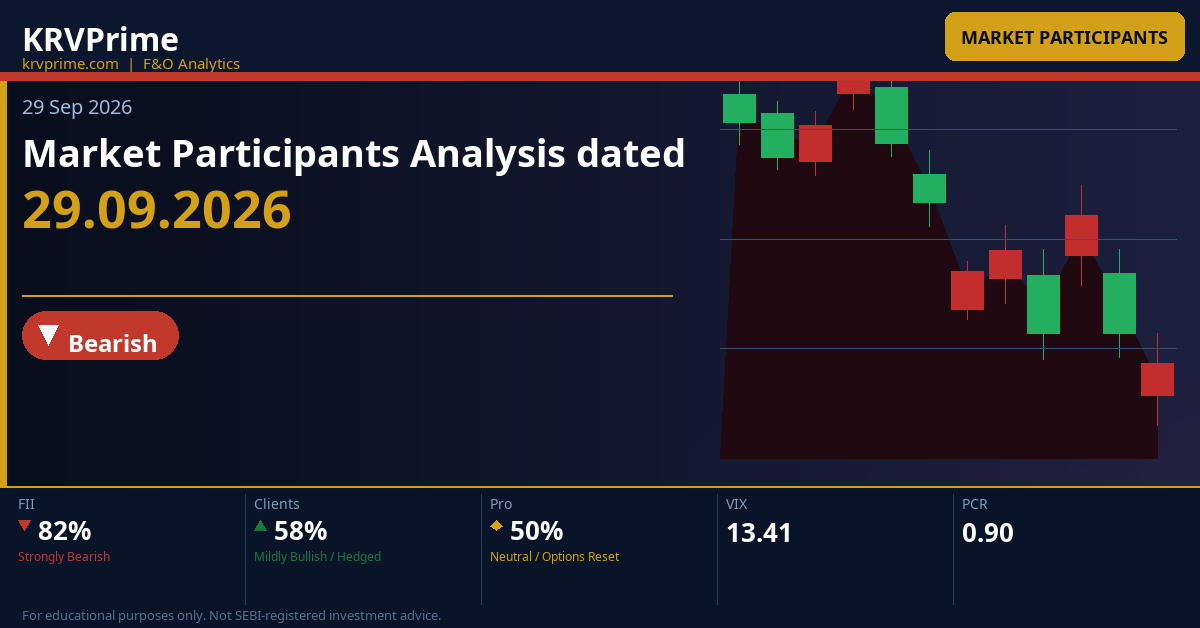
KRVPrime — Daily Market Outlook
Key Market Signals — Data: 29 Sep 2026
NIFTY 50 22,716.20 ▼ -64.05 (-0.28%) | BANK NIFTY 54,259.95 ▼ -211.70 (-0.39%) | SENSEX 72,529.07 ▼ -242.65 (-0.33%) |
OVERALL PCR 0.90 ▲ +0.18 (+25.05%) PCR surged from 0.72 to 0.90 — put OI held better than call OI into expiry unwind, cautiously improving sentiment | INDIA VIX 13.41 ▼ -0.23 (-1.65%) VIX eased to 13.41 — complacency zone, options pricing lower tail risk but not signalling panic | TOTAL OI CHANGE 36,034,044 ▼ -22,083,884 (-38.00%) Massive OI destruction of 38% — driven by monthly/weekly expiry unwinding across all participant classes |
FUTURES OI 787,444 ▼ -209,650 (-21.03%) Futures OI fell sharply — net position rollover and expiry-driven unwinding, directional conviction reduced | CALL OI CHANGE 7,106,268 ▼ -8,680,037 (-54.98%) Call OI nearly halved — massive expiry cleanup with short-covering dominant; resistance structure lightened | PUT OI CHANGE 6,361,403 ▼ -4,940,447 (-43.71%) Put OI fell but at slower pace than call OI — resulting PCR improvement signals residual put support holding |
Participant-wise Key Points
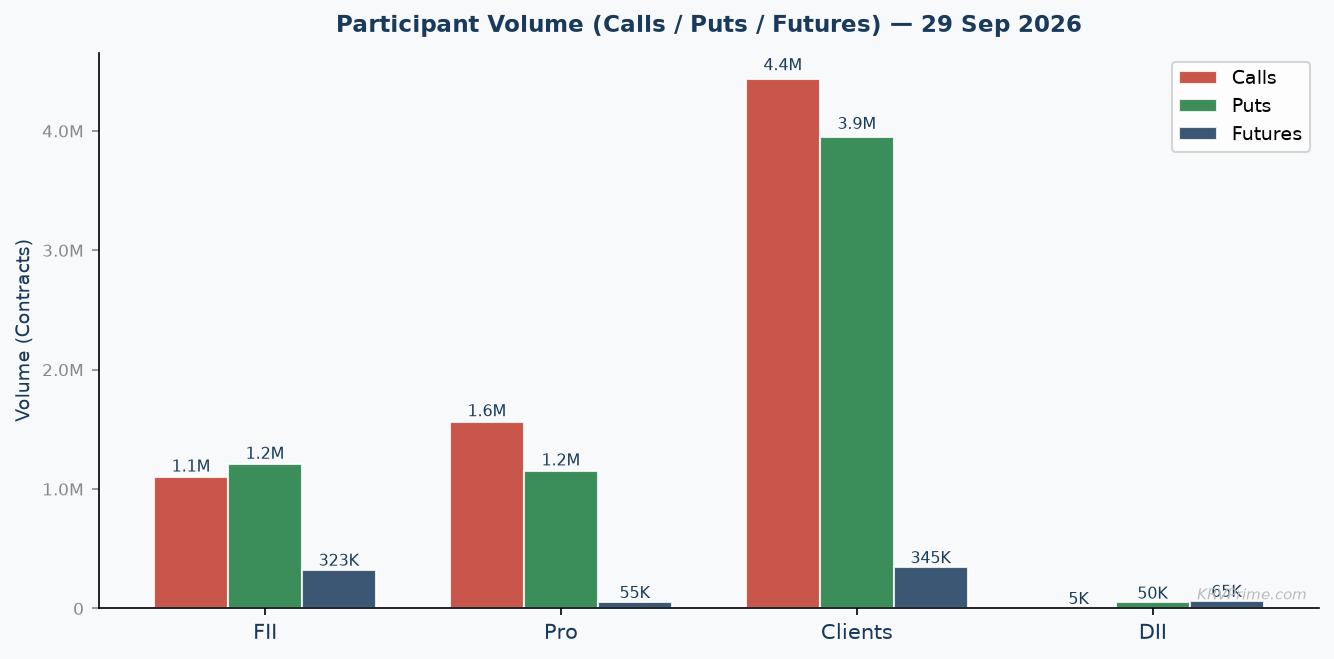
FII Bearish — Expiry Unwind With Persistent Net Short Futures
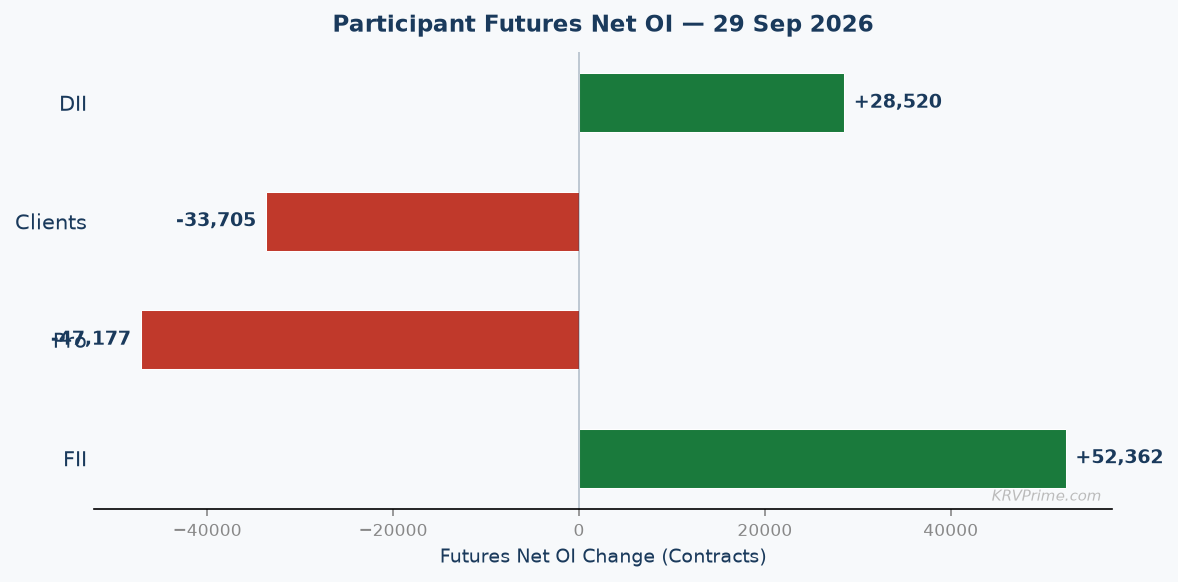
- Futures net improved from -319,669 to -267,307 (net change +52,362 contracts). The Long side collapsed from 51,567 to 27,879 contracts [Long Unwinding - High Vol] — a reduction of 23,688 contracts (-45.94%) — while the Short side simultaneously shrank from 371,236 to 295,186 contracts [Short Covering - High Vol] — a reduction of 76,050 contracts (-20.49%). Both the Long Unwinding and Short Covering carry High Vol tags, meaning both moves were deliberate and executed with above-average participation — this is not stale OI rolling off passively. Critically, FIIs covered 76,050 short contracts versus only unwinding 23,688 long contracts, meaning the net improvement of +52,362 is entirely short-covering driven, not fresh bullishness — the gross short-to-long ratio remains deeply skewed at 10.6:1 (295,186 shorts vs 27,879 longs), confirming FIIs retain a massive directional short book even after today's expiry cleanup.
- Long PCR surged from 1.26 to 2.73 (+116.55%) and Short PCR contracted from 0.55 to 0.37 (-33.48%). A Long PCR of 2.73 means FIIs now hold 2.73 times as many put longs as call longs — this is one of the most defensive/bearish hedging postures possible, signalling either aggressive equity book protection or an outright directional bearish expression through options. The dramatic +116.55% single-session jump in Long PCR tells us that as FIIs unwound call longs aggressively (-802,184 contracts, -70.14%), put longs were preserved proportionally — put longs fell only -35.35% versus call longs falling -70.14%, showing deliberate preservation of downside protection. The Short PCR falling from 0.55 to 0.37 means FIIs are now writing far fewer puts than calls on the short side — a ratio below 0.50 means they are writing more than 2.7x as many calls as puts, which is a cap-the-upside strategy consistent with their bearish futures positioning. Together, Long PCR 2.73 (deeply bearish) and Short PCR 0.37 (capping upside) represent a fully consistent dual-sided bearish options architecture.
- Call OI net worsened to -421,463 (Long: 341,438 [Long Unwinding - High Vol], Short: 762,901 [Short Covering - High Vol]; prev net was -246,475). Despite significant short covering in calls (-627,196 shorts removed), long covering was proportionally larger (-802,184 longs removed), resulting in a net call position that became more net short by -174,988 contracts — FIIs are now net sellers of calls to a greater degree than yesterday. Put OI net eased slightly to +651,257 (Long: 930,823 [Long Unwinding - High Vol], Short: 279,566 [Short Covering - High Vol]; prev net was +673,794) — the net long put book contracted by only -22,537 contracts, which is a minor reduction relative to the scale of overall expiry unwind. The architecture remains a textbook synthetic bearish collar: net short calls (-421,463) capping upside + net long puts (+651,257) providing downside participation — this is not a hedging posture for a participant who expects a rally.
- Synthesis — FII Expiry-Adjusted Persistent Bearish Architecture: FIIs enter the post-expiry session with their structural bearish thesis fully intact and in some dimensions amplified. Despite the massive expiry unwind removing roughly half of all OI, FIIs have emerged with a futures net of -267,307 (still a dominant short book at 10.6:1 gross short-to-long ratio), a Long PCR of 2.73 (up sharply from 1.26), a net short call book of -421,463, and a net long put book of +651,257. The fact that call longs were cut twice as aggressively (-70.14%) as put longs (-35.35%) during the expiry unwind is the most important signal — FIIs chose to preserve downside protection while abandoning upside optionality, which is an active bearish choice, not a passive expiry cleanup. The Short PCR contracting to 0.37 tells us they are writing far more calls than puts on the short side, consistent with a view that the market is range-capped or headed lower. There is no internal contradiction in the FII book today — futures, Long PCR, Short PCR, call net, and put net all point in the same direction: bearish with high conviction.
- Forward: The key threshold to watch in tomorrow's data is whether FII futures net deteriorates back below -280,000 (fresh short buildup) or continues to improve above -250,000 (genuine short-covering/thesis softening). If FII gross shorts rebuild toward 310,000+ on the first post-expiry session with a declining PCR and VIX tick up, the bearish thesis accelerates and 22,700 (Nifty PE OI Support) will be tested directly. If instead FII futures net improves further and Long PCR retreats from the extreme 2.73 level, a short-squeeze toward the 23,500 CE OI Resistance becomes the operative risk scenario.
DII Bullish — Futures Long Buildup With Short Covering, Institutional Accumulation Signal
- Futures net improved sharply from +6,988 to +35,508 (net change +28,520 contracts) — the largest single-session net improvement of any participant group today. The Long side expanded from 39,355 to 50,075 contracts [Long Buildup - High Vol] — an addition of +10,720 contracts (+27.24%) — while the Short side simultaneously collapsed from 32,367 to 14,567 contracts [Short Covering - Low Vol] — a reduction of -17,800 contracts (-54.99%). Critically, the Long Buildup carries a High Vol tag (deliberate, above-average conviction buying) while the Short Covering carries a Low Vol tag (thin, possibly passive expiry roll-off) — this asymmetry is important: the long addition was an active decision, while the short reduction may partly be routine expiry cleanup. The gross long-to-short ratio now stands at 3.44:1 (50,075 longs vs 14,567 shorts), the highest net long futures positioning of the session, signalling DIIs are the only participant group actively adding directional long exposure on this expiry day.
- DII options PCR data is not separately provided in the dataset for today's session, so a direct Long PCR / Short PCR breakdown cannot be derived for this participant. However, the overall options posture can be inferred from the OI changes: Put OI Long reduced marginally from 53,067 to 49,694 (-3,373, -6.36%) [Long Unwinding - Low Vol], and the Low Vol tag suggests this is routine expiry cleanup rather than a deliberate defensive reduction. Call OI Long fell from 12,734 to 4,948 (-7,786, -61.14%) [Long Unwinding - High Vol] — the High Vol tag on this call long reduction is notable and indicates DIIs actively shed call longs, which is consistent with a view that upside beyond current levels is limited in the near term. The overall picture from available DII options data is mildly defensive on the call side but not alarming on the put side.
- Call OI net moved to +4,572 (Long: 4,948 [Long Unwinding - High Vol], Short: 376 [Short Covering - High Vol]; prev net was +10,846). Both the call long and call short sides contracted sharply on High Vol tags — DIIs removed 7,786 call longs and 1,512 call shorts in the same session. Put OI net stands at +49,394 (Long: 49,694 [Long Unwinding - Low Vol], Short: 300 [Short Covering - Low Vol]; prev net was +52,467) — the put net contracted only modestly (-3,073) on Low Vol tags, suggesting the bulk of DII put longs are being maintained as a structural hedge. The architecture is net long puts (+49,394) with negligible call exposure (+4,572) — this is a simple protective long posture: hold the equity-linked long futures book and hedge it with a substantial put long buffer, which is classic institutional accumulation-with-hedge behavior.
- Synthesis — DII Counter-Trend Institutional Accumulation: DIIs are the clear bullish outlier in today's expiry session and are executing a strategy that is the direct mirror image of FII positioning. While FIIs cut longs aggressively and maintained/rebuilt net short exposure, DIIs added 10,720 long futures contracts on a High Vol tag — a deliberate, above-average-conviction purchase — while simultaneously cutting their short book by 17,800 contracts to bring net futures to +35,508, the largest positive futures net of any participant. The put long book of 49,694 contracts provides downside protection for this long futures position, forming a classic covered long with protective put structure. The contrast with FIIs is stark: FIIs carry a 10.6:1 short-to-long ratio in futures versus DIIs' 3.44:1 long-to-short ratio — these two institutional participants are in direct opposition at expiry, with DIIs effectively absorbing supply being created by FII short building. This divergence between FII (bearish) and DII (bullish) is the most important macro signal from today's data.
- Forward: The critical confirmation for the DII bullish thesis is whether futures net sustains above +30,000 in the next session and whether put long OI (currently 49,694) is maintained or expanded — any reduction in put longs on High Vol would signal DII is reducing its hedge, implying higher conviction in the upside. If DII futures net retreats below +20,000 in the next session with renewed short buildup, the expiry-day accumulation would be classified as a failed breakout attempt. Watch Nifty's ability to hold 22,700 (PE OI Support) — if this level holds, DII's long book is protected; if it breaks, their put long hedge monetises and the long book comes under pressure.
Pro Neutral to Mildly Bearish — Expiry Unwind Dominant, Call Net Turned Positive
- Futures net collapsed from +55,163 to +7,986 (net change -47,177 contracts — the sharpest absolute futures net deterioration of any participant today). The Long side fell from 86,620 to 31,565 contracts [Long Unwinding - High Vol] — a reduction of 55,055 contracts (-63.56%) — while the Short side contracted from 31,457 to 23,579 contracts [Short Covering - High Vol] — a reduction of only 7,878 contracts (-25.04%). Both sides carry High Vol tags, confirming deliberate position management, but the asymmetry is decisive: Pro desks unwound 55,055 longs versus covering only 7,878 shorts, leaving their futures net virtually flat at +7,986 — a near-complete liquidation of the +55,163 bullish futures position they carried into today's expiry. The gross long-to-short ratio has collapsed from a comfortable 2.75:1 to just 1.34:1 (31,565 longs vs 23,579 shorts), signalling Pro desks have largely exited their futures directional bias and are operating in a near-neutral stance post-expiry.
- Long PCR compressed from 0.81 to 0.72 (-11.05%) and Short PCR expanded from 0.61 to 0.76 (+23.71%). A Long PCR of 0.72 means Pro desks hold 28% more call longs than put longs — a mildly bullish options tilt on the long side. However, the direction of change (falling from 0.81) indicates that put longs are being shed faster than call longs, reducing the overall hedge ratio. The Short PCR rising from 0.61 to 0.76 is the more interesting signal: Pro desks are now writing 76 put contracts for every 100 call contracts on their short book, an increase of +23.71% — this means they are increasingly willing to write puts (bullish/income bet on the downside) versus calls, suggesting a mild bullish tilt or range-income positioning on the short options side. The combination of a low but rising Short PCR and a falling Long PCR suggests Pro desks are transitioning from a hedged long to a more neutral or mildly bullish income-generation stance post-expiry.
- Call OI net flipped to +100,235 (Long: 831,703 [Long Unwinding - High Vol], Short: 731,468 [Short Covering - High Vol]; prev net was -200,015). This is a significant structural shift — Pro desks moved from net short calls (-200,015) to net long calls (+100,235) in a single session, driven by shorts being covered more aggressively (-1,028,758 contracts, -58.44%) than longs being unwound (-728,508 contracts, -46.69%). Put OI net contracted sharply to +45,318 (Long: 600,229 [Long Unwinding - High Vol], Short: 554,911 [Short Covering - High Vol]; prev net was +186,627) — both put longs and put shorts were cut heavily on High Vol tags. The resulting architecture is now net long calls (+100,235) with negligible net long puts (+45,318) — this is a shift toward a mildly bullish options tilt, contradicting the sharp futures net deterioration and suggesting Pro desks may be replacing directional futures longs with cheaper call long exposure in the new series.
- Synthesis — Pro Desk Expiry Reset With Mildly Bullish Options Reload: The Pro desk story today is fundamentally an expiry reset narrative overlaid with a subtle new-series repositioning signal. Their futures long book was nearly entirely liquidated (-55,055 longs, -63.56% on High Vol) but was not replaced by fresh shorts — the residual net of +7,986 is essentially flat. More tellingly, their options architecture has undergone a complete reversal: from net short calls (-200,015) yesterday to net long calls (+100,235) today — this flip occurred because short-covering in calls (-1,028,758) vastly exceeded long unwinding (-728,508), leaving Pro desks as net long call holders in the new series. This is consistent with a strategy of closing out the old series hedged book and initiating a fresh mildly bullish call position for the next expiry cycle. The rising Short PCR (0.61 → 0.76) confirms a parallel shift toward put-writing on the short options side — together this builds a long call + short put structure, which is a net bullish risk profile for the new series. The key internal tension is that futures are near-flat while options suggest mild bullishness — Pro desks appear to be expressing next-series bullishness through options rather than futures.
- Forward: The defining signal to watch for Pro desks in the next session is whether their futures net rebuilds above +30,000 (confirming the new-series re-entry is underway) or stays near flat/deteriorates (confirming they remain on the sidelines). If call OI long expands and Short PCR continues to rise above 0.80, Pro desks are building a structured bullish income position (long call + short put) that would become a tailwind for the market above 22,700 (Nifty PE OI Support). If instead call longs are quickly trimmed and futures net does not rebuild, the expiry-day reset should be read as a clean exit rather than a repositioning, and the directional vacuum left by Pro departure would amplify FII bearish dominance.
Client Mildly Bullish Bias — Large Net Long Futures, Reducing Put Shorts Signals Caution
- Futures net deteriorated from +257,518 to +223,813 (net change -33,705 contracts). The Long side contracted from 321,005 to 284,203 contracts [Long Unwinding - High Vol] — a reduction of 36,802 contracts (-11.46%) — while the Short side fell from 63,487 to 60,390 contracts [Short Covering - High Vol] — a modest reduction of 3,097 contracts (-4.88%). Both sides carry High Vol tags, confirming deliberate activity, but the long side was reduced far more aggressively than the short side — Clients unwound 36,802 longs versus covering only 3,097 shorts, resulting in a net deterioration of -33,705. Despite this reduction, Clients retain by far the largest net long futures position of any participant at +223,813, with a gross long-to-short ratio of 4.70:1 (284,203 longs vs 60,390 shorts) — the retail/HNI client base remains structurally long index futures even as they scaled back on expiry day.
- Long PCR improved from 0.56 to 0.67 (+20.58%) and Short PCR expanded from 0.80 to 1.14 (+42.00%). A Long PCR of 0.67 means Clients hold 67 put longs for every 100 call longs — a moderate hedge ratio, improving from 0.56, indicating that put longs were preserved better than call longs during today's expiry unwind (consistent with continued desire for downside protection on their large long futures book). The Short PCR jumping from 0.80 to 1.14 is the most striking individual PCR move of the session — a Short PCR above 1.00 means Clients are now writing more puts than calls on their short options side, a classic retail income trade indicating they believe the market will not fall significantly below current levels and they are collecting put premium. This +42.00% expansion in Short PCR combined with a rising Long PCR creates a mixed signal: buying put protection while simultaneously selling puts at lower strikes — a put spread or split-strike structure that caps both their cost of protection and their maximum downside gain.
- Call OI net remained positive at +316,656 (Long: 2,375,045 [Long Unwinding - High Vol], Short: 2,058,389 [Short Covering - High Vol]; prev net was +435,645). Both call longs (-2,801,541, -54.12%) and call shorts (-2,682,552, -56.58%) were cut heavily in the expiry washout, with the net call position contracting by -118,989 but remaining net long. Put OI net improved to -745,968 (Long: 1,599,956 [Long Unwinding - High Vol], Short: 2,345,924 [Short Covering - High Vol]; prev net was -912,888). Despite put short covering of 1,459,053 contracts, the Client put net improved (became less negative) by +166,920 — meaning put shorts were covered more aggressively than put longs were unwound, slightly reducing the net put short exposure. The overall architecture remains net long calls (+316,656) and net short puts (-745,968) — a classic synthetic long structure: long calls and short puts both profit when the market moves higher, fully consistent with the large net long futures book.
- Synthesis — Client Retail Synthetic Long With Rising Caution Signals: Clients present the most internally consistent bullish structure of any participant, but with emerging caution signals that deserve attention. The core position — +223,813 net long futures, +316,656 net long calls, -745,968 net short puts — is a three-dimensional synthetic long that benefits from any market move higher. However, the session-specific signals introduce nuance: the Long PCR improvement to 0.67 (rising put long retention) and the dramatic Short PCR expansion to 1.14 (now writing more puts than calls) together suggest retail participants are simultaneously bullish AND increasingly nervous — they are hedging their long book with put longs while funding that hedge by writing lower-strike puts. This is the behavior of participants who are bullish but shaken, not bullish and confident. Compared to FIIs (deeply bearish, 10.6:1 short-to-long in futures), Clients are in direct opposition — the +223,813 vs -267,307 futures net showdown between Clients and FIIs is the defining structural tension of the current market. Historically, when FIIs and Clients are this opposed, the resolution often follows FII direction given their superior information and hedging discipline.
- Forward: The critical data point to watch for Clients tomorrow is whether their futures net holds above +200,000 (confirming the long thesis remains intact) or deteriorates toward +180,000 (signalling accelerating long unwinding). If the Short PCR continues to expand above 1.20 in the next session, it would indicate Clients are aggressively selling puts — this becomes dangerous if Nifty breaks below the 22,700 PE OI Support level, as their short put book would monetise against them, triggering forced covering and a potential cascade. Watch for Client Long PCR to remain above 0.60 as a minimum hedge maintenance signal — a drop below 0.60 would indicate the put hedge is being abandoned, increasing net exposure and vulnerability.
Bull vs Bear Strength by Participant
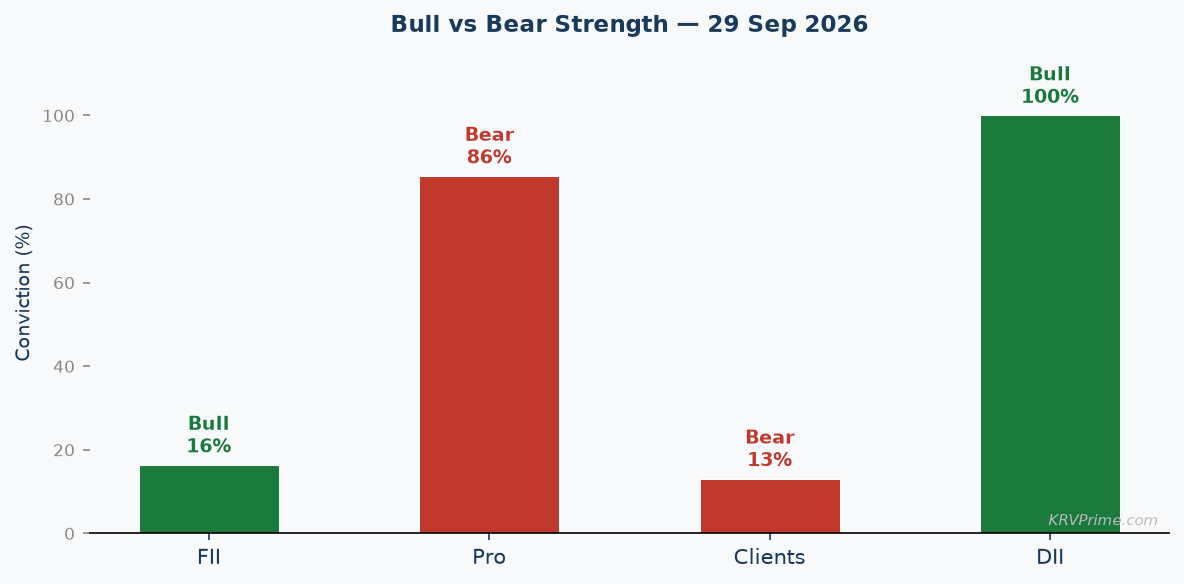
FII Strongly Bearish 82% ▼▼ | DII Bullish — Accumulating 72% ▲▲ | Pro Neutral / Options Reset 50% ▶ | Clients Mildly Bullish / Hedged 58% ▲ |
Conclusion — Market Outlook for Tomorrow (30 Sep 2026)
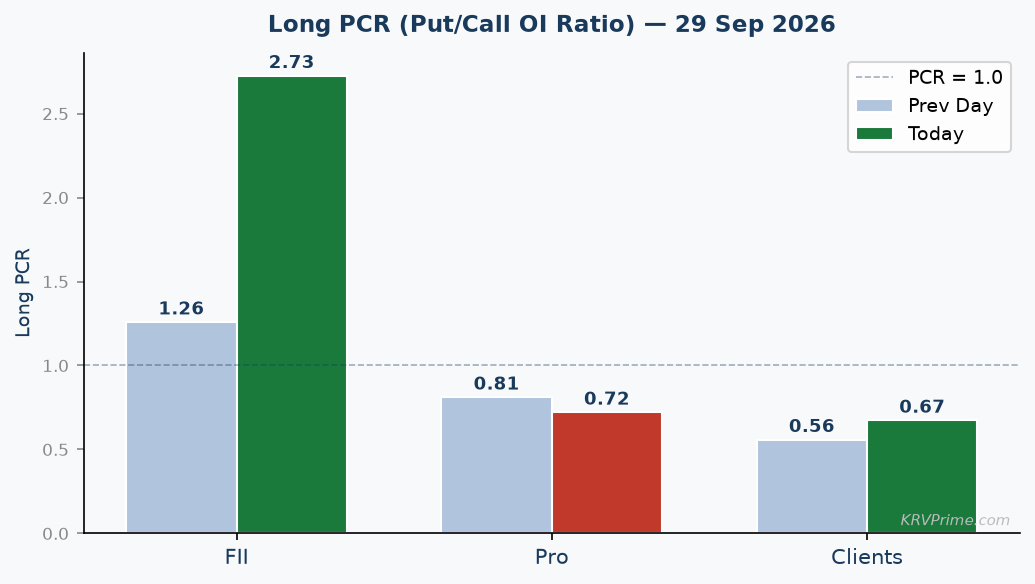
The collective participant positioning after today's monthly expiry washout reveals a market in structural tension, not resolution. FIIs emerge as the dominant bearish force with a futures net of -267,307 (10.6:1 gross short-to-long ratio), a Long PCR of 2.73 (the most extreme defensive put accumulation of any participant), net short calls of -421,463, and net long puts of +651,257 — a fully integrated bearish architecture that survived the expiry unwind with its thesis intact and in some dimensions reinforced. In direct opposition, DIIs added +10,720 long futures contracts on a High Vol tag (deliberate conviction buying) to reach a futures net of +35,508, the strongest bullish futures signal of the session. Clients sustain a massive +223,813 net long futures book backed by a synthetic long options structure, but their rising Short PCR of 1.14 and improving Long PCR of 0.67 reveal growing unease beneath the surface bullishness. Pro desks have largely exited their futures position (net collapsed from +55,163 to +7,986) and are rebuilding mildly bullish exposure through options (net long calls +100,235), leaving the battle to FII vs DII and Client in the new series.
The Overall PCR surging from 0.72 to 0.90 (+25.05%) in a single session is a significant sentiment improvement — put OI declined at a slower pace than call OI during the expiry washout, leaving a proportionally larger put cushion in the system. This PCR improvement is a near-term constructive signal for the market, suggesting participants are not abandoning downside hedges even as calls are aggressively stripped. India VIX at 13.41 (down from 13.64, -1.65%) sits in a low-complacency zone — the absence of fear premium in options means the market is not pricing a tail event, but it also means any sudden macro shock would see VIX spike disproportionately from this compressed base. The OI support structure places 22,700 as the Nifty PE OI Support (maximum put OI strike for both weekly and monthly series) — this level is actively defended by FII net long puts and DII put longs. The 23,500 CE OI Resistance for Nifty is where FII short calls are concentrated, capping any rally attempts in the near term.
The bear thesis breaks down if FII futures net improves meaningfully above -240,000 in the next session (short-covering acceleration), if the Overall PCR sustains above 1.00 (put-to-call balance tilts bullish), or if VIX compresses below 12.50 (fear completely absent, forcing short-covering). The bull thesis faces its primary risk at 22,700 Nifty PE OI Support — a sustained close below this level on expanding volume would trigger Client short put losses, DII put long monetisation, and a cascade of long liquidation from the 223,813 Client long futures book. Until one of these triggers fires, the market is likely to remain in a 22,700–23,500 Nifty range defined entirely by the post-expiry OI structure.
Scenario 1 — Bull case:
If FII futures net improves toward -240,000 or better in the next session (indicating accelerating short-covering beyond today's expiry-driven cleanup), accompanied by Overall PCR sustaining above 0.95, and VIX declining toward 12.80, the bearish thesis loses momentum. DII continued long buildup (net sustaining above +35,000) combined with Client put short book intact (Short PCR holding above 1.10) would confirm a short-squeeze setup targeting the 23,500 CE OI Resistance. The trigger confirmation would be FII gross shorts declining below 270,000 contracts — below that threshold, the 10:1 short-to-long ratio begins to compress meaningfully.
Scenario 2 — Bear case:
If FII futures net deteriorates back below -290,000 (fresh short buildup in the new series post-expiry), with Overall PCR retreating below 0.80, and VIX climbing above 14.50, the bearish pressure intensifies materially. Client Short PCR expanding above 1.20 while Nifty tests 22,700 PE OI Support would trigger a put-writing risk (Client short puts going against them), potentially accelerating selling. A simultaneous reduction in DII futures net below +20,000 would remove the only structural bullish counterweight to FII dominance, opening a path toward a deeper correction below the 22,700 support level.
Key Resistance — Nifty 23,500 (CE OI Resistance — weekly and monthly series). FIIs are net short -421,463 call contracts concentrated at this strike, making it an active supply wall. Any approach toward 23,500 will be met by FII call short positions that benefit from the market staying below this level. | Key Support — Nifty 22,700 (PE OI Support — weekly and monthly series). FIIs hold +651,257 net long puts and DIIs hold +49,394 net long puts anchored at or near this level. A break below 22,700 on volume would monetise FII and DII put longs, but would simultaneously damage Client short put positions (Short PCR 1.14 — writing puts below market). | Trigger to Watch Overall PCR crossing and sustaining above 1.00 in the next session. A PCR above 1.00 would signal that put OI is now exceeding call OI on a structural basis (not just expiry-driven), confirming genuine hedging demand and shifting the balance toward bulls. Below 0.85, the recent PCR improvement fades and FII bearish dominance reasserts. Also watch FII futures net: a move above -250,000 is the minimum threshold to reclassify FII positioning from 'persistent bearish' to 'covering/softening'. |