
Market Participants Analysis dated 30.09.2026
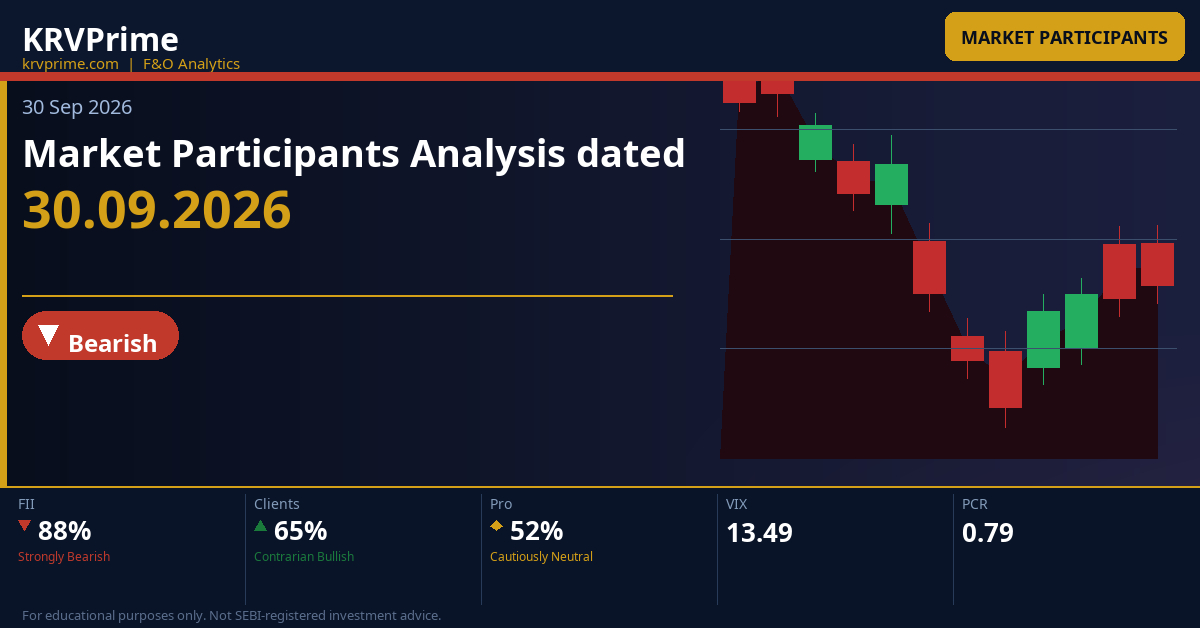
KRVPrime — Daily Market Outlook
Key Market Signals — Data: 30 Sep 2026
NIFTY 50 22,620.45 ▼ -95.75 (-0.42%) | BANK NIFTY 54,633.05 ▲ +373.10 (+0.69%) | SENSEX 72,480.29 ▼ -48.78 (-0.07%) |
OVERALL PCR 0.79 ▼ -0.11 (-11.57%) PCR below 0.80 signals call-heavy OI build — market tilting toward bearish sentiment as put writing lags call writing. | INDIA VIX 13.49 ▲ +0.08 (+0.58%) VIX ticking up from 13.41 — mild fear creeping in, complacency zone but directional risk rising into expiry. | TOTAL OI CHANGE 41,216,262 ▲ +5,182,218 (+14.38%) Massive 14.38% OI surge on a down-close in Nifty — fresh shorts being added, not short-covering rally. |
FUTURES OI 830,708 ▲ +43,264 (+5.49%) Futures OI expanding while Nifty falls — textbook short buildup confirmation across participants. | CALL OI CHANGE 9,724,545 ▲ +2,618,277 (+36.84%) Call OI surged 36.84% — aggressive call writing at resistance levels caps upside and signals supply zone. | PUT OI CHANGE 7,698,408 ▲ +1,337,005 (+21.02%) Put OI grew 21.02% but lagged calls — PCR falling to 0.79 confirms calls dominating; put longs add downside hedge. |
Participant-wise Key Points
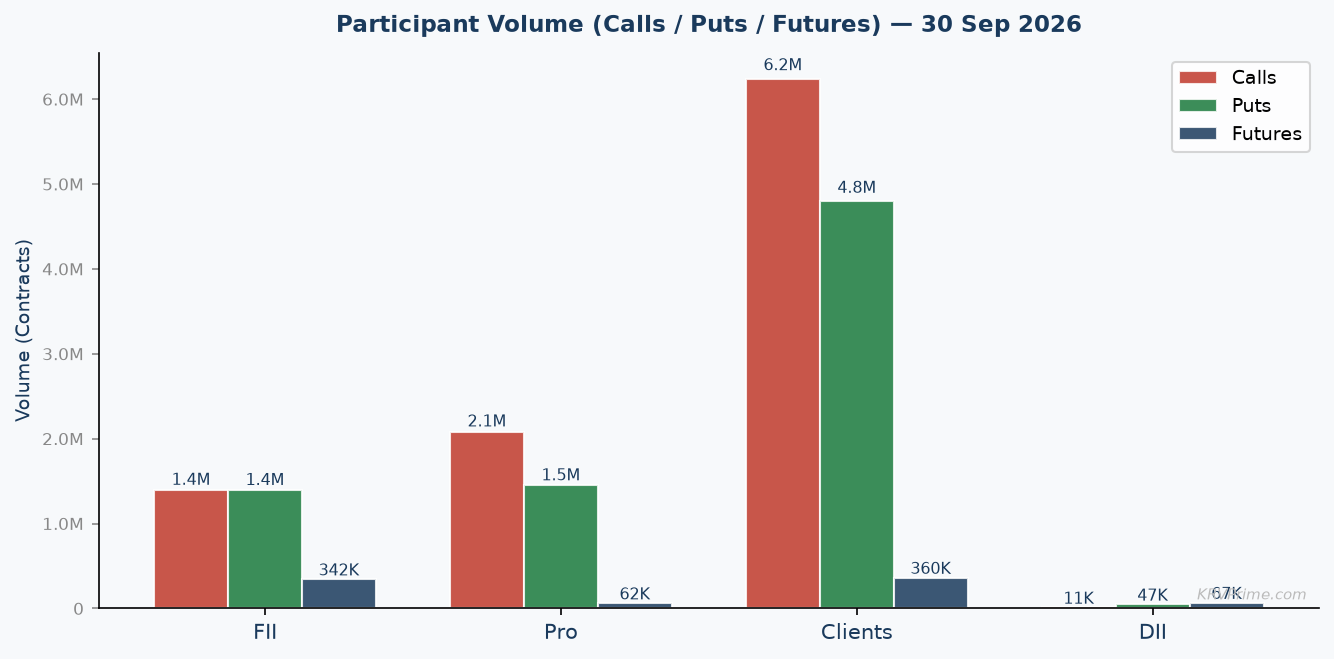
FII Strongly Bearish — Dual-Leg Conviction Short with Protective Put Floor
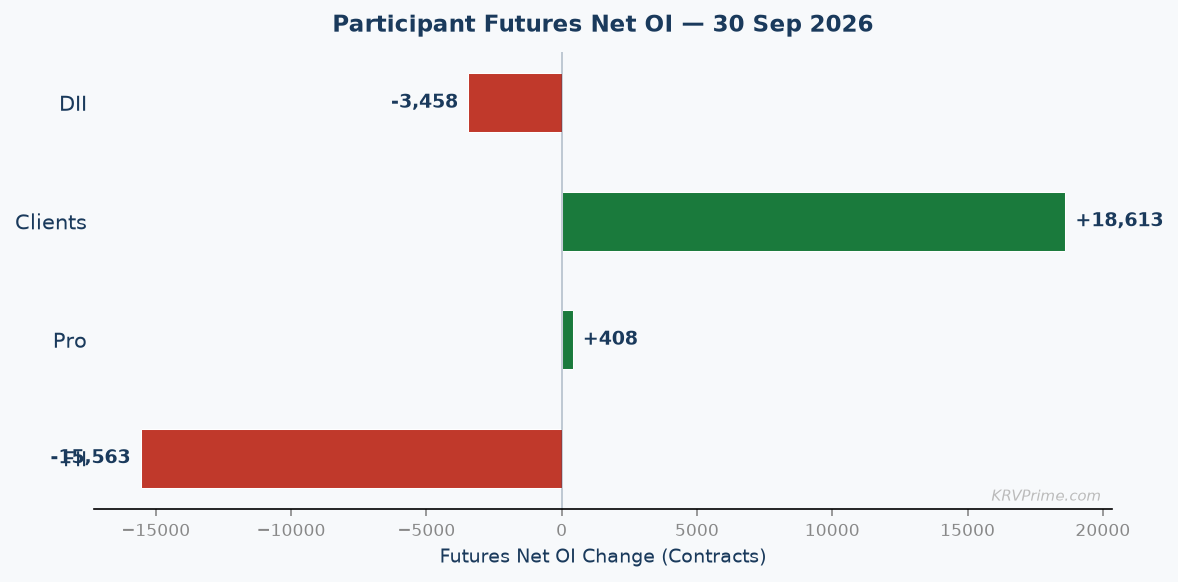
- Futures net deteriorated from -267,307 to -282,870 (net change -15,563 contracts, a worsening of +5.83%). The Long side added 1,515 contracts (prev 27,879 → today 29,394, +5.43%) tagged [Long Buildup - Low Vol], while the Short side added a far more aggressive 17,078 contracts (prev 295,186 → today 312,264, +5.79%) tagged [Short Buildup - Low Vol]. The Low Vol tag on both legs is notable — it indicates these positions were built without exceptional single-session volume, meaning FIIs added to their short book consistently and methodically rather than in a panic or high-urgency rush. The gross short-to-long ratio now stands at an extreme 10.62:1 (312,264 shorts vs 29,394 longs) — this is not a hedged position; it is an outright, heavily skewed directional short of the highest conviction, and the widening net of -282,870 confirms FIIs are accelerating their bearish futures thesis into this session's decline.
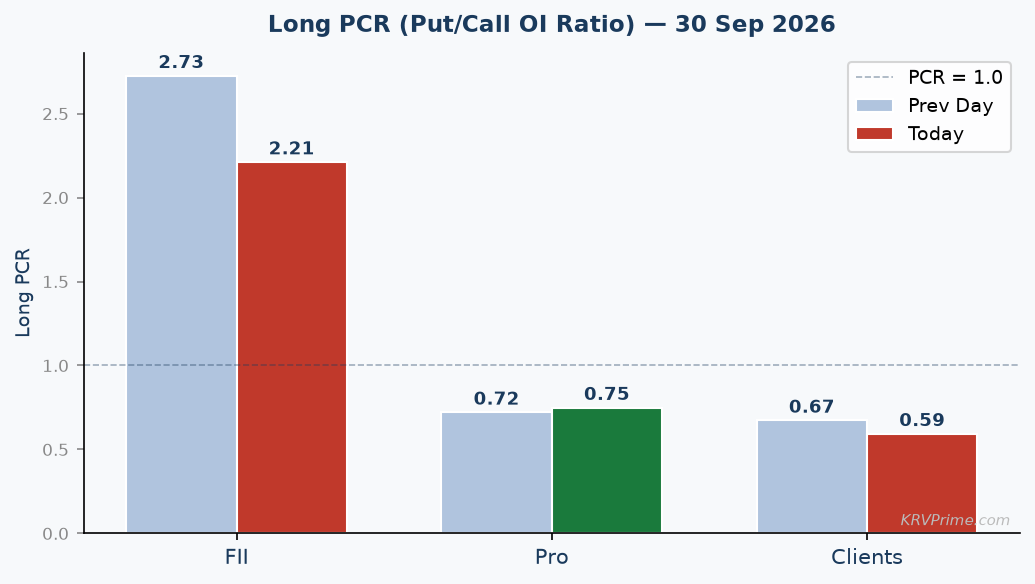
- Long PCR fell from 2.73 to 2.21 (change -18.85%) and Short PCR rose from 0.37 to 0.39 (change +6.52%). A Long PCR of 2.21 means FIIs hold 2.21 times more put longs than call longs — this is an extreme defensive posture that functions either as portfolio insurance for a large equity book or as an outright directional bearish bet through options. The fact that the Long PCR has declined from 2.73 to 2.21 — a drop of 18.85% — does not represent reduced bearishness; rather it reflects that FIIs grew their call long book faster (+36.63%) than their put long book (+10.87%), likely buying cheap calls as event-driven insurance or as part of a spread. The Short PCR rising from 0.37 to 0.39 on the short side means FIIs are writing marginally more puts relative to calls — writing puts below the market to collect premium on the view that the floor (22,000 PE support) will hold, even as they press shorts above. The dominant signal remains deeply bearish: a Long PCR of 2.21 does not belong to a bullish participant — it belongs to one who expects downside to materialize.
- Call OI net deteriorated to -465,583 (Long: 466,513 [Long Buildup - Low Vol] vs Short: 932,096 [Short Buildup - Low Vol]; net change -44,120). Put OI net improved to +668,125 (Long: 1,032,048 [Long Buildup - Low Vol] vs Short: 363,923 [Short Buildup - Low Vol]; net change +16,868). FIIs are simultaneously net short calls (selling upside) and net long puts (buying downside protection) — this is a textbook synthetic short / protective collar architecture layered on top of an already massive futures short book. The combination of 932,096 gross call shorts capping the market from above and 1,032,048 gross put longs providing profitable downside exposure creates a comprehensive two-legged bearish structure; every contract move lower in Nifty benefits FIIs on three fronts simultaneously — futures shorts, put longs, and decaying call shorts.
- Synthesis — FII Triple-Leg Bearish Conviction Architecture: FIIs present the most internally consistent and multi-layered bearish positioning of all participants today. Their futures net of -282,870 (a 10.62:1 short-to-long gross ratio), a Long PCR of 2.21 (2.21x more put longs than call longs), net short calls of -465,583, and net long puts of +668,125 all point to one unified thesis: FIIs believe Nifty will move lower from current levels of 22,620.45, and they have positioned across all three instruments — futures, calls, and puts — to profit from that move. The strategy constitutes a synthetic triple short: short futures + short calls (capping any rally) + long puts (profiting from decline). The Low Vol tags across all legs indicate this is a methodical, ongoing accumulation rather than a panic-driven response. Compared to the prior session where futures net stood at -267,307, today's acceleration to -282,870 confirms FIIs are not pausing — they are pressing their bearish thesis with renewed aggression even as BANKNIFTY rose +0.69%, suggesting FIIs are specifically bearish on NIFTY/index direction rather than reacting to sector-level strength.
- Forward: The critical trigger to watch is whether FII futures net moves further below -282,870 in the next session — any deepening toward -295,000 or beyond would confirm outright bearish acceleration and could precede a sharp move toward the 22,000 PE support (NIFTY weekly and monthly OI floor). Conversely, if FII futures net contracts improve meaningfully above -270,000 (implying short-covering of 12,000+ contracts), that would be the first credible signal of thesis exhaustion and could trigger a violent short-covering squeeze. Watch the FII put long book: if Long PCR falls below 2.00, it signals they are lightening their hedges — which would be paradoxically bearish for the short-term, as it could mean the downside move they were hedging against has already been monetized.
DII Mildly Bearish — Reducing Long Futures, Cutting Put Longs, Adding Selective Call Exposure
- Futures net deteriorated from +35,508 to +32,050 (net change -3,458 contracts, -9.74%). The Long side shed 433 contracts (prev 50,075 → today 49,642, -0.86%) tagged [Long Unwinding - Low Vol], while the Short side added 3,025 contracts (prev 14,567 → today 17,592, +20.77%) tagged [Short Buildup - Low Vol]. The dominant driver of the net deterioration is the aggressive +20.77% short buildup, not long liquidation — DIIs added 3,025 fresh short contracts even while modestly trimming their long book, signaling that institutional domestic money is not just reducing bullish conviction but actively positioning for downside in futures. The gross long-to-short ratio stands at 2.82:1 (49,642 longs vs 17,592 shorts) — DIIs remain net long futures overall, but today's short buildup alongside long trimming marks a directional tilt that diverges from their typically buy-and-hold equity-hedging behavior. This is the most cautious futures posture DIIs have shown recently.
- DII options PCR data is not available in the participant dataset (no Long PCR or Short PCR reported for DII). Accordingly, no PCR-based inference can be drawn for this participant. The assessment of DII options positioning must rest entirely on the absolute OI changes in calls and puts, which are discussed in Bullet 3. The absence of PCR data for DII is itself informative — it may reflect that DII options activity is relatively thin compared to FII/Client/Pro participants and that their options books are more complementary to their futures directional positions rather than standalone hedging structures.
- Call OI net improved to +5,551 (Long: 8,483 [Long Buildup - High Vol], Short: 2,932 [Short Buildup - High Vol]; call net change +979). Put OI net declined to +46,658 (Long: 46,958 [Long Unwinding - Low Vol], Short: 300 [Short Flat - Low Vol]; put net change -2,736). The High Vol tags on both call legs are striking — the +71.44% surge in call longs and +679.79% surge in call shorts (both flagged High Vol) indicate these are deliberate, high-conviction options trades, not routine hedges. DIIs appear to be constructing a short-term call spread or straddle — buying call longs while simultaneously writing call shorts against them — to express a capped, range-bound view on the upside. Simultaneously, their put long unwinding (-2,736 contracts, Low Vol) suggests they are removing downside protection, which combined with short futures buildup creates a slightly contradictory signal: reducing put hedges while adding futures shorts implies they believe the downside move is already underway rather than being a future risk to hedge against.
- Synthesis — DII Cautious Institutional Repositioning: DIIs today exhibit a subtle but meaningful directional shift. Their futures net contracted from +35,508 to +32,050 driven by both long trimming and short buildup, their put long book was reduced by 2,736 contracts (Low Vol, suggesting routine rebalancing), and their call book saw unusually high-volume activity on both sides — a 71.44% long call surge and a 679.79% short call surge (both High Vol). The net result is that DIIs are simultaneously lightening their bullish futures exposure, removing put-side hedges, and constructing what appears to be a call spread structure (net call long of +5,551). This is the positioning of an institution that expects the market to remain range-bound rather than trend sharply in either direction — they are not aggressively bearish like FIIs (no large net short futures), but they are clearly stepping back from their prior long-biased stance. The contrast with FII positioning is stark: FIIs are pressing outright shorts while DIIs are merely reducing longs — a classic domestic-vs-foreign divergence in market outlook.
- Forward: The key trigger for DII positioning is whether their futures net long position falls below 30,000 contracts in the next session. A break below this level would signal that DIIs are actively neutralizing their equity-long futures hedge, which historically precedes a more aggressive defensive stance. Conversely, if the call long buildup (currently 8,483 contracts, High Vol) expands further while put longs remain at ~46,958, it would signal DIIs are pivoting to a structured range strategy and expect Nifty to consolidate rather than break lower toward the 22,000 OI support floor.
Pro Cautiously Neutral — Hedged Both Ways with Slight Put-Side Lean
- Futures net improved marginally from +7,986 to +8,394 (net change +408 contracts, +5.11%). The Long side added 3,713 contracts (prev 31,565 → today 35,278, +11.76%) tagged [Long Buildup - Low Vol], while the Short side added 3,305 contracts (prev 23,579 → today 26,884, +14.02%) tagged [Short Buildup - Low Vol]. Both legs expanded in near-equal proportion — the gross long-to-short ratio holds at 1.31:1 (35,278 longs vs 26,884 shorts), almost unchanged from yesterday's 1.34:1 — indicating Pros are running a balanced, hedged futures book with a slight net long bias. The Low Vol tags on both sides confirm this is not a high-urgency directional trade but rather routine position management or delta hedging against the massive options book Pros carry. The +408 net improvement is too small to be directionally meaningful in isolation, but it slightly reinforces the net long tilt that has persisted across sessions.
- Long PCR rose from 0.72 to 0.75 (change +3.88%) and Short PCR fell from 0.76 to 0.64 (change -15.07%). A Long PCR of 0.75 means Pros hold 75 put longs for every 100 call longs — a moderately defensive posture that reflects their role as active market-makers requiring two-sided hedges rather than expressing a strong directional view. The Long PCR rising from 0.72 to 0.75 indicates Pros incrementally increased their put-long exposure relative to calls — a mildly defensive tilt. More importantly, the Short PCR's sharp fall from 0.76 to 0.64 (-15.07%) tells a critical story: Pros wrote proportionally far more calls than puts on their short side today, meaning they are aggressively supplying call premium to the market (selling calls more than puts). A Short PCR below 0.70 on the Pro book means upside call supply is dominant — Pros see calls as overpriced and are selling them, which typically suppresses rally potential. This combination of rising Long PCR (more put longs) and falling Short PCR (more call shorts) creates a mildly bearish net options tilt for Pros.
- Call OI net contracted sharply to +26,254 (Long: 1,052,809 [Long Buildup - Low Vol], Short: 1,026,555 [Short Buildup - Low Vol]; net change -73,981 from prev net +100,235). Put OI net expanded strongly to +127,910 (Long: 789,280 [Long Buildup - Low Vol], Short: 661,370 [Short Buildup - Low Vol]; net change +82,592 from prev net +45,318). The dramatic swing in Pros' call net — from +100,235 to just +26,254 — occurred because call shorts grew far faster (+295,087 new short contracts, +40.34%) than call longs (+221,106, +26.58%). Simultaneously, put longs grew faster (+189,051, +31.50%) than put shorts (+106,459, +19.18%), expanding the put net long from +45,318 to +127,910. This creates a net short call + net long put architecture that mirrors a synthetic short or bearish skew position — even though Pros are nominally net long futures, their options architecture now leans bearish, suggesting the futures long is a delta hedge against a larger net short options position rather than outright directional bullishness.
- Synthesis — Pro Market-Maker Shifting to Bearish Skew: Pros' positioning today reveals a subtle but definitive shift toward bearish skew in their options book, even as their futures net remains nominally positive at +8,394. The collapse in their call net from +100,235 to +26,254 combined with the near-doubling of their put net from +45,318 to +127,910 means Pros are now running a net long put / net short call options architecture — precisely the configuration of a participant who expects downside or range-capping. The Short PCR's fall to 0.64 confirms that Pros are writing calls aggressively relative to puts on their short side, supplying overhead resistance at the 23,000 CE level (NIFTY weekly OI resistance). Their Long PCR of 0.75 rising moderately signals incremental put-side protection being layered in. The net result is a cautiously range-bearish strategy: their futures longs are effectively delta offsets to their options book, not a standalone bullish bet. Low Vol tags across all legs indicate this is methodical market-making rather than panic hedging — Pros are executing deliberate spread and skew trades consistent with their role as structural liquidity providers.
- Forward: Watch whether Pro's put net long expands beyond 150,000 contracts in the next session — a break above that threshold would confirm Pros are actively building a bearish options overlay and would align their positioning squarely with FII's directional short thesis. If instead the call net long recovers above 75,000 (implying call buying acceleration or short-covering), it would signal Pros are pivoting back to a range-neutral stance and may suppress any downside follow-through. The most critical watch-level is the Short PCR for Pros — if it falls further below 0.60 tomorrow, it confirms aggressive call-writing above the market and structural resistance at 23,000 (NIFTY weekly CE resistance) is being reinforced.
Client Contrarian Bullish — Long Futures, Long Calls, But Heavily Hedged via Put Shorts
- Futures net improved from +223,813 to +242,426 (net change +18,613 contracts, +8.31%). The Long side added 16,837 contracts (prev 284,203 → today 301,040, +5.92%) tagged [Long Buildup - Low Vol], while the Short side reduced by 1,776 contracts (prev 60,390 → today 58,614, -2.94%) tagged [Short Covering - Low Vol]. The combination of fresh long addition and short covering is a double-bullish futures signal — Clients are simultaneously pressing longs and removing shorts, which is the most unambiguous bullish futures behavior available in OI data. The gross long-to-short ratio has expanded to 5.14:1 (301,040 longs vs 58,614 shorts), up from 4.71:1 yesterday — Clients are adding conviction to their bullish futures stance with each session. However, the Low Vol tag on both the long buildup and short covering suggests this is not panic-driven retail buying but rather a steady accumulation that is consistent with the contrarian positioning Clients typically take against the FII short book.
- Long PCR fell from 0.67 to 0.59 (change -11.82%) and Short PCR fell from 1.14 to 0.97 (change -14.59%). A Long PCR of 0.59 means Clients hold only 59 put longs for every 100 call longs — they are disproportionately positioned in call longs, a strongly bullish options posture. The Long PCR falling from 0.67 to 0.59 confirms Clients are buying significantly more calls than puts today, tilting their long options book even more aggressively toward the upside. The Short PCR's dramatic fall from 1.14 to 0.97 (-14.59%) is equally significant: it means Clients were writing more puts than calls on their short side (Short PCR >1.00 yesterday), but today it has fallen below 1.00 — they have shifted to writing more calls than puts on the short side. This could reflect an overwriting strategy (selling calls against long positions) or a spread structure. Combined with the Long PCR of 0.59, Clients appear to be running a bullish call spread — long calls at lower strikes, short calls at higher strikes — while maintaining a heavily net long futures position.
- Call OI net improved to +433,777 (Long: 3,334,467 [Long Buildup - Low Vol], Short: 2,900,690 [Short Buildup - Low Vol]; net change +117,121). Put OI net deteriorated to -842,693 (Long: 1,980,918 [Long Buildup - Low Vol], Short: 2,823,611 [Short Buildup - Low Vol]; net change -96,725). Clients are net long calls (+433,777) and net short puts (-842,693) — this is a textbook synthetic long / bullish options architecture. Net long calls profit if the market rises; net short puts (writing puts below the market) generate premium income on the view that the market will not fall to those strikes, and also carry assignment risk if the market does fall — meaning Clients are effectively underwriting the downside for premium income. This architecture directly opposes FII's net short call / net long put structure — the two largest participant groups are taking mirror-image positions, with FIIs structurally short the market and Clients structurally long. The Low Vol tags on all four Client options legs indicate this is not impulsive retail activity — it is steady, consistent synthetic long construction.
- Synthesis — Client Structural Synthetic Long vs FII Mirror Short: Clients present the clearest bullish counter-thesis to FII's bearish conviction today. Their futures net of +242,426 (5.14:1 long-to-short ratio), a Long PCR of 0.59 (59 put longs per 100 call longs — heavily call-biased), net long calls of +433,777, and net short puts of -842,693 collectively constitute a full synthetic long position — they benefit in futures, in calls, and through put premium collection if Nifty holds or rises. The put short book of 2,823,611 contracts is enormous and represents the most significant risk in the Client book: if Nifty breaks sharply below the 22,000 OI support floor (weekly and monthly PE support), Clients face mark-to-market losses on their put shorts that could force defensive action. The falling Short PCR from 1.14 to 0.97 shows Clients are already beginning to reduce their put-writing tilt, possibly as a defensive acknowledgment that FII shorts are intensifying. Clients' Low Vol confirmation tags across all legs suggest this is a deliberate, structured position — not panic retail buying — which makes the FII vs Client divergence one of the most important structural tensions in today's market.
- Forward: The critical trigger for the Client bullish thesis is Nifty holding above the 22,000 OI support level (weekly and monthly PE max OI strike). If Nifty closes below 22,000, Clients' net short put position of -842,693 contracts will begin to accumulate significant losses and forced covering will create a negative feedback loop — a classic gamma squeeze to the downside. Watch the Client futures net: if it deteriorates below +230,000 (implying long liquidation of 12,000+ contracts), it would signal Clients are abandoning their bullish stance under pressure from FII selling. Conversely, if Clients' Long PCR rises back above 0.65 (buying more puts alongside calls), it would indicate they are adding downside hedges and transitioning from naked bullish to hedged bullish — a more sustainable posture against the prevailing FII short pressure.
Bull vs Bear Strength by Participant
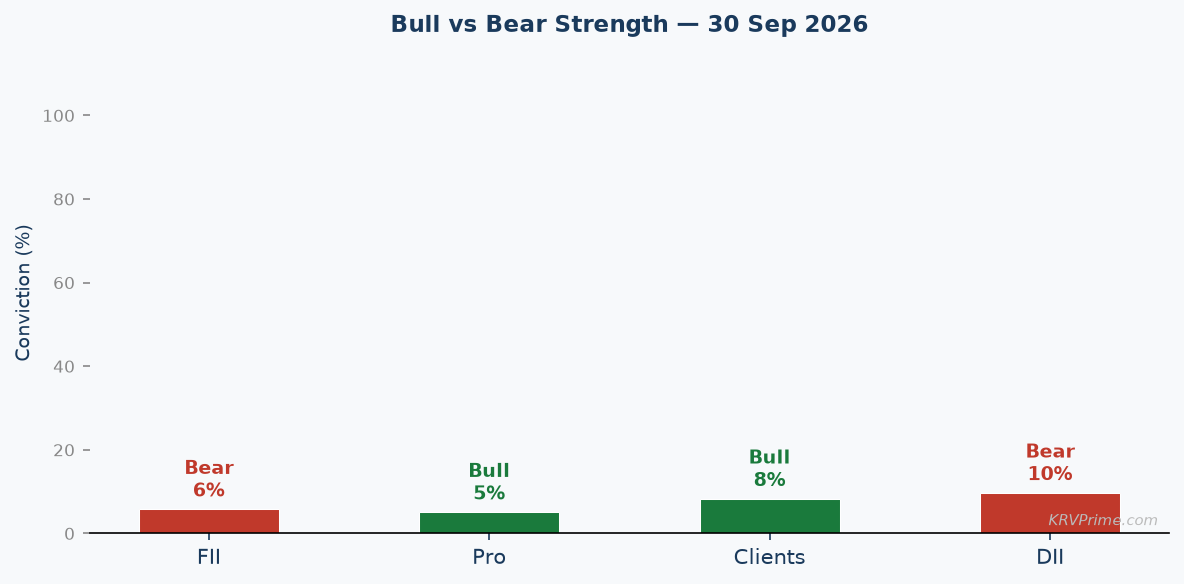
FII Strongly Bearish 88% ▼▼ | Clients Contrarian Bullish 65% ▲▲ | Pro Cautiously Neutral 52% ▼ | DII Mildly Bearish 60% ▼ |
Conclusion — Market Outlook for Tomorrow (30 Sep 2026)
The collective positioning across all four participant groups paints a structurally bearish picture for Nifty in the near term. FIIs have the most aggressive and internally consistent bearish architecture — a futures net of -282,870 (10.62:1 short-to-long ratio), net short calls of -465,583, and net long puts of +668,125 together form a triple-leg synthetic short that leaves no ambiguity about their directional conviction. DIIs are quietly reinforcing this by trimming long futures (net down to +32,050) and adding short futures (+3,025 new contracts) even while reducing put long protection — the behavior of an institution that believes downside is imminent rather than merely possible. Pros have pivoted their options architecture to a net short call / net long put structure (call net collapsed from +100,235 to +26,254; put net expanded from +45,318 to +127,910), confirming that professional desks see overhead supply as real and are positioning to profit from it. The only structural bull in this market is the Client segment, whose +242,426 futures net and +433,777 call net long represent a massive contrarian bet — but their net short put position of -842,693 contracts is a ticking risk if the OI support floor at 22,000 is tested.
The overall PCR has collapsed from 0.90 to 0.79 (-11.57%) — a single-session 11-point drop in PCR is a significant bearish signal. When PCR falls sharply it means call OI is expanding faster than put OI, which confirms that participants are writing calls to cap the market (selling upside) rather than buying puts for protection — this is structurally bearish. Call OI surged +36.84% (adding 2,618,277 contracts) while Put OI grew only +21.02% (adding 1,337,005 contracts) — the disproportionate call build confirms supply is being layered heavily at the 23,000 CE (NIFTY weekly OI resistance) and 23,500 CE (monthly OI resistance) levels, making any rally into those zones extremely difficult to sustain. India VIX at 13.49 (up +0.58% from 13.41) remains in the low-fear zone but the uptick is meaningful in context — VIX rising on a day when Nifty fell 0.42% confirms that options buyers are pricing in slightly more tail risk, and any further VIX expansion above 14.50 would signal genuine fear entering the market and accelerate put buying.
The bull thesis requires Clients and retail to successfully defend the 22,000 OI support level (NIFTY weekly and monthly PE max OI strike, where put longs are concentrated) while simultaneously seeing FII futures net improve from -282,870 — the first sign of short-covering. If instead FIIs continue to deepen their short book, PCR falls further below 0.75, and VIX breaks above 14.50, the path toward 22,000 becomes highly probable as the dominant FII + DII + Pro bearish architecture overwhelms Client-side buying.
Scenario 1 — Bull case:
Trigger: FII futures net improves from -282,870 toward -265,000 (implying short-covering of ~18,000 contracts), overall PCR recovers back above 0.88 (signaling put buying catching up with calls or call OI unwinding at resistance), and India VIX retreats below 13.00. If this combination materializes, Client long positions of +242,426 futures net and +433,777 call net long gain momentum and Nifty can attempt a recovery rally with the 23,000 CE weekly OI resistance as the first structural ceiling to overcome. The Client put-short book of 2,823,611 contracts would also stop bleeding, removing the gamma-squeeze risk on the downside.
Scenario 2 — Bear case:
Trigger: FII futures net deepens below -295,000 (adding another 12,000+ short contracts), overall PCR slides further below 0.75 (confirming call OI domination and put-side abandonment), and India VIX spikes above 14.50 as tail-risk pricing accelerates. In this scenario, the 22,000 PE OI support (NIFTY weekly and monthly floor) becomes the primary magnet — Client put-short positions of -842,693 contracts generate forced mark-to-market losses that trigger defensive covering (buying back short puts = buying puts = puts surge = PCR spikes), creating a disorderly move lower. DII futures short buildup (+3,025 new shorts at 17,592 total) would add to the selling pressure, and the entire FII + DII + Pro options architecture — net short calls + net long puts — would be in profit, accelerating the bear thesis.
Key Resistance NIFTY 23,000 (weekly CE max OI) and 23,500 (monthly CE max OI) — FIIs hold 932,096 gross call short contracts at and above these levels, Pros are aggressively writing calls (Short PCR fell to 0.64), and overall call OI surged +36.84% — three layers of sell-side supply structurally capping any rally attempt at these strikes. | Key Support NIFTY 22,000 (weekly and monthly PE max OI) — FIIs hold 1,032,048 gross put long contracts anchored near this level (Long PCR 2.21), Client put longs of 1,980,918 contracts provide structural demand, and total put OI of 7,698,408 represents the broadest concentration of downside hedging in the market. A breach of 22,000 would trigger Client put-short liquidation (-2,823,611 net short puts) and FII put-long monetization simultaneously. | Trigger to Watch Overall PCR crossing back above 0.88 (prior session level) would be the first signal that bearish call-writing momentum is stalling and put-buying is re-accelerating — watch this alongside FII futures net: any improvement above -270,000 in the same session would confirm a potential short-covering inflection. Failure to recover PCR above 0.88 with VIX holding above 13.50 keeps the bear case firmly in control. |